
Author: Gravitas

  • Fintech Is The Forgotten Network Card To Play

    Fintech Is The Forgotten Network Card To Play

    Brexit has delivered a win. There, I said it. Now, before you all head off to lobby on my behalf for a co-anchor slot on GB News with the Moggster, Bad Enoch and the Rishibot, there’s a distinct possibility I could be clutching at correlation rather than causation. However, the numbers – for a change – are real. According to KPMG’s bi-annual report, Pulse of Fintech, last year was a tough year for global fintech with funding levels hitting a 6 year low. The UK did not escape the bear market as its $12.3 billion of new investment represented a 34% drop. But….the UK remains, by far, the capital of European fintech and ranks second globally behind Silicon Valley. For global context (and Nigel Farage cartwheels), UK-based fintechs attracted more funding in 2023 than France, Germany, China, Brazil, India and Canada combined. That feels like winning to me but also prompted thought on networks and London’s global positioning in the financial ecosystem.

    London is blessed with an enormous talent and innovation pool thanks to centuries of being the dominant global financial centre and a time zone which straddles the Americas and Asia. This global positioning means there is a bigger and more realistic point to be made than Brexit. It is striking to me that when a country is in the middle of a political, institutional and trading meltdown there is a sub-sector of economic activity which defies the gloom. Fintech might have suffered investment flight in 2023 but the resilience of UK fintech in the midst of a national mental health event points to the recovery of a structural story we have written about many times before.

    It’s a network story but it has had to play second-fiddle to two much ‘hotter’ networks in recent times. Social network platforms (quasi-relationship processors!) are now bigger than sovereign nations – billions spend hours of screen time with Facebook, Instagram, YouTube, Tik Tok etc. And yes, Meta may have picked the wrong name but its share price is at all-time-highs. Also, this week we got another blow-out pulse-check on the hottest network story of recent times; Nvidia’s leading role and 400% y-o-y growth in supplying AI-capable chips for data centres. The computer/digital processor network now lives in the cloud powered by a rapidly growing network of data centres operated by Amazon, Google, Microsoft, Apple etc. However, this week we were reminded that the global financial network is the biggest beast of all and still searching for next-generation financial processing. In the vast field of fintech covering regulation, cybersecurity, analytics, flashboy trading, execution algos, insurtech and blockchain the Big Daddy of them all is payments, call it financial processing.  And this week, we saw some big payments developments.

    First, US bank Capital One announced it is buying Discover Financial Services in a $35 billion deal. At first glance this looks like Discover’s credit cards were the target and, indeed, the combined card operation would create the No.1 US credit card company, passing out JP Morgan and Citigroup. But, no, what caught my eye is that Discover also operates a payments network. Furthermore, Capital One CEO, Richard Fairbank, said that by adding Discover, he could start building “a payments network that can compete with the largest payments networks and payments companies,” a reference to Visa and Mastercard, which dominate the industry. To put the card deal in context, the $35 billion deal is not even a tenth of Visa’s $550 billion market value which is fast catching up on Nasdaq poster-child, Tesla. It’s not just traditional banks like Capital One eying up payments networks. Closer to home, there was an interesting private deal announced.

    UK digital bank, Monzo, is reported by the FT to be close to completing a £350m funding round with a £4 billion valuation. So far, so unremarkable. After a bit more reading, two things struck a chord. First, little Monzo now has a whopping 9 million customers, with 2 million coming aboard in 2023. That’s quite the banking network build and I wasn’t the only one intrigued. Apparently, the lead investor in this round is Google’s very own investment wing, CapitalG. Note Monzo is a banking service which includes payment processing but guess who is the processor behind Monzo? Stripe. And, Stripe wasn’t the only hot payments fintech I was reading about this week.

    When Mario Gabriele of the Generalist newsletter flags a disruptor company I usually pay attention. This week he did a deep dive on Australian payments fintech, Airwallex. It’s not in Stripe’s league – they raised $6.5 billion in 2023 –  but Airwallex has just raised $160m at a $5.6 billion valuation supported by 100,000 corporate customers (including SHEIN, Qantas, Canva) generating $80 billion of annual volume and $400m in revenues. The service offers payouts in 150 countries in 46 currencies, is executed by a couple of clicks and costs markedly less than traditional financial institutions. Once again, the issue of costs and tolls charged by traditional financial intermediaries looks like a key ‘win’ for fintech disruptors, and even traditional banks like Capital One. Check out the words of their own CEO, Fairbank (perfect name when you think about it);


    “Owning a network allows us to deal more directly with merchants rather than a network intermediary…..We create more value for merchants, small businesses and consumers and capture the additional economics from vertical integration.”


    That network word seems important. Arguably, there already exists a disruptive network and it’s already worth a trillion dollars. Yes, the blockchain-powered cryptocurrency, Bitcoin, traded back to the $50,000 mark in recent weeks and put the total value of the currency at $1 trillion. Of course, the recent decision of US regulators to allow funds (ETFs) invested in Bitcoin to trade on public exchanges like the NYSE is a further validation for this particular ecosystem. However, Bitcoin’s connectivity to the merchants, consumers and businesses which Fairbank covets is still very limited. What is not in doubt is the size of the global digital payments market which is, per Statista, going to exceed $15 trillion by 2027. The good news for fintech disruptors and start-ups is that reducing the “tolls” on these money flows can be a quicker route to profits than other sectors.

    In Europe, just two of the ten most valuable venture capital (VC) backed companies are making profits. Interestingly, both are fintechs –  Revolut(neobank) and SumUp (mobile merchant payment hardware). Clearly, route-to-profitability is an increasing focus of investors as higher interest rates bring tighter funding conditions. However, investor interest in payments networks appears strikingly robust. Check out the following recent funding deals:

    • UK-based Kriya secures £50m funding boost to supercharge B2B payments revolution – TechNews 180
    • Valar Ventures backs Berlin fintech, Monite, with $6 million – CB Insights
    • Colombian payments startup, Bold, secures $50m in Series C funding, led by General Atlantic – HUBFX
    • Payment orchestrator, Navro, raises $14m Series A from Bain Capital and Motive Partners – Dealroom


    The truth is that payments funding has ‘only’ seen a 30% fall in funding activity compared to wider fintech funding collapses of 50-70%. So, perhaps my Brexit blurt was too impetuous and the stronger logic attaches to London’s critical positioning in the payments ecosystem. There goes my GB News career but I’d rather you keep an eye on the forgotten third giant network – payments. And, now you know there are 15 trillion reasons why.

  • Get On The AI Bus Or Lose Business..

    Get On The AI Bus Or Lose Business..

    As somebody who has been watching, I’m still stunned. No, not that Rishi Sunak has his own GB News TV show and that the regulator, Ofcom, hides. Not even the fact that a former US President has thrown his NATO allies under the Vlad bus in plain sight of the forever fear-filled US media. Of course, I’m sure Poland and Estonia are terrified by Joe’s age or Hilary’s emails. Mind-boggling. However, on a brighter note there’s another bus which is enabling millions to work better. The AI bus is flying. Again, the mainstream media headlines run with AI fear but the flow of money and corporate action point to an extraordinary business revolution. The numbers are now simply too big for businesses and investors to ignore. Let’s do a brief tour of developments…

    This week kicked off with the staggering news that AI chip maker, Nvidia, has now achieved a $1.84 trillion market valuation which is higher than both Amazon and Google. To understand the expectations baked into that valuation, reflect on Amazon’s projected 2024 revenues of circa $600 billion. Then know that Nvidia is expected by Wall Street analysts do just one tenth of that revenue number. The 90% revenue catch-up is somewhere in the future but the future numbers look big, very big. The famous AI evangelist and rescued CEO of OpenAI, Sam Altman, is actively seeking funding for the development of AI chips like those of Nvidia. The word ‘funding’ doesn’t really do this exercise justice. It’s almost nation building. Sam reckons he will need $7 trillion, or the combined GDP of Japan and France. Sounds dreamy, but he’s not alone.

    Consulting firm, McKinsey, have published research suggesting the creator-focused application, Gen AI, deployed in 63 actual use cases could add $2.6 trillion to $4.4 trillion of economic benefits. Note these are actual business ‘use cases’. There’s more than dreaming going on here. In fact, Google has launched its Gemini workflow assistant to “supercharge your creativity and productivity”. Gemini is multi-modal which means it can create content using text, voice/audio, images and video. Its output can also be multi-modal. Think about a medical professional using an ‘assistant’ which can ingest a physician’s audio snippets/notes, X-ray images and MRI video scans. Also, we have moved past Chat GPT text prompts and free trials. Google is charging a $20 monthly subscription for its Bard successor, Gemini, to assist with email summaries, research, code-free data analytics and audio visual staff and customer education. Microsoft is also charging $20 a month for its Copilot AI Tool. Oh, and people and businesses really do pay for access to these AI tools.

    While OpenAI started out in life as a not-for-profit entity, it is amazing to see that the OpenAI business is already generating annualised revenues of $2 billion. The use cases might even surprise. For example, McKinsey analysis shows that 73% of fashion executives named generative AI as a priority for their companies in 2024, but only 28% have actually deployed AI so far. It’s not just business prioritising AI adoption. The investment world, particularly in our world of early stage funding is acutely aware of venture capital (VC) funds pulling in their bullish horns and nursing some of their existing investments out of sick bay. However, AI-related VC investment is bucking that trend. Check out these data points from CB Insights:


    • Broader venture funding fell 43% in 2023, but AI funding slipped by just 10%.
    • The US actually witnessed AI investment grow by 10% in 2023. Europe dropped by 29% and Asia saddled with a China confidence crisis cratered by 61%.
    • There were 22 AI unicorns (start-ups valued at $1 billion or more) created in 2023 which accounts for 31% of a global total of 71.
    • Generative AI unicorns, in particular, are hitting warp speed wealth creation mode. Gen AI unicorns reached the $1 billion valuation mark in a little over 3 years, or half the time taken by unicorns in other sectors.


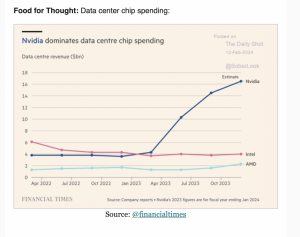
    However, investment doesn’t just happen at a company level, big or small.  If we consider Sam Altman’s funding estimate of $7 trillion, this investment capital will mainly be used to build facilities to manufacture those AI chips (fabs) and then house them (data centres).  I have written previously about the linkage between the explosive growth of AI and the race by Big Tech to build the data centres supporting their digital cloud businesses. As a proxy for this linkage, the Financial Times has highlighted Nvidia’s dominance in the area of data centre spending:


    Closer to home, the opportunity presented by data centres has attracted private equity giant, Blackstone, and prompted talks on a $900 billion acquisition of data centre construction leader, Winthrop Technologies. Clearly, the ramp up in investment activity on both a company and an infrastructure basis is signalling real AI revenues and real usage from businesses. And, it would be wrong to assume it’s part of the future. It’s now.


    • Forbes reckon 83% of companies deem AI to be a top priority in their business strategy.
    • MIT have said 9 in 10 organizations back AI to give them a competitive edge over rivals.
    • More than 50% of Americans use voice assistants for information purposes (Source: Edison)
    • Manufacturing businesses that utilize AI are performing 12% better than those using traditional methods only (Source: Microsoft)


    Remember this is AI in its infancy. That 12% ‘edge’ is only going to grow. For me, there is now an additional competition-critical question for every business to add to existing queries on the progress of their digital and sustainability transitions. Have you boarded the AI bus yet….?

  • Which Global Themes Are Flying?

    Which Global Themes Are Flying?

    Only one sleep to go until “Sixmas”, or the 6 Nations. Giddy. Another 28 days to go in the “Freezbrury” cold water swim challenge. Not so giddy. Such is the emotional ebb and flow of life but what do we make of the January investment emotional roller-coaster? Dare we say January was a game of three ‘halves’? The early days of the year saw markets puke, only for the next three weeks to see markets roar higher on familiar big tech AI giddiness, interest rate cut hopes and stronger economic numbers out of the US and Asia. Then, more fear. As always, the cost of money (rates) drives all asset markets. So when the Fed said “not so fast” on March rate cut expectations markets had another little tantrum to close out the month. Now, ignore all that trading noise. Let’s stick to longer-term thinking and revisit a few themes we flagged for 2024.

    First, we go big. The “Magnificent 7” big tech names have been driven to new all-time highs on the continuing AI theme with Microsoft hitting a $3 trillion market valuation for the first time, and AI poster-child, Nvidia, adding another 24% to its value in January alone. However, if you’re a Tesla shareholder, you might need access to the Elon Musk drugs cabinet to dull the pain of a January 24% crash in the value of the once biggest EV manufacturer in the world. As we write of potential regime shifts, I am reminded of a mandatory Thursday lunchtime every quarter in the naughties being glued to my desk and screen awaiting Nokia’s latest earnings report from Helsinki. The equivalent global pulse-check these days is one evening every quarter in New York when Microsoft and Google tell us how their cloud(AI) business is doing. This week the update was 30% and 26% cloud revenue growth respectively. Let’s just say theme intact.

    Now, go smaller. Well, not so small. On the Microsoft analyst call, Ireland’s very own An Post received a shout out from Microsoft CEO, Satya Nadella, as an example of a customer using its AI CoPilot Studio. This did prompt some thought about small companies and start-ups using AI. We probably don’t give technology and digitalisation enough credit for empowering founders and scaling up businesses over the past two decades. With a website, e-commerce applications, security/payment apps, and cloud hosting/workflow support, a start-up business no longer had to sink capital into up-front infrastructure costs but, instead, could pay software subscription fees (SaaS) to big tech and go to market quickly. This writer is just wondering could AI be an additional accelerant for start-up businesses? Maybe it’s not just me. Review site, Yelp, recently published data on a record 762,200 new US business openings in 2023, up 20% on 2022. Furthermore, US government data confirms the pandemic-inspired “entrepreneurship boom” is alive and kicking going into 2024.  However, some start-ups do need serious up-front capital….

    Check out our cleantech theme. The initial construction of huge EV battery gigafactories, renewable energy installations and decarbonised manufacturing (see steel, fertiliser, cement etc) requires billions of investment capital dollars. Encouragingly, we are seeing some really big funding deals get over the line. Sweden’s Northvolt announced a $5 billion debt financing round in January and a week later another Swedish name, H2 Green Steel, raised €4.5 billion in debt and equity. And, it’s not just cleantech start-ups being backed by significant banking syndicates. Despite the gloomy macro headlines, it feels like banks are feeling better about life in general. Note the record $188 billion of bond issuance by US companies in January and the index(ETF) which tracks the US Banks sector (XLF) hitting a 2-year high. No wonder Bloomberg was leading with a headline this week “The Credit Market Is Quietly Booming again”.

    Of course, in our earlier 2024 themes article we expected continuing stress in global real estate so it’s not all good news for banks. The slow-moving Chinese train crash of Evergrande finally hit its liquidation wall in the Hong Kong courts but the potentially more significant real estate news came out of Tokyo this week. Aozora bank shares plunged 20% after it revealed a $191 million loss for the year due to write-downs on its loans to the US commercial real estate (CRE) sector.  Meanwhile, back in the US, New York Community Bancorp reported a $185 million charge-off on just two CRE loans and watched its share price crater 38% in a matter of hours.

    Expect more of this but the key global credit swing factor will be China. For now, Beijing’s efforts to stimulate the economy is pushing capital into the wider Asian economy as the Chinese manufacturing engine ramps up activity. Evidence of early policy traction across Asia might be seen in the bellwether South Korean economy and its PMI survey of factory activity showing expansion for the first time in 19 months. Of course, with interest rate cuts firmly expected in 2024, central banks and investor want a “goldilocks” outcome rather than economies running excessively hot. We shall see, but in the area of healthcare it sounds like one form of excess has been whipped. More specifically, we are revisiting our weight-loss and healthcare/biology theme.

    In recent days Danish pharma company, Novo Nordisk, became just the second European company to  pass the $500 billion valuation mark. Its obesity drugs, Ozempic and Wegovy, have revolutionised the prospects of this 100-year old company and can only focus investor minds on further medical opportunities. We have previously highlighted the intersection of biology and technology as a theme so recent news from Cambridge University was intriguing. Scientists in recent weeks have published research on the successful re-programming of microbes to unlock new materials. This could lead to a whole range of innovative products from new drugs to enhanced carbon-absorbing materials. Here were our own thoughts on new materials and speed to discovery from a few weeks ago:

    “However, artificial intelligence(AI), probably the hottest investment theme outside cleantech right now, has just been used in conjunction with supercomputing to discover a brand new material which could reduce lithium usage by up to 70%……Microsoft and Pacific Northwest National Laboratory (PNNL) research teams whittled down 32 million potential material combinations to 18 promising molecular structures within a week. Incredibly, the whole discovery project took 9 months in a screening process that would typically have taken more than 20 years using traditional lab research methods. The new AI-derived material, simply called N2116, should prompt thought as to what’s possible in the world of medicine, agriculture, transport and construction”

    One final thought which is not so much a theme but is a necessity for these themes to accelerate; our investors always ask “where’s the exit?”. The text book response is that investor exits usually happen through a trade sale(M&A), buy-out (Private equity) or listing shares on public markets via IPO. Private equity house, Bain Capital, reckon global M&A activity of $3.2 trillion was down 15% in 2023 to its lowest in a decade. Meanwhile, EY’s global IPO report indicated listing activity was down 33% in value terms compared to 2022, and Goldman Sachs said it was the worst IPO year since 2016. The good news is that many advisory teams in the investment banks are quietly confident of an uptick in IPO pipelines for 2024. Indeed, the expected New York listing of Chinese fast-fashion play, Shein (ask the kids!), with a $90 billion valuation will be an early test of lift-off. The big global themes will still play out but juicy sales and exits would definitely confirm things are really flying. Also, and more importantly, confidence spreading outside the “Magnificent 7” to smaller businesses would be very good news.


  • The Value Of Good Times Revisited

    The Value Of Good Times Revisited

    My first year on this planet was the first for humanity on the moon. A good year but no memory of it. Probably my earliest happiest memory was lying on the floor playing with Airfix toy soldiers in a Waterloo battle scene at Christmas time as Simon & Garfunkel’s ‘The Boxer’ played on my parents’ hi-fi. Happy times, and always grateful for plenty more over the following decades. However, last week another ‘good times’ feeling was prompted by the radio belting out “The Boxer”, quickly followed by a news update on another lunar expedition. Yep, it was Japan’s turn to visit the moon but also a reminder of how much I loved living in Tokyo in the ‘90s. Good years, many memories. I won’t be visiting there any time soon but the memory-jog from the East could be timely. Japan might just be about to revisit its own good times…..

    The main stock market index in Tokyo, the Nikkei 225, recovered to a 34-year high this week. That’s a positive headline but doesn’t escape the fact that the Japanese stock market has only returned to index levels last seen when I first landed in Japan. However, there’s a lot more going on than headlines highlighting 34-years of zero wealth creation. In fact, I’d almost use the word ‘progress’. Progress might not sound like a big deal to readers, and I might have shared that very same view until I came across a fascinating piece of data in the Financial Times(FT) in recent weeks. Thanks to the Google AI tool, Ngram Viewer, one can explore language usage trends over time by searching millions of books, documents and other text sources.

    According to the FT’s John Burn-Murdoch, usage in the West of English, French and German words for “progress, advance, future, rise and improvement” have been in decline since a few years after Apollo 11’s daring touch-down on the moon. Meanwhile, usage of the words for “threat, worry, caution, risk and caution” have increased significantly to suggest a multi-decade cultural shift to risk-aversion, or ‘safetyism’ which is being used a lot these days in AI discussions. Indeed, a recent excellent David McWilliams podcast with Burn-Murdoch explored this potential connection between culture, language and growth. For Japan, this analysis must genuinely resonate. After decades of trying to unwind huge debt levels in its financial system, and persuade its ageing population to spend, there are interesting developments which point to a significant cultural shift.

    Leaving aside the ambition to be only the 5th nation in history to successfully ‘soft’ land on the moon, Japan is flexing its ‘progress’ and ‘advance’ muscles further afield. How about the daring move by Nippon Steel last September to buy iconic US industrial asset, US Steel, for $14 billion? Or Softbank swooping for Ireland’s Cubic Telecom in a €473m deal pre-Christmas? Perhaps the even bigger deal is the incoming capital landing on the island nation. Last April we wrote about Warren Buffett buying up significant stakes in Japanese sogo shosha, 150-year old industrial trading houses, described by Buffett himself as “a cross-section of not only Japan, but of the world”. In some ways, Japan is the beneficiary of a global China de-coupling. Indeed, its trading houses could be considered a new de-risked staging post to access the Asian middle-class; a cohort which will account for a stunning two thirds of the global total by 2030. And….Buffett is not the only financial guru revisiting Japan.

    Steve Cohen, has opened a Tokyo office of his Point72 hedge fund and US private equity player, Ares Management, has announced plans to do the same in 2024. Ken Griffin’s Citadel, the most successful hedge fund in history, has also decided to reopen its Japan office. So what’s the deal? Well, when an iconic Japanese industrial giant like Toshiba agreed in September 2023 to a $14 billion sale to local private equity firm, Japan Industrial Partners (JIP), that was a very big deal. Not the size, but the business cultural signal. Typically, underperforming companies on the Japanese market have stubbornly rebuffed shareholders’ demands for maximizing returns on invested capital. In fact, the Japanese authorities have frowned upon the unfettered threat of Anglo-Saxon-style unsolicited takeover bids. Without the threat of takeovers, Japanese companies, in aggregate, have displayed the following unique features:


    • Japan’s listed companies sit on enormous cash piles amounting to almost 45% of their market capitalization. That’s about three times what UK or US companies hold (Source: IMF)
    • Prior to Covid-19, Bloomberg reported that total cash held by Japanese companies on their balance sheets had reached 90% of Japan’s $5 trillion GDP.
    • 40% of companies listed on the Tokyo Stock Exchange finished 2022 with net cash holdings equal to more than 20% of their equity. (Source: Carlyle)
    • 50% of companies listed in Japan are trading below the value of the assets on their balance sheets. In financial valuation terms this is expressed as a price-to-book ratio of less than 1x. (Source: Schroders)


    So, cash is king. But, in a super-low interest rate Japan, un-deployed cash is killing investment returns. This is reflected in so many companies trading on valuation multiples less than 1x price-to-book, but is now poised for a shake-up. The Tokyo Stock Exchange (TSE) has formally instructed all listed companies whose price-to-book ratio is less than 1x to raise their multiple above 1x, or risk being de-listed. One way to do that is to reduce the book value in the ratio by handing cash back to shareholders. The TSE has published a “name and shame” list and this is raising investor expectations of better governance and deployment of capital. In fact, more than 50% of Japanese companies have increased their cash dividends to shareholders in the last year. Sounds like Warren, Ken and Steve have their eyes on the ball. And, if you like ball games, then Japan is making waves there too..

    Shohei Otani from Iwate Prefecture has just signed a $700 million contract with the Los Angeles Dodgers baseball franchise. This is the biggest individual contract signed in history, in any sport, and it feels like ‘a moment’ for Japan. I sense other moments too. Tokyo’s stock exchange has just passed out Shanghai in market value and regained its place as Asia’s biggest equity market. And, it’s not just investment capital coming to Japan. Back in the mid-1990s tourist numbers were just over 3 million. That number had rocketed to over 30 million before Covid struck. Anecdotally, Japan seems to be on so many ‘bucket lists’ as the last advanced economy which is truly a different experience for travellers. Also, thanks to its price stagnation problem over the last 30-years Japan is presenting far better relative value attractions than its “pricy” reputation. Of course, value is a huge factor in financial markets so my final Japan revelation might surprise.

    We mentioned earlier that Japan’s stock market has only just returned to levels last seen in 1990. In other words, the long-run multi-decade returns on Japanese assets (on average) have been close to zero. However, the annual valuation “bible” published by Nobel Prize winner, Eugene Fama, and Kenneth French has just thrown up an amazing bit of data. Japanese stocks which qualify as value stocks (low valuation ratios like Price-Earnings, Price-Book etc) have compounded returns at 6.5% annually in the period 1990 to 2022. In a global market recently dominated by Big Tech and “Magnificent Seven” turbo-charged valuations and share price gains this is a timely reminder of Warren Buffett’s super-power, TIME, and his focus on value for long-run returns. For investors today, the investment question should always address value but also… timing. Right now, watching these moments, I’m wondering is it Japan’s time for good times again?  It certainly has a fighting chance.

    “In the clearing stands a boxer
    And a fighter by his trade
    And he carries the reminders
    Of every glove that laid him down”      –    Simon & Garfunkel

  • More Blue Sky Than Blue Monday

    More Blue Sky Than Blue Monday

    Apparently, the Monday of this week is the worst every year for negative thought. Furthermore, the new UK Foreign Secretary, Lord Cameron, fresh from launching war in the Red Sea, told us in a weekend TV interview that “the lights are absolutely flashing red” on the global risk dashboard. Excellent. Well, that’s settled then – I mean Lord “Call Me Dave” gets all the big calls right doesn’t he? Ok, let’s not invite the rest of the world to turn the air blue. In fact, let’s do what should have been done in 2016 and pay attention to what’s really happening in the world right now. Not surprisingly for this writer, January is already confirming themes established and developing from earlier years and we are more than happy to keep screaming about them until we are blue. So, here we go with a little whistle-stop tour of the real world….

    We truly believe the ‘convergence’ of various technologies is about to turbo-charge the acceleration of change in the global economy. An existential crisis also helps focus minds and….. money. The climate change crisis has prompted the greatest capital shift in history as $6 trillion of annual spending on cleantech is forecast every year until 2050 (Source: McKinsey). Indeed, one of the key investment destinations in moving away from fossil fuels has been electric vehicles(EVs), and the batteries used to store energy and power these vehicles. Chemistry advances have been key in driving costs down and capacity up where lithium-ion type batteries are the predominant storage technology. However, artificial intelligence(AI), probably the hottest investment theme outside cleantech right now, has just been used in conjunction with supercomputing to discover a brand new material which could reduce lithium usage by up to 70%.

    Yep, Microsoft and Pacific Northwest National Laboratory (PNNL) research teams whittled down 32 million potential material combinations to 18 promising molecular structures within a week. Incredibly, the whole discovery project took 9 months in a screening process that would typically have taken more than 20 years using traditional lab research methods. The new AI-derived material, simply called N2116, should prompt thought as to what’s possible in the world of medicine, agriculture, transport and construction,  but also counter an unhealthy commentariat focus on AI ‘safetyism”. The social and economic basics of health, shelter, mobility and food are in dire need of blue sky thinking but might just have found a genuine innovation accelerator. Microsoft themselves have told the BBC that one of the company’s missions was “to compress 250 years of scientific discovery into the next 25.” Thankfully, this was not the only positive solution speed surprise of recent weeks.

    The IEA has confirmed that renewable energy capacity increased globally by 50% in 2023 alone(!). That’s the biggest growth seen in more than two decades. At that pace, it is conceivable renewable energy could be 50% of electricity generation by 2030 and, brace yourselves… would actually meet the renewables ‘tripling’ target agreed at Cop 28. Germany – not getting great economic press in recent times – is already at the 50% renewable electricity production level with CO2 emissions currently at a 70-year low. Furthermore, coal usage at a 60-year low in Germany makes for clearer skies but the gloomy headlines could have obscured another Teutonic trophy win.  The EU has given the go-ahead for Germany to provide €902 million of state aid to battery producer, Northvolt, for the construction of a gigafactory producing EV batteries. Without that aid, Northvolt would have probably moved the project to the US. Instead, the €2.5 billion project at Heide will be the first to avail of the new ‘matching aid’ exception allowed by the EU to support more flexible/higher amounts of state aid to prevent an investment exodus to the US.  Expect more good European news on this front as the region is forecast to build a further 250 battery factories by 2033 (Source: Buck Consultants). These are real actions and projects (not headlines) but companies are also showing confidence with more traditional strategic moves.

    We perennially write “watch what they do, not what they say” and the big “tell” is often M&A activity. Given acquiring other companies results in wealth destruction almost 50% of the time, we tend to see a flurry of M&A activity as a positive illustration of executive confidence and found the headlines of recent weeks interesting.  You might think the announced $14 billion purchase of Juniper Networks by HP was just another example of the technology sector enjoying the benefits(and valuation multiples) of a stellar 2023 but back in the ‘old economy’ things are stirring too. And, if M&A was tricky enough why not try to acquire a national icon, as a foreign company? Cue the Japanese execs at Nippon Steel have decided to swoop for US Steel in another $14 billion deal. Once the most valuable company in the world, US Steel could become a political football but both boards have agreed the deal and are acutely aware that the most recent offer from domestic rival, Cleveland Cliffs, was just over $7 billion. You don’t need the finance gurus to figure that one out. Anyway, they are busy too. The world’s biggest asset manager, BlackRock, has announced the $12.5 billion purchase of Global Infrastructure Partners (owner of Gatwick Airport and Melbourne Port). Clearly, the $10 trillion giant sees a future for the old stuff.  As for the new stuff…

    The SEC in the US has just approved funds (ETFs) which invest in cryptocurrencies (Bitcoin). This is massive for the crypto and blockchain ecosystem. In simple terms, this approval by the SEC means funds invested in Bitcoin are now regulated and can be considered an asset class in their own right. Nine funds (ETFs) have been approved to trade on New York regulated exchanges, and in the first two days of trading attracted $1.5 of investor inflows. BlackRock’s fund led the way with $500m followed by Fidelity’s fund bringing in $422m. For me, cryptocurrencies are a very good indicator of risk appetite, or confidence. So, if Bitcoin is trading close to $40,000, this feels like the world is not about to fall apart. Other new stuff is doing well too.

    We’ve already touched on AI’s benefits to humanity but, if you’re an investor, the AI posterchild is still Nvidia. While the broader equity markets have spluttered in January, Nvidia continues to march to new record highs. Its market value is now in the region of $1.4 trillion. For context, if Nvidia’s share price increases by another 15% its valuation will match that of Amazon. Then consider Microsoft, another AI play, which overtook Apple this week as the most valuable company in the world. You might think all the AI excitement is in the big tech names but CB Insights has published data showing AI start-ups benefitting from  significant valuation premia when raising capital. Median valuations for early stage/seed fundings were 21% higher, larger Series A fundings saw a 39% premium and Series B funding rounds clipped an extra 59% from investors compared to non-AI companies. Get ready for more AI references in investment ‘story telling’, but also watch out for the continuing battle for authentic stories and content needing no AI.

    Over the weekend, the exclusive rights to the NFL game between the Miami Dolphins and the Kansas City Chiefs were sold to NBC’s streaming service, Peacock, for $110 million, or $1.8 million per minute of game time. According to the superb sports finance newsletter, Huddle Up, this is all about Peacock/NBC being given a foothold by the NFL as streaming overtakes cable consumption over the next 5 years.  That means Apple, Amazon and Netflix will be a big part of media rights negotiations in many sports in the coming years. Think Hulu and Wrexham, then marvel at the Rightmove data showing Wrexham as the busiest property rental market in the UK in 2023. That certainly wasn’t forecast on those Brexit red buses in 2016.

    Of course, a market whistle-stop tour would not be complete without a check on the ‘Big Daddy’ driver of all asset classes; the cost of money. Here too, the news was not blue. The cost of two year money in the US in the past week (measured by the yields on traded 2 year US Treasuries) was back to levels not seen since May 2023. In fact, the world’s most profitable bank, JP Morgan, didn’t just announce record profits last week but also told investors they believe the Fed will cut interest rates SIX times in 2024. We shall see, but it is clear that capital is “climbing a wall of worry” in lots of interesting parts of the global economy. That does not mean we can ignore the concerns of some serious and credible analysts. The world’s risk experts continue to watch Russia vs Ukraine, Israel vs Hamas and China vs Taiwan. More than enough volatility, and enough for Ian Bremmer, CEO of the Eurasia Group consultancy, to describe this year as…

    “Politically it’s the Voldemort of years. The annus horribilis…. and then there’s the biggest challenge in 2024… The United States versus itself”.

    Again, voting like sport doesn’t need AI. Who would have thought that US democracy would be the greatest geopolitical risk of 2024? Simply stunning. Yet, I am hopeful that younger voters, business leaders, investment capital and credible domestic influencers will begin to spell out the true potential cost of burning the US Constitution in front of the whole world. Just imagine fighting the “Red” threat of totalitarian Communism for decades and then discovering you have your very own Red totalitarian party at home? Now that must make more than a few voters go blue……

  • Five Numbers Say Don’t Give Up….

    Five Numbers Say Don’t Give Up….

    Perhaps it’s the prospect of beginning a 100 day no-alcohol stint which is causing, on my part, a sudden obsession with numbers. Then again, it could be just a time thing. I mean, who knew one of the World Darts finalists would be younger than the iPhone? Or, that just 9% of UK voters believe Brexit is going to plan? Well, probably the rest of the world knew that a policy to sanction your own economy more heavily than Russia was going to end in tears. However, the rest of the world should drop the sermons-in-smug and pay attention to the first of five key numbers we are watching in 2024….

    Climate Crisis: The temporary visit on November 17th of global temperatures more than 2 degrees above pre-industrial averages is a five-alarm-bell ringing of an existential crisis for the planet. Given we have been in perpetual storm mode since late November, and the storm-naming cycle is already past “H” with Storm Henk, there is a personal sense that bad news could be good news. In particular, catastrophe losses in the insurance and capital markets could focus political leaders’ minds on the sheer cost of loose non-urgent language in the recent Cop 28 commitments.

    Bond Markets: We regularly remind readers that the cost of money (interest rates) is the critical driver of ALL asset prices. The number which caught the eye this week was that bond prices (which fall when interest rates/yields rise) have been in negative territory for 41 consecutive months – the longest ever draw down in history. And, forgive the repetition, but again bad news might actually be good news for bond prices. In other words, a slower economic environment and some employment weakness could be the trigger for global central banks to ease interest rates and allow bond prices recover.

    Venture Capital: In the Spark world of start-ups we are always watching the private markets as well as the more liquid (and better performing) public equity markets. The S&P 500 might have sucked in AI-excited investment and delivered 25% gains in 2023, but for younger companies access to capital was far more difficult. The VC data research team at PitchBook reckons global VC funding fell to $345 billion in 2023, down from $531 billion the previous year. In private equity, deployment of capital dropped by 29% and exit activity was down by 26%. That’s the worst combined performance since 2016. However, the silver lining in these numbers is that funding activity has shifted away from more mature private opportunities to early-stage, seed-type investments. In fact, two in every three deals done were in early-stage companies.

    Cleantech: While Tesla is overtaken by Chinese rival, BYD, as the top electric vehicle(EV) producer globally, there is strong evidence that Europe is ramping up its capabilities in the EV ecosystem. Buck Consultants have published research forecasting the installation of 250 EV battery gigafactories in Europe by 2033. This won’t be a huge surprise to those who have seen McKinsey estimates of annual cleantech spend until 2050 exceeding $6 trillion. Imagine investing more than the entire GDP of Japan every year…..for decades.

    Democracy: Of course, investment in our survival and a phasing out of fossil fuels can only happen with strategic political leadership. The shift to right-wing populism has been a striking feature of the global political landscape in recent years but 2024 is truly the “Year of The Vote”. The US and UK are high profile elections on the horizon but the global stakes are much much higher than that. Seven of the ten most populous countries in the world, with a combined 4 billion voters, go to the polls in 2024. That’s 46% of the world’s population, or 54% of global GDP, deciding where we go next. Oh, and don’t forget European/MEP elections this year too.

    So, we can perhaps understand why financial markets are opening up 2024 in a jittery manner. However, as Sergeant Kenneth “Hutch” Hutchinson departs in his iconic red Gran Torino for his celestial precinct in the sky, I’m hopeful that young companies and young voters can put the five numbers above on the right trajectory. In particular, we must hope that younger voters reject the fear fraudsters and focus on the sustainability of their own future. Dare we suggest that the temperatures of both hate and climate are the key dial-down numbers to their survival, and engagement? Or, as David Soul might sing, “Don’t Give Up On Us Baby…”

  • What’s The Score For ’24?

    What’s The Score For ’24?

    It’s that time of year again to pause, reflect and hope to do better in future. Unless, of course, you’re the Conservative Party in the UK or the Republican Party in the US and ‘the race-to-most-nasty’ is the leadership badge of shame soon to be re-spelt with a ‘Z’. Back in the do-better world, a review process can help shape future efforts. So, let’s do a quick check on our four multi-year investment themes we identified almost a year ago in “Four Pictures To Develop This Year”.  First, we will remind ourselves of what was written, and then score/review how things developed for AI, Housing, Corporate Credit and Cleantech/Batteries. We kick off with the biggie….. Artificial Intelligence (AI):

    “The excellent database resource, Our World in Data, shows annual corporate investment in AI doubling from circa $80 billion in 2019 to over $160 billion by mid 2021. More specifically, the explosion of interest in generative AI (ChatGPT, DALL-E etc) has seen VC investment increase by 425% to $2.1 billion since 2020”

    Review: Well, at the half-way stage of this year, 18% of global venture(VC) funding went to AI, clocking a total of $25 billion(Source: Crunchbase). Furthermore, with the tech-heavy Nasdaq index gaining almost 50% this year, Nvidia reaching a trillion dollar market cap and OpenAI hitting an $85 billion private market valuation, it is not hard to identify AI as the single biggest positive driver of investment markets this year. Of course, the trajectory of the cost of money (interest rates) also helps with the confidence bit, but we have written before that November 17 has more than one revolutionary connotation. As of this year, the night of November 17th will be remembered for the $200 billion swing in value between Google and Microsoft in a matter of hours, and entirely driven by the relative success or failure of their respective cloud computing divisions. The AI revolution is in full swing and will continue into 2024

    While the cloud has become the housing proxy for AI, what about our own housing markets? A year ago we were concerned:

    “Of course, rising interest rates don’t just impact companies. The biggest item on an individual’s balance sheet is likely to be a house and as interest rates rise, so do mortgage rates. The push/pull effect of higher interest/mortgage rates can reduce the price of the assets being purchased, in this case houses rather than growth companies…… indicates a more difficult 2023 for a number of major housing markets.”

    Review: Arguably, this theme did not play out in a significant way, unless you were Chinese. Bluntly speaking, the doomsday predictions of housing crashes in the US, Australia, Canada and the UK just did not materialise. However, house prices are somewhat softer in many markets. The St Louis Fed has said median house prices in the US are off 10%. Even the UK with its dysfunctional government, and one Prime Minister(Liz Truss) having a good go at crashing the property market all by herself, has seen price slippage of just 1% (Source: Halifax). The key flaw in the doomster arguments was that most people kept their jobs. Major economies in a state of full employment was not expected as the “vibecession” never turned into a recession. And, if recession is avoided then there’s another asset class which has dodged a bullet; corporate debt/credit. Here’s what we feared….

    “In real world terms, the knock–on effect of tighter funding conditions will begin to reveal themselves in 2023 as companies with challenged balance sheets/indebtedness – aka ‘zombies’ – move into distressed territory.”

    Review: As a proxy for corporate stress you’d expect high yield bond (lower quality debt) spreads to have risen through the year. But no. They’re actually at their lowest since April 2002. However, we’ve had a few big bankruptcies through the year – Silicon Valley Bank, WeWork, Diebold Nixdorf, Rite Aid, Van Moof, and even Birmingham City Council. By June UK bankruptcies were up 40% on the year before. According to S&P Global, in the first 10 months of this year 561 companies sought bankruptcy protection in the US. That’s more than any year since 2010, except for the Covid-19 hit in 2020. So, I’d give us a pass mark on this but feel there’s another year of stress ahead. In particular, commercial real estate as an asset class is going to witness some very painful write-downs and outright collapses. Check out the recent travails of Austrian billionaire, Rene Benko, and his $25 billion property empire, Signa, for a very current case study.  However, not all building is in trouble….

    “In some ways, the best proxy for the planet’s race towards reducing fossil fuel dependence is the enormous investment currently being ploughed into production facilities for batteries to power a generational shift to electric vehicles(EV). China in 2020 accounted for 75% of global battery production capacity but that’s going to change. Europe intends to up capacity 5-fold by 2030 and the US isn’t just home-shoring semiconductor manufacturing.”

    Review: Like AI, I think this gets us pretty good marks. The cleantech and energy storage(battery) revolution is in full flow. McKinsey reckon $6.5 trillion will be spent every year on capital expenditure/building facilities which, in the words of the latest Cop-out 28 text, will “transition away from fossil fuels”. We did say catch up was required by Europe and the US in battery manufacture, but arguably the US has accelerated faster. Thanks to ‘Bidenomics’ and the IRA Act the US is seeing capital investment in manufacturing reach levels not seen in four decades. According to MIT, cleantech investments in the 12 months to July 2023 hit $213 billion, and was mostly allocated to EV battery manufacturing, renewable energy and green hydrogen infrastructure. No wonder the old-economy barometer, the Dow Jones Index, just hit an all-time-high level of 37,000 points. More amusingly, Trump whisperer, Maria Bartiromo, on Fox Business was forced to say “the economy is doing much better than most people understand.”  Wonder how that misunderstanding developed, Maria?

    So, there’s a temptation to stick with the same four themes for 2024, but in the spirit of Christmas we’d like to give a bit more. The bonus good news is that Christmas might also be easier on the waistline in the coming years. Yes, AI has stolen many of the headlines this year but there’s a 100 year old company in Europe breaking records too. Denmark’s Novo Nordisk is now the most valuable company in Europe with a $437 billion market capitalisation thanks to its insulin product, turned weight-loss miracle drug, Wegovy. This semaglutide-based drug is a game-changer for up to 750 million people living with obesity. However, there might be even bigger break-through treatments to come. And, it’s all about BIOLOGY.

    We are entering the world of gene editing spearheaded by CRISPR technology. Get used to that term. CRISPR stands for Clustered Regularly Interspaced Short Palindromic Repeats. It is a component of bacterial immune systems that can cut DNA, and has been repurposed as a gene editing tool. Only this week we were reading that the FDA has approved two ground-breaking cell-based gene therapies, Casgevy and a new one, Lyfgenia, for treating sickle cell disease (SCD) in patients aged 12 and older. Notably, Casgevy is the first FDA-approved therapy utilizing CRISPR.

    Now, think about healthcare spend being almost 11% of global GDP, or $11-12 trillion. The prospect of biology rather than pharmacology being used to eliminate various life-changing diseases is mind-blowing. Furthermore, as the first attempts to regulate AI emerge let’s open our minds up to the probability that these massive new computing powers can save decades of research time. So, as a final thought, perhaps 2024 will deliver a break-through global healthcare solution through the combination of AI and biology. Just imagine, our health becoming your wealth…. I definitely think that would score well.