Category: Equity Crowdfunding

  • A Decade of Lessons for European Equities

    Well, here we are. Just 54 days until a new decade dawns. These milestones tend to prompt a little bit of reflection albeit I do try to avoid the mirror for illustrations of the ravages of time. On a more constructive note, time is typically an investor’s friend as the miracle of compounding over multi-year periods can deliver surprisingly strong returns.

    If we reflect on Europe’s financial decade there has been no shortage of millstones to weigh on performance. Take your pick from the recession, sclerotic growth, banking woes, sovereign debt crises, Greece or BBBBBrexit. Would you be surprised to know that European equities managed to carve out a total return of 92.7% since October 2009?

    Thanks to the analytics team at Albert Bridge Capital we were pleasantly surprised to find out that the annualised return for European equities(MSCI Europe Index) was a solid 6.9% per annum over the ten year period. That’s pretty much what any wealth advisor will assume over the long run as a return for perceived higher-risk equities. So all ok then? Not quite.

    Obviously, the starting point for measuring performance is somewhat helpful given markets had plummeted in 2008-2009 during the global credit crisis. However, like most things in finance, exploration of relative performance can generate a better understanding and potential insights. In the same Albert Bridge report, we learned that US markets have had a much better decade. Total returns for the S&P 500 since October 2009 were 233.8%. That equates to an annualized return of 13% per annum or almost double the annual rates of return achieved by investors in Europe.

    There might be some readers who feel the US typically has been the superior performing market due to business-friendly regulations/taxes, deeper capital markets plus a vibrant tech sector. That’s where things get quite interesting. If we look at the previous three decades from 1979 to 2009 the bull market delivered total returns of over 2500% or 11.5% per annum for US investors. Amazingly, returns for European investors were exactly the same! So the question is why has the relationship broken down in the past decade?

    My own personal focus in previous articles has been the stubborn stall speed of European equities for pretty much the last 5 years. European equities have gone precisely nowhere in performance terms since April 2015. The US market has accelerated in the same 5 year period by a further 50%. It is possibly a little early to definitively explain the divergence in performance and we have noted recently belated signs of life in European equities(mean reversion anybody?). However, the following observations are worth some consideration.

    1. The US technology sector has a vastly bigger weighting in the US market than that of tech in the equivalent European index. The big tech winners like Microsoft, Apple and Amazon have accounted for a large portion of overall market performance. It is worth recalling the famous statistic from Hendrick Bessembinder’s “Do Stocks Outperform Treasury Bills?”. Bessembinder found in his study of US equities markets that the best performing 4% of stocks were responsible for all the wealth created in the stock market from 1926 through to 2018! It could be the case that the US has had a small number of very significant tech winners in the past 10 years.
    2. If we look at the European market index one can’t help noticing that there is a very big weighting attached to the banks’ sector. This is one of the sectors most challenged by technology as well as unresolved bad debts. The Japanese experience will inform readers that this can be a performance killer for decades. There’s another interesting point to make about “losers” or underperforming stocks. By avoiding losers(difficult) overall portfolio performance can dramatically improve. The research team at OSAM found that if the bottom 25% of performers were excluded since 1994 one would have enjoyed annualized returns of 22% per annum over the subsequent 25 years to today. Think how Europe would have performed in the past 5 years without its banking sector.
    3. My own preferred focus is the unintended impact of the relative difference in interest rates between the US and Europe. With zero interest rates in Europe, zombie companies(and banks) have been able to survive and continue to consume capital which otherwise might have funded a new Amazon or Netflix. The blunt truth is that companies in the US fail more quickly as lenders and investors require higher returns. The absence of a genuine cost of capital has dogged Japan’s recovery too. High numbers of limping zombies or “losers” can seriously damage the efficiency of capitalism and overall market performance.

    For private investors perhaps the key message would be that Europe has plenty of world-class investment opportunities but is also carrying a lot of baggage. For equity crowdfunding investors bear in mind that little statistical nugget about how a relatively small number of winners deliver the majority of wealth creation. There is plenty of merit in a strategy to build a portfolio of start-up investments to boost one’s risk exposure. And remember, even in the big blue-chip markets there are lots of failure zombies too. The US markets have found a few winners in recent years but there’s no reason you can’t find a few too over the next decade.


    Enjoyed this blog? Then why not check out our other great content by clicking here!

  • Private Funding Meets Public Reality

    Private Funding Meets Public Reality

    WeWork really really doesn’t work. What a week it has been. The WeWork IPO has not just been pulled but its CEO, Adam Neumann, has also been yanked off the stage along with a number of other senior executives. WeWork’s mission to ”elevate the world’s consciousness” has elevated much much more. WeWork planned leases have been canceled, loans/bonds are being watched nervously and the investors are now putting private company valuations under a public reality microscope.

    Another planned IPO, Endeavour, in the events/talent space has been pulled in New York and the much-hyped lifestyle franchise, Peloton, has had a difficult first few days trading since IPO. Current losses for public investors in Peloton are 13% after a couple of days but it could be worse. Teeth straightening play, SmileDirectClub, is generating very few investor grins as its share price has plummeted 44% in its first few weeks as a public quoted company. It will be argued that WeWork was the most egregious attempt to sell to “the greater fool” and was the sudden trigger for valuation fatigue and a halt to governance nonsense. However, this writer would suggest that the divergence between private funding froth and the greater transparency of public market valuations was running out of road over a much longer period of trading time.

    Yes, public markets are not far off all-time highs in a US context but this narrative hides a more demanding environment for public markets in recent years. If US markets(big if) finish 2019 at similar levels as today the S&P 500 will have gone pretty much nowhere over a period of 2 years. No wonder the Orange Toddler Twitter machine is in super frustration mode. It could be worse, you could be an investor in Europe. The benchmark European index, the Stoxx 600, is actually trading at the same level as March 2015. Go East and weep at Groundhog Day for China whose markets have endured a round trip to nowhere since 2014!

    Investors in the likes of Uber, Lyft and Slack will attest to public market debuts lacking in any joy. The simple truth is that valuation eventually does count and lends itself to Benjamin Graham’s assertion that in the long run the market is a weighing machine. The shorter-term popularity, voting machine approach to private equity unicorn valuations are now poised to give way to some serious discussions on valuations and governance. As we previously wrote, there will be real skepticism surrounding any “cult” founder stories and one suspects Adam Neumann’s humbling 169 mentions in WeWork’s IPO filing will be a high watermark for funding hagiography.

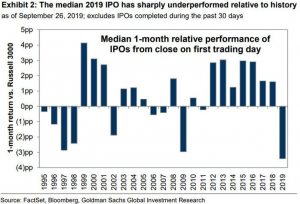
    The good news for startups and younger companies seeking funds is that a solid story with a strong management structure and realistic financials will have less funding competition from “hot” concepts. This is capitalism. Creative destruction will create a cautionary tone for a while but ultimately ensure capital is properly allocated in line with more fundamental investment processes. The data suggests 2019 has provided an inflection point for private valuation excitement. The median IPO in 2019 has had its worst first-month performance since 2009. The S-1 filing documents for IPOs like WeWork can mislead but this chart certainly does not:

    The good news for startup founders is that there is plenty of private capital out there and interest rates/yields for investors are currently at historic lows. So, there is plenty of interested investor ears. For those thinking about access to capital, one should consider crowdfunding as a good platform to learn and ultimately execute your own fundraising story. Equity crowdfunding does work. Contact us today to learn more about how Spark Crowdfunding can help your company grow.

  • Equity Crowdfunding – How Irish Private Investors can Identify Winners

    Equity Crowdfunding – How Irish Private Investors can Identify Winners

    With interest rates at an all-time low, Irish investors are looking for the best ways to get a return on their funds.  Investing in the right private companies can deliver high rates of returns.

    Equity crowdfunding makes it easy for small to medium sized investors to buy shares in private companies.

    Think of equity crowdfunding as an online version of Dragons’ Den where an entrepreneur is looking to raise (say) €300,000 in return for 20% of their company and ordinary individuals (i.e. the ‘crowd’) can invest anything from €100 upwards.

    The crowdfunding platform, such as Spark Crowdfunding, then pools all of these small investments into one large amount to buy the 20% share of the company on offer.

    Equity crowdfunding therefore gives small investors access to investment opportunities that were previously only available to angel investors or private equity companies.

    Picking Winners

    But now that smaller investors are able to purchase shares in these start-ups, how can Irish investors identify the best companies in which to invest?

    Here at Spark Crowdfunding, we see dozens of companies every week that are looking to raise new venture funding.  So, we’d like to share with you what are the factors we consider when deciding which companies have the highest chances of successfully raising funds from our database of investors and, equally importantly, what signals or clues emerge from the equity crowdfunding campaign itself that our investors should look out for.

    Factors we consider when trying to spot Winners

    1. Management Team

    The most important consideration for us is the Management Team and their skills, knowledge, attitude and aptitude.  A good Management Team with a bad idea is better than a bad Management Team with a good idea.  We want to know their track record in business and have they built successful companies previously.  The academic qualifications of the Management Team are also important.

    1. Results achieved to date

    We have a greater preference for companies that have actually achieved something, as opposed to a company that says it is going to achieve something.  Specifically, we like to see evidence of demand for the product in the form of Revenues from Sales.  Two investment industry buzz words of relevance here are ‘Proof of concept’ and ‘Traction’.  Evidence of both is preferable.

    1. Amount already invested by Management

    If the Management have personally invested money in the business, it tells us they have more to gain by it succeeding and more to lose if it fails.  We take comfort if their interests are aligned with shareholder interests.  The industry buzz term for this is ‘skin in the game’ and the more the better.  For the avoidance of doubt, when we say ‘invested money in the business’, we mean ‘has purchased shares in the company’, not ‘lent money to the company’.  Loans are only of interest if the management is prepared to convert them into shares at the same time as new investors are buying in.

    1. Scale Potential / International Potential

    A business has ‘scale potential’ if it can increase revenues exponentially without a commensurate increase in costs.  Tech or digital businesses are more likely to have this feature, whereas ‘bricks and mortar’ retailers tend to have limited capacity and growth potential.  We prefer companies that have ‘scale potential’, especially those with international scale potential.

    1. Use of Funds

    The use to which the newly raised funds will be put is another important consideration.  We prefer to see as much of the funds as possible going directly into areas that will generate Sales Revenues quickly, as opposed to building an infrastructure.  Related to this is the length of time before the company stops burning cash and becomes cash-flow positive.  We don’t like to see a prolonged period of cash-burn.

    1. Any Patents or other forms of Protection

    We look for businesses that have some protection from competitors or operate in industries with reasonably high barriers to entry.  A Patent can give companies a head-start over the competition, but other equally valuable forms of protection include specialist industry expertise or signed long-term contracts with major clients.

    1. Is the company an Enterprise Ireland Client?

    Companies that are clients of Enterprise Ireland tend to have been through a prior screening process and we take some comfort from this.  Equally valuable is a previous investment in the company from an experienced investor, other than a friend or family member.

    1. EIIS approved

    Our investors can reclaim 40% of their investment in the form of a tax rebate by investing in companies that are EIIS approved.  Clearly, these companies have a higher appeal to our investor database and are more likely to achieve their fundraising target as a result.

    1. B2C or B2B Company

    Crowdfunding investors have the potential to support companies in ways other than just making an investment.  This could include purchasing the product, making introductions to new sales channels or simply offering advice.  B2C companies tend to be more suitable for this.

    1. Exit Plans and Timeframe

    Investors in private companies typically look for an exit within 5-6 years and would expect to receive a multiple of the amount they initially invest.  What this multiple is depends on the risk profile of the investment.  For low risk investments a minimum of 3x would be expected while 10x would be expected for high risk investments.

    1. Realism in Financial Projections and Pre-Money Valuation

    We understand and appreciate entrepreneur ebullience and optimism more than most.  However, we also need to ensure that the Financial Projections and related Pre-Money Valuation are credible and based on realistic and assumptions.  Companies without a defensible valuation rationale will not succeed in achieving their equity crowdfunding target on Spark Crowdfunding.

    These factors highlighted above are what we consider before a campaign goes live on the site.  But once a campaign goes live, there are clues and signals that a savvy investor should look out for, in advance of pledging funds to a campaign.

    Signals that emerge from the Equity Crowdfunding Campaign that Investors should look out for

    1. How much is the Management Team investing at the current valuation?

    The best proof that Management believe the valuation represents a good investment opportunity is if they are also investing in this current fundraising round.  It is a very positive signal if Management are investing a meaning amount.

    1. How much are other investors investing? Sophisticated Investors or mugs?

    The beauty of an equity crowdfunding campaign is its transparency.  Everyone can see how much has been invested at any given point in time.  If others are investing, then the campaign is worth exploring further.

    1. How quick does the Campaign Promoter respond to questions about the fundraising?

    Questions arise during every crowdfunding campaign and can range from simple issues, like the number of employees, to more complex ones, like the strategy for international market penetration.  Investors can learn a lot about the CEO of a company, not least his or her communication skills, by the speed and depth of the answers.

    In conclusion ………

    Picking winners is difficult, particularly with early stage businesses.  But the landscape has changed and through equity crowdfunding, small and medium sized investors can now sit at the same table as the private equity and venture capital investors.

    As Ireland’s only equity crowdfunding company, Spark Crowdfunding is democratising finance by creating new investment opportunities for small and medium sized investors.  To receive announcements about Irish start-ups looking to raise funds from Irish investors join Spark Crowdfunding for free today.

    You don’t want to miss the next Uber!

  • Can Equity Crowdfunding avoid the emotional crowd?

    Can Equity Crowdfunding avoid the emotional crowd?

    Human beings are social animals with 70 to 80% of our waking hours spent in some form of communication. On average we are speaking 30% of the time but we do significantly more listening at 45% of the time. So, more than half our waking hours are spent taking our cues from our environment, especially other people, on how to act. Humans have survived and prospered because of our ability to band together but this adaptive behaviour has hard-wired our brains to be consistently awful investors. Harsh? Check out the data.

    The results of research done by Dalbar Inc, a company which studies investor behaviour and analyzes investor market returns has consistently highlighted below-average returns for the average investor. For example, the 20 year period to 2015 saw the S&P 500 deliver an attractive 9.85% per year. However, the average investor missed out on almost half those returns with an annualised performance of just 5.19%. Before we reveal the reason behind this debacle here’s another data point which might give the reader a clue. Fidelity, the giant fund management company, conducted a study a few years ago of its highest-performing individual investor accounts. The report when published attracted quite a bit of publicity when the star performers weren’t exactly market experts or algo-savvy wizards. The galling reality for Fidelity and thousands of embarrassed wealth advisors was that the top-performing account holders had either died or totally forgotten they had an account!

    The problem for the average investor is that our psychological DNA leads to illogical investment decisions based on emotional reactions to the short term good or bad news flow generated by the crowd and its media channels.  We eschew our normal retailing discipline and insist on buying goods/funds when prices are flying high and then returning goods/funds at ‘on sale” prices rather than original purchase prices.  No wonder Warren Buffett wrote in his annual letter in 1986, “Inactivity strikes us as intelligent behaviour.” On the subject of Buffett, there have been libraries of literature on his investment process but perhaps his greatest business initiative was to consistently educate his investors as to the value of time and a long term perspective. Sadly, this logical use of time and the miracle of compounding income is absent in the majority of investor pools. Additional research by Dalbar Inc shows that the average holding period for supposedly long-term investment fund products is just less than 4 years. This week’s events will no doubt add to those damning statistics.

    As financial headlines scream Trade wars (China), Trump wars (Iran) and Tech wars (Facebook) markets have had a volatile week yet many will resist the logic of doing absolutely nothing. Apart from counsel from a professional advisor, a little bit of long term perspective can prevent our hard-wired urge to “fit in” and join the reactive emotional crowd. Think about all that trading, emotional activity and then consider that the S&P 500 in the 93 years since 1927 has had just 11 years where markets were down by more than 10%.  Those scary headlines this week didn’t mention the 68 positive years experienced by the S&P 500 but that doesn’t capture eyeballs or generate commissions. In some ways, technology and ease of execution have exacerbated the problem, allowing investors to react quickly and emotionally to the prevailing mood of the market place. One does wonder whether one day we will have fund products which demand long-term commitment? It doesn’t look like a commercial winner but maybe there are more subtle offerings out there.

    If one looked for an investment proposition which required a long term capital commitment and contained some volatility comfort then an EIIS scheme could tick those boxes. It’s a 3-4 year commitment and a 40% tax saving provides a significant valuation comfort. For context, there have been just 3 years out of 93 years where the S&P 500 lost more than 30%. Funding start-ups, of course, has its own risks but the discipline of long term investing could, in its own right, be a diversification of behavioural risk. And for those still sticking to their social DNA requirements, there is a great opportunity via equity crowdfunding platforms to seek out EIIS opportunities and the less emotional wisdom of crowds!


    Enjoyed this blog? Then why not check out our other great content by clicking here!
     

    Spark Crowdfunding is Ireland’s only equity crowdfunding platform. We are based in Dublin city centre. Our equity crowdfunding platform enables investors to invest into various stage Irish companies and it gives Irish companies the opportunity to raise new funds quickly and at low cost to accelerate their business growth. Click here to find out more.

  • Equity Crowdfunding Platforms – Keep an Eye on the Ladies!

    Equity Crowdfunding Platforms – Keep an Eye on the Ladies!

    The female wallet is expanding rapidly and this could be very good news for equity crowdfunding platforms.

    Recent reports on the $35 billion divorce settlement between Amazon supremo, Jeff Bezos, and his ex-wife, Mackenzie, may have supplied eye-catching headlines but this merely scratches the surface of a seismic global shift in the history of human wealth creation.

    The paper “The (Financial) Future is Female” published by S&P Global Intelligence to mark International Women’s Day in March 2019 details a doubling of female wealth in the 10 year period to 2020. For tabloid headline context the addition of $36 trillion in female controlled wealth equates to the creation of a $900 billion Amazon franchise every 3 months!

    The influence of female investors and entrepreneurs is growing rapidly and is very evident on the Spark Crowdfunding investment platform with a significant 28% representation in total investor registrations.

    For equity crowdfunding platforms this should be considered a very positive development for the valuation process in a fundraising campaign.

    Ultimately, valuations reflect risk and it would appear female expertise in this area has been recognised earlier than perhaps other activities in financial markets;  a compensation survey by Risk and Insurance Management Society revealed that women are compensated highest, relative to men, in risk management than nearly any other field.

    To be clear, this writer is not an advocate for gender-superior skills in risk rather that male and female approaches can be different and, in combination, more effective. Interestingly, the Peterson Institute for International Economics surveyed more than 20,000 companies in 91 countries and found that firms were 15% more profitable where more than 30% of C-Suite leaders are women compared to similar firms with no female leaders.

    An enhanced investor pool is good news for companies looking to raise funds but there is an equally important benefit to crowdfunding investors seeking returns on their equity.

    The integration of  environmental, social and governance (ESG) factors into investment processes and decision-making is now firmly established.

    Today ESG investing is estimated at over $20 trillion and is based on the assumption that ESG factors have financial relevance.

    In fact, the original ESG study published in 2005 was titled “Who Cares Wins” and this aspiration has received a massive boost from demonstrable superior returns from investment strategies using ESG factors.

    Research from Axioma has shown investment  portfolios weighted in favour of companies with better ESG scores have outperformed benchmarks by as much as 2.43% in the four years to March 2018.

    In the context of “The Great Wealth Transfer” occurring right now it is not unreasonable to expect companies scoring highly on Social factors involved in gender equality, workforce inclusion and female health to be the likely recipient of  influential network endorsement and funding from female wealth sources.

    Spark Crowdfunding has already successful completed two fundraising campaigns with female founders focusing on the healthcare space and there is no doubt there will be many more companies who will score strongly not only in ESG terms but also offer the possibility of strong equity returns for investors.

    Very few investments turn out to be Amazons but it is worth recalling Amazon started out commercial life in 1995 as an online bookstore, just the three hundred and fifty years after the first documented book clubs.

    Whoodathunk a book retailer would evolve into a trillion dollar franchise?!  Then again, what are the chances investment pitch books from equity crowdfunding platforms could be the time-friendly texts of the future to discuss with a cheeky bottle of Pinos Gris and avocado humus……?