Tag: America

  • Beautiful Minds Will Prevail

    Beautiful Minds Will Prevail

    The late Peter Sutherland would smile. Sutherland’s stellar career took in stints as Ireland’s youngest ever Attorney General, youngest ever EU Commissioner, father of the student Erasmus Programme, Director General of GATT and its successor, the World Trade Organisation, topped off with Chairman roles at Goldman Sachs and BP. He was a pretty decent rugby prop forward too. Sutherland’s appreciation of equilibrium at scrum time, laser-like attention to detail and powerful negotiation skills were critical to his success in securing 123 sovereign signatories to the General Agreement on Tariffs and Trade (GATT) in 1993 when the highly complex Uruguay Round of global trade talks were in danger of collapse. He might always have been “Suds” to his friends, but in the international business world Sutherland was the “father of globalism”. And, he truly understood the complexity of global trade agreements. So, what would he make of the Trump regime’s shakedown of the global trading system? Well, as all students devouring legal judgments in the UCD Sutherland School of Law will know, precedent is key. And…..we have Brexit as our stare decisis case study.

    Recall the Brexiteer mantra of “Global Britain” and those fantasy soundbites like “we hold all the cards”, “they need us more than we need them”, or best of all “Britannia Unchained”. Sound familiar? In hindsight, the freedom to pursue new trade deals featured far more chains and ridicule than expected. Britain is still to create the promised bi-lateral free trade deals with the likes of the US and India, while Truss-trumpeted deals done in Pacific Rim countries have had no more impact than if these faraway agreements had been signed by penguins. We mentioned “equilibrium” earlier and this really isn’t just a scrummaging thing. The brilliant Nobel Prize winning research by John Nash, featured in Hollywood’s “A Beautiful Mind”, are the foundation of all game theory analysis applied to trade deals. The Nash Equilibrium is a key concept in game theory where knowledge of other players’ strategies (politics) gives no players incentives for deviating from their own strategy. Hence, we experienced a “hard” Brexit. Now, think about China and the US currently engaged in escalating tariff retaliations. Also, remember the Pacific penguins.

    The Trump trade team seem to believe they have 70 nations queuing up to sign trade deals with the US. Let’s be very clear, and Britain can attest to same, the signing of bilateral trade agreements (two countries in isolation) is extremely difficult to execute. Peter Sutherland would quickly point out that a change in trade terms with one country automatically opens up the possibility of trade being diverted through more favourably disposed countries eg China production switching to Vietnam during the Trump 1.0 administration. Trade is by definition MULTI-LATERAL and requires Nash-like understanding of game theory and trade negotiation. Britain’s trade delegations can sheepishly tell you all about how their Japan deal negotiations went. The short version is that Japan told Britain any new trading terms would be inferior to the EU because the EU was a far bigger and  more important trading partner. Now,  cast your minds back to Trump 1.0 and his renegotiation of an existing trade agreement (NAFTA) with Mexico and Canada. This “straightforward” renegotiation took TWO YEARS to complete. The current Trump trade advisory team are delusional about their ability to close out a series of bilateral trade deals in 90 days. Also, there is no Nash or Sutherland on the US team. In fact, it’s far worse than that…


    *Trump’s White House Counsel on Trade, Peter Navarro, and his alter false ego Ron Vara, went on TV last night to claim bond yields (which “didn’t intimidate” his mobster boss) were going down while the rest of the sane world saw them continue their worrying climb higher.

    *US Secretary of Commerce, Howard Lutnick, continues to laugh hysterically in his media appearances and reassured all viewers on Fox yesterday that the US economy would “explode”. Yes, Howard, that’s what we all fear.  

    *If you were hoping AI was going to help frame a complex trade agreement then think again. US Secretary of Education, Linda McMahon, was outside her WWE wrestling comfort zone but still managed to stun a panel discussion this week with her comments on how “A1” would impact teaching. Yep, Linda hasn’t really heard the “AI” term in conversation before, and her reading to date on the topic picked up the AI term as “A1” which is a steak sauce apparently.  


    Not only will trade deals not get done there is now a US institutional credibility issue. As I write, the US dollar, US Treasuries and US stock markets are being sold by investors all over the world. Typically, the US dollar and Treasuries would strengthen in a period of stock market volatility so this is HIGHLY unusual erosion of trust in US governance. There is perhaps worse to come. Lost in the crazy headlines this week was a decision by the US Supreme Court to allow Donald Trump to fire officials leading two independent agencies. Again, the critical point is precedent. These officials have the same legal status as that of Federal Reserve governors. Already, Trump is whining about the Fed not cutting interest rates so the possibility of Federal Reserve Chair, Jay Powell, being removed by Trump can’t be ruled out. We should also be aware that the trade war with China could go financial and some commentators are speculating about the US government reneging on US Treasury interest(coupon) payments. A hint of either of these actions would make this week’s market gyrations look like jelly ripples in comparison. And yet, it’s possible we could have an “Orange Swan” event in the global financial system. Also, if it’s black swans you’re looking for, keep an eye on Chinese internal politics.

    President Xi looks like he’s in for the long haul in this trade war with the US, but he’s not sure about his comrades. Latest reports suggest that the second ranking general in the People’s Liberation Army(PLA), He Weidong, has been purged. That level of rank in the PLA being purged has not happened since 1968 during Mao’s Cultural Revolution, and signals some dissent within the Politburo. Regime change in Beijing is a long-shot but most of the action in the near term will be in Washington.

    Business decision-making is paralysed and the charts showing US Economic Policy Uncertainty Index in this week’s Financial Times were unprecedented, surpassing even Global Pandemic levels of confusion. Consumers aren’t feeling much better. The results of the University of Michigan consumer survey has just hit the screens and the commentary is ugly:


    “Consumer sentiment PLUNGED 11% this month to a preliminary reading of 50.8, the second-lowest reading on records going back to 1952. April’s reading was lower than anything seen during the Great Recession”


    This all reads as gloomy stuff but there’s a potentially “beautiful” outcome not quite in Trump’s strategic vocabulary. Financial markets, business and voters are all aligning in rapid fashion and beginning to smell incompetence. Was it only a few weeks ago that Trump’s security team shared military operational details with the outside world in real time via mobile phone chat groups? This week, team Trump stands credibly accused of almost blowing up the world’s financial markets. Whether you’re a Fox News viewer, or an oil worker in Galveston, or a farmer in Idaho you know something’s up and it isn’t pensions, savings or 401ks. Global trade needs great thinkers not spoofers, and the world is calling this ugly trade bluff quickly.



  • Three Pictures Of Opportunity From A Changing World Order

    Three Pictures Of Opportunity From A Changing World Order

    It is difficult to avoid pictures of the St Patrick’s Day sex-pest parade at the White House but I can assure you it is well worth the effort. Clearly, the rule of law and the world order is enduring a seismic shakedown but it would be a mistake to assume all is lost. Hidden behind the disbelieving headlines and festive mug-shots there are a number of alternative pictures really worth thinking about. Hedge fund billionaire, Ray Dalio, wrote The Changing World Order: Why Nations Succeed and Fail  as recently as 2021 and used five centuries of history to show how nation success depends on cycles much like business. So, I have been struck by three investment trends whose emergence could be attributed to these long-run cycle shifts. The first cycle journey actually starts with cars…..


    The mighty Volkswagen AG (VW) of Wolfsburg was founded in 1937 in the midst of another seismic geopolitical shift and 80 years later in 2017 became the world’s largest automotive manufacturer by global sales. In 2021 VW reached its peak market value of €155 billion but the Ukraine war, rocketing energy prices and electric vehicle (EV) competition has wiped almost €100 billion from that valuation since then. In fact, this week the even-older arms and military vehicle manufacturer, Rheinmetall AG, surpassed VW in market value. In reality this is a 10-year story rather than a 135-year history. As recently as 2014, Rheinmetall’s 125-years of manufacturing ammunition, missiles and military transport vehicles had built a total franchise value of just €1.3 billion. The invasion of Crimea by Russia in the same year was the “butterfly wing flap” moment as the company’s valuation over the following 10 years increased exponentially to deliver a 48x return to any far-sighted Kremlin watching investors. The picture below is a graphic reminder of the defence sector resurgence opportunity and the industrial shift away from the internal combustion engine (ICE):


    Of course, Germany is not the only country impacted by geopolitical change. Plenty of Trump apologist commentators seem to believe “Agent Orange” is playing 4D chess and seeking an alliance with Putin to take on the growing threat of China. Well, how’s that going? About as well as Trump’s ‘day one’ defeat of inflation or the $5 trillion evaporation of the US stock markets driven by a tech-heavy “Magnificent 7” meltdown. In contrast to US investors, the Chinese are enjoying a 40% rise year-to-date for their tech sector stocks and a healthy almost-20% gain for the broader Hang Seng Index. Ironically, it’s a Chinese AI company called Butterfly Effect which is creating possibly even greater waves than the DeepSeek cost ‘shock” back in January. Butterfly’s AI digital assistant, Manus, is more powerful than DeepSeek and has automated up to 50 tasks from buying a property in New York to editing a podcast. There have also been big Chinese breakthroughs in recent weeks in quantum computing and robotics adding to a stark picture below (Source: Bloomberg) – a whopping 40% outperformance by the Chinese tech sector over the US tech sector since Trump took office in January.


    If it feels like US Big Tech is in relative retreat then the latest data from VC research house, Pitchbook, makes for interesting reading. Big Tech is playing a less prominent role in the US start-up M&A market due to regulatory pressures but big corporates seem to have been replaced by start-ups themselves as acquirors. More specifically, in 2024 more than one third of start-up acquisitions were made by VC-backed start-ups. This highlights the emergence of a new buyer profile and exit route for start-ups; VC-backed ‘unicorns’ with significant cash reserves and an appetite for growth. Indeed, Pitchbook analysts put this rather well:


    “Amid the trend toward ‘profitability’, it is important to remember that growth remains essential and serves as a key motivating factor for these buyers…..The high number of VC-backed companies also creates numerous opportunities for consolidation. While acquisitions by VC-backed companies may not often dominate the headlines, they are becoming an important aspect of the venture capital liquidity narrative. ”


    The chart below (Source: Pitchbook) shows start-ups accounting for just 20% of M&A by value as recently as 2018. So, the move above 33% today seems significant…


    In summary, the pictures above should be viewed as opportunities happening in real time while we are distracted by tawdry turmoil and photo-ops in Washington. More importantly, we should start to think about geopolitics as the driver of not just nation cycles, but also business cycles and new long-run structural trends.


  • Does Europe Have Whatever It Takes?

    Does Europe Have Whatever It Takes?

    This is tricky. Here goes… I’m going to sound like Boris Johnson for a moment. Relax. No Greg Wallace, Master Chef or “middle-class women of a certain age”. More like the Middle Ages, and a stunning personal discovery this week that, before counterparties sign off a private investment in Germany, a public notary must read every single word out loud. Yip, not a banana-straightener but for a venture capital investor this week that meant “12 hours and counting” for a Series A investment document to be read out loud in front of founders and investors. In person. It sort of feels like Germany has missed out on a few productivity hacks since the Gutenberg printing press arrived in 1439. Meanwhile, European leadership is in disarray as the French government collapses, Germany’s industrial base struggles and the UK paddles alone in its own faeces-filled waters. It is difficult to ignore the “Europe is Donald Ducked” chorus growing louder by the day. And yet, I believe Europe can change course for the better. First, let’s identify a few key problems…

    Actually, why don’t we turn to the man who rescued Europe once before. Back in 2012 Mario Draghi as President of the European Central Bank (ECB) declared that “the ECB is ready to do whatever it takes to preserve the euro”. Remember the “PIIGS” who struggled in the crosshairs of European debt crisis traders for weeks? Well, Portugal, Ireland, Italy, Greece and Spain have more than survived that credit (or credibility) crisis. In fact, this week Greece was able to borrow at cheaper rates than France. Stunning. And perhaps, that should be Europe’s inspiration. Greece was a mess. Not now. However, the same Mario Draghi in his 400 page EU Competitiveness report is telling us Europe is in a mess and that “without action, we will have to either compromise our welfare, our environment or our freedom”.  Draghi sees the following challenges:


    1. Productivity: European GDP growth has lagged the US by 0.5% every year since 2000. Interestingly, demographics (population growth) has played its part in that too. How about building that wall? Maybe not.
    2. Innovation: There are no leading technology companies in Europe. Draghi identifies a “middle tech” trap where Europe seems happy to be in “the peloton” rather than lead. Indeed, outside the information and communications technology sector, European productivity growth matches and often beats US competition.
    3. Finance: Draghi bemoans the lack of joined-up thinking and fragmentation in the area of debt financing and regulation. Think about those hoarse notaries and the 1,330 banks servicing Germany. Then know that Canada has just 93 banks.
    4. Security: Draghi deals with a number of distinct challenges in his report but I have lumped them together as almost existential threats: defence(war), climate crisis (decarbonisation) and industrial dependence(China).


    There’s a danger these challenges are perceived as nothing new. Arguably, the outbreak of a full scale European war is the only really new challenge of recent years. The other challenges have been slow-moving train wrecks over a decade or more. However, the point to be made is, like our climate crisis, Europe is running out of time. As always, I try to use data to tell a story and here are a few standout numbers which have crossed my desk in recent weeks:


    *In the 1950s to 1970s period European investment in innovation equated to 4% of GDP. That percentage is now 0.5%.


    *Venture capital investment in Europe is 6 times lower than the US.


    *71% of all current funding for AI globally is in the US. Europe accounts for just 14% of global AI investment.


    *The performance gap between US and European stock markets this year is over 21%. That’s the biggest performance divergence since 1976. In fact, US stock markets now account for 65% of global stock market capitalisation but with just 26% of global GDP.


    *According to Bank of America research, US to European equity valuations have risen to 3.6x in November, an all-time record. This ratio has DOUBLED in 8 years, and is 3 times the historic average.


    *The US stock market has outperformed Europe in 12 out of the last 15 years.


    *There are more than 270 regulatory bodies involved in digital networks in the EU today.


    *The EU has 34 mobile network operators. China has four, and the US three.


    If the list above feels a bit “money” oriented there is good reason. If investment, performance, valuations and growth gravitate to one economic region the knock-on effect is significant for competing regions like the EU. Stripe didn’t even bother starting out in Ireland. The Collison brothers went straight to California. It’s not just start-ups. One of Europe’s homegrown fintech stars, Revolut, is about to IPO but co-founder and CEO, Nikolay Storonsky, has said the US will be their public listing home as London “can’t compete”. Not surprisingly, CB Insights are saying 40% of the world’s AI companies (and talent) are located in the US.

    It’s not just a money tale – those stats above about regulators and network fragmentation are massive hurdles to companies competing for investment capital based on growth. You don’t need a notary to grow GDP. However, like Greece and Ireland in the recent past, it is possible to be ‘forced’ into survival strategies which may require pain. As an illustration, the decision of VW to close manufacturing plants in Germany for the first time in 87 years might only be the start of bad news for the 100,000 VW workers striking in protest. Now for some better news, and a bit of European inspiration…

    Europe has proven already it has whatever it takes to win the battle of the skies. In a truly pan-European collaboration project, Airbus has emphatically emerged as the dominant aircraft manufacturer on this planet. Even before Boeing’s troubles, Airbus was racing towards 60% global market share and currently is winning the market for large single-aisle planes on an 80/20 basis. The European champion of the skies has been beating Boeing for 5 consecutive years and has an order backlog of 8,600 planes. This is the inspiration and illustration of European collaboration. Now look to the skies again.

    War is a tragic European fact of life in Ukraine. However, battles for survival can bring innovation. WW2 was the catalyst for Europe to invent radar, penicillin and jet engines. Today, you might consider the 200 Ukrainian companies currently manufacturing Unmanned Aerial Vehicles (UAVs). Yep, drones are the future and Elon Musk has had the temerity to suggest US F-35 jet fighters are “already obsolete”. If Musk is right and “Future wars will be drone wars” then Europe is the epicentre of UAV innovation. Interestingly, Germany’s start-up AI software company, Helsing, has focused on drones and jet-fighters and is now manufacturing its own attack weapons. These drones are armed and don’t need pilots or GPS, it’s all AI. And, Helsing is already valued at $5 billion.

    Our other survival battle is climate. And Europe can lead. One of the key drivers of productivity and valuation divergences over the years has been energy costs. An auto factory or chemical plant in Europe can typically pay $500m to $1 billion more for its power supply…. each year. Electrification is not just the decarbonised future, it is European industrial survival. While Europe might be stuck in a “middle-technology” trap it might be the US and China who remain wedded to cheaper fossil fuel options. Draghi’s analysis envisages Europe spending €3-4 trillion on electrification, or about 25% (!) of EU GDP over the next 10 years.

    Investment/spend is critical to innovation, and Europe right now looks like it is losing out in the energy race. So, we must hope a power crisis breeds innovation opportunity in electrification and perhaps gives Europe a head start over more complacent rivals. In fact, one of my favourite stats this week emerged in the decarbonisation space. A research paper from University of Chicago and Wharton estimates the total carbon burden of US corporates is $87 trillion. That’s 1.3 x the market capitalisation of US companies in 2023, and starkly demonstrates payment for damages caused by greenhouse emissions would bankrupt corporate America.

    Adversity forcing dramatic shifts in industrial policy and investment capital could ultimately be Europe’s saviour. Furthermore, we should look east to see how countries and cultures free themselves from government and regulatory over-reach. Poland is now, per capita, as rich as Japan or Spain. Its military is arguably the strongest in Europe, and its GDP has grown by 3.5x since 1990. Quietly Poland is becoming a tech and innovation hub. And, behind that drive is a STEM graduate pipeline ranked 4th in Europe between 2013 and 2019. That will only accelerate as Microsoft invests $1 billion, Google builds an R&D centre and a talent brain drain now moves into reverse. Inspiring stuff.

    It can be done. However, it might need a further crisis to prompt Europe’s leaders to commit to ‘whatever it takes’ to survive and lift itself out of decades of decline. And… the data and vibes suggest we are close to that moment.


  • Silver Linings For Finishing 2nd Almost Everywhere…

    Silver Linings For Finishing 2nd Almost Everywhere…

    I blame the Irish. Should have seen it coming. Poor immigrants once upon a time, the changed perspectives were there for all to see. A couple of Kellys, a Mulvaney, a Spicer, a McMahon and a McGahn, all key lieutenants in the Trump 1.0 cabinet of 2017, championed Muslim bans, Mexican walls and family separations. I’m being flippant and skipping through a few decades of political evolution here but political integration of immigrant communities is a good thing. Take it as a genuine US presidential election positive. Of course, there will be plenty of Democratic Party navel-gazing and gnashing of teeth in the days and years ahead, but finishing second for the first time in 20 years (last popular vote loss was 2004) will focus minds on the stunning shift of ethnic minority voters to an anti-immigrant Trump ticket.

    Things looked bad for the Harris campaign very early on Tuesday evening. Hispanic-heavy Miami-Dade County in Florida had given Hilary Clinton a 30 point winning margin in 2016. On election day, Trump obliterated that by 40 points to secure a 10 point winning margin. There were other shockers – Star County (Texas and 97% Hispanic), Suffolk County (New York) and my personal favourite, Anson County in North Carolina. Republicans have won this 45% black county only once before since…. 1870. Wowzers. The purpose of this article is not to follow most post-mortem commentary and examine where the Democrat messaging didn’t connect but rather to highlight some potentially positive developments. If anything, the change in the mix of the Republican vote is more interesting. Try the dilution of white voting power.  The ‘dilution’ phrasing might surprise readers’ perceptions of what constitutes the Republican party base vote, but the scores are in:


    *Trump won less of the white vote this year (55%) than 2020 or 2016. And…


    *Harris (43%) did better with the white vote than Hilary Clinton or Joe Biden.


    *Hispanic men voted for Trump 54% vs 44% for Harris.


    The always excellent Noah Smith in his newsletter recalled a former Irish Republican, Ronald Reagan, saying that Latinos would eventually become Republicans. The social negatives attached to that shift are for another day but Smith highlights an even more important point for a polarised US society:


    “This largely destroys the narrative that non-white immigration will demographically drown White Americans under a tide of imported minority votes….. At some point, Republicans are going to realize this, and hopefully become less anxious about America’s racial future. Hopefully they will also realize that any attempt to make voting harder actually hurts them in the future, because the impact would fall disproportionately on their own base”.


    Oooooh Tucker Carlson might not like that narrative challenge to the “Great Replacement Theory”. But, there’s also another positive attached to this stunning shift in voting patterns. Harris lost so emphatically and so early that there was no dispute over electoral process. In fact, Trump improved his vote in 90% of all counties in the USA, and that includes Guam flipping to red. For those who hoped for decency, that feels like finishing 2nd just about everywhere. Many wanted democracy to prevail. It did, but with the anticipation that the “right” side probably had to win for a smooth transition, right? That caveat is for another day’s discussion too.

    Also, while we are on the topic of ‘right’, another stunner for me was that the white evangelical vote was 22% of the total vote and they voted 81-17 for Trump. Other voters who make up the remaining 78% of the electorate voted overwhelmingly for Harris by a 19 point margin (58-39). So, without white evangelicals Harris would have won the election by 20 points!  Let’s hope God is right……

    Meanwhile, for the socially agnostic financial markets, uncertainty is a wealth destroyer, paralyses decisions and kills investment activity. So, not surprisingly, there have been a few financial wins in the early days after the election. We’d highlight the following:


    *Banking and asset management stocks like Goldman Sachs, Blackstone, Blackrock, JP Morgan and Apollo all flew up by 10% or more.


    *The S&P 500 had its best day in 2 years and best ever post-election bump (+2.5%).


    *Elon Musk’s Tesla jumped 15%


    *Bitcoin’s price rise by 9% to $75,000.


    The Musk win is probably a struggle for some but the EV revolution is climate critical and hopefully keeps Trump tangentially on board with decarbonisation of the economy. Intriguingly, the presence of Musk as chief Trump mascot could bring a slightly contrary positive. There are some, including me, not comfortable with the billionaire “broligarchs” brazenly pushing their own commercial agendas. However, it would be a mistake to conclude that it is only the Republican party engaging billionaire promoters. The Democrats had their own, possibly glitzier line up of billionaires, influencers and celebs. And, the big strategic mistake would be to react to a Jaws-like electoral savaging by suggesting “we need a bigger boat” or better billionaires. That boat has sailed. The positive lesson from this would be to “listen” and start exerting proactive power.

    One of the critical shifts in voting patterns was urban voting. Democrats still won the big cities but the winning margins were embarrassingly small compared to double-digit history. Urban voters in the likes of New Jersey, New York, Chicago, San Francisco and Detroit have witnessed a disgraceful decline in the condition of their cities. And, other urban voters have noticed. Where Democrats have governing power, they need to deliver better city living. Security, mental healthcare, housing, crime and infrastructure are very real challenges experienced, in particular, by the lower middle and working classes. Investment and solutions to these challenges will improve urban lives and win votes.

    Commentators recently described the US voter base as one now split evenly across three cohorts: i) white college-educated, ii) white non-college educated and iii) everybody non-white. Currently, the Republican party is connecting more effectively and adding voters with two of those three. The Democratic Party should be surprised and concerned about the only one with which they are growing/connecting. The good news is that the key driver of political power in today’s America is not ideology or race. The winning factor is DELIVERY, perceived or promised. Clearly, social growth and stability are important for a nation but there’s a price for everything. In this instance, the price (inflation) – and a perception of social agenda prioritisation – was too high. Just ask Latinos, now known as “Latinx” in Democratic Party literature.

    For investors, less financial regulation, lower technology oversight(AI) and more deals (M&A, IPOs) all promise more exits and further investment cycles. All good news, until it’s not. Note, only 15 years ago the world paid a shattering economic price for deregulation of financial credit markets. Go back another two decades, and here’s a final thought for the autocracy delivery (over democracy) fans out there celebrating technology and commercial freedom…….

    The last global authoritarian empire to implode was tipped into collapse by lies and a catastrophic failure of technology .


    “Every lie we tell incurs a debt to the truth. Sooner or later, that debt is paid”


    Valery Legasov, chief of the Chernobyl disaster investigative commission.

  • How To Trade A Trump Win

    How To Trade A Trump Win

    The financial text books and academia will tell you that stock markets tend to reflect investor views 6 to 9 months ahead of events. In financial ‘jargon monoxide’ it is said that stock markets ‘discount’ future events or, in main street terms, it’s a bet. It should also be said that this is real investment money taking a view. Bluntly, opinions are cheap, even worthless. So, when I read the frequent headlines about poor polling numbers for President Biden and a likely November election win for ‘The Accused’, Donald J Trump, my instant reaction is to check the ‘money view’. Polling responses are ‘free’ and we are now entering into that critical stock market focus period of 6-9 months ahead of a significant macroeconomic event. Real money should be starting to show its teeth and the latest financial indicators might surprise.

    The Trump policy manifesto, aside from staying out of jail, is focused on four key messages for the GOP cult.

    1. The US is the largest importer in the world – the US Office of Trade Representative puts the annual import figure at $3.2 trillion (in 2022).  Trump has proposed a 10% across-the-board tariff on all imported goods which would have a seismic impact on all parts of the US economy and instantly add to inflation pressures.
    2. Immigration: Trump plans the detention and deportation of millions of undocumented immigrants while the economy is in full employment. This is another potential inflationary stimulus.
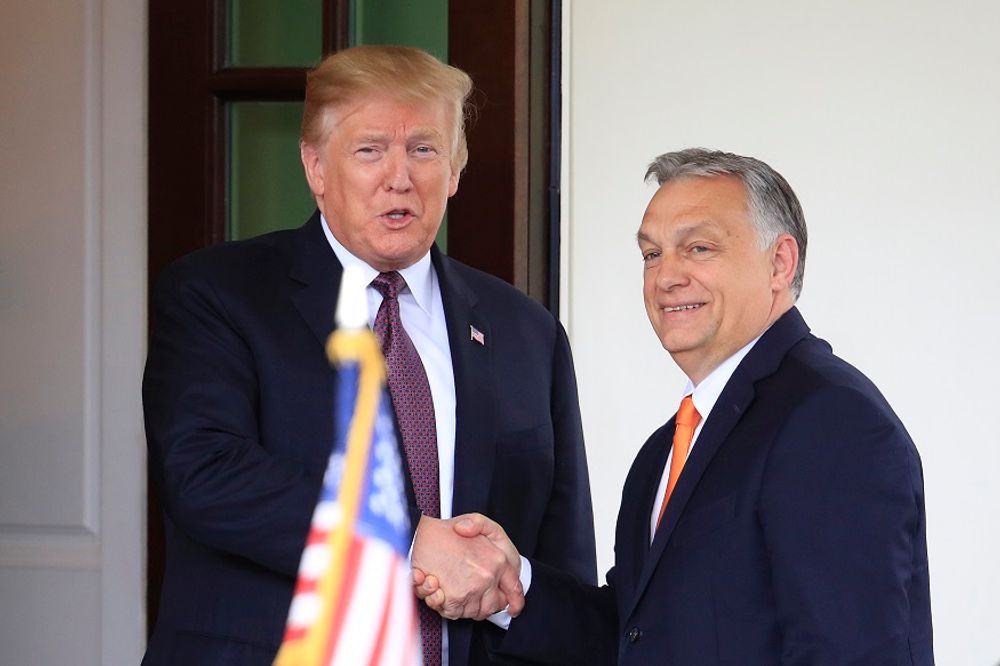
    3. As an undisguised (but curiously skirted around by US media) fan-boy of Orban and Putin, the Trump policy line is to cut off Ukrainian funding support and force a settlement with Russia. The implications for front line European nations like Poland, Finland and Estonia are enormous.
    4. Fossil fuels: Trump has made clear that the climate change crisis and sustainability initiatives of the Biden administration will be reversed, keeping the oil and gas industry happy….and paying into Trump-related coffers.


    That’s the plan. And, the polls say Trump will win. However, financial markets don’t seem to believe it, or follow that probability with the obvious trades. Allow me to illustrate the point with a few trading examples.

    Firstly, the import and immigration shockers in Trump’s policy golf bag should not just impact inflation but should also really spook the most important and intimidating market in the world – the bond market. And frankly, it’s not looking too fussed. The bond market and the Fed are still thinking – and trading – inflation (with the odd wobble like last week’s report) is on a glide path to 2-3% and will be accompanied by 3-6 interest rate cuts by the Fed going into 2025. For context, the global bond and debt markets are three times the size of the headline grabbing stock markets which dominate the first 29 pages (of 32) in the Financial Times. As we always say, the cost of money(rates) drives the prices of all financial assets. But, let’s humour the stock market followers…

    Agent Orange seems pretty keen to throw Ukraine and NATO under the bus. So, one would have thought Poland would be terrified of being abandoned by the US while it acts as temporary home to 3 million Ukrainian refugees. In fact, a macro commentator who I hold in high esteem has recently asked the question as to how long before Poland requests or sources its own nuclear weapons for location on its sovereign territory? Terrifying stuff, but again financial markets are more sanguine about the Trump threat. Poland’s stock market – tracked by the $EPOL exchange traded fund (ETF) – was the best performing major country-specific stock index in 2023 – up an almost tech-like 50.8%. Furthermore, Poland’s benchmark index is chugging along at chirpy 3% gain year-to-date in 2024. And, Warsaw is not the only place defying the US polling forecasts.

    Germany is not without its challenges but it has surpassed Japan as the world’s 3rd largest economy. This economic feat has been powered by the most formidable export engine ever seen and, again, would be hugely threatened by a Trump across-the-board 10% tariff on any company exporting to the US. Guess what? Germany’s stock market is hitting all-time-highs. Note, this is not even a country specific phenomenon. The US tech sector might be grabbing all the AI headlines but Europe’s own exporting superstars, nicknamed the “GRANOLAS” by Goldman Sachs, are absolutely flying and don’t seem to be catching any of this Trump (head)wind either. Clearly, investors are not betting on exporting chaos for these companies. In fact, we recently highlighted financial market excitement and the tech-like performance of these 11 companies in our new Private Portfolio Newsletter:

    More strikingly, the Granolas have matched the 63% gain achieved by the US-based Magnificent 7 since January 2021, and paid out much higher dividends. Whoodathunk!! For the curious, and those holding pharma and medtech startups, here are the 11 names: LVMH, ASML, SAP, Nestle, Novo Nordisk, L’Oreal, Sanofi,  GSK, Roche, Novartis and Astra Zeneca.

    Finally, climate and science denial might be very good news for the US oil and gas industry. However, even an almost-broke Trump knows that money talks. So, check out the US Oil & Gas sector represented by the exchange-traded-fund (ETF) known by the ticker “$XOP”. Stunningly, in a Ukraine crisis dominated energy market the US oil and gas sector has inched upwards by barely 4% since the beginning of 2023. For context, one could have earned a higher return by buying a risk-free US Treasury bond over the same period. In fact, US oil production levels are ironically rocketing toward 14 million barrel per day levels under Biden, or as “Honest Don” – no seriously he suggested this name – would say “like never before seen in history”. Go figure, or quiz the GOP!

    That’s real money, investing (or not) in real outcomes in 6 to 9 months’ time and offers certain investors the biggest trading opportunity of a lifetime. The financial instruments referenced above are clearly trading at the ‘wrong prices’ if Trump is set to win the 2024 US Presidency in November. The ‘MAGA Trump Trade’ involves buying inflation-protection bonds (TIPs), buying oil and gas stocks, selling German and Polish stocks and exiting any property funds sensitive to increased inflation and higher interest rates. However, there is one tiny catch. You have to believe the polls and Trump. And….. remember neither has any money.


  • Joe Biden’s Letter To Santa

    Joe Biden’s Letter To Santa

    If Joe Biden were to ask for just ONE thing this Christmas it would have to be a new writer or storyteller. I was reading various geopolitical scribes this week describe the poorly-polling Biden’s problem. According to the middle-ground commentariat, the Biden administration is describing an America with fantastic headline achievements on the economy but which the average American is not feeling on Main Street. Well, go ask the rest of the world. In fact, if Biden’s team were to follow through on their belief that “America is an idea, not a geography” then the solution to their messaging woes is staring right at them. Simply put, The USA has never been in a stronger economic or geopolitical relative position in its entire history. So here goes the report card….

    The latest GDP print for the US shows an economy roaring along at 5% growth rates. That’s the first time in decades the US growth rate has overtaken China and there’s more relative superiority to report. Other large economies at a European or Asian regional level are not seeing that growth and you will only find US-envy among German or UK voters currently enduring stagflation.

    US voters may not know it but international investors have already spotted US relative dominance. US stock markets clocked a stunning 8% monthly gain in a very rocky geopolitical November. The broader S&P 500 index is up almost 20% year-to-date and the tech-heavy Nasdaq indices have rocketed just shy of 50% this year.

    We always write about how the cost of money drives asset prices everywhere. A lower cost of money is good news and the US bond market has indicated a 0.75% drop in interest rates in the last few months. In real life terms that’s the equivalent of the central banks cutting rates by 0.25% three times in 6 weeks. It is US businesses and mortgage holders reaping that benefit, not any Europeans.

    Oil prices are back below $74 per barrel despite a Middle-East war. Of course, you won’t hear any Trump-cult Republican blowhard talk about the fact that US oil production is currently roaring along at 13.2 million barrels per day. Yep, that’s more than any country has ever produced in history. Not great for the climate, but a historic mark for US energy independence. Hold that climate thought….

    On climate and cleantech the US is leading the way in transforming the industrial base of America. The Biden IRA Act is pumping more capex investment into the US economy in this presidential term than in any of the last 3 decades. The nation is at full employment, but to paraphrase Jeff Daniels’ famous monologue in the TV series Newsroom, the average American and all Fox News viewers have “become fearful”. The daily dose of fear on US media is staggering – “deep state”, Qanon conspiracies, baby-snatchers, immigrant hordes storming the borders, lawless cities, race replacement theory, and on and on it goes. No wonder there are more guns owned (350 million) than the number of people living in this fear frenzied nation.

    It is clear that Biden’s story must feature the rest of the world. These are challenging times for the whole world, but somebody needs to tell the average American they are doing better than pretty much everyone else. The US is not perfect but it is definitely leading the planet on multiple opportunity metrics. Even better, the “America as an idea” vision is truly happening; eight of the US’s largest corporations including Microsoft, Adobe, IBM and Google have Indian-born CEOs. Incredibly, of the 700 US ‘unicorn’ start-ups with valuations above $1 billion, 100 of those companies have Indian founders. And, the beauty of nation power without borders is that it can drive activity globally.

    We already have supra-sovereign corporations with billions of customers from Google to Microsoft to Facebook. Others will want to follow from outside the US. We are now reading about China retailer Shein readying for a potential $80 billion IPO. Elsewhere, in the venture capital world Q3 funding activity globally was up 11% at almost $65 billion(Source: CB Insights). And, for those of us in the start-up universe, we are always watching exit activity. So, check out Q3 M&A activity in acquisitions which were valued at more than $100m each; deals in that $100m + category were up 38%. Also, it was interesting to see VC Q3 activity in retail fintech increasing at a 53% clip.

    Back in the US, inflation has been tamed and month-on-month price increases reduced to ZERO %. That will help Biden along with a crippled Russian military, a non-escalation by Iran or Hezbollah over Gaza, and a critical uptick in US consumer confidence. We don’t need Gen AI to write this story, albeit the US controls the 3 largest AI models globally through Microsoft(OpenA)I, Google (Bard) and Amazon (Claude/Anthropic). So, we will put that down as another Biden win too.

    In the interim, I will just wait for that call……or write to Santa myself.

  • The Most Important Poll In Markets Today

    As impeachment hearings begin in Washington this week one can’t help wondering what Roger Ailes would do. Ailes, the creator of Fox News, is the subject of the latest US blockbuster mini-series, The Loudest Voice. It’s a scary reminder of how Fox News dramatically changed the US political landscape and used TV, not just to shape audience views but to deliver a vision of the world demanded by its viewers. Ailes himself once said, “Truth is whatever people will believe”. It is already clear Ailes’s legendary truth-shaping genius would be sorely tested on Capitol Hill right now. However, it might not even matter.

    There seems to be an air of resignation that Donald Trump’s base support of Fox viewers are unmoved by their President’s daily dose of awful. Porn star pay-offs, Greenland annexation, Kurdish betrayal, North Korean love letters, Twitter tantrums and Putin puppy dog fawning have failed to erode core voter support of circa 44% in current national polling. Critical to this robust base is the cult-like devotion of almost 90% of Republican voters. Thanks to the electoral college voting system in the US it’s entirely possible Trump could be re-elected in 2020 with a sub-50% support base. However, wall-to-wall TV coverage of impeachment hearings in Washington is possibly the last chance for this core support to shift.

    The live TV depositions of the first two witnesses from inside the US State Department, George Kent and Bill Taylor, paint a very stark reality that the Prime Minister of an ally, Ukraine, was the subject of a mobster style shake-down. The foreign policy version of wise-guy extortion was the blocking of much needed military aid to force a false investigation into election rival, Joe Biden. There are multiple other witnesses due to testify with similar tales and the only accounts missing are White House figures defying subpoenas to appear. It’s TV torture for Trump and his Twitter account is exhibiting heightened levels of agitation. However, there is only one poll that ultimately counts.

    We are only in the impeachment hearings phase. The vote to impeach is still to come in the House of Representatives and will likely pass. Then it’s on to the Senate for a trial. The hurdle in the Senate to actually convict Trump and remove him from office is a two-thirds majority guilty vote. This is where Republicans failed in impeaching Bill Clinton. Most observers correctly believe it is currently almost impossible to see how the required 20 Republican Senators cross the aisle to vote with Democrat Senators for removal of the President.

    This reluctance of Republicans to convict is not driven by any devotion to the country, the presidency or the constitution. It is entirely driven by survival instincts. Republican political careers without the support of the Trump base are toast. But that Trump approval rating within the Republican vote needs to stay at 70% or above. Below that and Senators will know the numbers with or without the MAGA Trump base won’t stack up to beat their Democrat rivals in 2020 elections. So, this internal approval rating within the Republican/Fox base is absolutely critical for Trump’s survival. It also will be watched closely by financial markets.

    A Trump presidency in real trouble will encourage the Chinese to stall on trade war negotiations. That, in turn, will continue to hurt global manufacturing activity levels. One should also consider the impact of a chaotic exit of Trump from the presidency. There will likely be an electoral backlash and fears of a new less business-friendly occupant of the White House. Wall Street is already ringing alarm bells about a potential Warren or Sanders presidency. One should also not overlook the impact on US consumer confidence.

    It will not be easy for a nation to digest the likely truth that the 2016 election was manipulated to install a Russian foreign policy asset. One should be mindful of the performance of markets the last time the US suffered a crushing embarrassment. Arguably, the Nixon resignation and the Vietnam retreat in 1973-1974 had multi-year consequences rather than the Middle-East oil crisis of 1973. The Watergate Hearings were first televised in May 1973 when the S&P 500 was trading at 615 points. By June 1982 the S&P had more than halved to the 290 level after a multi-year bear market. This makes for sober reading but one could argue we are in a better place than the 70s. Globally, investors are enjoying a good year despite geopolitics and slowing economic activity. It’s all very Goldilocks – cooler economics, warmer money-printing/rates.

    Sure, the S&P 500 chart makes for cheerful watching as it reaches all-time highs. Also, TV screens will provide some amusing moments from Capitol Hill in the coming weeks. But…voter polls have the potential to present an uncomfortable truth whether they change or not. The first possibility is that the truth, as most sentient beings understand the meaning of the word, will be ignored and the Trump support belief/truth remains unmoved. In that case, the longer-term implications of constitutional chaos, geopolitical instability and continued illegal actions from the White House will be significant.

    The alternative scenario of a significant shift in Republican polling will deliver more immediate negative market reaction but hopefully undo 25 years of Fox News reality shaping and abdication of broadcasting responsibility. No doubt there will be short term pain and embarrassment for many but a restoration of truth to US politics can only be a good thing. The loudest voices have enjoyed too much airtime.


    Enjoyed this blog? Then why not check out our other great content by clicking here!

  • Making America Great Again – Was Trump Necessary?

    Making America Great Again – Was Trump Necessary?

    Donald Trump’s signature slogan “Make America Great Again” would suggest that the world’s foremost sovereign power has suffered a dilution of its global influence.  Not for the first time, a pillar of Trumpian policy may not reflect actual reality.

    As recently as 2006 US companies’ market share of the operating systems(OS) which power mobile technology struggled to reach 10% globally. Today that figure, thanks to Apple’s IOS and Google’s Android, is sitting comfortably over 99%.

    Yes, private enterprise in America totally controls the functionality of perhaps the most revolutionary consumer device in the history of the planet.  The mobile phone’s ability to empower individuals to engage in media, finance, retail, education, travel and even health care activities is a concentration of consumer influence beyond the dreams of business 25 years ago.

    And, to this writer, the development of such market power, rather than the 1991 collapse of  the USSR,  marks “Peak U.S.A” .  Then again, that might have changed this week.

    In response to proposed US government sanctions against Huawei, the giant Chinese mobile company, Google has warned that Huawei mobile phone users may lose its operational support for its Google Maps and YouTube applications.

    Early financial market reaction focused on potential commercial damage to technology suppliers to Huawei and potential retaliatory action from China against the likes of Apple. Clearly, this US government initiative cannot be unrelated to the ongoing trade war/negotiations bewteen the world’s two largest economies.

    Irrespective of an ultimate trade agreement between both nations, this development should serve as an uncomfortable reminder to businesses and other countries that there are concentration risks associated with U.S. domination of the global OS ecosystem and the potential loss of valuable customers who fall foul of a somewhat erratic U.S foreign policy.

    Ironically, the populist backlash against globalisation led by Donald Trump could reverse peak global power for business interests in America.  This has implications for Ireland too.

    The consistently excellent commentary by John Kennedy on the Irish tech scene in Silicon Republic recently highlighted Ireland’s critical positioning as the place where companies with global ambitions tend to concentrate their scale-up efforts. He puts it well here –

    “Ireland has cultivated a crucial role at the heart of the global tech and internet world as the place to do business and hack growth.

    As Brian Halligan, co-founder of HubSpot, put it once, Dublin is seen in leadership circles as the scale-up capital of the world.  When Google came to Ireland in 2003, it was as a sales outpost for a handful of Googlers. Today, Google employs about 8,000 people here and is growing across a plethora of roles and functions, including sales and engineering. Similarly, Facebook came to Dublin in 2008 with a small outpost in mind and today it is hurtling towards 5,000 people. If you study companies such as HubSpot, which last year surpassed the 100-engineer mark in Dublin, it is clear that engineering is moving closer to the sales function because it is vital that products and actual customer success stories occur thanks to greater empathy by the people who make the products as well as those that sell them”.

    There is a danger that there are countries and companies watching developments from a strategic perspective and begin to put in place plans to reduce exposure to U.S. technologies.

    Ireland as a scale up base for companies could also be perceived as having an unhealthy dependence on investment from America and….. goodwill. Dublin’s political ability to take a principled stand on foreign policy initiatives is rather limited and in this upside-down Trumpian world it is difficult to know who actually is currently a U.S. political ally.

    Indeed, it has always seemed a little strange that the U.S. spends more on its military than the next 12 ranked countries combined – ten of whom are American allies!

    Now, former friends watch nervously as a succession of authoritarian leaders parade through the White House accompanied by fawning praise from the Donald.

    The global reality is that American power and influence through its technology and military has never been higher. It’s weaknesses are captured by any quick analysis of long-term domestic/social trends in health, education and income inequality which have triggered a flawed political backlash against globalism and the technological hegemony it currently enjoys.

    The Huawei story has possibly let the genie out of the bottle and given businesses pause for strategic thought.

    A reversal of U.S. dominance in technology and a de-risking by companies of concentration risk could have negative impacts on previous scale-up plans and development costs as companies factor in the potential requirement to cater for competing technology platforms and more complicated regulatory and market access conditions.

    Globalisation and scaling up is about to become tougher. However, the Chinese word for “crisis” features two characters signifying “danger” and opportunity”.

    If Huawei is forced to go alone on its OS platform then a reasonable question might be whether its Irish R&D centre, with circa 100 staff , is about to grow quite significantly?

    The thornier question might be… will America be pleased? Welcome to Trumpistan.