Tag: Apple

  • Torn In The USA: A European View

    Torn In The USA: A European View

    I know, I know. Who wants views, just get this bloody vote over with. Well, we hope the bloody bit doesn’t come true but, if you want Hitler’s generals and your chief cheerleader is a just-revealed Putin (pay)pal, then you never know. Anyway, forget the politics. Let’s pause and reflect where the US economy is today, not where it will be in 11 days. Also, note that financial markets, for the first time in 2024, through emerging market equities and inflation-measuring instruments (bonds, gold) are beginning to think about a different USA to come. However, in this article I’d like to highlight ten things which the average European would envy about our US ally today.


    1. The US stock market now accounts for 50% of the global total, but is home to less than 5% of the world’s population.


    1. The IMF this week (Financial Times) has provided some explanation for this dominance by highlighting stagnant European productivity growth since 2005. In the same two decade period US productivity has rocketed by 40%.


    1. Technology you say. You’d be right. Just 5 US technology companies – Apple, Amazon, Google, Microsoft and Meta/Facebook – have a collective market value of $12.2 trillion which is more than the value of any other stock market in the world. Indeed, the new AI chip star, Nvidia, is worth more than the entire stock markets of five of the G7 countries.


    1. The old stuff is going well too. US domestic oil production hit 13.4 million barrels a day in August. That’s the highest production number for ANY country(even OPEC) in history. The US is a NET exporter of oil while Europe watches its eastern gas pipelines anxiously. But, you won’t hear that on Fox News. Drill baby, drill…just not the facts.


    1. Not surprisingly, US banks with the biggest corporate customers in the world are doing quite well. US banking giant, JP Morgan, has a market value of $540 billion which exceeds the combined value of Europe’s top 10 banks.


    1. Maybe Europe will disrupt US economic hegemony and bounce back with AI? Ehhhh…that’s not looking like a great bet right now. The sheer cost of talent and large-language-models (LLM) used to train and build AI applications are turning the AI race into Big Tech 2.0. Recent newsflow would suggest it’s only Microsoft/OpenAI, Amazon, Meta and Google who have the deep pockets to win the race. And, Asia will be watching anxiously too. The Asian dominance of hardware/semiconductor chip production is in “transition” as Taiwan’s TSMC just told the markets that the production yields in its new Arizona plant are 4% higher than in its home base Taiwan.


    1. Speaking of home bases…US home owners are sitting on $32 trillion of value attached to their home equity. That’s a quadrupling of property wealth from the $8 trillion low recorded as recently as 2012. How did that happen?


    1. Jobs, and lots of them. The US economy is at full employment, the highest seen in 100 years. Oh, and average hourly earnings are up 26% since 2020. In fact, US real (adjusted for inflation) wage growth is up 26% since 2000. More companies too…


    1. Back in 2015, 2.8 million new companies were formed in that year. The number in 2023 was 5.5 million. That’s a near doubling of start-up activity in less than 10 years. And…. money doesn’t just talk.


    1. Risk earns rewards. High risk venture capital (VC) is the oxygen of innovation and explains much of the US tech dominance. The US capital markets are the source of 50% of ALL venture capital funding globally. Asia is 40%. And Europe…… ahem…… 5%.


    That’s enough. But, I could mention military dominance too as Russia impales itself on imperial delusion in Ukraine and is now resorting to throwing North Korean troops into meat-grinder combat action on its own soil in Kursk. Of course, the US is not in a perfect place, leaving aside its toxic partisan politics. Its health and hate crises seem to be impossible to address by looking overseas for solutions or perspective. Indeed, the sheer presence of 350 million guns in the most prosperous land on the planet are a startling reflection of fear in the midst of so much opportunity. We can only watch over the next few days, as US citizens cast their votes. The list of ‘wins’ above looks like a fabulous starting point. The polls suggest voters are not so sure.

    As Europeans, we can attest to similar ‘win’ lists for Germany and the UK ten years ago. Not so today, and their voters painfully know they played their part in believing not-so-great-again political calculations in new energy and trade policies. Tick tock…..



  • Four Huge Trends For Your Private Portfolio

    Four Huge Trends For Your Private Portfolio

    I scared a few people last week. Apologies. Then again, you could be a public servant or journalist in the US today and be referred to as “the enemy within” by the bookie’s favourite for the Oval Office. Or, how about being a lifetime Tory party member faced with the extremist choice of “KemiKaze” Badenoch or “Honest Bob” Jenrick as your next leader? Better still, put yourself in the shoes of the Tory tactical masterminds who ‘traded’ leadership votes and eliminated their own likely winning candidate, Jimmy “Dimly” Cleverly. Breathe, just breathe slowly. We can’t promise an end any time soon to populist buffoonery but in the real world big changes are afoot. Four developments, in particular, caught the eye this week and highlighted future opportunities for those building new businesses or investment portfolios.


    Electricity: If $150 billion of hurricane damage in Florida doesn’t focus climate crisis minds I’m not sure what will. Indeed, there is an encouraging reality check beginning to filter into financial discussions. Just this week the Washington Post ran a story about the cost of extreme weather exerting further strain on an already challenged Federal government’s fiscal position($35 trillion debt). Of course, moving away from fossil fuels to electricity is already set to be the greatest financial shift ever experienced by the global economy – $275 trillion to be invested in the transition by 2050(Source: McKinsey). So, the following statistics really hit home. They are sourced from the International Energy Agency (IEA) and flag the recent growth of electricity use being twice as fast as the growth of energy demand. However, the future is about to turbo charge that relationship. Between now and 2035 electricity usage will outpace energy demand growth by a factor of 6x. Yep, that’s electric vehicles (EVs), AI chips, data centres all doing their future thing. Another way of looking at this shift is that this 6x electricity acceleration equates to the entire energy demands of Japan (4th biggest GDP in world) being added EACH year to global electricity usage.


    Banking: In the old days it was banks that provided loans, or credit. Now, every second ‘growth’ headline in investment markets is referencing “private credit”. So, what is it? It is quite simply lending by private pools of capital(not banks), usually sitting within large investment firms. The original “Barbarians at the Gate” were private equity firms who used debt to buy out big companies. Today you might read about Blackstone buying software Smartsheet for $8 bilion. Back in 1988 it was KKR buying RJR Nabisco for $25 billion. Historically, the debt part of the ‘leveraged’ buy-out came from banks. Now the Barbarians (private equity) want to do the banking (debt) too. In the last 12 months there have been 14 different partnerships announced between banks and private credit(debt) firms. Most recently, Citibank announced a partnership with private equity/credit giant, Apollo Global. Amazingly, this relationship turns banking orthodoxy on its head – Citibank’s investment bank will source the deals and Apollo will provide the money/debt. Bankers turned deal makers, deal makers turned bankers. Wowzers. Note, if the Barbarians are now keen to provide debt funding to companies, then they must see opportunity and excellent returns. Current estimates of the size of the market indicate private lending assets (AUM) currently at $1.5 trillion growing to $2.7 trillion by 2027 (Source: Prequin).


    Life Sciences: Despite the anti-elite denial of science prevalent in the social media and political spheres, the incredible speed-to-discovery of vaccines seen during Covid-19 is set to continue. However, with a little AI twist. Arguably, AI won its first Nobel Prize in recent days. From The Japan Times….


    “The recent awarding of the Nobel Prize in chemistry is an incredible vote of confidence in the potential for artificial intelligence to transform the way medicines are invented by using AI to illuminate and manipulate proteins, life’s most basic building blocks. The Royal Swedish Academy of Sciences honoured University of Washington professor David Baker and two scientists from Google DeepMind, CEO Demis Hassabis and senior research scientist John Jumper.”


    Yep, AI machine-learning cracked the code to predicting protein structures with Google scientists right in the middle of it all. Meanwhile the Nobel Prize for Physics went to the “Godfathers of AI”, Geoffrey Hinton and John Hopfield, who developed the tools which power the neural networks underpinning today’s AI boom. Now, think about the Nobel tradition of rewarding decades of research and recognition. Then think about chemistry protein discovery work barely 2 years old and not one, but two, Nobel prizes. Simply astonishing.

    Nuclear Power: It’s not just gold hitting all-time highs. Uranium mining stocks are flying too. Let’s face it, the news flow in nuclear power has been hard to miss. Japan has just re-started a 47 year old nuclear reactor at the Takahama nuclear power station. Amazon is pumping $500 million into nuclear capabilities, and Google has entered an interesting deal with Califormia start-up, Kairos Power. Google has committed to buying nuclear power generated by multiple small modular reactors(SMRs) built by Kairos. And, one for the nuclear history buffs – the infamous Three Mile Island nuclear power station will be restarted in a $1.6 billion deal struck between Microsoft and the energy utility, Constellation. Again, AI is the power demand trigger for these moves. And, mining stocks sitting on uranium reserves might just be the wrong price (low) if a Big Tech AI race goes nuclear on many levels.

    So, there’s four thoughts or trends which are very much part of our future. You might spot AI as the common factor across a lot of these developments but that’s possibly not the only private opportunity. There seems to be some enormous shifts happening in traditional sectors like infrastructure, materials, banking, power and chemistry. The good news is that there are lots of private companies plugged into these transition sectors right now and many will need funding (debt or equity) in the years to come. If that sounds like a private portfolio-building strategy then you’d be right. It’s time to take a private dip. Even better, we might be able to help you very soon…..


  • Are You Following The Wrong Monster AI Moves?

    Are You Following The Wrong Monster AI Moves?

    There are now “Nvidia watch” parties. Yip. Stay up on a Wednesday night, grab some popcorn and watch the release of Nvidia’s quarterly results. There’s a whiff of Nokia about this single company focus. Then again, the commentariat are beginning to say in all seriousness that Nvidia’s results are more important to global financial markets than the Federal Reserve’s Open Market Committee (FOMC) and its guidance on the direction of interest rates. Bonkers. Anyway, Nvidia’s results this week were a bit of a yawn. Stunning growth, earnings beat, $50 billion buy backs and raised forward guidance. Still not enough for the party people, as the AI chip monster promptly lost $150 billion of market value in the after-hours trading session. Interestingly, data from the last 50 trading days has confirmed Nvidia as the most traded stock in the world with an average value transfer of $40 billion each day(!). That’s more than previous kings of the tape, Apple and Tesla, daily trading combined. So, AI certainly is focusing trading minds but we could be missing more significant business events. Like real monster moves. Try these for size….

    Coding Carnage:  During a leaked “fireside chat,” the head of Amazon Web Services (AWS), Matt Garman, suggested that in as little as two years, human developers may need to learn different skills to make way for artificial intelligence coders. “If you go forward 24 months from now, or some amount of time — I can’t exactly predict where it is — it’s possible that most developers are not coding,” he exclaimed in audio leaked to Business Insider.

    Consulting Charge: The big global consultancy firms are on the AI charge, and I don’t mean their fees. CB Insights has flagged some very big numbers as the Big 4 accountancy outfits ramp up AI investment:


    • Deloitte — announced $1.4B upskilling program (December 2022) and $2B for development of industry-specific applications of tech including AI (April 2024)
    • EY — invested $1.4B in AI, launching EY.ai enablement platform (September 2023)
    • KPMG — spending $2B on AI & cloud services in partnership with Microsoft over 5 years (July 2023)
    • PwC — investing $1B in genAI in its US operations over 3 years (April 2023)


    Then check out what another professional services giant is saying. Less than one year after announcing it would invest $3B in AI tech, publicly traded Accenture reported $600M in gen AI bookings in Q2 FY 24 and $900M in Q3 FY 24. On the company’s Q2 earnings call, CEO Julie Sweet said, “Our sales in generative AI…are the fastest we’ve ever seen.”

    Productivity Proof: There’s lots of commentariat guff about AI lacking enough use cases. Ahem. Let’s see what European payments player, Klarna, is doing. Quite well actually. Having cut staff from 5,000 to 3,800, staff productivity has exploded upwards by 78%. The company has so much faith in the AI tasks performed in marketing and customer service that management is talking about cutting staff by a further 50%. One can only imagine what other European fintechs like Stripe and Revolut are going to do. But two things are certain. These nimble fintechs can’t do nothing as the cost advantage is existentially massive with AI. Oh, and that’s fintechs. So, what are the lumbering ‘digital transition’ legacy banks going to do? Do, or dAI me thinks.

    Of course, AI chip expectations attached to Nvidia have a good chance of ultimately disappointing as with all cyclical manufacturing companies in history. However, the twaddle about “lack of use cases” now needs to come with serious business health warnings. Note that Klarna also told the market that 90% of its staff are using generative AI tools… daily.  Also, when talking to a medtech consultant with IBM in Dubai this week, she stated that EVERY pitch or business project now contains an AI piece.

    Just today I’m reading about plans in the UK to move to a 4-day week and you know AI will be in the discussion. It’s also in HSBC’s latest report on the UK venture capital scene. A stunning more than one in every 5 dollars raised ($4.4 billion forecast for 2024) is going to the not so niche sector of AI. Not technology, not life sciences…. just AI. Now think about ChatGPT’s parent, OpenAI, potentially receiving multi-billion dollar investments from Apple and Nvidia at a $100 billion + valuation, and then see CB Insights report M&A activity in the AI sector delivering a record 119 deals in Q2 this year.

    The business message seems very clear. Don’t watch. Move, and fast.

  • A Few Pictures Of Promise

    A Few Pictures Of Promise

    So, despite all the scary headlines and genuine bad-actor or bad-bot risks, artificial intelligence (AI) now officially rules the financial world. Nvidia, the AI chip superstar, is now worth a staggering $3.327 trillion and has overtaken Apple and Microsoft as the most valuable company on the planet. Or to put it in simple futuristic terms, investors are expecting greater returns from this company over time than from any other company operating today. To quantify the sheer scale and speed of the change in expectation from investors, let me paint a slightly different picture. Just over 3 years ago in March 2021 the market value of Nvidia was just $330 billion. So, in just over 3 years financial markets have changed their view of Nvidia’s future by $3 trillion. Wowzers. Now, in the spirit of changing views, allow me to present a few more pictures which promise better things than current headlines might suggest.

    The perception and headlines written post the recent European elections would suggest Green/climate candidates suffered setbacks and populist near-term promises won the day. Indeed, closer to home, Green Party leader, Eamonn Ryan, has decided to step down. A rushed analysis might suggest voters have decided that climate crisis policies have stunted growth and opportunity. However, the following chart from the Financial Times using World Bank data suggests reducing carbon emissions can be achieved, or can be ‘decoupled’, while countries’ growth trajectories diverge in a positive way:


    Another area perceived to be struggling with our ambition to decarbonise the global economy is electricity. In our last article we certainly identified a significant need, and worrying potential shortage, for critical metals like copper to assist the electrification of economic activity. However, a more encouraging perspective might emerge from an unusual source. China gets bad press on coal, pollution and environmental damage but its electricity story is a global leader. The excellent writer, Noah Smith, has pointed out that China is miles ahead of every other country and could arguably be described as the world’s “first major electrostate”.  The next chart or picture doesn’t lie and is based on data from sustainability research group, RMI:


    Perhaps, China is a good example of how countries or regions can gain a laggard reputation but can then become a leader. For example, Europe’s productivity growth has lagged the US for almost 2 decades. Incredibly, the GDPs of the US and EU were roughly the same size back in 2008. Today, the US economy is 44% larger than that of the EU. The productivity story in this Financial Times graphic is pretty stark and uses LSE Group data:


    Clearly, the digital revolution has been a big factor in that productivity divergence. However, it’s more nuanced than just digital adoption. Bluntly, US capital backed its entrepreneurs and its flagship digital leader companies in a big way, and in frustrating contrast to a more risk-averse European business and investment culture. It’s not just a finance thing. The US became the coding and software capital of the world. Software developer talent was paid extremely well, were encouraged to create more products and became the rock stars of the US economy. So, would you be surprised to know that the US now employs fewer software developers than it did in 2018? This chart from ADP Research might surprise….


    Then I read an interesting piece from the excellent Angular Ventures VC newsletter this morning and started to think some more. The newsletter cited a recent post written by Chris Paik at Pace Capital which has raised eyebrows in the tech world. The title alone was provocative.. “ The End of Software”. He reckons AI and large-language-models (LLMs) are driving the cost of software downwards like content creation in the early 2000s. He concluded with the punchy view, “Majoring in computer science today will be like majoring in journalism in the late 90’s.” Ouch. Angular Ventures’ David Peterson can see some merit in Paik’s view on the direction of software travel and paints the picture succinctly:


    “It’s uncontroversial at this point to say that LLMs are surprisingly good at writing code. Is the code as elegant or performant as the code written by an experienced software developer? No. Could you ask an LLM to write a custom piece of enterprise-grade software? Also, no. But even today LLMs are good enough to empower non-technical people to write small snippets of code – tiny, trivial, seemingly insignificant lines – to solve problems which they previously thought impossible to solve by themselves. And that is more meaningful than it seems, because it has the potential to shift the clearing price of software itself.”


    My own thinking is still evolving but I do believe Europe and its productivity stagnation might now be an opportunity. That might seem a little bold but the AI talent race is looking good for Europe. In turn, innovative applications of AI in the European economy could close the software and productivity gap with the US. A recent report from VC Atomico on “The State of Tech” states that Europe has more AI talent than the US. Here’s the encouraging picture:


    Again, the headlines might suggest the US is leading in the AI race but the talent story will be a critical driver of future growth rates. So, lots to think about and, whether it’s electricity, carbon emissions, AI or productivity, readers should be keenly aware of the dangers of chasing rear-view mirror headlines. The data and charts can paint an opportunistic picture not seen by the headline writers. As a final thought, and an illustration of change, the Nvidia $3.3 trillion valuation mark prompted me to look at other historic charts and ‘beginnings’. So, here goes….. Nvidia’s current market value is roughly the same ($3.5 trillion) as China’s entire GDP as recently as 2007. China’s economy today is worth $18 trillion.

    Keep looking at the big picture…

  • Warning: 3 Zones Of Interest

    Warning: 3 Zones Of Interest

    Nobody likes to be admonished. So, it’s an interesting commercial call to deliberately call out one’s customers. Even more daring to use the Holocaust as your messaging context. There are no adequate words (almost literally in many scenes) for Jonathan Glazer’s brilliant but upsetting Oscar-winning film, The Zone of Interest. The luxury dream life of Auschwitz commandant Rudolf Höss, his wife Hedwig and five children in a house right next door to the walls of the Nazi death camp is almost two films. One is seen, the other heard. The effect is extremely unsettling – you see nothing, but hear and know really evil events are happening.  However, director Glazer is using this notorious historical setting to deliver a present day admonishment. Like Hedwig Höss and her household, we hear things but choose not to ‘see’ bad things. However, you’ll be relieved to read I don’t plan a similar scolding…..but have some cautionary thoughts.

    It has been an interesting week for the planet’s hottest investment topic, Artificial Intelligence or AI. For main street consumers we are on the cusp of not just hearing about AI, but actually ‘seeing’ it in action. First, Google showed off the latest use cases for its AI model, Gemini, in search, education, video, workflow etc. All hugely impressive, and the intention is for Gemini to be embedded in Android powered phones soon. Not to be outdone, reports are flying around that Apple will do something similar with its iPhone and OpenAI’s ChatGPT model. As the tech-heavy Nasdaq index hits all-time-highs, it’s clear AI is going to move rapidly from being a corporate cloud story (Nvidia, Microsoft etc) to being a main street consumer revolution on our phones. However, the cloud and the powering of AI models is still entirely relevant to this move. Arguably, AI infrastructure is today’s gold rush version of  ‘spades and shovels’ which, for investors, means data centres are critical to deploying AI. You’ve probably already heard that. But, do you ‘see’ the reality…?

    My favourite trivia question of the week has been how many data centres will Microsoft open in 2024. Every answer I have received has been wrong, mainly in the low double digits. The reality, per a recent Financial Times article, is that Microsoft is opening a data centre “every three days”. Mind-blowing. These are $300-400 million facilities, not Starbucks cafes or KFC restaurants. And, that’s just one company. Here’s another – Echelon Data Centres. I had the pleasure of briefly meeting its owner, Niall Molloy, at the excellent Renatus Real Deal 2024 conference this week where Molloy was interviewed as winner of the “Deal of the Year” award. I was stunned to learn Echelon only started in the data centre construction business in 2017. Just 7 years later private equity giant, Starwood Capital,  has invested $850 million in Echelon and the business is currently valued at north of $2 billion. A super story of bold vision and world-class execution, but Molloy had a cautionary word about the pressures on global electricity grids as data centre campuses begin to match the power consumption of capital cities. The AI and data centre revolution is coinciding with an even bigger global shift – decarbonisation of our economies. The solution is more electricity power, and the challenge is the expansion of under-invested electricity grids. However, where there is risk there is opportunity.

    Ireland has been mentioned as one of the most challenged national electricity grids and many readers will have ‘heard’ the negatives of data centre power consumption. However, all data centres now have to create/install their own power supply and most likely the source will be renewable energy. That means huge investment capital is required because it is no longer just a construction project, but also includes incremental builds of electricity generation and water supplies. Hence, we should ‘see’ this week’s reports of Intel’s plans to expand its Fab34 semiconductor chip factory in Leixlip as a ‘wow’ moment. The plans are not new but the financing is ground-breaking. Intel was originally looking to spend $2 billion. Now, the number is $11 billion and global private equity player, Apollo Global, is being tapped as the solo partner on the project. The entry of global private equity into AI infrastructure funding should signal opportunity and expert eyes ‘seeing’ a way forward despite grid challenges. So, my second cautionary word after ‘seeing’ a consumer AI shift is that there are risks but also huge opportunities away from the actual technology. In other words, investing in power, storage, construction, critical minerals/materials, water, skills training/resourcing and other professional support services could generate top class returns.

    Clearly, private equity giants have spotted an investment opportunity. And, don’t forget Blackstone’s recent $1 billion purchase of a majority stake in Dublin-headquartered data centre engineering firm, Winthrop Technologies. Still, there’s one final cautionary tale; under-investment caused by political inertia or regulatory uncertainty. Exhibit A on political misrule is probably the UK. However, Brexit might be the go-to lament you ‘hear’ but the reality is a long-standing issue we wrote about in March:


    The Institute for Public Policy Research estimates the under-investment in business at $500 billion less than what other comparable OECD countries have invested since 2005. Public sector investment (infrastructure) was a further $200 billon below the G7 average. All in, this chronic lack of investment places the UK 27th out of 30 OECD countries.


    As regular readers will know, we have been quite positive about UK investment opportunities in recent months but this warmer view has been based on a contrarian prompt. Investors have been fleeing UK investments for years and Panmure Gordon published some startling figures in a research report from their Economics team this week. I would highlight three in particular:


    • UK public companies trade on a like-for-like basis (taking into account sector and growth characteristics) at a 17% valuation to comparable companies trading in the rest of the world (RoW).
    • The gap in valuation between the biggest UK companies (FTSE 100) who are globally engaged and the more domestically-focused smaller UK companies (FTSE 250) is at its widest in 20 years.
    • Funds focused on UK investing strategies have reported outflows for 82 of the last 97 months (Source: IA)


    Please ‘see’ this as the damage inflicted by chronic under-investment for almost 20 years. So, given our planet faces an existential threat without decarbonisation, the critical need for investment in global electricity grids is not exclusively an AI or data centre issue. Data centres are just a ‘wall’ blocking the bigger picture view . Without joined-up policy thinking, we risk ‘hearing’ about data centres but missing a planetary extinction event moving into irreversible territory. Don’t zone out on this one.


  • Welcome To Growing Sports Opportunity

    Welcome To Growing Sports Opportunity

    “Sports is now no longer a hobby for rich guys” was the introductory quote in this week’s Fortune magazine profile of ex-Goldman Sachs dealmaker Gerry Cardinale. The day before, it was the turn of an earlier Gravitas name-drop and breakfast ‘buddy’, Todd Boehly, to appear in Forbes magazine. One owns AC Milan, the other Chelsea FC – both former investment bankers. Two articles in two days….hmmm. Curiosity tweaked, I did a bit more reading and my sense is that sport as a business has evolved significantly and is staring down the barrel of a seismic technology shift. Let’s start with evolution.

    In a week when Taylor Swift becomes music’s first billionaire on personal performances and song-writing alone (Source: Forbes) we are reminded of the increasing value attributed to exclusive entertainment. Sport is a form of entertainment but the lines between showbiz and professional sport are beginning to blur. Swift’s attendance at her boyfriend’s Kansas City Chiefs games might have helped NFL TV viewing figures but that’s a superficial coincidence and misses the critical building blocks required to create wealth in sport these days. One could easily presume that the huge growth in value of sports franchises in recent years can be attributed to simply more (and wealthier) buyers than there are available suitable selling franchises. Yes, Saudi Arabia’s sovereign wealth fund(PGA golf, Newcastle Utd),  the UK’s richest man Jim Ratcliffe of INEOS(Man Utd) and Wall Street’s finest (Boehly, Cardinale etc) are buying assets but, to use a property analogy, they are developers not real estate landlords/traders. These purchases are not about spotting undervalued assets to trade, but are all about building franchise value across the entire operation.

    Gerry Cardinale’s RedBird has merged sport and entertainment in investments across football (AC Milan), media (LeBron James’s Spring Hill), Formula 1( Alpine Racing team with Ryan Reynolds) and stadium hospitality(Legends Hospitality) and he’s a believer in layering event expertise on top of sporting excellence:


    “Sports is a multibillion-dollar live event entertainment business, and you have to bring relationships and multidisciplinary skill sets across a range of activities to be able to get these things done”


    The formula for modern sports ownership needs deep pockets and is focused on three key areas:

    Brand:  The on-boarding of multi-year sponsors requires relationship and story-building skills.

    Infrastructure: Building world-class stadiums, training grounds and player rosters.

    Rights: Expertise and finance skills in the area of media rights are critical in modern sport.


    Clearly, investment in the product (arenas, players) builds the brand and leads to the showbiz discussions where audience and finance are the key leverage points. It is no accident that the owner (Boehly) of the LA Dodgers and Chelsea FC is also the owner of Hollywood’s Golden Globes awards event and Oscar-winning film production company A24. Boehly also was once a bond trader for Guggenheim which brings a world-class grasp of financing and risk. So, should we be surprised that it was he who structured the richest individual sports contract in history for the LA Dodgers’ signing of baseball star, Shohei Ohtani? The deal is worth $700 million but Ohtani has agreed to be paid only $20 million of the package until 2034, then the balance over the next 9 years to 2043. Meanwhile, the Dodgers press conference introducing the deal and their new star drew an audience of 70 million and sold more jerseys in 48 hours than Lionel Messi did when going to Miami’s soccer franchise.

    Phasing payments over decades is only one side (liabilities) of the balance sheet evolution of sport. On the assets side of the franchise balance sheet, the LA Dodgers back in 2014 signed a 25-year broadcasting rights deal with Time Warner Cable for…..$8.4 billion. Now consider that Boehly and his Eldridge investment vehicle bought the Dodgers two years earlier for $2 billion. Smart business, but there’s another smart thing in the Eldridge investment approach. The sports and media portfolio of Eldridge holds more than 100 companies and includes Bruce Springsteen’s song catalogue as well as betting site, DraftKings. Yes, for those using Spark’s EIIS Private Portfolio service, the risk-sensible ‘portfolio approach’ is music to our ears. Now, let’s hit the senses with five more data points before we tackle the technology revolution coming.

    • The average Gen Z consumer is spending $56 per month on streaming subscriptions (Spotify, Netflix etc)
    • Netflix has done a $5 billion deal over 10 years for the live broadcasting rights to wrestling franchises, WWE and UFC, owned by the TKO Group.
    • Investment firm, Sixth Street, is the first to launch a sports team from scratch – the 14th franchise, Bay FC, in the US national women’s soccer league.
    • NBC’s streaming service, Peacock, paid $110 million in January to broadcast a single NFL play-off game between the Miami Dolphins and the Kansas City Chiefs. That works out at $1.8 million per minute of game action.
    • Legal sports betting in the US reached $119 billion in 2023 (Source: American Gaming Association).


    That Peacock-NFL streaming experiment annoyed plenty of sports fans but did draw a world-record live sport streaming audience of 27.6 million (Source: Nielsen). And, there’s a simple reason why the NFL risked fan fury and tried out new broadcasting tech. Streaming (via internet) is set to pass out cable viewership at some point this decade. This is a monster media technology shift. It means that the existing sports broadcasting giants like Fox, Sky, ESPN, Time Warner etc will be battling the likes of Apple, Amazon, Peacock and Netflix for live sports media rights. Please remember not that long ago Netflix said they had no interest in live sports broadcasting rights. Well, they do now and shocked everyone with the WWE deal. So, more buyers…..and then you do wonder what happens next to the value of sports broadcasting rights, particularly as live sport betting in its infancy in the US goes stratospheric? However, be wary of ‘build it and they will come’ expectations and strategies despite Sixth Street success in little more than 12 months. Note the various skillsets employed by the new sports investment giants – brand building, player and facilities investment, finance/media expertise and use of AI powered datasets. Also, recall that Formula 1 has no facilities or stadia. In essence, it is a travelling event circus. The success of Netflix’s “Drive to Survive” fly-on-the-wall series was the audience and brand build.

    Interestingly, I am currently involved in two sports finance projects and, in both cases, the ‘story’ and the product/people will likely be the key value drivers. It is increasingly apparent that both these elements – brand and product build – require planning before any financing comes into play. Not every story can rely on Hollywood stars like Ryan Reynolds and Rob McElhenney in Disney’s “Welcome to Wrexham”. Watch carefully as sport and web streaming services grow commercially closer and you never know, opportunities might appear closer to home than even Wrexham. Oh, and this is not our first sporting call. We did suggest watching back in 2019….

    “No Netflix, no WAG nor streaming device can generate the social capital of watching sporting thrills and greatness in real time. So, for those with an entrepreneurial bent get thinking. There’s a strong possibility governments and private investors will sit up and take notice of the rich returns available in sport in a low returns world. Sport loves a crowd and one would be confident that equity crowdfunding will equally love a sports story. Tell it soon with the data and, as they say, if you’re not in you can’t win”


  • Get Ready For The Cloud Wars

    Get Ready For The Cloud Wars

    When the value of just two companies changes by $200 billion in a matter of hours I usually take a closer look. That can even happen when “Married At First Sight”, and not Gaza, has brought you to the point of giving up on humanity. More Gaza later. For now, let’s revisit the events of October 24th. Despite the glow of its recent 25th birthday, Google’s quarterly earnings results failed to impress investors and the subsequent share price dive clipped the guts of $75 billion off the value of the Mountain View tech giant. In contrast, investors were excited by the update on the same night from the world’s second most valuable company, Microsoft, as investors rushed to buy shares and added a cool $125 billion to the valuation of the Seattle tech giant.

    The only word on any traders’ lips that evening in New York was ‘cloud’. More specifically, the revenues earned by the critical data storage and processing architectures which support all our personal and business digital apps and services. The ‘cloud’ is where big tech has leveraged its scale and offered enormous computing power to live and work your digital existence. However, these apps and services are now feeding off a new digital super-power – Artificial Intelligence(AI).

    Generative AI with its large language models(LLMs) and enormous data learning appetites have turned the cloud into a battle field fought by the big three – Microsoft, Google and Amazon. And, the cloud is flying – not quite literally but Microsoft’s Azure cloud business revenues are rocketing at 29% annual growth rates. Google’s cloud business was perceived the ‘loser’ last week with a growth rate of just….. 22%. You get the picture – the cloud is big money, but it’s also really all about AI. Revenues earned by cloud services (powered by data centres) are a proxy for measuring who is winning the AI ‘war’. Let’s be very clear Google and Microsoft have lots of other revenue channels but there is no doubt that the $200 billion shift in valuations between the two giants was entirely driven by the cloud, and by AI. Still sceptical? Allow me to expand on this thread…

    Remember Mistral? Yep, that was the company with 4 guys who raised $120 million with no business and no revenues. Just a PowerPoint presentation. Well, that was 4 months ago. And, now they’ve reportedly raised another $300 million. This time they can actually demonstrate a proprietary large language model(LLM) built with 7 billion parameters for AI training. Yes, built… in 4 months. In valuation terms, Mistral is already a ‘unicorn’ – a startup worth more than $1 billion. If you thought this was merely VC excitement about ‘disruption’ then think again. It feels like the world is still figuring out which of emerging disruptors (with new AI models) or big tech (with its massive proprietary data head start) will win the modelling wars. However, big is still beautiful in investors’ eyes.

    Check out all the gloomy headlines – inflation, painful interest rate hikes, war, recession. You’d think stock markets would be cratering. And, you’d almost be correct. If you strip out the share price performance of just 7 technology companies – aka the “Magnificent 7” – then global equities are probably in negative territory for 2023 so far. Now, think about what is driving Apple, Microsoft, Tesla, Google, Facebook, Nvidia, and Amazon who, on AVERAGE, have rocketed in value by 80% this year. For this writer, it is clear these 7 companies possess the best databases on the planet and are in pole position to train AI models to do whatever they want. Some are happy to use 3rd party models like OpenAI’s ChatGPT or Anthropic’s Claude and the investment monies are still flowing fast.

    Microsoft has already put $10 billion into OpenAI and the latest reports of funding activity suggest OpenAI’s valuation has jumped from $20 billion to $85 billion….in 8 months. Amazon is putting $4 billion into Claude but, as we have illustrated, there are about 200 billion reasons and counting to be in this race. We can’t forecast the future but it is worth remembering that this is AI in its infancy, or to put it another way, at its worst.

    I had the genuine pleasure of chatting to “the Oracle of AI”, Jim Dowling, who presented at an IIBN business event last week. He’s usually based in Sweden and, uniquely, is that country’s only resident lecturer in Deep Learning. It was fascinating to hear him talk about “emerging reasoning” in some of the very large AI models and how lots of well-known businesses are using his company, Hopsworks, to re-configure their data architecture for pending AI applications. What was less fascinating was my estimate that probably 75% of the questions from the audience were fixated on deep fakes, misinformation, AI ‘hallucinations’ and cheating on…. homework. I know, how do we sleep at night!

    Now, recall my earlier words that these early building stages are seeing AI ‘at its worst’. Then just repeat one word to yourself, quite a few times. GAZA. As a species we seem to be perfectly good at bringing ourselves to the brink of World War III or demonstrating barbaric behaviours which, on reflection, didn’t quite end with Ghengis Khan or the Inquisition. Bluntly, we can do far better and AI could help – think of education, the unbanked, healthcare, medicine, energy, decarbonisation, urban planning or agriculture. You know, all the bits to do with living. Of course, all important things must have governance and guardrails. How many unapproved foods, drugs or banks do you know? So, get ready for more of the following:

    Biden Executive Order Imposes New Rules For AI – ABC News


    The excellent Tech Brew newsletter gives a good summary in the following bullets:


    • The directives in the order cover everything from housing discrimination to bioweapons, and aim to address AI at each stage of development.

    • Developers must share safety test results with the government, and various agencies will work on developing standards designed to mitigate threats from AI-created biological weapons and deceptive deepfakes.

    • The order includes a regimen of new privacy research and rules that aims to better govern how developers use information they collect on users.

    • A section of the order homes in on algorithmic discrimination; it calls for guidance to landlords, federal contractors, and welfare programs on reducing bias in any AI tools they use, as well as new guidelines for the Department of Justice to probe this type of discrimination and more rules around AI’s use in the criminal justice system.

    • The general consumer protection section focuses mostly on developing standards for AI’s use in healthcare and education.

    • The order calls for a report on AI’s impact on the workplace, and lists directives for working with allies to implement AI standards internationally.


    Meanwhile, over the other side of the pond……


    UK, US, EU and China sign declaration of AI’s ‘catastrophic’ danger – The Guardian


    Hosted by the British government this week, twenty-eight governments signed up to the so-called Bletchley declaration on the first day of the AI safety summit. One can understand the British government’s eagerness to exhibit some form of responsible stewardship given the stunning revelations coming from the ongoing Covid-19 inquiry in Westminster. An “unfit” Prime Minister surrounded by “f*ckpigs and morons” administering a staggeringly incompetent response to a global pandemic is truly a review for the ages. And a relative reminder of AI’s infancy and humanity’s ability to be……. ehhh…..almost inhuman, or non-human.

    So…..GAZA or AI? My money (and clearly a lot of investment capital) is on cloud wars potentially delivering a better humanity. Keep watching, and hoping. It will be worth it.

  • An Apple A Day Keeps Capital Away …….?

    An Apple A Day Keeps Capital Away …….?

    Swimming is the new banana bread I am told. My fellow swimmers in the Forty Foot this morning might argue this is a healthier, if colder, development of our pandemic response. Not so in financial markets. Things are hotting up dramatically and possibly not in a healthy way. As of today, Apple is now worth more than all of the blue chip companies listed in the UK’s flagship FTSE 100 index, combined.

    Yep, the corporate empire of Boristan and Elgar’s “Hope and Glory” has just been trumped by a $2 trillion mobile ring tone. On a less flippant note, investor capital flows are chasing an ever smaller opportunity set. Big is not only beautiful, but grows bigger every day in a fundamentals vacuum. For illustration, yesterday Apple Inc and Tesla Inc executed a stock split. This administrative exercise has no impact on the valuation of either Apple or Tesla, it merely creates more shares with a lower price. Not last night. Here is what happened.

    Apple Inc’s valuation increased by $72 billion.

    Tesla Inc’s valuation increased by $51 billion.

    The combined additional value of $123 billion generated in just one day’s trading exceeds the entire market value of IBM.

    This additional $123 billion “franchise” value would equate to the FTSE 100’s second largest stock, BHP Billiton.

    Of course, there will always be “hot” stocks and sectors like technology. A global pandemic has certainly focused investor minds on the winners. Our worry is that governments and central banks might be doing the same. Check out the US corporate debt market. Federal Reserve support of debt markets has triggered a wave of borrowing by large US companies with total corporate debt soaring to $10.5 trillion. Ultra low interest rates definitely help but one wonders whether investor capital is being steered into the right places?

    The Bank for International Settlements (BIS) appears to share our fears according to this Bloomberg article:

    Companies with annual revenues above $1 billion dominate corporate borrowing now more than any time in at least a decade, according to the Bank for International Settlements. These firms account for 78% of global issuers of dollar bonds so far this year, according to data compiled by Bloomberg.

    “Led by easier access to bond markets, large firms significantly increased their borrowing,” BIS researchers Tirupam Goel and José María Serena wrote this month in a report about credit during the Covid-19 crisis. “The rest of the firms faced bottlenecks due to their reliance on a strained syndicated loan market and hurdles in switching to bond markets.”

    You may have read lots of the financial commentariat debate the prospects of a “V shaped” recovery. However, the colder reality for many smaller firms is no access to funding as banks tighten lending conditions. This opens up the possibility of what some are calling a lopsided “K shaped” recovery where large firms attract nearly all available investor capital and crowd out smaller firms. Ultimately, the overall economy suffers when capital is misallocated on a grand scale. Current headlines may gush about record, even bananas, valuations but the outcome could be far from healthy for economic recovery. As small firms fail and job losses continue it will not just be the streets of Portland hosting inequality protests…..

  • Tik Tok …. Time for Europe to Shine

    Tik Tok …. Time for Europe to Shine

    I love Sarah Cooper. Not long ago Sarah was writing articles for the Financial Times. Now she’s a TikTok star. Her hilarious use of the lip-sync video app to ridicule Donald Trump’s daily vomit of gibberish have been social media gold. Needless to say, the Donald has been less impressed and one can only wonder what the true motivation for his most recent executive order.

    The thin skinned Toddler-in-Chief has ordered the Chinese corporate parent of TikTok to sell its US operations citing security concerns. Sarah will be fine – she has just secured a contract for a Netflix series – but there’s a potentially much bigger impact. The Trump administration is also demanding that US firms sever commercial links with another social media platform, WeChat, owned by a Chinese parent.

    WeChat is the Chinese equivalent of Whatsapp, Instagram and Facebook all rolled into the one app. It is commercially critical for any company with Chinese customers. Surveys already confirm iPhone sales in China would evaporate if Apple was unable to support WeChat on its devices. Is this the next phase of the technology decoupling between the planet’s two largest economic powers? If so, what next? Financial markets might already be providing a few clues.

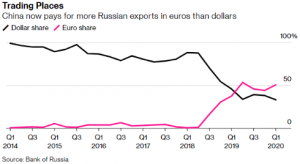
    The currency markets are seeing some interesting moves. Not long ago the Trump regime was all talk about building a wall to keep immigrants out. It turns out, thanks to a spectacularly bad management of the C19 pandemic, that the rest of the world now wants its own wall to curtail the cross-border travel of American citizens. As US infection rates over the past 3 months climbed to the 5 million mark it has been noteworthy to see the euro strengthen by 10% in the same period compared to the US dollar. More striking was this chart below from Bloomberg showing the Chinese now paying for more Russian exports in euros than in dollars.

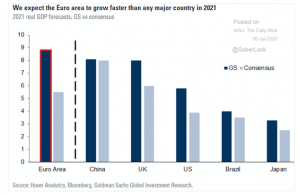
    The new-found enthusiasm for the euro might be a relative vote of confidence in a post-pandemic recovery. Goldman Sachs thinks the Eurozone economy will grow faster than any other major country next year. The next chart tells that story.

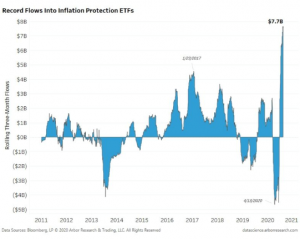
    Of course, growth stocks have dominated the headlines in 2020 as technology sector valuations have rocketed and clocked our first $2 trillion company, Apple. Cheaper, more traditional old economy stocks have struggled to perform for a decade. Europe, with a relatively small technology sector, has lagged too. But whisper it softly, old economy(value) and European stocks could benefit from the “i” which hasn’t really been seen since the iPhone arrived. We are seeing signs of investors protecting themselves from….. inflation. An early vaccine(I’m hearing lots about October) and $10 trillion worth of central bank pandemic pumping is a juicy inflation combo and might explain this chart of record buying levels in inflation protection instruments(ETFs):

    Time will tell on inflation but one thing is almost certain. The unwind of Chinese-US trade and internet connectivity is set to continue. TikTok might have 45 days to comply with Washington’s demands but investment capital can move even quicker. Like right now. The charts above suggest that capital is ready to sync with Europe. Cue Ms. Cooper, Netflix and the theme tune from ‘Curb Your Enthusiasm’ with footage from the White House bunker……

  • Is There A Sequel To The FAANTAM ‘Menace’ ………..?

    Is There A Sequel To The FAANTAM ‘Menace’ ………..?

    I can remember working in Tokyo when the grounds of the Japanese Imperial Palace had an implied valuation greater than the entire state of California. Fun times and fantasy didn’t last. Sadly, only Hollywood can deliver entertaining sequels for decades. Financial markets are thrilling investors right now but I’m beginning to wonder whether we are entering fantasy territory? Let’s revisit Japan and California again.

    The combined value of just three Californian companies – Apple, Alphabet(Google) and Facebook – plus Microsoft, up the road in Seattle, currently exceed the value of the entire $4.7 trillion Japanese economy. We didn’t even need to include the $1.5 trillion Amazon in that calculation but bear with us. Here are a few other fantastic data points driving current markets.

    • These same five companies have delivered 35% returns to investors year-to-date. The next 495 biggest stocks have declined by 5% in the same period.

    • The FAANG stocks – Facebook, Apple, Amazon, Google and Netflix – recently hit a new 22% high as a percentage of the value of the overall S&P 500 index.

    • The Wall Street Journal reported this week that 78% of the S&P 500 returns over the past 5 years came from the technology and e-commerce sectors.

    • Tesla is not even included in the S&P 500 because, up until this week’s quarterly results, it had failed to make profits for four consecutive quarters….ever. At its recent $300 billion valuation Tesla is the tenth biggest company in the world by value. That’s $100 billion more than Toyota which sold 10.6 million cars in 2019. I kept the ‘0.6’ in that figure because Tesla didn’t even reach that mark and probably won’t this year either.

    Clearly, this concentration of euphoria in such a small number of stocks causes some unease and resonates with veterans of the TMT fantasy party of 1999. Perhaps we have seen this movie before or this is the original ‘FAANTAM Menace’ like its Star Wars contemporary which had its first release, ironically enough, in 1999 too.

    The FAANTAM stocks – Facebook, Alphabet, Apple, Netflix, Tesla, Amazon and Microsoft – are my own $7 trillion(!) creation but I’m struggling to see how any sequel could thrill investors to the same extent. Right now investors are enjoying the possibilities of these companies dominating their respective global markets for years to come. They could be right but do not be too surprised to see potentially darker sequels. Here are two potential contenders for an eventual trilogy:

    Inflation Strikes Back: Yes, some inflation is a good thing. But too much inflation and things go horribly wrong quickly. Why? Equity markets might look a little stretched but debt markets are incredibly vulnerable if interest rates rise to counter inflation. The IIF estimates total global debt will reach $257 trillion in 2020 as central banks and governments reflate a pandemic crippled economy. Global equity markets, for perspective, are valued at around $90 trillion.

    Revenge of The Dragon: China is being battered on the political front at the moment. UK moves on Huawei, Australian C19 fury, US consulate closures, Indian military skirmishes and Hong Kong protests are pushing China further into an isolated corner. The back lash from China could be very painful given their critical positioning in global trade. All the FAANTAM valuations assume singular global trade and technology platforms. Clearly, a world divided into two different trade and technology ecosystems is not a friendly one for equity valuations.

    Unlike Hollywood, there will be no great appetite to view those sequels.