Tag: banking

  • Tales On Tour

    Tales On Tour

    Events dear boy. That was Harold Macmillan’s famous response to the query about what can cause government failure. Undoubtedly, there is significant truth attached to that guidance. However, we are currently in an era of unmatched clown-car incompetence, chronic short-termism and self-interest at the highest levels of political power. On Brexit’s 10th anniversary we are about to welcome the 7th occupant of 10 Downing Street since that embarrassing day. Who knew Ed Milliband’s scuppering of his brother David’s bid for leadership of the Labour Party would facilitate Brexit passivity and bonkers trade assumptions across the UK political spectrum? Meanwhile, the Russians are discovering Vladimir Putin is the worst military leader in Europe since Olaf the Hairy accidentally ordered 80,000 Viking helmets with the horns on the inside(thank you Blackadder). And, of course, how can we forget the failed casino, burger, vodka, sneaker, NFL, airline, crypto toddler himself….the Orange Emperor with no Hormuz close (!) babbling about reflection swamps in Washington.  Prepare for Algae-fa to be designated a single-celled terrorist organization. Despite that swampy distraction, it turns out that the Donald is going to go down in history as the worst-returning oil acquisition strategist after his Venezuela and Iran escapades (unless you have an insider trading account).  We seem to be receiving months’ worth of news in mere days so forgive me if I’m a bit event focused. But, I’m not the only one….let’s go on an events tour.

    Prediction markets are the hottest thing in the finance world right now. Regulators in the US decided companies like Kalshi and Polymarket were trading derivatives, rather than betting platforms for events from sports to elections to wars. Famously, a US Special Forces sergeant was arrested having placed a trade on Polymarket to win $400,000 on the probability of Maduro losing power in Venezuela….. just before he hopped on a Black Hawk chopper to abduct Maduro and his wife. Maduro isn’t the only one suffering right now. Sports betting companies like Paddy Power/Flutter, William Hill and Bet 365 are losing out to these new ‘events prediction’ players. Kalshi sports volumes are up 300% since the World Cup started and is now valued at $22 billion. For context, global leader Flutter/Paddy Power is currently valued at $17 billion slightly more than Polymarket’s $15 billion value underpinned by a recent $600m investment from the New York-based Intercontinental Exchange (ICE).  That’s a big bet but after a recent trip to the UK, I’m beginning to wonder about another event prediction…

    Macroeconomic strategists are currently analysing the impact of another economics-light Labour leader in Andy Burnham taking the PM reins in the UK. And lurking in the background is the crypto puppet, Nigel Farage, anticipating a general election win in a few years. At last, thanks to the excellent Sally Nugent on BBC, the ‘ordinary man’ mask is slipping off Nigel (the car crash interview is worth a watch) as are the Reform Party’s electoral hopes. However, Westminster intrigue could amount to a financial distraction. It was acutely apparent during the worst of the Iran war volatility that the UK’s sovereign debt/bonds did worse than most other major advanced economy financial assets. That’s a very worrying signal. It means the UK is considered a ‘vulnerable’ sovereign risk. So, here’s an event prediction not being discussed in the UK financial or political press right now. My personal view is that the UK’s 8th political leader (after Burnham) will be the IMF/Troika who will have to impose financial sanity on the nation. Just saying, but there’s a huge amount of evidence that the UK has failed to do very much over the last 3 decades…

    In recent weeks, both on a recent IMI panel in Dublin and at a business lunch in London, the theme of under-investment was raised as a huge factor in UK decline. It is striking that the UK has quietly lagged at the bottom of the G7 rankings by corporate spending in 24 of the last 30 years. UK investment averaged 23.7% of GDP between 1970 and 1990. But, after that it fell by a quarter, to an annual average of just 17.9%. In contrast, other major OECD economies have, on average, kept their investment levels above 20% of GDP. Back in 2024, I also had highlighted this shocking lack of long-term planning:


    “The Institute for Public Policy Research estimates the under-investment in business at $500 billion less than what other comparable OECD countries have invested since 2005. Public sector investment (infrastructure) was a further $200 billon below the G7 average. All in, this chronic lack of investment places the UK 27th out of 30 OECD countries.” 


    Thatcherism might need to be reviewed. At least, the English football team is in better shape these days. In fact, sport is on my mind too.

    Closer to home, the return of world-class tennis to Ireland at the Dublin ATP Challenger Tour event at Elm Park opened eyes up to the possibilities of showcasing memorable sporting experiences. There is a reason why sports franchises, festival events, city-break tourism and concert tickets continue to smash valuation records. The experiential industry plays to scarcity, living in the moment and shared memories. Check out the acceleration of NBA franchise valuations from 2020 to 2025. Utah Jazz was acquired for a record $1.66 billion in 2020, but in 2025 the LA Lakers were bought for a new record franchise value of $10 billion. That’s a 6x shift in asset values. So, just as Big Tech companies have become bigger than sovereign states (and borders), it feels like sport will be a border-less global platform. Indeed, the recent reports about an ice hockey franchise coming to a Dublin home (in Cherrywood) and a brand new stadium could be flagging some very interesting long-term thinking? Follow that puck, and reach for the stars….literally.

    One can marvel or guffaw at SpaceX’s peak post-IPO valuation near $3 trillion, but there are big lessons for Europe. Global business in many communications and technology sectors is dominated by quasi-monopolies. That global monopolistic ‘north star’ for start-up founders in the US seems to be a cultural differentiator. Apple, Amazon, Google, Microsoft, Netflix, Nvidia and Meta dominate their sub-sectors and have benefitted from the massive depth of US capital markets prepared to back global domination. We should, of course, celebrate the recent $3.6 billion exit by the founders of Fin/Intercom. But, at a strategic level, Europe needs to mobilize all its financial innovation and resources to plot the building of trillion dollar global champions over the coming years. So, on a positive note for both Europe and the UK, I’m looking at one huge sector still fragmented and missing the economies of scale which digital dominance can deliver. I’m thinking banking where London is still a major financial centre combining centuries of financial experience, stable common law, a concentration of necessary skillsets and….rapid  innovation.

    The UK is the second biggest fintech hub on the planet behind only the United States. In 2025 UK fintechs raised $3.6 billion across 534 separate deals, more deals than the next five European countries combined. Also, London is home to Revolut, now worth around $75 billion and  the most valuable private tech company in Europe. In fact, 8 of the top 10 fintechs in Europe come from the UK. It’s entirely possible London will produce Europe’s first trillion dollar financial services company. Ironically, with my monopoly/north star thinking cap on, the much-maligned fragmentation of Europe’s banking market could help the growth of a new trillion dollar financial franchise. Currently, Europe is home to over 9,000 banking entities. That’s not sustainable, but we might have to wait for events dear boy.


  • Are We Ready For Another Banking B-AI-L Out?

    Are We Ready For Another Banking B-AI-L Out?

    Domestic business and investing titan, Dermot Desmond, upset the orthodoxy this week. Ireland’s 500-year plan to build the Metrolink might be cut short, even ended. Desmond suggested the €12 billion urban rail project due to start in 2028 could be a white elephant project superseded by AI and autonomous-driving vehicles. Any bets on the kilometres per annum build speed on this 18 kilometre ‘monster’? Actually, don’t bother. Reflect on China’s average motor expressway construction build of circa 8,000 kilometres per year. Then think about the UK adding barely 65 miles of motorway over the past ….decade. Given the Irish public service obsession with tracking the UK National Health Service or UK Housing/Planning as benchmarks, one shudders to think what our ‘ambition’ could deliver in over-spend and century-shifting deadlines. On a more positive note, AI could be one of the tools which could dig us out of our transport infrastructure black hole.  A bit early to call that one you might say, but I’m beginning to think another crucial economic sector which gets its fair share of criticism is enjoying the halo AI effect. Don’t bank on it but the banking sector is suddenly looking interesting….

    The ”animal spirits” of Wall Street and record financial market highs always help the banking sector. Indeed Wall Street’s banks have just finished reporting quarterly results where trading revenues clocked a whopping $34 billion in Q2, up 17% on the previous year. Yes, the phenomenal gains in AI-focused stocks like Nvidia and Microsoft inflate bank trading revenues and drive increased investment activity but there’s more going on. You might have read about meme-stocks and unheard of companies in the US smaller cap markets (Russell 3000) tripling their share prices since April; 33 companies at the last count and only 5 actually making profits. But, banks as meme-stocks? Really? Well check out the Financial Times headline this week:

    “European banks get their meme-stock moment”

    Not even US banks, but European ones tracking an economic bloc getting its tummy tickled on tariffs by the Fiddler on The Roof of the White House. Can’t wait for the South Park treatment on that one, but back to the FT and European banks. When French banks like Societe Generale see their share prices increase by more than 100% year-to-date then my “spidey sense” tells me this is not about mundane cyclical banking drivers like trading revenues, interest rates or the shape of the bond yield curve. The aggregate European bank sector is up a whopping 40% in 2025 and there could be an (infra)structural driver of this story. Think back to our earlier sniping about Ireland’s struggles on transport infrastructure. Banks have struggled with unwieldy data and service infrastructures which have been a nightmare to upgrade to modern customer expectations. As we have written many times on these pages, the banks sit on some of the richest consumer data on the planet. Critical information on individual and institutional funding, spending and income patterns are in the possession of the banks. What if that data could be mobilised in a far more efficient way using AI and its agentic tools? Like Dermot Desmond’s thinking, could AI allow banks to skip an infrastructure bottleneck? It is early days but let’s take a look at a company you’ve probably never heard about before.

    Palantir Technologies might be named after a Tolkien crystal ball but it looks like its future might be right now, thanks to AI. The Denver-based company has been around since 2003 and specializes in software to analyze or “mine” data. Its early customers were government departments seeking assistance with unwieldy datasets and looking for actionable information. In particular, it gained traction with security/police departments searching for surveillance and predictive intelligence solutions. Sound familiar, or creepy? Park that thought and think banking. Then consider Palantir only just hit quarterly revenue run rates of $1 billion in its most recent results. However, that was enough to make it one of the 20 most valuable companies in America. Stock market investors think it’s worth $440 billion which is bigger than the mighty healthcare player, Johnson & Johnson (J&J) and its 138,000 employees. Yes, if you were wondering if the valuation of Palantir was looking a bit punchy, you’d be correct. Annualized revenues of just over $4 billion (vs J&J’s $85 billion) means the Palantir valuation multiple is currently 110x current revenues. The excitement and valuation is driven by two recurring messages whenever Palantir is mentioned:


    1. AI is accelerating the monetization of data infrastructure
    2. AI is reshaping enterprise software and Palantir is uniquely positioned


    Palantir is expanding beyond government into commercial sectors like healthcare, finance and energy. The first thing that should strike readers about government and these three specific sectors is that they have enormous customer/user bases. This is the banking sector clue, and possibly its infrastructure B-AI-L out. AI will very likely remove the need for “transition” projects to upgrade data infrastructure and provide banking organizations with valuable action prompts which might even be carried out by AI-agents/bots. That’s a business model ‘Hail Mary’ for the bank sector and Wall Street’s banking analysts are doing something unusual too.

    Typically, bank analysts stick close together and move their recommendations in tandem with their competitor analysts at the other investment banks. Remember, “nobody gets fired if we are all wrong” is an established career strategy for the average analyst. This also means that share price targets set by analysts move in relatively small increments so as not to spook the herd or attract excessive attention to their analysis or models (usually flawed as with all human forecasting exercises). So, I was checking a few market analytics dashboards today and spotted the following:

    KeyBanc target price moved UP from $60 to $100

    RBC Capital  target price moved UP from $63 to $97

    Raymond James target price moved UP from $79 to $95

    Believe me, 25%-65% banking share price target upgrades are not the done thing on Wall Street when TACO Trumpolini is threatening the Chairman of the Federal Reserve Bank on interest rate policy.  So, this is yet another sector to add to your list where the two letter response to any share price move query can be “AI”. However, at a structural level, you don’t need a Tolkien crystal ball to know that technology can transform the commercial prospects of a country or sector saddled with a perceived long-term ‘challenge’. I’m old enough to remember the gloomsters telling us Ireland was destined to perpetual under-development because we had no energy resources and could never compete in manufacturing/building things. Who knew? Maybe, the leaders who finally gave up on Ford in 1984 after welcoming and watching Apple begin manufacturing in Cork in 1980…..


  • Watch Out For The New Stable Empire Build

    Watch Out For The New Stable Empire Build

    Stability wouldn’t be the word of the week. Middle East war, Indian air crash tragedy, horrific school shooting in Graz, the US Marine Corp deployed in Los Angeles and the death of America’s Mozart, Brian Wilson. But… the ground-breaking Beach Boy might also SMILE**. Tortured by mental health challenges for most of his life, his genius is rightly being recognised at a rather weird moment. Thousands of miles away from the Californian beaches which inspired a true genius, a delusional “stable genius” is marking his birthday with a military parade in Washington. The irony indeed of a wannabe emperor, without clothes or genius. However, the sharper minds out there have been busy building another type of empire….Here’s a few timely illustrations.

    Stripe kicked off the week with the $1 billion acquisition of Privy. This is Stripe’s second billion dollar acquisition in less than six months (Bridge $1.1 billion in February) in the area of stablecoins. As a quick refresher, stablecoins are digital currencies (crypto) built on blockchain technology whose value are fixed to the value of a recognized liquid security or currency. In the vast majority of cases the “stable” part of a stablecoin is the world’s chosen reserve currency, the US dollar. This means that these stablecoins can be instantly exchanged for US dollars, in most cases, at a 1:1 ratio (FX rate). However, I only use the “FX rate” terminology to assist understanding because stablecoins operate differently, and have one massive potential advantage over typical foreign exchange (FX) rates. They cut out all the intermediaries’ costs and “toll takers” that drive us all to distraction at airports when it feels like a robbery rather than a financial service has taken place. This digital capacity to cut out costs and deliver ‘frictionless’ currency services has been identified by Stripe as an enormous opportunity to “grow the GDP of the internet”, namely e-commerce. Two deals in 6 months demonstrate that strategic appetite.

    Stripe, as a global leader payments platform, bought Bridge specifically as a platform for payments in stablecoins. Bridge provides the payments infrastructure for financial services companies to issue stablecoin-linked Visa cards. So, that covers the payments bit but Stripe has moved further into stablecoin infrastructure with its Privy acquisition. As Stripe CEO, Patrick Collison put it, “Money has to reside somewhere, and Privy builds the world’s best programmable vaults. Alongside our other stablecoin work, we’re looking forward to enabling a new generation of global, internet-native financial services.” In relatively simple terms, Stripe has acquired the ability to handle stablecoin payments AND the digital wallets (vaults) needed to store those digital currencies. Note, this is not some futuristic ‘bet’. This is a very current service. Indeed, Mastercard reckon one third of Latin American consumers have already used stablecoins for purchases. And, it’s not just “Main Street” embracing stablecoins. Wall Street is buzzing this week.

    The IPO of Circle on the NYSE was 25x over-subscribed before it even began trading last week. Circle is the issuer of probably the safest and most transparent stablecoins, USDC, which is pegged 1:1 with the US dollar. By the end of its first week of trading, Circle’s share price had rocketed 378% above the IPO price to reach a valuation of $32 billion. Clearly, Wall Street’s frenzied embrace of digital currencies, wallets, payments etc could spell trouble for the traditional custodians of currency storage and movement, the banks. They are moving too.

    French banking giant, Societe Generale, announced this week plans to launch a publicly tradable dollar-backed stablecoin. Societe Generale is the first major bank to enter the stablecoin market and has named its new digital currency “USD CoinVertible”. Meanwhile, in the US, Congress is poised to pass legislation to create a regulatory framework for stablecoins. Bank of America could launch a stablecoin, its CEO said earlier this year, and some other large banks are also considering issuing a joint stablecoin. The banks won’t be alone.

    The world’s two biggest retailers, Amazon and Walmart, are looking into issuing their own stablecoins for US customers to use at checkout instead of credit or debit cards, the Wall Street Journal reported yesterday. The WSJ article suggested other big companies, including Expedia and some airlines, are also considering the move. The motive is simple and relates to my earlier explainer. Costs. Stablecoins are hugely attractive digital innovations to process payments quickly and potentially save corporations billions of dollars in swipe fees that they pay every year to credit card companies, banks, and fintech startups like Toast and Square. Businesses forked out over $172 billion in US transaction fees in 2023, a near 50% increase from before the pandemic, as more customers went contactless. Even Washington is taking notice, and is moving legislation with, again, a teeny weeny bit of irony….

    The US Congress is due to vote on a bill known as the GENIUS Act (the other crypto legislation due is the STABLE Act, I kid you not)  which would give private companies a blueprint for issuing their own stablecoins. That vote could be as soon as Monday, and rely on a body politic flushed with the narcissistic joy of watching a military parade on the streets of Washington DC – an exercise once the autocratic preserve of the Kremlin, Beijing or Pyongyang. It’s a strange new world, but there is still real genius and opportunity out there.  Watch that stablecoin empire build….


    **Brian Wilson and the Beach Boys began recording their album, Smile, in 1966. Brian was convinced it would be his masterpiece. Struggles with mental health intervened, and delayed the release of the album until almost 40 years later. TIME magazine described its ultimate arrival as “rapturously received” and ranked it as one of the ten best comeback albums of all time.


  • Betting On Small Can Really Win

    Betting On Small Can Really Win

    Please, no political bets. The headline is absolutely not referring to the UK Prime Miniature. The 14-year Conservative Party mission to shrink public services, business investment, critical trading relationships, institutional integrity and individual standards of public behaviour is ending in electoral wipe-out. Time for new beginnings, even small ones. As I read about UK ‘global leadership’ (with China) in a potential 9,000 millionaires leaving the country before the end of this year, I’m thinking more about generational change and down-sizing shifts in wealth creation strategies. That might seem strange in a world of mega-trillion tech companies but wealth works across different types of assets and for different generations. First a couple of size observations.

    An interesting chart this week from Private Equity/VC research data house, Pitchbook, showed smaller private equity(PE) funds outperformed bigger ones over a 10-year time horizon. In the best performing quartile of funds the performance gap was a whopping 6.7%. In real money terms, the returns of small funds were one third higher than the bigger funds. Here’s the chart:


    Clearly, the challenge of earning high returns with massive pools of money runs into the problem of a smaller opportunity set. In other words, big funds can only deploy capital in bigger companies and miss out on opportunities with smaller (probably faster growing) companies. However, funds as they become bigger can also suffer from strategy “drift” as pressure to deploy capital forces funds into other sectors, geographies, vintages, styles etc. As a classic illustration of this challenge, look no further than the ARKK innovation fund managed by Cathie Wood. Back in 2021, a big winning bet on Tesla and other innovative companies by the ARKK fund attracted billions of investor dollars. However, since then, the fund has cratered in value by 59% while the funds which track the Nasdaq tech index are up 37%. Big can sometimes be painful. Of course, new strategies can help diversify risk for investors and five headlines caught my eye this week:


    Blackrock Muscles Into Private Assets Market For Wealth ClientsBloomberg

    Andreessen Horowitz plans to launch a private equity fund  –  Fortune

    Carlyle and KKR beat rivals to win $10bn Discover Financial loan portfolio – Financial Times

    Private Credit Is Trouncing Private Equity So Far This Year – Wall Street Journal

    Watford FC Sells Digital Equity Tokens – Techopedia


    So, the giant manager of publicly listed assets is looking for private assets, the venture capital giant wants private equity, the private equity monsters are going for better returns in private credit (loans) and Elton John’s former club is looking for digital equity. Got all that? Probably not, but, if we think about Elton and the music business 20 years ago then you’re witnessing a similar generational shift in investment/wealth products. Investors, as individuals or as families, are increasingly looking to invest in private assets, not just publicly listed companies or funds. There is also an additional trend we should be watching. Private investors are now organising themselves in syndicates or family office structures and the latter segment is sitting on enormous pools of wealth. Try these for size:


    *Family offices currently manage circa $10 trillion of investments. Compare that to the higher profile hedge fund industry which manages $6.5 trillion.


    *There are currently 15,000 family offices operating and actively investing globally.


    *Now, for the banger. In the next 20 years there will be a seismic transfer of wealth from “Baby Boomers” to the next generation. Current estimates of this generational wealth transfer exceed $80 trillion.


    So, this investor base of family offices will have new principals and new ‘purpose’. Apart from asset growth , tax structuring, succession planning and philanthropy, it is increasingly likely these investors will be ‘values driven’, and possibly less interested in the buy-and-sell 5-year cycles of private equity and venture capital funds. In this writer’s view, a massive pool of patient purposeful capital is poised to disrupt the traditional way companies are funded. And, for smaller companies and smaller investors this should be considered a win without any need for Gambling Commission scrutiny…..

  • Risk Warning: Trust, But Verify…..

    Risk Warning: Trust, But Verify…..

    On the fifth check of my passport at Paris’s Orly airport I did wonder. Will trust die before our planet dies? Both are under severe threat and, yet, I’m hopeful. Let’s take a look at three particular examples of widely-held mistrust where recent developments might challenge the negativity. First, some history. Ronald Reagan’s signature phrase in nuclear disarmament talks with the Soviet Union was derived, ironically, from an old rhyming Russian proverb: Trust, but verify. Of course, it was tough to trust the Kremlin but technology, in the form of satellite imagery, was the critical verification tool. These days it’s technology which is not trusted but could also be the solution.

    We have previously written about global payments processing as possibly the biggest ‘network’ yet to platform and join social media and cloud computing in the multi-trillion dollar wealth creation club. However, the payments opportunity starts with technology mistrust. Bitcoin is flying high but the cryptocurrency ecosystem is still widely mistrusted by consumers, governments and regulatory authorities. Stripe famously ceased processing Bitcoin payments on its platform back in 2018. Now, it’s all change. Stripe is bringing back crypto payments, this time with a stablecoin. The USDC stablecoin to be accepted by the platform will be pegged to the US dollar ie it tracks the US dollar value. More critically, the technology which underpins the security and verification of these currency assets is blockchain. On so many levels this is a huge verification moment for digital currencies and the software blocks used to build them. Now, for some more building…..

    The 2022 CHIPS and Science Act was a Biden administration attempt to reinvigorate the US manufacturing base by attracting huge factory construction projects. Scepticism was rife, given the Trump toddler promised ‘infrastructure week’ every week but never delivered. Well, let’s verify. First, the US government has paid out more than half its ear-marked $39 billion of incentives to companies planning to invest in manufacturing facilities. The corporate follow-through has been extraordinary – microchip manufacturers and their suppliers have announced $327 billion of investments over the next 10 years. Micron alone is planning a $100 billion project in Syracuse, NY. That’s a nationwide 15x leap in construction spend on these type of facilities and will capture 20% of the global chip manufacturing market by 2030. Currently, that number is zero. But what about our planet and other targets with Zero (Net)?

    Let’s face it, the push back on global sustainability and ESG targets is worrying. We often write that money talks and the following headlines paint a picture of worrying reversal:


    Flows to European ESG exchange traded funds halve in first quarter –  Financial Times


    US Fund Managers With ESG Mandates Have Worst-Ever OutflowsBloomberg


    Clearly, this is not good news. However, we should be careful not to equate fund flows with commitment to climate change targets. For example, the banking sector in recent decades could be described as the ultimate counterparty requiring ‘trust, but verify’ checks on their behaviours and risk management. So, with the global financial crisis barely 15 years in the rear-view mirror, how did genuine ESG investors feel about this week’s staggering headline?


    Western banks in Russia paid $800m in taxes to Kremlin last year –  Financial Times


    Yep, that was the tax bit. The profits according to the FT were over $3 billion. Trust, but verify indeed……ESG investors can rightly ask how are those “S” and “G” policies going in these shame-free and profit-full banks? Answers on a post card to Kyiv please.  Before we all blow a complete gasket, let’s finish with some more wind but a bit more climate positivity. And, no, it’s not a Trump legal challenge. But it could ultimately rhyme by starting badly, and then ending with a positive reality check.

    First, the severity of the storms and tornados sweeping through the Midwest heartland of the US this week are truly frightening. However, there’s a bigger financial storm brewing further south. An excellent article in The Lever this week highlighted the plight of Louisiana homeowners struggling to insure their houses while 12 insurance companies have failed, and 12 others have left the state. Almost one in five Louisiana residents lost their homeowner insurance last year. The crisis is climate caused. Global insurance giant, Swiss Re, in a recent report stated that natural disasters now cost the United States $97 billion a year.

    In Florida, the climate denial Governor, Ron De Santis, might be kissing the Trump ring again but home insurance rates jumped 42% last year and coverage from big players, AAA and Farmers Insurance, has been pulled from the market before hurricane season. Unsurprisingly, Florida for-sale housing inventory has jumped 57% in 12 months. Leaders in denial-mode face a wave of voters, mortgage banks, pension funds and Wall Street analysts giving them the ultimate verification check on climate crisis. The critical shift is that investment capital has checked, and is already fleeing.

    Trust me, that seismic capital flight will force leadership change and action. Verification…..pending.

  • Banking on Digital Destruction?

    Banking on Digital Destruction?

    Crikey, that was an awful dose of George (g)Lee on the radio this morning. The intrepid RTE correspondent for Science is building quite the reputation for gleeful gloom. Yes, the pandemic data is stubbornly flatlining but to opine that the critical R-rate “must be over 1.0” ventures into emotional bias territory rather than the realm of science and analysis. Perhaps he will be right but the more immediate benefit of George’s latest BULLetin was to prompt some self-reflection. Do I exhibit similar emotional bias in certain areas? I often wonder if I am too gloomy on the prospects of the banking industry so this might be a good week to introduce some balance. And, it has been a good week for banks.

    Banking is about the provision of debt capital – more on that later – but it was other areas of the capital markets where the good news was to be found. Thanks to positive vaccine news bank share prices have been on a tear. AIB’s share price has rocketed up over 50% in the last 8 weeks. However, that 8 week period referenced hints at more than just vaccine relief. Whisper it quietly but inflation or reflation is working its way into market forecasts and that helps the banks.

    It also helps when there is a general rotation into VALUE stocks which is typical when investor confidence in economic growth picks up rapidly. Investors have not been too picky and a basic trading strategy of buying the most depressed share prices has worked very well. Oil and banking shares are very much in that depressed cohort and are enjoying much needed buying activity. Like George, investors could be correct but such affirmation could depend on one’s time horizon. You have read about a “Great Rotation” out of the pandemic stars in technology and healthcare. The less polite might refer to the investor switch as a “flight to sh*te”. Both descriptions tend to suggest investor enthusiasm is brief and lacking any real fundamental conviction. However, there is market activity elsewhere which illustrates greater conviction.

    Spanish banking giant, BBVA, has just announced the sale of its US franchise to the top 5 US player, PNC. The American purchaser is making an interesting strategic move and the value of the deal at $11.6 billion is the largest banking transaction since Lehmans collapsed. Particularly striking is that PNC have funded the deal with the sale of their stake in fund management behemoth, Blackrock. Please note strategic shifts out of fund management into traditional banking are as rare as evidence of fraudulent voting in the US these days. Other merger activity is happening in Spain with Bankia/Caixa and BBVA/Sabadell tie-ups plus the intriguing rumours of a monster Swiss deal between UBS and Credit Suisse. These are not short-term ‘rotations’ or trades. They are big long-term management calls which require confidence. However, they could also be described as “defensive” moves and news closer to home does trigger a bit of George in me.

    Ulster Bank’s Dublin HQ not only sits on George’s Quay but could in a matter of years be empty. Ulster’s parent, Nat West, has acknowledged the future of the bank is “under review”. One of the less desired options is that the bank is put in run-off mode if it fails to attract a buyer for its Irish operations. Just to remind readers, run-off is the modus operandi of a “bad bank” like the IBRC successor to the Anglo-Irish casino. What is remarkable is that Ulster Bank is not a bad bank and currently sits on €22 billion of deposits and a loan book of more than €20 billion. I have read wise commentators elsewhere describe this as the biggest banking news in Europe for years. In effect, it is a bank deciding its traditional banking business model is capital destructive ie its cost of capital exceeds its returns on that capital. You do wonder what was the straw that broke the camel’s back?

    Banking is tough these days. Even tougher with a pandemic setting your loan book on fire but that’s a cyclical/one-off(?) challenge. The triple whammy of structural challenges from ultra-low interest rates, soaring regulatory costs and technology catch-up/competition are well documented and long-term. This writer’s personal view is that technology is the big one, the asteroid. These banking beasts are manifestly ill-equipped to develop technologies and compete with digital platforms unburdened by legacy businesses and IT infrastructure.
    The truth is that, even if the banks catch up on current technologies, the pace of change is too hot and remains a potential extinction event if capital is exhausted to merely survive the first hit. First, you ask? Well, we are not great as a species on the forecasting front but it might be worth noting the words of Bank Of England’s chief economist, Andy Haldane, this week. Whether you are looking for an Ulster Bank final straw or straws in the wind, the Bank of England has floated the prospect of ditching cash and replacing it with a digital currency. Haldane sees it as a necessary tool to facilitate negative interest rates; and feasible thanks to the emergence of blockchain technologies and cryptocurrencies.

    So, no surprise to see Bitcoin’s price roar past $18,000 this week , a three year high. Joy for crypto traders but no such glee for bank executives still pouring billions into digital transition projects. Imagine throwing a digital currency into the technology mix!! Now, what are the chances Nat West’s management got wind of Bank of England thinking and moved into extreme defence mode? We just don’t know… which is what we wish George would say more often.

  • Winning In A Crisis

    Yes, the headlines are scary. And, of course, some commentators are making 2008 comparisons but all this “noise” will pass and those companies who seize opportunities during this Covid-19 crisis will win big time. History is a rather good guide. When the TMT bubble imploded it was Amazon and Google who hoovered up lots of talent fleeing weaker business models. More importantly, this talent was acquired at a less bubbly price.

    When the credit crisis (GFC) hit in 2008 the US banking system wobbled and many famous institutions went to the wall. However, in the aftermath of the GFC, the major US banks aggressively wrote down bad loans and restructured their business models and invested in technology. In contrast, the European banks failed to act in any significant way to address their obvious vulnerabilities and that is the lesson for today.

    The big US banks are now the most robust and profitable financial institutions on the planet. Meanwhile, European banks are teetering on the brink of another financial crisis as the fragile Italian banking system stares down the barrel of a Covid-19 economic shock. The strategic lesson is clear. A crisis can provide opportunities to future proof a franchise. In more pragmatic terms, expectations on profits for 2020 are softening along with share prices which provides useful cover for some very wise investment. Bold strategic action is likely to be rewarded and we can think of a few obvious areas:

    • Digital Transition: In a low inflation world there are many sectors where pricing is under pressure. The winning franchises will be those who successfully excel on two fronts. First cost bases need to be best-in-class which necessitates smart technology and faster cheaper solutions. Second, technology can drive sales with superior marketing, customer engagement, execution, finance interfaces and customer retention. Many of these technology solutions are now residing in “the cloud” and it was fascinating to see leading Irish cloud transition services player, Version1, make its 11th acquisition this week with the purchase of another Irish digital star, Singlepoint. This type of corporate activity/confidence gives you a clue about the pipeline of digital transition work coming down the tracks.
    • ESG: Climate change is the hot topic but that’s only the “E” in ESG. We have repeatedly stated that corporate health is wealth. Environmental, Social and Governance criteria are now being monitored by investors managing over $30 trillion of funds. Many companies will try to “greenwash” this emerging trend by paying lip service to ESG frameworks but this will end up being a costly lack of action. McKinsey in a recent report made it very clear that funding costs, operational costs, regulatory/safety fines, personnel productivity/retention and cash flow are real risks that will ultimately diminish the value of a franchise. As an illustration, banks are now beginning to peg lending rates to a corporate’s ESG rating.
    • Automation & Talent: Imminent research from Loughborough University is about to reveal that the UK is facing the biggest slowdown in productivity in 250 years. Amazingly, Brexit is not the key culprit. In fact, all developed economies have particularly struggled on the productivity front since the GFC crisis. The reasons are complex but the good news is that automation offers huge productivity opportunities for both employees and companies. The implementation of robotic process automation(RPA) is poised to accelerate dramatically and take a huge number of repetitive, low-value manual tasks off employee to-do lists. The powering of employees using AI and RPA will enable them to focus on higher-value activities and enhance creativity. One can expect that companies who fail to embrace automation will struggle to keep quality employees and, more importantly, customers wary of franchises with high staffing turnover and outdated clunky business processes.

    All of the above actions require investment and management focus. The companies which seize the opportunity to strengthen their business models in the increasing likelihood of a challenging 2020 can gain a very valuable head start on distracted competitors. Just think, Yahoo celebrated its 25th anniversary this week. It is safe to say most of the business world didn’t really notice. The choice for companies is simple; DO or YAHOO.

  • Banking Facing The Digital Music

    As I flicked through the quarterly results of JP Morgan and Citigroup this week I was reminded that in some ways the whole future of the financial system lies in my brother’s hands. He currently works for another monster bank and there’s a part of me which hopes he will leave banking for all our sakes. Perhaps I’m over-egging this career wish but the previous four banks for which my grim reaper-relative worked all went bust. The world can’t afford a sudden megabank failure. The good news, for now, is that things in the near term big banking world are pretty strong.

    Despite some gloomy predictions for the future of banking, JP Morgan just posted the most profitable year in the history of US banking. This makes it increasingly likely the record total $111 billion profits made by the big 6 US banks in 2018 will be beaten in the next few weeks as 2019 joins the reporting history books. Regular readers are certainly familiar with the challenges to traditional banks posed by technology transitions and even Big Tech competition.  However, it is still possible banks will not disappear but rather change their interface with customers.

    We recently wrote in our article “Are You Ready For Change?” that finance would probably become “a feature” of most products and services but would no longer be accessed as a standalone access point:

    “If we recall the pre-Amazon era, consumer spend and logistics were separate activities. Now, delivery is a feature of consumer spend from Christmas trees to sushi. In the world of finance, it is quite likely payments and financial services will be embedded features of other services rather than standalone banking. Prepare for “location” banking to die.”

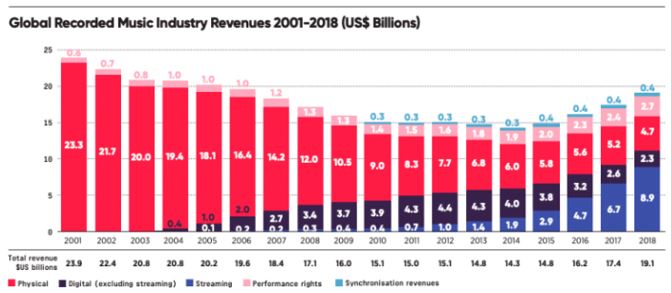
    This prompted some thought as to whether there were any analogous experiences in another industry. Well, it has become mainstream thinking these days that banking is facing a technological music with which it might struggle for relevancy. So, let’s look at the music industry. As recently as 2014 the death knell of the industry was sounded with global recorded music revenues collapsing by 25% from $19.6 billion to $14.3 billion since 2006.

    The revenues from physical music alone in 2006 were worth $16.4 billion. The doomsdayers were correct. Physical music revenues have fallen a further 75% but there was no such thing as “streaming” back in 2006. Now, music streaming revenues account for more than 50% of global music revenues. Here’s the comeback graphic:

    Graphic showing the global recorded music industry revenues 2001-2018 (US) Spark Crowdfunding blog

    So let’s hold that “streaming” thought for the banking industry. It is entirely possible there will be new channels for banks to deliver core services. We should be watching activity in the “plumbing” of financial services for clues to the future. Interestingly, this week we witnessed a very big fintech deal with Visa Inc agreeing to purchase fintech start-up Plaid for…. $5.3 billion.

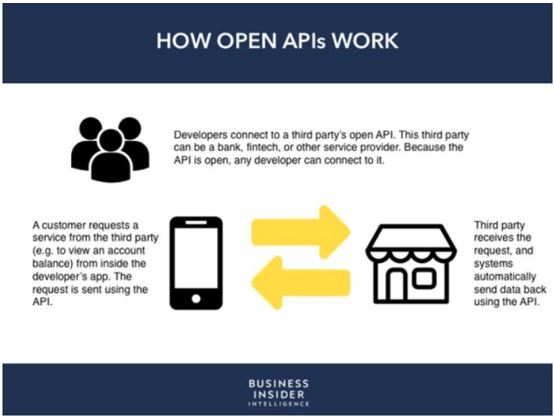
    For perspective, Plaid raised $250m in a Series C funding round barely more than a year ago at a $2.65 billion valuation. Plaid is a “plumbing” or “streaming” play as it allows consumers to connect their bank accounts to various 3rd party services from wealth manager robo-advisors to insurance. The technology which allows this connectivity is Application Programming Interfaces, or APIs. The following graphic shows how APIs work:

    How Open APIs work Spark Crowdfunding blog

    Clearly, Visa Inc sees the value of owning the plumbing which is connecting the latest fintech to traditional bank accounts. Note this deal does not preview a world where bank accounts disappear. Perhaps current thinking is too negative on the future of banking?  Music could be the inspiration, and ironically music featured in our last banking crisis. It was a rather unfortunate quote from a Citigroup CEO in 2007 who insisted “as long as the music (liquidity) is playing, you’ve got to get up and dance”. Well, the music stopped too quickly for Chuck Prince and many other failed banks.

    Technology is the current gloomy soundtrack for banking but “streaming” and APIs provide potential recovery and a future. Now, all we have to do to ensure planetary financial survival is persuade my brother to take up the guitar full time…..