Tag: Blockchain

  • More Blue Sky Than Blue Monday

    More Blue Sky Than Blue Monday

    Apparently, the Monday of this week is the worst every year for negative thought. Furthermore, the new UK Foreign Secretary, Lord Cameron, fresh from launching war in the Red Sea, told us in a weekend TV interview that “the lights are absolutely flashing red” on the global risk dashboard. Excellent. Well, that’s settled then – I mean Lord “Call Me Dave” gets all the big calls right doesn’t he? Ok, let’s not invite the rest of the world to turn the air blue. In fact, let’s do what should have been done in 2016 and pay attention to what’s really happening in the world right now. Not surprisingly for this writer, January is already confirming themes established and developing from earlier years and we are more than happy to keep screaming about them until we are blue. So, here we go with a little whistle-stop tour of the real world….

    We truly believe the ‘convergence’ of various technologies is about to turbo-charge the acceleration of change in the global economy. An existential crisis also helps focus minds and….. money. The climate change crisis has prompted the greatest capital shift in history as $6 trillion of annual spending on cleantech is forecast every year until 2050 (Source: McKinsey). Indeed, one of the key investment destinations in moving away from fossil fuels has been electric vehicles(EVs), and the batteries used to store energy and power these vehicles. Chemistry advances have been key in driving costs down and capacity up where lithium-ion type batteries are the predominant storage technology. However, artificial intelligence(AI), probably the hottest investment theme outside cleantech right now, has just been used in conjunction with supercomputing to discover a brand new material which could reduce lithium usage by up to 70%.

    Yep, Microsoft and Pacific Northwest National Laboratory (PNNL) research teams whittled down 32 million potential material combinations to 18 promising molecular structures within a week. Incredibly, the whole discovery project took 9 months in a screening process that would typically have taken more than 20 years using traditional lab research methods. The new AI-derived material, simply called N2116, should prompt thought as to what’s possible in the world of medicine, agriculture, transport and construction,  but also counter an unhealthy commentariat focus on AI ‘safetyism”. The social and economic basics of health, shelter, mobility and food are in dire need of blue sky thinking but might just have found a genuine innovation accelerator. Microsoft themselves have told the BBC that one of the company’s missions was “to compress 250 years of scientific discovery into the next 25.” Thankfully, this was not the only positive solution speed surprise of recent weeks.

    The IEA has confirmed that renewable energy capacity increased globally by 50% in 2023 alone(!). That’s the biggest growth seen in more than two decades. At that pace, it is conceivable renewable energy could be 50% of electricity generation by 2030 and, brace yourselves… would actually meet the renewables ‘tripling’ target agreed at Cop 28. Germany – not getting great economic press in recent times – is already at the 50% renewable electricity production level with CO2 emissions currently at a 70-year low. Furthermore, coal usage at a 60-year low in Germany makes for clearer skies but the gloomy headlines could have obscured another Teutonic trophy win.  The EU has given the go-ahead for Germany to provide €902 million of state aid to battery producer, Northvolt, for the construction of a gigafactory producing EV batteries. Without that aid, Northvolt would have probably moved the project to the US. Instead, the €2.5 billion project at Heide will be the first to avail of the new ‘matching aid’ exception allowed by the EU to support more flexible/higher amounts of state aid to prevent an investment exodus to the US.  Expect more good European news on this front as the region is forecast to build a further 250 battery factories by 2033 (Source: Buck Consultants). These are real actions and projects (not headlines) but companies are also showing confidence with more traditional strategic moves.

    We perennially write “watch what they do, not what they say” and the big “tell” is often M&A activity. Given acquiring other companies results in wealth destruction almost 50% of the time, we tend to see a flurry of M&A activity as a positive illustration of executive confidence and found the headlines of recent weeks interesting.  You might think the announced $14 billion purchase of Juniper Networks by HP was just another example of the technology sector enjoying the benefits(and valuation multiples) of a stellar 2023 but back in the ‘old economy’ things are stirring too. And, if M&A was tricky enough why not try to acquire a national icon, as a foreign company? Cue the Japanese execs at Nippon Steel have decided to swoop for US Steel in another $14 billion deal. Once the most valuable company in the world, US Steel could become a political football but both boards have agreed the deal and are acutely aware that the most recent offer from domestic rival, Cleveland Cliffs, was just over $7 billion. You don’t need the finance gurus to figure that one out. Anyway, they are busy too. The world’s biggest asset manager, BlackRock, has announced the $12.5 billion purchase of Global Infrastructure Partners (owner of Gatwick Airport and Melbourne Port). Clearly, the $10 trillion giant sees a future for the old stuff.  As for the new stuff…

    The SEC in the US has just approved funds (ETFs) which invest in cryptocurrencies (Bitcoin). This is massive for the crypto and blockchain ecosystem. In simple terms, this approval by the SEC means funds invested in Bitcoin are now regulated and can be considered an asset class in their own right. Nine funds (ETFs) have been approved to trade on New York regulated exchanges, and in the first two days of trading attracted $1.5 of investor inflows. BlackRock’s fund led the way with $500m followed by Fidelity’s fund bringing in $422m. For me, cryptocurrencies are a very good indicator of risk appetite, or confidence. So, if Bitcoin is trading close to $40,000, this feels like the world is not about to fall apart. Other new stuff is doing well too.

    We’ve already touched on AI’s benefits to humanity but, if you’re an investor, the AI posterchild is still Nvidia. While the broader equity markets have spluttered in January, Nvidia continues to march to new record highs. Its market value is now in the region of $1.4 trillion. For context, if Nvidia’s share price increases by another 15% its valuation will match that of Amazon. Then consider Microsoft, another AI play, which overtook Apple this week as the most valuable company in the world. You might think all the AI excitement is in the big tech names but CB Insights has published data showing AI start-ups benefitting from  significant valuation premia when raising capital. Median valuations for early stage/seed fundings were 21% higher, larger Series A fundings saw a 39% premium and Series B funding rounds clipped an extra 59% from investors compared to non-AI companies. Get ready for more AI references in investment ‘story telling’, but also watch out for the continuing battle for authentic stories and content needing no AI.

    Over the weekend, the exclusive rights to the NFL game between the Miami Dolphins and the Kansas City Chiefs were sold to NBC’s streaming service, Peacock, for $110 million, or $1.8 million per minute of game time. According to the superb sports finance newsletter, Huddle Up, this is all about Peacock/NBC being given a foothold by the NFL as streaming overtakes cable consumption over the next 5 years.  That means Apple, Amazon and Netflix will be a big part of media rights negotiations in many sports in the coming years. Think Hulu and Wrexham, then marvel at the Rightmove data showing Wrexham as the busiest property rental market in the UK in 2023. That certainly wasn’t forecast on those Brexit red buses in 2016.

    Of course, a market whistle-stop tour would not be complete without a check on the ‘Big Daddy’ driver of all asset classes; the cost of money. Here too, the news was not blue. The cost of two year money in the US in the past week (measured by the yields on traded 2 year US Treasuries) was back to levels not seen since May 2023. In fact, the world’s most profitable bank, JP Morgan, didn’t just announce record profits last week but also told investors they believe the Fed will cut interest rates SIX times in 2024. We shall see, but it is clear that capital is “climbing a wall of worry” in lots of interesting parts of the global economy. That does not mean we can ignore the concerns of some serious and credible analysts. The world’s risk experts continue to watch Russia vs Ukraine, Israel vs Hamas and China vs Taiwan. More than enough volatility, and enough for Ian Bremmer, CEO of the Eurasia Group consultancy, to describe this year as…

    “Politically it’s the Voldemort of years. The annus horribilis…. and then there’s the biggest challenge in 2024… The United States versus itself”.

    Again, voting like sport doesn’t need AI. Who would have thought that US democracy would be the greatest geopolitical risk of 2024? Simply stunning. Yet, I am hopeful that younger voters, business leaders, investment capital and credible domestic influencers will begin to spell out the true potential cost of burning the US Constitution in front of the whole world. Just imagine fighting the “Red” threat of totalitarian Communism for decades and then discovering you have your very own Red totalitarian party at home? Now that must make more than a few voters go blue……

  • And You Thought Only The Bots Did Comebacks…

    And You Thought Only The Bots Did Comebacks…

    As pantomime season approaches, it almost explains why most of the Conservative Party front bench are off the front pages. Unless, of course, you’re new Home Secretary, James Cleverly, and a wee bit envious of the coverage given to Nigel “I’m A C…….. Get Me Out Of Here”. Poor James, affectionately known in the corridors of Westminster as “Jimmy Dimly”, has been caught not once but twice using expletives in awkwardly public circumstances. However, if we are looking for real awkward stuff, consider the board of OpenAI. It has been quite the week. The board room coup and firing of CEO Sam Altman last weekend shocked the AI world and threatened to incinerate $90 billion of corporate value in OpenAI. However, a whirlwind four days later we were on to our fourth CEO, a potential 600 resignations out of 700 personnel, thousands of worried start-ups built on OpenAI’s flagship ChatGPT model and a potentially costless acquisition by Microsoft. Anyway, the fourth CEO happens to be Sam Altman who seems to have had the comeback of comebacks. So, all is back on track? Ehhh… not quite.

    The details as to what was the exact cause of the original board room bust up are not yet clear. But… the general gist of things is the tension between executives wanting to develop AI at break-neck speed and board members worried about the risks involved with super powerful models capable of Artificial General Intelligence(AGI). The advance hidden in the AGI acronym is the ability of a machine to reason and think, potentially in a superior way to a human being. Now, AGI(vs AI) was supposed to be some way off on development timelines, but reading between the lines something has spooked the members of the OpenAI board. The existential threat of out-of-human-control technology is a genuine fear but there are two key drivers as to why the “growth” champions want to keep moving, and fast:

    The Stakes: At a corporate and sovereign level, the risk of your competitors or geopolitical rivals gaining a lead in AI has huge market and political power implications. If someone gets a sufficiently big technological lead, you could be corporately or literally dead.

    The Incentives: We saw this week the incentive to be ahead in AI. The company nobody had ever heard of 6 months ago, Nvidia, released its Q3 results. Expectations were sky high evidenced by the market giving it a current market value of more than $1.2 trillion. And, yet it still beat expectations with its data centre chips (AI) revenues up 279% year-on-year and exceeding the sophisticated forecasting models of Wall Street’s finest by a whopping $2 billion.

    So, this tension between technology risk and technology development/growth is going to dominate AI discussion and regulation in the coming years. We have already seen the Biden administration put in place an Executive Order on AI safety and security, and Europe’s AI Act is imminent. However, these attempts to mitigate risk might lead to another comeback by a technology closely connected to another Sam.

    Unfortunately, Sam Bankman Fried faces Federal incarceration and won’t be restored any time soon to the helm of crypto platform FTX. Indeed, this week another platform founder in the space Changpeng Zhao or “CZ” of Binance was convicted of money laundering, fined $4 billion, stepped down from his executive role and narrowly avoided a prison sentence. Those are the bad headlines in the crypto world and could cause readers to miss the bigger picture. The reality is that one of the huge risks of AI is fraud, caused by deep fake imagery, false ID and misrepresentation. Now, crypto can help. Well, not crypto or cryptocurrencies because they are applications/digital assets. However, they are built on a really powerful technology, blockchain. And, blockchain technology is really good at ID verification, security and transparency/ traceability. Clearly, this could help with fears over AI and, like Nvidia, blockchain technologies could be a way to play or track the opportunity in AI. As always, we like to follow the money for evidence of our thinking. So, consider the following…..


    • Bitcoin is up 130% this year.
    • PayPal has launched a US dollar stablecoin ie a digital currency layered on to blockchain technology.
    • For those that giggled at NFT madness and wealth destruction, note Disney has launched its own NFT market platform in recent weeks.
    • And if you thought nobody wanted to read about their crypto wealth destruction, you might be surprised to hear that crypto exchange, Bullish, has just acquired industry publication, Coin Desk.
    • Blockchain.com just raised $110 million with a $7 billion valuation.
    • Blockchain payments firm, Fnality, in London just did a funding round for $95 million backed by Goldman Sachs.


    The funding rounds in particular indicate significant capital seeing a future for blockchain. Indeed, AI and its risks look like they are driving a faster blockchain comeback than investors expected. If the OpenAI rumours of a big AGI breakthrough are true, then the risk genie is truly out of the bottle and blockchain is on for a BIG comeback.


  • Global Trade On The Rocks Or Blocks?

    It is strange to see a tiny fishing village in East Cork provide a global image for a media world currently dominated by Coronavirus cruises, Apple warnings, Love Island tragedies and a Bloomberg presidential charge. Ironically, the ghost freighter ship washed up on the rocks of Ballycotton might represent the watershed event that will endure as the world inevitably moves on to other news stories. Yes, air travel to and from China has collapsed by up to 90% but it will recover. However, the information vacuum surrounding the current state of the Chinese economy and critical supply chains in global trade is certain to raise more fundamental questions about the latter.

    Global trade is not just under attack from a mystery virus. The rise of populism (or anti-globalism), 5G cybersecurity fears and the ESG revolution in investment will find China at the epicentre of all three developments.

    Global trade is critically dependent on China and that may not be sustainable as these three trends develop. The US Chamber of Commerce has stated that more than 60% of its member firms with Chinese manufacturing facilities have no contingency plans for a prolonged shut down of their operations in the Middle Kingdom. This should prompt a serious strategic re-think on concentration risks in supply chains. However, not all the news on trade is gloomy. China, in fact, might be the leading light on the future of trade.

    Think of trade and blocks, not rocks. Specifically, blockchains. Blockchain technology has been associated with crypto-currencies and understandably conjures up images of complexity, volatility and significant risk. However, blockchain technology can deliver significant benefits to global trade in terms of finance and security without ever touching currency units. Blockchain type solutions involve some form of private/secure digital channel to execute a transfer of goods/services in exchange for payment. The slightly more ‘techno-speak’ term is distributed ledger technologies (DLT). Note no mention of currencies or crypto!

    As you can see in the language used above, technology is in effect digitizing a contract. In the context of trade, the creation of a digital contract can be enhanced further by adding additional automated/ functions customized for the contracting parties. Remember Nokia mobile phones. Now think Android or iOS powered smartphones. The former is now “a ghost”, the latter two now control 99% of the market. Step forward “smart contracts” and watch the world of trade transformed. Not yet transformed, but the Chinese are once again blazing a trail on trade. Research firm, IDC, believes 85% of China’s container shipping will be contracted and tracked using blockchain by 2024.  A staggering 50% of these contracts will utilize blockchain-powered cross-border payments.   The key benefits of smart contracts can be summarized as follows:

    • Privacy: Blockchain technology facilitates coded privacy exclusive to the contracting parties.
    • Security: The elimination of 3rd parties reduces cyber-security risks and the irreversible nature of the multi-ledger(evidenced) code in the digital contract prevents fraud/alterations.
    • Environment: The elimination of mountains of paperwork is an obvious digital dividend.
    • Personnel: Staff retention and engagement in higher-value activities deliver financial benefits in their own right as repetitive administration workloads are reduced.
    • Funding: Trade requires funding. Banks are enthusiastic promoters of trade growth as they can earn fees on facilitating funding that growth.
    • Timely Payments: We said the contracts would be smart. Not only are the contracts digitally recording the agreement, but they are also coded to execute performance ie when goods/services are verified as received, payment is triggered automatically. For smaller businesses, this is seriously good news on the cash flow front. Also, it should, in an ESG world, improve the behaviour of larger corporates who have been guilty of delayed payments to fund their own activities. In a more monitored future, it could be considered “suspicious” if a firm was unwilling to sign up to a smart contract…..

    Global trade is temporarily on the rocks but it will bounce back and then face other structural challenges associated with China. Change is inevitable, as is risk and opportunity. For trade sceptics, it might surprise to read this writer’s view that companies who embrace change and smart solutions can still profit from following China. Then again, the view from Ballycotton’s cliffs has always been uplifting.

  • We need to talk about Cryptocurrencies …. NOW!

    We need to talk about Cryptocurrencies …. NOW!

    Would your business accept payment in a cryptocurrency? You might have to consider this question a bit sooner than expected. The extreme volatility of Bitcoin and other crypto challengers would correctly give the impression that such payments would be a commercial risk requiring a rather strong stomach. However, Facebook’s recently announced plans to launch a new digital currency, Libra, is a potential game changer and has prompted serious consideration from unlikely quarters.


    The Bank for International Settlements(BIS) is the bank used by central bankers and would be perceived as a bastion of conservative thinking and risk aversion.  So, it is noteworthy to hear BIS bank head Agustin Carstens admit that “it might be… sooner than we think that there is a market and we need to be able to provide central bank digital currencies”.  Bitcoin has been with us for ten years so why has Facebook’s move caught the attention of central bankers? Clearly, the entry of big tech into financial services raises some serious strategic issues for incumbent banks already struggling with their own technology transitions. However, there are two other aspects to the Facebook initiative which suggest a viable digital currency could be a genuine business banking consideration sooner rather than later.


    Firstly, Facebook is addressing the business-killing problem of extreme volatility in cryptocurrencies. Libra’s value will be stabilised by backing it with real world financial assets drawn from liquid pools of bank deposits and short term government securities denominated in a variety of hard currencies eg. USD, JPY, GBP and EUR. This should result in a “stable coin” with reduced fluctuations compared to the local currencies used by consumers and businesses.


    Second, a credibility problem surrounding cryptocurrencies has been the lack of institutional reputation or trust being put on the line.  In a nutshell, governance and validation are critical to mainstream adoption.  The striking thing about Facebook’s approach is the international partnerships established with 100 validators to ensure neutrality and trust in the running of the Libra network(Blockchain).  The Libra Association will base itself in Switzerland and has already secured 27 founding partners including the likes of Visa, Paypal, Uber, Vodafone, Stripe, and eBay. If one can park current concerns regarding Facebook’s extraordinary data control over 2.5 billion consumers, Libra looks like a serious prospect as a global digital currency.


    This article does not propose to look at the technology issues but, given Facebook’s execution track record, we can assume their plans to use a combination of existing blockchain technologies will deliver a stable digital currency in 2020. If one re-reads the BIS quote above one senses central banks know its going to happen and are preparing for the creation of their own digital currencies. This raises a number of fundamental considerations as currency/legal tender underpins the commercial activities and financial instruments used across the global economy.  The traditional banking system and central bank/ BIS should not assume a counter initiative in digital currencies will necessarily restore some sort of influence parity.


    A clue as to traditional banking concern over the control of the foundation block of the financial system is the just published BIS Annual Economic Report and its prominent Section III – “ Big Tech in Finance: Opportunities and Risks”. While it recognizes the entry of technology firms into financial sevices as a positive for efficiency gains and potential inclusion of the “unbanked” 30% of the world’s population the report also focuses on “new and complex trade-offs between financial stability, competition and data protection”.  The reality for central banks is that technology firms have huge user bases, a commensurate stock of massively rich user data which is utilized to offer services that exploit network effects, generating further usage and even more data to drive activity. In a previous article on Internet Trends we highlighted the case of Chinese giant, Alipay, which already has a billion users and provides financial services to hundreds of millions of customers. Think Facebook and its 2.5 billion user network.


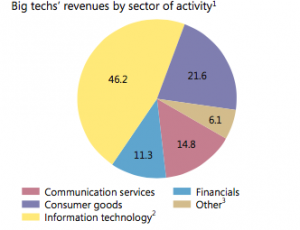
    Already commentators are focusing on the potentially rapid evolution of Facebook into a dominant financial services player. It’s early days yet and the BIS report points out that big tech currently only derives 11% of its revenues from finance as seen in the following chart:

    Given currency’s position as the commercial foundation of modern civilization and commerce there is a fascinating article in Wired which perhaps reveals the true concerns of traditional banking institutions, policy makers and regulators.  The following passage in the article was perhaps the most provocative:


    “And while Facebook’s ambitions appear unsubtle (at least to me), the biggest tech companies are all building more and more advanced and immersive ecosystems. So maybe it’s time to start asking: What is the functional difference between a company and a country?


    It’s not a crazy question: We’re already at a point where huge multinational tech monopsonies have so much power over the global economy that central bankers and regulators are starting to wonder if they even have the tools to set economic policy, like they used to in the old days.


    And the reason these big tech companies are different from other giant multinational corporations like Exxon Mobile or ConAgra or even, strangely, Microsoft is that their ambition really is to own all your interactions, not just your driving or your eating or your typing.”


    Wowzers. Facebook or Google achieving country-like status with control and influence over monster populations, or user bases, and revenues in excess of the GDPs of most countries on the planet.  No wonder the bankers are looking to wrest back control before it’s too late.  BIS head of research Hyun Song Shin does little to hide the fact that Facebook’s Libra has moved the risk dialsignificantly – “ ..there is a need for international cooperation on rules and standards. The recent proposal by Facebook to launch a digital currency, Libra, has underscored the importance of cross border cooperation.”  Yes, the regulatory stick is being waved already.  Indeed, even the US Senate Banking Committee is sitting up and taking notice; a hearing on Libra is scheduled this month while various European politicians have voiced concerns about the emergence of a Facebook “shadow bank” with a user base vastly bigger than Europe’s 600 million population. The euro under pressure from Italian mini-BOT proposals, plunging negative interest rates and pending Brexit trade chaos can ill-afford another existential threat.


    Traditional players won’t be the only ones seeing a threat. It is highly unlikely that Amazon, Google or Apple will stand idly by.  All three have rolled out their own payment options as their users have become comfortable with digital commerce. Interestingly, a country which has effectively gone almost cash-less is also moving quite rapidly towards a digital version of its currency.


    Sweden’s central bank, the Riksbank, is fully aware that only 13% of the population has carried out a recent transaction in cash.  Four out of every five purchases in Sweden are made electronically and the Riksbank can see where this is going. Hence, they have launched a pilot project to develop and test a technology solution for an “e-krona”.  This pilot is generating plenty of domestic controversy as a potential state-like interference from the Riksbank in private commerce. The future of the e-krona is more than uncertain but the digital genie is out of the banking bottle. Central bankers are clearly assuming big tech is going to enter and disrupt the financial ecosystem.


    Business owners will need to watch digital currency developments carefully and prepare for relatively quick adoption. Think back to all the lost revenues(and franchises) of retailers slow to embrace e-commerce and online payment facilities/technologies. Of course, there will be sceptics. None more famous than the world’s most powerful commercial banker, Jamie Dimon of  JP Morgan. As recently as November 2015 Dimon said Bitcoin, trading at $400 at the time, would not survive. Well, almost ten years after its launch Bitcoin is still with us and trading around $10,000. We would tend to agree with Dimon that the technology(blockchain) is more sustainable than Bitcoin but there was more than a hint of irony in February this year when JP Morgan launched its own cryptocurrency – “JPM Coin” –  for its clients.  The bankers’ message is clear.


    Digital currencies are coming to mainstream commercial activities. Big Tech is the catalyst forcing banking responses including actual crypto solutions. Businesses will need to pay attention as they most likely will have to be digital-ready quite soon….