Tag: Brexit

  • ‘Tis The Season For Some Folly

    ‘Tis The Season For Some Folly

    This week has been a bit of a head wreck. Pandemic deaths in America are now at a daily 9/11 toll level but the GOP and its cult leader wants citizens to focus on delusional vote rigging conspiracies. Worse still, it seems to be working as upwards of 50 million voters don’t believe there could be 81 million of their compatriots who hold a less worshipping view of the President. This mass cognitive dissonnance is not exclusive to the US.

    Closer to home we are witnessing millions of Brexit supporters in total denial that in every multi-party trade deal ever concluded in history there existed a compromise on sovereignty. Any chance they’d check the not-so-small print in the WTO trade frameworks or even the cuddly Koala version presented as an “Australia – style” deal? No chance now to calmly point out that single (multi-party) markets and total sovereign control are utterly incompatible and devoid of any logic. Head scratching stuff but dare we suggest these flights of folly are not confined to politics. Financial markets, IPO activity in particular, are potentially veering into irrational territory.

    Let’s start with DoorDash which made its market debut on Wednesday. This seven year old company is the top food delivery app in the US so Wall Street’s analysts had initially proposed a valuation in the $30 billion region. By Wednesday night that valuation, after the first day of public trading, had rocketed closer to $70 billion. That’s pretty close to the valuation of the fifty year old global logistics giant, FedEx. Need to lie down? Try an AirBNB, or should we say try its IPO.

    Yep, AirBNB having stared global pandemic calamity in the face was anticipating an IPO debut valuation of around $50 billion yesterday. Silly analysts. Investors swooped on the shares and the stock soared to a the $100 billion valuation. Yep, the online vacation rental platform is now worth the same as Marriott, Hyatt, Expedia and Hilton combined. Or…. More than six Ryanairs and its annual 150 million passengers. These two IPOs might benefit from strong retail profiles/brands but investor euphoria is not confined to the headline grabbing monster issues.

    Consider the AI software play, C3.ai. Its IPO was expected to deliver a valuation in the $5 billion region. Try $12.5 billion! That equates to 40 years of sales….. not income. That’s a lot of growth, modelling, guessing and whatever you fancy for Christmas. AirBNB will hardly blush, trading at a sales multiple of 20x its forecasts for 2021 and DoorDash is on a 16x sales promise. Even the most demanding of Santa letters would struggle to match this innocent optimism.

    Indeed, we have written many times here that human beings are awful at forecasters but let’s just say there’s a staggering level of future forecasting and certainty in these valuations. Did Covid-19 and a global economic shutdown really just happen in the past 12 months? Clearly, the return of investor confidence is a good thing but markets are partying pretty hard right now. As we all know, Doctor Tony doesn’t approve of partying at the moment and we can even agree with Boris on this occasion – “Be jolly careful!”

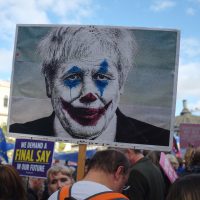
  • Brexit Clown Car Now A ClusterTruck

    Brexit Clown Car Now A ClusterTruck

    The satirical puppet show, Spitting Image, will soon be back on our screens after a 24 year break. It might struggle. The daily reality comedy show from Westminster surely can’t be trumped. Can a puppet really compete with the awfulness of Michael Govern Oven Ready, Dinghy Patel, Mark ne-Francois-pas, Lord Rayling of Failing or Jacob Rees-Mogg, Honourable Member for the 18th Century? These are just the minor characters but often they steal the show.

    I thought the Secretary for Health, Matt Hancock, would this week. When challenged by Sky News’ Kay Burley about newly appointed trade envoy Tony Abbot and his track record of misogyny and homophopia in Australian politics, the quick-thinking Matt was able to play defence with “but he’s good on trade”. Hold that gong. Enter Boris Johnson and his Svengali of Barnard Castle, Dominic Cummings with their latest Brexit wheeze.

    The UK Prime Minister and signatory to the Brexit Withdrawal Agreement is now claiming this international treaty is “contradictory” on Northern Ireland and “never made sense”. Incredibly, Boris Johnson is the very same man who negotiated the deal, signed it, prevented parliamentary scrutiny of it, campaigned and won an election on the back of it. Who needs Spitting Image? Well, possibly the financial markets. International providers of capital are not amused. There is extreme unease about a government going rogue and conceding they are breaking international law. No wonder the kingdom’s top legal civil servant, Jonathan Jones, has just quit. He’s not alone. Check out the following stories of UK fright and flight….

    Global Factory Growth Hits 21-month High; FTSE 100 Hits 3 month Low – The Guardian

    Pound Could Fall To Parity With Euro – Dow Jones

    So, those are equity and foreign exchange traders running for the exits. UK debt markets remain stable but there’s another risk emerging in the financial world. This snippet from an article in the FT caught our eye this week:

    Global regulatory body to harmonise ‘plethora’ of ESG standards

    The huge rise in popularity of funds that invest according to environmental, social and governance principles over the past decade has led asset managers to ask for more information on sustainability risks from their investee companies. This has given rise to a wide range of initiatives aimed at defining disclosure standards, such as the voluntary Task Force on Climate-related Financial Disclosures.

    One might think sustainability risks are not exactly relevant to Brexit. However, ESG scoring frameworks will ultimately look at the risk profile of individual countries where the rule-of-law (or absence of same) can impact a company’s ability to meet Social and Governance commitments. Now think about the latest noises from Westminster where Northern Ireland Secretary, Brandon Lewis, has just astonished MPs with an admission that plans to reinterpret the Brexit Withdrawal Agreement “does break international law in a very specific and limited way.” Well, that’s alright then.

    If it were not so serious it would be comedy gold. Expect tough days ahead for puppets, satire and the rest of us.

  • Taking Back Control In A Brexit Clown Car

    Taking Back Control In A Brexit Clown Car

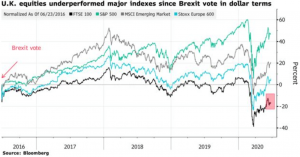
    Ooooohhh that was quick. Can it really be four years since the UK voted to leave the EU? Well, we are nearly there. In January the UK will leave the EU, with or without a trade deal agreed, and three Prime Ministers later we shall all agree this is “Taking Back Control”. Or, maybe not. Financial markets are probably the best data points to measure how much control is expected to be achieved. The charts are less than flattering. One chart in particular caught the eye in the past few days; Bloomberg has highlighted the serial underperformance in all four years of the UK’s flagship index, the FTSE 100:

    spark-crowdfunding-brexit

    Yes, the performance is being measured in US dollar terms but then the 20% decline of the once proud Pound Sterling tells its own story of faded glory. It’s not just this writer flagging the ‘downgrading’ of the UK’s economic influence in global financial markets. As Boris Johnson shuts foreign aid departments and spends on new yachts and government jet re-sprays, one could only gasp at the following Financial Times headline in the recent days:

    Pound is becoming emerging market currency, says Bank of America analyst

    The analyst, Kamal Sharma, didn’t pull any punches – “trading conditions in the pound and the big swings in exchange rates make it a better match with the Mexican peso than the US dollar…..We believe sterling is evolving into a currency that resembles the underlying reality of the British economy: small and shrinking with a dual deficit problem”. The prospect of the Great British Peso would prompt giggles if it were not so serious. The delusion that Boris Johnson’s government are going to masterfully execute a post-Brexit trade deal is becoming more stark by the day and in danger of entering fantasy territory. Look no further than the latest gems from Johnson’s cabinet.

    The embarassing policy U-turn on school lunches was apparently inspired by Daniel Rashford rather than the footballer, Marcus Rashford, according to health secretary, Matt Hancock. In fairness, Hancock will need a dose of Harry Potter magic to resurrect his career after the contact tracing app debacle. Not to be outdone, the doppleganger for Alan B’stard in the cabinet, Dominic Raab, reached into the fantasy vaults and credited Game of Thrones with the inspiration for taking the knee in the Black Lives Matter protests. Clearly, the Secretary of State for Foreign Affairs has his finger on the global pulse. What could possibly go wrong with a complex Brexit negotiation?

    The exceptionalism of the UK and US has been an accepted positive feature of geopolitics for decades but the twin challenges of CV-19 and globalism in trade have revealed a more malign, nationalistic application. As the Donald announces restrictions on H-1B visas for high skilled personnel and Boris considers a paint job for “Air Farce One”, both countries are breaking all the wrong records in containing a global pandemic. Exceptionalism now means exceptional incompetence. But, where does that leave “Brexit Means Brexit”?

    The honest answer is nobody knows but we will know a lot more before January. The Japanese have just given the UK government 6 weeks to negotiate a post-Brexit trade deal. The mind boggles. As we watch the UK Prime Minister being mauled on a daily basis in Westminster by opposition leader, Keir Starmer, and his forensic demand for answers/truth one wonders how the detail-oriented Japanese will cope with the sheer vacuousness of the Number 10 clown car during negotiation. The tragic cast of Gove, Raab, Rees Mogg etc. in the same Brexit chariot of delusion only adds to very real fears of a bad Brexit.

    Financial markets have already voted. Global investors in currencies and equities have priced real economic damage rather than the fantasy that Harry Potter magic or Tyrion Lannister cunning will appear at the trade negotiation tables. It will all become very real if the debt markets take fright. UK national debt levels are now more than 100% of GDP. If bond markets move, they will move very very fast. There will be no time for test drives and eye-sight checks. Just a sad Chernobyl reminder of how lots of little lies can incur a very large debt to the truth…..

  • Brexit Border Opportunity

    We have done our best to avoid mentioning the “B” word for a few weeks now but the coronation of Boris as King of the Little Englanders has forced our hand. A whopping victory for the Conservatives on a very effective “Get Brexit Done” message had initially led to hopes of a stable Johnson government having more flexibility to pursue a softer Brexit. As with most hopes associated with Boris Johnson, that didn’t last long.

    The new UK government has announced in its first week of power that it will push through legislation making it illegal to extend the 2020 extension period beyond 11 months. Clearly, this move is designed to pressure European negotiators to agree on a trade framework by 31st December 2020 or face the potential chaos of the UK automatically moving to a WTO-type trading relationship. The UK as a WTO trading counterparty would require the imposition of higher tariffs and more draconian regulatory restrictions on cross-border trade and services. This is not good news and currency markets have responded emphatically by paring back all the gains made by the GBP currency since the election last Thursday. However, the UK elections have presented a more optimistic scenario in one corner of the kingdom.

    Arlene Foster’s DUP, representing the 17th Century, suffered a fairly traumatic election. Its leader in the House of Commons, Nigel Dodds, lost his North Belfast seat to Sinn Fein and delivered a first time Nationalist representative for a constituency steeped in Unionist traditions and memories of Edward Carson as its most famous parliamentarian. Seismic stuff. But there’s more as the other Belfast Carson, Frank, used to say.

    Thanks to the win of the North Belfast seat by Sinn Fein there is now a majority of Westminster seats held by Nationalists. Furthermore, with the centrist Alliance party and the SDLP winning 3 seats there is a majority representation for parties who are politically opposed to Brexit. Not only has the DUP and Unionism lost its leverage with the Conservative government, it has lost its majority in Northern Ireland too. Demographics and social trends are unlikely to reverse this situation any time soon.

    Whisper it softly but there’s a chance of reviving the local Stormont government with a chastened DUP and then potentially some progress for the people of Northern Ireland. The requirement under international law and the Good Friday Agreement (GFA) to keep the border open with the Republic of Ireland presents an interesting opportunity. In the financial world, we might term this “regulatory arbitrage” but in the language of main street Northern Ireland has a unique status being simultaneously in the post-Brexit UK and in the EU. Think Hong Kong and its “gateway” status into mainland China and a completely different set of laws and political systems. Irrespective of current unrest in Hong Kong, its unique status has generated enormous wealth for investors and businesses in the territory.

    A more inclusive Northern Ireland (NI) with a functioning local government could become a very attractive location for UK and EU businesses wishing to capitalise (arbitrage) on its unique status. While tariffs and regulations are usually considered non-business friendly there will no doubt be smart management who will sniff out an opportunity to gain an advantage over their competitors. Companies in the following four industries/activities will probably take a close look at NI developments:

    1. Logistics: Could Belfast port return to previous glories as a significant EU gateway?
    2. Finance: The challenges faced by financial services companies would suggest any small tax or regulatory advantage is worth investigation.
    3. Food Processing: The food sector is reliant on time-sensitive supply chain systems. The potential use of an EU “badge” could be very interesting to companies engaged in value-added food manufacturing.
    4. High-Value Manufacturing: The Republic of Ireland is already considered the number one high value manufacturing location in the world. Businesses that can straddle the different UK and EU regulatory and tax regimes will be very interested to explore the possibilities of locating to NI.

    Of course, the opportunities don’t just lie with business owners. Investors would do well to think about the potential increases in income (lowest in UK) and the likely positive impact on asset values in the commercial real estate, hotels and consumer services sectors.

    Perhaps this all sounds a bit fanciful. Edward Carson’s former Trinity College acquaintance, Oscar Wilde once said, “A dreamer is one who can only find his way by moonlight, and his punishment is that he sees the dawn before the rest of the world”. Certainly, the North of Ireland’s unique status and dual identity will continue to confound the outside world but there’s a sense we are moving from the darkness into the light. How wonderfully ironic it would be if the North Belfast political fortress of Edward Carson, a Dubliner, could be the catalyst for a different union with exciting wealth creation possibilities!

    Enjoyed this blog? Then why not check out our other great content by clicking here!

  • Six Impossible Things to Believe Before Brexit

    Six Impossible Things to Believe Before Brexit

    It is looking increasingly likely that Brexit negotiations between the UK government and the EU will end in chaotic break down. A Merkel-Johnson telephone call has already triggered a blame game fueled by various unsourced briefings from Downing Street advisors. One would have hoped that recent judicial censure for misleading the Queen would have tempered said advisors’ enthusiasm for the ridiculous, but sadly not.

    The Brexit Mad Hatters Tea Party remains shameless and determined to foist an alternative view of Brexit realities upon potential voters who at some point will discover they stepped through a logic-lite looking glass. Before then, one can’t help feeling that Brexiteers are faithful subjects of another Queen, the White Queen, who once confessed to Alice, “Sometimes I’ve believed as many as six impossible things before breakfast”. Indeed, there could also be six impossible things to believe before Brexit. Here’s our six favourites.

    1. The solution to a hard Northern Ireland border is three borders: Difficult as it is to believe, the latest thinking from the Johnson brains trust is to put customs posts/stops at a polite distance on either side of the border thus creating “three” borders or if one were to be constructive a much wider border.
    2. Technology will ensure the seamless operation of two distinct customs/regulatory regimes: The tiny flaw in this solution is that the technology does not exist.
    3. The UK will avoid recession with government fiscal support: Profit warnings from construction sector bellwethers(SIG) and recruitment firms(Page Group) on top of the worst UK September retail figures since 1995 would suggest Brexit paralysis is already paralysing business and consumer spending decisions.
    4. A clean quick (no deal) Brexit will end this uncertainty and business paralysis: Perhaps the biggest lie of all. There is an assumption that the UK will immediately switch into the WTO trade framework and carry on trading with its largest partner, the EU. Think again. Trade agreements will still need to be agreed with the EU but in a post-Brexit world all the leverage will lie with the larger trading bloc as a country of 65 million subjects discovers its diminishing relevance in the global trade discussion.
    5. The Trump administration will provide a favourable trade deal with the world’s largest economy: The US Congress is not only about to impeach Trump but its leadership has been emphatic that any failure to honour the Good Friday Agreement will prevent any trade deal being done with the US and its highly influential Irish-American vote. Bonnie Greer on a recent BBC Question Time is worth a look if one needs confirmation of that Brexiteer pipe dream.
    6. Other People will fund the UK government’s fiscal efforts post Brexit: This column often writes about the folly of relying upon “other people’s money”. Britain’s public finances in a no-deal Brexit scenario would push UK debt to its highest since the 1960s according to the Institute for Fiscal Studies(IFS). Consider a likely drop in the GBP currency and a simultaneous spike in inflation before assuming foreign investors will commit funds to a country which has demonstrated unprecedented levels of self harm and delusion.

    Irrespective of these impossible delusions the Brexit saga will drag on for a while longer and suck the life out of most sentient human beings. However, amid the paralysing uncertainty there are still a few certainties when it comes to the relationship between the UK and Europe. As tempers fray between the UK and EU, one can be assured of a generous supply of un-diplomatic soundbites plus the always reliable talk of surrender, the empire and plucky Blighty “taking back control”. Language will undoubtedly drift into dreamy wartime territory so it will be difficult to separate tragedy from comedy but, if it has to be war then we will leave it to Captain Blackadder to say it best:

    “There hasn’t been a war run this badly since Olaf the Hairy, King of all the Vikings, ordered 80,000 battle helmets with the horns on the inside.”
     

    Enjoyed this blog? Then why not check out our other great content by clicking here!

  • Belt Up for the Year of the Rat

    Belt Up for the Year of the Rat

    In terms of purchasing power China is now the number one economy in the world. However, when we read financial headlines about monetary policy, Brexit and trade wars there is a tendency to view the challenges facing the global economy through Western-oriented glasses. More bluntly, one could be under the impression that it is in the gift of Western economies to find solutions to said challenges and all will be right with the world. Whisper it quietly to the Donald but 2020, the Chinese Year of the Rat, might not just be about whistleblowers…

    Trade wars may grab the headlines but the reality in a US context is less weighty. Goldman Sachs in 2017 published a report which showed the top 500 companies in the US (S&P 500) earned 30% of their revenues overseas. However, China accounted for just 1% of its revenues. In fact, a mere 41 of those companies generate 10% or more of their revenues in China. There is a real possibility that the business world is placing too much significance on the dampening effects of the US-China trade war on economic activity. In this writer’s view market analysts need to be more curious as to why Germany is teetering on the brink of recession.

    There is a real possibility that China is facing a structural challenge which Japan has faced for the last 3 decades; the growth-killing combination of a 300% debt/GDP ratio and an ageing labour force which is projected to lose 200 million workers by 2050. These numbers are massive and frankly won’t be changed by Fed monetary policies or the impeached removal of a US President. The global trade truth is that Europe is the largest trading bloc in the world and therefore serves as the canary in the coalmine for China’s impact on all its trading partners. The struggles of the German manufacturing sector tell us there may be a bigger story emerging.

    The Belt & Road initiative (BRI), China’s strategy to become a rival super power to the US is a classic example of Sino-long term planning. What has been missed by many, and is possibly now being experienced by German factories, is the sheer scale of this project. Here are a few data points which tell a huge story.

    • The Plan: The BRI strategy involves investment in 65 countries.
    • The Population: BRI countries have combined population of 4.4 billion people or 62% of the world.
    • The Economy: Combined GDP of BRI countries is $23 trillion, larger than the $20 trillion US economy.
    • The Spend: Estimated infrastructure requirements and spend through 2030 is $26 trillion.

    Let’s just say all roads lead to China. Or did. There is no doubt the BRI project has been a key driver of global economic activity in recent years but has been very dependent on Chinese credit. Unfortunately, China which has pledged $1 trillion to the BRI project is struggling under a crippling debt pile. There is a strong suspicion that a downturn in Germany’s manufacturing sector is an early warning signal that China is reining in its spend and this will not change irrespective of trade war resolution or central bank monetary interference.

    One wonders if the waning influence of Oriental fiscal stimulus is the reason why the ECB is almost begging the Germans and other governments to launch fiscal programmes? The real fear of central bankers is that renewed QE has no economic impact and kills market confidence. If China really does dial down its BRI activity the ECB fears will undoubtedly prove correct. Watch China GDP and credit growth very carefully, not the trade negotiations.

    Misplaced optimism on the resolution of US-China trade issues in the Year of the Rat might sink a few ships as well as a Presidency.


    Enjoyed this blog? Then why not check out our other great content by clicking here!

  • Ireland is now Facing Category 5 Trade Winds

    Ireland is now Facing Category 5 Trade Winds

    Hurricane Dorian may have lost its Category 5 status in recent hours but the headwinds facing global trade are ratcheting up in intensity. At a mid-summer Spark Crowdfunding investor night the challenges facing Irish businesses from Brexit and Trump Trade wars were discussed. One of the key observations of the night was that when trade negotiation counterparties are driven by political survival motives – think Prisoners’ Dilemma – game theory models indicate the probable result is the worst economic outcome for both sides.

    The Nobel prize-winning work of John Nash was profiled in the Russell Crowe movie, A Beautiful Mind, and has become a key foundation of game theory and understanding how multi-lateral trade agreements can play out. Unfortunately, the Nash Equilibrium predicts an ugly commercial outcome for all when political risk considerations trump(sorry) co-operation between parties. Indeed, events over recent days have provided strong evidence of theory meeting reality head-on.

    Yes, there’s a huge hurricane approaching the US coastline but political protests in Hong Kong may well be the political typhoon which visits even more harm on the US economy. Consider the “butterfly effect” of chaos theory and it is increasingly likely that China’s relatively passive response to Hong Kong unrest makes it politically impossible for President Xi to show any weakness in the trade war with the US. The Dear Leader in Washington was apparently stunned China responded to his latest round of tariffs with tariffs of their own on US goods which would be politically sensitive for the White House toddler – think oil, more agricultural products, etc.

    The problem for Trump is that he can’t back down on the tariffs as that would be an admission that his esteemed economics team of the discredited economist, ridiculed CNBC host and Lego Batman movie producer has triggered a global manufacturing recession. In fact, the just-published US ISM Manufacturing Index just posted a sub-50 reading indicating a contractionary manufacturing environment in Trump’s own MAGA hinterland. As Trump would say, but neither the poor US farmers nor factory workers… “Always winning”.

    Having failed to build a Mexican wall, Trump is politically sensitive to showing any weakness on China and has resorted to excoriating his own Fed Chairman appointee, Jay Powell, and demanding lower interest rates to bail out his faltering “greatest economy ever”. The irony of the greatest economy needing a Fed bail will not be lost on some readers nor will the wayward nature of Trump’s trade weaponry. Who would have thought that a core part of the Trump fan base, Mid West farming communities, would be paying the hefty price for Trump’s insistence that China respect the IP/patents of the leftie liberal technology elites in Silicon Valley!

    It is fast becoming apparent that US-China relations have entered a new less co-operative phase. This is structurally bad news for global trade and Ireland’s business community will need to factor this into growth projections over the coming years, not months. One would hope Brexit could deliver a more upbeat outcome but the coronation of Boris Johnson has merely confirmed fears the UK political establishment is in a state of near-complete meltdown.

    Events of recent days would appear to confirm the Johnson strategy is to deliver Brexit no matter what. The request by the new PM of the Queen to prorogue Parliament has triggered a furious ongoing backlash in the House of Commons. EU negotiators and Ireland look on in bewilderment as Johnson’s parliamentary majority of one has evaporated to a 43 seat deficit. This purge of deal-supporting Conservatives including Winston Churchill’s grandson has forced Johnson to threaten a general election. The small problem with this initiative is that the Labour party and Jeremy Corbyn, in particular, are politically aware it is in their interests to see Johnson fail spectacularly and deliver a chaotic Brexit. There is a real chance an election will be delayed until after Brexit. That is worrying but our key mid-summer observation was that Brexit in the near term could be ugly due to political ineptitude and ignorance of international law(Good Friday Agreement). However, the longer-term story could be more positive. A delayed election for an electorate experiencing the chaos of Brexit might kill off the suicide mission once and for all. David McWilliams put it brilliantly in a recent FT article:

    “We understand the yearning for sovereignty, identity and independence, believe me. But just one piece of advice: the first 70 years are the hardest, after that it gets easier.”

    Clearly, Irish business would prefer to avoid any hard Brexit and certainly not a 70-year economic divorce from its closest trading partner. It is unfortunate timing that a combination of income inequality/populism and truly dreadful political leadership in both our largest trading partners has set in motion a series of events which make it very difficult for the protagonists to back down despite the huge commercial damage likely to be inflicted on all sides. There is a Sarajevo 1914 air about developments right now, almost the sense that troops have already been mobilized on thousands of trains and it’s too complicated and late to halt the escalation.

    As we witness Jacob Rees Mogg reclining on the front bench of the House of Commons this week and Trump bestowing the title of “The Chosen One” upon himself it is difficult to avoid comparisons with one of The Great War’s best parodies – “Blackadder Goes Forth”. In particular, this exchange in the trenches of the Somme between Captain Edmund Blackadder and his men resonates quite loudly with the Boris and Trump show we are currently enduring:

    Captain Blackadder: “You see, Baldrick, in order to prevent war two great super-armies developed. Us, the Russians and the French on one side, Germany and Austro-Hungary on the other. The idea being that each army would act as the other’s deterrent. That way, there could never be a war.”
    Private Baldrick: “Except, this is sort of a war, isn’t it?”
    Captain Blackadder: “That’s right. There was one tiny flaw in the plan.”
    Lieutenant George: “O, what was that?”
    Captain Blackadder: “It was bollocks.”

    If only it were a comedy right now. There are stormy days ahead with careful business leadership and strategies required. The good news is that even Category 5 hurricanes eventually die and generate a flurry of investment in perhaps less vulnerable areas. Ireland in a Brexit context could be a beneficiary from investment seeking more sane business environments.

  • The Most Important Chart in The World Today….

    The Most Important Chart in The World Today….

    Those parents anxiously awaiting CAO course offers for their children this week might have been taken by surprise at the huge number of points(601) required for admission to the Economics and Finance course in UCD.

    Observers of financial markets might be even more bemused.

    The recent financial headlines may be dominated by gold, negative interest rates, recession worries and trade wars but there is a more worrying financial trend which has been developing over a much longer period.

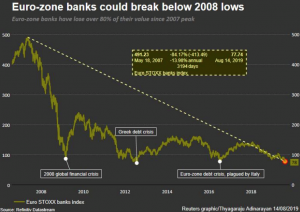
    The following chart is considered by a number of highly experienced market professionals as the most important risk signal in the world today:

    Spark-crowdfunding

    Irish readers will have very vivid memories of the 2008-2009 banking crisis. However, flashbacks are about to become more graphic now that Eurozone bank share prices in aggregate are revisiting the catastrophic lows of 2008.

    The long-run carnage visited upon European banking shares is quite staggering with prices on average down 84% from levels in the halcyon tiger days of 2007.

    Unlike short term foreign exchange moves or gold price spikes, this type of multi-year share price decline is indicative of a structural change in the banking business model and begs the question what will “finance” jobs look like 10 years from now?

    Let’s start with 10 working days from now…

    As market traders return from the beaches to their desks, and if this daily evaporation of banking equity continues, we can quite quickly expect headlines about Bank A, B or C sounding out market advisors about raising capital.

    The ugly truth is that European banks with wafer thin equity values will be perceived as having too little capital to support enormous asset bases. And, assets in  banking terms means loans.

    Think about French mega-bank, BNP, with equity values of €56 billion supporting an asset base of €2.2 trillion. Or how about the German car-crash, Deutsche Bank, with €12 billion equity supporting just the €1.4 trillion of assets.

    We are one shock(Brexit?) away from some very panicky banking days.

    For those that believe Europe’s banking problems are the result of ultra low or negative interest rates, think again. Low interest rates definitely don’t help profit margins but the major driver of banking zombiedom is the failure of banking authorities and managements to deal with problem loans post the 2008 credit freeze.

    This writer, from a previous life on Japanese trading desks, would be keen to remind readers that Japan’s banks really only started to disappear/collapse 10 years after the initial Nikkei collapse in 1989.

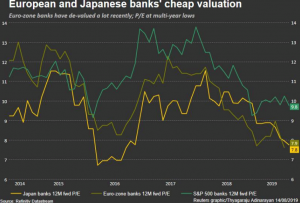
    For a more graphic reminder of how Japanified the Eurozone banks have become this Reuters chart is rather good at showing how closely Europe’s banks have tracked Japan’s since 2012 and how similarly the market now values both regions’ zombies:

    Spark Crowdfunding

    On a more positive note, Irish banks were forced by the ECB/IMF to take a lot of pain in the early days of GFC and, while not out of the woods, are possibly in better shape then many other European banking names.

    Of course, a sick European banking system is not good news but, again, on a more positive note the emergence of digital business/financial platforms has democratized finance significantly.

    Grads out there, the good news is those economics and finance degrees will more than likely be employed by new types of financial platforms. Who knew five years ago Alipay would have a billion customers?

    Furthermore, if the banking system continues to shrink, expect equity crowdfunding platforms to play a much more significant role in funding young businesses.

    Business owners should also be paying serious attention to building future “banking” relationships and could do worse than consider trial crowdfunding campaigns as an introduction to same.

    So it’s not quite Japocalypse Now….. but keep watching that chart.

  • Brexit – The Great British Bake Off or Break Off?

    Brexit – The Great British Bake Off or Break Off?

    Staff at the Spark Crowdfunding office had a little bake-off competition this week.

    The competition was keen, voting was controversial and rankings were debated long into the day. However, the true ‘reveal’ emerged over the next day as ‘tasting’ morphed into multiple appetising return visits to the competing creations. The empty serving plates and expanded waistlines revealed the true leaders but the barely touched dishes also put to bed any ranking disputes or inflated expectations…

    On further reflection, this revelatory process did bring to mind the wise words of one of the greatest ever investment thinkers, Benjamin Graham.

    As we ponder the potential outcomes of Brexit we could do worse than heed Graham’s explanation of financial markets, “In the short run the market is a voting machine, but in the long run it is a weighing machine.”

    In the context of the Brexit crisis (it is one now) there are no shortage of opinions, political machinations and financial media commentaries but such verbals are close to worthless. The most credible views are those expressed with real money.

    The currency markets have become the ultimate near term “voting process” on Brexit outcomes.

    So, the strongest voting on the gravity of the situation is now being expressed on a daily basis via the fluctuations of the value of the Great British Pound (GBP).

    Leaving aside the reflex reaction plummet of the GBP at the time of the Brexit referendum result in June 2016, arguably the currency is now at 34-year lows versus the global reserve currency, the US dollar. Clearly, currency traders and corporate treasury departments are taking evasive action in preparation for an ugly British break off from the EU. However, this is just a near term view reflecting understandable fearful emotions.

    The counter-intuitive longer-term view is possibly more interesting and is expressed via much larger individual bets.

    The “weighing machine” for the long run could arguably be reflected in the strategic mergers and acquisitions (M&A) activity of corporates.

    In this respect it might surprise readers to know that in 2018 M&A activity involving UK companies reached a three year high of £360 billion, beating 2017’s total by a whopping 28%. Admittedly activity in Q1 2019 slumped by 55% compared to the same period in 2018 but despite this apparent drop in deal-making confidence a survey published by EY in April revealed the UK as the most likely target for foreign companies seeking acquisitions pushing the US into second spot.

    History would suggest a fall in the value of a target currency and a relatively more expensive US market typically prompts opportunistic thinking from executives looking at long term corporate strategies.

    So, it was interesting to see last week a couple of huge deals announced which ran counter to the narrative generated by the GBP hitting multi-year lows on a daily basis.

    The announced combination of the London Stock Exchange and Refinitiv (formerly the Reuters data business) in a £27 billion deal is noteworthy given the US owners of Refinitiv are one of the sharpest private equity players on the planet, Blackstone Partners.

    There is also another deal to chew on this week. Food delivery giant Just Eat is merging with the Dutch outfit Takeaway.com in a €9 billion deal. Thus speaks the weighing machine.

    Worried Brexit watchers should reflect on Benjamin Graham’s words and consider the likelihood that the near term voting process in currency markets is more akin to a popularity contest with a truly awful collection of UK political representatives.

    Further Graham consideration would suggest the weighing machine of long term corporate dealmaking decisions reveals where there is real substance and value.

    For Irish corporates there may well be opportunities but it’s worth recalling our little bake-off and how the good stuff gets eaten quite quickly…