
Tag: cleantech

  • Who’s Really Losing Power…?

    Who’s Really Losing Power…?

    We sorta knew didn’t we? The Donald really doesn’t ever want to leave power. National Guard troops might be armed and patrolling the streets of Washington DC but we might be missing an even bigger power move. No, neither I nor the South Park writing team are contemplating a horse being appointed as a Senator, or JD Vance as President or Eric Trump …. replacing the horse. Parody and Caligula’s legacy are safe, for now. However, if you’re a fossil fuel investor things are looking anything but safe despite the Orwellian data-denial of the Dear Orange Leader. Let’s start with a few ground truths.


    *Oil prices have fallen in three of the last four weeks and are now in the low $60s per barrel pricing region which is close to a 4-year low.

    *Bloomberg recently reported that global oil markets are on track for a record surplus next year as demand growth slows and supplies keep growing [Source: International Energy Agency(IEA)]

    *IEA data shows oil inventories will accumulate next year at a rate of 2.96 million barrels a day, surpassing even the average build-up during the pandemic year of 2020

    *World oil demand this year and next is growing at less than half the pace seen in 2023.

    *But what about “Drill, Baby, Drill” ? Maybe not so much. US drilling activity continued to fall in early August as the oil rig count fell to 539, near its lowest since Dec 2021.


    No wonder Texas is trying to re-draw and gerrymander voting districts 5 years early. Texans are unlikely to fall for Fox News fealty to the Dear Leader, but they will be bombarded with untruths. That’s just a no-fact of life in politics these days. However, the strategic problem for the US in this energy leadership crisis is that climate crisis denial has directly impacted investment in renewable energy projects. The facts are stark. The Financial Times has reported a whopping $19 billion worth of projects have been cancelled this year alone. In fact, cancellation rates on all renewable projects are up over 2,000%.

    The most recent cancellation was a biggie in Rhode Island. An off-shore wind project 80% completed by Danish company, Ørsted, was halted by the Department of the Interior citing “concerns related to the protection of national security interests”.  That project would have powered 350,000 homes in Connecticut and Rhode Island. Meanwhile, the rest of the world is rapidly shifting focus away from fossil fuel projects. The graphic below is from the Visual Capitalist team using IEA data and compares global investment from the years 2015 and 2025 (estimated). Renewable energy investment projects have more than doubled to $780 billion and overtaken oil project investment which has shrunk from over $800 billion to $543 billion. Interestingly, electricity grid, storage and efficiency projects are now forecast to reach close to $800 billion in 2025.
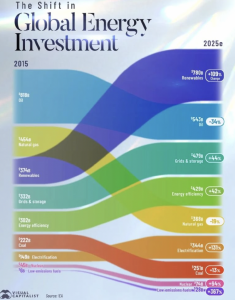


    The slippage of oil, gas and coal in the investment rankings is clear to see in the chart above. A seismic power shift is already happening and it is worth keeping an eye on the headlines and developments listed below. Arguably, the current White House administration, rather than bolstering “national security” is handing the energy keys of the future to more far-sighted leaders elsewhere. Check out these data points:

    In July, China’s single month electricity usage exceeded 1 trillion kw/hours. That’s more than Japan uses in a whole year. Of this total, 25% was generated by wind and solar energy sources.

    In April 2025, China’s solar generation of 95 TWh was larger than the TOTAL ELECTRICITY DEMAND of all but two countries in the same month.

    For the first time in history, despite soaring electricity usage, CO2 emissions in China are falling.

    The UK in Q2 granted planning for 16.1 GW of renewable energy capacity. That’s up 195% on last year.

    Renewables in the UK for the first time in 2024 supplied over 50% of the nation’s electricity over the entire year. Renewables and nuclear energy combined, accounted for 65% electricity generation in the world’s 5th biggest economy.

    In Pakistan, over the last two years private individuals have imported solar panels which equate to 68% of the entire national public grid!

    India’s solar PV manufacturing capacity has increased 50x in 10 years from 2GW to 100GW.

    In May this year, 68% of Germany’s net public electricity was generated from renewable sources.

    The electric vehicle (EV) revolution is not just happening in wealthy economies. 76% of new passenger cars sold in Nepal are electric. In Ethiopia that number is 60%.

    EV sales in Europe took 29% market share in June 2025. The share in Sweden is 65% while China moves in to the tipping point of more than 50% of sales being electric.


    The future is fast becoming electric, powered by renewable energy sources. One wouldn’t want to be on the wrong side of history, or your previously loyal customers. Ask Elon Musk and his European sales and marketing team. And…. if you want history to be a guide as to how power can shift slowly, then suddenly,  maybe don’t go to a US museum. Apparently, the Dear Leader doesn’t want US museums like the Smithsonian to raise awareness “too much of the past”, but rather “focus on the future”. Yep museums shouldn’t do history too much. Go figure.

    I’m going to stick my neck out here and risk future US visa issues but ……..it feels like the US energy future is not in good hands, just tiny ones clinging to the wrong power.


  • Is The World Going Full Oligarch?

    Is The World Going Full Oligarch?

    The lettuces won’t be happy. It looks like the UK’s new Chancellor of The Exchequer, Rachel Reeves, and her Autumn Budget 2024 will survive a relatively benign financial market reaction. So far, government debt (Gilts) markets are stable and the domestic-focused FTSE 250 stock index has bounced slightly. Liz Truss will shake her head in delusion but the more understanding reality of today’s world is that the government of the world’s 5th biggest economy was brought down by international asset traders back in October 2022. It probably won’t be the last sovereign state to lose power to commercial interests and yes, money. Simply put, at exactly the wrong moment in time, many of the world’s governments’ ATM spending cards are about to be declined. Check out the following recent headlines:


    Interest payments on the national debt (US) top $1 trillion as deficit swells  –   CNBC


    IMF warns Japan of debt deterioration in the event of future shock   –   The Japan Times


    Why France’s fiscal freak out matters to the world  – Axios


    China’s Fiscal Package Aims To Ease Debt Woes, Property Crisis   –  Asia Financial


    There’s never a good time for fiscal capacity to be tight. But… literally the planet’s survival is at stake. The climate crisis is everyone’s crisis but governments are expected to lead. Indeed, according to the IEA, governments globally in 2023 spent $1.3 trillion or 1.2% of global GDP on clean energy investment. That bill will surely rise but there’s a big question mark over how the clean energy transition will be funded by stretched governments running record deficits and the highest debt burdens in history. For a clue to that question, let’s take a look at another spending race.

    This race depending on your perspective also has an existential angle. The race, of course, is AI and Packy McCormack’s excellent piece in his Not Boring newsletter has identified a shift in commercial goal – “companies are spending for capability as opposed to straightforward ROI”. Why the ditching of seeking returns on investment? Apparently, the first company to create the AI “Digital God” boils down to an existential pursuit. Loser companies die. Indeed, Larry Page of Google fame has reportedly said many times internally…..


    “I am willing to go bankrupt rather than lose this race”


    That feels like extremely high stakes thinking. It might explain another development in the world’s most advanced technology economy. It’s one thing for a government to depend on a private company, SpaceX, to conduct an international space rescue mission. But, it’s quite another to see SpaceX’s owner Elon Musk in the words of VP hopeful, Tim Walz, “skipping like a dipshit” at various Trump rallies. Musk may cause me involuntary eye-rolls every time I read him on X or see him on TV but he’s a super-successful builder of future technologies. In fact, he has feet in both existential races with Tesla (climate) and xAI (AI) which is about to raise funds at a $40 billion valuation. If the latter doesn’t feel like an existential race, maybe the monies will convince you. In 2023, just 4 companies – Facebook, Amazon, Google and Microsoft – spent $196 billion or 0.72% of US GDP on AI research and infrastructure. Remember, these companies are really only ‘getting ready’. Furthermore, they are arguably investing at levels which historically would have only been within the compass of sovereign governments.

    I remember reading first about social media companies becoming effectively supra-sovereign powers. At the time, Facebook had 2.5 billion people on its platform, multiples of any other country populations on the planet. Now social media steers business and moves elections, but tech money might be about to go one step further. Forget about tech companies currently rolling out nuclear power for their hyper-scaling data centres. What about a seat in government?  Well, Elon Musk is on the cusp of entering a Trump ministerial cabinet with a role brief focused on cost cutting. I will give you a clue; plenty of those cuts will be in the regulatory, business and tech governance areas. Musk is not alone. Racist rallies in Madison Square Garden or not, big business is keen to put on the Orange war paint for Trump chaos and……… commercial insurance or favour. Check out the latest Trump luvvies from the world of business:


    Winklevoss Twins donate $1m each to Trump as champion of cryptocurrency  – The Guardian


    Steve Schwarzmann says Trump would be “efficient and effective” president this time – Business Insider


    Silicon Valley’s Andreesson Horowitz give Millions to Trump  – Bloomberg


    Billionaire Ken Griffin says “expectation today is that Donald Trump will win the White House” –  Fortune


    Washington Post flooded by cancellations after Bezos non-endorsement decision  –  NPR


    Ooooohh what would Washington Post legends Katherine Graham or Ben Bradlee think in this “Fat Nixon” era? It would appear big tech and big money “broligarchs” see Trump support as commercial insurance at the very least, and possibly a route to unfettered, compliance-light opportunity. One could become dispirited about the overt involvement of big business in politics. But, in reality business was always there in the Washington background. However, it’s not just a US phenomenon.

    Europe has had its share of big business influence on policy. In the UK, they have had trade and Brexit. In Germany, it was the powerful industrial sector and its push for cheap(then) dependency on Russian energy. We will say no more on either policy disaster, except there might be an intellectual reason why US business leaders are in a different universe of wealth creation compared to their strategically inept European counterparts.

    On a final more serious note, perhaps the difference this time is that governments really do need the balance sheets, cash and spending power of big tech. Just six US technology companies – Apple, Amazon, Google, Meta, Microsoft and Nvidia – have a combined market value of $15 trillion. For context, that $15 trillion equates to the  GDP of China as recently as 2020. In this writer’s reluctant view, politicians have two options – tax these guys or become partners. It might seem distasteful but public-private partnership is now an existential fact of life….or death.

    Gotta dip with the dipshits.


  • A Few Pictures Of Promise

    A Few Pictures Of Promise

    So, despite all the scary headlines and genuine bad-actor or bad-bot risks, artificial intelligence (AI) now officially rules the financial world. Nvidia, the AI chip superstar, is now worth a staggering $3.327 trillion and has overtaken Apple and Microsoft as the most valuable company on the planet. Or to put it in simple futuristic terms, investors are expecting greater returns from this company over time than from any other company operating today. To quantify the sheer scale and speed of the change in expectation from investors, let me paint a slightly different picture. Just over 3 years ago in March 2021 the market value of Nvidia was just $330 billion. So, in just over 3 years financial markets have changed their view of Nvidia’s future by $3 trillion. Wowzers. Now, in the spirit of changing views, allow me to present a few more pictures which promise better things than current headlines might suggest.

    The perception and headlines written post the recent European elections would suggest Green/climate candidates suffered setbacks and populist near-term promises won the day. Indeed, closer to home, Green Party leader, Eamonn Ryan, has decided to step down. A rushed analysis might suggest voters have decided that climate crisis policies have stunted growth and opportunity. However, the following chart from the Financial Times using World Bank data suggests reducing carbon emissions can be achieved, or can be ‘decoupled’, while countries’ growth trajectories diverge in a positive way:


    Another area perceived to be struggling with our ambition to decarbonise the global economy is electricity. In our last article we certainly identified a significant need, and worrying potential shortage, for critical metals like copper to assist the electrification of economic activity. However, a more encouraging perspective might emerge from an unusual source. China gets bad press on coal, pollution and environmental damage but its electricity story is a global leader. The excellent writer, Noah Smith, has pointed out that China is miles ahead of every other country and could arguably be described as the world’s “first major electrostate”.  The next chart or picture doesn’t lie and is based on data from sustainability research group, RMI:


    Perhaps, China is a good example of how countries or regions can gain a laggard reputation but can then become a leader. For example, Europe’s productivity growth has lagged the US for almost 2 decades. Incredibly, the GDPs of the US and EU were roughly the same size back in 2008. Today, the US economy is 44% larger than that of the EU. The productivity story in this Financial Times graphic is pretty stark and uses LSE Group data:


    Clearly, the digital revolution has been a big factor in that productivity divergence. However, it’s more nuanced than just digital adoption. Bluntly, US capital backed its entrepreneurs and its flagship digital leader companies in a big way, and in frustrating contrast to a more risk-averse European business and investment culture. It’s not just a finance thing. The US became the coding and software capital of the world. Software developer talent was paid extremely well, were encouraged to create more products and became the rock stars of the US economy. So, would you be surprised to know that the US now employs fewer software developers than it did in 2018? This chart from ADP Research might surprise….


    Then I read an interesting piece from the excellent Angular Ventures VC newsletter this morning and started to think some more. The newsletter cited a recent post written by Chris Paik at Pace Capital which has raised eyebrows in the tech world. The title alone was provocative.. “ The End of Software”. He reckons AI and large-language-models (LLMs) are driving the cost of software downwards like content creation in the early 2000s. He concluded with the punchy view, “Majoring in computer science today will be like majoring in journalism in the late 90’s.” Ouch. Angular Ventures’ David Peterson can see some merit in Paik’s view on the direction of software travel and paints the picture succinctly:


    “It’s uncontroversial at this point to say that LLMs are surprisingly good at writing code. Is the code as elegant or performant as the code written by an experienced software developer? No. Could you ask an LLM to write a custom piece of enterprise-grade software? Also, no. But even today LLMs are good enough to empower non-technical people to write small snippets of code – tiny, trivial, seemingly insignificant lines – to solve problems which they previously thought impossible to solve by themselves. And that is more meaningful than it seems, because it has the potential to shift the clearing price of software itself.”


    My own thinking is still evolving but I do believe Europe and its productivity stagnation might now be an opportunity. That might seem a little bold but the AI talent race is looking good for Europe. In turn, innovative applications of AI in the European economy could close the software and productivity gap with the US. A recent report from VC Atomico on “The State of Tech” states that Europe has more AI talent than the US. Here’s the encouraging picture:


    Again, the headlines might suggest the US is leading in the AI race but the talent story will be a critical driver of future growth rates. So, lots to think about and, whether it’s electricity, carbon emissions, AI or productivity, readers should be keenly aware of the dangers of chasing rear-view mirror headlines. The data and charts can paint an opportunistic picture not seen by the headline writers. As a final thought, and an illustration of change, the Nvidia $3.3 trillion valuation mark prompted me to look at other historic charts and ‘beginnings’. So, here goes….. Nvidia’s current market value is roughly the same ($3.5 trillion) as China’s entire GDP as recently as 2007. China’s economy today is worth $18 trillion.

    Keep looking at the big picture…