Tag: covid-19

  • Another Heroic Age Begins…..

    Another Heroic Age Begins…..

    I’m nervous. My trip to the Park Hotel Kenmare this week isn’t quite in the league of those heroic voyages chronicled in ancient Greek mythology, but the dress code request on the invite pumped the pulse rate for a moment. Just a moment. The invitation to recreate the year of the hotel’s opening in 1897 in a gathering of mostly creative types (after momentary panic) seemed like an opportune way to ditch my far-from-hip personal wardrobe and embrace Victorian disguise. Party on, but still I’m nervous. I have this nagging feeling that the years 1897 and 2024 might have more in common than we’d like to imagine. Indeed, Mark Twain would say the years and risks are rhyming.

    The Thirty Days War of 1897 between Greece and the Ottoman Empire (Turkey) was hardly a century, or even decade, defining event whereas the current war in Ukraine is generationally significant for Europe. Furthermore, the first border-to-border direct attack by Iran on Israel in the past week could, left to escalate unchecked, threaten the planet with warfare of global dimensions. Neither of the current conflicts will necessarily snowball into multi-country warfare, but 1897 starkly demonstrated how military alliances fracturing under pressure in local skirmishes can lead to tragic global outcomes.

    Just before the Greco-Turkish War broke out on the mainland in 1897, there was an intervention made by The International Squadron, a naval flotilla formed by the ‘Great Powers’ of Europe (UK, France, Italy, Russia, Austro-Hungary, Germany) to address a rebellion by native Greeks on the island of Crete against rule by the Ottoman Empire. Apart from being a precursor to war on the mainland, the Cretan intervention ultimately led to strategic disagreement followed by Germany and the Austro-Hungarian Empire withdrawing from the International Squadron. Only seventeen years later the same Balkan region erupted, and those two nations formed the Central Powers alliance with Bulgaria and the Ottoman Empire to fight the Allied Powers in World War I. So, fast forward to today and it’s not difficult to spot the strains in geopolitical alliances as they confront the following crises:


    Ukraine-Russia: European members of NATO bordering Russia are terrified by Ukrainian funding (frozen) being used as a partisan political chess piece in an increasingly dysfunctional US Congress. How long before Poland asks for, or sources, its own nuclear deterrent against Russian aggression….?

    Israel-Iran: Clearly, hundreds of missiles launched directly against Israel by Iran is a worrying first-time development in the traumatic history of the Middle-East. However, the co-ordinated defence of Israeli and neighbouring airspace by a coalition of US, UK, Jordanian, UAE, Saudi and Israeli forces could be considered a relatively surprising show of unity between Allied and Arab nations. Less encouraging is the horror of Gaza, and European countries (and the UN) looking for the US to pressure Israel’s leadership into a more humane approach.

    China-Taiwan: The potential collapse of munitions-starved Ukraine is not just terrifying eastern European nations. The perception of ‘abandonment’ of Ukraine by the US has massive European and NATO implications, but will also reverberate through Asia-Pacific island nations watching China’s moves on Taiwan. It is no surprise to see high profile visits from the leaders of Japan and the Philippines to Washington in recent weeks. However, the fate of Ukraine will be the true indicator of the strength of this trilateral alliance. And, China will be watching closely.


    Arguably, the timing-fuse for the potential explosion of any of the above crises is going to be a lot shorter than 1897’s seventeen year WW I burn. So, do we panic or seek inspiration? Geopolitical leadership, frankly, is lacking courage or heroes right now. However, dig deeper into the history of 1897 and that year’s other claim to historical significance was its status as the beginning of the last “Heroic Age” and lasted until 1922. This 25-year period saw 17 pioneering Antarctic expeditions launched from 10 different countries, but the Antarctic was not the only study subject enhanced by these expeditions.

    The methods of expedition commanders like Robert Scott, Roald Amundsen and Ernest Shackleton have been the subject of many academic studies and have provided a uniquely pure window into different leadership approaches to life or death decisions under extreme conditions while cut off from the outside world. Geopolitical anxiety aside, I am increasingly optimistic that the stars are aligning for another Heroic Age. So, who are today’s heroes and where is the 2024 unexplored equivalent of the Antarctic? More importantly, can these exploits alter the geopolitical direction of travel?  I have three pioneering hopes.

    Space Exploration: The brilliant George Mason University economist, Tyler Cowen, asserted more than 10 years ago that the US economy had been in a long productivity stall since the early 1970s. He referred to it as The Great Stagnation and this appears to have coincided with the suspension of genuine space exploration in the form of manned lunar landings since 1972. Undoubtedly, the space race of the 1960s accelerated many technological developments so I’m wondering will the renewal of manned space voyages to the moon (Artemis II) and Mars trigger global progress in remote services and activities. Consultancy group, McKinsey, have estimated the space economy will be worth $1.8 trillion by 2035. So, that’s almost like finding another Brazil with lots of new investment capital driving innovation. Think tele-health, agriculture, communications etc. Space exploration also remains a beacon of hope for collaborative endeavour – see the International Space Station (ISS) as a continuing example of cooperation between Japan , USA, Russia, Canada and the European Space Agency.

    Artificial Intelligence (AI): We have written many times about the urgent need to defend The Truth in a digital world overwhelmed by misinformation and bad actors at a corporate and sovereign level. So, it might seem strange that Artificial Intelligence (AI) could be part of the solution. A quick glance at any media headlines would suggest AI will be in the vanguard of misinformation rather than authenticity. However, I am struck in my day-to-day investment role by the number of recent AI applications which focus on one area and also could be a very profound instrument in the discovery of truth. The latest AI focus is video. We know Gen AI tools like Chat GPT or Gemini can be used to deliver super-quick summaries of large volumes of text from market analyst research to autobiographies to business plans. But, now hours of video can be analysed and checked in minutes, even seconds. So, imagine a future screen broadcast which is actually two screens, and the second screen is not a betting or chat platform. The broadcast could be Liz Truss, Donald Trump or Vladimir Putin in full delusion mode and the second AI screen could fact check (or just show previous contradictory video footage of same speaker) and alert viewers to misinformation. My hope is that real time credibility checks could be incredibly powerful in exposing populist charlatans and assisting truth discovery.

    Healthcare: Every week we read about new therapeutic discoveries using gene editing (CRSPRS), cell therapies (CAR-T), mRNA vaccine platforms, neural implants(Neuralink) or even drug manufacturing in space using micro-gravity(Varda). Healthcare remains a challenge for all governments and the recent memory of the Covid-19 pandemic should be an inspiration for further research co-operation. Recent news headlines on WHO worries about H5N1 bird flu mutations will likely focus minds and provide a potent reminder that viruses don’t stop at disputed historical borders. Indeed, a government closer to home looks like it will lose power despite delivering best-on-planet economic performance. Why? Ireland’s government coalition didn’t do enough on the health (hospitals) and safety (homes) of its citizens. You would have thought focus groups and polling research might have picked up on that genetic human instinct……to live. Politics, eh.

    So, maybe nothing much has changed since those courageous expeditions trudged across an unforgiving continent all those years ago. As a species, we are probably still driven by the same three things: discovery of new worlds, the truth, and survival. Clearly, success in these pursuits can be shared and, in turn, bring humanity closer together. So, I’m not sure this vision of our future requires heroic optimism, but we could definitely do with some leadership. And…. I’m sure the ghost of Tom Crean would have some wise Kerry thoughts this weekend on where it can all go wrong.

    P.S. The dressing up worked out, the creative crew were fantastic company, and the hotel is wow….!

     

  • Trends Check: Keep Calm and Worry On …….

    Trends Check: Keep Calm and Worry On …….

    I just read an article referring to today’s date as “December 42nd 2020”. Do you blame them? The early days of 2021 still see Dryrobes, George Lee, lockdowns, NPHET and Brexit regularly flying up the Twitter trending charts. Sadly, Covid-19 remains omnipresent but, thankfully, the Donald has been cancelled by Twitter and replaced with our very own Don, or Donie O’Sullivan. Democracy almost failed last week on Capitol Hill but Cahirsiveen’s gift to CNN was on the spot to bring some sanity to the chaos. Now, it’s our turn.

    It would be easy to pinpoint Covid as the source of most of this chaos but that would be almost Fake News. In reality, there are a number of markets and geopolitical trends which have been around for a few years now, even decades. However, one of the better descriptions of the pandemic’s impact was that it had hugely accelerated established trends. For illustration we thought it no harm to re-visit 10 trends we identified in December 2019 PP (pre-plague) and monitor the development or death of same.  The link to the full 2019 article is at the end of this piece but for explanatory convenience we will show those early views in bold text followed by our current thoughts and potential new trends gathering momentum. We will review in the same order as last year so here goes…..

    Debt: Global debt has just topped the $250 trillion mark according to the International Institute of Finance (IIF). It’s rather scary to think that in the ten years since the credit crisis of 2008-2009 the world has piled on another $70 trillion of debt. This debt mountain is incredibly sensitive to rising interest rates. Hence, central banks led by the Fed have had to abandon attempts in 2018 to return interest rates to more normal levels. Central banks are now stuck in a Japan-style debt trap with additional credit creation achieving less and less stimulatory impact on economies. Now, frustrated and worried central banks are pressuring politicians to introduce fiscal policies to break out of this stagnation spiral. Unfortunately, politics at a global level is increasingly polarised.

    The same IIF is now saying global debt reached $277 trillion in 2020. Another $27 trillion…. Hoo boy. Of course, trapped central banks didn’t see Covid coming but have played a critical role in supporting the global economy. However, the pressure is now on governments to deliver fiscal stimulus themselves. Let’s just say that debt number could be $300 trillion by the end of 2021. The pandemic was a definite accelerant.

    Democracy: Levels of income inequality not seen since the 1930s presents the potential danger of history repeating itself. Democracy is under pressure. The Freedom House think tank published a report in 2018 highlighting that year as the 13th in succession where democratic freedoms were in decline. A total of 68 countries witnessed a tightening of civil liberties and political rights whereas only 50 countries registered progress in these areas. As 2019 comes to a close the strong-arm tactics of Trump, Putin, Xi, Orban, Erdogan and Prince MBS do not provide reassurance that authoritarian trends will reverse any time soon.

    Democracy had a bad year where most bad actors named above got away with further repression. The only bright spot was the repudiation of the Trump regime at the ballot box but not without the deadly events on Capitol Hill. Arguably, the pandemic cost Trump the presidency and halted a dangerous erosion of US democratic institutions.

    ESG: There is grounds for optimism that businesses and investors see “doing good” as a prerequisite for wealth creation. It almost sounds like common sense but the ESG investment framework covering Environment, Social and Governance factors is gaining traction rapidly with $30 trillion worth of investments now employing ESG metrics in their investment processes. That $30 trillion number will grow and standardised metrics to measure and audit ESG will be the next challenge for business and investor alike.

    2020 was a huge year for ESG. The value of funds now employing ESG investment frameworks has exceeded $40 trillion during 2020 and will no doubt attract more follower funds in 2021. However, we would be wary of attributing all this enthusiasm as a pandemic appreciation of the need to save our planet. It was extremely helpful that technology stocks which score well in ESG frameworks had fantastic share price performances. Despite global economic chaos, the technology-heavy Nasdaq index delivered 43% returns to investors in 2020. Profits, or performance, always helps trends find new friends…..

    Trade: President Trump is now saying phase 1 of the China-US trade negotiations might not conclude until after the 2020 US elections. Who knows what will come out of Trump’s mouth next but expect 2020 to again be dominated by trade tensions in the EU with Brexit, and in Asia-Pacific with China. The rise of populist politics and trade protectionism are the two sides of a no-win economic confidence trick. Closer to home, Boris Johnson’s bombastic certainty of concluding trade deals with Europe by the end of 2020 will be particularly painful to watch unravelling.

    One of the few areas where there is bi-partisan agreement in US politics is trade with China. Ironically, despite the Orange Toddler’s tariff tantrums, China’s global trade surplus hit $460 billion in November. The surplus with the US alone was up 52% in November!! In this instance, China’s faster economic recovery from pandemic than the West has accelerated this sensitive surplus. Needless to say, trade tensions will continue into 2021, as will Brexit chaos but we will spare you the Johnson narrative.

    China: The most important macro story apart from debt in the world today is China. It’s arguably the engine of growth which services the planet’s debt. By the end of this year Chinese consumers will have purchased goods worth more than $5 trillion, exceeding that of the original consumption super power, the US. So, financial markets will now have to pay much closer attention to the role of Chinese consumer confidence in the global economy. Think of how many decades financial research and trading teams have agonised every first Friday of the month for the US Non-Farm Payrolls. Get ready for Sunday night China economic reports but before that keep an eye on bond default newsflow. There have been four or five relatively significant blow ups in recent weeks, even involving State Owned Enterprises (SOEs). Do not underestimate the potential impact on consumer confidence if the all powerful state can’t save its own.

    Our fears on debt defaults were unfounded so far. Debt defaults in the first 9 months of 2020 actually fell 20% to $13 billion according to Bloomberg data. The pandemic, in this case, may have stalled the trend rather than accelerated things .  China remains the biggest structural macro story in the world apart from global debt levels.

    Tech Tension: Technology has been a dominant driver of markets since the credit crisis. Some companies now have user bases which would be in the top 3 populations of the world if they were sovereign states. Think Facebook and Alipay with 2.5 billion and 1 billion users respectively. As Microsoft and Apple’s combined market value now exceeds that of Germany’s entire stock market at $2.25 trillion it is tempting to think this is a high water mark for tech valuations. Two developing stories/trends suggest the tech sector could meet some growth challenges. First, Facebook’s power and abdication of responsibility on publishing false information to huge numbers of people is moving towards a 1911 moment. That date is neither a typo nor hyperbolic. For the historians, that’s the year when the Standard Oil refinery monopoly was broken up. Second, the rise of ESG is ultimately not compatible with corporate deference and fear of China’s wrath. The recent China anger incidents involving the NBA, Apple and Google suggest corporates may have to decouple from Chinese internet and broadcasting platforms. Yes, the internet could splinter and anyone following the Huawei case with fears over 5G security might be forgiven for thinking a “net split” is not just a possibility but inevitable.

    Covid has possibly diverted attention away from the China tech/security threat but the 9/11 moment for democracy in America last week has possibly accelerated the 1911(Standard Oil monopoly) moment for Big Tech. Google and Facebook now face anti-trust litigation from the Federal government. But, these cases were announced months before the Senate run-off races in Georgia. If you are wondering why Google, Facebook, Amazon and Twitter have moved rapidly to neuter far-right conspiracy personalities and channels just think how many future Senate Committee heads(Democrats) were hiding under their desks in Washington last week. The role of social media disinformation in the awful pandemic death tolls in the US will also focus executive minds but it might be too late for Facebook.

    Content is King: Even with a potential internet split, original content continues to be the critical asset for every media platform on the planet. We mentioned monopolies earlier but has anyone noticed that Disney has quietly assembled a portfolio of content assets with enormous power? Even before Star Wars opens in cinemas, Disney has accounted for $1 in every $3 spent in cinemas in 2019! The battle for content has exploded to unsustainable levels with almost 500 originally scripted TV shows produced this year. In 2012 that number was less than 300. And the costs are rocketing. One statistic we read recently was that for each $1 of a Netflix subscription the user was receiving $1 billion of content. It’s not just entertainment content. Think about the $5 billion valuation of Manchester City implied by the recent private equity investment made by Silver Lake Partners from Silicon Valley. Live sport is hot but $5 billion for a franchise which can’t fill its home ground…?

    Production of content clearly suffered in 2020 but the uncertainty facing cinenas has accelerated the adoption of streaming services.  Remarkably, Warner Bros. have said they will debut ALL its movies in 2021 in cinemas and on its HBO Max streaming service on the same day! And check out Disney Plus. The ‘House of  Mouse’ only launched its streaming service, Disney Plus, just over a year ago but has reached subscriber numbers of 86 million already. For context, Disney planned to hit the 90 million subscriber mark by year FOUR in its initial communications.

    Energy: Climate change is for some top hedge funds now a critical factor in every investment selection. The climate crisis headlines multiply each week and this means continued pain for fossil fuel investors. Apple’s valuation is now bigger than the entire US Energy sector. Furthermore, for fossil fuel dependent economies like Saudi Arabia and Russia it is striking that their levels of sovereign interference have increased in recent years in the likes of Yemen, Syria and Ukraine. There is a suspicion that this projection of international power is an attempt to disguise significant structural weakness.

    Irrespective of pandemic hits to economic activity and energy consumption, the climate/ESG trends look set to continue to keep energy in the ‘unloved’ corner of the market. It is staggering to think that Tesla’s market value now exceeds the market cap of the entire US energy sector! However, it is worth bearing in mind how well “unloved” tobacco served its investors over the last three decades. Debt levels and long-term capital investment required do not make the tobacco and energy sectors comparable but there will be pockets of excitement along the way. Note LNG prices are rocketing in Asia to all time highs as unusually cold weather bites.

    AI: We have been inclined to highlight the risks/areas to avoid but Accenture tells us there is a $14 trillion opportunity in AI across 16 industries in the years out to 2035. Health, finance, logistics and agriculture all look particularly suited to AI innovation and it is striking to see an out-of-favour sector like finance now attracting the largest chunk of venture capital money via European fintech.

    We were told a pandemic vaccine was years away. It was delivered in 9 months. If ever the population of the planet was given a striking lesson on the power of AI this was it. The ability of AI to crunch huge numbers of varaiables and predict results in delivering a life or death solution for humanity will massively accelerate further AI investment in healthcare, education and finance.

    Inflating Value: And that leaves us finally with another potential positive albeit it is difficult to argue this trend is established just yet. However, we can include this in our list with a speculative health warning! For years, value investing has been clobbered in performance terms by growth and momentum investing strategies. Yes, it might be difficult for oil to make a come back but other commodities could bounce back sharply if inflation picks up. Whisper it very gently but there is data/evidence to support wage inflation picking up in Europe. Wages are growing at the fastest pace in a decade and Europe remains the largest trading bloc in the world. A stronger Europe would be a very positive development. No doubt, investors stuck in value strategies will be watching hopefully for an end to their performance misery. The rest of the world should hope for the same too.

    We are whispering again. However, for most of 2020, investing using value factors was a disaster. The FT was reporting at the end of October that value stocks were having their worst run in two centuries. Of course, economically sensitive stocks tend to sit at the value end of the investment spectrum so Covid allowed tech share prices to literally ‘Zoom’ while economies went into deep freeze and cheap stocks became even cheaper. Fast forward to today, and an earlier than expected vaccination, super low interest rates and fiscal spending from governments has thrown huge amounts of money into the system. There’s even chat of another ‘Roaring ‘20s”. Ireland borrowed €5 billion for 10 years last week at a negative interest rate, Tesla is racing towards a $1 trillion valuation and Bitcoin has just hit the $1 trillion mark too. Go back to that $27 trillion of new global debt in our first comments and then think about lots of capital chasing an unchanged number of opportuities and assets. We watch, we worry. But first, value investors could ride that inflation comeback extremely profitably.

    So, it would seem almost every trend has survived the pandemic, in many cases accelerated. However, did Covid kick start any new trends worth watching? We think three are worth keeping an eye on:

    1. The pandemic has shone a tragic light on income inequality and poor education. The death rates in the poorer sections of society are significantly higher than average. Governments will act. The next version of The Donald could be far more competent and dangerous.


    1. Hong Kong has attracted geopolitical attention for some time but there’s a far more critical flashpoint developing in the Sino-sphere: Taiwan. More critically for the global economy, Taiwan is the epicentre of global semiconductor production. These chips are the real “oil” of the global economy. Watch and worry as tensions rise over China’s inevitable plans to control Taiwan.


    1. Work-from-home is now accepted as the future. Expect more strategic decisions by companies to facilitate that shift. However, we might also expect to find in the coming years that early hopes of similar or superior worker productivity were unfounded. After all, we are only human, and the pandemic has surely shown us that we do crave social contact not just screen contact.


    Yes, we are human. We can’t forecast the future as there is always change around the corner. So, know the trends, keep calm and know some of your worst worries may never materialise.

    Our original December 2019 article is here: https://gravitas.sparkcrowdfunding.com/top-10-trends-to-watch-for-2020/

  • Charting The Uncharted Territory of Covid-19 Recovery

    Charting The Uncharted Territory of Covid-19 Recovery

    So, this might be the strangest financial quarter of all time. At one point, a third of the planet’s population was in pandemic lock-down plunging economic activity into a deep freeze. And yet, global stock markets are about to post a stunning recovery from pandemic despair with a whopping three month return of 18% for investors. I’m half expecting Monty Python’s limbless Black Knight to appear on CNBC and tell Jim Cramer, “Tis but a scratch…”. Please excuse the effort at dark comedy; rather treat it as a weak effort on my behalf to hide confusion.

    Yep, no point hiding it. It’s all very confusing for me. Rather than blather on about accepted capital markets norms in long paragraphs of text I thought some financial charts might be a better way of explaining my confusion. Don’t get me wrong, I am not saying stock markets and investors are Black Knights of laughable optimism. Quite the contrary, equity markets and investors discount the future (not present challenges) and I have absolutely no evidence to suggest that economic activity will not return to its pre-Covid scenario of Goldilocks growth and low inflation. No, my confusion is that nearly all financial instruments/assets are rising in value. Arguably, these other assets are discounting a less brilliant future.

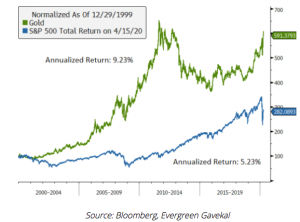
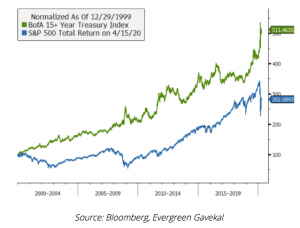
    Traditionally, gold and bonds have been considered “safe havens” to protect wealth in times of turmoil. These two asset classes have not just been flying in recent months, but actually for more than 20 years. Bloomberg and Gavekal illustrate in the chart below that gold has been quietly killing equities on performance over the past two decades.

    The stellar performance of bond markets thanks to low interest rates is probably more widely known but it might surprise to see the tech-powered S&P 500 struggle to keep up, even in recent FAANG-tastic years….

    Leaving aside twenty year trends, it is rather strange to see bonds, equities and gold all roaring higher during what we can all agree is a period of significant uncertainty. Of course, there is another explanation for investors buying all asset classes – the enormous monetary stimulus coming from central banks and governments. Current estimates of that funding pulse are as high as $10 trillion. If we assume global GDP has a very painful year-on-year contraction of 5% in 2020 that would equate to a $4 trillon loss. That sounds like a $10 trillion injection to plug a $4 trillion hole leaving a balance of $6 trillion likely to rush into the financial system. What’s not to like about that if you are an investor in risk assets?

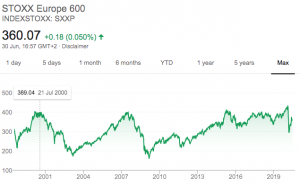
    It is early days yet but an interesting possibility that a massive emergency stimulus response to a pandemic could rip up the sclerotic inflation play book of the past twenty years. In that instance, the “sick man” of financial markets, Europe, could finally attract real interest and performance. I leave you with a chart of European equities still almost 10% lower than two decades ago, and a potential and much needed Covid19 recovery….

  • Store Up Some Fuel Thoughts

    The recently deceased actor, Brian Dennehy, once asked to stay the night in our house and we turned him away. True story.  However, context and logistics are everything. Of course, we would have loved to tell the tale of hosting a Hollywood legend except there were already 25 Irish teenagers staying in our house during that J-1 summer of 1989 in Montauk, Long Island. So, it is no surprise that Dennehy’s death and oil prices (with a minus) over the past week did jog the memory and highlight all over again the importance of space irrespective of the opportunity.

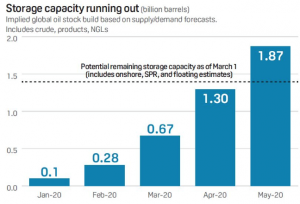
    As US oil futures plunged into negative territory in recent days we were reminded that if there is no storage available you can’t even give away a bulky commodity. In fact, some contractual parties in the futures market were prepared to pay somebody, anybody $35 for each barrel of oil to be taken off their hands. Just think, if one could have taken delivery of a million barrels of West Texas oil there was a whopping $35 million payment to accompany that load. The problem as the following chart from energy consultant, Platts, shows is that the US market has maxed out on storage capacity:

    Yes, that looks like we are rapidly approaching a stock build of almost 2 billion barrels of oil with storage capacity for closer to 1.5 billion barrels. The main driver of the stock build is CV-19 and the evaporation of oil demand. Think back to 2019 and daily oil consumption of 100 million barrels per day. Current estimates suggest we might be consuming 25 million barrels less, each day! To halt production would be very expensive hence the stock build and furious prayers to the Donald, Allah and Saint Christopher, the patron saint of travel. Hopefully, the rest of the world can follow China back to some sort of post Covid recovery phase but the decline of oil pricing power has been a multi-year trend.

    Here are a few further thoughts on the decline in influence of carbon fuel producers:

    1. For consumers of energy, as individuals or as businesses, a collapse in fuel prices should be viewed as an enormous tax cut.
    2. In 1980 the oil sector accounted for 30% of US equity markets. It now accounts for less than 3% while the technology sector represents more than 23% of the market. Who said data was the new business fuel?
    3. Rogue states and despotic leaderships dependent on commodity markets can be vulnerable to sovereign debt implosions and civil unrest. Russia and Saudi Arabia are more fragile than perhaps financial markets and investors appreciate.
    4. Storage has hurt the oil markets temporarily but on a longer term view storage will be equally important to the emerging renewable/electric/battery powered economy. There is still much to be done to improve battery/storage technologies. One can reasonably expect material science/chemistry graduates to be the hot talent property of the future.
    5. US shale oil production has exploded in recent years. Investment, employment and GOP election coffers have all benefitted. Oil prices, even if they recover back to the $30 levels, make shale oil an uneconomic proposition. US oil producing states are mainly Republican voting states but jobless voters can be fickle. It might be tough for them to stomach a Democrat President but it seems the current White House incumbent believes they can stomach disinfectant. So, anything is possible in the November election.

    As always, human beings are not great at forecasting the future. However, it is a racing certainty that the oil markets have not exhausted their ability to deliver further shocks in 2020.


    Enjoyed this blog? Then why not check out our other great content by clicking here!

  • We Are All Start-Ups Now!

    So, it’s The Great Lockdown then. That’s the name given to this crisis period by the IMF and I’m hoping there’s another Isaac Newton out there. Well, not quite. Newton famously developed humanity’s knowledge of calculus, light refraction and gravity while quarantined during the Great Plague of 1665. Right now, behind the global public health priority of a CV-19 vaccine, the world is in urgent need of a gravity-defying economic plan. Newton’s falling apple suggested what goes up must come down. The task today is to figure out how a Lock-Down transitions to, hopefully, an Open-Up in the coming months. The laws of gravity and economics are challenging to say the least.

    Let’s start with a few numbers. How much are we really down? The IMF reckons global GDP in 2020 will shrink by a higher percentage (3 %) than any period since the Great Depression. That’s even more than the nadir of the credit crisis in 2009. In dollar terms, January IMF forecasts of 3% growth this year have in a matter of weeks seen $5.2 trillion worth of activity evaporate from those 2020 expectations. The IMF think the ultimate cost through 2021 could be closer to $9 trillion – that is the equivalent of Japan and Germany’s economies disappearing. Here are a few other numbers which hint at the scale of the gravitational pull on economic recovery:

    • Commodities: The IEA is forecasting oil demand for 2020 to fall by more than 9 million barrels per day (!). In April alone that number will fall by 29 million barrels per day. In effect, global economic activity/consumption has returned to 1995 levels. Good news for the climate but catastrophic for nations dependent on exporting commodities.
    • Banks: Ireland might escape the worst GDP implosions likely to hit Italy and Spain but a quick check of bank share prices in Ireland gives some clues as to the scale of capital destruction. The combined market valuations of AIB, BOI and IPTSB amount to just over €4 billion, or just over 20% of the combined book value of these banks ie the market is discounting €16 billion of capital at risk of wipe-out. Then, factor in a 2020 Irish government budget surplus of €2 billion vaporizing into an estimated €19 billion deficit. That’s another €21 billion we might not have in 2021.
    • Corporate Debt: Back in 2009 a critical factor in capital destruction was the amount of leverage in the banking system. We have written frequently about the risks of being dependent on “other people’s money”. Fast forward to 2020, and it is clear companies across the globe have feasted on ultra-low interest rates and loaded their balance sheets with debt. The Institute of International Finance estimated corporate debt levels among non-banks had rocketed to $75 trillion by the end of 2019. That figure was $48 trillion at the end of 2009.

    Yes, the numbers are quite scary. However, the intention of this article is not to frighten but rather to highlight the difference between two competing emergencies. Governments and central banks everywhere have moved swiftly to address the immediate cash flow issues of citizens and companies experiencing a collapse in income and revenues. The longer term issue is how creditors and debtors deal with damaged balance sheets and the need for additional capital to “Open-Up”.

    The Lockdown is a cash flow emergency. The Open-Up phase will probably be phased and slow. The entire world from universities to airlines will need capital buffers to navigate a possibly very changed world. Bluntly, the capital destruction estimated/discounted in the forecasts summarized above suggests too many capital-hungry mouths to feed. Previous years’ financial performances by established corporates may not be a helpful guide to the future. Companies will have to be realistic with their projections and tell their story very well. The risk profile for many sectors has endured a meteor strike and, in a sense, business models will have to be rebuilt, or in start-up terminology, pivot.

    Yes, the Great Open-Up will be a capital event without precedent.  We are all start-ups now.

  • Corporate Change Is Not New, Just Accelerating…

    I have to confess I haven’t been sleeping great the last few days. It is probably only natural that a changing world is causing the mind to race a little. Pink moons, or not, the nights can be dark for many in these uncertain hours. Some might think of lithium. I’m thinking of equilibrium. Balancing so much uncertainty and change is a mental challenge but perhaps we were already doing that? Just at a slower pace. Let’s think slowly about change for a few moments.

    Amazon started out in life more than 25 years ago as an online marketplace for books. An online marketplace, who knew? The Amazon monster has been blamed for the obliteration of many retail businesses since but would it surprise you to know that prior to the CV-19 shut-down employment in the US retail sector was at an all-time high?  Change, yes. Destruction, not so much.

    Microsoft is 45 years old. The software giant is now at the forefront of a work revolution. Thanks to cloud hosting services, many businesses have been able to operate on a remote basis in the current shut down. But hot desks, work-from-home and 4-day weeks are not new concepts as companies compete for talent and efficiencies. In fact, productivity has been a major challenge for developed economies for the last decade. Microsoft itself, in 2019, trialled a 4-day week in its Japanese operation and achieved 40% productivity improvements. Expect more “trials” and rapid change after this crisis.

    Away from work, Netflix is 23 years old and streaming an enormous channel of high-quality content to our homes and mobile devices. It spent $15 billion on creating content last year and is forcing change at the very largest media giants. Disney will be relieved they had embraced the streaming revolution as cinemas and theme parks now lie empty. Their Disney+ streaming service just signed up their 50 millionth subscriber since November. So, they achieved in 5 months what it took Netflix 7 years to do.  Change can literally mean survival.

    Clearly, the education, fitness and healthcare industries have their own revolutionary protagonists. And don’t forget the EV revolutionary, Tesla, and it’s 17 year journey. Just a quick reminder that Tesla’s market value was higher than Ford, GM and BMW combined before CV-19! So, let’s be very clear that change is constant but can suddenly accelerate into more universal adoption. The prizes can vary from supra-normal profits to survival.  The costs can vary from increased integration/education costs and investment spend to bankruptcy and liquidation fees.

    CV-19 is an accelerator period not unlike WW2. Science, healthcare and security will be uppermost in people’s minds and exact a cost from business. But not all costs are bad. Change can be frightening but very often good for all in the long run. In two instances an acceleration of change would be a very good thing. For far too long urbanization has been a driver of wealth creation. But at what cost?  CV-19 has laid bare the risks in neglecting two huge public health issues: adequate access to housing and healthcare.

    Perhaps the biggest change to come is a reversal of urbanization as corporates embrace remote working arrangements and a diversification of their greatest asset, talent.  Be under no illusions, workers are recalibrating their values and their lives right now too. Change is guaranteed, much of it good. You might even sleep better too. Good night, John Prine.

    “ When I was a mailman, writing songs was my escape from the regular world, and now writing songs is my job. And I’ve always been one to avoid my job.” – John Prine (1946-2020)


    Enjoyed this blog? Then why not check out our other great content by clicking here!

  • Data For New Businesses And Behaviours

    And just for a moment I felt part of the new social Zeitgest. My search for business trivia questions for our Zoom table quiz this evening included a quick perusal of the Financial Times (FT) and a rude awakening. Germany is not just leading Europe in the Covid-19 containment stakes. The country is celebrating its medical Covid heroes in dramatic social fashion. The FT article which caught the eye highlighted data from Bavaria revealing a 3,000% increase in sales of fantasy nurse costumes. Leaving aside that racy data point, there is no question social activities and behaviours will evolve through this pandemic and create new business opportunities.

    If we return to more casual attire and online social interaction it would appear a Zoom generation of quiz maestros and game gurus has been launched. Zoom the online meeting app has experienced a 535% growth in monthly traffic with millions experiencing the low-cost joy of online giggles, competition and banter accompanied by the odd grape or grain sourced beverage. People have discovered their homes, big or small, can host a social life and skip the hassle of babysitters, taxis and wardrobe anxiety. One can expect social platforms for various interests and competitive activities to emerge with exciting scaling opportunities. Even before this pandemic, an online quiz app, HQ Trivia, was played by more than 2 million people a day at its peak. But it’s not all play and no work.

    The vast majority of my work conversations this week have referenced the future of work. More specifically, cramped open-plan offices are unlikely to be the answer in a post-Covid-19 world. According to the US real estate company, CoStar, the average number of square feet of office space per worker has declined from 260 square feet in 1990 to 180 square feet today in many large cities. We have previously written about how WeWork probably won’t work as an investment but its successors and other co-working sites will need to address design issues urgently. WeWork operates on a 75 square foot per worker model and that includes the spacious common areas and the beer taps!

    Of course, going forward companies will also potentially look at significant percentages of their workforce continuing to work from home for certain days in the week. Collaborative working tools like Microsoft Teams and Slack are witnessing explosive growth in usage. Microsoft alone added 12 million new users in the week ending March 19th.  On a more ominous note, there have been reports of some companies using the video cameras in worker laptops to alert them if people leave their desks. This raises privacy issues irrespective of what governments will use next in their efforts to enforce social distancing policies. In an uncertain world, one thing is certain. Companies are going to be spending a lot of money on advice on how best to re-configure their office staffing levels and work-from-home conditions. Benchmarking of those steps is yet another data opportunity for the ESG world and could be costly for less attentive corporates. Indeed, ignorance could be fatal.

    Speaking of ignorance and privacy. Who isn’t fascinated by the location data release from Google on population mobility?  In order to control populations, the Big Brother approach might be needed. Particularly if a worryingly large percentage of a population watch Fox News and have missed some pretty important information. The Governor of Georgia just yesterday claimed he was only aware of asymptomatic Covid-19 transmission “in the last 24 hours”. Meanwhile, Google traffic data tells us visits to retail and recreation locations are down by 62% in New York State. The state of Arkansas is another GOP governor state and blissful ignorance is still rife – just the 29% fall in retail and recreation movement.

    We are in an unknown territory but ignorance could be fatal for individuals and businesses. Data will help inform and record the experience but also signal change. Business owners and entrepreneurs would be advised to watch the data carefully.

  • Health And Wealth

    I am sitting in the ‘West Wing’ of my home office. Rooms, corners, even furniture pieces have been given new names to inspire a sense of space in The Emergency but the brain remains unmoved. That must change. There are potentially even greater socio-economic transformations ahead. Was it only a few days ago the political leaders of the UK and the US were attempting to calculate a public health and economic trade-off in their Covid-19 containment strategies?

    Thinking at the highest levels of the oldest capitalist democracies on the planet was actually trying to figure out was there an ‘acceptable’ human cost to ensure economic activity was sustained. The outcry was predictable but possibly misplaced. Yes, a failure to “flatten the curve” would lead to much higher death tolls. But, this raises an existing uncomfortable truth for many societies. Ageing populations, income inequality and dysfunctional insurance frameworks have challenged public health systems for years and resulted in unnecessary loss of life. That death toll rises every year and will continue to do so without fresh thinking. Clearly, this curve wasn’t steep enough to care enough. However, a global crisis has focused minds both globally and locally.

    Ireland, fresh from elections dominated by images of hospital trolleys and homeless statistics, has impressively responded to the Covid-19 pandemic with the rapid deployment of funds, medical resources, beds and even properties. All is utterly changed, and in record time. In the UK the railway system has been nationalised by a Conservative government. In Ireland the caretaker centre-right Fine Gael government is effectively nationalising private medical facilities. Arguably, capitalism is due a re-set. At the epicenter of this socio-economic inflexion point is the fundamental right of a country’s citizens to access healthcare and safe living conditions.

    A full-blown crisis has unleashed a massive effort to ensure limited medical resources can meet the needs of a supra-normal demand. It is a war. And wars can leverage combined intelligence to deliver huge efficiencies and innovations. Ventilators are the key weapons in the Covid-19 battles waged in all hospitals but they are expensive. As the likes of Dyson and GM apply their engineering expertise to mass-produce these life-saving devices one can be reasonably hopeful that the pricing point for such equipment will permanently fall for future generations of the sick. Closer to home, a drive to make our health system more efficient and capable to serve more patients has accelerated the embrace of technology.

    Wellola was a recipient of Spark CrowdFunding investor support and is now delivering a Covid-19 communication portal to allow patients remote access to GPs. Similarly, the Mater Hospital is using software robots to input data and save nurses hours of administrative work. It has taken a crisis to force decisions and change working practices and technologies in healthcare. The benefits will last beyond this crisis and highlight the dangers of dysfunction and utilitarian capitalism.

    The US is fast becoming the poster child of how a profit-based healthcare system can struggle to deal with a universal crisis.  Apart from 60 million citizens excluded from its health insurance system, we have witnessed extraordinary bidding wars between state and federal entities for the same urgently required medical equipment. It remains to be seen how the huge private hospital industry in the US deals with the expected surge in the numbers of Covid-19 patients requiring acute treatment but it is likely to be ugly. After the tiny orange finger-pointing is over expect a social and political backlash against a healthcare industry designed for dollars and not for disaster. The ultimate capitalist society will possibly have to consider another way to look after all its citizens.

    Indeed, as students ponder public exams being taken remotely, I am reminded of a literary figure from my own school days. Charles Dickens created the Thomas Gradgrind character in ‘Hard Times’ to illustrate the coldness of utilitarianism. One might hope the words of Gradgrind will echo in Washington political lobby chambers in the coming months…

    “Some persons hold that there is a wisdom of the Head, and that there is a wisdom of the Heart. I have not supposed so; but, as I have said, I mistrust myself now. I have supposed the Head to be all-sufficient. It may not be all-sufficient…”

  • Ten Rising Valuations

    On the odd occasion over the past week, I will admit to a tinge of regret over the timing of a 100-day alcohol-free challenge. It doesn’t last long. A quick glance at any news footage swiftly calibrates my thoughts as to the true challenges in our utterly transformed Covid-19 world.

    The human, economic and social losses are already dreadful and we have no idea when our lives might return to a more normal rhythm. The not knowing is tough. However, that day will come and a very sobering ten days has prompted a search for positive thoughts. Ironically, as financial markets fall in value there are welcome signs of other socio-economic essentials gaining in value. Here’s our top ten:

    1. Value of Science: Science and facts have recovered their essential role in decisions of critical importance. In this era of social media dependency there has been an alarming consequence of individuals “choosing” their own sources of information. Widescale disdain for science and subjective selection of “facts” has facilitated a dangerous conflation of opinion and fact. Unfortunately, it has taken more than 10,000 deaths, horrific ICU scenes and a global economic shut down to disabuse the “just a flu” view. The facts and real doctors have overwhelmed the spin doctors. Now the hope going forward is that expertise is once again valued rather than sneered upon.
    2. Value of Leadership: It is unfortunate that Ireland’s two most important trading partners are burdened with dysfunctional political environments and chronic fact-free leadership. The “herd immunity” gymnastics of Boris Johnson and Dominic Cummings have cost the UK precious days of Covid-19 containment. There is a real danger of needless additional loss of life and a painful realisation that a leader’s casual acquaintance with the truth in a crisis is extremely damaging. Indeed, the consequences of Donald Trump’s daily delusions could be even more catastrophic for US citizens. In contrast, the informed and realistic public messaging from Merkel, Macron and Varadkar has illustrated what leadership can be, but laid bare the risks of entrusting power in the hands of mendacious journalists and reality TV stars.
    3. Value of Planet Earth: We haven’t figured out anywhere else to inhabit. One would be hopeful that mass exposure to the threat of a global socio-economic collapse will focus minds on preventing similar threats in the future. Climate change is a scientifically documented threat to all inhabitants of our planet despite what Donald Trump and other fossil fuel champions might opine. So, expect the ESG revolution to gather further momentum.
    4. Value of Work: We have often written about the dangers of extreme income inequality which now rivals levels last seen in the 1930s. This crisis has surely revealed the true value of essential skills in the likes of healthcare, logistics, education and food supply. The irony of “unskilled workers” now being described as essential to the UK economy skirts over the fact that many of these workers are also immigrants. Perhaps the next round of pay negotiations will be more rewarding and supported by a more appreciative society. Furthermore, governments are also now being introduced to the instant evaporation of incomes from the gig economy and zero-hour contracts. Post Covid-19, expect companies who avail of state bailouts to receive serious scrutiny of their commitments to their workers, even if they don’t want them badged as employees.
    5. Value of Technology: As families, businesses and communities adjust to huge change many will be introduced for the first time to the solutions technology can provide. How many families were thankful of the online children’s PE class hosted by Joe Wicks yesterday morning? About 800,000 families apparently. Take your pick from tele-conferencing, online order/deliveries, entertainment streaming, telemedical apps and educational videos as 20% of the planet’s population is in lock-down. Life will never be the same again for many as they discover new services and more rewarding uses of their time. All powered by technology.
    6. Value of Education: As people experience a curtailment of their social lives and an exhaustion of Netflix, Instagram and Tik-Tok entertainment this is a timely opportunity to reflect and stretch the mind. In a sense, we have been forced to confront our own mortality and the safety of those we love. But also, we might reflect on the potential ‘mortality’ of a business or career. This feels like the moment when continuous learning and upskilling goes mainstream. Educational platforms like Coursera, LinkedIn Learning, EdX and Udemy can expect significant growth in the coming months.
    7. Value of Community: Who would have thought the UK Conservative Party would go full metal jacket socialist while the Labour Party ripped itself apart for a post-Corbyn coronation! On a more serious note, don’t be surprised to see the traditional and much-maligned European model of state/social support being the winner in a post Covid-19 world. Some communities will fare better than others in this crisis and it will depend on how all tiers of each society share the challenge and support the vulnerable. Reports of a spike in ammunition and gun sales in the US are not a particularly auspicious start to the challenges fast approaching that society. On a more positive note this is the first time the world is united against a common enemy since WW2. Community solidarity can achieve many things from innovation to workforce inclusivity. Even empathy.
    8. Value of History: Voltaire said, “History never repeats itself; man always does.” After the 2008-2009 credit crisis there has been frustration in many countries that previous bad actors in corporate, media and political life were able to re-invent themselves and airbrush history. Surely in a digital world we can do better this time. Exhibit A in the nausea stakes is White House economics advisor, Larry Kudlow, revisiting our screens to reassure and spout the same utter nonsense he floated on CNBC in 2008. This writer’s earnest wish is that all passive enablers and promoters of Trumpian and Boris falsehoods will be exiled from ‘expert’ panels, company boards, legislative bodies and TV screens forever. Covid-19 will have many innocent victims but history must convict the guilty few charlatans swiftly.
    9. Value of Mental Health: Social isolation will be a new experience for many. They will learn new coping mechanisms and swiftly understand the challenges of the lack of social interaction. For a significant percentage of society mental health is an every day, every year challenge. There is a genuine possibility this crisis will massively increase awareness, prompt good habits and deepen the understanding and importance of mental health.
    10. Value of Kindness: Already this crisis has revealed uplifting stories of outstanding kindness. What is less well documented is the positive feedback loop created by little acts of kindness. Just reaching out to 5 people a day and asking how they are doing is a good habit and strengthens the resilience of both parties during this period of quiet isolation. The same could be said in business. Those franchises that continue to communicate well to staff, suppliers, community and customers through this period will emerge from the crisis stronger versus less thoughtful competitors. It should also become apparent that deliberate misinformation or callous messaging could be fatal for business too. Fancy a pint in Wetherspoons any time in the next decade?

    The months ahead will be tough. Hopefully, the values listed above continue to rise and society re-sets in a positive way. Honesty will probably save many lives and prompts one final thought. In some ways the Chernobyl nuclear meltdown was a greater threat to the planet but we just didn’t know about it at the time. The HBO series documenting these terrifying events had a wonderful line from the nuclear scientist, Valery Legasov – “Every lie we tell incurs a debt to the truth. Sooner or later that debt is paid.”

    Now it’s our turn. Covid-19 truths and debts are coming due.

  • Interesting Corporate Activity Despite Covid-19 Fear Fest

    Pandemics are scary and the loss of life is a genuine tragedy. On a more positive note, the decisive actions of authorities in the likes of South Korea, Hong Kong and Singapore will hopefully provide a public health management template for Ireland and its European neighbours. Containment is key and discipline critical. Contagion can also be an unexpected risk in finance and is usually caused by rogue activity. Step forward Mohammed Bin Bonesaw.

    Not content with the murder of a US-based journalist, the Crown Prince of subtle appears to have set his sights on dismembering Texas and North Dakota from the election coffers of the GOP. Currently, markets are experiencing full-blown panic as Saudi and Russian leaders decided at the weekend that a deliberate oil pricing implosion was just what the world needed. Presumably, Agent Orange in the White House might have a different view after a few calls from Wall Street and Houston have set him straight.

    Good news at the gas pumps maybe, but not so good for oil companies and their creditors, the banks and junk bondholders. Once again the global banking system is about to be challenged. It is not news to readers here that financial services companies are already under pressure. The challenge for them is the adoption of technology to survive competition from nimble new entrants and existing players who execute digital transitions swiftly. Not unlike the Covid-19 crisis, swift decisive action rather than words is required.

    The good news is that recent headlines would suggest that there has been an acceleration of corporate activity which provides hard evidence of a renewed urgency in financial services. Take your pick from the following.

    A global crisis like Covid-19 will remain primarily a challenge for humanity with tragic losses. However, it will hopefully run its course like every other pandemic in human history. As financial observers, it will be instructive to see which sectors took decisive strategic action in a period of huge business uncertainty. It is not unreasonable to suggest that the necessity for certain sectors like financial services to act right now tells a bigger story than mere fear. Some business models have no choice; the failure to act will be fatal.


    Enjoyed this blog post? Then why not check out our other great content here!