Tag: Crowdfunding

  • Father Ted, Perspective And Portfolio Positives

    Father Ted, Perspective And Portfolio Positives

    “Ok. One last time, Dougal” says Father Ted to his TV side-kick Father Dougal. In a small caravan on Craggy Island, Ted is holding some miniature plastic cows while pointing through the window to the real much larger versions grazing in the adjacent fields . “These are SMALL. But the other ones out there are FAR AWAY….. small…. far away” repeated Ted in yet another failed attempt to teach perspective to a confused Dougal. “Ah, forget it!!” says a defeated Ted. Great comedy, but in real life that sort of capitulation can be both dangerous and costly. The confusing aftermath of the horrific carnage at the Al-Ahli Hospital in Gaza was a reminder of the increasing dangers of deep-fake imagery, misinformation campaigns and client-journalism in fighting to establish ‘a truth’. We just can’t give up on The Truth. Perspective and reflection does help. So, in a world dominated by ugly headlines and woeful weather let’s visit a few big investment themes growing real legs. Where better to start than security…far away

    The heads of cybersecurity from the UK, Australia, the US, Canada and New Zealand, known collectively as the “Five Eyes” security alliance, have seen “a sharp rise in aggressive attempts by other states to steal competitive advantage”. In particular, they urged smaller companies and startups to be more vigilant in protecting their IP and critical business information. Having recently raised funds for Binarii Labs, we are very much aware of the increasing demand to protect data rooms for corporate finance deals, cloud storage architecture, legal files and personal ID information from being breached. The good news for Binarii shareholders is that the cybersecurity theme continues to attract VC funding. In New York fraud prevention play, Prove Identity, secured $40m from MassMutual Ventures and Capital One Ventures. Also, despite its name, Fingerprint, has built a big reputation in detecting fraudulent devices rather than human beings. The Chicago-based company has attracted $77m of investment since its 2010 inception and completed a $33 million Series C funding round this week with Nexus Venture Partners as lead. Cybersecurity feels like a portfolio “keeper”. But, as always we advise diversification of risk in a portfolio for the health of your wealth. And, for health too…

    Well, for those who have invested in AuriGen Medical then you know we like healthcare technology on lots of levels. The good news is that we have a few more medical and biotech investment opportunities to add to your startup portfolio before the end of the year. Even Bloomberg is picking up on the super medtech ecosystem which has emerged in the west of Ireland. The recent arrival and $327 million investment by medtech Dexcom in Athenry might have been the prompt for the Bloomberg article and some great data featured. However, this has been a steady build in the shadow of the higher profile Big Tech “Silicon Docks” cluster in Dublin. Now, medtech and biopharma are experiencing that virtuous circle of investment, deep-tech expertise, spin- off activity, entrepreneurship and innovation. The inspiration for this flow of healthcare startups is a multinational backbone of 14 of the world’s 15 leading medtech companies and 10 of the leading global biopharma companies. Clearly, your wealth could also be your health…..or your pet’s health.

    I have always listened carefully to the UK’s best performing fund manager of the past decade, Terry Smith. Having worked for him, and embraced his investment philosophy of observing the cash flow returns on all of the capital in a business(debt, leases/commitments and equity), I know he likes high frequency consumer product businesses – think Coca Cola, Nestle, Unilever etc. Then know that he LOVES pet food and pet health producers! He would often quote some bonkers survey that consumers would sooner feed their pets than their children. The key point is that the spend on pets is enormous and consistent. In the UK alone £10 billion is spent annually on dogs. Dubliner-founded Butternut Box recently announced a £280 million funding round with venture giant, General Atlantic, as lead. That business is valued at over $500 million now, but at the other end of the pet healthcare spectrum, Spark is raising money for a vet-designed and managed platform to match reputable breeders with properly vetted owners. Pet healthcare is the mission and Pet Bond is currently offering equity at a significant discount. It’s also eligible for a further 40% valuation discount via its EIIS tax rebate eligibility for private investors. So, that’s a lot of health covered but what about the planet’s health

    We have written plenty on the cleantech theme but it’s highly likely there will a few portfolio investment opportunities coming Spark investors’ way very soon. To whet your appetite and apply perspective, know the following:


    • European VC market sentiment is at a record low. However, the drive to save the planet doesn’t do sentiment. It’s all about action. So check out the Q3 European VC funding activity. A whopping $4.5 billion, or 25% of total tech investment, went to green technologies in Q3.


    • Aira, the latest startup from Northvolt and H2 Green Steel founder, Harold Mix, has just raised €87 million for its heat pump business.


    Of course, early stage investment is higher risk but we do need to keep an eye on those themes which are enjoying healthy investment flows. Then again, there is no such thing as a sure thing. Or…. risk free. As a final reflection, for the sceptical and the risk averse out there, who would like to guess the fall from peak value for Bitcoin compared to that of ‘risk free’ US Treasury bonds guaranteed by the mighty US Government? Who got close to a 51% dive for Bitcoin? Probably a lot of you. But did you get anywhere near US Treasuries cratering by 47% from their all-time highs!!! Probably not. It’s all about perspective really. And, keep watching those healthy portfolios.


    • For details on the Spark EIIS Private Portfolio product DM direct or call your Spark relationship manager.

  • Democracy Winning Voters and Investors

    Democracy Winning Voters and Investors

    Pretty depressing week, eh? Not even a DryRobe can warm the spirits. Our leaders have clicked their heels three times this week and eventually told us, “There’s no place, but home.” Soon we will fantasize about the simple things in life and once again appreciate basic freedoms. That’s maybe not a bad thing. In fact, far far away from the Emerald Isle there’s a storm brewing with fantasy-like good news possibilities. Not Kansas this time, but Texas.

    Early Presidential election voting has started in some US states and one data point just jumped off the page this week. Voter registration in Travis County, Texas, has rocketed to 97% of the county’s estimated 850,000 eligible voters. Yes, US elections have dominated international headlines through every Presidential cycle, not just Trump’s, but has never captured the full attention of US voters. Turnout, even in the highly polarised 2016 election, was just 55.5% of eligible voters. The brutal fact is that more than 100 million of the 250 million eligible US voters didn’t vote last time. The issue is more complex than a simple desire to vote. Frankly, voter suppression has been a fact of life for many citizens. Moreover, despite Trump delusions and Fox fake fears, voter fraud is negligible. Here’s a few headlines to give a flavour of the ongoing battle to vote, and a sense quite a few of the missing 100 million have had enough:

    • Long Lines Mark The First Day Of Voting in Georgia – Washington Post

    • Ohio’s Quarter Mile Early Voting Lines? – The Guardian

    • Federal Court Sides With Texas Governor Limiting Mail Ballot Drop-off Sites – CNBC

    • Californian Republican Party Admits It Placed Misleading Ballot Boxes Around State – New York Times

    • Record Early Turnout With Three Weeks To Go – Reuters

    Despite waiting times of up to 10 hours, suspicious failures of voting equipment and a mis-match of facilities for urban and rural voting communities, a whopping 14 million people have already cast their ballots in the first few days of the election. The most egregious example of Texas Governor Abbot’s suppression attempts is the provision of one drop box for mail-in votes for a population of over 4 million in Harris County. This less-than- subtle suppression wheeze is disguised as a policy of one drop box venue per county. Except, per the Guardian, Harris County “has – and this is not a typo – 2,780,000% more residents than the least populous” county. JR Ewing would be impressed. Urban voters less so, but they are fighting back with the most basic of freedoms despite the challenges.

    The US has difficult days ahead but renewed civic engagement by its citizens and a determination to utilise the right to vote is an encouraging start. The other encouraging news is that financial markets are reasonably relaxed about a potential Biden win on currently huge polling leads. So much for Trump claims of markets loving his Presidency. In fact, this period of policy chaos could soon feature in financial textbooks as Exhibit A in the all-too-common experience of investors confusing causation with correlation. Maybe markets like democracy after all?

    Indeed, the phenomenon of huge numbers of new retail traders opening investment accounts can be considered a democratization trend too. Thanks to user-friendly technology platforms and almost-free commissions the likes of Fidelity, Schwab and Robinhood have introduced millions of users to financial markets for the first time. No longer the preserve of big banks, hedge funds and private wealth managers, financial markets are opening up and the little traders are making their mark. The numbers do not lie; individual trader activity now accounts for an estimated 20% of all trading volume, and up to 25% on days of heavy volume. That is double the levels of retail activity seen in 2019. Of course, there are concerns that extraordinary levels of activity in sophisticated derivates/options markets, “hot” IPOs and SPACs might not be the best place to begin one’s investing life but that misses two key catalysts. The arrival of super fast technology on any mobile device and fee-free entry are structural changes which can’t be reversed. Hi-tech investor platforms and low costs are massive drivers of investor engagement. It is not just a Wall Street phenomenon. Consider the following:

    Peer-to-peer and marketplace lending has invested/funded more than €40 billion of loans to SMEs and property companies in the UK and Europe since 2011.

    UK equity crowdfunding platforms, Crowdcube and Seedrs, have introduced hundreds of thousands of investors to SME and start-up companies with almost €2.5 billion of monies invested.

    The Irish Venture Capital Association(IVCA) recently published its survey results showing the highest levels of investment in Irish start-ups on record in Q2 2020.

    That last survey caught the eye with investment totals of €363 million up 58% compared to the same period 12 months earlier. However, first-time funding for start-ups fell by 60%. This was understandable in the middle of maximum pandemic uncertainty but also highlights the opportunity for individuals without access to fee-charging venture capital funds. Think back to our earlier observations on opportunities presented by technology and zero commissions.

    Now think about democratization of start-up investing. Would it surprise you to know the Spark Crowdfunding platform saw a 75% increase in new investor accounts in the same Q2 period? After this read you won’t be surprised to know that the combination of an easy-access technology and no fees is a big winner. But, not the only winner. An individual investor can be a Dragon in the start-up Den for as little as €100 and find the next Palantir or Snowflake. Of course, most readers might never have heard of these companies a few years ago but it’s difficult to ignore Snowflake having a higher market value than the once mighty BP right now! It might even irritate you.

    The good news is you’re probably already at home and don’t need to kick or click your heels in frustration. Just click on www.sparkcrowdfunding.com and familiarise yourself with exciting companies like Motarme, Horsepay, HaloSOS, BusterBox and Frequency. No fantasy trips to Oz required, just follow the crowdfunding road to great start-ups, interesting opportunities and financial democracy.

  • Crowdfunding The ESG Revolution

    ESG might strike some as a larger company fad to keep investors comfortable that the C-suite are good corporate citizens on environmental, social and governance issues. Wrong. We often say actions speak louder than words, particularly investment. Check out Spark Crowdfunding’s platform whose last three campaigns raised an eye-catching €1 million for companies providing solutions to real environmental challenges. Accucolour is the latest start-up company to successfully raise funds for innovative products allowing fast-track recycling of plastic bottles. Pardon the pun but an ESG ‘ecosystem’ is emerging.

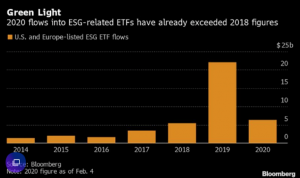
    ESG is here to stay and companies who can help larger companies meet ESG benchmarks/standards are going to do rather well. The flow of funds into investment products that track ESG friendly corporates is striking and provides further incentive for laggard companies to up their game or face valuation discounts in public markets or M&A discussions.  Already, fund flows 6 weeks into 2020 have surpassed total flows for all of 2018 as this graphic from Bloomberg illustrates:

    To get a flavour of the punishment inflicted on less ESG friendly companies, consider the case of Exxon Mobile whose valuation has crumbled by $184 billion since its peak in 2014. Clearly, an excess supply of oil, consequent lower prices and the growth of renewable energy have hurt cash flows. However, that doesn’t explain all of Exxon’s collapse from being the world’s most valuable company as recently as 2012. Climate change is the elephant in the room which is applying an ESG discount to those still-enormous cash flows.

    The opportunity for smaller companies is to help these monster enterprises join the ESG-friendly club. There is no shortage of cash to throw at this challenge and no shortage of opportunities for innovative solutions. Just yesterday BP, under a new Irish CEO, announced plans to “reinvent” the oil giant by setting a net-zero carbon footprint target by 2050. Whether BP meets those targets or not is up for debate but it is absolutely certain they are going to spend BIG to reposition the firm.

    That’s a double whammy of good news for entrepreneurial spirits. It’s always good to know there are some very rich and desperate ESG customers out there, as well as an informed and active investor base consistently funding great startups at Spark Crowdfunding. These investors are not alone. Currently, $30 trillion of investment funds use ESG criteria in their securities selection process.  So, as the political world grapples with daily Watergate flashbacks and worse, it would seem prudent once again to take the sage advice of that era to follow the money…..

    Interested in learning more about ESG? Then check our previous blog on the topic “ESG: Corporate Health Is Your Wealth“!

  • The Most Important Crowdfunding Chart in Europe

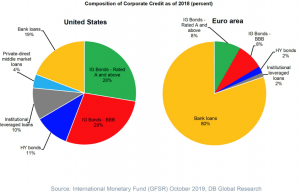
    The market value of The Walt Disney Company is now greater than that of the five largest banks in Europe. If one were impolite you might describe this as a triumph of creativity over destruction. However, the aim of this article to be constructive and recognize the role of Europe’s banks as the primary source of capital for business. That must be a good thing, right? Yes, but there can be too much of a good thing. Here’s a chart from the IMF which should challenge the thinking of all investors and business owners in Europe. It compares the role of US and European banks in funding corporates.

    Wowzers! Banks in Europe provide about 80% of debt capital to businesses. Only 20% of funds are provided by investment markets. In the US the market structure is almost the exact opposite. The graphic above tells us that capital markets are far deeper, more diversified and more sophisticated in the US. It is very apparent, if we consider the US a market leader, that there are opportunities for alternative providers of capital to engage with European corporates. Of course, there are cultural challenges and banking traditions in Europe but the ugly truth is that corporates will have to look elsewhere as ultra-low interest rates (ZIRP) crush banking business models.

    If one were to think further about the market data above it is also clear that European investors have favoured saving in bank deposits rather than investing. In a negative interest rate world that strategy looks a little challenged. It is quite possible decades of traditional saving behaviour will change and seek out new investment opportunities. Many investors will have seen “Dragons’ Den” TV programmes in recent years and wonder can they add a little extra risk/return to their portfolio. The good news is that equity crowdfunding platforms are growing rapidly in size and numbers across Europe to bank the start-up Disneys of the future. The dragons are hunting in size.

    That’s not a fantasy. It’s a current banking reality on Planet ZIRP.


    Enjoyed this blog? Then why not check out our other great content by clicking here!

  • Equity Crowdfunding – How Irish Private Investors can Identify Winners

    Equity Crowdfunding – How Irish Private Investors can Identify Winners

    With interest rates at an all-time low, Irish investors are looking for the best ways to get a return on their funds.  Investing in the right private companies can deliver high rates of returns.

    Equity crowdfunding makes it easy for small to medium sized investors to buy shares in private companies.

    Think of equity crowdfunding as an online version of Dragons’ Den where an entrepreneur is looking to raise (say) €300,000 in return for 20% of their company and ordinary individuals (i.e. the ‘crowd’) can invest anything from €100 upwards.

    The crowdfunding platform, such as Spark Crowdfunding, then pools all of these small investments into one large amount to buy the 20% share of the company on offer.

    Equity crowdfunding therefore gives small investors access to investment opportunities that were previously only available to angel investors or private equity companies.

    Picking Winners

    But now that smaller investors are able to purchase shares in these start-ups, how can Irish investors identify the best companies in which to invest?

    Here at Spark Crowdfunding, we see dozens of companies every week that are looking to raise new venture funding.  So, we’d like to share with you what are the factors we consider when deciding which companies have the highest chances of successfully raising funds from our database of investors and, equally importantly, what signals or clues emerge from the equity crowdfunding campaign itself that our investors should look out for.

    Factors we consider when trying to spot Winners

    1. Management Team

    The most important consideration for us is the Management Team and their skills, knowledge, attitude and aptitude.  A good Management Team with a bad idea is better than a bad Management Team with a good idea.  We want to know their track record in business and have they built successful companies previously.  The academic qualifications of the Management Team are also important.

    1. Results achieved to date

    We have a greater preference for companies that have actually achieved something, as opposed to a company that says it is going to achieve something.  Specifically, we like to see evidence of demand for the product in the form of Revenues from Sales.  Two investment industry buzz words of relevance here are ‘Proof of concept’ and ‘Traction’.  Evidence of both is preferable.

    1. Amount already invested by Management

    If the Management have personally invested money in the business, it tells us they have more to gain by it succeeding and more to lose if it fails.  We take comfort if their interests are aligned with shareholder interests.  The industry buzz term for this is ‘skin in the game’ and the more the better.  For the avoidance of doubt, when we say ‘invested money in the business’, we mean ‘has purchased shares in the company’, not ‘lent money to the company’.  Loans are only of interest if the management is prepared to convert them into shares at the same time as new investors are buying in.

    1. Scale Potential / International Potential

    A business has ‘scale potential’ if it can increase revenues exponentially without a commensurate increase in costs.  Tech or digital businesses are more likely to have this feature, whereas ‘bricks and mortar’ retailers tend to have limited capacity and growth potential.  We prefer companies that have ‘scale potential’, especially those with international scale potential.

    1. Use of Funds

    The use to which the newly raised funds will be put is another important consideration.  We prefer to see as much of the funds as possible going directly into areas that will generate Sales Revenues quickly, as opposed to building an infrastructure.  Related to this is the length of time before the company stops burning cash and becomes cash-flow positive.  We don’t like to see a prolonged period of cash-burn.

    1. Any Patents or other forms of Protection

    We look for businesses that have some protection from competitors or operate in industries with reasonably high barriers to entry.  A Patent can give companies a head-start over the competition, but other equally valuable forms of protection include specialist industry expertise or signed long-term contracts with major clients.

    1. Is the company an Enterprise Ireland Client?

    Companies that are clients of Enterprise Ireland tend to have been through a prior screening process and we take some comfort from this.  Equally valuable is a previous investment in the company from an experienced investor, other than a friend or family member.

    1. EIIS approved

    Our investors can reclaim 40% of their investment in the form of a tax rebate by investing in companies that are EIIS approved.  Clearly, these companies have a higher appeal to our investor database and are more likely to achieve their fundraising target as a result.

    1. B2C or B2B Company

    Crowdfunding investors have the potential to support companies in ways other than just making an investment.  This could include purchasing the product, making introductions to new sales channels or simply offering advice.  B2C companies tend to be more suitable for this.

    1. Exit Plans and Timeframe

    Investors in private companies typically look for an exit within 5-6 years and would expect to receive a multiple of the amount they initially invest.  What this multiple is depends on the risk profile of the investment.  For low risk investments a minimum of 3x would be expected while 10x would be expected for high risk investments.

    1. Realism in Financial Projections and Pre-Money Valuation

    We understand and appreciate entrepreneur ebullience and optimism more than most.  However, we also need to ensure that the Financial Projections and related Pre-Money Valuation are credible and based on realistic and assumptions.  Companies without a defensible valuation rationale will not succeed in achieving their equity crowdfunding target on Spark Crowdfunding.

    These factors highlighted above are what we consider before a campaign goes live on the site.  But once a campaign goes live, there are clues and signals that a savvy investor should look out for, in advance of pledging funds to a campaign.

    Signals that emerge from the Equity Crowdfunding Campaign that Investors should look out for

    1. How much is the Management Team investing at the current valuation?

    The best proof that Management believe the valuation represents a good investment opportunity is if they are also investing in this current fundraising round.  It is a very positive signal if Management are investing a meaning amount.

    1. How much are other investors investing? Sophisticated Investors or mugs?

    The beauty of an equity crowdfunding campaign is its transparency.  Everyone can see how much has been invested at any given point in time.  If others are investing, then the campaign is worth exploring further.

    1. How quick does the Campaign Promoter respond to questions about the fundraising?

    Questions arise during every crowdfunding campaign and can range from simple issues, like the number of employees, to more complex ones, like the strategy for international market penetration.  Investors can learn a lot about the CEO of a company, not least his or her communication skills, by the speed and depth of the answers.

    In conclusion ………

    Picking winners is difficult, particularly with early stage businesses.  But the landscape has changed and through equity crowdfunding, small and medium sized investors can now sit at the same table as the private equity and venture capital investors.

    As Ireland’s only equity crowdfunding company, Spark Crowdfunding is democratising finance by creating new investment opportunities for small and medium sized investors.  To receive announcements about Irish start-ups looking to raise funds from Irish investors join Spark Crowdfunding for free today.

    You don’t want to miss the next Uber!