Tag: debt

  • Technology Sector Serves Up Critical New Pension Risks…

    Technology Sector Serves Up Critical New Pension Risks…

    That was quick. Half the year gone already but no World War III, no AI ending humanity and no gains for all those crypto lemmings who increased the wealth of the Trump family by $1.4 billion. The Donald deftly sidestepped the crypto shake down with the reassuring deflection of a practiced mobster – “The stock market is going up…Everybody’s profiting”. Sure, Jan. Between Love Island and the upcoming weekend sports-fest one can understand people lacking a little financial focus. So, I will keep it brief today. I’d like to take a look at a number of technology sector financial milestones which have been achieved and then flag a couple of unintended consequences, and probably pension risks. First, the milestones….


    • Tech-heavy Nasdaq Index gained 20% in H1 vs S&P 500 up 9.5%.
    • Semiconductor/chip sector went rocketed 82% in the same 6 months (Nvidia, Broadcom, Intel etc)
    • Memory chip stocks like Sandisk, Micron, Hynix and Samsung are up a whopping 120% in H1.
    • Research house, Gartner, say AI spending will hit $2.6 TRILLION in 2026.
    • The AI hyper-scalers – Google, MSFT, Amazon and Meta – are set to spend $650 billion on AI infrastructure in 2026. 
    • The combined weight of AI-focused stocks across hyperscaling, semiconductor chips, power, hardware and software tots up to 51% of the total value of the S&P 500 index.
    • Nine major AI companies accounted for almost half of global technology borrowing, raising $122 billion in corporate bonds in a single year to fund data centres and infrastructure.


    So, my first observation based on these milestones is that, if your pension is tracking global/US stock markets, then there is a strong possibility you are ‘running’ a significant bet on AI without actually realising it. It’s what the pensions/wealth industry might refer to as a ‘concentration risk’. And, I think the following headlines are flagging a few other AI risks right now….


    • OpenAI Leans Toward waiting Until Next Year For IPO – New York Times
    • Tesla Caps Employee AI Spend At $200 Per Week After Adoption Push – The Information
    • OpenAI in early talks to give 5% stake to US government – The Guardian


    OpenAI, as a reminder, is attached to almost $1 trillion of AI infrastructure projects and the ‘mood music’ in the above headlines is not great. These projects have been funded by trillions of equity and debt from technology and banking partners. So, these partners must be wondering why OpenAI feels the need to grease Donald Trump’s tiny toddler fingers. I’m wondering too, but speculation gets us nowhere. Of course, the complete anti-Donald antidote is truth, numbers, facts and genuine science. So, I was intrigued to come across some excellent research by former colleagues of mine at Quant Insight. These guys use big AI computational power and principal component analysis (PCA) to strip out all the ‘noise’ attached to the pricing/trading behaviour of financial instruments in the equity, debt and FX markets. The benefit of this huge analytical undertaking is to identify the key factors/drivers of a share price or bond price in the current market environment/regime. This is what they found was driving the $10 trillion semiconductor sector ETF (SOXX) which rocketed 80% in Q2 alone….

    It turns out that the biggest external (macro) factor driving the share prices of semiconductor companies was….. lower cost of corporate borrowing. Now think about these companies involved in heavy capex manufacturing and infrastructure activities. A glance at the financial milestones above and trillions of dollars of planned investment spend means these tech companies need external funding given their own revenues and cash flow can’t keep up with the pace of investment required. This means technology companies are now borrowing which was never really a feature of these high margin/cash flow companies previously. For pension funds this ALSO means the whole AI infrastructure story is not just a stock market story. Hidden behind the headlines, there is a borrowing, credit, balance sheet story. Now, think about that 51% exposure of the S&P 500 index to AI. You think you’re getting equity and AI exposure but….. you’re also acquiring an exposure to a credit (lending) book as large as many dedicated private credit funds. Now check out the recent headlines on private credit funds.

    Actually don’t. Enjoy the weekend sport first!

  • The Truth Can Hurt ….. Investment

    The Truth Can Hurt ….. Investment

    Forty years ago this week, reactor 4 of the Chernobyl Nuclear Power Plant exploded. The human and monetary costs were in the thousands and hundreds of billions respectively. More difficult to quantify was Chernobyl’s contribution to the collapse of the Soviet Union. However, I did re-watch the excellent HBO series Chernobyl in recent days and was struck by a non-monetary factor which might resonate for those currently enduring daily White House appeals to ignore our eyes and ears. The words of Professor Valery Legasov of Moscow State University in the opening scene of Chernobyl seem almost prescient  –  “What is the cost of lies? It’s not that we’ll mistake them for the truth. The real danger is that if we hear enough lies, then we no longer recognize the truth at all.”  For the USSR, the truth of technological decline, an obsolete economic model, and the inability of centralised power to deal with the complexity of a more connected global economy was easy to see. But fatally, not recognized. Fast forward to today, and we could be in similar TRUTH territory….

    Don’t worry, we won’t go down any conspiracy theory rabbit holes. So, no need to wonder why a would-be assassin might gain access without security challenge to the Washington Hilton and within one floor of almost the entire Trump regime senior leadership at Saturday’s annual White House Correspondents dinner. If the current head of the FBI is nicknamed “J. Edgar Boozer” then the truth is closer to incompetence than conspiracy. Similarly, but with far greater global economic impact, if Germany’s normally cautious Chancellor Merz is saying that the US has “no clear exit strategy” and is being “humiliated” by Iran, then the truth is that the US does not really “hold all the cards” or the keys to “Schrödinger’s Strait” of Hormuz. The consequences are plain to see as oil prices soar past $110 per barrel again and OPEC’s number 3 producer, UAE, just left the cartel after 59 years of membership.

    Clearly, the old world order alliances from NATO to OPEC are fragmenting. And, that’s before anyone dares to mention the eye-catching new Pew (March 2026) poll showing 60% of Americans now view Israel unfavourably — up from 42% in 2022. That’s almost as bad a swing as Trump’s voter approval on dealing with inflation shifting to a net MINUS 40, and national Consumer Sentiment surveys (Michigan/Ipsos) diving to the lowest levels seen since 1978. And yet….

    There’s a danger we have been distracted and miss other truths. Watch what people do, not what they feel. For example US consumer sentiment might be plummeting but US retail sales are running ‘hot’ at 7.7% year-on-year growth, the fastest growth pace seen since 2022. Meanwhile, fossil fuels and Strait of Hormuz blockades (unless you’re a Russian oligarch’s yacht – I know…Russia, Russia, Russia) might be dominating the gloomy headlines but there’s more positive long-term developments accelerating at speed. If you have been unable to copy or track Baron Trump’s oil trading strategies or share the Fox Business congratulations of Maria Bartiromo on Eric Trump’s new $24 million contract with the Pentagon(yup), then there’s good news and bad news. The bad news is you’re not making millions on risk-free trading or commerce, but the good news is you won’t need a fitting for an orange jump suit. However, away from the fossil fuel supply crisis, check out the following quiet developments which could hurt your investment portfolio if you miss them…


    • In 2025, for the first time in history, clean power met every single unit of new global electricity demand.
    • Renewable energy sources (33.8%) officially crushed coal (33.0%) for the first time in 100 years.
    • Electric vehicle (EV) sales in emerging markets have surged 80%.
    • In Europe, EV sales soared 51% in March while EV sales smash through 25% of the total global market.
    • Chinese company, CATL, just unveiled a battery with a 1,500km range that charges in 6 minutes
    • China exports of batteries, EVs and solar cells were up 34%, 53%, 80% respectively last month.


    A quick glance at the last two developments might suggest another uncomfortable truth; China is winning this global electrification ‘war’ and arguably is the winner of the Persian Gulf one too. However, there’s clearly only one country, USA, winning the global race for AI investment capital right now. The AI chip superstar stock, Nvidia, has just clocked up another $1.25 trillion increase in market value in less than 4 weeks. Nvidia’s current market capitalisation of $5.25 TRILLION is just shy of the entire value of Germany’s GDP and surpassed by only those of China and the USA itself. Google and Nvidia’s combined market value is now over $10 trillion.

    AI is acting like a ‘death star’ for other investment sectors as it sucks up huge amounts of investment dollars. In Q1 of this year software stocks collapsed 29% from their highs while 81% of all venture capital funding ($265 billion out of $330 billion) went to AI start-ups, with 65% of that going to just 4 companies (Source: Pitchbook). You’ll keep hearing and reading that word “concentration” and how investment capital is racing into ever narrower niches within technology. However, it might be worth keeping a mix of old and new names on the investment radar. Here’s two to watch:

    NEW: Anthropic, the parent of my new best work friend this week, Claude, is apparently trading in private markets right now at a $1 trillion valuation. Of course, it does help valuations if your annualised revenue jumps from $9 billion to $30 billion….in just 3 months.

    OLD: Samsung, the unwieldy Korean conglomerate of TV, phone and memory chip manufacture, is going to be the most profitable company in the world by 2027. Bloomberg reckon Samsung will edge out Nvidia for top spot with a whopping operating profit of $330 billion. Yep, good old memory chips (DRAM, NAND etc) are needed by Claude, Gemini and all the other agentic chatbots to remember you (and your prompts).

    So, that’s all good for now. But, let’s get back to the Truth thing. And, we’re not talking about AI chatbot hallucinations, or even Trumpolini’s Jesus delusions. It’s much more basic than that. In the middle of all this AI euphoria sits the company who kicked things off with ChatGPT, Open AI, and its CEO, Sam Altman. This week we heard OpenAI are behind on planned revenues and new subscriber growth targets. These things happen in fast growing tech stories, but OpenAI is attached to $1.2 trillion of AI infrastructure deals where OpenAI’s commitment is $600 billion despite current annual cash burn of…… $17 billion. Furthermore, OpenAI does not have a huge balance sheet like Google, Microsoft or Amazon. So, credibility and confidence matters. And, I’m concerned.

    Altman’s career history per various in-depth media articles (the New Yorker one is best) is littered with massive commercial relationship breakdowns and a common theme. Loss of trust. Phrases like “profound mistrust”, “lack of candour”, “consistent pattern of lying” and “deceptive and chaotic behaviour” are used to describe the CEO of a company seeking to publicly list (IPO) in New York this year with a valuation of more than $800 billion. This week Altman faces Elon Musk in court for a $150 billion lawsuit brought by the latter regarding governance at OpenAI. Let’s just say the potential damage to Altman’s credibility could have ‘nuclear’ consequences for the AI financial ecosystem. Watch carefully and remember the fragility of the Open AI balance sheet in the context of its trillion dollar commitments. Then think of Chernobyl and Valery Legasov’s most powerful words which we have cited before on these pages…

    “Every lie we tell incurs a debt to the truth. Sooner or later that debt is paid”

  • When Words Are Definitely NOT Our Bonds…

    When Words Are Definitely NOT Our Bonds…

    There’s only one thing sicker than an Irish parrot outfit this morning. That’s the global bond market. The biggest bully of them all is sick of the nonsense. Not just the front-running of the US President’s social media posts. The Financial Times rightly flagged this week the gob-smacking scale of corruption and ‘insider’ trading going on close to the Oval Office but, in real financial terms, the pricing reactions of equity and oil markets to Trump’s Monday TACO were relatively muted. Of course, oil prices dipped below $100 earlier in the week but they’re back above $110 now. Similarly, the S&P 500 spiked for a day but it too is back slightly below Monday levels. Arguably, Trump’s words have been losing credibility since his first TACO retreat on tariffs in April last year but there’s a much more dangerous aspect to this credibility failure now. Truth has officially fled the higher echelons of US institutions and that impacts the biggest contracts of them all, United States Treasury bonds’ (or IOUs) credit worthiness with the rest of the world. Here are the headlines you’re not reading…


    • The yield on the US 10-year Treasury bond has deteriorated/risen by 13.5% (in yield or cost of money terms) since the Iran war began.
    • The yield on the US 20-year Treasury bond has deteriorated/risen by 11% in the same period (25 days!!).
    • The yields on US Treasuries are used to price almost everything so the average cost of a mortgage in the US is now at a 7 month high despite job creation being at a multi-year low.
    • It’s not just the cost of US assets. The global disruption caused by the Iran ‘operation’ has driven Japanese government bond yields up by 16%.
    • UK bond yields above 5% are the highest seen in 20 years.


    The price moves above are the ones that really count. And their message is very clear: the damage done to energy infrastructure and global supply chains is inflationary. The bond traders don’t believe a word of what is coming out of the White House and Pentagon propaganda machines. The opening up of the Strait of Hormuz is dependent on Iranian cooperation and the ability of logistics companies to commit their ships and crews to a safer and insurable environment.  At current levels of reduced shipping activity, the world is losing 11 million barrels of oil every day, as well as numerous other critical distillates like ammonia, diesel, helium, urea etc.  The key point is that bond markets do not “price” temporary cost spikes or supply squeezes. The bond market is explicitly contradicting the Trump regime and suggesting longer-term disruption. In fact, the French government have laid out the following observations:

    • 30-40% of Gulf oil refining capacity is destroyed.
    • That is the worst energy infrastructure destruction since WW2.
    • Full repairs could take 3 years.


    Thanks Donald. Actually, you don’t need to thank him. Speaker of the House of Representatives, Mike Johnson, went full North Korea at this week’s National Republican Congressional Committee fundraiser by presenting Trump with a new award. The Guardian reports:


    “The president has done so much for the American people and we want to honour him, in some small way, some token of our appreciation for his leadership,” said Mike Johnson, the US House speaker. “So, tonight, we have created a new award.” Johnson then introduced the “America First” award, made up of a golden eagle statue. “We could think of no better title for what that is,” said Johnson. “That’s this beautiful golden statue here – appropriate for the new golden era in America.”


    Idolatry and empty words. Asia might have other words right now. Latest headlines suggest crisis:


    Pakistan is reducing government working hours to save energy

    India is diverting gas from factories to homes

    Philippines declares a national emergency

    Japan to temporarily lift coal power plant curbs over Hormuz crisis


    Clearly, bond markets are looking East and not West for the true story. Indeed, it was striking how most commentators and traders earlier in the week were looking to Tehran to verify whether the US President was telling the truth about ‘negotiations’. Yes, an autocratic theocracy is now more credible than the leader of the ‘free world’.

    It’s a very strange world, but I suspect the bond market will have a very big say about how events unfold in the Middle East from here.

  • Software Is Eating Your Pension….

    Software Is Eating Your Pension….

    Is it time to rip up our favoured playbooks? No, I’m not trying to steer Andy Farrell after that first half ‘traffic cone’ tackling effort in Paris. Nor will I hold out any hope of Britain’s Labour Party saving its government from the existential fallout of ignoring its own “Prince of Darkness” links to Epstein. Sir Keir Starmer’s premiership is already “dead in the water” but I will stick with the trading theme. Long-time political commentators are rightly appalled that Peter Mandelson tipped off Jeffrey Epstein and his elite rolodex/assets about a €500 billion bailout of the euro currency during the Greek debt crisis. The €500 billion number is huge in its own right but the derivative opportunities in banking debt, currencies, bond markets etc at the time were in the trillions and available for exploitation by Epstein & Co without any obvious trace. So, following on from last week’s article, we promised to dig deeper into the huge AI numbers hitting our screens. Actually, we won’t. Instead, we will focus on a related huge number with potentially massive knock-on/derivative investment implications.

    For me, the big number this week is the $1 trillion of value wiped from software stocks (and their SaaS subscription/business models) in just 6 days of trading. Of course, this is directly connected to the threat of AI and some developments, in particular, from the Anthropic/Claude suite of products which are making massive strides in assisting coders and companies to develop/manage their own work processes. Software, of course, is the incumbent go-to solution for companies seeking to optimise work processes and engagement with their customers. Indeed, the venture capital guru, Marc Andreessen, in 2011 was moved to say  “software is eating the world”. From Netflix to Uber to Amazon, digital subscriptions gave companies and consumers access to technology-optimised services. As AI invades the digital opportunity, software is possibly no longer the ‘always’ solution on the Boardroom table. In fact, software could be on the displacement menu itself. The twin threats of AI are summarised well by Business Insider:


    “First, if employees get more efficient using AI tools, companies may not need to buy as many business software subscriptions. That would dent the growth of “seats” or how many subscriptions software companies sell. Each employee has a seat, so if there’s no new hiring, growth stalls.

     The second threat is more existential. If AI tools and AI agents get good enough, companies could replace the software they use entirely and instead rely on new AI-powered workflows. And with AI coding tools showing big improvements lately, companies could even develop their own software, without needing to buy it from established vendors.”


    There are plenty of analysts and observers who disagree with the gloomy interpretation of AI’s eventual impact on software companies like SAP, Salesforce, Adobe, Figma and HubSpot. However, these company share prices falling by 30-40% in just one month, is telling us the ‘fear’ is real. The $1 trillion of value evaporation in less than a week is not an earth-shattering number given some individual companies are valued in the trillions alone. But… perhaps looking at the software value obliteration in isolation is misguided. The commentariat might think software fears are ‘overdone’ but, if you have a pension, this might be the less scary of TWO outcomes. The first is that software stocks growth and valuations are hit severely by AI replacement. However, there’s a second set of updated numbers/data to take a look at. While the software sector was being hammered, the AI/Cloud giants were announcing quarterly results. Interestingly, their earnings and sales growth numbers were pretty much ignored as the market focused on just one number; capital expenditure spend on AI infrastructure and development. Last week Facebook promised $135 billion of INVESTMENT in 2026 which equates to their total sales in 2023. Microsoft told us their number was circa $105 billion. This week it was Google and Amazon’s respective turns to talk the AI ‘space race’…

    Google, perceived as the AI leader these days, told the market it would spend a cool $185 billion. That equates to its total revenues in 2020(!). Meanwhile, Jeff Bezos seems happy to test out the theory that “Democracy Dies in Darkness” at the investment-starved Washington Post, as his primary wealth creation vehicle, Amazon, announces a planned $200 billion capex spend for 2026. So, the Big 4 are up for a $625 billion investment splurge this year and probably every year for the foreseeable future. That looks like a bet of $3 trillion to $5 trillion on AI, and I’m just wondering what the ‘risk’ calculations could be? I chose the ‘space race’ phrasing earlier deliberately. It feels like the prospect of AI failure for these companies is existential in terms of economic power and analogous to the geopolitical calculations at the height of the Cold War in the 1960s. Well, the historians would probably agree that Reagan’s “Star Wars”  broke the Soviet empire. It’s too early to tell who will ‘break’ in the AI race but software is in the crosshairs right now. However, the sense that big tech including software is ‘going for broke’ introduces a very new risk for financial markets.

    The beauty of software and SaaS business models is recurring revenues, huge scalability at minimal incremental cost, 80-90% margins and enormous cash flow generation. The end result can be seen in the massive spending plans of Big Tech; these companies’ balance sheets were sitting on enormous cash piles (or equivalent liquidity). Simply put, these were the most robust (credit risk) companies on the planet. Pension funds, family offices, sovereign wealth funds and Swiss bank accounts loved the security/risk safety attached to loans and bonds issued by tech/software companies. These instruments were considered “defensive”. Now, not so much.

    Stock/equities markets (as my former boss Terry Smith used to point out to me) occupy 28 of the 30 pages of the Financial Times. But, the last two pages covering debt, currencies, commodities etc are much more significant for financial markets. Now the bonds and loans associated with big technology companies are receiving intense scrutiny (and investor selling) as they each seek to out-spend their cash and balance sheet credibility. This has incredibly important implications for your pension. The credibility of the United States and global technology stocks are being reviewed for their ‘risk safety’. Some serious investment institutions are already acting and re-positioning. This doesn’t mean just selling. What investors are buying at the moment is telling too. Here’s a few data snippets to alert you to what is happening right now….


    *Software sector selling activity is the worst since 2008

    *Software valuations – forward price/earnings multiples of 20x – are now at levels (low) not seen since 2014.  

    *Now the buying: defensive consumer staples companies (Nestle, Mondelez, Heinz etc) have been up 1% on consecutive days while technology sector companies fell 1% on the same days. That divergence of performance has not happened since ….2000.

    *The same consumer staples stocks are experiencing buying intensity (“RSI” for the technicians) not seen since 1995. Other indicators (DMA 200 day) are 4.2 standard deviations above average.


    It looks like people are buying ordinary stuff; petfood, protein, household goods, chocolate….. really boring but real. We have written before that investors are flocking to atoms (real) and hedging/selling their risk with bits(digital code). One suspects the meltdown in crypto land (Bitcoin at $65,000, down over 50% from its highs) is also partly driven by digital ‘fear’. So, for those keeping an eye on the headlines and their pensions, you might want to check with your advisors on three areas:


    1. Pension exposure to technology (software or AI spend). It could be as high as 30% of your portfolio.
    2. Pension exposure to defensive real stuff. It could be as low as 5% of your portfolio.
    3. Pension exposure to the USA. It could be as high as 70% but there is currently a lawless armed militia running around the country, a Supreme Court in dereliction of its duty, international grift on an epic scale and the real threat of mid-term election suspension.


    The advisors won’t have all the answers but it should be on ALL pension radars. This period of history offers mind-boggling opportunity but we must be also aware that there is an unusual confluence of technology ambition/confidence and global political leadership operating in an environment where traditional values and rules are being disregarded. Hopefully, rules-based leadership will return soon but here’s a warning from Andrew Ross Sorkin’s book, 1929:


    “It’s a haunting elegy for a fractured era, a timeless reminder that progress is fragile, choices have repercussions, and the flaws embedded in the human condition are ours to confront”


    Might be time to make better choices and confront those flaws (including White House ape videos)….

  • Don’t Get Angry, Get Ready….

    Don’t Get Angry, Get Ready….

    I was right. The first of my predictions for 2026 was spectacularly on the money. Sadly, it won’t make any of us wealthier given its focus on noise rather than direction. To refresh memories, the final words in my last article, Themes and Dreams For 2026, were as follows: “I’ve a feeling I won’t be short of writing material in 2026.” Little did I know there would be a year’s worth of material in just the first 10 days of 2026. Where do we start?

    The US is celebrating its 250th birthday by re-branding as an exploration company with an army (hat tip George Carlin) as Venezuela is ‘acquired’ and ‘takeover bids’ are lined up for the Panama Canal and Greenland. Back at HQ, the Boss re-asserts control of executive salaries and cash flows in the company’s defence supply divisions while promising a 50% expansion of investment ($1 trillion to $1.5 trillion) in its Business Development unit, previously known as the Department of War, and before that, as the Department of Defense. Meanwhile, the company’s traffic stop management division has secured immunity from regulatory or criminal oversight of its shoot-to-kill (or stop) policy on a nationwide basis, not just in Minneapolis. Of course, none of these revolutionary business initiatives can happen without funding. The company’s Treasury unit has set up overseas bank accounts to deposit proceeds of its newly acquired Venezuelan oil unit. In the interests of tax efficiency these bank accounts will be overseen directly by the Boss, and will not be consolidated in the parent company accounts. But, of course. However, US Inc is not the only company turning to oil….

    It is probably more accurate to say some companies are breaking with a seismic global shift to electric power. Again, it’s American-sourced exceptionalism. This week General Motors (GM) has followed Ford and abandoned its move in to electric vehicles (EV). These recent investment write-offs amount to $7 billion and $19 billion respectively which will hurt. But… that might not be the end of the pain. The train, or car, has already left the station. The Electric Age, per the superb Noah Smith, is here with 25% of cars purchased in 2025 of the EV variety. In many Asian and a few European countries that penetration rate is through the 40-50% level. China leads the world in the entire EV technology stack and have focused their attentions on battery production, manufacturing scale and grid expansion (solar). Fewer moving/motor parts, efficiency and superior performance are the current and long-term edge for EVs which will kill the internal combustion engine (ICE). Writer’s note: Be careful how you say or ‘weaponise’ that acronym these days.  All is political these days rather than factual which highlights why the US is making a fatal error on oil over electric. Noah Smith writes:


    The main reason America is missing the EV transition is that we’ve insisted on thinking of EVs in terms of climate — as a “green” technology whose purpose is to save the environment, rather than a superior technology whose purpose is to save you time and money. Trump canceled EV subsidies because he associates them with the environmental movement and the political left.


    It’s not just electric vehicles(EVs) experiencing their electric break-through moment. EVs share the same components as drones, trains, cameras, phones …..and robots. Just this week at the massive CES 2026 conference in Las Vegas, Nvidia’s Jensen Huang didn’t even blink when asked how long it would take for humanoid robots to match human-level ability. “This year”, he said. Guess what – those robots run on many of the exact same components which go inte EVs. Think batteries, power/motor electronics, sensors, software…..and AI. Clearly, in the AI piece of the assembly package, the US is perceived as the global leader. However, even AI and its support infrastructure is inextricably tied to electric power. And, before you say “but, but, but… the Venezuela oil reserves”, get ready for more non-delivery from the “stable genius” back at HQ. Venezuela currently produces less than a million barrels of oil per day. It’s like a rounding error of less than 1% of global oil production. Yes, that production level can grow but please note the lack of announcements from US oil company executives about investment plans and potential commercial negotiations with Venezuela’s 5,000 plus generals and regional warlords. While the Department of War was planning ‘business development’ in Latin America, China built more solar power capacity than the rest of the world combined in 2025. For perspective, that additional solar capacity of 380GW built in 2025 equates to 5x China’s total existing nuclear capacity (58 plants). Get ready or get digging on two fronts.

    First, we have written a lot in 2025 about the asynchronous explosion of excitement and revenue projections for the AI world and the mining sector. At certain times in 2025 one AI company, Nvidia, was worth 4 times more than the entire publicly listed mining sector. Get ready for a change. Gold, silver, platinum and copper prices have soared which has finally juiced the risk spirits of mining sector executives. We said the sector needed a big deal. Well, global giants Glencore and Rio Tinto are talking a megadeal again with a copper focus (yep, all that electricity) and a $260 billion valuation. Metals of course in earlier times were the basis for currency. In time, central banks became the back-stop or guarantor of currency but we might have to dig again.

    The global reserve currency, the US Dollar, lost almost 10% of its value in 2025. In isolation, this is not unprecedented. In fact, the Trump regime are quite keen on a softer dollar and lower interest rates for trade deficit and investment reasons. However, we must get ready for a further assault on institutional independence in the US. The current Fed Chair, Jerome Powell, is due to leave his post in May this year. The new appointee (apparently already decided by the Boss) will be expected to cut interest rates dramatically to keep Trump happy. However, the potential unintended consequence of this action in the context of a $40 trillion US national debt is loss of credibility for the Fed and its ability to prudently manage that debt, and the currency. Hopefully, the bond markets are more effective than Russian or Chinese radar systems in spotting and thwarting that assault on Fed and dollar credibility. A final word on markets and pensions.

    Those of you reading your pension updates/reviews for 2025 might be underwhelmed by the performance. Before you get angry, I would recommend a read of Terry Smith’s own review of his $20 billion fund which underperformed in 2025. As always, my former boss writes superbly and highlights some key factors driving investment markets these days. Terry always sticks to the basics and this might well be a theme for 2026. The thoughts above should ready minds for investment opportunities in electrification, real assets, financials, mining and assets located outside the exploitation company, US Inc, formerly known as the United States of America…..

  • Is This The End….?

    Is This The End….?

    Let’s start with the easy one. I’m A Celeb 2025 is almost finished. The more tricky version of this headline question might relate to the Epstein files or even the filing of war crimes charges in The Hague against US Secretary of War, Pete Hegseth. Not any time soon me thinks. We could ask Sleepy Don but he might become angry – about the sleepy bit, not the war crimes or paedophilia. Actually, the question most asked in recent weeks is about the end of the AI boom. I asked my own excellent AI ‘friend’ Claude (courtesy of Anthropic) about ‘bubble’ mentions in the media and even he agreed in his remarkably comprehensive market summaries of public and private markets that the AI bubble question is occupying investors’ minds. Mine, not so much. More on Claude later, but first a historical perspective. The last technology boom in 2000 did indeed end in a bust but generalisations on technology can be misleading.

    Back in 2000 we should remind ourselves of the telecoms companies racking up massive debt obligations to acquire mobile spectrum licences and build out fibre/internet networks. Then there were the infrastructure suppliers like Ericsson, Nortel and Cisco dependent on those telecoms, internet and wireless expansion projects. Then the projects stopped. A possible over-simplification by this writer, but a combination of over-build and debt pressures slowed activity and cratered the valuations (growth expectations) of the leading infrastructure players. For illustration, Cisco was trading on a price/earnings multiple of 200x in late 1999. Twenty five years later the Cisco share price has finally recovered to within touching distance of its $80 high in 2000. However, one must make a distinction between the infrastructure plays and the tools/applications which were built on those over-priced networks….

    The Nokia phone in my year 2000 pocket didn’t end up ruling the world but Apple and the mobile internet did. Similarly, Google was just 2 years old at the time and wouldn’t IPO until 4 years later, the same year as TheFacebook Inc was born. Mobile networks enabled commerce (Amazon) and communities (social media platforms) to flourish and generate enormous wealth. Readers might be now detecting a similar pattern with AI. The race for computing power (in 2000 it was networks) is an infrastructure story but investors must not lose sight of the applications of AI and the business models possible (Amazon was an online book store once). The tools like Claude, ChatGPT and Sora are really only in their infancy. The infrastructure story is driven by GPU/TPU chips (Nvidia), cloud computing, hyper-scale data centres and energy. And it’s possibly infrastructure again where risks are building. The CEO of IBM, Arvind Krishna, in recent days put some numbers on those risks.

    Krishna cited a data centre power consumption estimate of 100 GW which at current costs would mean an $8 trillion capital expenditure in the next few years. Now, for the wet blanket of capital reality. That ginormous $8 trillion spend would need to earn profits of $800 billion just to pay the interest/cost of that capital. Yep, that’s stretchy but get ready for the other reality. This infrastructure isn’t piping, fibre, railways or copper which lasts for decades and is depreciated gently over time. The chips which currently power Nvidia’s $5 trillion valuation and sit inside all these data centres could become technologically obsolete within 5 years. Arguably, at current innovation/evolution rates that timeline is too optimistic. Imagine having to replace all your chips every 3 years… ? That should make creditors to these huge data centre projects a little queasy.  The International Financing Review summarized the massive acceleration in borrowing as follows:


    An unprecedented splurge from companies at the forefront of the AI boom that has left banks and investors potentially on the hook for billions. Alphabet, Amazon, Blue Owl Capital, Broadcom, Oracle and Meta have between them issued US$120bn of corporate bonds since September – and are raising another US$38bn in the loan market. The debt binge shows no sign of abating, with JP Morgan predicting US$300bn of bond issuance next year – and US$1.5trn by the end of 2030. Another US$2.3trn could be raised in equity, structured finance and private capital markets over the next five years, as hyper-scalers tap every available pocket of capital to finance the US$5.3trn of investments into AI they are expected to make”


    Before everyone runs for the hills, we need to be mindful of some very positive starting points. These technology giants tapping the debt markets in most cases are swimming in cash, have dominant market positions and are generating prodigious annual cash flows of almost $700 billion. These are not the fragile telecom balance sheets of the TMT bust in 2000. Of course, OpenAI, sits in the middle of that famous Financial Times graphic showing $1.2 trillion of data centre projects. In my personal view, OpenAI is the weakest link but that could take years to play out. The harsh truth for all investors is that we don’t really know who will win the foundational large-language-model (LLM) race. Google’s Gemini 3.0 seems to be winning this month and did anyone notice Google share price is up 67% year-to-date? Yep, and my Claude’s parent company, Anthropic, is looking to IPO at a $350 billion valuation. These are very early days. Just ask Nvidia. Actually, don’t. They are saying nice things about almost everyone because all are prospective customers. But….. as always watch what a company does, not what it says.

    Nvidia made a $2 billion investment in chip designer, Synopsys, this week. This is just the latest move by Nvidia in what can only be described as a deal spree. In 2025 alone the company has backed 77 equity investments in start-ups, as well as making 5 outright acquisitions (Source: CB Insights). Let’s just say it looks like Nvidia is hedging its AI ‘winner’ bets. Indeed, the ‘AI infrastructure’ bubble fears run the risk of missing the true lessons of the TMT bubble bust of 2000. ChatGPT might be today’s Nokia but the monthly user statistics tell another ‘mobile’ story. ChatGPT is used by 800 million people each month. Gemini is fast catching up with 650 million devotees and Microsoft’s Co-pilot has 200 million monthly users. The market, business or individual, is already converted. That’s the true investor opportunity.

    Meanwhile, there’s a bigger story brewing at the other side of the world. Arguably, we really do need to see that story end very soon. More next week on why troubles in Japan’s bond market REALLY scare me……

  • Banks Are So Back!!!

    Banks Are So Back!!!

    It’s a weird world right now. I endured another episode of “The Celebrity Traitors” last night and wondered how the US version would work without offending the Kremlin ‘besties’ and reality TV cast of Mar-a-Lago. And who knew Joe Marler would out-smart Stephen Fry? Serious kudos to the rugby front row forwards fraternity. Anyway, park reality TV and let’s face market reality. Another weird one very close to home – Irish banks are now achieving 89% customer satisfaction ratings. It’s amazing what one can achieve by leaving the small business sector completely unbanked in terms of risk capital. However, it can’t be denied that banks are SO back in a global sense. And, some are really ratcheting up the risk dial. Today’s article is really a whistlestop tour of global financial sector developments which caught the eye in recent weeks.

    Let’s kick off with Blackrock Inc. It’s results season and Larry Fink’s giant asset manager recorded net inflows of investment monies in excess of $250 billion in Q3 alone. Blackrock’s current total assets under management (AUM) have just hit a record $13.5 trillion, yep trillion. You might say Blackrock is not a bank but if you look closer at those investment inflows, you’ll see private credit(lending) is a huge driver of asset growth. You’d be right in thinking that other institutions are competing or replacing banks in the financing space. That trend brings its own risks. Indeed, the IMF took the opportunity in its 6 monthly Financial Stability Report to warn about “the rapid growth of non-bank financial institutions”. Then, the EU’s Single Resolution Board (which ultimately sorts bank collapses) also warned this week of the “dire” consequences of a non-bank failure. Sounds nervy, but the financial services sector is enjoying record growth thanks to the lack of nerves among investors…

    Robinhood, the trading platform loved by meme-stock and crypto fund day-traders, has seen its share price rocket by 250% since January this year. Then check out Charles Schwab, the US broker/trading platform which started out in commercial life as a newsletter with 3,000 subscribers, and was briefly owned by Bank of America in the 1980s. I had to wipe my eyes on this one, but Schwab now holds $11.6 trillion of investor assets and has just announced its intention to offer digital currency (crypto) trading in 2026. That number was just over $4 trillion when Covid-19 struck. This growth in assets can be equated to the growth of balance sheets and collateral to be used in further investing activity. We can’t avoid mentioning AI but the infrastructure spending by cash rich tech giants is another boon for investment bankers. The latest data from research house, Gartner, is that global AI spending will be $2 trillion in 2026. Amazingly, the star of our most recent article, OpenAI, sits in the middle of $1 trillion of that spending. Needless to say, Wall Street investment banks are doing cartwheels as big tech names compete with each other to announce bigger and bigger spending plans as their share prices(and executive option pools) rocket on each headline. No wonder luxury laggard, LVMH, is seeing its share price suddenly perk up. It’s not alone.

    Investment banking blue chips like JP Morgan, Morgan Stanley and Goldman Sachs all posted record equity trading activity and revenues. The Daily Upside summed up the joy across the wealth and brokerage spectrum:


    “Results from other financial firms this week also showed that clients from scrappy retail traders to high-net-worth jetsetters are hankering for equities and investments. Wealth units at Bank of America  (revenue up 19% year over year to $1.3 billion), Goldman Sachs (up 17% to $4.4 billion), Morgan Stanley (up 13% to $8.2 billion) and more notched high marks. Customer assets at Schwab competitor Interactive Brokers rose 40% to $757.5 billion, and daily trades there rose 47% to $3.86 million.” 


    But it is a weird world. The crypto universe cratered last weekend as Bitcoin elevator-shafted investors with a 20% drop in price from $126,000 to $105,000. Then gold keeps marching remorselessly to $5,000/oz in $100 clips. There is a sense that different cohorts of investors are buying different assets but there’s enough liquidity (investment flow) to drive EVERYTHING upwards. It was striking to see in Schwab’s record inflows that Gen Z and Millenial investors accounted for a third each of new accounts being set up and looking for equity exposure mainly. Meanwhile in California, there’s a new bank coming. Erebor is a new crypto-focused bank which received federal approval this week. The excellent Morning Brew newsletter reports:


    “The new venture will offer traditional and crypto-oriented banking to upstart tech companies and the ultrawealthy, according to its charter application and approval letter. It needs another stamp of approval from more federal officials before operations can commence, but road bumps are unlikely under President Trump’s crypto-friendly administration.”


    Before you think it’s all crypto and AI out there, keep an eye on more familiar moves. Goldman Sachs has done an interesting deal buying Industry Ventures for nearly $1 billion. Small beer you might think, but Industry Ventures is in the venture capital ecosystem with $7 billion of VC assets bought from other VCs (known as secondaries). Clearly, Goldman is taking a view on more VC deals/exits happening and should be a boost for the start-up world. Oh, and JP Morgan are going to put $10 billion to work in nationally important industries and supply chains. In fact JP Morgan sees itself involved or banking $1.5 trillion of projects in the coming years. Here’s what those deals might look like…

    Meta/Facebook has just sealed a $30 billion private capital deal to finance its Hyperion data centre build in rural Louisiana. Here’s the kicker – Meta retains only 20% ownership. Morgan Stanley has arranged $27 billion of debt and $2.5 billion of equity in a special purpose vehicle (SPV). Yip, that’s a more than 10:1 debt-equity structure. Welcome to the world of superhero collateral in the form of AI infrastructure. This is the largest private capital deal ever but expect many more over the next few years. Of course, there are concerns.

    FT headlines this week highlighted poorly structured loans (read opaque dodgy) going wallop and hitting US regional banks’ share prices badly. Also, volatility in financial markets is picking up. However, the key drivers of global investment activity are big tech firms, private capital, sovereign funds etc and they have trillions of cash and collateral to deploy. This is not quite TMT era when the major players, telcos and media, were already swamped with debt. Returns on investment will obviously be the metric to watch in the future but arguably we are a few years away yet from getting visibility on AI’s payback. So get ready for more deals, more AI and more financial services profit joy. You’d almost be tempted to get exposure to these big structural trends. Well….. keep your eyes peeled next week as Spark Private will have a very interesting deal for you with a strong blend of alternative assets, financial services and AI baked into the offer.

    We are SOOOO back.

  • Virtuous Circle Or Circle Of P..AI..N?

    Virtuous Circle Or Circle Of P..AI..N?

    I’m getting flashbacks. Not good ones. Financial ‘engineering’ was a feature of the world’s last two financial crises. In the TMT bubble collapse, Enron used its stock as collateral in long-term contracts or asset sales which were described as “circular hedging transactions”. The goal or impression sought was to mitigate risk but ultimately all risk was really tied to the Enron share price. In the credit crisis of 2008/2009, new ways of packaging property debt with a bewildering array of acronyms (CLO, CMO, RMBS etc) were supposed to insulate risk within different tranches. Until, they didn’t.

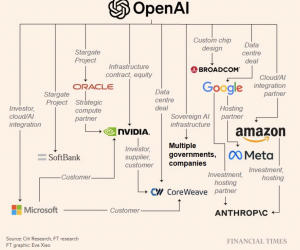
    Now, I’m reading about new ways to finance the AI boom and, again, the risks keep coming back to a very narrow collateral pool. The word “circular” is back and one name keeps cropping up; OpenAI. My newsfeed has been bombarded with multiple graphics from Bloomberg, Goldman Sachs and The Financial Times (see below) illustrating this circularity accompanied by headlines stating that OpenAI is at the centre of a $1 trillion AI infrastructure spending boom. And, I thought they were just building a chatbot (ChatGPT).


    Here’s a few things you might have missed about OpenAI….


    A recent funding round valued OpenAI at $500 billion, the world’s most valuable private company, but….


    It generates NO cash. Latest figures for H1 2025 reveal revenues of $4.3 billion while incurring a net loss of $13.5 billion. Yep, it’s losing more than 3 dollars for every dollar of sales it generates.


    OpenAI has signed up to $1 trillion of deals with the likes of Oracle ($300 billion), Nvidia ($100 billion), AMD ($80 billion) and Coreweave ($22 billion). The Stargate project alone is a $500 billion infrastructure project.


    OpenAI’s core product, ChatGPT, has built a weekly user base of 800 million people.


    Now, let’s return to the deals. I’m not sure the graphics of circularity really capture what’s going on. In recent weeks the world’s most valuable company, Nvidia, announced a $100 billion investment in OpenAI. In return, OpenAI will buy Nvidia’s graphic chips (GPUs) as it builds out its data centre infrastructure. You can see the circular vendor-financing risk in that deal. However, in the last 24 hours OpenAI has announced a further deal with Nividia rival chip maker, AMD. I’m going to lean on Bloomberg’s excellent Matt Levine in imagining the language of current deal negotiations with the loss-making OpenAI.


    OpenAI: We would like six gigawatts worth of your chips to do inference.

    AMD: Terrific. That will be $78 billion. How would you like to pay? 

    OpenAI: Well, we were thinking that we would announce the deal, and that would add $78 billion to the value of your company, which should cover it.  

    AMD:

    OpenAI:

    AMD: No I’m pretty sure you have to pay for the chips.  

    OpenAI: Why?

    AMD: I dunno, just seems wrong not to

    OpenAI: Okay. Why don’t we pay you cash for the value of the chips, and you give us back stock, and when we announce the deal the stock will go up and we’ll get our $78 billion back.

    AMD: Yeah I guess that works though I feel like we should get some of the value?

    OpenAI: Okay you can have half. You give us stock worth like $35 billion and you keep the rest.


    Levine is spot on. It has been bothering me for weeks now. CEOs in the tech world have spotted that a company’s share price goes up on the announcement of huge spending plans (not profits). In extremis, one could route the “value” of the share price gain to a cash-strapped customer like OpenAI. Funnily enough, AMD’s share price rocketed 35% on the OpenAI deal news adding $60 billion to its market value. And, so the merry go round continues. Sure enough, Nvidia, has responded to the behind-the-back dealing of OpenAI with rival AMD by announcing a $2 billion investment in OpenAI rival, xAI, owned by Elon Musk. The total funding round for xAI will be $20 billion but there’s a few extra ‘engineering’ twists. The $20 billion ($7.5 billion equity, $12.5 billion debt) is going into a special purpose vehicle (SPV – remember them?) which will buy GPU chips for xAI’s Memphis Colossus 2 data centre. The SPV, in turn, will rent out the GPU chips for 5 years, with the debt backed by the chips rather than the company. Hmmmm. The rent and SPV details should raise alarm bells.

    The attraction of constructs like rent, leases and special vehicles is that it increases the complexity of an organization and also makes it more difficult to track the true returns (or not) of a company. Rent and leases are considered off-balance sheet items ie they don’t show up as DEBT on the balance sheet. To complete the circle, I’m reading about Oracle today and its astonishing $380 billion in revenue it will generate by renting out its cloud servers to OpenAI and other AI developers over the next 5 years. Oracle can’t afford a rent default. It is not cash rich like Google or Microsoft. In fact, its debt-equity ratio is a whopping 520%. Michael Cembalest at JP Morgan put it rather well…


    “Oracle’s stock jumped by 25% after being promised $60 billion a year from OpenAI, an amount of money OpenAI doesn’t earn yet, to provide cloud computing facilities that Oracle hasn’t built yet, and which will require 4.5 GW of power (the equivalent of 2.25 Hoover Dams or four nuclear plants), as well as increased borrowing by Oracle whose debt to equity ratio is already 500% compared to 50% for Amazon, 30% for Microsoft and even less at Meta and Google. In other words, the tech capital cycle may be about to change.”


    Change, yes. But some things never change in credit or investment cycles. OpenAI might be at the centre of a $1 trillion investment revolution driving stock prices ever higher. But, ultimately “other people’s money” will make its presence felt. Bloomberg is reporting that the amount of debt tied to AI has ballooned to $1.2 trillion. This makes AI the largest segment(14%) of the investment-grade market, surpassing US banks. That means more eyes and scrutiny on the circular world of AI. Bluntly, if a problem emerges it won’t be seen in the stock markets first. It will be in the bond markets with its army of credit analysts. As a final thought, and given the scrutiny applied to the track records of key entities in investment ecosystems, what must credit analysts think of OpenAI?


    • As recently as 2023, the OpenAI CEO, Sam Altman, was fired, then re-hired.
    • OpenAI co-founder, Elon Musk, is now a bitter and richer rival.
    • The company is a strange governance hybrid with control residing in a non-profit Board.
    • OpenAI and early backer, Microsoft, have been in dispute over their partnership terms.
    • CEO Sam Altman was quoted this week in FT saying becoming profitable was “not in my top-10 concerns”
    • Recent $100 billion investor in OpenAI, Jensen Huang of Nvidia, was not told about the deal with rival, AMD.


    None of the above makes OpenAI a bad credit. But, with trillions of dollars of investment capital on the line any loss of confidence in OpenAI could spiral rapidly into a whole new circle of “engineering” PAIN.

  • Big Beautiful Bull Breaks Bonds…

    Big Beautiful Bull Breaks Bonds…

    Here we go again. Toddler throws tariff tantrum again, and then some. I’d say “Happy Friday” but our screens have just puked up a headline about 50% tariffs hitting Europe within the next week. Clearly, the crypto-corruption-fest dinner last night in Virginia didn’t lighten Agent Orange’s mood. Indeed, in the past few hours we have also seen Harvard’s entire international student programme blown up by a planned White House denial of education visas and Apple have been threatened with 25% tariffs on foreign manufactured iPhones. Only a few weeks ago commentators were flagging that trade policy had already changed more than 50 times since Trump 2.0 entered office, rather than a prison cell. One could despair, or even ignore the headlines, but in the bowels of the financial system something is stirring. At first, you’ll be alarmed but there might be an optimistic twist to follow. First, let’s look at the finance stuff.

    The global tail wagging the dog (or DOGE) is the bond market. Specifically, investors in US bonds (Treasuries) are worried about a now centrally-controlled economy run by a fella who almost uniquely bankrupted a casino. There were two events this week which signalled increased investor nerves about US debt and Washington’s ability to rein in its budget deficit. The catalyst was the passing of Trump’s “Big Beautiful Bill” by one vote in the House of Representatives which was a mix of spending cuts for poorer Americans and tax cuts for the rich. Economist, Robert Reich, estimates the have-nots will lose $700-$1000 of benefits (including Medicaid) while the have-yachts in the top 0.1% of US society will pocket an extra $390,000 per year. Sounds ugly, but the bond market is clearly not buying the thesis that making oligarchs richer will benefit the nation overall. Nope, investors in US Treasuries expressed their concern in two ways:


    1. US Bonds of longer maturities (20-year and 30-year Treasuries) were sold by foreign investors which resulted in the yields(rates) on those bonds rising. In simple terms, when a bond falls in price, its yield or rate of interest rises to hopefully attract new buyers.
    2. A regular auction of 20-year bonds conducted by the US Treasury was received poorly and forced the Treasury to offer higher yields to attract sufficient investor interest.


    The blunt impact of these events is that US bonds are becoming less attractive for investors and so they are demanding higher yields (interest rates) to compensate for the risk of policy lunacy in Washington. Think Liz Truss and lettuce economics and then put on your helmet. The undermining of the credibility of the US bond market is a far bigger deal than turbulence in the British bond markets. The critical point about US bonds is that they are the source of the primary building block in every debt or investment calculation around the world. You will see it referenced as the “risk-free rate” of interest which makes the presumption that the US would never default on its debt obligations. Did anyone say bull…..??? Well, the whole world is beginning to wonder is the next toddler tantrum going to be the stiffing of a sovereign counterparty on a debt repayment. And the casino cracker guy has form. However, it will be US citizens who suffer monetarily first.

    The price of mortgages, auto financing, insurance, credit cards, BNPL rates will all rise as ‘risk-free’ interest rates rise. The scary thing is that the concept of “risk-free” returns on dollar denominated debt being trashed will impact the entire financial system and the calculations of everything from M&A deals to commodity prices.  Hopefully, this might spook the right people in Washington, including the 100 Senators who must vote on the “Big Beautiful Bill” too. There are potentially a few other things that might catch their eye.

    Firstly, credit default swaps (CDS) which this country became familiar with prior to Troika/IMF intervention can measure a sovereign state’s risk of default. Right now, the financial markets (through these CDS instruments) are pricing US default risk higher than…. Greece. Second, somebody might spot a little flaw in the MAGA make- everything-in-America dogma. Sure, the US has trade deficits on goods. But, what about services surpluses? More importantly, and a critical input into all GDP calculations, is foreign investment in US assets. We have written recently on Japan’s position as the world’s biggest creditor/investor in foreign assets. But, do you know the country which has the world’s worst, or most negative, net international investment position…? According to research by Deutsche Bank, that would be the good ol’ USA in the chart at the end of this article.

    Finally, as institutional vandalism is in full swing in Washington, the rest of the world is hoping the independence of the Federal Reserve (the Fed), and its Chairman Jay Powell, can be preserved. Again, there is breaking news and it’s not so good. The US Supreme Court overnight has decided that it is comfortable with the idea of independent government agencies (like the FTC, FCC, EPA etc) being abandoned. Instead, the right-wing constructed court has embraced the idea of a “unitary executive” which means Trump gains control over these agencies. However, the majority decision of the court stated that the Fed was not covered by this judgment.  For now. There is perhaps a wider perspective than Fed independence. If US rule of law is under threat, that will ultimately feed into US bond market weakness. Bonds are, in effect, a legal contract between the USA and investors. And, I’m quietly hopeful international bond market investors are going to be bullying quite a few US Senators before they vote…..and understand the impact of the chart below.

  • Beautiful Minds Will Prevail

    Beautiful Minds Will Prevail

    The late Peter Sutherland would smile. Sutherland’s stellar career took in stints as Ireland’s youngest ever Attorney General, youngest ever EU Commissioner, father of the student Erasmus Programme, Director General of GATT and its successor, the World Trade Organisation, topped off with Chairman roles at Goldman Sachs and BP. He was a pretty decent rugby prop forward too. Sutherland’s appreciation of equilibrium at scrum time, laser-like attention to detail and powerful negotiation skills were critical to his success in securing 123 sovereign signatories to the General Agreement on Tariffs and Trade (GATT) in 1993 when the highly complex Uruguay Round of global trade talks were in danger of collapse. He might always have been “Suds” to his friends, but in the international business world Sutherland was the “father of globalism”. And, he truly understood the complexity of global trade agreements. So, what would he make of the Trump regime’s shakedown of the global trading system? Well, as all students devouring legal judgments in the UCD Sutherland School of Law will know, precedent is key. And…..we have Brexit as our stare decisis case study.

    Recall the Brexiteer mantra of “Global Britain” and those fantasy soundbites like “we hold all the cards”, “they need us more than we need them”, or best of all “Britannia Unchained”. Sound familiar? In hindsight, the freedom to pursue new trade deals featured far more chains and ridicule than expected. Britain is still to create the promised bi-lateral free trade deals with the likes of the US and India, while Truss-trumpeted deals done in Pacific Rim countries have had no more impact than if these faraway agreements had been signed by penguins. We mentioned “equilibrium” earlier and this really isn’t just a scrummaging thing. The brilliant Nobel Prize winning research by John Nash, featured in Hollywood’s “A Beautiful Mind”, are the foundation of all game theory analysis applied to trade deals. The Nash Equilibrium is a key concept in game theory where knowledge of other players’ strategies (politics) gives no players incentives for deviating from their own strategy. Hence, we experienced a “hard” Brexit. Now, think about China and the US currently engaged in escalating tariff retaliations. Also, remember the Pacific penguins.

    The Trump trade team seem to believe they have 70 nations queuing up to sign trade deals with the US. Let’s be very clear, and Britain can attest to same, the signing of bilateral trade agreements (two countries in isolation) is extremely difficult to execute. Peter Sutherland would quickly point out that a change in trade terms with one country automatically opens up the possibility of trade being diverted through more favourably disposed countries eg China production switching to Vietnam during the Trump 1.0 administration. Trade is by definition MULTI-LATERAL and requires Nash-like understanding of game theory and trade negotiation. Britain’s trade delegations can sheepishly tell you all about how their Japan deal negotiations went. The short version is that Japan told Britain any new trading terms would be inferior to the EU because the EU was a far bigger and  more important trading partner. Now,  cast your minds back to Trump 1.0 and his renegotiation of an existing trade agreement (NAFTA) with Mexico and Canada. This “straightforward” renegotiation took TWO YEARS to complete. The current Trump trade advisory team are delusional about their ability to close out a series of bilateral trade deals in 90 days. Also, there is no Nash or Sutherland on the US team. In fact, it’s far worse than that…


    *Trump’s White House Counsel on Trade, Peter Navarro, and his alter false ego Ron Vara, went on TV last night to claim bond yields (which “didn’t intimidate” his mobster boss) were going down while the rest of the sane world saw them continue their worrying climb higher.

    *US Secretary of Commerce, Howard Lutnick, continues to laugh hysterically in his media appearances and reassured all viewers on Fox yesterday that the US economy would “explode”. Yes, Howard, that’s what we all fear.  

    *If you were hoping AI was going to help frame a complex trade agreement then think again. US Secretary of Education, Linda McMahon, was outside her WWE wrestling comfort zone but still managed to stun a panel discussion this week with her comments on how “A1” would impact teaching. Yep, Linda hasn’t really heard the “AI” term in conversation before, and her reading to date on the topic picked up the AI term as “A1” which is a steak sauce apparently.  


    Not only will trade deals not get done there is now a US institutional credibility issue. As I write, the US dollar, US Treasuries and US stock markets are being sold by investors all over the world. Typically, the US dollar and Treasuries would strengthen in a period of stock market volatility so this is HIGHLY unusual erosion of trust in US governance. There is perhaps worse to come. Lost in the crazy headlines this week was a decision by the US Supreme Court to allow Donald Trump to fire officials leading two independent agencies. Again, the critical point is precedent. These officials have the same legal status as that of Federal Reserve governors. Already, Trump is whining about the Fed not cutting interest rates so the possibility of Federal Reserve Chair, Jay Powell, being removed by Trump can’t be ruled out. We should also be aware that the trade war with China could go financial and some commentators are speculating about the US government reneging on US Treasury interest(coupon) payments. A hint of either of these actions would make this week’s market gyrations look like jelly ripples in comparison. And yet, it’s possible we could have an “Orange Swan” event in the global financial system. Also, if it’s black swans you’re looking for, keep an eye on Chinese internal politics.

    President Xi looks like he’s in for the long haul in this trade war with the US, but he’s not sure about his comrades. Latest reports suggest that the second ranking general in the People’s Liberation Army(PLA), He Weidong, has been purged. That level of rank in the PLA being purged has not happened since 1968 during Mao’s Cultural Revolution, and signals some dissent within the Politburo. Regime change in Beijing is a long-shot but most of the action in the near term will be in Washington.

    Business decision-making is paralysed and the charts showing US Economic Policy Uncertainty Index in this week’s Financial Times were unprecedented, surpassing even Global Pandemic levels of confusion. Consumers aren’t feeling much better. The results of the University of Michigan consumer survey has just hit the screens and the commentary is ugly:


    “Consumer sentiment PLUNGED 11% this month to a preliminary reading of 50.8, the second-lowest reading on records going back to 1952. April’s reading was lower than anything seen during the Great Recession”


    This all reads as gloomy stuff but there’s a potentially “beautiful” outcome not quite in Trump’s strategic vocabulary. Financial markets, business and voters are all aligning in rapid fashion and beginning to smell incompetence. Was it only a few weeks ago that Trump’s security team shared military operational details with the outside world in real time via mobile phone chat groups? This week, team Trump stands credibly accused of almost blowing up the world’s financial markets. Whether you’re a Fox News viewer, or an oil worker in Galveston, or a farmer in Idaho you know something’s up and it isn’t pensions, savings or 401ks. Global trade needs great thinkers not spoofers, and the world is calling this ugly trade bluff quickly.