Tag: EIIS

  • Father Ted, Perspective And Portfolio Positives

    Father Ted, Perspective And Portfolio Positives

    “Ok. One last time, Dougal” says Father Ted to his TV side-kick Father Dougal. In a small caravan on Craggy Island, Ted is holding some miniature plastic cows while pointing through the window to the real much larger versions grazing in the adjacent fields . “These are SMALL. But the other ones out there are FAR AWAY….. small…. far away” repeated Ted in yet another failed attempt to teach perspective to a confused Dougal. “Ah, forget it!!” says a defeated Ted. Great comedy, but in real life that sort of capitulation can be both dangerous and costly. The confusing aftermath of the horrific carnage at the Al-Ahli Hospital in Gaza was a reminder of the increasing dangers of deep-fake imagery, misinformation campaigns and client-journalism in fighting to establish ‘a truth’. We just can’t give up on The Truth. Perspective and reflection does help. So, in a world dominated by ugly headlines and woeful weather let’s visit a few big investment themes growing real legs. Where better to start than security…far away

    The heads of cybersecurity from the UK, Australia, the US, Canada and New Zealand, known collectively as the “Five Eyes” security alliance, have seen “a sharp rise in aggressive attempts by other states to steal competitive advantage”. In particular, they urged smaller companies and startups to be more vigilant in protecting their IP and critical business information. Having recently raised funds for Binarii Labs, we are very much aware of the increasing demand to protect data rooms for corporate finance deals, cloud storage architecture, legal files and personal ID information from being breached. The good news for Binarii shareholders is that the cybersecurity theme continues to attract VC funding. In New York fraud prevention play, Prove Identity, secured $40m from MassMutual Ventures and Capital One Ventures. Also, despite its name, Fingerprint, has built a big reputation in detecting fraudulent devices rather than human beings. The Chicago-based company has attracted $77m of investment since its 2010 inception and completed a $33 million Series C funding round this week with Nexus Venture Partners as lead. Cybersecurity feels like a portfolio “keeper”. But, as always we advise diversification of risk in a portfolio for the health of your wealth. And, for health too…

    Well, for those who have invested in AuriGen Medical then you know we like healthcare technology on lots of levels. The good news is that we have a few more medical and biotech investment opportunities to add to your startup portfolio before the end of the year. Even Bloomberg is picking up on the super medtech ecosystem which has emerged in the west of Ireland. The recent arrival and $327 million investment by medtech Dexcom in Athenry might have been the prompt for the Bloomberg article and some great data featured. However, this has been a steady build in the shadow of the higher profile Big Tech “Silicon Docks” cluster in Dublin. Now, medtech and biopharma are experiencing that virtuous circle of investment, deep-tech expertise, spin- off activity, entrepreneurship and innovation. The inspiration for this flow of healthcare startups is a multinational backbone of 14 of the world’s 15 leading medtech companies and 10 of the leading global biopharma companies. Clearly, your wealth could also be your health…..or your pet’s health.

    I have always listened carefully to the UK’s best performing fund manager of the past decade, Terry Smith. Having worked for him, and embraced his investment philosophy of observing the cash flow returns on all of the capital in a business(debt, leases/commitments and equity), I know he likes high frequency consumer product businesses – think Coca Cola, Nestle, Unilever etc. Then know that he LOVES pet food and pet health producers! He would often quote some bonkers survey that consumers would sooner feed their pets than their children. The key point is that the spend on pets is enormous and consistent. In the UK alone £10 billion is spent annually on dogs. Dubliner-founded Butternut Box recently announced a £280 million funding round with venture giant, General Atlantic, as lead. That business is valued at over $500 million now, but at the other end of the pet healthcare spectrum, Spark is raising money for a vet-designed and managed platform to match reputable breeders with properly vetted owners. Pet healthcare is the mission and Pet Bond is currently offering equity at a significant discount. It’s also eligible for a further 40% valuation discount via its EIIS tax rebate eligibility for private investors. So, that’s a lot of health covered but what about the planet’s health

    We have written plenty on the cleantech theme but it’s highly likely there will a few portfolio investment opportunities coming Spark investors’ way very soon. To whet your appetite and apply perspective, know the following:


    • European VC market sentiment is at a record low. However, the drive to save the planet doesn’t do sentiment. It’s all about action. So check out the Q3 European VC funding activity. A whopping $4.5 billion, or 25% of total tech investment, went to green technologies in Q3.


    • Aira, the latest startup from Northvolt and H2 Green Steel founder, Harold Mix, has just raised €87 million for its heat pump business.


    Of course, early stage investment is higher risk but we do need to keep an eye on those themes which are enjoying healthy investment flows. Then again, there is no such thing as a sure thing. Or…. risk free. As a final reflection, for the sceptical and the risk averse out there, who would like to guess the fall from peak value for Bitcoin compared to that of ‘risk free’ US Treasury bonds guaranteed by the mighty US Government? Who got close to a 51% dive for Bitcoin? Probably a lot of you. But did you get anywhere near US Treasuries cratering by 47% from their all-time highs!!! Probably not. It’s all about perspective really. And, keep watching those healthy portfolios.


    • For details on the Spark EIIS Private Portfolio product DM direct or call your Spark relationship manager.

  • SME Survival: Three Numbers, Three Truths…

    SME Survival: Three Numbers, Three Truths…

    If it wasn’t so awful you would laugh. The Twitter Toddler is hiding in a bunker in the White House, with the lights off, as fires burn on Lafayette Square. Meanwhile, I keep thinking of those final non-responsive two minutes and 53 seconds of George Floyd’s life. Three police officers watched and did nothing. We should be angry but save some indignation for closer to home. Our SME sector which employs more than 1 million people is struggling to survive and we are watching and waiting for a new government more than 100 days after our election. The SME companies gasping for breath don’t have much time and three numbers indicate a fatal lack of commercial awareness.

    The first number is 11 million. That is the grand total of euros provided to small businesses in the two months since the government launched its SME main support scheme. Eleven million! It gets worse; a tiny number, 400 companies out of 250,000 in the SME sector, have succeeded in accessing a funding lifeline. Apart from the fact that the support is coming in the form of debt capital with unattractive terms, there is the additional problem that our banks are being asked to take on some of the risk too. This introduces our second number. It is bigger than our first number.

    Four billion. Yes, that is the estimate by J.E. Davy and Goodbody Stockbrokers of the euro value of bank loan losses stemming from the Covid-19 crisis. The three banks, AIB, BOI and PTSB, are currently tasked with supporting the government SME support schemes. The truth is they really have too many fires to fight in their existing loan books. The combined loan books of these three domestic banks, outside of mortgages, are in the region of €100 billion. One suspects that 4 billion figure (or 4% of book) from the broker analysts is a little optimistic and you can bet the banks fear the same. So, it is difficult to see how the banks have any incentive to increase their risk at this time of maximum uncertainty. And, here’s the really worrying number. It is much much bigger.

    The Central Bank of Ireland as the oversight authority and regulator of the Irish banking system publishes lots of really good data. In a recent report, “Covid-19 and the transmission of shocks through domestic supply chains”, the authors Samantha Myers and Fergal McCann stated that trade credit activity is ‘relatively large’ in Ireland. For illustration, they stated that as recently as Q3 2019 outstanding trade credit liabilities stood at €250 billion. Ireland currently has entire sectors of the economy shut down. Would 10% or €25 billion be an unreasonable estimate of the true scale of the evaporation of supplier/creditor capital?

    We will soon find out but two months into this crisis there are three very clear truths emerging. They are as follows:

    1. Existing government capital support(not payroll) schemes are not working
    2. The expectation that Irish banks will add to risk books is commercial nonsense.
    3. The cascading effects of a freeze in trade credit chains are much bigger than current estimates of SME support(but not accessed) required.

    The purpose of this article is not meant to be gloom and doom. The creation of awareness is a necessary catalyst to prompt leadership and one can be more hopeful of new thinking from here than from 1600 Pennsylvania Avenue. In fact, very close to home, there are three exciting companies about to raise more than €500,000 on the SparkCrowdfunding platform. Now think, that’s almost 5% of the national total from government in the past 8 weeks! These fund raises are an excellent example of combining a good government incentive (EIIS Tax Scheme), equity capital(not debt), alternative pools of capital(retail investors) and technology(Spark). So, thinking positively, the SME sector can be helped. And, we have more time than two minutes and 53 seconds. But not much more.

  • Use It or Lose It – One Solution to Income Inequality

    Use It or Lose It – One Solution to Income Inequality

    The prevailing political narrative of recent years has been the rise of populism and right wing parties but the elections in Spain at the weekend give pause for thought.

    Socialists greatly increased their number of seats and conservative parties suffered crushing losses. As Jeremy Corbyn waits in the wings in a Brexit-paralysed UK and a succession of Democratic US presidential contenders advocate centre-left solutions, there are grounds for a reappraisal of the policy solutions likely to be demanded by electorates.

    The high priests of capitalism are also taking note. Ray Dalio, the founder of  the largest hedge fund in the world, has recently made the noteworthy observation that “capitalism is a fundamentally sound system that is now not working well for the majority of people”. 

    The World Economic Forum has also warned that rising income inequality poses the biggest threat to the global economy over the next few years.  Most surprisingly, surveys of the uber-wealthy by private banks like UBS are highlighting income inequality as their clients’ biggest fear – not inflation, not China, not terrorism, not rising interest rates, not recession, not trade wars. Remarkable.

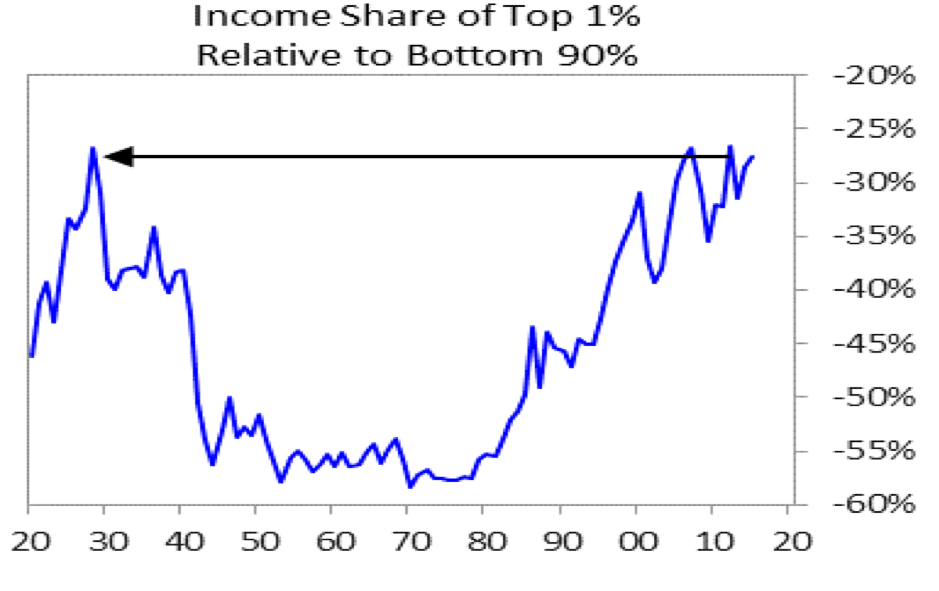
    Dalio, a keen student of history, notes that the conflict between populists of the left and right contains echoes of the 1930s and he provides a striking Income Inequality chart for historical context. The chart below shows the wealth gap is indeed the highest since the late 1930s:


    One senses something has to give. The perennial policy dilemma is described rather well by Dalio when he states that “most capitalists don’t know how to divide the economic pie well and most socialists don’t know how to grow it well”. 

    Some readers will have seen US Presidential contender Elizabeth Warren propose a wealth tax for fortunes in excess of $50m but wealth taxes scare the hell out of lots of governments for the following reasons:

    1. In response to wealth taxes, the wealthy remove funds from the relevant tax jurisdiction
    2. Wealthy investors reduce investment as incentives to make incremental profits/returns are reduced

    One wonders is there a middle ground where passive deposits of cash over a particularly high level of, say $20m, incur an additional annual tax charge (see property taxes) UNLESS the equivalent amount is invested in smaller companies/start-ups operating in the same tax jurisdiction.

    There are already numerous EIIS-type schemes in Ireland, UK and US which provides investors with the option of investing in start-ups which have attractive tax incentives for the investor eg. 40% tax back in Ireland for EIIS investments. 

    The difference for the super wealthy is that these schemes would become mandatory to offset a wealth tax. The policy message would be clear: Use it or Lose it.

    Taxes or any mandatory directive on personal capital is never popular but these are challenging times in many societies and the 1% are already acknowledging a problem and the risk of a chaotic backlash.

    The attractions of EIIS-type schemes for policy makers would be a much greater chance of capital remaining onshore and a tangible support for business formation/employment from the private sector.

    In the event of such policies emerging equity crowdfunding platforms, such as Spark Crowdfunding, will be a natural conduit for investment flows. For both investors and start-up companies today there could be real opportunities in early utilisation of crowdfunding platforms.

    Firstly, companies can gain the experience of running a fundraising campaign in preparation for potentially much larger pools of capital being available in the future.

    Second, investors will undoubtedly see the attractions of early investment in a limited number of franchises which in the near future could be chased by a wall of new monies seeking refuge from capitalism’s response to an unsustainable situation.

    Now think about that…large pools of capital chasing limited opportunities. Early crowdfunding movers might be able to help, but at a pretty price!