Tag: equity crowdfunding

  • Have You Checked Your Pension’s American Assets Recently?

    Have You Checked Your Pension’s American Assets Recently?

    I’m nervous. This won’t win me a Nobel Peace Prize, a Pulitzer or a Green Card but it must be said. The United States is the richest, most successful and most powerful country in the world. On a global basis, we owe the United States on many levels, be it culture, sport, technology, education, medicine, defence, investment capital, tourism or friendship. Closer to home, our fortunes and miraculous recovery from a Troika bail-out are inextricably linked to US commercial supremacy. The vast majority of our pensions reflect that supremacy by holding significant amounts of US debt/bonds or stocks. EVERY pension should have exposure to US assets but risk radars are flashing red for a seismic investment shift. Behind the headlines and in the critical plumbing of the global financial system, there is increasing evidence of a global ‘exit’ from the US. That might sound odd and inevitably the counter view will cite current data which paints a record-rosy picture.

    US and global stock markets are regularly hitting record highs in recent weeks. However, the US stock markets have been clocking up vastly superior returns compared to other major bourses in the 16 years since the GFC. This outperformance of US assets has resulted in extreme levels of US weightings in global indices/benchmarks which your pensions are attempting to either track or beat. A recent Deutsche Bank research note flagged IMF data showing US equities now accounting for 67% of Bloomberg’s World Index. That’s quite the weighting for a country which represents 15% of global GDP. Go back 20 years, and the US actually accounted for a higher 19% of global GDP.  In 2005 US equities made up 51% of the same Bloomberg World Index. For context, Europe(EU) accounts for 12% of global GDP and 14% of the Bloomberg index. Of course, the big driver is technology stocks where the 6 top US tech companies are currently valued at $20 trillion, or more than the GDP of China. The AI/cloud (AI) revolution might be the more specific driver but is this hiding a bigger picture?

    According JP Morgan’s always interesting Michael Cembalest, “AI related stocks have accounted for 75% of S&P 500 returns, 80% of earnings growth and 90% of capital spending growth since ChatGPT launched in November 2022.” AI is indeed the gift that keeps on giving for US markets. But there’s giving and then there’s giddy. I’m not sure if anyone can keep up with tech companies trying to out-do each other on the size of their investment spend announcements. It has clearly been noted by the tech C-Suite that, if you announce huge investment spend on chips, data centres or any AI related infrastructure, your share price and stock options go up. Microsoft says $100 billion, Google says $85 billion, Alibaba says $53 billion and Nvidia thinks they’ve a better twist. This week Nvidia promised to invest $100 billion in ChatGPT parent, Open AI. Excellent news but where’s the $100 billion going? Ah, that would be mostly going back to Nvidia whose AI chips will be used in Open AI’s data centres. Yep, readers might see the Baldrick-esque possibilities around circularity and vendors(Nvidia) financing customers like Open AI. Anyway, investors seem optimistic, for now. Moving away from AI, and the risk of over-investment, there’s a bigger worry for US corporates and their share prices.

    The S&P 500 broke another record in recent weeks. Valuations observed by investors these days seem to ignore earnings multiples (Tesla P/E of 200x anybody?) and focus on revenues. However, there’s a traditional metric, the price-to-book ratio, which compares the market value(price) of a company to net assets (total assets minus liabilities aka book value). Where the ratio exceeds 1x, the valuation of the company is capturing ‘intangibles’ like goodwill, brand and future investment/revenue acceleration. Currently, the S&P 500 is trading at a price/book of 5.3x. That’s higher than the peak of the TMT ‘bubble’ in 2000. For context, that metric dropped to 1.6x in 2009. Of course, many companies are more ‘asset-lite’ these days and enjoy higher price/book and revenue multiples. But… there is an intangible element in many US companies’ valuation which is critically important to their premium rating over competitor companies in other countries; goodwill and/or brand power. You can see the potential goodwill problem.

    I’m no Jimmy Kimmel so it’s best be straight rather than funny. Corporate America from Disney to Tesla to law firms is haemorrhaging “goodwill” and brand value. Two thirds of the global middle-class will come from India and China by 2030. Yet, right now the US assets of Chinese video platform, TikTok, are being seized/transferred to White House friendly oligarchs while India is dealing with punitive Ukraine-related tariffs (not Russia?) and a shake-down on vitally important H-1B visas for overseas technology professionals (70% of recipients are Indian). Friendly countries like South Korea are in shock after ICE raids on Hyundai’s plant in Georgia and the detainment of more than 300 Korean workers. Trump’s speech this week to the UN with “your countries are going to hell” could have been shortened to a simple message of “Go to Hell” to the rest of the world. Anecdotally, the news from Canada is a window into future “ally” consumer behaviour. Supermarket shelves are seeing a buyers boycott of many US products as car traffic across the US-Canada border craters by 34% according to latest August data. Meanwhile, corporate America and its leaders cower in silence while the Trump White House vandalises US institutions, global trade and sovereign alliances. The assault on US rule of law is captured in almost every headline emerging from Washington:


    Trump’s new ABC threat proves Jimmy Kimmel right – CNN


    Former FBI Director James Comey expected to be indicted on criminal charges – The Guardian


    Trump pressure on Bondi to charge political foes could backfire – NBC News


    US Supreme Court ruling lets Trump fire top official – BBC News


    The final headline featuring the Supreme Court is critical to the risk profile of the US. Investors are worried that the Supreme Court will let the Trump regime interfere with the Federal Reserve Board, the most important financial institution in the world. The Fed underpins the status of the US dollar as the world’s reserve currency. That credibility is under threat as the dollar’s value against a basket of major currencies has fallen by 10% this year. That ‘fallen’ bit is people selling the US dollar and buying other stuff. Like Gold. Lots of investors are liking bullion’s 40% increase in value year-to-date. I’m not so sure it’s a positive signal. I’m also watching deposits sitting in US money market accounts hit a record $7.7 trillion, treble the number just 8 years ago.

    These depositors are not the only ones not fully convinced about the US being the “hottest” country on the planet. Investors SOLD $3.8 billion of US stocks last week (Source: BofA Securities) with institutions and hedge funds the biggest sellers by far in one of the highest exit numbers seen this year. Oh, and if record US stock markets sound positive, context is everything. The whole world is up this year and OUTPERFORMING the US. The S&P World ex-US Index is up over 20% year to date compared to US equity markets up only 10%. But…it’s worse than that if you factor in US dollar weakness. Returns for overseas investors in US equities are closer to ZERO this year. To be clear, this re-rating of US assets will happen over years not weeks but commercial contracts, the law and international treaties require a high degree of confidence. Imagine how Canada and Mexico feel right now re-negotiating a deal which Trump himself shook hands on as recently as July 2020. His own deal. Investors will deal too, and consider a sea change in how the US attracts talent (H-1B, visas), investment capital (Fed, US dollar) and goodwill (premium equity ratings). Sadly, US-based investors might struggle for similar analysis in their media.

    Despite Trump railing against windmills (literally) and media bias, the awkward truth is that the wealthiest person in the world, Elon Musk, owns Twitter/X. The second wealthiest person in the world, Larry Ellison, owns Paramount(including CBS) and will now be taking over TikTok and CNN. Jeff Bezos owns The Washington Post and Twitch. Mark Zuckerberg owns Facebook and Instagram. Throw in Larry Page as Google’s controlling shareholder and that looks like the top 5 richest men in the world are ALL media owners. It also looks like oligarchy. US corporate leaders should also consider another consumer shift within the borders of the US.

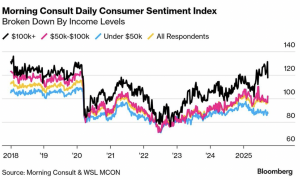
    Research from Moodys using Federal Reserve data shows the top 10% of earners in the US now account for 50% of all consumer spending. In the early 1990s (before Fox News) that number was closer to a third of all spend. Disney just discovered (as corporate America said zippo) that the average person felt that taking a comedian off air after government threats was plain un-American, and proceeded to cancel in massive numbers their Disney+ and Hulu subscriptions. Maybe, the 90% will push back on other White House over-reach? I’m not so sure, and that’s not good for US assets or pensions in the long run. Investment securities, after all, are contracts and the undermining of the rule of law will end in tears. Or, something less oligarchic. As my favourite bear strategist, Albert Edwards, said this week when posting the Bloomberg chart below, “When I look at this chart, I look at my calendar and just wonder when I should pencil in the next revolution..”   The chart dramatically shows consumer sentiment splitting sharply between the ‘have yachts’ and ‘have nots’…..

  • Private Portfolios And Future Returns: Part II

    Private Portfolios And Future Returns: Part II

    Well, we promised. This is a follow-up to our last piece on expected returns for a private portfolio. This time we are going to illustrate a variety of portfolio outcomes with some numbers. However, there IS a catch. Humans are not good at forecasting the future so these returns outcomes are just a guide. A bit like a US-NATO promise to Estonia – we might send military forces to fight off an attack from Russia, but then again we might not. The good news for investors (for Estonia not so much) is that history can provide some confidence but no guarantees. History, in this instance, is the long-run return on private assets which we referenced in last week’s article. As a refresher, here is the reference table we used (Source: Pitchbook):


    We noted the various categories of assets and concluded that Spark investors would be mostly invested in private equity and venture capital type assets. Then we decided to use 12% as a conservative ‘base case’  annual growth hurdle (IRR) expected of a portfolio with that mix of assets and quantified that growth over 10 years:


    “In real terms (and compounding those rates [12%] of return) that equates to an initial investment of €10,000 growing to €31,000 over 10 years. For context, a fund with publicly listed equities would be expected (by financial planners) to generate 7% returns per annum and thus turn €10,000 into €19,600” 


    However, many of the Spark investment opportunities are very early-stage (higher risk) so it would be reasonable to expect something in excess of this 12% base case growth/returns scenario. Rather than use another headline number, we thought this article would be an opportunity to build a returns scenario from the bottom up. In other words, we would use illustrative portfolios of 25 investments each and explore three different mixes of outcomes. Our reasoning for using a portfolio of 25 investments is that this approximates to what many of our Private Portfolio (service) investors are currently trying to target/build as a personal portfolio over three years. The other assumptions used across the different illustrative portfolios are as follows:


    Total investment cost = €50,000

    Position size = €2,000 equally invested across 25 companies

    EIIS tax rebate rate = 37%* 

    Holding period = 10 years


    *The EIIS tax rebate rate is a ‘blend’ of the new standard rate of 35% and the higher rate of 50% applied to pre-operational businesses.

    Now, let’s consider our first portfolio. According to the US Bureau of Labour Statistics, 65% of start-ups go out of business within 10 years. So let’s use that historic 65% failure rate as a future outcome for our first portfolio. In other words, 16 of our 25 portfolio companies will end up being worth zero. With the remaining 9 companies, we are going to assume that 5 of them become unspectacularly profitable and grind out a typical equity return of doubling every ten years(7% per annum). The final 4 companies are expected to be successful exits or ‘wins’ generating returns of between 7x and 15x. The table below illustrates those outcomes with an overall portfolio rate of return (IRR) of just over 13%. This equates to a multiple of 3.4x of the initial investment cost MINUS your EIIS tax rebate.

    Portfolio 1:


    The above example shows how important tax is to the initial cost or valuation multiple paid for your investments ie a 50% tax rebate cuts in half the valuation multiple paid. This portfolio generates a respectable 13% return but in the next example we’d like to demonstrate the importance of “winners”. So, in Portfolio 2 we raise the failure rate to 20 companies (80%) and model the impact of two big exits of 20x and 40x. This scenario delivers a superior IRR (vs Portfolio 1) of 15.4% and a multiple of 4.2x your initial cost of investment:

    Portfolio 2:


    Clearly, a return of 40x on a single investment would be huge but for ‘unicorn’ followers of companies reaching billion dollar valuation status this is the equivalent of a €25m company growing to €1 billion. Rare, but increasingly possible given the research team at Dealroom estimate 100 ‘unicorns’ have entered the billion dollar club every year since 2018. However, if the mention of unicorns smacks of fantasy territory let’s look at a more ‘diversified’ mix of outcomes in a portfolio. In particular, we want to model a portfolio reflecting some of the themes (including Spark’s risk management process) we touched upon in our first article of this series. Portfolio 3 is a mix of the following themes:


    Recovery: Failure of ‘asset lite’ businesses could actually deliver some recovery values due to the data base built, team domain expertise, customer relationship assets etc.


    B2B: Almost 70% of Spark investments are business-to-business (B2B) companies in a world where corporate VCs (CVC) are increasingly active eg Google has acquired more than 200 start-ups over the years.


    Taxation: Due to higher capital gains (CGT) and income tax (dividend taxation) regimes in Europe and particularly Ireland the ‘hurdle’ or exit/return expected of a young company must be commensurately higher to compensate institutional investors.


    Quality:  Start-up funding is, bluntly, more scarce in this part of the world and Spark probably turns down 9 out of every 10 investment opportunities. In theory, we are already investing in the top quality decile of opportunity.


    So, in Portfolio 3 the failure rate will be lower than previous examples (60%) and will also not amount to a ZERO return but include a recovery value of 20%. However, as demonstrated above, the key swing factor is the ‘winner’ category of investments. In Portfolio 3 we ‘diversify’ the outcomes of the surviving 10 companies with 6 actual exits. The following table outlines those outcomes across the portfolio:


    Portfolio 3:


    Clearly, diversification of outcomes and a higher number of more moderate exits does move the returns (IRR) dial. Any investor with a portfolio delivering 14.7% annual returns for an almost 4 X return on initial investment cost should be happy. Of course, these are merely estimates of the future anchored to historic data. We, like all forecasters, will get it wrong. However, it is reasonable to think a portfolio of mainly B2B assets with varying levels of maturity (along the start-up to private equity buy-out spectrum) operating in busy corporate VC activity sectors will achieve some exit success. You’ve read it here many times before… the future is private. But… there’s an additional Spark Private mantra to get to know – the process is portfolio. Private investors should build a sufficient opportunity set by holding multiple investments in a portfolio. As a small aside, this writer’s personal view is that exit valuations in the private asset world will surprise on the upside compared to even the multiples used in the portfolios above. Again, no promises!

    Writer’s Note: The above is just a basis for discussion and exploring the long-run drivers of portfolio returns. I would be more than happy to talk through our investment pipeline and deal-types with anyone interested in building a diversified portfolio of private assets over the next 2-3 years.


  • A Quick Guide For Private Investors In Start-Ups

    A Quick Guide For Private Investors In Start-Ups

    One of our portfolio companies ceased operating this week. Lesson learned? Yes. Would we use the same vetting process again? Yes. And, no, Einstein’s definition of insanity is not in play here. Let’s be very clear that mistakes will continue to be made. We just can’t forecast the future. In fact, human beings are not particularly good at the forecasting thing. However, we can control the controllables,  and one of the critical things for a private investor to control is one’s investment process. Call it a check list. Then, know that we probably turn down 10 opportunities for every one we offer on the Spark platform. So here’s a quick guide as to how we compile a score card for companies seeking new investment capital. Note we will expand on some areas in later articles but, for now, this could be an outline framework used by any wannabe early-stage investor….


    Founders: This is probably the most fundamental factor in any company assessment. The calibre of the founders is critical to our confidence that the key people in a startup have the energy, resilience, expertise, discipline and ‘market-listening’ gene to drive a project or business to success.


    Solution: A laser-like focus on solving a consumer or business problem which can be clearly defined should underpin any analysis of a company’s product or service.


    Validation: Revenues generated by the product or service are the ultimate validation. Note business customers are ‘stickier’ than main street consumers so it is not surprising that business-to-business (B2B) investments tend to attract more investment. Other elements of validation like awards, patents or industry thought-leader financial backers can also add weight to the pitch.


    Market Opportunity: Huge global market spend numbers sound good but also attract plenty of competing products and services, and imply a danger subsequent funding rounds shift to the perceived ‘winners’. A niche focus on a particular segment of the market can be an easier ‘sell’ and gain better traction with both prospective customers and investors.


    Communication: We just mentioned customers and investors together. For good reason. Founders and startups must be on top of their communications and messaging. A poorly worded investment pitch should raise investor concerns about the primary challenge – forget funding, what about founders’ abilities to win over prospective customers?


    Endorsement: Many pitches feature impressive testimonials or endorsements. However, there is a higher impact endorsement – money. Typically, in a funding round we would expect founders to bring some financial/investment endorsement to the table. Think about it – if the founders can’t ‘sell’ their business to ‘warm’ friends, family or commercial counterparties, it’s going to be a lot harder to convince ‘cold’ investors to back a project.


    Financials: Of course, not everyone is an accounting wizard. However, returning to our comment about ‘forecasting the future’, whatever projections are put in a business plan are most definitely going to be ‘wrong’. The thing to control is unsubstantiated growth trajectories or ‘hockey stick’ forecasts. Initial projections should show an understanding that a slower grind in the early years is a better (and more credible) base case.


    Business Model: Company’s when first entering a market will try out different pricing strategies but there’s a bigger strategic consideration than price. The payment framework for the customer is critical: monthly/annual subscription, up front/service models, wholesale, distribution partnerships etc. Investors should be clear as to how an investee company is going to be paid.


    Valuation: This is another area/assessment which is going to end up being completely wrong. However, a base valuation can be derived from the projected revenues/profits in the next two forecast years (and previous 12 months if any). Also, where it is very early days with minimal revenues, a good way to think about a business is to calculate how much would it cost to build the product/company/service today. Monies invested in a company to date are a good basis for valuation. And watch out for technology overspend (so so common) and marketing waste (lots of Google ads algorithm sob stories). On the other hand, proprietary databases built in a niche area can support a business valuation.


    Last Mile: Very often investors see great products or services and wonder why the business ultimately does not succeed. This writer increasingly believes ‘the last mile’, aka commercial intensity/engagement, is where analytical frameworks need to beef up risk metrics. Clearly, ‘build it and they will come’ is not a business strategy in today’s world. Scaling up customer bases and revenues is a real challenge for early stage companies. Hence, investors should be very clear about what the marketing/distribution/partner strategy is for a start up business. In many ways, fuzziness on this question makes estimates on the size of a market opportunity (with juicy TAM and SAM numbers) completely irrelevant. A roadmap with milestones, skills/talent build, later funding series, and customer mix evolution should be sufficiently clear for investors to understand the plan and the building blocks required to scale.


    Exit: Healthy deal activity for smaller businesses, a sector’s track record of consolidation, cash-rich global players as serial acquirors, the network of the founders etc all help paint an exit picture for an investor. For investors, make sure there is plenty of colour in the answer.


    The above is not an exhaustive list but captures the main pillars in our analytical framework, and could become a regular check list for a private investor. Of course, each section features mere highlights and headlines but at the same time this should not be ‘rocket science’. Many of the questions you, the investor, want answered need to be answered by customers and partners too. And, we know clear communication is critical to customer success. So, understand the fundamentals of a business and that’s a decent start to building a robust investment score-card. That’s all you can control. Or as ‘Cousin’ Greg in Succession might say… you don’t need to know everything, just the key business/relationship levers which matter.

  • Check Out Two Big Wins For Banks And EIIS Investors

    Check Out Two Big Wins For Banks And EIIS Investors

    Ok, I was wrong. I really thought that rising interest rates to over 5% over the last four years would cause greater stress in bank loan books. Yes, commercial real estate loans are causing angst in the global financial system but thanks to private equity, pension funds and family offices it’s not just the banks on the hook this time. Clearly, the rise of private investment vehicles in financial markets has helped to de-risk the banking system. Of course, the investor muscle memory of the 2008-2009 credit crisis has had a double impact too. First, consumer protective regulation has forced banks to build huge capital buffers (reserves). Second, bank customers through a combination of lack of finance education, risk aversion and behavioural inertia have added to those buffers. European bank customers in particular have left trillions of euros of cash in the bank earning almost no interest because they have not sought out specific interest-earning deposit or money market accounts. Ireland, with almost €150 billion euro sitting in accounts earning miniscule interest, is the worst European offender.  Here are the numbers:


    • Across the EU banking system there is €16 trillion of customer cash sitting in bank accounts.


    • 54% of that cash earns on average 0.13% in low-interest overnight accounts. Implicit in that number is that 46% of customer cash is in longer-term deposit accounts. In other words, almost half of European bank customers commit cash to ‘term deposit accounts’ which, in exchange for waiving access to the cash over defined time periods, pay depositors average rates of 2.65%.


    • Ireland has a VERY different mix of customer behaviours. Just 12% of customer cash earns income in term accounts. A whopping 88% of Irish cash sits in overnight accounts, earning almost nothing.


    Clearly, this is a win, if not a scandal, for Irish banks. On the other hand, the European banking system is in pretty good shape, steering capital away from higher returns but also higher risk. As an illustration of the European bank risk culture, I was staggered to see that US banking giant, JP Morgan, has a market value of $540 billion which exceeds the combined value of Europe’s top 10 banks. So, Europe’s banks are doing ‘ok’ but not exactly chasing higher returns for their shareholders which translates into underwhelming valuations. However, if you thought this was a hit piece on banks you’d be wrong. The other eye-popping data point I discovered this week was that in the critical world of customer experience (CX) – now a main priority for 80% of companies per Gartner – banks in seven major economies outside Ireland now top the CX league tables. That just wasn’t on my 2024 bingo card. In fact, that banking ‘bingo card’ is putting together a very interesting string of numbers….


    • US and global stock markets are hitting all-time highs again after August wobbles. Yes, the US tech sector has been the star sector of the last 12 months (+42%) but you might be surprised to see US Banks in second spot with a 29% return.


    • Euro area banks handed out €71 billion in loans for house purchases by consumers in July, the highest level since August 2022.


    • Italy’s Unicredito bank is signalling increased executive confidence with a shock swoop for a 9% stake in Germany’s Commerzbank. The Italians have asked permission of the German government to pursue merger discussions. Wow. Cross-border M&A featuring major European banks has not been seen for years.


    • Europe’s financial markets are increasingly pricing in climate-related risks. ECB reports that eurozone banks were charging companies in the top 25% of carbon emitters monthly interest rates 14 basis points higher on average than those in the lowest 25%


    • You may not have heard of Tether but it is a fintech platform specialising in trading digital currencies which track/tether to traditional major currencies using blockchain. These asset-backed digital instruments are known as stablecoins. Tether has 350 million stablecoin users globally and, incredibly, has generated more profit ($12 billion) than the world’s biggest asset manager, Blackrock, and its $10 trillion portfolio since early 2023.


    • Perhaps it’s no big surprise that Revolut is reportedly about to launch a stablecoin for its 45 million customers, of which 2 million reside in Ireland.


    One of the other big messages in the CX world these days is that brands suffer without innovation. Keeping the status quo is really going backwards. We have written before about the massive data/AI opportunity for banks and the ultimate platform play: payments. Trillions of dollar wealth has accrued to innovators in the social media and cloud computing platforms. Now, it could be the turn of payments to deliver trillion dollar opportunities. While we write of opportunities might we suggest another?


    As tax-return season kicks in, private investors should note that EIIS tax-friendly opportunities just became more lucrative. Thanks to changes in last year’s Finance Bill, many investments in early-stage companies currently attract 50% income tax rebate opportunities for Irish investors. Now, think about all that cash sitting in bank accounts with inflation of say 3.5% eroding its purchasing power. Here is a quick illustration of wealth destruction:


    • Keep €20,000 in overnight deposit as usual.
    • Hold for 10 years while asset prices inflate by 3.5% per annum.
    • Spend the €20,000 after 10 years but get only ‘value’ of €14,000 due to asset inflation/purchase power erosion.


    Or….. try this EIIS investment strategy.


    • Invest €20,000 in portfolio of 7-8 early stage companies.
    • Receive €10,000 back in income tax rebates.
    • In 10 year’s time, if your €20,000 investment has returned just €4,000, you have beaten the bank.
    • That €4,000 hurdle requires just one of your investments to double in value while all the others go to zero.


    Gotta be worth thinking about. Certainly, if you’re sitting on cash which will lose 30% of its purchasing value over the next 10 years. Better still, move some money into term deposit accounts and look for 3% long-term rates. Then think about using EIIS to offset the taxes on that deposit income. In the “real” world of tax savings that 3% interest earnings (offset with EIIS rebates) on your deposit equates to a 6% gross return typically promised on other types of assets, like a property or multi-asset wealth portfolio. Definitely worth a chat with your accountant.


    Finally, from a Spark perspective, we can promise our investors a very interesting pipeline of up to 8 EIIS deals spread across SaaS software, biopharma, medtech, ESG/sustainability and AI before Santa arrives and the EIIS window closes for 2024. And, if we were in Santa letter-writing mood we’d be tempted to ask government and banks to join the dots and incentivise specific support for small early-stage businesses via bank deposit accounts. Showing my age here, anyone remember SSIA’s of the early naughties? Answers on a post card to Apple or the Department of Finance with a recent €14 billion windfall/capital infusion to kick things off….


  • Warning: 3 Zones Of Interest

    Warning: 3 Zones Of Interest

    Nobody likes to be admonished. So, it’s an interesting commercial call to deliberately call out one’s customers. Even more daring to use the Holocaust as your messaging context. There are no adequate words (almost literally in many scenes) for Jonathan Glazer’s brilliant but upsetting Oscar-winning film, The Zone of Interest. The luxury dream life of Auschwitz commandant Rudolf Höss, his wife Hedwig and five children in a house right next door to the walls of the Nazi death camp is almost two films. One is seen, the other heard. The effect is extremely unsettling – you see nothing, but hear and know really evil events are happening.  However, director Glazer is using this notorious historical setting to deliver a present day admonishment. Like Hedwig Höss and her household, we hear things but choose not to ‘see’ bad things. However, you’ll be relieved to read I don’t plan a similar scolding…..but have some cautionary thoughts.

    It has been an interesting week for the planet’s hottest investment topic, Artificial Intelligence or AI. For main street consumers we are on the cusp of not just hearing about AI, but actually ‘seeing’ it in action. First, Google showed off the latest use cases for its AI model, Gemini, in search, education, video, workflow etc. All hugely impressive, and the intention is for Gemini to be embedded in Android powered phones soon. Not to be outdone, reports are flying around that Apple will do something similar with its iPhone and OpenAI’s ChatGPT model. As the tech-heavy Nasdaq index hits all-time-highs, it’s clear AI is going to move rapidly from being a corporate cloud story (Nvidia, Microsoft etc) to being a main street consumer revolution on our phones. However, the cloud and the powering of AI models is still entirely relevant to this move. Arguably, AI infrastructure is today’s gold rush version of  ‘spades and shovels’ which, for investors, means data centres are critical to deploying AI. You’ve probably already heard that. But, do you ‘see’ the reality…?

    My favourite trivia question of the week has been how many data centres will Microsoft open in 2024. Every answer I have received has been wrong, mainly in the low double digits. The reality, per a recent Financial Times article, is that Microsoft is opening a data centre “every three days”. Mind-blowing. These are $300-400 million facilities, not Starbucks cafes or KFC restaurants. And, that’s just one company. Here’s another – Echelon Data Centres. I had the pleasure of briefly meeting its owner, Niall Molloy, at the excellent Renatus Real Deal 2024 conference this week where Molloy was interviewed as winner of the “Deal of the Year” award. I was stunned to learn Echelon only started in the data centre construction business in 2017. Just 7 years later private equity giant, Starwood Capital,  has invested $850 million in Echelon and the business is currently valued at north of $2 billion. A super story of bold vision and world-class execution, but Molloy had a cautionary word about the pressures on global electricity grids as data centre campuses begin to match the power consumption of capital cities. The AI and data centre revolution is coinciding with an even bigger global shift – decarbonisation of our economies. The solution is more electricity power, and the challenge is the expansion of under-invested electricity grids. However, where there is risk there is opportunity.

    Ireland has been mentioned as one of the most challenged national electricity grids and many readers will have ‘heard’ the negatives of data centre power consumption. However, all data centres now have to create/install their own power supply and most likely the source will be renewable energy. That means huge investment capital is required because it is no longer just a construction project, but also includes incremental builds of electricity generation and water supplies. Hence, we should ‘see’ this week’s reports of Intel’s plans to expand its Fab34 semiconductor chip factory in Leixlip as a ‘wow’ moment. The plans are not new but the financing is ground-breaking. Intel was originally looking to spend $2 billion. Now, the number is $11 billion and global private equity player, Apollo Global, is being tapped as the solo partner on the project. The entry of global private equity into AI infrastructure funding should signal opportunity and expert eyes ‘seeing’ a way forward despite grid challenges. So, my second cautionary word after ‘seeing’ a consumer AI shift is that there are risks but also huge opportunities away from the actual technology. In other words, investing in power, storage, construction, critical minerals/materials, water, skills training/resourcing and other professional support services could generate top class returns.

    Clearly, private equity giants have spotted an investment opportunity. And, don’t forget Blackstone’s recent $1 billion purchase of a majority stake in Dublin-headquartered data centre engineering firm, Winthrop Technologies. Still, there’s one final cautionary tale; under-investment caused by political inertia or regulatory uncertainty. Exhibit A on political misrule is probably the UK. However, Brexit might be the go-to lament you ‘hear’ but the reality is a long-standing issue we wrote about in March:


    The Institute for Public Policy Research estimates the under-investment in business at $500 billion less than what other comparable OECD countries have invested since 2005. Public sector investment (infrastructure) was a further $200 billon below the G7 average. All in, this chronic lack of investment places the UK 27th out of 30 OECD countries.


    As regular readers will know, we have been quite positive about UK investment opportunities in recent months but this warmer view has been based on a contrarian prompt. Investors have been fleeing UK investments for years and Panmure Gordon published some startling figures in a research report from their Economics team this week. I would highlight three in particular:


    • UK public companies trade on a like-for-like basis (taking into account sector and growth characteristics) at a 17% valuation to comparable companies trading in the rest of the world (RoW).
    • The gap in valuation between the biggest UK companies (FTSE 100) who are globally engaged and the more domestically-focused smaller UK companies (FTSE 250) is at its widest in 20 years.
    • Funds focused on UK investing strategies have reported outflows for 82 of the last 97 months (Source: IA)


    Please ‘see’ this as the damage inflicted by chronic under-investment for almost 20 years. So, given our planet faces an existential threat without decarbonisation, the critical need for investment in global electricity grids is not exclusively an AI or data centre issue. Data centres are just a ‘wall’ blocking the bigger picture view . Without joined-up policy thinking, we risk ‘hearing’ about data centres but missing a planetary extinction event moving into irreversible territory. Don’t zone out on this one.


  • Government NOT Making It EIISy For Startups?

    Government NOT Making It EIISy For Startups?

    In the investment world of benchmarks and relative performance, portfolio managers will tell you every year is a tough year. World going thrillingly gang-busters? Gotta keep pace. Risk, slowdown and volatility? Don’t blow up, survive. Arguably, for startup businesses and founders dependent on external funding support there is a similar dynamic in play.

    In the giddy years, if your investment story isn’t ‘shiny’ enough you can be starved of capital which is diverted to other sectors. Then, in tougher more cautious funding environments like the last 12 months, you’re possibly juggling slower sales cycles and slower funding rounds and decisions. Worse still, no decisions. Uncertainty is a decision and business killer. And, we have no shortage of uncertainties fuelled by inflation, rocketing interest rates and geopolitical powder kegs in Ukraine and the Middle East. Now, smaller businesses and investors must deal with a fresh uncertainty coming from perhaps a surprising source, our own government.

    The last US President to close out a global geopolitical proxy war was Ronald Reagan but he’s also famous for his disdain of government over-reach. In a 1986 press conference he said, “The nine most terrifying words in the English language are ‘I’m from the government and I’m here to help.’” Arguably, these words might resonate with businesses and investors currently wrangling with the latest Finance Bill and its changes to EIIS rules for equity investors and investee companies. Firstly, an easy-to-understand flat rate of 40% income tax rebates for Irish resident investors in qualifying Irish startup businesses has been chopped up into 5 different bands. The different bands, to come into effect on January 1st 2024, are as follows:


    • 50% for businesses that ‘have not operated in any market’;
    • 35% for a business in its first EIIS fundraise within 7 years of its first sale;
    • 20% for a business in its second or subsequent EIIS fundraise;
    • 20% for a business expanding into new markets or regions; and
    • 30% for investments via a ‘Qualifying Investment Fund’, of which there is only one in Ireland.


    Quite apart from introducing potential confusion, the ‘core’ or standard EIIS rebate of an equity investment will now be reduced from 40% to 35%. Clearly, this reduces the incentive to invest rather than increases the incentive with what could be considered particularly poor timing. We would highlight three key pre-existing factors as challenges for businesses seeking investment capital:


    • Higher interest rates: Remember our reference to capital chasing the “shiny” things? Well, interest rates rocketing to 5% are forcing all asset classes to increase their attractiveness by offering better returns. Think deposit rates, mortgage bonds, corporate bonds and other lower risk options to earn returns. They are all upping incentives/yields while the government is seeking to make startup investment less “shiny” or easy.


    • Financial Conditions: The Goldman Sachs research team tracks the broader financial climate and looks at lending patterns, terms, spreads, credit trading etc Its view on euro-area financial conditions is that they haven’t been this tight since the Great Financial Crisis (GFC) in 2008-2009. This means businesses must search harder for investment, endure tougher terms and possibly find new banking channels unless your choice is….


    • Irish Banks: A senior Dublin legal eagle only recently told me that the banks are effectively ‘not open’ for any additional risk on their books before year end. True or not, the banking choices for SMEs are extremely limited as Nat West(Ulster) and KBC have pulled up sticks in Ireland and followed Rabobank and Danske Bank into retreat to their higher margin core markets.


    The recent memories of Covid-19 and the pitiful take-up of the government’s Credit Guarantee Scheme (just 12% of funds used by April 2021) hint at a limited banking system which isn’t massively interested in the SME sector. As a reminder, the government was guaranteeing 80% of the €2 billion in loans under this Credit Guarantee Scheme but it seems even a 20% share of the risk was too much for the Irish banks. But, also be mindful that 99% of active enterprises in the state are SMEs and account for 70% of employment. Of course, there are other institutional sources of capital.

    In the US 70% of venture capital comes from pension funds and educational endowments. In Europe, you’d be lucky if that number even reached 20%. So, despite the fabulous efforts of Ireland’s state funding agency, Enterprise Ireland, the role of private investors is critical in supporting early stage businesses. It is true that European government agencies and EU institutions(eg Horizon 2020, EIC) play a significant part and these latest EIIS changes in the Finance Bill are part of a broader harmonization of state aid. However, harmony works both ways.

    Due to limited competition and regulatory constraints, smaller Irish businesses are experiencing a much more difficult banking and funding environment than their European peers. In those circumstances, one would hope that European and Irish policy makers were encouraging private capital to fill the institutional and bank funding holes. Complicating simple tax treatments is not a good start and, to add to decision paralysis, there is a critical question outstanding in the new EIIS rules.

    The 50% rate applied to investments made in companies “not operating in any market” is leaving many people, both founders and investors, in the startup world scratching their heads. For us, we need to clarify the “not operating” phrase. Does this mean companies not generating revenues yet or is this demarcation geared towards companies in earlier risk stages like R&D, pre-API-type development phases? These are the questions which, left unanswered, will delay business funding and investment. Fatally, in some cases.

    Now, to finish on a more upbeat note. This writer, as a long-time analyst of investments and their returns, has always been wary of treating tax rebates as a means of re-setting your starting point. In other words, if EIIS of 40% is applied, your €1,000 investment cost only €600 post your tax rebate. In my world of valuations and RETURNS the more critical point was that your investment value remained €1,000. So, in a 35% EIIS rebate world the return of your €1,000 in subsequent exit value would amount to just shy of a 54% return. If that €1,000 becomes €2,000 that’s a greater than 3x return, irrespective of whether you started with a €600 or €650 cost. That broad quantum of outcome should still keep investors very interested in startup investing. However, as we hit GFC levels of funding tightness, the government may not be able to magic up more banks but it could certainly incentivise more private investors to support the 99%. Kinda like what governments used to say they do.

  • Democracy Winning Voters and Investors

    Democracy Winning Voters and Investors

    Pretty depressing week, eh? Not even a DryRobe can warm the spirits. Our leaders have clicked their heels three times this week and eventually told us, “There’s no place, but home.” Soon we will fantasize about the simple things in life and once again appreciate basic freedoms. That’s maybe not a bad thing. In fact, far far away from the Emerald Isle there’s a storm brewing with fantasy-like good news possibilities. Not Kansas this time, but Texas.

    Early Presidential election voting has started in some US states and one data point just jumped off the page this week. Voter registration in Travis County, Texas, has rocketed to 97% of the county’s estimated 850,000 eligible voters. Yes, US elections have dominated international headlines through every Presidential cycle, not just Trump’s, but has never captured the full attention of US voters. Turnout, even in the highly polarised 2016 election, was just 55.5% of eligible voters. The brutal fact is that more than 100 million of the 250 million eligible US voters didn’t vote last time. The issue is more complex than a simple desire to vote. Frankly, voter suppression has been a fact of life for many citizens. Moreover, despite Trump delusions and Fox fake fears, voter fraud is negligible. Here’s a few headlines to give a flavour of the ongoing battle to vote, and a sense quite a few of the missing 100 million have had enough:

    • Long Lines Mark The First Day Of Voting in Georgia – Washington Post

    • Ohio’s Quarter Mile Early Voting Lines? – The Guardian

    • Federal Court Sides With Texas Governor Limiting Mail Ballot Drop-off Sites – CNBC

    • Californian Republican Party Admits It Placed Misleading Ballot Boxes Around State – New York Times

    • Record Early Turnout With Three Weeks To Go – Reuters

    Despite waiting times of up to 10 hours, suspicious failures of voting equipment and a mis-match of facilities for urban and rural voting communities, a whopping 14 million people have already cast their ballots in the first few days of the election. The most egregious example of Texas Governor Abbot’s suppression attempts is the provision of one drop box for mail-in votes for a population of over 4 million in Harris County. This less-than- subtle suppression wheeze is disguised as a policy of one drop box venue per county. Except, per the Guardian, Harris County “has – and this is not a typo – 2,780,000% more residents than the least populous” county. JR Ewing would be impressed. Urban voters less so, but they are fighting back with the most basic of freedoms despite the challenges.

    The US has difficult days ahead but renewed civic engagement by its citizens and a determination to utilise the right to vote is an encouraging start. The other encouraging news is that financial markets are reasonably relaxed about a potential Biden win on currently huge polling leads. So much for Trump claims of markets loving his Presidency. In fact, this period of policy chaos could soon feature in financial textbooks as Exhibit A in the all-too-common experience of investors confusing causation with correlation. Maybe markets like democracy after all?

    Indeed, the phenomenon of huge numbers of new retail traders opening investment accounts can be considered a democratization trend too. Thanks to user-friendly technology platforms and almost-free commissions the likes of Fidelity, Schwab and Robinhood have introduced millions of users to financial markets for the first time. No longer the preserve of big banks, hedge funds and private wealth managers, financial markets are opening up and the little traders are making their mark. The numbers do not lie; individual trader activity now accounts for an estimated 20% of all trading volume, and up to 25% on days of heavy volume. That is double the levels of retail activity seen in 2019. Of course, there are concerns that extraordinary levels of activity in sophisticated derivates/options markets, “hot” IPOs and SPACs might not be the best place to begin one’s investing life but that misses two key catalysts. The arrival of super fast technology on any mobile device and fee-free entry are structural changes which can’t be reversed. Hi-tech investor platforms and low costs are massive drivers of investor engagement. It is not just a Wall Street phenomenon. Consider the following:

    Peer-to-peer and marketplace lending has invested/funded more than €40 billion of loans to SMEs and property companies in the UK and Europe since 2011.

    UK equity crowdfunding platforms, Crowdcube and Seedrs, have introduced hundreds of thousands of investors to SME and start-up companies with almost €2.5 billion of monies invested.

    The Irish Venture Capital Association(IVCA) recently published its survey results showing the highest levels of investment in Irish start-ups on record in Q2 2020.

    That last survey caught the eye with investment totals of €363 million up 58% compared to the same period 12 months earlier. However, first-time funding for start-ups fell by 60%. This was understandable in the middle of maximum pandemic uncertainty but also highlights the opportunity for individuals without access to fee-charging venture capital funds. Think back to our earlier observations on opportunities presented by technology and zero commissions.

    Now think about democratization of start-up investing. Would it surprise you to know the Spark Crowdfunding platform saw a 75% increase in new investor accounts in the same Q2 period? After this read you won’t be surprised to know that the combination of an easy-access technology and no fees is a big winner. But, not the only winner. An individual investor can be a Dragon in the start-up Den for as little as €100 and find the next Palantir or Snowflake. Of course, most readers might never have heard of these companies a few years ago but it’s difficult to ignore Snowflake having a higher market value than the once mighty BP right now! It might even irritate you.

    The good news is you’re probably already at home and don’t need to kick or click your heels in frustration. Just click on www.sparkcrowdfunding.com and familiarise yourself with exciting companies like Motarme, Horsepay, HaloSOS, BusterBox and Frequency. No fantasy trips to Oz required, just follow the crowdfunding road to great start-ups, interesting opportunities and financial democracy.

  • Back to Work – All is Very Good!

    Back to Work – All is Very Good!

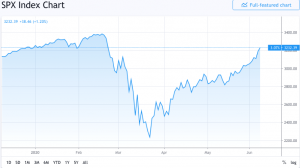
    Well, that was quick. As Main Street tip-toes back to work, Mr. Market has voted with a loud and large V. That’s the ‘V shaped” recovery of financial charts all over the world, particularly in the US. Check out the S&P 500 recovery and its move back into positive territory for 2020. Whooodathunk!

    That is a 40% move since the lows of March. The tech-heavy Nasdaq index has had an even stronger rocket ride; it hit all time highs yesterday and is actually up 10% in 2020. Wall Street is doing its market thing and looking through the current turmoil and “discounting” a better future. Even if a company is “dead”. Rental zombie, Hertz, filed for bankruptcy a few weeks ago but the share price (yes, the equity) gained 115% yesterday. Chesapeake Energy with its $8 billion of Q1 losses and debts in write-off mode went a bit better; just the 181% trip to the stars yesterday. The market is always right, right? Honestly, we just don’t know. Benjamin Graham puts it better – “In the short run, the market is a voting machine, but in the long run, it is a weighing machine.”

    Investors have voted and followed a wall of central bank emergency funding into risk assets. Back on Main Street business owners are weighing up the challenges presented by an ongoing global pandemic, lost revenues, new regulations, new behaviours and their costs. Oh, and Covid-19 is still here – WHO said it recorded its highest daily tally of new infections on Sunday (136,000). Interestingly, for those assuming all will return to pre-Covid exuberance, the National Bureau of Economic Research didn’t quite get the White House ‘Keep-America-Great’ memo. It turns out that the US officially went into recession in February. Yes, the US economy was already contracting before lock-down. Who cares, say investors clocking gains every day. Dare we say exuberance is back? Buckle up, we have a transport dream to sell you.

    Nikola Corp makes hydrogen and battery powered trucks. Not one truck has been produced yet, we don’t know who will make them and the company has zero revenues to date. The Nikola share price doubled on Monday and the value of the company now exceeds $33 billion. That is now $3 billion higher than the value of the 117 year old Ford Motor Company and its annual revenues of $150 billion. Punchy stuff. I think we can agree Wall Street has voted for a big V-shaped recovery. ‘Mission Accomplished” springs to mind.

    There is one tiny flaw in that prognosis. Main Street gets to vote too. Up until now, most business people with US commercial interests would tell you their local contacts/partners are emphatic President Trump will be re-elected. With the most recent CNN poll putting Biden 14 points ahead of Bunker Boy, one wonders is that confidence about to be tested? As Main Street returns to work and polls its pandemic pain through the hot summer months, what are the chances Mr Market reaches for the weighing-scales and reins in its exuberance. Then, we may appreciate “V’ is for volatility too.

  • Good Portfolio Habits Pay Off

    Nobody ever told me the Great South Wall was that long! As the muscles screamed and the expletives flowed on my not-so-little run yesterday there was a fleeting moment when I almost quit. I wouldn’t have been alone on January 19thResearch conducted by Strava based on 800 million user-logged activities predicts this date as the day most people are likely to give up on their New Year’s resolutions. In fact, approximately 80% of resolutions are abandoned by the second week of February. Thankfully, the sun was shining and the brain cajoled me into accepting that this run was just one of a series of good habits to deliver a very productive 2020. Of course, the outcome is not a certainty but good habits vastly increase my chances. The same goes for investment goals.

    Investment can be made to sound very complex. The professionals love complexity as it’s a perfect environment to sell expensive products and services to the least sophisticated clients.  Whoodathunk there are more investment funds (75,000  at last count) to choose from than individual stocks globally? Yes, financial markets are complex but simple good financial habits can greatly increase investors’ chances of meeting their goals over time. We have previously written about the advantages of a portfolio approach versus the “lucky dip” dreamer derby so a portfolio of multiple investments is a sensible start.  But what’s your goal?

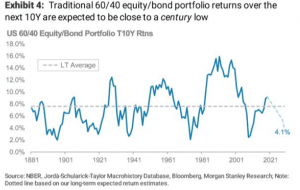
    The answer to this is entirely dependent on your age and your tolerance/capacity to suffer loss (even permanently). We shall assume for the purposes of this article the time horizon is 10 years and that the capital in this portfolio can incur some losses along the way and won’t be needed to fund living expenses over the period. No doubt readers are aware financial markets have had a good run over the past decade. It is entirely sensible to take the view that we must rein in our expectations for the next decade. Wall Street giant, Morgan Stanley, has already tried to manage expectations with its strategists suggesting a standard mix of bonds and equities in a portfolio would earn just 4.1% each year over the next ten years. Low-interest rates, low growth and commensurate low inflation are the familiar returns killers.  Here’s the chart to anchor our goal expectations:

    Now, let’s shift our attention away from the expensive large listed companies and all those bonds yielding zero or even less. In a previous thought piece, we wondered if smaller companies have some performance catch up to do on their much bigger listed peers. Holding that thought, we reckoned it might be helpful to illustrate the relative possibilities of assembling a portfolio of crowdfunding start-up opportunities over a four year period. So, here’s a suggested approach with plenty of good habits:

    1. Invest €100 in an equity crowdfunding campaign every month for 48 months (4 years). This good monthly habit avoids trying to “time” your entry into markets which will fluctuate over a long period.
    2. The portfolio goal is to own 48 equity opportunities in equal amounts of €100 by the end of year 4. This good habit of multiple holdings diversifies the portfolio across industries and geographies.
    3. A portfolio with multiple holdings also allows an investor to collect financial data across those companies and monitor various key metrics like sales, growth, cash flow/burn, margins, debt etc. Like all resolutions/habits – they are only sustainable if measured. This habit of measuring will ensure discipline and selection of opportunities which are consistent with the metrics/averages being observed. More on that again.

    Good habits now in place, will the portfolio deliver? There are no guarantees in finance but here are a few suggestions as to outcomes and the understanding that the professionals think 4% per annum might be the best on offer over the next 10 years. We are suggesting a €4,800 investment of capital. We will assume that all target investments (48) benefit from a 40% tax refund under the EIIS investment scheme.  After refunds of €1,920, investors’ are risking €2,880 in real terms. So that’s the capital at risk. We need to look at where the returns come from.

    Readers will recall our previous references to the famous Arizona University research showing just 4% of all the listed stocks in US history have delivered the entire returns of the S&P 500 since 1926. In theory, and the sample size is small, it is possible as few as 2 holdings in a 48 constituent portfolio will account for the majority of returns. Now, remember Morgan Stanley is telling us a 4 year period might deliver a return on our capital of just over 16%.  Here’s a table to suggest potential outcomes. We are going to assume the rest of the portfolio loses the equivalent of the tax refund(40%) ie 46 of the companies which received €4,600 in capital will lose €1,920 between them. Admittedly, this is probably too harsh an outcome but it will help illustrate what is required by just a few successes to beat a 16% portfolio return forecast on Wall Street. The following table lists a few scenarios and the impact of two companies achieving significant valuation growth:

    Please note in the “2 Winners”  column we are using €200 (€100 in each company) as the initial invested capital. Therefore a gain of €500 in the Match Wall Street scenario requires both companies to increase their value by just 1.5x. This is not a significant hurdle in the world of smaller companies and start-ups. The Run Wall Street scenario might sound fanciful equating to a 20x gain (or 2,000%) on the initial capital invested in the two companies. However, this is very possible in the world of private equity and startups. Yes, there is the risk of losing all your capital when betting on single winners but portfolio diversification is a very good strategy in a high-risk asset class.

    Returns are inextricably linked with risk. That’s a fact and don’t ever buy any product which claims no risk involved. In the worked example above your total capital at risk was €2,880. For perspective, that equates to €15 per week of spend where the loss of capital is permanent – think almond cappuccinos, cars/taxis and mobile data usage on a weekly basis. Maybe take a walk with a bottle of H2O? What productivity goals wouldn’t prosper by ditching the screens, exercising and hydration…..

    Finally, in the spirit of fresher thinking, it is worth noting the most unlikely companies can be the big winners so keep an open mind and spread the risk when building an investment portfolio. As an illustration and a little quiz, what’s the best performing listed stock in the US over the last 20 years? The clues would be that it features in a previous article and it delivers energy, but not the carbon-based kind!  A real Monster which has delivered 87,000% returns over two decades. Wowzers!  Good habits can really energize……

  • Pick A Winner Or A Portfolio?

    I met a very glum Italian fund manager at a Dublin bus stop the other day. A former client, he’s usually a cheerful chap and my initial fear was that after 18 years living in Ireland the excruciating “1-minute due” display at urban bus stops had finally broken him. I was wrong. Something else was broken.

    Irrespective of our professional relationship, both of us over the years would have shared a passion for financial markets and the events that shape them. On this particular morning, my fund manager friend was less talkative and declared he was past caring about the specific drivers of markets as it just didn’t matter anymore. For a brief moment, I thought he had lost his job but he quickly reassured me he was still working in the equities market. He then explained that the reason for the dip in his professional enthusiasm was a sense that markets were “broken”.

    After further discussion, it was clear that central banks’ ultra low-interest rates and consequent turbocharging of prices across all asset classes were not his only professional frustration. Yes, as an “active” fund manager this combination of almost free money and frothy asset inflation made it difficult for his firm to beat or even match the performance of overall market replicating index funds and exchange-traded funds (ETFs). But there was also a whiff of resignation that the higher fees charged by an “active” manager who picks individual stock winners could no longer be justified. Bluntly, the active fund manager business model was in danger of breaking too.

    Not so in the world of super cheap index funds and ETFs. These funds don’t pick winners or actively trade. They just mimic at very low cost the exact constituents of major indices like the S&P 500, Nasdaq, Dax and FTSE 100. The past decade has only seen one negative performance year for global equities and passive fund costs to investors continue to go lower, in some cases to almost zero. No surprise then to see that index funds and ETFs have quadrupled in size since 2010 to just over $10 trillion according to Robin Wigglesworth at the FT.

    The investor flight to cheap index portfolios is killing the traditional active manager who charges his/her clients an annual management fee based on their expertise in researching and selecting winning stocks. The ugly truth is that such “expertise” fails to reveal itself consistently and only a very few active managers produce long-run market-beating performance. Time is possibly the active manager’s greatest weapon – think Warren Buffett. However, long-run historic data would suggest there really are only a few meaningful winning bets.

    We have previously referenced a famous 2017 research paper from Arizona State University’s Hendrik Bessembinder. The findings are stunning. The best-performing 4% of all listed companies account for the entire gains of the US market since 1926. As practitioners in the world of start-up investments, this has given us pause for thought as to the best investment strategy for investors on equity crowdfunding platforms like Spark CrowdFunding.  The good news for crowdfunding investors is that a critical component of performance/success in the larger public markets is low costs.

    The no-fee model for investors on crowdfunding platforms is a great start. It gets even better if one takes into account a further 40% discount on your initial capital stake when the investee start-up company carries an EIIS badge.  So far so good. The next suggestion leverages the experience of active and passive managers over the years and the historical truths in Bessembinder’s research. It is incredibly difficult to pick winners, particularly at an early stage in a company’s journey. The information gaps are huge. However, by employing a portfolio/index type strategy an investor can not only build his own low cost (free) exposure to an entire asset class of start-up private equity but can also avail of a steady stream of opportunities on crowdfunding platforms over 3-4 years.

    A simple monthly budget of even €100 to be invested in a company every month for 4 years would give a patient investor exposure to almost 50 companies with exciting prospects. Some companies might not survive but those that thrive can deliver very nice returns for the overall portfolio. Don’t forget you have a 40% tax cushion to start with so your approximate €5,000 budget over 4 years is really only €3,000. Then remember that 4% figure from Arizona.  My fund manager friend is beginning to realise his time would have been better spent building portfolios for specific asset classes (like private equity) rather than trying to find the very few “winners” in the broader market indices.

    Crowdfunding investors can benefit from the 2020 hindsight of battered active fund managers over the coming years with a sensible portfolio strategy. We will be writing much more on this in the coming weeks as we get a sense of our monthly pipeline of campaign opportunities. Unlike Dublin Bus, we will avoid the “1-minute” hype and do our best to provide a steady flow of campaigns through 2020.


    Enjoyed this blog? Then why not check out our other great content by clicking here!