Tag: ESG

  • Is The World Going Full Oligarch?

    Is The World Going Full Oligarch?

    The lettuces won’t be happy. It looks like the UK’s new Chancellor of The Exchequer, Rachel Reeves, and her Autumn Budget 2024 will survive a relatively benign financial market reaction. So far, government debt (Gilts) markets are stable and the domestic-focused FTSE 250 stock index has bounced slightly. Liz Truss will shake her head in delusion but the more understanding reality of today’s world is that the government of the world’s 5th biggest economy was brought down by international asset traders back in October 2022. It probably won’t be the last sovereign state to lose power to commercial interests and yes, money. Simply put, at exactly the wrong moment in time, many of the world’s governments’ ATM spending cards are about to be declined. Check out the following recent headlines:


    Interest payments on the national debt (US) top $1 trillion as deficit swells  –   CNBC


    IMF warns Japan of debt deterioration in the event of future shock   –   The Japan Times


    Why France’s fiscal freak out matters to the world  – Axios


    China’s Fiscal Package Aims To Ease Debt Woes, Property Crisis   –  Asia Financial


    There’s never a good time for fiscal capacity to be tight. But… literally the planet’s survival is at stake. The climate crisis is everyone’s crisis but governments are expected to lead. Indeed, according to the IEA, governments globally in 2023 spent $1.3 trillion or 1.2% of global GDP on clean energy investment. That bill will surely rise but there’s a big question mark over how the clean energy transition will be funded by stretched governments running record deficits and the highest debt burdens in history. For a clue to that question, let’s take a look at another spending race.

    This race depending on your perspective also has an existential angle. The race, of course, is AI and Packy McCormack’s excellent piece in his Not Boring newsletter has identified a shift in commercial goal – “companies are spending for capability as opposed to straightforward ROI”. Why the ditching of seeking returns on investment? Apparently, the first company to create the AI “Digital God” boils down to an existential pursuit. Loser companies die. Indeed, Larry Page of Google fame has reportedly said many times internally…..


    “I am willing to go bankrupt rather than lose this race”


    That feels like extremely high stakes thinking. It might explain another development in the world’s most advanced technology economy. It’s one thing for a government to depend on a private company, SpaceX, to conduct an international space rescue mission. But, it’s quite another to see SpaceX’s owner Elon Musk in the words of VP hopeful, Tim Walz, “skipping like a dipshit” at various Trump rallies. Musk may cause me involuntary eye-rolls every time I read him on X or see him on TV but he’s a super-successful builder of future technologies. In fact, he has feet in both existential races with Tesla (climate) and xAI (AI) which is about to raise funds at a $40 billion valuation. If the latter doesn’t feel like an existential race, maybe the monies will convince you. In 2023, just 4 companies – Facebook, Amazon, Google and Microsoft – spent $196 billion or 0.72% of US GDP on AI research and infrastructure. Remember, these companies are really only ‘getting ready’. Furthermore, they are arguably investing at levels which historically would have only been within the compass of sovereign governments.

    I remember reading first about social media companies becoming effectively supra-sovereign powers. At the time, Facebook had 2.5 billion people on its platform, multiples of any other country populations on the planet. Now social media steers business and moves elections, but tech money might be about to go one step further. Forget about tech companies currently rolling out nuclear power for their hyper-scaling data centres. What about a seat in government?  Well, Elon Musk is on the cusp of entering a Trump ministerial cabinet with a role brief focused on cost cutting. I will give you a clue; plenty of those cuts will be in the regulatory, business and tech governance areas. Musk is not alone. Racist rallies in Madison Square Garden or not, big business is keen to put on the Orange war paint for Trump chaos and……… commercial insurance or favour. Check out the latest Trump luvvies from the world of business:


    Winklevoss Twins donate $1m each to Trump as champion of cryptocurrency  – The Guardian


    Steve Schwarzmann says Trump would be “efficient and effective” president this time – Business Insider


    Silicon Valley’s Andreesson Horowitz give Millions to Trump  – Bloomberg


    Billionaire Ken Griffin says “expectation today is that Donald Trump will win the White House” –  Fortune


    Washington Post flooded by cancellations after Bezos non-endorsement decision  –  NPR


    Ooooohh what would Washington Post legends Katherine Graham or Ben Bradlee think in this “Fat Nixon” era? It would appear big tech and big money “broligarchs” see Trump support as commercial insurance at the very least, and possibly a route to unfettered, compliance-light opportunity. One could become dispirited about the overt involvement of big business in politics. But, in reality business was always there in the Washington background. However, it’s not just a US phenomenon.

    Europe has had its share of big business influence on policy. In the UK, they have had trade and Brexit. In Germany, it was the powerful industrial sector and its push for cheap(then) dependency on Russian energy. We will say no more on either policy disaster, except there might be an intellectual reason why US business leaders are in a different universe of wealth creation compared to their strategically inept European counterparts.

    On a final more serious note, perhaps the difference this time is that governments really do need the balance sheets, cash and spending power of big tech. Just six US technology companies – Apple, Amazon, Google, Meta, Microsoft and Nvidia – have a combined market value of $15 trillion. For context, that $15 trillion equates to the  GDP of China as recently as 2020. In this writer’s reluctant view, politicians have two options – tax these guys or become partners. It might seem distasteful but public-private partnership is now an existential fact of life….or death.

    Gotta dip with the dipshits.

     

  • The Hottest Investment This Summer

    The Hottest Investment This Summer

    Ok, I’m a bit hot and bothered. When a tee-shirt ripping Hulk Hogan is the warm-up act for possibly the next President of the United States I’m inclined to think our planet is in trouble. The Republican National Convention(RNC) in Milwaukee this week marked a new level of bizarre in US politics, but the hot air sadly can’t be confined to the GOP speaker line-up. As a record-breaking 1,400 tornadoes and scorching heat batters the US, I am resigned to the fact that decarbonisation of the global economy is way down the MAGA Republican (GOP) list of priorities. However, political mayhem can often leave investment markets unmoved, even relaxed. This seems to be the case so far, but things are fascinatingly stirring in long-forgotten parts of the market and I see one particular opportunity heating up fast. First, let’s look at some data:

    Technology: It’s not just Microsoft having a bad cyber outage day. In recent days, technology stocks experienced their worst share price falls since 2022. However, overall, stock markets continue to hit new highs. Why?


    Old Economy: Sectors neglected for months, even years, are attracting investors who are watching potential interest rate cuts and interesting valuation discounts to technology, pharma and AI-giddy companies. The top performing sectors over the past week were old-fashioned financials, industrials, energy and real estate.


    Smaller Companies: Only a few weeks ago we wrote an article “Betting On Small Can Really Win”. Hoo boy. The share prices of smaller companies over the past week have been on an historic tear. Stock indices which track smaller companies are flying as Trump would say “like you’ve never seen before”. The Russell 2000 is a benchmark used for smaller companies in the US and it has rocketed 12% in just the past week.


    UK Markets: The benchmark FTSE 100 post the Tory election rout immediately embarked on a two week winning streak. Coinciding with this political re-set, UK consumer confidence just hit a 3 year high.


    Venture Capital (VC): The latest data from VC research team, Pitchbook, shows that fintech and cleantech/sustainability start-ups are attracting the most investment in Europe of recent quarters.


    Clearly, investment capital is ‘rotating’ out of large company technology and looking for alternative opportunities. Furthermore, some structural themes are here to stay. So, we believe there are alternative opportunities to plug into the ‘monster themes’ like AI, decarbonisation, cloud wars and electrification. Where better to start than our planet and the urgent need to stem global warming? We have written many times before that this $9 trillion per year decarbonisation spend can’t happen without critical materials like rare earths and base metals. However, the mining sector essential to extract these critical materials has been starved of investment as large pools of capital shun the sector’s poor sustainability/ESG track record.

    That is changing as the big money now realises if there’s no mining, there’s no EVs, no batteries, no AI, no data centres etc These big funds are now pushing for sustainability assurance solutions which will allow them to deploy capital again and ensure the supply of critical materials can keep up with the demands of economic electrification. So, if you can excuse the mining pun, we have found a little gem of a play on mining/ESG which ticks the following boxes:

    *Market leadership: The company is a fintech with mining-valuable data built over 4 years.

    *Market fit: It is winning mining company customers – there are 4,500 publicly listed and investment capital-hungry mining companies – and generating more than $1m of annual revenues already.

    *Institutional endorsement: Critically, big investment houses are telling the mining industry this company’s independent ESG assurance process can open up investment and significantly speed up investment decisions.

    *Structural tailwinds: The macro themes of smaller companies, UK and old economy all feature in this opportunity.

    *Money talks: And.. founders and international institutions are putting in their own money to grow the company’s global footprint.

    So many boxes ticked, with macro and structural themes aligning. This has to be our hottest opportunity to fight global heat this summer, and for many summers more. But, not too many. This company will surely be bought by a global data player or consultancy in less than 5 years with a potential 10x return to private investors. Think Bloomberg, Accenture, Reuters, S&P Global etc but don’t tell them yet – we are keeping this opportunity exclusive and private.

    Links to next week’s webinar here and the company’s investment memorandum here.


  • ESG Goes MEGA: Making Europe Good Again….

    ESG Goes MEGA: Making Europe Good Again….

    The current perceived wisdom of markets is that doing good helps financial performance. Doing good even has its own fancy financial acronym these days – ESG. That covers corporate adherence to Environment, Social and Governance standards. In fact, more than $30 trillion of investment funds are now using ESG metrics/data in their decision making. It would seem the performance debate over ESG is now over which raises an awkward query for this writer. If ESG is a such a big driver of performance why does Europe’s equity markets lag the US so badly?

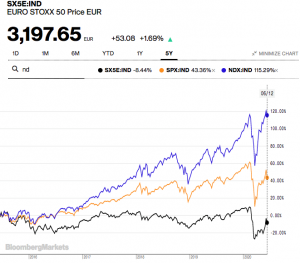
    The data rarely lies. The following chart provides a stark reminder of a European Stoxx50 index going precisely nowhere over the past 5 years while US indices, like the S&P 500 and Nasdaq, roar ahead.

    Spark-crowdfunding-blog

    Of course, there are other macro drivers of equity markets. One of the most topical themes these days is the massive underperformance of the value style of investing. Europe is clearly more exposed to more traditional companies and business models and definitely lacks the turbo boost coming from the US technology titans. A $6 trillion boost no less. Yes, the 5 largest tech companies in the US have a market value equivalent to China’s GDP from just a decade ago. And yet, markets are supposed to discount the future. Technology is certainly the future but what about the future US?

    Recent headlines from the US do not look out of place in a banana republic with ESG alarm bells ringing very loudly. Check out this medley of mayhem:

    Trump demanded 10,000 active-duty troops deploy to streets – CBS News

    Justice Department Reversal “Gross Abuse of Power” – New York Times

    Revolt of The Generals – Washington Post

    Trump Threatens to Invade Seattle – Vice.com

    After Facebook staff walkout, Zuckerberg defends no action on Trump – Reuters

    The media fixation on the unstable non-genius in the White House almost misses the point. The bigger ESG issue is the passive acceptance by half the legislators in the country(Republican party) of the potential corruption of the DOJ, the military and a massive social media company with a user base twice the size of China’s population. Trump is merely a symptom of decades-long social dysfunction. Yes, George Floyd’s death has forced the national address of systemic racism and a wave of corporate PR statements recognizing the issue and a firm commitment to do good, better. ESG box ticked, move along? Ehhh, not so fast. Where is the corporate concern on the following….

    • The US has a prison population of well over 2 million. That is 25% of the global prison population for a country with less than 5% of the planet’s population.

    • More than 300 million guns owned in the US.

    • Thousands of immigrant children held in cages.

    • Toddlers causing death/serious injury with guns annually exceed all Jihadi/Islamic terrorist activity.

    • The top 1% of the population in 2018 held over $25 trillion in wealth which exceeded the wealth of the bottom 80%. With 40 million now out of jobs and the Nasdaq hitting all time highs one shudders to think where the current disparity lies.

    • 1,000 people are killed by US police annually.

    One suspects the most wide-scale street protests seen since 1968 are about far more than George Floyd’s gruesome murder. Europe is not a perfect place but the Covid-19 pandemic has surprisingly revealed a crisis response far more coherent than originally feared. It is early days yet in a hopeful recovery but one wonders if financial markets over time will see Europe through a more atttractive ESG prism. How ironic it would be if European capital markets over the next decade outperform the US due to the comeback of social values rather than financial value…..

  • Crowdfunding The ESG Revolution

    ESG might strike some as a larger company fad to keep investors comfortable that the C-suite are good corporate citizens on environmental, social and governance issues. Wrong. We often say actions speak louder than words, particularly investment. Check out Spark Crowdfunding’s platform whose last three campaigns raised an eye-catching €1 million for companies providing solutions to real environmental challenges. Accucolour is the latest start-up company to successfully raise funds for innovative products allowing fast-track recycling of plastic bottles. Pardon the pun but an ESG ‘ecosystem’ is emerging.

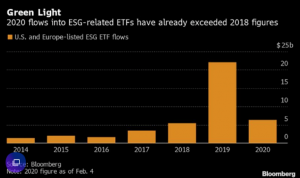
    ESG is here to stay and companies who can help larger companies meet ESG benchmarks/standards are going to do rather well. The flow of funds into investment products that track ESG friendly corporates is striking and provides further incentive for laggard companies to up their game or face valuation discounts in public markets or M&A discussions.  Already, fund flows 6 weeks into 2020 have surpassed total flows for all of 2018 as this graphic from Bloomberg illustrates:

    To get a flavour of the punishment inflicted on less ESG friendly companies, consider the case of Exxon Mobile whose valuation has crumbled by $184 billion since its peak in 2014. Clearly, an excess supply of oil, consequent lower prices and the growth of renewable energy have hurt cash flows. However, that doesn’t explain all of Exxon’s collapse from being the world’s most valuable company as recently as 2012. Climate change is the elephant in the room which is applying an ESG discount to those still-enormous cash flows.

    The opportunity for smaller companies is to help these monster enterprises join the ESG-friendly club. There is no shortage of cash to throw at this challenge and no shortage of opportunities for innovative solutions. Just yesterday BP, under a new Irish CEO, announced plans to “reinvent” the oil giant by setting a net-zero carbon footprint target by 2050. Whether BP meets those targets or not is up for debate but it is absolutely certain they are going to spend BIG to reposition the firm.

    That’s a double whammy of good news for entrepreneurial spirits. It’s always good to know there are some very rich and desperate ESG customers out there, as well as an informed and active investor base consistently funding great startups at Spark Crowdfunding. These investors are not alone. Currently, $30 trillion of investment funds use ESG criteria in their securities selection process.  So, as the political world grapples with daily Watergate flashbacks and worse, it would seem prudent once again to take the sage advice of that era to follow the money…..

    Interested in learning more about ESG? Then check our previous blog on the topic “ESG: Corporate Health Is Your Wealth“!

  • ESG: Corporate Health Is Your Wealth!

    Readers may have noticed yet another deal announced in the health technology sector this week. Irish 3D imaging company, 3D4Medical, is about to be bought by Dutch media giant Elsevier for nearly €50m. This newsflow will no doubt keep venture capital (VC) funds focused on current “hot” sectors, health tech and fintech. However, start-up entrepreneurs and retail investors need not despair if they feel they are being excluded from VC activities. There’s another “health” sector which could offer plenty of wealth creation opportunities.

    This writer attends the odd financial conference and was seriously struck by the size of attendance at this week’s Bloomberg ESG Summit in Dublin. The audience was in the hundreds and it had nothing to do with a campaign for the US presidency or a wonderful display of tractors on St Stephen’s Green. The attendees’ focus was ESG investing. In layperson terms, ESG investing describes the application of environmental, social and corporate governance factors into investment selection processes. The corollary to applying ESG investment criteria is a growing awareness by companies that their own response to these considerations, from water management to employee diversity, will be monitored and ultimately “valued” by these investment houses.

    ESG is a term around since 2005 but SRI (Socially Responsible Investing) predates it as an ethical framework. However, latter-day thinking is the assumption that ESG factors have financial as well as ethical relevance. You will often hear the phrase “sustainable investment ” in ESG discussions and this possibly best captures the financial rationale for an ESG focus. Bluntly, if a company culture is not healthy it is at risk of losing fixed assets, customers, quality staff/management, suppliers or investors. None of these potential losses are good for company or investor returns. Financial fundamentals (or health) were always critical to investment decisions but the wider “corporate health” of a company is now a big deal.

    Current estimates suggest up to $30 trillion of assets under institutional management now include ESG considerations in their investment processes. Clearly, corporate health is a growth area and already forcing both investors and companies to spend money on resourcing this analysis with quality people and information. Remember, all this resource is about outcomes. The luxury goods sector has featured in headlines this week with LVMH making a $16 billion swoop for Tiffany. Perhaps more intriguing, and hidden away from the front pages, was the news that Prada has secured a €45 million bank loan with repayment terms/interest rates conditional on meeting “sustainability targets” in its products and operations. Better health means cheaper capital ….Hmmm. For the entrepreneurs out there here’s a few thoughts as to how one could capitalise on this corporate health rush.

    Companies will need guidance as to best ways to integrate ESG on both cultural and operational bases. This requires expert advice, possible internal training/education and periodic audits of companies’ “health” and responses to ESG considerations.

    Audits require metrics or data. Most ESG conferences these days focus on the challenge of “standardising” ESG compliance. There is a huge opportunity for those that can create and gather credible measures for ESG factors as investors and companies are crying out for benchmarks and raw data. Current thinking is that different companies will provide data in different areas ie carbon footprint(CO2e) and health and safety data(EHS) is likely to come from separate providers.

    The combination of performance and people’s money inevitably attracts the attention of regulators. ESG regulation will follow soon and, of course, the legal profession will be getting giddy at the thought of litigation risk and advisory fees. Be under no illusion, finance always pays the middlemen. As for investors, the evidence is more mixed. So, ESG compliance is going to be a very big area.

    Encouragingly, Ireland is taking the lead in some ESG initiatives. There are currently €140 billion of “Green Bonds” listed on the Irish Stock Exchange as part of the wider Euronext group of international exchanges. This feels like Euronext is betting on Dublin as ESG lead, not unlike the aircraft leasing ecosystem successfully built here too. Furthermore, the existence of a “live” asset class of investment securities in Dublin is a good “lab rat” for enquiring minds trying to figure out how they might monetise the ESG revolution.

    No doubt the VCs will move on from mainstream healthcare one day. However, right now there are 30 trillion reasons for curious minds to get a head start in the rapidly expanding area of corporate health.


    Enjoyed this blog? Then why not check out our other great content by clicking here!