Tag: Facebook

  • Charting the Next Era of Change

    Charting the Next Era of Change

    Dr. Tony “Holocaust” Houlihan will try and change government minds again this week on Covid-19 curtailment strategies. Change seems inevitable. Indeed, the timing of change seems to be the only area of dispute between NPHET and the politicians. In business and financial markets, change is omnipresent but again strategy shifts are often resisted. Sometimes for too long. Look at IBM which has just decided to break itself in two.

    Founded 109 years ago, IBM was as recently as 1980 the most valuable company in the world. The global pandemic can’t be blamed for this remarkable strategic decision but there is no doubt Zoom was a catalyst. In recent months this video conferencing upstart has attracted a market value of over $130 billion and left IBM in the dinosaur dust at a mere $117 billion valuation. IBM spent too long defending a hardware business; the future and focus should have been cloud software. However, IBM is not alone in its strategic sclerosis.

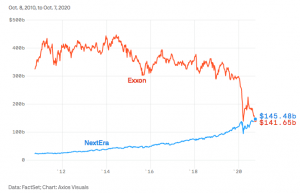
    Exxon Mobile(XOM) as recently as 2013 was the most valuable company in the world. Zoom is almost as valuable as XOM but the real zinger this week was watching wind and solar power company, NextEra, surpass the market capitalization of the Rockefeller fossil fuel descendent. Quite remarkable. But, also an embarassing reminder of the costs of hubris, climate change denial and sipping the Trump kool-aid. NextEra is now the most valuable energy company in the US and the following chart painfully captures the strategic miss by XOM executives.
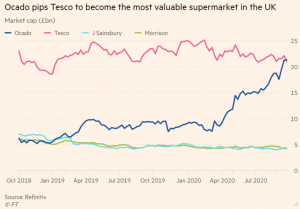
    XOM should have gone shopping for renewable energy assets years ago. Then again shopping has changed too with Ocado just overtaking Tesco as the UK’s most valuable retailer with a £21.7 billion valuation. Tesco executives must be scratching their heads with a 27% share of the UK grocery market compared to Ocado’s hi-tech delivery share of….. 1.7%! This writer must confess to similar confusion but the chart below points to some pretty impressive confidence from financial markets:
    Investors have perhaps decided that retail is moving rapidly towards being a service attached to a technology platform. We shall see. However, we have more conviction, and have written so previously, in the world of banking. It is interesting to note that Europe’s relatively small technology sector has now exceeded the value of the region’s enormous banking system. See the chart below and think about that €800 billion valuation of Europe’s entire banking sector.
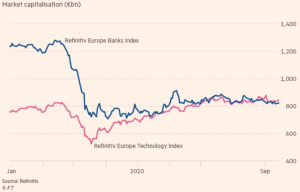
    Yes, that €800 billion figure resonates with us. It happens to be only slightly more than the current market value of a single social media platform company, Facebook. How will that comparison chart loook in the years to come? We certainly won’t have to wait 109 years like IBM to see banks change dramatically. But, perhaps the more interesting question is what will Facebook look like in the next decade. Only 10 years ago we watched the Facebook start-up story, “The Social Network”. The corporate skulduggery detailed in that version was at the playschool end of the spectrum compared to what we (and most US and UK voters) know today. The ugly truth of supra-sovereign power was already apparent in this 2017 chart below:
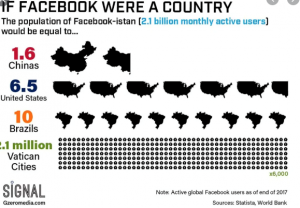
    The brutal truth is that Facebook exerts more influence than entire countries. China might be the focus of US geopolitical worries today given its huge consumer market and outsized influence on the world economy. However, one wonders will a probable Democrat President in the White House initiate a more robust discussion about breaking up Facebook. In America, the home of capitalism? Really? Never? Think again and revisit history.

    In the same year that IBM was founded, another huge US monopoly was broken up. The Republican Presidency of William Howard Taft in 1911 witnessed a successful antitrust case brought by the US Justice Department against the Rockefellers and Standard Oil. What a year it was. The world’s largest company was broken up and a future global number one, IBM, began its corporate journey. However, IBM wasn’t the only global number one company to begin its corporate life that year. One of the 34 independent oil companies spun out of Standard Oil was…….. Exxon. Fuel for thought me thinks. Whither Facebook and its influencing spawn in 2021?


  • Is There A Sequel To The FAANTAM ‘Menace’ ………..?

    Is There A Sequel To The FAANTAM ‘Menace’ ………..?

    I can remember working in Tokyo when the grounds of the Japanese Imperial Palace had an implied valuation greater than the entire state of California. Fun times and fantasy didn’t last. Sadly, only Hollywood can deliver entertaining sequels for decades. Financial markets are thrilling investors right now but I’m beginning to wonder whether we are entering fantasy territory? Let’s revisit Japan and California again.

    The combined value of just three Californian companies – Apple, Alphabet(Google) and Facebook – plus Microsoft, up the road in Seattle, currently exceed the value of the entire $4.7 trillion Japanese economy. We didn’t even need to include the $1.5 trillion Amazon in that calculation but bear with us. Here are a few other fantastic data points driving current markets.

    • These same five companies have delivered 35% returns to investors year-to-date. The next 495 biggest stocks have declined by 5% in the same period.

    • The FAANG stocks – Facebook, Apple, Amazon, Google and Netflix – recently hit a new 22% high as a percentage of the value of the overall S&P 500 index.

    • The Wall Street Journal reported this week that 78% of the S&P 500 returns over the past 5 years came from the technology and e-commerce sectors.

    • Tesla is not even included in the S&P 500 because, up until this week’s quarterly results, it had failed to make profits for four consecutive quarters….ever. At its recent $300 billion valuation Tesla is the tenth biggest company in the world by value. That’s $100 billion more than Toyota which sold 10.6 million cars in 2019. I kept the ‘0.6’ in that figure because Tesla didn’t even reach that mark and probably won’t this year either.

    Clearly, this concentration of euphoria in such a small number of stocks causes some unease and resonates with veterans of the TMT fantasy party of 1999. Perhaps we have seen this movie before or this is the original ‘FAANTAM Menace’ like its Star Wars contemporary which had its first release, ironically enough, in 1999 too.

    The FAANTAM stocks – Facebook, Alphabet, Apple, Netflix, Tesla, Amazon and Microsoft – are my own $7 trillion(!) creation but I’m struggling to see how any sequel could thrill investors to the same extent. Right now investors are enjoying the possibilities of these companies dominating their respective global markets for years to come. They could be right but do not be too surprised to see potentially darker sequels. Here are two potential contenders for an eventual trilogy:

    Inflation Strikes Back: Yes, some inflation is a good thing. But too much inflation and things go horribly wrong quickly. Why? Equity markets might look a little stretched but debt markets are incredibly vulnerable if interest rates rise to counter inflation. The IIF estimates total global debt will reach $257 trillion in 2020 as central banks and governments reflate a pandemic crippled economy. Global equity markets, for perspective, are valued at around $90 trillion.

    Revenge of The Dragon: China is being battered on the political front at the moment. UK moves on Huawei, Australian C19 fury, US consulate closures, Indian military skirmishes and Hong Kong protests are pushing China further into an isolated corner. The back lash from China could be very painful given their critical positioning in global trade. All the FAANTAM valuations assume singular global trade and technology platforms. Clearly, a world divided into two different trade and technology ecosystems is not a friendly one for equity valuations.

    Unlike Hollywood, there will be no great appetite to view those sequels.

  • Which Floor Will You Work On?

    Which Floor Will You Work On?

    High profile developer Johnny Ronan had a tricky PR week with a Bewleys collapse and a questionably toned and timed holiday video. But…it could have been worse. Not that long ago Johnny’s PR efforts were devoted to convincing Dublin City Council of the benefits of high rise office buildings. The Council were not persuaded. Now, in a Covid-19(CV19) world, that decision may have been a blessing in disguise.

    As back-to-work health and safety protocols come into effect you do wonder about elevator capacity restrictions (potential max 4 persons for skyscrapers) and the practicality of very tall buildings. Anecdotally, one hears about HSBC calculating a potential 2-3 hour wait for its 5,000 personnel in 20 Canada Square, Canary Wharf. The brutal truth for managers of that facility is that possibly only 10% of its workforce would be able to get to their desk in a reasonable time.

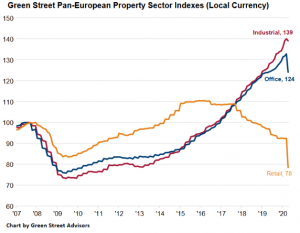
    It will not be just retail properties dealing with a new reality. However, the chart below of European property price indices from Green Street Advisors would suggest a 6.6% fall in the office sector might not capture the full impact of CV19 compared to the 15% hit in the retail sector.

    The consultants, Teuben and Bothra, estimated the size of the global professionally managed real estate market at $8.5 trillion. Savills thought the total commercial property market(retail plus office) was $30 trillion in 2015. Let’s just say there’s a lot of investment capital staring down the barrel of a design disaster if CV19 precautions remain an ongoing feature of working life.

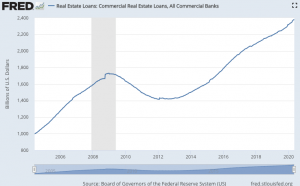
    The US and its Federal Reserve Bank have pretty good data on the risks involved. Here is a chart showing commercial real estate loans from all US banks hitting $2.4 trillion which is a 50% higher exposure than the 2008 crash period. Now, think about all the non-bank providers of debt capital who were chasing yields over the last decade of almost-zero interest rates. Think hedge funds, private equity, pension funds, sovereign wealth funds……

    Meanwhile, the daily drum beat of “forever” work-from-home announcements from the likes of Facebook, Shopify and Twitter would suggest office leases and valuations are due some challenging reviews.

    Of course, there are challenges everywhere in business but now and again a fortuitously delayed decision or a stubborn policy stance can make things a lot easier. It would appear, at this surreal pandemic moment in time, that Dublin and Johnny Ronan might have just dodged a high rise bullet….