
Tag: finance

  • Virtuous Circle Or Circle Of P..AI..N?

    Virtuous Circle Or Circle Of P..AI..N?

    I’m getting flashbacks. Not good ones. Financial ‘engineering’ was a feature of the world’s last two financial crises. In the TMT bubble collapse, Enron used its stock as collateral in long-term contracts or asset sales which were described as “circular hedging transactions”. The goal or impression sought was to mitigate risk but ultimately all risk was really tied to the Enron share price. In the credit crisis of 2008/2009, new ways of packaging property debt with a bewildering array of acronyms (CLO, CMO, RMBS etc) were supposed to insulate risk within different tranches. Until, they didn’t.

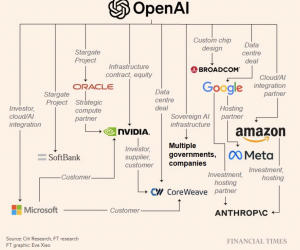
    Now, I’m reading about new ways to finance the AI boom and, again, the risks keep coming back to a very narrow collateral pool. The word “circular” is back and one name keeps cropping up; OpenAI. My newsfeed has been bombarded with multiple graphics from Bloomberg, Goldman Sachs and The Financial Times (see below) illustrating this circularity accompanied by headlines stating that OpenAI is at the centre of a $1 trillion AI infrastructure spending boom. And, I thought they were just building a chatbot (ChatGPT).


    Here’s a few things you might have missed about OpenAI….


    A recent funding round valued OpenAI at $500 billion, the world’s most valuable private company, but….


    It generates NO cash. Latest figures for H1 2025 reveal revenues of $4.3 billion while incurring a net loss of $13.5 billion. Yep, it’s losing more than 3 dollars for every dollar of sales it generates.


    OpenAI has signed up to $1 trillion of deals with the likes of Oracle ($300 billion), Nvidia ($100 billion), AMD ($80 billion) and Coreweave ($22 billion). The Stargate project alone is a $500 billion infrastructure project.


    OpenAI’s core product, ChatGPT, has built a weekly user base of 800 million people.


    Now, let’s return to the deals. I’m not sure the graphics of circularity really capture what’s going on. In recent weeks the world’s most valuable company, Nvidia, announced a $100 billion investment in OpenAI. In return, OpenAI will buy Nvidia’s graphic chips (GPUs) as it builds out its data centre infrastructure. You can see the circular vendor-financing risk in that deal. However, in the last 24 hours OpenAI has announced a further deal with Nividia rival chip maker, AMD. I’m going to lean on Bloomberg’s excellent Matt Levine in imagining the language of current deal negotiations with the loss-making OpenAI.


    OpenAI: We would like six gigawatts worth of your chips to do inference.

    AMD: Terrific. That will be $78 billion. How would you like to pay? 

    OpenAI: Well, we were thinking that we would announce the deal, and that would add $78 billion to the value of your company, which should cover it.  

    AMD:

    OpenAI:

    AMD: No I’m pretty sure you have to pay for the chips.  

    OpenAI: Why?

    AMD: I dunno, just seems wrong not to

    OpenAI: Okay. Why don’t we pay you cash for the value of the chips, and you give us back stock, and when we announce the deal the stock will go up and we’ll get our $78 billion back.

    AMD: Yeah I guess that works though I feel like we should get some of the value?

    OpenAI: Okay you can have half. You give us stock worth like $35 billion and you keep the rest.


    Levine is spot on. It has been bothering me for weeks now. CEOs in the tech world have spotted that a company’s share price goes up on the announcement of huge spending plans (not profits). In extremis, one could route the “value” of the share price gain to a cash-strapped customer like OpenAI. Funnily enough, AMD’s share price rocketed 35% on the OpenAI deal news adding $60 billion to its market value. And, so the merry go round continues. Sure enough, Nvidia, has responded to the behind-the-back dealing of OpenAI with rival AMD by announcing a $2 billion investment in OpenAI rival, xAI, owned by Elon Musk. The total funding round for xAI will be $20 billion but there’s a few extra ‘engineering’ twists. The $20 billion ($7.5 billion equity, $12.5 billion debt) is going into a special purpose vehicle (SPV – remember them?) which will buy GPU chips for xAI’s Memphis Colossus 2 data centre. The SPV, in turn, will rent out the GPU chips for 5 years, with the debt backed by the chips rather than the company. Hmmmm. The rent and SPV details should raise alarm bells.

    The attraction of constructs like rent, leases and special vehicles is that it increases the complexity of an organization and also makes it more difficult to track the true returns (or not) of a company. Rent and leases are considered off-balance sheet items ie they don’t show up as DEBT on the balance sheet. To complete the circle, I’m reading about Oracle today and its astonishing $380 billion in revenue it will generate by renting out its cloud servers to OpenAI and other AI developers over the next 5 years. Oracle can’t afford a rent default. It is not cash rich like Google or Microsoft. In fact, its debt-equity ratio is a whopping 520%. Michael Cembalest at JP Morgan put it rather well…


    “Oracle’s stock jumped by 25% after being promised $60 billion a year from OpenAI, an amount of money OpenAI doesn’t earn yet, to provide cloud computing facilities that Oracle hasn’t built yet, and which will require 4.5 GW of power (the equivalent of 2.25 Hoover Dams or four nuclear plants), as well as increased borrowing by Oracle whose debt to equity ratio is already 500% compared to 50% for Amazon, 30% for Microsoft and even less at Meta and Google. In other words, the tech capital cycle may be about to change.”


    Change, yes. But some things never change in credit or investment cycles. OpenAI might be at the centre of a $1 trillion investment revolution driving stock prices ever higher. But, ultimately “other people’s money” will make its presence felt. Bloomberg is reporting that the amount of debt tied to AI has ballooned to $1.2 trillion. This makes AI the largest segment(14%) of the investment-grade market, surpassing US banks. That means more eyes and scrutiny on the circular world of AI. Bluntly, if a problem emerges it won’t be seen in the stock markets first. It will be in the bond markets with its army of credit analysts. As a final thought, and given the scrutiny applied to the track records of key entities in investment ecosystems, what must credit analysts think of OpenAI?


    • As recently as 2023, the OpenAI CEO, Sam Altman, was fired, then re-hired.
    • OpenAI co-founder, Elon Musk, is now a bitter and richer rival.
    • The company is a strange governance hybrid with control residing in a non-profit Board.
    • OpenAI and early backer, Microsoft, have been in dispute over their partnership terms.
    • CEO Sam Altman was quoted this week in FT saying becoming profitable was “not in my top-10 concerns”
    • Recent $100 billion investor in OpenAI, Jensen Huang of Nvidia, was not told about the deal with rival, AMD.


    None of the above makes OpenAI a bad credit. But, with trillions of dollars of investment capital on the line any loss of confidence in OpenAI could spiral rapidly into a whole new circle of “engineering” PAIN.

  • Who’s Really Losing Power…?

    Who’s Really Losing Power…?

    We sorta knew didn’t we? The Donald really doesn’t ever want to leave power. National Guard troops might be armed and patrolling the streets of Washington DC but we might be missing an even bigger power move. No, neither I nor the South Park writing team are contemplating a horse being appointed as a Senator, or JD Vance as President or Eric Trump …. replacing the horse. Parody and Caligula’s legacy are safe, for now. However, if you’re a fossil fuel investor things are looking anything but safe despite the Orwellian data-denial of the Dear Orange Leader. Let’s start with a few ground truths.


    *Oil prices have fallen in three of the last four weeks and are now in the low $60s per barrel pricing region which is close to a 4-year low.

    *Bloomberg recently reported that global oil markets are on track for a record surplus next year as demand growth slows and supplies keep growing [Source: International Energy Agency(IEA)]

    *IEA data shows oil inventories will accumulate next year at a rate of 2.96 million barrels a day, surpassing even the average build-up during the pandemic year of 2020

    *World oil demand this year and next is growing at less than half the pace seen in 2023.

    *But what about “Drill, Baby, Drill” ? Maybe not so much. US drilling activity continued to fall in early August as the oil rig count fell to 539, near its lowest since Dec 2021.


    No wonder Texas is trying to re-draw and gerrymander voting districts 5 years early. Texans are unlikely to fall for Fox News fealty to the Dear Leader, but they will be bombarded with untruths. That’s just a no-fact of life in politics these days. However, the strategic problem for the US in this energy leadership crisis is that climate crisis denial has directly impacted investment in renewable energy projects. The facts are stark. The Financial Times has reported a whopping $19 billion worth of projects have been cancelled this year alone. In fact, cancellation rates on all renewable projects are up over 2,000%.

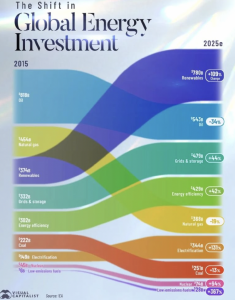
    The most recent cancellation was a biggie in Rhode Island. An off-shore wind project 80% completed by Danish company, Ørsted, was halted by the Department of the Interior citing “concerns related to the protection of national security interests”.  That project would have powered 350,000 homes in Connecticut and Rhode Island. Meanwhile, the rest of the world is rapidly shifting focus away from fossil fuel projects. The graphic below is from the Visual Capitalist team using IEA data and compares global investment from the years 2015 and 2025 (estimated). Renewable energy investment projects have more than doubled to $780 billion and overtaken oil project investment which has shrunk from over $800 billion to $543 billion. Interestingly, electricity grid, storage and efficiency projects are now forecast to reach close to $800 billion in 2025.


    The slippage of oil, gas and coal in the investment rankings is clear to see in the chart above. A seismic power shift is already happening and it is worth keeping an eye on the headlines and developments listed below. Arguably, the current White House administration, rather than bolstering “national security” is handing the energy keys of the future to more far-sighted leaders elsewhere. Check out these data points:

    In July, China’s single month electricity usage exceeded 1 trillion kw/hours. That’s more than Japan uses in a whole year. Of this total, 25% was generated by wind and solar energy sources.

    In April 2025, China’s solar generation of 95 TWh was larger than the TOTAL ELECTRICITY DEMAND of all but two countries in the same month.

    For the first time in history, despite soaring electricity usage, CO2 emissions in China are falling.

    The UK in Q2 granted planning for 16.1 GW of renewable energy capacity. That’s up 195% on last year.

    Renewables in the UK for the first time in 2024 supplied over 50% of the nation’s electricity over the entire year. Renewables and nuclear energy combined, accounted for 65% electricity generation in the world’s 5th biggest economy.

    In Pakistan, over the last two years private individuals have imported solar panels which equate to 68% of the entire national public grid!

    India’s solar PV manufacturing capacity has increased 50x in 10 years from 2GW to 100GW.

    In May this year, 68% of Germany’s net public electricity was generated from renewable sources.

    The electric vehicle (EV) revolution is not just happening in wealthy economies. 76% of new passenger cars sold in Nepal are electric. In Ethiopia that number is 60%.

    EV sales in Europe took 29% market share in June 2025. The share in Sweden is 65% while China moves in to the tipping point of more than 50% of sales being electric.


    The future is fast becoming electric, powered by renewable energy sources. One wouldn’t want to be on the wrong side of history, or your previously loyal customers. Ask Elon Musk and his European sales and marketing team. And…. if you want history to be a guide as to how power can shift slowly, then suddenly,  maybe don’t go to a US museum. Apparently, the Dear Leader doesn’t want US museums like the Smithsonian to raise awareness “too much of the past”, but rather “focus on the future”. Yep museums shouldn’t do history too much. Go figure.

    I’m going to stick my neck out here and risk future US visa issues but ……..it feels like the US energy future is not in good hands, just tiny ones clinging to the wrong power.

  • Are We Ready For Another Banking B-AI-L Out?

    Are We Ready For Another Banking B-AI-L Out?

    Domestic business and investing titan, Dermot Desmond, upset the orthodoxy this week. Ireland’s 500-year plan to build the Metrolink might be cut short, even ended. Desmond suggested the €12 billion urban rail project due to start in 2028 could be a white elephant project superseded by AI and autonomous-driving vehicles. Any bets on the kilometres per annum build speed on this 18 kilometre ‘monster’? Actually, don’t bother. Reflect on China’s average motor expressway construction build of circa 8,000 kilometres per year. Then think about the UK adding barely 65 miles of motorway over the past ….decade. Given the Irish public service obsession with tracking the UK National Health Service or UK Housing/Planning as benchmarks, one shudders to think what our ‘ambition’ could deliver in over-spend and century-shifting deadlines. On a more positive note, AI could be one of the tools which could dig us out of our transport infrastructure black hole.  A bit early to call that one you might say, but I’m beginning to think another crucial economic sector which gets its fair share of criticism is enjoying the halo AI effect. Don’t bank on it but the banking sector is suddenly looking interesting….

    The ”animal spirits” of Wall Street and record financial market highs always help the banking sector. Indeed Wall Street’s banks have just finished reporting quarterly results where trading revenues clocked a whopping $34 billion in Q2, up 17% on the previous year. Yes, the phenomenal gains in AI-focused stocks like Nvidia and Microsoft inflate bank trading revenues and drive increased investment activity but there’s more going on. You might have read about meme-stocks and unheard of companies in the US smaller cap markets (Russell 3000) tripling their share prices since April; 33 companies at the last count and only 5 actually making profits. But, banks as meme-stocks? Really? Well check out the Financial Times headline this week:

    “European banks get their meme-stock moment”

    Not even US banks, but European ones tracking an economic bloc getting its tummy tickled on tariffs by the Fiddler on The Roof of the White House. Can’t wait for the South Park treatment on that one, but back to the FT and European banks. When French banks like Societe Generale see their share prices increase by more than 100% year-to-date then my “spidey sense” tells me this is not about mundane cyclical banking drivers like trading revenues, interest rates or the shape of the bond yield curve. The aggregate European bank sector is up a whopping 40% in 2025 and there could be an (infra)structural driver of this story. Think back to our earlier sniping about Ireland’s struggles on transport infrastructure. Banks have struggled with unwieldy data and service infrastructures which have been a nightmare to upgrade to modern customer expectations. As we have written many times on these pages, the banks sit on some of the richest consumer data on the planet. Critical information on individual and institutional funding, spending and income patterns are in the possession of the banks. What if that data could be mobilised in a far more efficient way using AI and its agentic tools? Like Dermot Desmond’s thinking, could AI allow banks to skip an infrastructure bottleneck? It is early days but let’s take a look at a company you’ve probably never heard about before.

    Palantir Technologies might be named after a Tolkien crystal ball but it looks like its future might be right now, thanks to AI. The Denver-based company has been around since 2003 and specializes in software to analyze or “mine” data. Its early customers were government departments seeking assistance with unwieldy datasets and looking for actionable information. In particular, it gained traction with security/police departments searching for surveillance and predictive intelligence solutions. Sound familiar, or creepy? Park that thought and think banking. Then consider Palantir only just hit quarterly revenue run rates of $1 billion in its most recent results. However, that was enough to make it one of the 20 most valuable companies in America. Stock market investors think it’s worth $440 billion which is bigger than the mighty healthcare player, Johnson & Johnson (J&J) and its 138,000 employees. Yes, if you were wondering if the valuation of Palantir was looking a bit punchy, you’d be correct. Annualized revenues of just over $4 billion (vs J&J’s $85 billion) means the Palantir valuation multiple is currently 110x current revenues. The excitement and valuation is driven by two recurring messages whenever Palantir is mentioned:


    1. AI is accelerating the monetization of data infrastructure
    2. AI is reshaping enterprise software and Palantir is uniquely positioned


    Palantir is expanding beyond government into commercial sectors like healthcare, finance and energy. The first thing that should strike readers about government and these three specific sectors is that they have enormous customer/user bases. This is the banking sector clue, and possibly its infrastructure B-AI-L out. AI will very likely remove the need for “transition” projects to upgrade data infrastructure and provide banking organizations with valuable action prompts which might even be carried out by AI-agents/bots. That’s a business model ‘Hail Mary’ for the bank sector and Wall Street’s banking analysts are doing something unusual too.

    Typically, bank analysts stick close together and move their recommendations in tandem with their competitor analysts at the other investment banks. Remember, “nobody gets fired if we are all wrong” is an established career strategy for the average analyst. This also means that share price targets set by analysts move in relatively small increments so as not to spook the herd or attract excessive attention to their analysis or models (usually flawed as with all human forecasting exercises). So, I was checking a few market analytics dashboards today and spotted the following:

    KeyBanc target price moved UP from $60 to $100

    RBC Capital  target price moved UP from $63 to $97

    Raymond James target price moved UP from $79 to $95

    Believe me, 25%-65% banking share price target upgrades are not the done thing on Wall Street when TACO Trumpolini is threatening the Chairman of the Federal Reserve Bank on interest rate policy.  So, this is yet another sector to add to your list where the two letter response to any share price move query can be “AI”. However, at a structural level, you don’t need a Tolkien crystal ball to know that technology can transform the commercial prospects of a country or sector saddled with a perceived long-term ‘challenge’. I’m old enough to remember the gloomsters telling us Ireland was destined to perpetual under-development because we had no energy resources and could never compete in manufacturing/building things. Who knew? Maybe, the leaders who finally gave up on Ford in 1984 after welcoming and watching Apple begin manufacturing in Cork in 1980…..


  • The Euphoric Wisdom Of Crowds

    The Euphoric Wisdom Of Crowds

    I laughed a lot at a very sad funeral this week. Emotions, eh. I’m hopeful this weird juxta-positioning of emotions is a kind of human coping strategy, rather than a sociopathic tell. Then again, the mourning crowd laughed at the brilliant life narration too. Back at my desk, a flurry of headlines hitting the screen prompted a further emotional conflict. Surging extreme weather events globally, Europe battered by tariff tyranny, Gaza starved and Ukrainian cities terrorised by Russian bombardment are hardly sources of optimism for the progress of our species. And, yet……I’m picking up a very euphoric vibe from the financial markets. Strangely for this publication, I’m not that interested in retro-fitting the euphoria with some financial rationale along the lines of falling cost of money(rates), corporate earnings, tech innovation or economic cycles. The sheer phenomenon of financial euphoria is worth highlighting first. Then we can do some thinking, all of us.  Now for the euphoria…..

    The “wisdom of crowds” leans on the idea that large groups of people (markets) are collectively more likely to be correct than individual experts. What is particularly striking about current financial market behaviours is that there is a wide variety of “crowds” ignoring the gloom-filled headlines and seeing a better future out there. However, that optimism is not exactly a new phenomenon. Note that financial markets typically enjoy positive returns in seven out of every ten years. In other words, it pays off to be relatively optimistic. However, in this piece we are looking at something more, evidence of euphoric excess. Let’s try a few of these crowds for starters…..


    *The crypto crowd: Bitcoin is hitting record highs of $118,000 while the entire crypto ecosystem has now surpassed $4 trillion in value.

    *The IT crowd: If one uses pre-2018 sector classifications, then technology stocks’ weighting in the S&P 500 is above 45%. That’s way higher than the dotcom bubble of 2000.

    *The ‘Magnificent 7’ crowd: There’s now, not one, but two Big Tech companies with market values in excess of $4 trillion. For context (and wobbly comparison), the $8 trillion combination of Microsoft and Nvidia alone would rank 3rd globally as a single country GDP.  

    *The meme-stock crowd: In 2021 it was Gamestop and the Robinhood day-traders. Now, it’s Kohl,’s (retail) Krispy Kreme(donuts) OpenDoor (estate agent) and American Eagle with Sydney Sweeney dominating social media, chat rooms and…. Wall Street trading volumes.

    *The AI/Cloud crowd: Earlier in the year Microsoft CEO, Satya Nadella, in a Davos interview stated he “was good for $80 billion of investment in 2025” in AI/Cloud infrastructure. Scratch that. This week he said the number will be $120 billion. Google said $85 billion (up from $75 billion) as Big Tech companies look like they will do a giddy AI spend of close to $400 billion in 2025.

    *The M&A crowd: Research data from Pitchbook shows robust merger and acquisition (M&A) activity in Q2, marking the third consecutive quarter for deal value to hit about $1 trillion across roughly 12,000 transactions. It’s not just tech showing confidence. Railway giants Norfolk Southern and Union Pacific are doing an $85 billion merger to create the first transcontinental railway line in US history.

    *The retail crowd: Barclays research points to retail investors as the “primary driver” of the recent stock market rally. In the past month alone, retail investors poured $50 billion into US stocks and now account for up to 20% of daily trading volume on Wall Street. That’s double the levels seen before the pandemic.

    *The VC crowd: The challenged venture capital (VC) world has been looking for a genuine positive pulse-take via an IPO exit. As I write, Greylock Partners, Sequoia and Index Venture will be the VCs doing cartwheels tonight after the largest VC-backed tech IPO in years, Figma, tripled in value within hours of its NYSE debut to almost $50 billion. Or… will they be wondering how they got the selling (IPO) price so wrong?

    It is entirely possible many of the above trends are rooted in fundamental investment theses but suggestions of dangerous  “euphoria” can be found in aggregate valuations of US stocks. The average price/sales valuation multiple (per Bloomberg) for US stocks is a punchy 3.3x. Furthermore, Warren Buffett’s favoured sanity check of comparing the market value(cap) of all publicly traded US companies with total US GDP currently stands at 212%. As a risk guide, Warren is usually uneasy when that number is over 100%. My own two personal favourites in the euphoria beauty parade are more esoteric but tell their own stories.

    First, it is no secret Facebook/Meta and others in the AI “arms race” are desperately looking for AI talent. However, the numbers are starting to look bonkers. According to Wired magazine, at least one prospective employee was offered a 3-year billion dollar salary package to join Meta. Others were offered hundreds of millions (rumoured to be Mira Murati’s Thinking Machines Lab team) but here’s the best bit…. the prospective hires turned down the offers!! Now, here’s a few other proposals that were turned down as recently as November 2022.

    If that date sounds familiar, you might have been vowing to stay away from markets at the time as stocks hit bear market lows spooked by rising global interest rates. Online car retailer, Carvana, was “on sale” that day after its share price had collapsed by almost 99% from its highs the previous year. Nobody wanted to touch it. As of today, it’s up more than 10,000% since then. Fear and greed, emotions eh. Oh, and Meta’s share price on that day after a rough year for the Zuck was $88.91 per share. It’s up almost 800% since then but here’s the best bit….in barely one trading session after its excellent quarterly results this week, Meta’s share price jumped by about $88.91 per share. That number sound familiar?

    No more teasing. The key point is that confidence is surging in public markets. The quieter, less public private markets have struggled to generate similar headlines. Yes, there are pockets of excess. However, it would be foolish to ignore the ‘wisdom’ of the public market crowds. Ultimately, higher trading activity levels, record capex investment, big M&A deals and higher valuations will feed into private markets and smaller companies. Indeed, you might have to get used to the giddy headlines for a bit longer. Goldman Sachs have done a bit of historical analysis and concluded that spikes in speculative trading actually precede abnormally high returns on a one-year time horizon. Don’t stay too long at the beach….the YOLO crowd might be on to something.


                                      N.H.  RIP


  • Big Beautiful Bull Market Or Bust?

    Big Beautiful Bull Market Or Bust?

    It has been a very good week for the accused. Vlad Putin gets free war-crime shots at defence-stymied Ukraine courtesy of ‘Whiskey Pete’ in the Pentagon, P.Diddy is acquitted on the worst RICO charges, Bibi flies to Washington without fear of arrest and the US Supreme Court gives King Donald a July 4th gift of even more freedom to ignore other judges. Oh, and Trump’s “Big Beautiful Bill” was passed in the US Congress. Tempted to laugh, cry or rant? Don’t. Investors need to focus on the ‘cards’ dealt and be alert to an investment environment which is increasingly looking like a “Big Beautiful Bull Market”. Despite ongoing tariff tantrums and confusion (Japan and South Korea getting their letters as I write) we should be keeping a close eye on a number of market developments.

    The obvious pulse take on investment market health is the performance of stock markets. Irrespective of dollar weakness, the key US benchmark indices of the S&P 500 and Nasdaq hitting all-time-highs in recent days is a strong positive signal to investors. But it’s not just the headline numbers which are flashing green. There are additional promising signals in different parts of the capital markets. Many commentators believe the markets are entirely driven by AI optimism so it is no harm to see the AI chip poster child, Nvidia, regain its crown as most valuable company on the planet and gently ease its way to within 2% of a $4 trillion market value. The all-too-recent excitement about the first trillion dollar company (Apple in 2018) seems almost quaint amid such phenomenal acceleration in wealth creation. And, there’s more AI chip good news in Washington’s Big Beautiful Bill.

    There’s a quasi-arms race going on globally in AI chip manufacturing which the Biden administration spotted and supported with the CHIPS & Science Act. Trump might be happy to burn the planet (and Elon Musk!) by reversing the electrification revolution championed by Biden but…. he’s not reversing the CHIPS tax incentives. In fact, Trump’s bill has increased investment tax credits from 25% to 35% for any manufacturers building new facilities on US soil.  It’s not the only recent policy win for the industry. Last week, the US Commerce Department told leading semiconductor design software providers — including Synopsys and Siemens — that they are no longer required to obtain government licenses to conduct business in China. One can be sceptical about the true value being created by AI but there’s no doubt real money being spent by Big Tech companies like Microsoft, Amazon and Google has massive knock-on positive impacts in the global economy. Forget that old canard of “trickle down” tax reliefs for the wealthy benefitting the wider economy, but corporate incentives really do work. Indeed, if you want money to flow into the economy then it’s always good to see banks become more ambitious in their lending activities. Even better, if an entirely new bank comes along.

    Silicon Valley Bank may have failed the basics of asset-liability matching (term horizons) in 2023 but the venture funding world never really managed to fill that $218 billion gap left by the early-stage champion. Now, there are reports Musk billionaire buddy, Peter Thiel, and an investing team of tech titans have applied for a bank charter. The new bank will be called Erebor, another Tolkien reference like Anduril and Palantir, to assist the ‘innovation economy’ and companies engaged in developing cryptocurrencies, AI and next-generation defence technology. Banks don’t usually emerge in risk-off moments so there must be some confidence bubbling back into the private early-stage investing world. Of course, it’s great to see new money or new bank flows IN to riskier parts of the investment market but what about getting OUT the other side of the risk journey? More good news.

    IPO data compiled by Bloomberg shows that a slowish start to 2025 has delivered some very interesting performance figures. The weighted average performance of companies whose shares made their debut on US exchanges in 2025 was a punchy 53% compared to single digit returns year-to-date on the S&P 500. The highlights were stablecoin fintech Circle up a whopping 585% since its IPO in…. June. Not far behind, cloud computing player, Coreweave, has returned 300% since its March listing. Suddenly, but not surprisingly, it’s raining IPOs with another high profile fintech, Wealthfront, filing for IPO.  Crypto exchange, Gemini, has filed for a public listing too. Europe didn’t miss out on the IPO fun either in the first 6 months of 2025– a weighted average return of 38% for its newly listed companies is not too shabby. They are the public liquidity or exit events a market needs to see for confidence to flow into the early stage private markets and there’s early evidence of increasing optimism.

    Medtech VC funding activity had its best quarterly performance since 2022 with $4 billion invested globally in young companies (Source: Pitchbook). Meanwhile the value of VC exits hit a 3-year high in Q2 with almost $115 billion of deals completed and exits celebrated. It can be a little too easy to criticize the US these days at a political level but Europe needs to look in the mirror. This article mostly cites US capital market develoipments. For good reason. Mark Rubinstein in his excellent Net Interest newsletter titled “Ode to America” this week put it well:


    “European policymakers bemoan that while households in their part of the world save more than Americans, they keep a third of their assets in low-yielding deposits, compared with a tenth in the US. European pension funds allocate just 0.02% of assets to venture capital versus 2% for their US peers. And the median European venture-backed company receives around half as much funding as its US counterpart. European Central Bank president Christine Lagarde recently calculated that, if Europeans matched Americans’ appetite for capital markets, some €8 trillion currently trapped in bank deposits would be unleashed to finance transformation.”


    Wowzers. Eight trillion euro. Food for thought but we might need that eight trillion for other things. One can’t ignore that there is a critical part of financial markets which is not as cheery as a Republican pardon party. The half year reviews are in and the mighty US dollar is feeling the heat. A loss of purchasing power to the tune of 11% in just 6 months has not happened since Richard Nixon was President, and then he wasn’t. We might not want to draw a dreamy historical parallel but it is curious how quiet the bond market has been since the passing of the Big Beautiful Bill and its reckless debt implications. If the US dollar is pointing to a credibility issue and ultimately a US bond market BUST, it could be European savings pools which will be needed to stabilise things. The price will be a hell of a lot more than tariff tweaking and that’s not wishful thinking. Even if you’re on the beach, it’s worth following the money right now but do keep an eye on the bond market too.


  • Time To Think Different

    Time To Think Different

    I must confess I was very jealous. My son met Mike Bloomberg on his visit to Dublin this week, not me. Bloomberg and his eponymous data/media company have always fascinated me as a former customer, and as a financial markets observer. The Bloomberg business is still the gold standard for data analytics, trading communications and news for circa 350,000 financial market professionals who each pay $27,000 per year for the service. The company has been around since 1982 and it has made Bloomberg the owner incredibly wealthy. Uniquely so, perhaps, because it was done in private. If you check the ranks of the wealthiest people on the planet the top 10 features the usual names like Musk, Arnault, Gates, Zuckerberg, Ballmer and Ellison. However, all those names are attached to publicly listed companies which underpin their wealth. Bloomberg is still a private company, and still 88% owned by its founder.

    Think about a SaaS-type business doing circa $12 billion of revenues a year and 88% of the profits (probably 30% + margins) accruing to one person…..since 1982. Officially, Forbes Magazine ranks Mike Bloomberg in 18th place on the world’s richest list with a $105 billion fortune. I’m guessing it’s WAY more than that. But, the bigger reveal is how a private company was able to create wealth over decades without a fluctuating public share price and short-term institutional shareholders demanding it respond to dotcom revolutions, search engines, mobile internet, big data, cloud-based SaaS, credit crises and AI. Privacy gave Bloomberg time and strategic room to act in a different way to the Wall Street ‘crowd’ and its emotional baggage. Indeed, there were a few other reminders this week of how the “crowd” can miss important truths when analysis is dominated by a volatile public share price and human emotions. Remember Cisco?

    If you invested in Cisco this month 25 years ago you would have caught its peak dotcom bubble valuation before boom turned to bust. This week is the first time in 25 years you could sell those Cisco shares at a profit. Ouch. Patience and time is not just the preserve of investors in private illiquid assets. In fact, lack of liquidity can be an investor’s friend when markets are volatile. Fast forward to today and think about how many people sold stocks and bought oil on the weekend news that the US had bombed Iran’s hidden nuclear facilities. Well, the oil price is 15% off its peak price through the Iran-Israel conflict period (or “12 Day War” as named by the bomber-in-chief and Nobel Peace Prize wannabe) and actually below the trading price before hostilities even began. Oh, and the Nasdaq 100 just hit an all-time-high yesterday. For the faint-hearted, that’s a 36% gain for the largest tech stocks over two months of toddler tariffs, broken bromances, Gaza abandonment, WW3 fears, a Russian drone drubbing of its airforce and Love Island shocks. Rather than dodging a “risk-off” bullet, investors have been rewarded for not selling with strong stock market performances this week. It might not sound rational but there’s a very powerful lesson about the importance of “staying in the market”. For investors in publicly listed assets, there is an option every minute to sell and exit the market. But, there’s a cost.

    A piece of research from JP Morgan, studying the returns of the S&P 500 between 2002 and 2022, shows annualized performance(returns) of 9.4%. That’s pretty good. But…..if you missed the 10 best days your return would almost halve to 5.21%. More strikingly, 7 of those 10 best days happened within two weeks of the 10 WORST days. So, if you opt out during the bad periods of volatility you tend to lose out on the big bounces which have a huge impact on longer term performance. The uncomfortable truth is that the best days and worst days tend to occur within weeks of each other. Further angst for many, is that human emotions take over and investors flee for the exits after market turbulence. However, for investors in private assets that emotional self-destruct button is not available given there is no natural daily exit option. There is also another public market reality which leads to misleading comparisons with private asset investing.

    The accepted wisdom or orthodoxy in finance is that investing in early-stage companies has a high failure rate. The text books would suggest that failure rate is in the 70-90% range. That rightly implies that the vast majority of returns for investors in a portfolio of early-stage risky investments is delivered by a small number of investments. However, what is not mentioned in those texts or in plenty of fund investor information sheets is that portfolios of publicly listed companies have a similar story. A study conducted by Professor Hendrik Bessembinder at the Arizona State University Business School shows that just 4% of companies in the US stock markets have accounted for all of the wealth gains since 1926. Amazingly, the average cumulative return of the 29,078 common stocks listed since 1926 was a hefty 23,000% but….the median stock in that time experienced a cumulative return of NEGATIVE 7.4%. Given that’s a median number, that means more than half of all stocks have experienced negative returns. Fund manager, Bailie Gifford, has done further research on this data to identify the key performance drivers of the small number of genuine wealth creating companies. Interestingly, R&D investment was a critical driver. Now, let’s think private and different.

    Clearly, public and private markets are not so different. It’s better to be in the market ALL the time and only a small number of companies in a portfolio deliver the majority of returns. However, in order to capture that opportunity one needs to build a portfolio. It also looks like R&D is important to create a big enough competitive advantage to grow rapidly. We don’t know how much money Bloomberg invested in its famous desktop terminal over the years to effectively “own” the market but we do know he didn’t have to report profit numbers like Cisco to the market on a quarterly basis. So, if we think differently, how can we act differently?

    Well, you don’t need a Bloomberg terminal to tell you that high net worth investors are increasingly investing in private assets. Global giant private equity house, Blackstone, this week stated their belief that “Europe is in a unique position to capture more investment”. Blackstone themselves are going to invest $500 billion in Europe over the next decade. The other data point worth considering is that JP Morgan reckon the mass affluent investor market has just 2% of their portfolios allocated to alternative/private investments. So, this is not a dotcom/Cisco rush into peak investment cycles. There is real early opportunity in private assets and Spark Private can actually help kick start a portfolio very quickly. This summer Spark Private investors will be able to invest in a selection of up to seven R&D-rich medtechs, a few SaaS/software high-growth options, an exciting AI play and some really interesting infrastructure franchises.

    We now know the phrase “timing is everything” doesn’t work when trading public markets. However, we also know if you’re not in, and you’re not diversified, you can’t win. So, think different and think private. Now is an excellent time to combine private opportunity with portfolio-building deal flow.

    ** For further information on Ostoform, SymPhysis Medical, Social Voice, Digital Gait Labs, Tympany Medical, Liltoda, Array Patch or Quadrant Scientific contact us on www.sparkprivate.com


  • Watch Out For The New Stable Empire Build

    Watch Out For The New Stable Empire Build

    Stability wouldn’t be the word of the week. Middle East war, Indian air crash tragedy, horrific school shooting in Graz, the US Marine Corp deployed in Los Angeles and the death of America’s Mozart, Brian Wilson. But… the ground-breaking Beach Boy might also SMILE**. Tortured by mental health challenges for most of his life, his genius is rightly being recognised at a rather weird moment. Thousands of miles away from the Californian beaches which inspired a true genius, a delusional “stable genius” is marking his birthday with a military parade in Washington. The irony indeed of a wannabe emperor, without clothes or genius. However, the sharper minds out there have been busy building another type of empire….Here’s a few timely illustrations.

    Stripe kicked off the week with the $1 billion acquisition of Privy. This is Stripe’s second billion dollar acquisition in less than six months (Bridge $1.1 billion in February) in the area of stablecoins. As a quick refresher, stablecoins are digital currencies (crypto) built on blockchain technology whose value are fixed to the value of a recognized liquid security or currency. In the vast majority of cases the “stable” part of a stablecoin is the world’s chosen reserve currency, the US dollar. This means that these stablecoins can be instantly exchanged for US dollars, in most cases, at a 1:1 ratio (FX rate). However, I only use the “FX rate” terminology to assist understanding because stablecoins operate differently, and have one massive potential advantage over typical foreign exchange (FX) rates. They cut out all the intermediaries’ costs and “toll takers” that drive us all to distraction at airports when it feels like a robbery rather than a financial service has taken place. This digital capacity to cut out costs and deliver ‘frictionless’ currency services has been identified by Stripe as an enormous opportunity to “grow the GDP of the internet”, namely e-commerce. Two deals in 6 months demonstrate that strategic appetite.

    Stripe, as a global leader payments platform, bought Bridge specifically as a platform for payments in stablecoins. Bridge provides the payments infrastructure for financial services companies to issue stablecoin-linked Visa cards. So, that covers the payments bit but Stripe has moved further into stablecoin infrastructure with its Privy acquisition. As Stripe CEO, Patrick Collison put it, “Money has to reside somewhere, and Privy builds the world’s best programmable vaults. Alongside our other stablecoin work, we’re looking forward to enabling a new generation of global, internet-native financial services.” In relatively simple terms, Stripe has acquired the ability to handle stablecoin payments AND the digital wallets (vaults) needed to store those digital currencies. Note, this is not some futuristic ‘bet’. This is a very current service. Indeed, Mastercard reckon one third of Latin American consumers have already used stablecoins for purchases. And, it’s not just “Main Street” embracing stablecoins. Wall Street is buzzing this week.

    The IPO of Circle on the NYSE was 25x over-subscribed before it even began trading last week. Circle is the issuer of probably the safest and most transparent stablecoins, USDC, which is pegged 1:1 with the US dollar. By the end of its first week of trading, Circle’s share price had rocketed 378% above the IPO price to reach a valuation of $32 billion. Clearly, Wall Street’s frenzied embrace of digital currencies, wallets, payments etc could spell trouble for the traditional custodians of currency storage and movement, the banks. They are moving too.

    French banking giant, Societe Generale, announced this week plans to launch a publicly tradable dollar-backed stablecoin. Societe Generale is the first major bank to enter the stablecoin market and has named its new digital currency “USD CoinVertible”. Meanwhile, in the US, Congress is poised to pass legislation to create a regulatory framework for stablecoins. Bank of America could launch a stablecoin, its CEO said earlier this year, and some other large banks are also considering issuing a joint stablecoin. The banks won’t be alone.

    The world’s two biggest retailers, Amazon and Walmart, are looking into issuing their own stablecoins for US customers to use at checkout instead of credit or debit cards, the Wall Street Journal reported yesterday. The WSJ article suggested other big companies, including Expedia and some airlines, are also considering the move. The motive is simple and relates to my earlier explainer. Costs. Stablecoins are hugely attractive digital innovations to process payments quickly and potentially save corporations billions of dollars in swipe fees that they pay every year to credit card companies, banks, and fintech startups like Toast and Square. Businesses forked out over $172 billion in US transaction fees in 2023, a near 50% increase from before the pandemic, as more customers went contactless. Even Washington is taking notice, and is moving legislation with, again, a teeny weeny bit of irony….

    The US Congress is due to vote on a bill known as the GENIUS Act (the other crypto legislation due is the STABLE Act, I kid you not)  which would give private companies a blueprint for issuing their own stablecoins. That vote could be as soon as Monday, and rely on a body politic flushed with the narcissistic joy of watching a military parade on the streets of Washington DC – an exercise once the autocratic preserve of the Kremlin, Beijing or Pyongyang. It’s a strange new world, but there is still real genius and opportunity out there.  Watch that stablecoin empire build….


    **Brian Wilson and the Beach Boys began recording their album, Smile, in 1966. Brian was convinced it would be his masterpiece. Struggles with mental health intervened, and delayed the release of the album until almost 40 years later. TIME magazine described its ultimate arrival as “rapturously received” and ranked it as one of the ten best comeback albums of all time.


  • AI…AI…AI…AI…I Just Don’t Know

    AI…AI…AI…AI…I Just Don’t Know

    I’m going to have to up my game. Not just tennis. As a frequenter of the occasional business discussion panel, this week threw up a very different type of panelist. The Dublin Tech Summit at the RDS hosted a panel discussion on AI which featured contributions from a meta-human avatar created by AI, named Anja. Quite unnerving in a way. If it had been a horse on the panel, I don’t think it would have unsettled me more. Mind you, the no-clothes Emperor Taco Trump guy can’t be far away from appointing a horse to the Senate soon. Anyway, I digress as humans do. Back to AI, and I was thinking it would be no harm to highlight a few significant AI datapoints and developments which have caught my eye in recent weeks. First, the data.

    The Stargate data centre project backed by OpenAI, Japan’s Softbank, Oracle and Nvidia and to be built in the UAE is estimated to eventually have the capacity to consume 5GW of power, For context, that’s the power consumption equivalent of the entire island of Ireland. And, Ireland would already be considered a global leader in terms of data centre capacity as a proportion of the total energy grid, about 21%. Clearly, AI and its critical data centre/cloud infrastructure is moving at pace to meet expected future AI usage demand. The pulse-take on AI investment pace has been chip-maker, Nvidia, who reported quarterly results this week. Revenues for Nvidia (despite Trump China tariffs/blocks) are still growing at almost 70% but this doesn’t quite capture the scale of growth. Two years ago, at the time of ChatGPT’s launch, quarterly revenues at Nvidia were $6 billion. Now, they are at $44 billion. Furthermore, Nvidia plans to invest $500 billion to build AI infrastructure in the US. Note, things have also moved on from  ChatGPT and other Gen AI tools (like Gemini and Claude) as the drivers of AI investment. The big move now is to “Agentic AI” or “AI Agency”.

    Agentic AI is not a pilot or learning model wanting users to test its knowledge. No, this is the real “doing” stuff which companies are now paying to integrate in their work flows. According to CB Insights research, enterprise AI and copilots will generate $13 billion of revenues by the end of 2025 across a variety of activities from sales to coding to customer service. That’s a growth rate of 155% year-on-year and a wake-up call for most companies; the reality is that their competitors are likely deploying AI to dramatically improve productivity and costs. One wouldn’t want to be in the spectator seats for too long and it’s not just a corporate caution. At a sovereign level, Dubai has offered all its citizens free access to the premium ChatGPT Plus service which normally costs $20 per month. The digital information race is truly ‘on’ but there’s also a hardware story emerging.

    OpenAI has just acquired  Jony Ive’s AI hardware start-up, Io Products. The former Apple key man, whose design credits include the iPhone and iPad, will now lead design at OpenAI as the company pushes deeper into hardware. The move highlights a trend of VC-backed companies buying one another amid a shifting tech landscape and a hunger for talent. However, it is worth noting that this is the largest private-to-private acquisition ever at $6.4 billion. Indeed, over 40% (7) of all-time $1B+ private-to-private acquisitions have happened in just the last year. OpenAI, Databricks, and Stripe have each spent over 15% of their total funding to date on acquisitions in the last 2 years. Don’t forget Anja too. Venture capital investment in humanoid robots are estimated to double this year to over $2 billion per CB Insights data. Then consider that there are 660 million people in Asia (average age 27) using digital companions. That disturbing little gem came from anthropologist, Dr Lollie Mancey, in a recent RTE interview and….. I just don’t know. I’m not alone.

    The fascinating story of Irish recycling software company, AMCS, and its $2 billion wealth creation story was told by its founder, Jimmy Martin, at the Renatus/Fitzgerald Power “Real Deal” SME conference in Goffs this week. When asked about AI, he wisely declined to predict the future but did make one very interesting and more definitive point. As a hugely successful observer of ‘margin’ in industry ecosystems, Martin was quick to identify the monopolistic power of the big 3 cloud infrastructure players, Microsoft, Amazon and Google. For me, the unanswered question of who will be the winner(s) will focus on the following :


    1. The manufacturers of the critical semiconductor chips
    2. The owners of data centre infrastructure
    3. The providers of energy/power capacity
    4. Sovereign/digital alignment (China, Europe or US).


    I really don’t know, particularly the geopolitical/sovereign and energy/power questions. However, I do think it interesting that in recent days companies exposed to the nuclear power industry have seen big share price moves. Not coincidentally, the US and a number of European countries have been embracing a nuclear industry revival at the same time. Plenty to ponder, not all of it comfortable. Isn’t that right, Anja?

  • Big Beautiful Bull Breaks Bonds…

    Big Beautiful Bull Breaks Bonds…

    Here we go again. Toddler throws tariff tantrum again, and then some. I’d say “Happy Friday” but our screens have just puked up a headline about 50% tariffs hitting Europe within the next week. Clearly, the crypto-corruption-fest dinner last night in Virginia didn’t lighten Agent Orange’s mood. Indeed, in the past few hours we have also seen Harvard’s entire international student programme blown up by a planned White House denial of education visas and Apple have been threatened with 25% tariffs on foreign manufactured iPhones. Only a few weeks ago commentators were flagging that trade policy had already changed more than 50 times since Trump 2.0 entered office, rather than a prison cell. One could despair, or even ignore the headlines, but in the bowels of the financial system something is stirring. At first, you’ll be alarmed but there might be an optimistic twist to follow. First, let’s look at the finance stuff.

    The global tail wagging the dog (or DOGE) is the bond market. Specifically, investors in US bonds (Treasuries) are worried about a now centrally-controlled economy run by a fella who almost uniquely bankrupted a casino. There were two events this week which signalled increased investor nerves about US debt and Washington’s ability to rein in its budget deficit. The catalyst was the passing of Trump’s “Big Beautiful Bill” by one vote in the House of Representatives which was a mix of spending cuts for poorer Americans and tax cuts for the rich. Economist, Robert Reich, estimates the have-nots will lose $700-$1000 of benefits (including Medicaid) while the have-yachts in the top 0.1% of US society will pocket an extra $390,000 per year. Sounds ugly, but the bond market is clearly not buying the thesis that making oligarchs richer will benefit the nation overall. Nope, investors in US Treasuries expressed their concern in two ways:


    1. US Bonds of longer maturities (20-year and 30-year Treasuries) were sold by foreign investors which resulted in the yields(rates) on those bonds rising. In simple terms, when a bond falls in price, its yield or rate of interest rises to hopefully attract new buyers.
    2. A regular auction of 20-year bonds conducted by the US Treasury was received poorly and forced the Treasury to offer higher yields to attract sufficient investor interest.


    The blunt impact of these events is that US bonds are becoming less attractive for investors and so they are demanding higher yields (interest rates) to compensate for the risk of policy lunacy in Washington. Think Liz Truss and lettuce economics and then put on your helmet. The undermining of the credibility of the US bond market is a far bigger deal than turbulence in the British bond markets. The critical point about US bonds is that they are the source of the primary building block in every debt or investment calculation around the world. You will see it referenced as the “risk-free rate” of interest which makes the presumption that the US would never default on its debt obligations. Did anyone say bull…..??? Well, the whole world is beginning to wonder is the next toddler tantrum going to be the stiffing of a sovereign counterparty on a debt repayment. And the casino cracker guy has form. However, it will be US citizens who suffer monetarily first.

    The price of mortgages, auto financing, insurance, credit cards, BNPL rates will all rise as ‘risk-free’ interest rates rise. The scary thing is that the concept of “risk-free” returns on dollar denominated debt being trashed will impact the entire financial system and the calculations of everything from M&A deals to commodity prices.  Hopefully, this might spook the right people in Washington, including the 100 Senators who must vote on the “Big Beautiful Bill” too. There are potentially a few other things that might catch their eye.

    Firstly, credit default swaps (CDS) which this country became familiar with prior to Troika/IMF intervention can measure a sovereign state’s risk of default. Right now, the financial markets (through these CDS instruments) are pricing US default risk higher than…. Greece. Second, somebody might spot a little flaw in the MAGA make- everything-in-America dogma. Sure, the US has trade deficits on goods. But, what about services surpluses? More importantly, and a critical input into all GDP calculations, is foreign investment in US assets. We have written recently on Japan’s position as the world’s biggest creditor/investor in foreign assets. But, do you know the country which has the world’s worst, or most negative, net international investment position…? According to research by Deutsche Bank, that would be the good ol’ USA in the chart at the end of this article.

    Finally, as institutional vandalism is in full swing in Washington, the rest of the world is hoping the independence of the Federal Reserve (the Fed), and its Chairman Jay Powell, can be preserved. Again, there is breaking news and it’s not so good. The US Supreme Court overnight has decided that it is comfortable with the idea of independent government agencies (like the FTC, FCC, EPA etc) being abandoned. Instead, the right-wing constructed court has embraced the idea of a “unitary executive” which means Trump gains control over these agencies. However, the majority decision of the court stated that the Fed was not covered by this judgment.  For now. There is perhaps a wider perspective than Fed independence. If US rule of law is under threat, that will ultimately feed into US bond market weakness. Bonds are, in effect, a legal contract between the USA and investors. And, I’m quietly hopeful international bond market investors are going to be bullying quite a few US Senators before they vote…..and understand the impact of the chart below.

  • Land Of The Rising Sums

    Land Of The Rising Sums

    Japan still blows me away. After almost three weeks in the Land of the Rising Sun, it’s not just the cultural kaleidoscope of ancient ways and tech adoption which wows. Being a data lover, I just thought I’d share some numbers and sums as a final reflection, and possible inspiration. I’m going to start at the end – Dublin Airport, our little island of zero rail connectivity. We hope for Rugby World Cups, UEFA and FIFA group matches but we don’t do transport. In contrast, when Japan were awarded the 1964 Olympics they decided to build a high speed rail solution to connect their big cities. The design, execution and project delivery before those Olympics was the Shinkansen, or “Bullet” train. Yes, I know – more than  60-years old but still capable of whizzing me and my tour-inspiring partner around Japan at 320km per hour. But here’s the best bit…

    One of the days on tour we were in danger of missing a Bullet connection to Hiroshima. It’s not actually a big deal, you just hop on the next one without a reserved seat. But, you do have to wait…..  6 minutes. Yip these 300 km/hour country-crossing marvels run at a faster frequency than our peak-time Darts! As we worry about the decline of city centre vibrancy, you can’t help but notice the role trains play in Japan’s urban centres. Train stations often house vast underground shopping malls, restaurants and towering hotels above ground. And, great transport creates great footfall. My second stunner stat is that the station nearest our Tokyo hotel, Shinjuku, and a former home district of mine plays host to 3.5 million passengers….every day. But, before this number overwhelms you with angst about over-crowded streets and lack of personal space, let’s take a look at Japan’s urban planning.

    By historic accident and design, the classic Japanese urban scenes portrayed in media hide a massive secret. The multi-floor buildings housing restaurants, retail, nightclubs, gaming cafes, hair salons etc tend to be clustered around the train stations and are lit up with the famous neon signs flashing the services available on each floor of the building. Of course, these emporia of consumption end up in Blade Runner futuristic urban shots but the Zakkyo, as they are known, serve another purpose. These vibrant urban areas thrive because of high commercial density. They are also enjoyable – thousands of small businesses in close proximity makes it fascinating for the curious. And, walkable. We walked everywhere, and that reveals the hidden magic of urban Japan. Shibuya is possibly Japan’s most famous shopping area with its famous “Scramble Crossing” and statue of a patient dog, Hachiko, who waited every day for his owner who had sadly passed away. However, Hachiko had plenty of company. The famed “Scramble Crossing” sees up to 3,000 pedestrians cross at each light change during busy periods, but two streets and 250 metres away it’s a different universe. You can hear a pin drop; total quiet, no cars, green areas and low-rise buildings housing both residents and businesses. The excellent financial writer and former Tokyo resident, Noah Smith, explains:


    “A lot of older Japanese buildings are made of wood, even if they have external facades that make them look like stone or concrete. This is a giant fire hazard, especially in a city like Tokyo where buildings are crammed so closely together. So in order to contain the possible spread of fires, Tokyo created a bunch of large streets fronted by giant concrete buildings, to act as natural firebreaks. This had a very interesting effect on the urban landscape. It created …..“pocket” neighbourhoods, where a dense maze of small streets and low-rise buildings are shielded by what are basically giant walls…. What this means is that if you’re inside the pocket, you don’t run into a lot of cars. Cars still can go inside, into the maze of small streets, but they typically don’t, because it’s almost always easier to just stick to the big streets outside the pocket. So the pocket neighborhoods become very quiet and peaceful…”


    So, the Zakkyo high-rise buildings are really a gateway into the true strength of Japan’s cities. Big block, mall economics which has obliterated town centres in many advanced economies has not happened in Japan. Critical to that success has been mixed-use zoning. People in residential areas might have small living spaces but they really LIVE in the neighbourhood where hair salons, Pachinko parlours, multiple tiny restaurants, bars, bike shops, cafes and vintage clothing stores are pretty much next door. I’d say 50% of our meals in Japan were in restaurants with seating for less than 15 people. How does small business survive in advanced economies in thrall to scale economics? Well, the Japanese government supports small businesses with miniscule rate charges, low taxes, low-interest loans and a Large Store Law which protects smaller businesses from mall creep. For example, our relatively small new office in Dublin will pay rates of €2,500 per annum but in Japan it might not even be €200. And, don’t get me started on comparable SME banking or tax regimes. No point whining, just see the results and hope one day our leaders do too. Here’s one sum to whet the appetite….

    Paris has 13,000 restaurants. London has 15,000 and New York has 25,000. But…. sum them all up and you still don’t get Tokyo.  Stunningly, Zakkyo fire-breakers, pocket neighbourhoods, train connectivity and walkable streets have created an environment where 160,000 restaurants are in business in the country’s capital. Oh, and Tokyo manages change too. Many of the buildings I last saw in 2002 don’t exist today. Note to Dublin urban planners, cities work when buildings are actually USED… for a variety of activities and not strangled by zoning tyranny. The average lifespan of buildings in Tokyo is 26 years. In the US it’s 55 years and the UK (and us probably) drags out progress by 77 years. We have lots to learn. Hopefully, my final data point will inspire given our hospitality industry is struggling and recent tourist figures are causing concern.

    As a resident of Japan in the 1990s I was one of barely 1 million non-nationals living in Japan out of a total population of 126 million. The year I left (1994)2.7 million tourists visited this amazing country. This year the tourist number will probably hit 40 million. And, the Shinjuku district of Tokyo with its mind-boggling train station of 3.5 million passengers and 200 exits (seriously intimidating) hosts a non-national residential population close to 15% of total. Clearly, a strong government commitment to infrastructure and urban planning is good for business of all sizes. And the tourists tell their friends too…..