Tag: Gold

  • Gold Glitters, Money Waits ………….

    Gold Glitters, Money Waits ………….

    It wasn’t just the waters of East Cork glistening last week. Gold prices hit $2,000 per ounce for the first time ever too, but the barbarous relic was not the only financial asset glittering on our trading screens. The technology-rich Nasdaq index touched new record highs and Apple marched towards a staggering $2 trillion valuation. Hot stuff. And yet, the nether regions still shrank in the bracing waters of Ballycotton. Should we be mindful of Twain’s aphorism as we observe all this financial glitter? Let’s take a look at a few headlines which tweaked our curiosity.

    • ‘As dollar slides, investors fret about status as world’s reserve currency’ – Reuters

    • ‘Bitcoin rockets above $11,000 to year highs as dollar weakens’ – Business Insider

    • ‘China’s 800 year old paper money pilot project will be ending soon’ – Forbes

    • ‘Turkish lira hits record low in sharp decline’ – Financial Times

    • ‘US Debt Outlook is Downgraded’ – New York Times

    You will note there are no headlines in this selection above referencing stock markets but readers will already know share prices are flying from previous FAANTAM articles written here. Clearly, this is not the case with many commentators writing on record gold prices in recent days. Most have attributed gold’s recent rush to “nervous investors”. Tell that to the Robinhood investors trading an average 4.3 million times daily and chasing the combined valuation of Apple, Amazon, Google and Microsoft to over $6 trillion. For context, that number would place these four companies as the third largest GDP on the planet after China and the US. There is no fear in those expectations. Yes, there are investors investing in gold for safety but, when one views frothy corners of the stock market, perhaps there is a more nuanced interpretation of gold’s return to favour?

    If we return to our selection of headlines you will note they are all very closely linked to currency markets. Currencies are the most basic store of ‘value’. Indeed, gold is often described in similar terms and historically was often used to “back” a currency. However, after the US abandoned the gold standard and the linkage to the dollar in 1971, central banks have since relied upon interest rates to manage the flow of capital in and out of a currency. Now think about those headlines capturing the emergence of digital currencies, China and soaring government debt as a challenge to the position of the US dollar. Of course, human beings are woeful at forecasting the future but this writer is inclined to wonder whether current moves into gold are driven by investors who are curious and seriously asking the following questions about the future of money…

    1. Will a more insular US foreign policy ripping up international treaties on a monthly basis lead to a commensurate deterioration in the status of the US dollar as the financial system’s reserve currency?

    2. Will China-US geopolitical tensions accelerate Chinese moves into digital currencies and drive capital into same from those countries wishing to trade with 20% of the planet’s population?

    3. Will fiscal spending by governments to support economic recovery from the C-19 pandemic lead to debt defaults and devaluations of currencies more influential than those of Turkey, Argentina, Lebanon etc?

    It is too early to answer those questions but one senses, as always, change is on its way. As the most fundamental financial asset, currency markets and their headlines are worth watching closely. Gold prices are the hint of change, not the answers. The big money must wait…..

  • Charting The Uncharted Territory of Covid-19 Recovery

    Charting The Uncharted Territory of Covid-19 Recovery

    So, this might be the strangest financial quarter of all time. At one point, a third of the planet’s population was in pandemic lock-down plunging economic activity into a deep freeze. And yet, global stock markets are about to post a stunning recovery from pandemic despair with a whopping three month return of 18% for investors. I’m half expecting Monty Python’s limbless Black Knight to appear on CNBC and tell Jim Cramer, “Tis but a scratch…”. Please excuse the effort at dark comedy; rather treat it as a weak effort on my behalf to hide confusion.

    Yep, no point hiding it. It’s all very confusing for me. Rather than blather on about accepted capital markets norms in long paragraphs of text I thought some financial charts might be a better way of explaining my confusion. Don’t get me wrong, I am not saying stock markets and investors are Black Knights of laughable optimism. Quite the contrary, equity markets and investors discount the future (not present challenges) and I have absolutely no evidence to suggest that economic activity will not return to its pre-Covid scenario of Goldilocks growth and low inflation. No, my confusion is that nearly all financial instruments/assets are rising in value. Arguably, these other assets are discounting a less brilliant future.

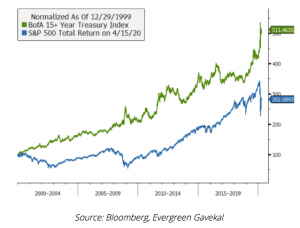
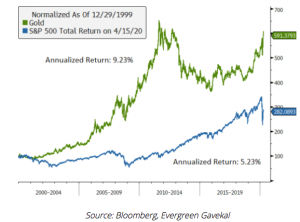
    Traditionally, gold and bonds have been considered “safe havens” to protect wealth in times of turmoil. These two asset classes have not just been flying in recent months, but actually for more than 20 years. Bloomberg and Gavekal illustrate in the chart below that gold has been quietly killing equities on performance over the past two decades.

    The stellar performance of bond markets thanks to low interest rates is probably more widely known but it might surprise to see the tech-powered S&P 500 struggle to keep up, even in recent FAANG-tastic years….

    Leaving aside twenty year trends, it is rather strange to see bonds, equities and gold all roaring higher during what we can all agree is a period of significant uncertainty. Of course, there is another explanation for investors buying all asset classes – the enormous monetary stimulus coming from central banks and governments. Current estimates of that funding pulse are as high as $10 trillion. If we assume global GDP has a very painful year-on-year contraction of 5% in 2020 that would equate to a $4 trillon loss. That sounds like a $10 trillion injection to plug a $4 trillion hole leaving a balance of $6 trillion likely to rush into the financial system. What’s not to like about that if you are an investor in risk assets?

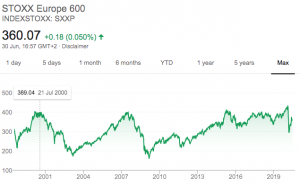
    It is early days yet but an interesting possibility that a massive emergency stimulus response to a pandemic could rip up the sclerotic inflation play book of the past twenty years. In that instance, the “sick man” of financial markets, Europe, could finally attract real interest and performance. I leave you with a chart of European equities still almost 10% lower than two decades ago, and a potential and much needed Covid19 recovery….

  • Inflating Expectations

    Inflating Expectations

    It’s Groundhog Day again at the European Central Bank. Was it only nine months ago the ECB declared an end to its easy money policy of Quantitative Easing (QE)? Well, trade wars and a manufacturing downturn have raised the imminent spectre of German recession and forced the ECB to embark on a new round of QE purchases and even more negative interest rates. And…we haven’t even mentioned Brexit.

    It all sounds so painfully Japanese and this can easily conjure up images of a lost generation of low-interest rates, large debt mountains and stubbornly low inflation. However, there is a suspicion the central banks already know this new round of QE will be as equally ineffectual as previous monetary interference. The new ingredient in the stimulus mix could be governments willing to initiate fiscal spending programmes and abandon budgetary discipline. Do we dare imagine the return of a long lost financial phenomenon which we touched upon in a previous article “Five Market Risks”? Yes, whisper it here…. Inflation could make a comeback. It’s a possibility rather than a nailed on probability but we see a number of conditions and indicators which suggest business owners and investors should have inflation on their risk radar.

    We are fans of data here and financial markets are excellent real-time indicators of investor expectations. So, let’s start with gold which has traditionally been used as a hedge against the dwindling purchasing power of currency; in other words, inflation. The gold price has been hitting six-year highs in recent times which is interesting as one would have thought the collapse in interest rates and a whopping $16 trillion worth of negatively yielding bond yields would be pointing to a very subdued inflation environment. What is noteworthy is that when bonds were last seen at very negative yields in 2016 the gold price did not break out as they have on this occasion.  Note, inflation kills the value of bonds as well as the purchasing power of cash.

    Another data point from industry also caught our eye. There is no doubt global manufacturing is in quasi-recession so it is somewhat surprising wage inflation in the US is now hitting a 4% cruising speed. There is a growing sense that income inequality needs to be urgently addressed as the rise of nationalist populist politics reflects restless electorates being “left behind” by technology, asset inflation and urbanization. Wage inflation can be expected to pick up as the 1% try to quell a political backlash.

    A less constructive type of inflation can also be expected to raise its profile. Supply chain management and global trade has been the driver of the global economy for decades but messy trade wars and Brexit will introduce new costs into global logistics. These costs will inevitably be put through to consumers/customers and drive inflation statistics.

    A more difficult data point to quantify at this point is the effect of potential fiscal stimulus by governments in dealing with a slower economic cycle. Arguably, the US with its ballooning budget deficit and the UK in Boris-electioneering mode have already embarked on a “bread and circuses” campaign which even Caligula would appreciate. All that’s missing in these campaigns is horses being appointed to senate and cabinet positions, albeit this can’t be ruled out just yet. For a bit of Teutonic sanity and the critical piece in the fiscal pie the world waits for Germany to finally spend. Early soundings from Berlin are encouraging and lead us to our final indicator of  ‘something different this time’.

    As the ECB confirms further cuts in interest rates one would expect European bank share prices to be on a firm downward trajectory this week. We couldn’t be more wrong. The European banks’ index is up almost 10% in September! That is noteworthy and like the gold price was not the experience in 2016 when global interest rates were plunging. The most dangerous words in the investment lexicon are “this time it’s different” and this writer has no doubt central banks acting with monetary policy alone will confirm Einstein’s theory on repetition and insanity. However, governmental interference for good(fiscal stimulus) and bad(trade wars) could change the outcome this time. Gold and bank share prices are already behaving differently but it will take time for political and trade mists to lift and reveal the new world order and change expectations.

    “We changed again, and yet again, and it was now too late and too far to go back, and I went on. And the mists had all solemnly risen now, and the world lay spread before me.” ― Charles Dickens, Great Expectations


    Enjoyed this blog? Then why not check out our other great content by clicking here!