Tag: Ireland

  • Watch Big Leadership Changes…

    Watch Big Leadership Changes…

    We do need heroes. As Irish rugby lost one this week (F.S. RIP), I was reminded of those dark days in the 1970s and 1980s and the importance of uplifting heroes at a time when Ireland needed leadership and inspiration. Regular readers of this weekly piece will know I have been very concerned about leadership on a global level for quite some time. The challenges of the breakdown of world order, AI, Ukraine, Gaza/Lebanon, climate change and the success of misinformation at the expense of truth, are crying out for leaders. At times, the challenges feel overwhelming. However, we can still be inspired and encouraged. Think back to Russia’s invasion of Ukraine on 24th February 2022. The consensus view was that Ukraine would be conquered in a matter of  days. As the conflict moves into its 5th year and surpasses even the duration of WW2 for the former Soviet Union, all is utterly changed. And, Europe might have a genuine hero.

    The 82nd anniversary of the pivotal D-Day “Operation Overlord” landings of World War II were celebrated this weekend. Melvin Hurwitz, 99 years old and one of the last surviving veterans of the Omaha Beach landing, was back there again. As was Ukraine’s President Zelensky. Melvin took the opportunity to pull Zelensky close to him and the stage microphones picked up the veteran’s words – “You’re the saviour of the people. You’re my hero”. Zelensky quickly responded, “No, no. You saved Europe. You are our hero”. Classy stuff. Two men, who both know the value and ideals of defeating totalitarian aggression. Meanwhile, a criminal grifter in Washington presides over the East Wing of the White House lying in ruins and the South Lawn playing host to a UFC fighting cage. Institutional vandalism on full display. Trump is not alone in being exposed by true heroes. Vladimir Putin woke up last Friday morning for his “Davos-for-Dictators” world economic forum to see the host city, St Petersburg, 1,100 kms from Ukraine, buzzed by drones and rocked by explosions at fuel/energy and Baltic Fleet military facilities. Incredible. Four years ago, drone “technology” amounted to grenades dropped through tank turret hatches from quadcopters purchased at Circuit City. This year Ukraine will manufacture 4 million drones of dizzying long-range and short-range capabilities.

    Arguably, Friday 5th June 2026 might well have been D-Day (drone day) for Vladimir Putin. Ukraine is  ‘winning’ this war. Russian supply chains and oil refining assets are being decimated, and military casualties at more than 1,000 per day are exceeding the numbers of replacement troops being rushed to the front lines. The Ukrainians are now destroying Russian battlefield positions without using any ground troops, just unmanned ground vehicles and watchful lethal drones in the skies. At a fraction of the cost of the annual $1 trillion US defence budget, Ukraine has changed ‘war gaming’ assumptions and possibly revealed the obsolescence of large portions of modern military weaponry and delivery equipment. Ukraine is not the only European technology leader receiving attention this week.

    Nvidia might capture the financial market headlines with its AI semiconductor chip dominance. However, it is interesting to read an increasing number of stories about AI chip competition and efforts by Big Tech like Google and Microsoft to customize their own AI chips. Let’s just say monopolistic 75%-80% gross margins enjoyed by Nvidia might not be a long-term sure thing. In fact, the entire AI chip ecosystem has a number of monopoly-like players. What about the equipment essential for every leading-edge chip manufacturing facility? Well, the standout monopolistic player in extreme-ultraviolet (EUV) lithography machines is a Dutch company. ASML, based in Veldhoven, was only founded in 1984, but has just become Europe’s most valuable company with a market capitalisation of more than $600 billion. Its customers are global, Chinese, TSMC, Apple suppliers, Intel, Hynix, Samsung etc. The mention of the last two companies is deliberate. Both these Korean manufacturers of memory chips for AI are considered ‘essential’ and have earned $1 trillion valuations. My sense is that ASML (and its relatively small 53% gross margins) is even more critical for the AI chip ecosystem…..so Europe might soon have its first trillion dollar 1980s ‘baby’.

    Sticking with European leadership, but at a sovereign level, Germany is fast losing stature. The failure to secure the ‘slam dunk’ certainty of a rotating seat on the UN Security Council reflects Germany’s abdication of leadership on anything from Ukraine to Gaza to China. The fact that relatively small European powers like Austria and Portugal were trusted more by voting nations to bring leadership to the UN has caused national introspection, and fury. And, the next European piece of leadership news won’t ease Teutonic tantrums. Germany’s perennial European rival, France, has just secured a whopping €75 billion investment commitment from Japan’s Softbank to focus its European data centre building efforts in the Gallic nation. Despite Macron’s domestic unpopularity, it does feel like France, with AI wonder-kid Mistral in the innovation vanguard, is stealing a European march in the global AI race.  Of course, not all wonder-kids grow up to deliver.

    My final thought on leadership change is in the crypto world. Bitcoin is now off 50% from its all-time highs, and one recent development hints at further trouble ahead. One of the key cheerleaders of the Bitcoin revolution has been Michael Saylor and his publicly listed MicroStrategy vehicle. Saylor’s vehicle has been a perma-buyer of Bitcoin since 2020. This dogged purchasing strategy has accumulated almost 850,000 Bitcoins which equates to 4% of total Bitcoin supply. But, last week the MicroStrategy vehicle tried to sell ….. 32 Bitcoins. Yes, thirty two at a value of just $2.5 million (circa $75,000 price). And the crypto market puked. Bitcoin has dropped below $60,000 and MicroStrategy’s share price is 78% off its all-time highs. Saylor’s strategy is now sitting on nearly $12 billion of unrealized losses. And, I’ve seen him explain and try to give comfort to investors in US TV interviews. It wasn’t pretty, or in any way financially logical. As the Strait of Hormuz continues to be strangled in non-negotiation by the “Art of The Deal” self-promoter, we should be wary of cheerleaders. They usually don’t turn out to be heroes.


  • Strong Grounds For Optimism, And Action….

    Strong Grounds For Optimism, And Action….

    I should be terrified. Watching Netflix’s House of Dynamite was definitely disturbing. In real life, the guy with the nuclear codes is having another Canada tantrum and refusing to rule out a third presidential term. Meanwhile, financial market headlines are full of ‘bubble’ talk as Hallowe’en approaches and yet…… I’m suddenly very optimistic. It might be Hallowe’en season but there are two other ‘seasons’ in full swing which could bring significant wealth enhancement. Firstly, we are in the middle of corporate earnings results for Q3. Secondly, Irish earners will soon be looking for opportunities before year end to invest in EIIS-eligible deals to reduce their income tax costs and balance their investment portfolios. My sense is that the stars are aligning nicely for a further burst of action in the next few months. As always, companies need to lead so check out the latest developments.

    We mentioned Q3 earnings season but we didn’t mention the “Magnificent 7” superstar tech stocks dominating the financial headlines. Deliberately so. The latest ‘tot up’ of Q3 earnings reveals a much broader participation of companies in healthy earnings reports. So far, 145 companies out of the S&P 500 index have reported Q3 earnings. A whopping 84% of those companies “beat” analysts earnings forecasts which is the highest “beat” rate seen in four years (Source: Bloomberg).  Average earnings growth across the reporting companies is on track for a year-on-year acceleration of 15%. The bottom line, literally, is that operational fundamentals are very strong. Critically, this profit growth is spreading to smaller companies; the Russell 2000 index of smaller companies is clocking an even higher 2025 profit uplift of 25%. You might have to pinch yourself, then check your notes re current challenges faced by companies. Try these for starters:


    • Global disruption to supply chains and energy markets due to Ukraine war.
    • Relatively high interest rates since 2022.
    • Tariff and trade chaos thanks to the unstable ‘genius’ in the White House.


    In many ways these are historical known ‘unknowns’ in Rumsfeld-speak. However, the positive twist on this uncertainty is that, if companies are able to generate significant profit growth despite these challenges, then this generation of corporates must be fundamentally very robust. This opens up another possibility, a very exciting one. What if interest rates were now beginning to fall and China and the US were about to agree a trade framework? Well, there’s a 97% chance (per money markets) of the Fed cutting interest rates this week and the news from the Trump trip to Asia is positive on a China deal happening too. Dare we dream of a Ukraine breakthrough? We might ease up on the Kool-Aid there, but we do note a weekend article in The Telegraph about Putin’s fears of a coup. We will continue to dream. However, the deal junkies in the private equity world seem to be picking up on the same fundamental positivity.

    Blackstone’s COO, Jon Gray, in its Q3 results call with Wall Street analysts was certainly pointing to more activity:


    “Directionally healthier markets, more liquid markets, better credit markets, better IPO markets; that’s healthier for realizations….The deal dam is breaking.”


    Closer to home, private equity exits in Europe’s financial services have reached an all-time high with 77 deals year-to-date worth $31 billion. As we wrote last week…… Banks are SOOOO back! However, it would be a mistake to think this was frothy financial ‘engineering’. In fact, it’s more engineering than finance on a global basis. Private equity investment deals in global infrastructure have rocketed by 44% year-on-year to $25 billion. That’s the second highest total deal value seen in a decade. Clearly, there is a lot more going on than an AI revolution. In the Spark Private world of venture funding and smaller private equity deals we keep a close eye on smaller company activity benchmarks. Two caught the eye this week:


    • Smaller company tech equity indices in the US are up 23%…. in just 3 months.
    • Small company industrials are hitting new all-time highs and breaking out on technical charts.


    An environment where global trade tensions, interest rates, corporate earnings, smaller company valuations and private equity deal activity are all moving in the right direction will undoubtedly generate more deal opportunities. Pitchbook’s latest review of European private equity (PE) activity is telling:


    “A run of large-cap deals in Q3, buoyed by interest rate cuts and improved macro stability, saw European PE dealmaking grow to €177.1 billion (about $206.7 billion) in Q3…….37% of overall PE deal value, €66 billion, came via 19 deals worth over €1 billion—more than Q1 and Q2’s mega-deal value combined. In total, 48 mega-deals took place in Europe over the first nine months of the year. That figure is expected to approach 70 by year-end, making 2025 one of the most active years for such deals in the region on record.”


    So enough of the headlines, where’s the action for private investors? The key questions for many investors at this time of year are…


    How can I access the deal flow?


    Can I do it in a tax friendly manner?


    Spark Private can help on both fronts. More specifically, investors can quickly build a well-diversified portfolio of 7-8 companies with top-calibre teams, EIIS tax rebates and genuine structural growth opportunities in a matter of months. Now, for the action…..YOUR action.

  • Back To School For A Monster Theme…

    Back To School For A Monster Theme…

    I’m running out of expletives. It’s a sort of “FOMO” thing which rules out obsessing on Labour’s implosion or the Epstein “hoax” which mysteriously keeps removing only British citizens from high profile roles. No, the headlines driving my heightened state of anxiety are derived from a familiar theme. However, it’s a theme which is now hitting warp speed. We have previously written that the best pulse-take of the monster AI trend was tracking the “picks and shovels” of AI/cloud infrastructure rather than the “gems” of digital intelligent progression. Well, this week is turning into a “biggie” for the AI infrastructure theme. I’d highlight three key developments and a few other snippets. So, here goes….

    The creation of start-up billion dollar ‘unicorns’ has hardly any scarcity value these days. Maybe, we should think in trillions. Step forward almost 50-years old Oracle. Who knew Larry Ellison’s database software business would rack up a trillion dollar enterprise value at the beginning of this week? Probably nobody. Even the Wall Street analysts paid to follow every line of the Oracle business and financial model were truly shocked by the big reveal in Oracle’s quarterly update. In fact, earnings results were slightly shy of expectations. But, the share price proceeded to rocket 40%. Why? The future contract work backlog in its cloud(AI) infrastructure business grew 359% to $455 billion. I mentioned “warp speed” earlier so here’s what caught the eye. Oracle’s cloud revenues from Amazon, Google and Microsoft grew by 1,500% but the entire division this year is annualising revenues of circa $10 billion. That number will be $144 billion by 2030. Welcome to trickle-down AI economics. Oracle was barely mentioned in AI giddiness a year ago, now its owner is the richest man in the world. Oracle is not the only AI ‘unknown’ making waves.

    Anyone heard of Nebius? No, me neither until this week but I do remember its former Russian search/e-commerce platform, Yandex. Anyway, Russian sanctions forced a sale of the Russian assets leaving Nebius as an Amsterdam-listed company specializing in cloud computing (GPU) infrastructure. This week Microsoft signed an agreement worth up to $19.4 billion for Nebius in exchange for 5 years’ access to its GPU datacentre infrastructure in Vineland, New Jersey. Nebius’ market value before that news was less than $15 billion. Not surprisingly, the share price has roared 50% higher and the company is now seeking to raise $3 billion in fresh funds to accelerate its growth plans. This was not the only Dutch tech/AI zinger story this week…..

    Eindhoven-based ASML is the world’s dominant player in critical lithography technology used in chip manufacturing equipment. A single machine can contain up to 100,000 parts and cost $300-400 million. Clearly, semiconductor chips and AI are thematically closely connected. But investing in an AI start-up caught ASML analysts on the hop. ASML has just invested $1.5 billion in French AI player, Mistral, for a circa 11% stake valuing Mistral at close to $14 billion. Remember, Mistral raised $385m in late 2023 with a $2 billion valuation and early investor support from BNP Paribas, AndreessenHorowitz, Lightspeed Ventures and telecoms entrepreneur, Xavier Niel. Less than 2 years later, the Mistral valuation is racing towards a 7-8x return for those early investors. Apart from being an example of multi-layer AI investment activity, the deal is being hailed as a boost to Europe’s AI and semiconductor chip sovereignty.  And maybe I’m not the only one feeling a bit FOMO….

    It seems Ireland’s Taoiseach, Micheál Martin, has been thinking ‘sovereign’ too and looking at France’s early initiatives in funding AI startups. The Business Post has reported that Martin has sought the help of Eir owner, Xavier Neil (see above), in establishing an AI/tech incubator modelled on his highly successful Station F start-up campus. There might be good reason why Ireland needs to increase the pace of its AI and start-up readiness. I thought the next few little snippets should be focusing minds in Government buildings and elsewhere:


    Private investing: The UK debt market is worrying many, but on a more positive note it was interesting to see Hargreaves Lansdowne and Schroders join forces to offer UK retail investors the opportunity to add private assets to their pension pots. Note to Irish government – start-ups need investor incentives first, then campuses.


    Consumer behaviour: Wildfire Systems’ 2025 Consumer Shopping Trends Report shows 61% of consumers are now using generative AI tools like ChatGPT as a tool for deal-hunting.


    Company growth speeds: Stripe’s Indexing the AI Economy report shows AI companies reaching $1m annual recurring revenues (ARR) 4 months faster than even the fastest growing SaaS/software companies. And… AI companies reaching $5m revenues are reaching that milestone 3x faster.


    I feel my back-to-school mantra should read:    The future is private, AI and fast. Very fast.


  • AI…AI…AI…AI…I Just Don’t Know

    AI…AI…AI…AI…I Just Don’t Know

    I’m going to have to up my game. Not just tennis. As a frequenter of the occasional business discussion panel, this week threw up a very different type of panelist. The Dublin Tech Summit at the RDS hosted a panel discussion on AI which featured contributions from a meta-human avatar created by AI, named Anja. Quite unnerving in a way. If it had been a horse on the panel, I don’t think it would have unsettled me more. Mind you, the no-clothes Emperor Taco Trump guy can’t be far away from appointing a horse to the Senate soon. Anyway, I digress as humans do. Back to AI, and I was thinking it would be no harm to highlight a few significant AI datapoints and developments which have caught my eye in recent weeks. First, the data.

    The Stargate data centre project backed by OpenAI, Japan’s Softbank, Oracle and Nvidia and to be built in the UAE is estimated to eventually have the capacity to consume 5GW of power, For context, that’s the power consumption equivalent of the entire island of Ireland. And, Ireland would already be considered a global leader in terms of data centre capacity as a proportion of the total energy grid, about 21%. Clearly, AI and its critical data centre/cloud infrastructure is moving at pace to meet expected future AI usage demand. The pulse-take on AI investment pace has been chip-maker, Nvidia, who reported quarterly results this week. Revenues for Nvidia (despite Trump China tariffs/blocks) are still growing at almost 70% but this doesn’t quite capture the scale of growth. Two years ago, at the time of ChatGPT’s launch, quarterly revenues at Nvidia were $6 billion. Now, they are at $44 billion. Furthermore, Nvidia plans to invest $500 billion to build AI infrastructure in the US. Note, things have also moved on from  ChatGPT and other Gen AI tools (like Gemini and Claude) as the drivers of AI investment. The big move now is to “Agentic AI” or “AI Agency”.

    Agentic AI is not a pilot or learning model wanting users to test its knowledge. No, this is the real “doing” stuff which companies are now paying to integrate in their work flows. According to CB Insights research, enterprise AI and copilots will generate $13 billion of revenues by the end of 2025 across a variety of activities from sales to coding to customer service. That’s a growth rate of 155% year-on-year and a wake-up call for most companies; the reality is that their competitors are likely deploying AI to dramatically improve productivity and costs. One wouldn’t want to be in the spectator seats for too long and it’s not just a corporate caution. At a sovereign level, Dubai has offered all its citizens free access to the premium ChatGPT Plus service which normally costs $20 per month. The digital information race is truly ‘on’ but there’s also a hardware story emerging.

    OpenAI has just acquired  Jony Ive’s AI hardware start-up, Io Products. The former Apple key man, whose design credits include the iPhone and iPad, will now lead design at OpenAI as the company pushes deeper into hardware. The move highlights a trend of VC-backed companies buying one another amid a shifting tech landscape and a hunger for talent. However, it is worth noting that this is the largest private-to-private acquisition ever at $6.4 billion. Indeed, over 40% (7) of all-time $1B+ private-to-private acquisitions have happened in just the last year. OpenAI, Databricks, and Stripe have each spent over 15% of their total funding to date on acquisitions in the last 2 years. Don’t forget Anja too. Venture capital investment in humanoid robots are estimated to double this year to over $2 billion per CB Insights data. Then consider that there are 660 million people in Asia (average age 27) using digital companions. That disturbing little gem came from anthropologist, Dr Lollie Mancey, in a recent RTE interview and….. I just don’t know. I’m not alone.

    The fascinating story of Irish recycling software company, AMCS, and its $2 billion wealth creation story was told by its founder, Jimmy Martin, at the Renatus/Fitzgerald Power “Real Deal” SME conference in Goffs this week. When asked about AI, he wisely declined to predict the future but did make one very interesting and more definitive point. As a hugely successful observer of ‘margin’ in industry ecosystems, Martin was quick to identify the monopolistic power of the big 3 cloud infrastructure players, Microsoft, Amazon and Google. For me, the unanswered question of who will be the winner(s) will focus on the following :


    1. The manufacturers of the critical semiconductor chips
    2. The owners of data centre infrastructure
    3. The providers of energy/power capacity
    4. Sovereign/digital alignment (China, Europe or US).


    I really don’t know, particularly the geopolitical/sovereign and energy/power questions. However, I do think it interesting that in recent days companies exposed to the nuclear power industry have seen big share price moves. Not coincidentally, the US and a number of European countries have been embracing a nuclear industry revival at the same time. Plenty to ponder, not all of it comfortable. Isn’t that right, Anja?

  • A World Losing Control Of Truth….

    A World Losing Control Of Truth….

    You know that feeling. No control, just watching helplessly. On a personal level, I observed the devastating wildfires in Los Angeles from afar via Google Maps and X(itter) but was updated on the ground by my son dangerously close to events on the UCLA campus. Evacuation to San Diego was his fortunate escape while the estimates of fatalities and rebuild costs continue to climb. Sadly, the losses are not just in the physical world of lives and properties. Truth has also been scorched by the partisan politics of the US. Incoming President Trump and his oligarch allies have been quick to blame political incompetence for the fires and deflect from the urgency of the climate crisis. A cursory look at Xitter and other online channels reveals waves of misinformation on lack of water and firefighting resources, saving smelt fish(yep), DEI /woke policies (open season it seems) and even funding Ukraine as the ultimate source of blame. Now, for a few stubborn facts:

    No rain in Los Angeles (LA) since May 2024

    Highest summer temperatures in LA ever

    Land/vegetation is the second driest on record – UCLA research suggests 25% drier than average

    Strongest seasonal Santa Ana winds in 14 years (up to 150 kph)

    That lethal combination of extreme heat, bone-dry fuel and tornado-like winds are climate change driven. Fires are nothing new for California, but the change in wind/heat patterns has dramatically increased the intensity of the fires and the speed-of-spread when they occur. However, the extent of climate denial deflection at the highest US political leadership levels is amply demonstrated by the words of the incoming Trump nominee for Energy Secretary, Chris Wright, at his Senate confirmation hearing just this week: “I stand by my past comments…..the hype over wildfires is just hype”. Not for the first time, the world of finance will have its say too. In particular, the exit of insurance companies and house protection coverage for residents of LA, West Virginia, Florida and Texas is probably more instructive than the internet warriors in their underpants shrieking about political mismanagement, conspiracy theories or super-powered immigrant arsonists.  Credibility and truth are inextricably linked and the biggest bully of them all is flexing its truth-seeking muscles….

    We have written in recent days about debt markets constraining the actions of autocrats in the geopolitical world. However, in the financial world there are increasing words of worry from some very credible players about a credibility gap emerging. So, without bamboozling with jargon, let’s flag two financial facts.

    *Interest rates around the world are either falling or stabilising at lower levels than 18 months ago.

    *Bond yields which usually track interests rates are not falling, or even stabilising. Longer term yields in the UK, Japan and US have broken free of their relationship with interest rates and are rocketing higher.

    This divergence of trajectories for interest rates and bonds is HIGHLY unusual. So, what’s happening? Well, debt and bond markets do track interest rates set by the central banks….normally. But, in this instance, credibility or credit has come into play on two fronts. First, central banks like the Fed and Bank of England are facing increased scrutiny in their battle to tame inflation. Second, government bonds track the credibility of sovereign governments – their ability to confront or tell the truth. And that’s a problem now. Nobody believes current UK government policies are able to deliver growth and not many believe Trump’s tax cuts and tariffs menu will tame inflation. Bluntly, there are increasing fears in financial circles that the Fed has lost control of the most important financial market in the world: the US Treasury market. Again, truth and credibility (not denial) are critical to attract risk capital, insurance, investment etc.

    Finally, we should note the warning in President Joe Biden’s farewell address to the nation this week. Critics might argue his presidency wasn’t bold enough, even cruel enough, but his departing words might resonate with those who read President Dwight D. Eisenhower’s farewell speech warnings in 1961 about the dangers of the “military-industrial complex”. Biden points to an oligarchy of “extreme, power, wealth and influence” in a “tech-industrial complex” which wields a very modern weapon to serve their own interests. The tacky million dollar Trump inauguration donations and spineless abandonment of content moderation by the tech oligarchs could be mistaken as the source of bitterness for an ousted president but I’ve a feeling the following statement will be revisited by historians as a prescient warning:


    “Americans are being buried under an avalanche of misinformation and disinformation, enabling the abuse of power. The free press is crumbling [or] disappearing. Social media is giving up on fact checking. The truth is smothered by lies told for power and for profit…. Meanwhile, artificial intelligence is the most consequential technology of our time, perhaps of all time.”


    I’ve got some bad news. That “avalanche of misinformation” is just the start, and the reference to AI is key. It feels like every funding round at the moment is attached to “AI-agents”, bots who will carry out the mundane content generating tasks of human workers. In fact, one in every two dollars of VC funding in the US right now is going to AI. The number globally is 37% (Source: CB Insights). However, let’s think about that ‘army’ of bots to be unleashed on the future of work and communications. First, know that an estimated 50% of all online traffic right now is bot generated. Yep, that’s bot created content, bot engagement, bot dissemination….. the whole false fly-wheel effect. Now, imagine a vicious circle of billions of bots, content pieces and false engagement. Then think false content.

    You will hear more about “Dead Internet Theory” in 2025. It started out as a peripheral online conspiracy theory claiming the internet has been taken over by artificial intelligence(AI). Viral posts, engagement rankings, traffic stats etc all have a whiff of AI-bot promotion these days but there’s worse to come. The sheer volume of misinformation coming our way via AI-agency bots could kill online platforms’ utility value. Even this week, using Xitter was an exercise in dodging the underpants brigade + bots and finding real true information on the LA fires. And, now the chat is Elon Musk will be buying Tik Tok. A change of commercial control perhaps, but the reality at a higher communications level is more existential. We could lose control of not just the internet, but truth itself.


    “You can’t handle the truth!!”  – Colonel Jessup, A Few Good Men.


  • Another Heroic Age Begins…..

    Another Heroic Age Begins…..

    I’m nervous. My trip to the Park Hotel Kenmare this week isn’t quite in the league of those heroic voyages chronicled in ancient Greek mythology, but the dress code request on the invite pumped the pulse rate for a moment. Just a moment. The invitation to recreate the year of the hotel’s opening in 1897 in a gathering of mostly creative types (after momentary panic) seemed like an opportune way to ditch my far-from-hip personal wardrobe and embrace Victorian disguise. Party on, but still I’m nervous. I have this nagging feeling that the years 1897 and 2024 might have more in common than we’d like to imagine. Indeed, Mark Twain would say the years and risks are rhyming.

    The Thirty Days War of 1897 between Greece and the Ottoman Empire (Turkey) was hardly a century, or even decade, defining event whereas the current war in Ukraine is generationally significant for Europe. Furthermore, the first border-to-border direct attack by Iran on Israel in the past week could, left to escalate unchecked, threaten the planet with warfare of global dimensions. Neither of the current conflicts will necessarily snowball into multi-country warfare, but 1897 starkly demonstrated how military alliances fracturing under pressure in local skirmishes can lead to tragic global outcomes.

    Just before the Greco-Turkish War broke out on the mainland in 1897, there was an intervention made by The International Squadron, a naval flotilla formed by the ‘Great Powers’ of Europe (UK, France, Italy, Russia, Austro-Hungary, Germany) to address a rebellion by native Greeks on the island of Crete against rule by the Ottoman Empire. Apart from being a precursor to war on the mainland, the Cretan intervention ultimately led to strategic disagreement followed by Germany and the Austro-Hungarian Empire withdrawing from the International Squadron. Only seventeen years later the same Balkan region erupted, and those two nations formed the Central Powers alliance with Bulgaria and the Ottoman Empire to fight the Allied Powers in World War I. So, fast forward to today and it’s not difficult to spot the strains in geopolitical alliances as they confront the following crises:


    Ukraine-Russia: European members of NATO bordering Russia are terrified by Ukrainian funding (frozen) being used as a partisan political chess piece in an increasingly dysfunctional US Congress. How long before Poland asks for, or sources, its own nuclear deterrent against Russian aggression….?

    Israel-Iran: Clearly, hundreds of missiles launched directly against Israel by Iran is a worrying first-time development in the traumatic history of the Middle-East. However, the co-ordinated defence of Israeli and neighbouring airspace by a coalition of US, UK, Jordanian, UAE, Saudi and Israeli forces could be considered a relatively surprising show of unity between Allied and Arab nations. Less encouraging is the horror of Gaza, and European countries (and the UN) looking for the US to pressure Israel’s leadership into a more humane approach.

    China-Taiwan: The potential collapse of munitions-starved Ukraine is not just terrifying eastern European nations. The perception of ‘abandonment’ of Ukraine by the US has massive European and NATO implications, but will also reverberate through Asia-Pacific island nations watching China’s moves on Taiwan. It is no surprise to see high profile visits from the leaders of Japan and the Philippines to Washington in recent weeks. However, the fate of Ukraine will be the true indicator of the strength of this trilateral alliance. And, China will be watching closely.


    Arguably, the timing-fuse for the potential explosion of any of the above crises is going to be a lot shorter than 1897’s seventeen year WW I burn. So, do we panic or seek inspiration? Geopolitical leadership, frankly, is lacking courage or heroes right now. However, dig deeper into the history of 1897 and that year’s other claim to historical significance was its status as the beginning of the last “Heroic Age” and lasted until 1922. This 25-year period saw 17 pioneering Antarctic expeditions launched from 10 different countries, but the Antarctic was not the only study subject enhanced by these expeditions.

    The methods of expedition commanders like Robert Scott, Roald Amundsen and Ernest Shackleton have been the subject of many academic studies and have provided a uniquely pure window into different leadership approaches to life or death decisions under extreme conditions while cut off from the outside world. Geopolitical anxiety aside, I am increasingly optimistic that the stars are aligning for another Heroic Age. So, who are today’s heroes and where is the 2024 unexplored equivalent of the Antarctic? More importantly, can these exploits alter the geopolitical direction of travel?  I have three pioneering hopes.

    Space Exploration: The brilliant George Mason University economist, Tyler Cowen, asserted more than 10 years ago that the US economy had been in a long productivity stall since the early 1970s. He referred to it as The Great Stagnation and this appears to have coincided with the suspension of genuine space exploration in the form of manned lunar landings since 1972. Undoubtedly, the space race of the 1960s accelerated many technological developments so I’m wondering will the renewal of manned space voyages to the moon (Artemis II) and Mars trigger global progress in remote services and activities. Consultancy group, McKinsey, have estimated the space economy will be worth $1.8 trillion by 2035. So, that’s almost like finding another Brazil with lots of new investment capital driving innovation. Think tele-health, agriculture, communications etc. Space exploration also remains a beacon of hope for collaborative endeavour – see the International Space Station (ISS) as a continuing example of cooperation between Japan , USA, Russia, Canada and the European Space Agency.

    Artificial Intelligence (AI): We have written many times about the urgent need to defend The Truth in a digital world overwhelmed by misinformation and bad actors at a corporate and sovereign level. So, it might seem strange that Artificial Intelligence (AI) could be part of the solution. A quick glance at any media headlines would suggest AI will be in the vanguard of misinformation rather than authenticity. However, I am struck in my day-to-day investment role by the number of recent AI applications which focus on one area and also could be a very profound instrument in the discovery of truth. The latest AI focus is video. We know Gen AI tools like Chat GPT or Gemini can be used to deliver super-quick summaries of large volumes of text from market analyst research to autobiographies to business plans. But, now hours of video can be analysed and checked in minutes, even seconds. So, imagine a future screen broadcast which is actually two screens, and the second screen is not a betting or chat platform. The broadcast could be Liz Truss, Donald Trump or Vladimir Putin in full delusion mode and the second AI screen could fact check (or just show previous contradictory video footage of same speaker) and alert viewers to misinformation. My hope is that real time credibility checks could be incredibly powerful in exposing populist charlatans and assisting truth discovery.

    Healthcare: Every week we read about new therapeutic discoveries using gene editing (CRSPRS), cell therapies (CAR-T), mRNA vaccine platforms, neural implants(Neuralink) or even drug manufacturing in space using micro-gravity(Varda). Healthcare remains a challenge for all governments and the recent memory of the Covid-19 pandemic should be an inspiration for further research co-operation. Recent news headlines on WHO worries about H5N1 bird flu mutations will likely focus minds and provide a potent reminder that viruses don’t stop at disputed historical borders. Indeed, a government closer to home looks like it will lose power despite delivering best-on-planet economic performance. Why? Ireland’s government coalition didn’t do enough on the health (hospitals) and safety (homes) of its citizens. You would have thought focus groups and polling research might have picked up on that genetic human instinct……to live. Politics, eh.

    So, maybe nothing much has changed since those courageous expeditions trudged across an unforgiving continent all those years ago. As a species, we are probably still driven by the same three things: discovery of new worlds, the truth, and survival. Clearly, success in these pursuits can be shared and, in turn, bring humanity closer together. So, I’m not sure this vision of our future requires heroic optimism, but we could definitely do with some leadership. And…. I’m sure the ghost of Tom Crean would have some wise Kerry thoughts this weekend on where it can all go wrong.

    P.S. The dressing up worked out, the creative crew were fantastic company, and the hotel is wow….!


  • Take Your Pension Or Portfolio To Another Level

    Take Your Pension Or Portfolio To Another Level

    Fizzle sticks! There goes another billion dollar ‘unicorn’ I didn’t back. Sound familiar? This week’s news that Ireland’s Cubic Telecom has entered the ‘unicorn’ club thanks to a €473 million investment from Japan’s Softbank should focus financial planning minds. In particular, we should focus on two things very familiar to readers of these pages. Firstly, speed. The business world is moving faster and faster. Secondly, technologies are rapidly merging and compounding value.

    Just over a year ago, Cubic Telecom was reporting annual sales(Sept 2022) of circa €30 million with its connectivity software installed in 10 million vehicles. Yep, €30 million not €300 million. So, what prompted Softbank to enter into discussions for a 51% stake purchase on a valuation multiple of 31x the previous year’s revenues? One could hazard a guess that speed of growth was one consideration, given installations of its software have ramped up to 450,000 vehicles per month and are expected to go ‘exponential’. Also, one suspects the compounding of a number of technologies is beginning to drive traction. Cubic is at the fortunate intersection of the Internet of Things(IoT), 5G connectivity, electric/battery powered vehicles (EVs), cloud computing and Artificial Intelligence(AI). We need to start thinking about multiple technologies compounding at speed rather than focusing on one technology advance, and it’s not just Ireland illustrating these two themes.

    All the gloomy headlines this year have put us all in a strange place. And, awkwardly so for financial advisors who possibly went into ‘bunker’ mode. I have been asked to look at 3 different pensions in the last week where returns to date were hovering at just over 3%. That’s actually less than you’d earn on risk-free US Treasuries currently. However, the killer data point is that the tech-heavy index, the Nasdaq 100, is up 48% year-to-date. Oh, and despite all those war headlines and oil worries from Russia/Ukraine and the Middle-East, the energy sector is DOWN year-to-date. Even Germany which is staggering into recession boasts a stock-market (DAX) hitting all-time highs and returning 18% gains this year. Note, the DAX is definitely NOT filled with tech names. However, the Nasdaq is telling us lots of technology from energy storage(Tesla) to cloud(Microsoft) to AI(Google) are emerging at the same time. Just yesterday, Google showed us a new AI bot, Gemini, and its market value jumped by $85 billion over the day. That’s the equivalent of Citibank’s market capitalization after 211 years in existence. Just one day. It feels like wealth creation cycles are shrinking.

    Latest reports suggest the AI team at French start-up, Mistral, are raising funds again. Recall that this crew of AI gurus raised over $100 million 6 months ago with no product, no business or revenues. Just a PowerPoint presentation deck. Now the team have a product (large language model(LLM) for Generative AI) and want to raise more than $300 million. The current valuation level for Mistral is ….. reported to be over $2 billion. Six months. However, before we go all dollars dreamy, note that the hard yards and years are still the norm. For example, Cubic Telecom started up back in 2005. At a higher level, consider it took Microsoft 44 years to hit the trillion dollar market value mark, Apple 42 years, Amazon 24 years and Google 21 years. Keep those tech and time thoughts and let’s move to the other end of the business life spectrum.

    We have already referenced pensions, but for many investors these are vehicles for a variety of funds investing in a mix of blue chip publicly listed company shares and their debt(bonds), government bonds, possibly some real estate and a bit of cash. Given the fast-moving tech world we live in, it is increasingly apparent that investors’ pensions or savings portfolios should allocate a small portion of monies(5-10%) to early-stage companies. Pensions are not the ideal vehicle(for the majority of people) for these investments, but the good news is that the government provides incentives with a similarly attractive taxation impact.

    For years, starting with BES schemes and then evolving into the current EIIS funding initiatives, government has encouraged private investor capital to support employment and growth for early-stage companies by offering tax rebates against income generated in the year of investment(s). That rate of rebate has been a standard 40% but is due to change. More on that later but first, let’s briefly explain the mechanics of EIIS.

    If a company is eligible for EIIS investment it will typically be introduced to private investors in three ways. Note, not all companies qualify for EIIS treatment eg. financial trading businesses are not eligible. Companies which do qualify, offer shares through the following:


    • Direct Investment: The investee company offers its shares directly to investors. These direct investment opportunities are typically offered to small groups of investors known to the company’s founders or its financial advisors, and not made public.


    • EIIS Funds: These funds are managed by financial intermediaries/brokers and request lump sums up front from private investors. The capital raised is then deployed across EIIS investment opportunities. The up-front sums can be significant(> €10,000) and the managers will charge annual fees.


    • CrowdFunding Platforms: A platform like Spark (or Seedrs or Crowdcube in UK) will give thousands of signed-up investors access to 12-15 fundraising campaigns by EIIS qualifying companies each year. The business model of these platforms is different to a fund. The investors do not pay any up-front lump sums or fees. Investors can invest as little as €250 in each EIIS investment with NO commissions, and NO management fees. Instead, Spark and other platforms only charge the companies a fee(and only if successful). One other variation on this is Angel Networks, or syndicates, which invest as opportunities arise. However, the entry level investment size (€5,000 – €10,000) and lead times are not for everyone.


    So, after paying for your shares, those shares will sit in a broker account, or a fund, or in a nominee account(independent of platform). The company will then apply for EIIS certification from the Revenue. On receipt of this notification, investors will get a certification confirming same which can be filed with the Revenue to offset taxes paid in that year.

    What sort of people could this interest? The income which qualifies for tax rebates includes employment income, rental income, dividends and ARF distributions. The amount of income which can avail of EIIS has been increased from €250,000 to €500,000 in a single year under new rules to come into effect in January 2024. Also, note the investment must be for a minimum of 4 years. The new rules in the Finance Bill also have broken the standard 40% rebate rate into different bands which we have summarised in a previous article as follows:


    • 50% for businesses that ‘have not operated in any market’;
    • 35% for a business in its first EIIS fundraise within 7 years of its first sale;
    • 20% for a business in its second or subsequent EIIS fundraise;
    • 20% for a business expanding into new markets or regions; and
    • 30% for investments via a ‘Qualifying Investment Fund’, of which there is only one in Ireland.


    Quite apart from introducing potential confusion, the ‘core’ or standard EIIS rebate of an equity investment will now be reduced from 40% to 35%. On a more positive note, the 50% relief for early-stage pre-operating companies could be very interesting for Ireland and Irish investors. It won’t have escaped your attention that the trillion dollar tech club is entirely US based. That can be attributed to deeper capital markets and Silicon Valley tech leadership but could Ireland be a leader now? I’m thinking three big areas where the Irish ecosystem is quietly building real scale and a pipeline of early-stage opportunities. Here we go:

    Medical Technology/Bio-pharma: 14 of the 15 biggest MedTech players have significant operations including critical R&D functions in Ireland. Also, 12 of the biggest global pharma players are there too. That ecosystem is beginning to deliver a fly-wheel effect of training, management, success, entrepreneurial juices and world-class innovation.

    Cleantech: Irish engineering and construction companies are already leveraging their experience of executing huge hi-spec projects for tech giants like Microsoft and Intel, and global life sciences companies. These Irish companies are now key players in the build-out of EV battery gigafactories, data centres, clean energy manufacturing plants, pharmaceutical plants and chip manufacturing facilities all over the world. It is highly likely this hi-tech project expertise will generate new innovations and young companies to drive the cleantech revolution.

    Artificial Intelligence(AI): The creator economy is a $250 billion monster with all the major players from Google to LinkedIn to Meta/Facebook positioning their European HQs in Ireland. It is clear the creator economy is in the cross-hairs of AI and one can expect the Silicon Docks of Dublin to spin out a number of AI innovations. In fact, Spark will be bringing an exciting AI play to investors very soon.


    Furthermore, or a bit further afield, we should note interesting developments in Europe. Spark as a newly regulated entity with EU ‘passport’ will be looking at potential investment opportunities and encouraged by the latest data from Atomico’s “State of European Tech 2023” report:


    • Investment levels in European tech has reached $45 billion which is up 18% on 2020. Every other region is down over the same period.


    • Europe’s talent pool has grown from 750,000 to 2.3 million in the last 5 years. And, in 2023 Europe was a net beneficiary of people moving from the US to Europe. How Trumpy….


    • Europe now has 4,000 growth stage tech companies.


    • Europe (not just Mistral) can compete in AI globally. In fact, Europe has more resident AI talent than the US (120k vs 112k).


    There will be early stage investment opportunities in a faster world. And, frankly, waiting for IPOs could be a long way off. Thanks to huge private investment pools, companies like Stripe, Shein and OpenAI can stay private for longer, or forever. In the US alone, 70% of early stage/VC funding comes from pension funds and educational endowments. Europe has a bit of catching up to do; only 20% of funding comes from institutional sources. But….. on a contrarian view, this presents an opportunity for European and Irish private/individual capital to step into the gap and seize opportunities that typically might have gone straight to institutional/professional players. So, instead of fizzle sticks maybe think about sticking some funds into one of the EIIS access vehicles referenced above. As always, we recommend a portfolio-building approach, spreading your risk in smaller amounts across 8-10 investments per year. See the table below as a quick summary of what might work for you:


    Finally, if it’s speed and technology you’re looking for, then a 3-minute sign up process on the Spark platform is a pretty slick start to your early-stage investing journey.


  • Ireland Is Hot Right Now

    No, this is not a climate change observation. Let’s ignore the “soft” February days soaking Dublin commuters on a daily basis and highlight a significant heating up of Ireland Inc. Despite domestic electoral demands for change (we can’t recall a democratic election being any different) and genuine Covid-19 virus fears, Ireland’s economy could actually be picking up speed. Whoodathunk! Readers can judge for themselves but here’s a selection of stories we’ve been reading with interest….

    • Global Tech Giants Building: It looks like Google, Amazon, LinkedIn, Facebook and Salesforce have plans to add 3.6m square feet of office space to their Dublin campuses. Based on those plans that translates into space for 36,000 workers.
    • Job Numbers Hit Record: The CSO has reported a record 2.36 million people had jobs in Q4 of 2019. Despite more sclerotic growth elsewhere in the world, particularly Europe, employment grew by 3.5% in 2019 with the addition of 80,000 new jobs. Tech added 12,300 new roles but growth was seen in 13 of 14 sectors tracked.
    • Modern Ireland: CSO report also highlights the total number of non-nationals living in Ireland now accounts for 12.7% of the population. The tech sector now employs more people than the agriculture sector.
    • FT Awards: The Financial Times FDI Magazine has awarded Ireland South East the number 1 ranking as “Small EU Region of the Future for FDI Strategy”. Well done to the Crystal Valley – love the name!
    • High Profile Buy-Outs: The recent big-money exits by the founders of Pointy ($160 million) and Decawave ($400 million) is sure to inspire a few more entrepreneurial spirits.
    • Great Future For Irish Start-ups in Next Decade: Finn Murphy of VC firm, Frontline, penned an interesting article this week highlighting a shift in the tech ecosystem. Ireland is no longer a sales & operations centre for tech. It has now moved into the product/engineering space. Witness Amazon quietly building a 1200-strong engineering team in Dublin. Murphy’s view is that in the past decade only one venture-backed domestic firm, Intercom, has reached a billion-dollar valuation. He expects that number to be higher in the next decade and name-checks the following prospects: Evervault, Inscribe, Workvivo, Teachkloud, WarDucks, Modulz, Sweepr, Manna, Flipdish and 17 other names. Between them, the 26 start-ups have raised $125m over the past 18 months.
    • UK To Close Door To Unskilled Workers: The UK as our closest English speaking neighbour competes with us for capital and talent. While Ireland Inc hurts when the UK economy falters there is no reason to fear our growth prospects outstripping those of our larger neighbour. It has been a difficult week for the UK government to discover from its EU negotiating counterparties that it is not “Canada”. Number 10 is also about to discover that taking back “full control” of UK borders and an overhaul of immigration laws might not appeal to sharper minds(talent) who understand the importance of a functioning service sector, particularly the health and food industries.

    Possibly the most positive development from the stories above is the culture shift in Ireland from a large sales/operations base to a rapidly growing engineering/building gene pool. It does feel like there is more activity and a sense that the tech community has seen successes like Stripe and Intercom and wants more. Don’t forget a lot of these start-ups are driven by founders who have already experienced success.

    This also brings another new important player to the table. Global venture capital houses. Clearly, the previous track records of the current generation of start-up founders have attracted heavy-hitting overseas capital. Check out the arrival of the likes of Sequoia, Greylock Partners, Kleiner Perkins, Blossom and Index Ventures. Success does indeed breed success.

  • Ireland is now Facing Category 5 Trade Winds

    Ireland is now Facing Category 5 Trade Winds

    Hurricane Dorian may have lost its Category 5 status in recent hours but the headwinds facing global trade are ratcheting up in intensity. At a mid-summer Spark Crowdfunding investor night the challenges facing Irish businesses from Brexit and Trump Trade wars were discussed. One of the key observations of the night was that when trade negotiation counterparties are driven by political survival motives – think Prisoners’ Dilemma – game theory models indicate the probable result is the worst economic outcome for both sides.

    The Nobel prize-winning work of John Nash was profiled in the Russell Crowe movie, A Beautiful Mind, and has become a key foundation of game theory and understanding how multi-lateral trade agreements can play out. Unfortunately, the Nash Equilibrium predicts an ugly commercial outcome for all when political risk considerations trump(sorry) co-operation between parties. Indeed, events over recent days have provided strong evidence of theory meeting reality head-on.

    Yes, there’s a huge hurricane approaching the US coastline but political protests in Hong Kong may well be the political typhoon which visits even more harm on the US economy. Consider the “butterfly effect” of chaos theory and it is increasingly likely that China’s relatively passive response to Hong Kong unrest makes it politically impossible for President Xi to show any weakness in the trade war with the US. The Dear Leader in Washington was apparently stunned China responded to his latest round of tariffs with tariffs of their own on US goods which would be politically sensitive for the White House toddler – think oil, more agricultural products, etc.

    The problem for Trump is that he can’t back down on the tariffs as that would be an admission that his esteemed economics team of the discredited economist, ridiculed CNBC host and Lego Batman movie producer has triggered a global manufacturing recession. In fact, the just-published US ISM Manufacturing Index just posted a sub-50 reading indicating a contractionary manufacturing environment in Trump’s own MAGA hinterland. As Trump would say, but neither the poor US farmers nor factory workers… “Always winning”.

    Having failed to build a Mexican wall, Trump is politically sensitive to showing any weakness on China and has resorted to excoriating his own Fed Chairman appointee, Jay Powell, and demanding lower interest rates to bail out his faltering “greatest economy ever”. The irony of the greatest economy needing a Fed bail will not be lost on some readers nor will the wayward nature of Trump’s trade weaponry. Who would have thought that a core part of the Trump fan base, Mid West farming communities, would be paying the hefty price for Trump’s insistence that China respect the IP/patents of the leftie liberal technology elites in Silicon Valley!

    It is fast becoming apparent that US-China relations have entered a new less co-operative phase. This is structurally bad news for global trade and Ireland’s business community will need to factor this into growth projections over the coming years, not months. One would hope Brexit could deliver a more upbeat outcome but the coronation of Boris Johnson has merely confirmed fears the UK political establishment is in a state of near-complete meltdown.

    Events of recent days would appear to confirm the Johnson strategy is to deliver Brexit no matter what. The request by the new PM of the Queen to prorogue Parliament has triggered a furious ongoing backlash in the House of Commons. EU negotiators and Ireland look on in bewilderment as Johnson’s parliamentary majority of one has evaporated to a 43 seat deficit. This purge of deal-supporting Conservatives including Winston Churchill’s grandson has forced Johnson to threaten a general election. The small problem with this initiative is that the Labour party and Jeremy Corbyn, in particular, are politically aware it is in their interests to see Johnson fail spectacularly and deliver a chaotic Brexit. There is a real chance an election will be delayed until after Brexit. That is worrying but our key mid-summer observation was that Brexit in the near term could be ugly due to political ineptitude and ignorance of international law(Good Friday Agreement). However, the longer-term story could be more positive. A delayed election for an electorate experiencing the chaos of Brexit might kill off the suicide mission once and for all. David McWilliams put it brilliantly in a recent FT article:

    “We understand the yearning for sovereignty, identity and independence, believe me. But just one piece of advice: the first 70 years are the hardest, after that it gets easier.”

    Clearly, Irish business would prefer to avoid any hard Brexit and certainly not a 70-year economic divorce from its closest trading partner. It is unfortunate timing that a combination of income inequality/populism and truly dreadful political leadership in both our largest trading partners has set in motion a series of events which make it very difficult for the protagonists to back down despite the huge commercial damage likely to be inflicted on all sides. There is a Sarajevo 1914 air about developments right now, almost the sense that troops have already been mobilized on thousands of trains and it’s too complicated and late to halt the escalation.

    As we witness Jacob Rees Mogg reclining on the front bench of the House of Commons this week and Trump bestowing the title of “The Chosen One” upon himself it is difficult to avoid comparisons with one of The Great War’s best parodies – “Blackadder Goes Forth”. In particular, this exchange in the trenches of the Somme between Captain Edmund Blackadder and his men resonates quite loudly with the Boris and Trump show we are currently enduring:

    Captain Blackadder: “You see, Baldrick, in order to prevent war two great super-armies developed. Us, the Russians and the French on one side, Germany and Austro-Hungary on the other. The idea being that each army would act as the other’s deterrent. That way, there could never be a war.”
    Private Baldrick: “Except, this is sort of a war, isn’t it?”
    Captain Blackadder: “That’s right. There was one tiny flaw in the plan.”
    Lieutenant George: “O, what was that?”
    Captain Blackadder: “It was bollocks.”

    If only it were a comedy right now. There are stormy days ahead with careful business leadership and strategies required. The good news is that even Category 5 hurricanes eventually die and generate a flurry of investment in perhaps less vulnerable areas. Ireland in a Brexit context could be a beneficiary from investment seeking more sane business environments.

  • What would Ireland’s population be today if we didn’t have the Famine?

    What would Ireland’s population be today if we didn’t have the Famine?

    Ever wonder what Ireland’s population would be today if we didn’t have the famine from 1845 to 1849?

    I met with a senior Google executive recently and had a little moan.

    My complaint was about Big Tech’s ability to pay relatively junior employees huge salaries compared to smaller companies who desperately need talent to develop products which could benefit the planet at large. He was reasonably sympathetic to the dangers of outsized talent flight to Big Tech but also highlighted the small population of Ireland relative to Big Tech scale-up plans as being a significant contributing factor.

    This prompted a little quiz question which featured in a recent Spark Crowdfunding Investor Night – what would Ireland’s population be today if there was no 1840s famine and the supra-normal emigration which followed?

    Given the current population of the UK is 66 million you still might be a little surprised by the projected population estimate. A quick look at the relative land masses of the two islands might be a clue….

    My Google man was staggered that his 20 million guesstimate was about 12 million people shy of the actual 32 million projection. Both of us then proceeded to agree this capacity for population growth and flexibility to strategically influence demographics could be a big opportunity for Ireland. Imagine how many Irish startups could be funded through equity crowdfunding if we had a population of 32 million!

    That might appear slightly delusional as we struggle to house our existing population but some policy thought leadership could emerge if big money is put on the table.

    It has been interesting to read in recent weeks about the Google plans to invest $1 billion in the San Francisco Bay area to build 20,000 homes, of which 5,000 will be affordable housing units.

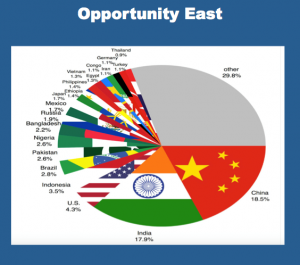
    Watch that space and another map which prompted plenty of discussion at the Investor Night mentioned previously. You might ask who would be the most likely new residents in a scaled-up Ireland?  Let’s take a look at another thought provoking graphic:

    The graphic above is telling us 36% of the planet’s population is living in China and India and both countries are grappling with major environmental and climate change challenges.

    Perhaps the more stunning statistic is that 64% of the global middle class is projected to be living in Asia by 2030. Now think about that 64% and Ireland’s current export value to Asia of circa €2 billion.

    One would expect Ireland’s current over-dependence on the US and UK is posing some strategic questions at corporate level in light of Trump trade wars and Brexit.

    At the same time perhaps we should think about encouraging some of this new middle class to move to less environmentally challenged regions of the world. Vancouver and Canada can already bear witness to significant Asian immigration with positive economic effects.

    Maybe Big Tech and Ireland should put their heads together and solve their housing and talent problems simultaneously….?