Tag: japan

  • Watch Big Leadership Changes…

    Watch Big Leadership Changes…

    We do need heroes. As Irish rugby lost one this week (F.S. RIP), I was reminded of those dark days in the 1970s and 1980s and the importance of uplifting heroes at a time when Ireland needed leadership and inspiration. Regular readers of this weekly piece will know I have been very concerned about leadership on a global level for quite some time. The challenges of the breakdown of world order, AI, Ukraine, Gaza/Lebanon, climate change and the success of misinformation at the expense of truth, are crying out for leaders. At times, the challenges feel overwhelming. However, we can still be inspired and encouraged. Think back to Russia’s invasion of Ukraine on 24th February 2022. The consensus view was that Ukraine would be conquered in a matter of  days. As the conflict moves into its 5th year and surpasses even the duration of WW2 for the former Soviet Union, all is utterly changed. And, Europe might have a genuine hero.

    The 82nd anniversary of the pivotal D-Day “Operation Overlord” landings of World War II were celebrated this weekend. Melvin Hurwitz, 99 years old and one of the last surviving veterans of the Omaha Beach landing, was back there again. As was Ukraine’s President Zelensky. Melvin took the opportunity to pull Zelensky close to him and the stage microphones picked up the veteran’s words – “You’re the saviour of the people. You’re my hero”. Zelensky quickly responded, “No, no. You saved Europe. You are our hero”. Classy stuff. Two men, who both know the value and ideals of defeating totalitarian aggression. Meanwhile, a criminal grifter in Washington presides over the East Wing of the White House lying in ruins and the South Lawn playing host to a UFC fighting cage. Institutional vandalism on full display. Trump is not alone in being exposed by true heroes. Vladimir Putin woke up last Friday morning for his “Davos-for-Dictators” world economic forum to see the host city, St Petersburg, 1,100 kms from Ukraine, buzzed by drones and rocked by explosions at fuel/energy and Baltic Fleet military facilities. Incredible. Four years ago, drone “technology” amounted to grenades dropped through tank turret hatches from quadcopters purchased at Circuit City. This year Ukraine will manufacture 4 million drones of dizzying long-range and short-range capabilities.

    Arguably, Friday 5th June 2026 might well have been D-Day (drone day) for Vladimir Putin. Ukraine is  ‘winning’ this war. Russian supply chains and oil refining assets are being decimated, and military casualties at more than 1,000 per day are exceeding the numbers of replacement troops being rushed to the front lines. The Ukrainians are now destroying Russian battlefield positions without using any ground troops, just unmanned ground vehicles and watchful lethal drones in the skies. At a fraction of the cost of the annual $1 trillion US defence budget, Ukraine has changed ‘war gaming’ assumptions and possibly revealed the obsolescence of large portions of modern military weaponry and delivery equipment. Ukraine is not the only European technology leader receiving attention this week.

    Nvidia might capture the financial market headlines with its AI semiconductor chip dominance. However, it is interesting to read an increasing number of stories about AI chip competition and efforts by Big Tech like Google and Microsoft to customize their own AI chips. Let’s just say monopolistic 75%-80% gross margins enjoyed by Nvidia might not be a long-term sure thing. In fact, the entire AI chip ecosystem has a number of monopoly-like players. What about the equipment essential for every leading-edge chip manufacturing facility? Well, the standout monopolistic player in extreme-ultraviolet (EUV) lithography machines is a Dutch company. ASML, based in Veldhoven, was only founded in 1984, but has just become Europe’s most valuable company with a market capitalisation of more than $600 billion. Its customers are global, Chinese, TSMC, Apple suppliers, Intel, Hynix, Samsung etc. The mention of the last two companies is deliberate. Both these Korean manufacturers of memory chips for AI are considered ‘essential’ and have earned $1 trillion valuations. My sense is that ASML (and its relatively small 53% gross margins) is even more critical for the AI chip ecosystem…..so Europe might soon have its first trillion dollar 1980s ‘baby’.

    Sticking with European leadership, but at a sovereign level, Germany is fast losing stature. The failure to secure the ‘slam dunk’ certainty of a rotating seat on the UN Security Council reflects Germany’s abdication of leadership on anything from Ukraine to Gaza to China. The fact that relatively small European powers like Austria and Portugal were trusted more by voting nations to bring leadership to the UN has caused national introspection, and fury. And, the next European piece of leadership news won’t ease Teutonic tantrums. Germany’s perennial European rival, France, has just secured a whopping €75 billion investment commitment from Japan’s Softbank to focus its European data centre building efforts in the Gallic nation. Despite Macron’s domestic unpopularity, it does feel like France, with AI wonder-kid Mistral in the innovation vanguard, is stealing a European march in the global AI race.  Of course, not all wonder-kids grow up to deliver.

    My final thought on leadership change is in the crypto world. Bitcoin is now off 50% from its all-time highs, and one recent development hints at further trouble ahead. One of the key cheerleaders of the Bitcoin revolution has been Michael Saylor and his publicly listed MicroStrategy vehicle. Saylor’s vehicle has been a perma-buyer of Bitcoin since 2020. This dogged purchasing strategy has accumulated almost 850,000 Bitcoins which equates to 4% of total Bitcoin supply. But, last week the MicroStrategy vehicle tried to sell ….. 32 Bitcoins. Yes, thirty two at a value of just $2.5 million (circa $75,000 price). And the crypto market puked. Bitcoin has dropped below $60,000 and MicroStrategy’s share price is 78% off its all-time highs. Saylor’s strategy is now sitting on nearly $12 billion of unrealized losses. And, I’ve seen him explain and try to give comfort to investors in US TV interviews. It wasn’t pretty, or in any way financially logical. As the Strait of Hormuz continues to be strangled in non-negotiation by the “Art of The Deal” self-promoter, we should be wary of cheerleaders. They usually don’t turn out to be heroes.

  • Ten WOW Moments This Week

    Ten WOW Moments This Week

    I feel good. Maybe it’s an Arsenal triumph thing? Ok, I won’t go there but I do think we need to absorb some astonishing other developments this week. Dare I say it, even Republicans are astonished by their own crime family in the White House. Currently, Republican politicians are fleeing Washington to avoid precarious Capitol Hill votes, press scrutiny and global ridicule as the world digests the single most corrupt action by any US President in history. The phrasing I use is almost Trumpian but deserved this time. A self-dealing ‘settlement’ between the Trump family and the US government (via its IRS taxation department) is truly one for the ages. The establishment of a $1.776 billion ‘slush fund’ to spend on anyone the Donald wants, as well as a full waiver on Trump family tax audits in perpetuity is finally generating senior GOP leader outrage….and rebellion. This is ‘end of days’ stuff only missing a Caligula-like attempt to appoint a loyal horse (or Eric) to the Senate. However, the real WOW stuff is to be found elsewhere. Join me on a quick whistlestop tour of developments which have genuinely earned their superlatives.

    • The $5 trillion AI chip superstar stock, Nvidia, reported quarterly earnings this week. Again, as the most analysed company on the planet, the company managed to exceed revenue and earnings forecasts in the quarter, and then increased its guidance for the following quarter way ahead of the estimates in dozens of analyst spreadsheets. But, the real wow bit was Nvidia’s CFO forecasting global AI spend of $4 trillion PER YEAR by 2030.


    • IPO markets have been sleepy in recent years but get ready for a very hot IPO summer. SpaceX, Open AI and Anthropic are expected to list on US stock exchanges with a combined valuation of $3.5 trillion. For context, that equates to the GDP of France! More crucially, IPO exits means investment capital is freed up to be re-invested in the next SpaceX or Google. For illustration, Founders Fund, Valor Equity Partners, and Sequoia are set for over $100B, $60B, and $20B windfalls respectively from SpaceX alone in the biggest VC exit ever.


    • Ukraine rarely gets the headlines these days but something’s up. Vladimir Putin is increasingly paranoid about his personal safety as Russian advances in Ukraine stall or go into reverse. Losses are now approaching Vietnam war (57,000 US deaths) levels every 6 weeks. Meanwhile, deep-strike capabilities of Ukrainian drones into the Russian motherland are reaching targets 1,500 kilometres away. Military and infrastructure targets are being picked off at will by Ukrainian drones and there are emerging reports of large parts of Russia’s road network littered with destroyed military equipment. This writer’s personal view is that Putin’s removal and Ukraine peace could be the summer wow geopolitical moment.


    • The UAE’s announcement to transform healthcare, public services and federal operations with AI — including deploying Agentic AI across 50% of government services and training 80,000 employees in AI technologies — feels like a significant inflection point. The commitment to train 80,000 public service employees is particularly noteworthy.


    • The structural tailwind of generational wealth transfer continues to be under-estimated, particularly by those convinced 5 times a year that financial asset markets are going to crash. In Europe alone, €3.5 trillion of wealth will shift into new hands by 2030. That means new relationships and new wealth tools. So, please DO pay attention to this enormous structural trend and possibly take a look at NestiFi which is raising funds with Spark right now.


    • The biggest stock market move this week was not actually the US, despite Nvidia’s best efforts. Actually, it was South Korea’s KOSPI index which rocketed 8% in one trading session adding more than $400 billion of value to the market. The reason for the move was Samsung’s last minute deal with its worker unions, an agreement to pay a $26 billion AI bonus to employees. Wow. However, don’t forget Samsung is now a trillion dollar company and accounts for 30% of South Korea’s stock market value.


    • Not all news in Asia is good news. One can’t help feeling an untethered Japanese bond market could cause the global economy some real pain. Japan’s bonds are selling off in ways not seen since 1999. The current yield on Japan’s 30-year debt instruments is 4.2% (yields rise as prices fall). Watch this very carefully.


    • Bond and debt prices rising globally are the critical risk factor right now but the M&A market is showing continued confidence that debt markets will settle down. For illustration, the electric utility merger deal in the US between NextEra Energy and Dominion Energy is a $67 billion whopper bet, and biggest ever seen in the sector. Again, AI and its insatiable demand for power is driving deals in the sector.


    • As the Strait of Hormuz focuses minds on supply chains and logistics, there was a double reminder of two big trends from Japan. Logistics is a ‘hot’ sector for private equity, as is Japan. So, it was interesting $4.6B Japan-listed logistics firm NIKKON Holdings is exploring going private, with Bain Capital, Warburg Pincus, and Blackstone seen as potential bidders. That’s a helpful tailwind for our own portfolio name, Net Feasa, which has just this week teamed up with network giant, Ericsson, to deliver 5G IoT connectivity on container ships. Watch that connectivity trend too – Ericsson’s share price is up 44% and Nokia’s has rocketed 145% year-to-date. Wowzers.


    • Finally, as Europe prepares a €25 billion IPO of its tank manufacturer, KNDS, with 80% ownership by French and German government… it’s worth thinking about other traditional areas of German engineering prowess. The AI data centre race for power is driving massive demand for grid/transformer equipment and you should check out Siemens’ latest margins in this activity. Margins(EBITDA) in recent years have more than trebled from 5% to 18%. The old economy and real assets can still wow.


    All of the above are big themes to keep an eye on, but now it’s time to dream. Can Leinster follow Arsenal with another long-awaited triumph?    That would be WOW too…..

  • Land Of The Rising Sums

    Land Of The Rising Sums

    Japan still blows me away. After almost three weeks in the Land of the Rising Sun, it’s not just the cultural kaleidoscope of ancient ways and tech adoption which wows. Being a data lover, I just thought I’d share some numbers and sums as a final reflection, and possible inspiration. I’m going to start at the end – Dublin Airport, our little island of zero rail connectivity. We hope for Rugby World Cups, UEFA and FIFA group matches but we don’t do transport. In contrast, when Japan were awarded the 1964 Olympics they decided to build a high speed rail solution to connect their big cities. The design, execution and project delivery before those Olympics was the Shinkansen, or “Bullet” train. Yes, I know – more than  60-years old but still capable of whizzing me and my tour-inspiring partner around Japan at 320km per hour. But here’s the best bit…

    One of the days on tour we were in danger of missing a Bullet connection to Hiroshima. It’s not actually a big deal, you just hop on the next one without a reserved seat. But, you do have to wait…..  6 minutes. Yip these 300 km/hour country-crossing marvels run at a faster frequency than our peak-time Darts! As we worry about the decline of city centre vibrancy, you can’t help but notice the role trains play in Japan’s urban centres. Train stations often house vast underground shopping malls, restaurants and towering hotels above ground. And, great transport creates great footfall. My second stunner stat is that the station nearest our Tokyo hotel, Shinjuku, and a former home district of mine plays host to 3.5 million passengers….every day. But, before this number overwhelms you with angst about over-crowded streets and lack of personal space, let’s take a look at Japan’s urban planning.

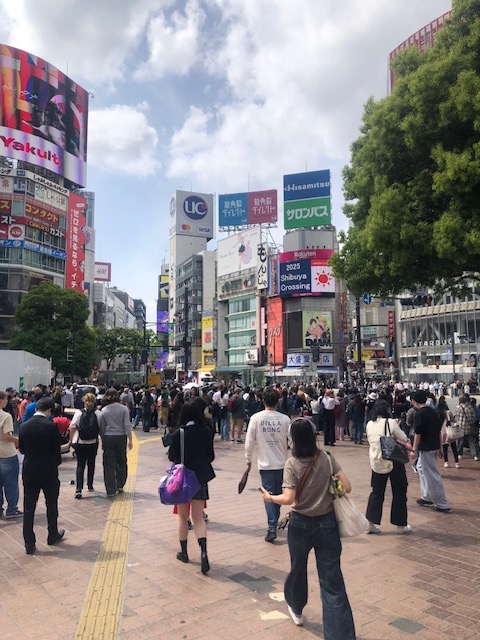
    By historic accident and design, the classic Japanese urban scenes portrayed in media hide a massive secret. The multi-floor buildings housing restaurants, retail, nightclubs, gaming cafes, hair salons etc tend to be clustered around the train stations and are lit up with the famous neon signs flashing the services available on each floor of the building. Of course, these emporia of consumption end up in Blade Runner futuristic urban shots but the Zakkyo, as they are known, serve another purpose. These vibrant urban areas thrive because of high commercial density. They are also enjoyable – thousands of small businesses in close proximity makes it fascinating for the curious. And, walkable. We walked everywhere, and that reveals the hidden magic of urban Japan. Shibuya is possibly Japan’s most famous shopping area with its famous “Scramble Crossing” and statue of a patient dog, Hachiko, who waited every day for his owner who had sadly passed away. However, Hachiko had plenty of company. The famed “Scramble Crossing” sees up to 3,000 pedestrians cross at each light change during busy periods, but two streets and 250 metres away it’s a different universe. You can hear a pin drop; total quiet, no cars, green areas and low-rise buildings housing both residents and businesses. The excellent financial writer and former Tokyo resident, Noah Smith, explains:


    “A lot of older Japanese buildings are made of wood, even if they have external facades that make them look like stone or concrete. This is a giant fire hazard, especially in a city like Tokyo where buildings are crammed so closely together. So in order to contain the possible spread of fires, Tokyo created a bunch of large streets fronted by giant concrete buildings, to act as natural firebreaks. This had a very interesting effect on the urban landscape. It created …..“pocket” neighbourhoods, where a dense maze of small streets and low-rise buildings are shielded by what are basically giant walls…. What this means is that if you’re inside the pocket, you don’t run into a lot of cars. Cars still can go inside, into the maze of small streets, but they typically don’t, because it’s almost always easier to just stick to the big streets outside the pocket. So the pocket neighborhoods become very quiet and peaceful…”


    So, the Zakkyo high-rise buildings are really a gateway into the true strength of Japan’s cities. Big block, mall economics which has obliterated town centres in many advanced economies has not happened in Japan. Critical to that success has been mixed-use zoning. People in residential areas might have small living spaces but they really LIVE in the neighbourhood where hair salons, Pachinko parlours, multiple tiny restaurants, bars, bike shops, cafes and vintage clothing stores are pretty much next door. I’d say 50% of our meals in Japan were in restaurants with seating for less than 15 people. How does small business survive in advanced economies in thrall to scale economics? Well, the Japanese government supports small businesses with miniscule rate charges, low taxes, low-interest loans and a Large Store Law which protects smaller businesses from mall creep. For example, our relatively small new office in Dublin will pay rates of €2,500 per annum but in Japan it might not even be €200. And, don’t get me started on comparable SME banking or tax regimes. No point whining, just see the results and hope one day our leaders do too. Here’s one sum to whet the appetite….

    Paris has 13,000 restaurants. London has 15,000 and New York has 25,000. But…. sum them all up and you still don’t get Tokyo.  Stunningly, Zakkyo fire-breakers, pocket neighbourhoods, train connectivity and walkable streets have created an environment where 160,000 restaurants are in business in the country’s capital. Oh, and Tokyo manages change too. Many of the buildings I last saw in 2002 don’t exist today. Note to Dublin urban planners, cities work when buildings are actually USED… for a variety of activities and not strangled by zoning tyranny. The average lifespan of buildings in Tokyo is 26 years. In the US it’s 55 years and the UK (and us probably) drags out progress by 77 years. We have lots to learn. Hopefully, my final data point will inspire given our hospitality industry is struggling and recent tourist figures are causing concern.

    As a resident of Japan in the 1990s I was one of barely 1 million non-nationals living in Japan out of a total population of 126 million. The year I left (1994)2.7 million tourists visited this amazing country. This year the tourist number will probably hit 40 million. And, the Shinjuku district of Tokyo with its mind-boggling train station of 3.5 million passengers and 200 exits (seriously intimidating) hosts a non-national residential population close to 15% of total. Clearly, a strong government commitment to infrastructure and urban planning is good for business of all sizes. And the tourists tell their friends too…..


  • Japan’s Secret Private Power….

    Japan’s Secret Private Power….

    Thirty three years ago I was slightly ahead of George Soros in battering Sterling (GBP) out of the European exchange rate mechanism (ERM). In time terms only. I left the trading bit to the Japanese banks who I witnessed on the Tokyo trading floor of broker, Meitan Tradition, wield financial power like the world had never seen. Sound a bit Trumpy?  Yes, but unlike the Orange trade toddler, this was all attached to financial reality. In fact, nine of the ten biggest banks in the world at the time (September 1992) were Japanese. And, that night those banks tried to buy every German Deutschmark (DEM) on the planet, sharing the view of Soros that the British government would give up defending Sterling (against the DEM link) and pull their currency from the ERM. They were right.

    Soros and the hedge funds got the headlines but traders in every global trading centre knew who really moved the markets and broke Sterling. Fast forward to today, another financial sage, the greatest of them all, Warren Buffett is retiring and rightfully grabbing the headlines. However, one of Buffett’s final significant trades was to build 10% stakes in five of Japan’s biggest trading conglomerates. We referenced this in the first of our Japan series of articles and promised more on the investment environment and why the smart money is quietly returning to Tokyo trading floors.  So let’s start with the public markets.

    Japan’s stock market has suffered infamous ‘lost decades’, and it was only last year that the benchmark Nikkei index recovered to previous peaks and marked a new all-time-high. It took 34 years. However, the recovery of Japan’s stock markets has been accelerating in recent years and Buffett first started building equity positions in 2019. Change in corporate behaviour has been slow, but the following initiatives have been considered the key catalysts:


    *Japan Corporate Governance Code: Introduced in 2015 by the Tokyo Stock Exchange (TSE) as a set of principles to improve long-run value creation and encourage engagement with shareholders. Previously, Japan Inc had a notorious reputation for rejecting any strategic/governance or ownership challenges through “poison pill” defensive tactics.


    *TSE “name and shame” pressure: In early 2023 the TSE asked companies with poor ratings (valuations with a price-to-book ratio (PBR) of below 1x) to disclose initiatives they were making to improve ratings. In main street terms, a PBR of less than 1x is effectively the investment market saying the company is destroying value and therefore the book value is in decline, rather than creating wealth. In financial terms, returns running below the cost of capital destroys wealth. 


    So, did it work? Yes, slowly but surely, Japanese companies started to address return on capital, shareholder dividends and non-core holdings dragging performance. For example, Toyota started to offload cross-shareholdings in companies like Denso and KDDI. Then Obayashi, one of the biggest construction companies increased its dividend. Finally, share buybacks, which were extremely rare in Japan’s corporate world, have exploded. In 2024 more than $100 billion of buybacks (from existing shareholders) were committed to by companies publicly listed in Tokyo. That’s a 75% increase in this shareholder-friendly activity on 2023. And, there’s lots more to come. Consider the following:


    *The price-to-book (PBR) of Japan’s entire stock market is barely 1.3x. That compares to the US market on 3.9x.


    *There are at least six sectors in Japan where average PBR is below 1x:  banking, insurance, utilities, basic materials, autos, and auto parts.


    Please note these companies can remain cheap forever if investors believe there is no possibility of improved returns and strategies. So, there needs to be confidence in the ability to influence change. Of course, the ultimate barometer of change appetite is the willingness to accept new owners of a business. And, that’s where private equity activity and the buying out of publicly listed (cheap) companies is the pulse check on CHANGE actually happening. Let’s just say things are quite giddy. Activity really picked up with the 2023 buyout of the iconic blue chip firm, Toshiba, by local private equity house, Japan Industrial Partners(JIP) for $14 billion. That set the tone for M&A activity in Japan to grow by 44% to $230 billion in 2024(Source: Nikkei Asia), and the involvement of private equity houses has been striking.

    In previous times Japanese corporates would have considered it “a loss of face” to be seen meeting and exploring investment from “the barbarians at the gate”. Now, it’s very much game on and Japan Inc is increasingly open to private equity investment.  The big buyout battles have featured the usual global giants like Blackstone, Bain, Carlyle, Elliott etc but the acquisition targets in recent months have been a fascinating mix of $60 billion convenience stores (7-Eleven), $4 billion software (Fuji Soft), $8.5 billion cybersecurity (Trend Micro) and $42 billion auto parts (Toyota Industries). The last deal does not actually involve private equity but is in fact a potential acquisition by Toyota Motor Corp. It’s the sheer size of this deal which caught the eye and also a reminder of the cash firepower in Japanese listed companies. Two things to consider:


    *Cash held on Japanese corporate balance sheets is estimated to be more than $2 trillion, or almost 50% of Japan’s GDP.


    *Despite market reforms and 80% compliance with TSE “name and shame” pressures, almost 50% of Japanese listed companies (TOPIX) are trading at PBR valuations of less than 1x.


    This mix of cheap underperforming companies and enormous “dry powder” of cash on balance sheets is incredible fuel for both corporate and private equity buyout activity. The US since 1996 has seen the number of publicly listed companies decline from 7,300 listings to just 4,300. In Japan, the opposite has happened with 3,900 companies now listed and adding about 100 companies per year. I could see that trend reverse as private equity and corporates increase acquisition activity (and take public companies private) but there’s also another potentially massive driver of public assets moving into private hands. We have written about demographics before, but we haven’t considered the seismic and more rapid financial transfer going on in Japan right now.

    According to a Japan Times article written back in 2020, the country was about to embark on a wealth transfer never experienced by any other country in history. Between the years of 2020 and 2030 it was forecast that $5 trillion would transfer to Japan’s “Millennial” generation via inheritance. That’s $500 billion per annum or more than 10% of GDP every year for ten years. We have previously written about the $14 trillion of savings by Japan’s households (50% of it in passive cash) but this active $5 trillion wealth transfer is highly likely to lead to changed financial behaviours and riskier investment targets. The local millennial generation watching private equity activity take off must be tempted to get involved. Indeed , local capital (JIP) has shown what’s possible with the Toshiba take-out. Europe might be tempted to get involved too. Not necessarily with a Japan focus. But, recall Mario Draghi’s EU Competitiveness Report last year and its recommended financial policy changes for the following:


    • Infrastructure project funding
    • Innovation investment of €884 billion, mostly from venture capital.
    • Strengthening the Capital Markets Union (CMU) across the 27 jurisdictions
    • Revitalizing the securitization market to improve the financing capacity of the banking sector.


    Bluntly, Europe has been poor at putting risk capital to work. However, the experience of Japan and financial market reform has been extremely positive in driving domestic and foreign investment capital into its corporate assets. So, there is recent precedent. But, is there the money? Well, try this for starters – a 2021 report from X-Wealth forecasts a wealth inheritance transfer of $3.6 trillion across all of Europe by 2030. Maybe the demographic  “Japanification” of Europe won’t be as scary as some think. In fact, the future is looking increasingly private.


  • Tech Up And Smell The Coffee

    Tech Up And Smell The Coffee

    Japan is the number one coffee-to-go consumer in the world. It wasn’t always so. For 12 centuries the Japanese were a tea-drinking nation while a stigma attached to coffee and its miniscule 1% market penetration. Early commercial attempts to expand coffee consumption in the 1970s were a disaster. Contrast that with today where Japan’s best-in-world urban centres are served by a massive coffee culture. In fact, 48% of all coffee consumption is coffee to-go beating the likes of the US (45%), Australia (23%) and UK(17%) to global top spot. What happened? Well, Nestle spent a fortune in the 1970s and failed. Then, they hired a child psychologist. Nestle knew the existing tea culture (ceremonies, 90% domestic presence etc) was in the national DNA so they ignored the adult consumer and focused on youth tastes. Literally taste. They didn’t sell coffee.

    Nestle sold coffee flavoured candy, then snacks, then ice-cream. Of course, kids grew to love the flavour. By the 1980s vending machines and canned coffee were everywhere. In the ‘90s, when I was living in Tokyo, the marketing push had entered “genki drink” territory  associating nostalgic childhood flavour with increased productivity and professional success. Fast forward to today and the 30-year re-wiring of Japan’s taste buds has created a coffee market worth $12 billion consuming 7 billion cups annually (Source: Statista). So, as my Bullet train races away from Hiroshima, I can’t help thinking about generational shifts and how advanced technology (A-bomb) was part of a nation’s destruction but was adopted by subsequent generations to lead its future. Japan might be considered conservative but there is a boldness attached to their use of technology. World-leading in fact.

    Japan might be considered a strange leader-location for cryptocurrency payment/usage given its reputation as a cash-preferring economy. Wrong. Most of my trip payments here have been done on my phone but there’s more to report. In a number of retailers I have seen iris-scanning orbs supporting the Worldcoin crypto ecosystem set up by Sam Altman (OpenAI founder). For me, the big evolution to come in crypto/blockchain is payments ie the ‘currency’ actually being used. To date, the emphasis has been on cryptocurrencies and stablecoins as stores of value or investment instruments. Interestingly, there is a strong piece of Japanese DNA which lends itself to the use of tokens instead of cash. Ever heard of Pachinko? Here’s what we wrote about it back in 2023…


    “Ever heard of Pachinko? If not, this game’s annual revenues might surprise. Estimated annual revenues of $200 billion are more than ten times those of the NFL! Pachinko is a ball game too but it’s a vertical pinball game played in Japanese gaming arcades. Players twist wheels to steer descending small steel balls into cups which trigger a prize-winning payout of more balls which, in turn, can be exchanged for cash or small prizes. Gambling for cash is illegal in Japan but this low-stakes, low-strategy game exploits a legal loophole and is 30 times bigger than the annual gambling revenue of Las Vegas, as well as twice the size of Japan’s export car industry.”


    The key point is that entire Japanese generations have grown up exchanging prizes/tokens for cash. Not surprisingly, I note that Japan’s three biggest banks – Mitsubishi UFJ, Mizuho and Sumitomo Mitsui – plan to integrate stablecoins, blockchain and digital ID into their use of the SWIFT cross-border payment platform. My suspicion is that Japan is going to lead on payments which is the ultimate route to crypto commercial penetration. And, they culturally ‘get’ tokenisation, as well as providing Bitcoin with its pseudonymous founder name, Satoshi Nakamoto. So, if you smell Japanese opportunity, it might not just be you. It could be a robot. Seriously.

    Yep, our digital world has been built on two digits: 0 and 1. So, how can a robot smell? Japanese robotics company, Ainos, has installed its AI Nose in a humanoid robot built by another Japanese robotics player, Ugo. The collaboration introduces a new class of robots that can perceive the world not just through sight and sound, but also through smell, enabling them to make more intuitive and intelligent decisions that will transform industries, public health, and everyday life. The new robot combines a high-precision gas sensor array, real-time signal processing, and advanced AI algorithms to identify and digitize a wide range of scents, turning them into unique “Smell IDs.” Clearly, this is big news for life sciences precision manufacturing, elder care, gas safety etc. Again, it should not be a surprise that Japan is leading in robotics.

    Japan dominates the global robotics market with a 40% share of global exports. No fear of AI here. Of course, given the demographics of a shrinking workforce, it has become a social necessity as Japan turns to robots to care for its elderly population. Like crypto and blockchain payments (vs investment), robots are the natural next step for AI adoption. Nvidia’s CEO, Jensen Huang, is on record as saying that the “ChatGPT moment for robotics is coming…. I can’t imagine a better country to lead robotics AI revolution than Japan. This country loves robots”. Japan also has buckets of engineering talent. Almost 50% of global industrial robots are made by 3 Japanese giants – Fanuc, Yaskawa and Nachi-Fujikoshi. But….Nvidia knows these AI powered robots will need advanced semiconductor chips. Japan might have the latest manufacturing answer in a world where tariffs, supply chains, China decoupling and Taiwan are an increasing source of business worry. So, Japan is going technology “bold” and fearless again.

    Build it and they will come is a tried and failed tech commercialisation strategy. However, Japan is making a $67 billion bet on its semiconductor chip industry without securing any customers yet. Specifically, the Japanese government has passed legislation to allow it to invest in chip manufacturing start-up, Rapidus. The homegrown chip maker is due to produce the smallest chips in history (2 nanometer size for improved performance, density and efficiency) in its Hokkaido-based facility, backed by $27 billion of investment from heavyweight Japanese corporates like Sony and Toyota plus a design collaboration with IBM. In fact, IBM has made very clear that Japan as a next-generation chip manufacturer is “good for the world” given the global economy’s dependence on Taiwan and China for chips. The first chips are due to be produced from the Hokkaido plant in July (rumoured to be for Broadcom) and the latest reports suggest Apple and Google are in talks with Rapidus too. Watch carefully as this would be a massive chip comeback for Japan. On a broader level, Japan Inc can look forward to a re-assessment by global business as a stable supply chain partner with a healthy respect for international trade agreements. Who knew healthy democracy would be a business winner in 2025….? But, we do know health is big.

    Japan is already a leader in the $6 trillion wellness industry with its outsized presence in the personal care/beauty, healthy food/nutrition, wellness tourism and spa infrastructure sectors. However, one senses demographics, AI and robotics will combine to significantly increase Japan’s investment focus in the medtech sector. Typically, European and Irish medtechs have looked to the US for product market entry and venture funding. That will continue, but watch out for an increasing Japanese investment profile. We are often asked by Spark medtech investors “where will the exit come from?”. Well, Japan might need to be added to the list. Indeed, Digital Gait Labs (currently raising funds through Spark) tick those AI, wellness and elder-care boxes very nicely. As for Japan’s investment power, there are a few things you need to know.

    Japan is effectively the biggest creditor or banker to the world. There’s a reason why the Japanese can actually buy more coffee to-go than America and…. intimidate its President. Japan is hugely wealthy. The Japanese population holds a whopping $14 trillion in financial assets, or almost 5x the GDP of France. More strikingly, half of these assets are in cash or deposit accounts. That’s almost 50% of the EU GDP waiting to be used…… possibly by the next less-conservative generation. For me, this is the generational “coffee” wealth moment to start showing opportunities to Mrs Watanabe and her children. And, there’s an early leader.

    We recently wrote about ChatGPT/AI company, OpenAI’s funding round being the biggest public(IPO) or private raise in history. What we didn’t mention was that the lead investor was Japan’s Softbank who have committed $30 billion to the AI trailblazer. Softbank is an investment holding company led by Masayoshi Son whose career has been chronicled by ex-FT editor, Lionel Barber. The book is a fascinating read and the title, Gambling Man, hints at the highs of Alibaba, DoorDash, Uber and Slack as winners but also the losers like WeWork. However, the tagline of the book title tells us more –  “the world’s greatest disruptor.” I strongly believe Son has planted the “risk seed” in this generation of Japanese investors like Nestle did in the ‘70s with coffee. Japan has got “the taste” of private early-stage equity. Now, the rest of us need to show them candy with the same “unicorn” taste as Son has pursued. No psychologist is needed this time, just on the ground observation. Then action. We need to tech up, and show up.


  • An Eastern Promise  Worth Exploring…

    An Eastern Promise Worth Exploring…

    It is 23 years since I was last in Japan. I still love it. The cultural collision of ancient tradition, mass urbanisation and advanced technology is a gobsmacking experience. And, then there’s the friendly population hungry to learn while blessed with fabulous food, beautiful rural scenery, extraordinary attention to detail, safe streets and a commitment to social harmony. It is perhaps unique among the advanced economies of the world. However, Japan has its challenges. We all do these days but maybe Japan offers a fresh perspective on how to cope with change. I lived in Tokyo for three years in the ‘90s and this visit has been an eye-opener on how Japan is responding to change. So, I have decided to write a series of short articles in the coming weeks while travelling here on topics relevant to European business and investment. I’m currently on a Shinkansen (Bullet) train out of Tokyo on my way to the beautiful Gifu region and wanted to touch on a few early themes. Let’s set the scene.

    A quick glance at the daily newspapers – Yomiuri Shimbun, The Nikkei and The Japan Times – confirms that global trade disruption is the topic du jour in common with almost every other country on the planet. The Japanese economy is a trade-based one, given its relative lack of natural resources. It also had its own MAGA-type isolationist experiment from 1602 to 1863 when trade and foreign visitors were effectively shut out from Japan by its ruling Shoguns. So, it’s interesting to note the Japanese media focus on the “isolationist” aspect of the extremist Trump regime in Washington. Let’s just say the Japanese are a bit sceptical on Washington’s ability to put together a coherent trade framework. In fact, the unofficial feedback from the Japanese trade delegation sent to the White House was damning.

    There was a strong Tokyo view that the American negotiators “have no idea what they want”. Furthermore, this is a Japanese negotiating team which agreed trade deals with Trump in 2017 (TPP) and 2019 (agriculture/industrial products). As long-time Japan observers know, Japanese business and its leaders value relationship building and trust before committing slowly to any commercial deal. The mind boggles as to how Trump’s negotiating team think they will get any deal done with the Japanese while ignoring the terms agreed with Trump himself during his first presidency. Trust in the US is evaporating.

    There has been a global ‘sell America’ trade in recent weeks as the US dollar, US Treasury bonds and US stocks have been whacked by foreign sellers who have lost faith in US institutional stability. Japan is believed to have been the original foreign seller of US Treasuries (it holds $1 trillion (!) of these bonds) which spooked Trump into delaying tariffs on ‘negotiating countries” like Japan earlier in the month. Instead, Trump’s team focused its tariff tantrums on China while giving most countries a 90 day breather. As I write, the White House attempt to shift focus and possibly gather trade “allies” against China is blowing up rather embarrassingly. Indeed, Japan have just said they will not join any co-ordinated trade axis against China as it is too important as a trading counter-party. Sensible stuff. Meanwhile, the CEOs of Walmart, Target and other US retailers have apparently told Trump that store shelves “will be empty in 2 weeks”. Indeed, import activity at US ports has collapsed and the country’s 8 million truck drivers (and MAGA hats) are on stand-by for mass lay-offs. Whoops… not so sensible stuff.

    It turns out China can’t be removed from the US economy on the whim of Agent Orange. In fact, the latest word from the ‘stable genius’ is that tariffs on China will be reduced. No doubt, there will be some spurious ‘win’ claimed by Trump and his blowhard MAGA champions but the silence from China and President Xi has been deafening to all sane watchers of geopolitics. China has been prepping for this trade war for years, and has forced Trump to blink for all to see. However, the damage is already done to US credibility and increases the relevance of Japan as a trading partner for economic blocs in Asia and Europe. So, where can Europe work with Japan in a new world order? I already see a few shared pain points.

    In many ways Japan is a window into Europe’s future. Europe is already in “low growth” phase with its ageing population and high level of risk-averse savings. However, the demographic cliff facing Japan has already sparked a dramatic change in policy. For context, Japan’s working population is expected to lose more than 10 million workers (72m to 62m) in the next 15 years. Yep, ten million. So, it was immediately striking on this visit to Tokyo to see the number of non-Japanese working in the hospitality and retail sectors. So striking that I went to check the statistics. According to a Japan Times report in 2018, more than 1 in every 8 adults living in Tokyo’s 23 wards (cities) are not Japanese citizens. That is remarkable considering when I first worked in Japan there were just over 1 million foreigners living amongst a Japanese population of 126 million across a country roughly the size of Italy. Perhaps the desire to live in Japan is less surprising when you consider in the same time period (from the ‘90s to now) the annual number of tourists has rocketed from 2.7 million to 40 million. However, the true surprise is the policy shift in Japan to allow immigration in significant numbers. Bluntly, despite far right political party activity in Europe, immigration is a necessary part of its future. But…. not the only solution. Japan again is leading.

    Mario Draghi in his 2024 European Competitiveness report highlighted innovation and productivity as a necessary policy focus. In Japan, the use of robots and technology to assist in service-heavy healthcare and retail is well established. I personally witnessed robots in action in Narita airport and  a variety of Tokyo retail settings but the presence of humanoid robots in Japanese nursing homes is also well established. In fact, Japan dominates world robotics, accounting for 40% of the global market. Of course, innovation does not happen without risk capital/investment. While the financial headlines have obsessed over AI and the gyrating performances of “Mag 7” tech stocks, Japan has quietly turbo-charged its investment environment.

    Thanks to policy changes facilitating shareholder activism and takeover activity, the Japanese private equity market has exploded. We often write that the “future is private” so it is remarkable to see conservative Japanese capital markets experience 40% growth in 2024 private equity/venture capital activity. Unsurprisingly, the global private equity giants like KKR, Blackstone and Bain are all over this structural shift. Hedge funds have been racing to set up offices in Tokyo to follow the action too. Back in Europe, Draghi has highlighted the lack of innovation and investment/financial policy coherence across 27 different jurisdictions. Joined up thinking on investment could be as transformational for Europe as it appears to have been in Japan. And if you’re looking for policy endorsement, then who better than Warren Buffett.

    We will return to the Japan private investment environment in greater detail in subsequent articles but the public markets have already received the “Buffett kiss”. Over the last few years Berkshire Hathaway has built 10% equity stakes in each of 5 Japanese trading houses. These trading houses, also known as sogo shosha, are large, diversified conglomerates involved in a wide range of businesses, from trading and investment to logistics and manufacturing. Buffett has invested in the big five sogo shosha –  Mitsubishi, Mitsui, Sumitomo, Itochu, and Marubeni. We have written previously on this Buffett move but way before the Trump tariff tornado hit global markets. And, now I’m beginning to wonder. Did Buffett see an isolationist America coming and deliberately seek out the centuries-old trading relationships established across Asia by these Japanese trading giants? It wouldn’t be the first time Buffett saw a structural shift early. However, it’s not too late for Europe. A deliberate attempt to increase co-operation and relationships with Japan might be a very clever way to diversify risk away from an inward-focused US and explore Asian opportunity. Certainly, the Japanese can offer interesting perspectives and responses to deal with the four horses of Europe’s stagnation apocalypse: trade, immigration, demographics and innovation. Lots to learn, lots to write (or right).