Tag: Oil

  • Don’t Get Angry, Get Ready….

    Don’t Get Angry, Get Ready….

    I was right. The first of my predictions for 2026 was spectacularly on the money. Sadly, it won’t make any of us wealthier given its focus on noise rather than direction. To refresh memories, the final words in my last article, Themes and Dreams For 2026, were as follows: “I’ve a feeling I won’t be short of writing material in 2026.” Little did I know there would be a year’s worth of material in just the first 10 days of 2026. Where do we start?

    The US is celebrating its 250th birthday by re-branding as an exploration company with an army (hat tip George Carlin) as Venezuela is ‘acquired’ and ‘takeover bids’ are lined up for the Panama Canal and Greenland. Back at HQ, the Boss re-asserts control of executive salaries and cash flows in the company’s defence supply divisions while promising a 50% expansion of investment ($1 trillion to $1.5 trillion) in its Business Development unit, previously known as the Department of War, and before that, as the Department of Defense. Meanwhile, the company’s traffic stop management division has secured immunity from regulatory or criminal oversight of its shoot-to-kill (or stop) policy on a nationwide basis, not just in Minneapolis. Of course, none of these revolutionary business initiatives can happen without funding. The company’s Treasury unit has set up overseas bank accounts to deposit proceeds of its newly acquired Venezuelan oil unit. In the interests of tax efficiency these bank accounts will be overseen directly by the Boss, and will not be consolidated in the parent company accounts. But, of course. However, US Inc is not the only company turning to oil….

    It is probably more accurate to say some companies are breaking with a seismic global shift to electric power. Again, it’s American-sourced exceptionalism. This week General Motors (GM) has followed Ford and abandoned its move in to electric vehicles (EV). These recent investment write-offs amount to $7 billion and $19 billion respectively which will hurt. But… that might not be the end of the pain. The train, or car, has already left the station. The Electric Age, per the superb Noah Smith, is here with 25% of cars purchased in 2025 of the EV variety. In many Asian and a few European countries that penetration rate is through the 40-50% level. China leads the world in the entire EV technology stack and have focused their attentions on battery production, manufacturing scale and grid expansion (solar). Fewer moving/motor parts, efficiency and superior performance are the current and long-term edge for EVs which will kill the internal combustion engine (ICE). Writer’s note: Be careful how you say or ‘weaponise’ that acronym these days.  All is political these days rather than factual which highlights why the US is making a fatal error on oil over electric. Noah Smith writes:


    The main reason America is missing the EV transition is that we’ve insisted on thinking of EVs in terms of climate — as a “green” technology whose purpose is to save the environment, rather than a superior technology whose purpose is to save you time and money. Trump canceled EV subsidies because he associates them with the environmental movement and the political left.


    It’s not just electric vehicles(EVs) experiencing their electric break-through moment. EVs share the same components as drones, trains, cameras, phones …..and robots. Just this week at the massive CES 2026 conference in Las Vegas, Nvidia’s Jensen Huang didn’t even blink when asked how long it would take for humanoid robots to match human-level ability. “This year”, he said. Guess what – those robots run on many of the exact same components which go inte EVs. Think batteries, power/motor electronics, sensors, software…..and AI. Clearly, in the AI piece of the assembly package, the US is perceived as the global leader. However, even AI and its support infrastructure is inextricably tied to electric power. And, before you say “but, but, but… the Venezuela oil reserves”, get ready for more non-delivery from the “stable genius” back at HQ. Venezuela currently produces less than a million barrels of oil per day. It’s like a rounding error of less than 1% of global oil production. Yes, that production level can grow but please note the lack of announcements from US oil company executives about investment plans and potential commercial negotiations with Venezuela’s 5,000 plus generals and regional warlords. While the Department of War was planning ‘business development’ in Latin America, China built more solar power capacity than the rest of the world combined in 2025. For perspective, that additional solar capacity of 380GW built in 2025 equates to 5x China’s total existing nuclear capacity (58 plants). Get ready or get digging on two fronts.

    First, we have written a lot in 2025 about the asynchronous explosion of excitement and revenue projections for the AI world and the mining sector. At certain times in 2025 one AI company, Nvidia, was worth 4 times more than the entire publicly listed mining sector. Get ready for a change. Gold, silver, platinum and copper prices have soared which has finally juiced the risk spirits of mining sector executives. We said the sector needed a big deal. Well, global giants Glencore and Rio Tinto are talking a megadeal again with a copper focus (yep, all that electricity) and a $260 billion valuation. Metals of course in earlier times were the basis for currency. In time, central banks became the back-stop or guarantor of currency but we might have to dig again.

    The global reserve currency, the US Dollar, lost almost 10% of its value in 2025. In isolation, this is not unprecedented. In fact, the Trump regime are quite keen on a softer dollar and lower interest rates for trade deficit and investment reasons. However, we must get ready for a further assault on institutional independence in the US. The current Fed Chair, Jerome Powell, is due to leave his post in May this year. The new appointee (apparently already decided by the Boss) will be expected to cut interest rates dramatically to keep Trump happy. However, the potential unintended consequence of this action in the context of a $40 trillion US national debt is loss of credibility for the Fed and its ability to prudently manage that debt, and the currency. Hopefully, the bond markets are more effective than Russian or Chinese radar systems in spotting and thwarting that assault on Fed and dollar credibility. A final word on markets and pensions.

    Those of you reading your pension updates/reviews for 2025 might be underwhelmed by the performance. Before you get angry, I would recommend a read of Terry Smith’s own review of his $20 billion fund which underperformed in 2025. As always, my former boss writes superbly and highlights some key factors driving investment markets these days. Terry always sticks to the basics and this might well be a theme for 2026. The thoughts above should ready minds for investment opportunities in electrification, real assets, financials, mining and assets located outside the exploitation company, US Inc, formerly known as the United States of America…..
  • Raining Catfights And Dogs On The Trump Victory Trade

    Raining Catfights And Dogs On The Trump Victory Trade

    You could smell the global fear on Monday. By Friday, that fear mostly wafted around Donald Trump’s Mar-a-Lago compound. Forty five years ago Colonel Kilgore in Apocalypse Now first memorably stated, “I love the smell of napalm in the morning. It smells like victory”.  Arguably, the Republican party scribes will recount in time how the smell of ketchup-spattered walls in Florida this week marked the beginning of the end for a once-likely victory for Donald Trump. Tuesday’s Presidential debate watched by an audience of 67 million people was a disaster for Trump, and hailed as a triumph for “dumb as a rock” Kamala Harris. As eminent Bush Republican strategist, Karl Rove, cheekily asked, “What does that make Trump?”. A loser, but possibly there’s a bigger loser out there. It is interesting to note that Colonel Kilgore and Francis Ford Coppola’s Vietnam epic is today viewed as possibly the most powerful  “anti-lie” rather than “anti-war” movie of all time. Fast forward to today, and here are a few big lies under pressure in the real world, real money arena of financial markets….

    On the debate night, Trump flounced into the post-debate spin room declaring victory and quoting nonsensical Twitter and Fox viewer polls. However, as we always say… opinion is cheap, but investment decisions risk real money. So, it was striking to see the following morning that Trump’s publicly listed vehicle for his Truth Social platform, $DJT,  puked 16% of its value and now trades 80% lower than 6 short months ago. It should also be noted that the climate denial Don’s awful performance prompted heavy buying of clean/green energy stocks too; First Solar was up 14%, Enphase Energy up 5% and Sunrun up 10%…in one day. Let’s just say traders had a very different take on Trump’s bloviating spin-room review.

    We should also review some of the markets we highlighted in our article back in March “How To Trade A Trump Win”. In brief, we stated that there were three key ‘canaries’ which tracked the major Trump policies:

    Tariffs: Trump wants a 10% across -the-board tariff on all imported goods. Tariffs on imports are agreed by all credible economists as inflationary costs borne by the consumer. But…current inflation expectations in the market tracked by bonds, loans and money markets suggest those tariffs ain’t happening. Moreover, the current inflation rate of 2.5% is at a 3-year low. In fact, if one were to step out of the partisan bubble of US politics, one would know that the US is the global superstar in the post-Covid inflation battle.

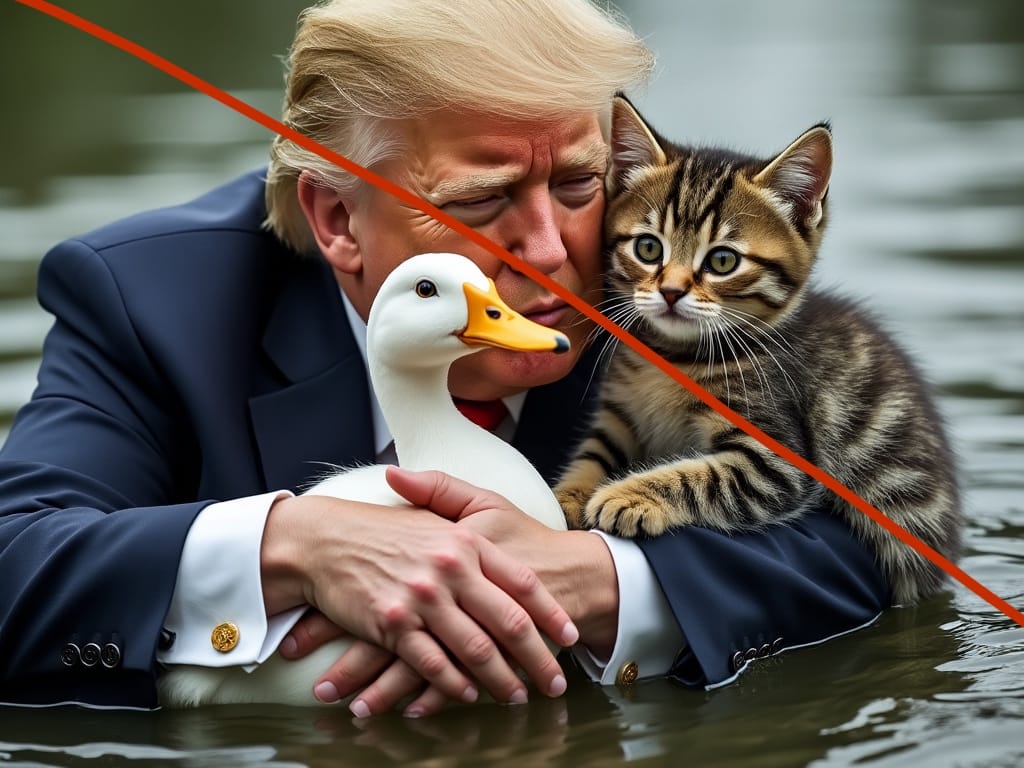
    Oil: The Donald likes to tell voters he’s the fossil fuel industry’s best friend while promising consumers he will cut energy bills by 50%. This is almost as ridiculous as promising to protect cats, dogs and geese in Springfield Ohio, and becoming quite embarrassing for the Trump team on both fronts. Even Homer Simpson could tell you US oil and gas production is at all time highs of 14m barrels per day (vs Saudi Arabia 8m!). Meanwhile, oil costs measured by benchmark Brent Crude prices are back to the same levels seen before Russia’s full invasion of Ukraine in February 2022. Go figure!

    Ukraine: Finally, on the subject of foreign policy, and Ukraine in particular, the chances of a Trump victory also look flaky. We flagged the extreme risk of placating Russia – with ceasefire negotiations forced by Trump’s ending of Ukraine military support – and the threat this capitulation posed to eastern European countries like Poland. Well, check out Poland’s stock market; in the last 12 months it has roared upwards by 40% compared to the giddy S&P 500 ‘only’ rising 26%. Smell that Trump capitulation fear? No, me neither.

    The financial markets are struggling to believe Trump, and his chances of victory. With less than 60 days left before voting, expect an increasingly panicked Trump campaign team. The meltdown of Trump immigration/racist-in-chief, Stephen Miller, when being caught out on a Venezuela crime statistic lie is one for the ages. And, for pure popcorn moments, keep an eye on the social media spats between rabid Trump surrogate, Laura Loomer, and the more restrained Marjorie Taylor Greene(no really!) and Senator Lindsay Graham. You just couldn’t make it up. Well, Donald could.

  • Store Up Some Fuel Thoughts

    The recently deceased actor, Brian Dennehy, once asked to stay the night in our house and we turned him away. True story.  However, context and logistics are everything. Of course, we would have loved to tell the tale of hosting a Hollywood legend except there were already 25 Irish teenagers staying in our house during that J-1 summer of 1989 in Montauk, Long Island. So, it is no surprise that Dennehy’s death and oil prices (with a minus) over the past week did jog the memory and highlight all over again the importance of space irrespective of the opportunity.

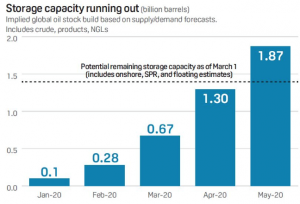
    As US oil futures plunged into negative territory in recent days we were reminded that if there is no storage available you can’t even give away a bulky commodity. In fact, some contractual parties in the futures market were prepared to pay somebody, anybody $35 for each barrel of oil to be taken off their hands. Just think, if one could have taken delivery of a million barrels of West Texas oil there was a whopping $35 million payment to accompany that load. The problem as the following chart from energy consultant, Platts, shows is that the US market has maxed out on storage capacity:

    Yes, that looks like we are rapidly approaching a stock build of almost 2 billion barrels of oil with storage capacity for closer to 1.5 billion barrels. The main driver of the stock build is CV-19 and the evaporation of oil demand. Think back to 2019 and daily oil consumption of 100 million barrels per day. Current estimates suggest we might be consuming 25 million barrels less, each day! To halt production would be very expensive hence the stock build and furious prayers to the Donald, Allah and Saint Christopher, the patron saint of travel. Hopefully, the rest of the world can follow China back to some sort of post Covid recovery phase but the decline of oil pricing power has been a multi-year trend.

    Here are a few further thoughts on the decline in influence of carbon fuel producers:

    1. For consumers of energy, as individuals or as businesses, a collapse in fuel prices should be viewed as an enormous tax cut.
    2. In 1980 the oil sector accounted for 30% of US equity markets. It now accounts for less than 3% while the technology sector represents more than 23% of the market. Who said data was the new business fuel?
    3. Rogue states and despotic leaderships dependent on commodity markets can be vulnerable to sovereign debt implosions and civil unrest. Russia and Saudi Arabia are more fragile than perhaps financial markets and investors appreciate.
    4. Storage has hurt the oil markets temporarily but on a longer term view storage will be equally important to the emerging renewable/electric/battery powered economy. There is still much to be done to improve battery/storage technologies. One can reasonably expect material science/chemistry graduates to be the hot talent property of the future.
    5. US shale oil production has exploded in recent years. Investment, employment and GOP election coffers have all benefitted. Oil prices, even if they recover back to the $30 levels, make shale oil an uneconomic proposition. US oil producing states are mainly Republican voting states but jobless voters can be fickle. It might be tough for them to stomach a Democrat President but it seems the current White House incumbent believes they can stomach disinfectant. So, anything is possible in the November election.

    As always, human beings are not great at forecasting the future. However, it is a racing certainty that the oil markets have not exhausted their ability to deliver further shocks in 2020.


    Enjoyed this blog? Then why not check out our other great content by clicking here!

  • Fuel For Thought for Aramco…

    Well, well, well. It appears oil wells are no longer the stuff of bankers’ dreams. For a fleeting moment this writer almost felt sorry for the investment bankers who had to meet with Crown Prince Mohammed bin Salman’s officials in Riyadh at the weekend. The message the bankers had to deliver over the whirring of bonesaws was not an easy one. The crown jewel of Saudi industry and national oil champion, Aramco, was due to embark on a series of investor roadshows around the world this week to sell shares in its planned December IPO. However, there was a small flaw in the plan.

    Despite the efforts of the 25 banks employed in the selling syndicate there was almost zero international investor appetite for shares in Aramco at even reduced valuations. The awkward advisory report delivered was that there would be no international roadshows and that the only likely interest was in Saudi Arabia itself and some neighboring Gulf states. The shunning of Aramco is remarkable given its status as the world’s most profitable company. In 2018 it’s profits were $111 billion thanks to an ability to pump an average of 13 million barrels of oil daily. For context, the total US output is 10 million barrels daily.

    The banker embarrassment didn’t end with roadshow cancellations. The much-hyped goal of the Crown Prince to list a company valued at $2 trillion was dashed with current valuations pitched at around the $1.5 trillion level. Without international participation, the number of shares is being scaled back dramatically to just 1.5% of the total share capital rather than the anticipated 5%. One suspects the subjects of the Saudi kingdom won’t have the luxury of negotiating valuations albeit they might get the opportunity to visit the Riyadh Ritz Carlton…

    On a slightly more serious note there are a number of issues to consider for investors in light of this IPO push back. Aramco is no WeWork. It is a hugely profitable company with real assets, sovereign customers like China and the prospect of relatively high dividend yields in a zero interest rate world. It is easy to dismiss investor unease as a fear of being a minority shareholder in a Saudi state-owned enterprise or Aramco’s vulnerability in the unstable Middle East. Recent Houthi/Iran attacks on Aramco refining infrastructure will also bolster that risk factor in investor minds but we think there are bigger structural trends to consider.

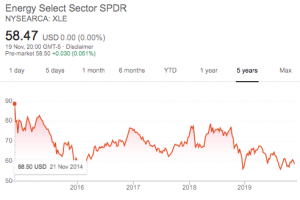
    Fossil fuel energy is in a long term downtrend in international financial markets. The US energy sector ETF (XLE) has almost halved in value in the past 5 years. In previous articles, we have referenced hedge funds which now consider climate change risks before every investment. Pools of capital are chasing renewable energy, electric vehicles, recycling, meat alternatives, etc. as the investment assets with future rising demand and returns. Oil is not part of the climate change future. In fact, Aramco alone has generated 4.4% of all the world’s CO2 and methane emissions since 1965. That’s some history. Here’s the misery chart for oil company investors over the last 5 years.

    Fuel For Thought Spark Crowdfunding blog
    So there is definitely an environmental risk factor in most investors’ processes these days. However, that’s not the only risk consideration. The increasing popularity of ESG compliant investment (that’s Environment, Social, Governance standards) is not just driven by a sudden embrace of “good” corporate citizenship by companies and investing institutions alike. The other critical factor is that recent performance data suggests funds which feature ESG risk filters in their investment process are more likely to outperform.

    The problem for Aramco and its outsized share of the Saudi economy was that investors have equated Aramco with the Saudi kingdom itself. The Saudi track record of repression of women, dissent, Shiite minorities and weaker neighbour states like Bahrain was a difficult pitch for the bankers to investors who would be minority shareholders in governance terms. The human rights atrocities in Yemen and the murder of WSJ journalist Jamal Khashoggi are the more lethal examples of societal tyranny listed earlier and would be red flags in any social or ESG risk evaluation.

    Aramco is an extreme example of ESG failure given investors are now prepared to give up on attractive near term dividends. ESG will continue to grow in influence and actually start to impact valuations; think of it in terms of investor demand(ability to invest). Unfortunately for the oil sector, all the ESG trends are moving in the wrong direction. Climate comes first… and then the creditors.

    Many oil and gas companies will in the not too distance future have their Riyadh Ritz Carlton “moment” with their lenders. Tears will flow rather than oil, but not so many from the planet’s citizens who will continue to battle extreme fire, flood and temperature events.


    Enjoyed this blog? Then why not check out our other great content by clicking here!

  • Oiling our Fears

    Oiling our Fears

    Crude oil prices are now trading at the same levels as they were on the Friday before the bombing attacks on the Saudi Arabian oil fields. That seems odd. Five decades of Middle East strife has taught market traders that significant cuts to oiling due to war leads to prolonged spikes in prices.

    This is not just a 1970s phenomenon. As recently as 2003 and the second US-Iraqi conflict, the global economy experienced an oil shock of mid-$20 per barrel pricing motoring up to $140 per barrel by 2008.

    Sure, the recent Saudi outage is not quite a war scenario but the precision (too precise?) attack has taken out 5 million barrels or almost 5% of global oil supply. That’s not far off the impact of the 2003 Iraq war, and the initial 20% spike in oil prices on news of the attack did reflect a major event in energy markets. Of course, the Saudis and an election-frazzled Trump administration were quick to reassure markets about adequate reserves, quick restoration of supply etc. However, almost two weeks after the attack there is a growing acceptance by Saudi Arabia’s wannabe IPO, state oil company Aramco, that production facilities will be out of action for many months, possibly a year. That’s before we even mention a ramping up of tensions with alleged attack sponsor, Iran. Bluntly, where has all the fear gone?

    Perhaps it has been replaced by a greater fear.  Donald Trump was so scared of a 16 year old at the UN meeting in New York he chose to skip the Climate Action Summit and instead made a speech at a Religious Freedom meeting. Always important to keep those avangelicals happy. As for the one million Uighur Muslims incarcerated in China, there wasn’t even a mention. Happily, Greta Thunberg’s fear-filled speech garnered far more attention than the Dear Orange Leader’s.

    The teenage wake up call to the world was quickly followed by a rather scary report from Goldman Sachs(hardly a leftie liberal socialist champion) highlighting the significant impact of climate change on urban populations living less than 10 meters above sea level. The numbers are staggering and sadly it might be too late to prevent the consequences of an already warmer world. The warning from this Wall Street leader was stark, “ It might be prudent for some cities to start investing in adaptation now.”

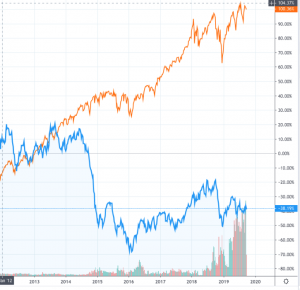
    Clearly, there is a growing consensus that carbon/greenhouse emissions are affecting climate. We have written previously on some leading hedge funds who now factor climate change into ALL their investment decisions. Arguably, the smart money has been selling out of oil for years. Here are a few data points which tell that story. The first is a chart showing how the S&P 500(orange) has diverged dramatically from the downward trajectory of oil prices(blue) since the middle of 2014.  It has been a period of healthy economic growth so that is quite striking.

    It is not just the commodity price which has lagged the market. Exxon Mobile is about to drop out of the S&P 500’s top 10 stocks for the first time in 90 years. Furthermore, the energy sector now accounts for just 4% of the overall US market. One can’t help feeling that actions of economic leaders are being watched very closely. Take, for example, the decision by Amazon to place an order for 100,000 electric delivery vans(yes, that is the correct number of zeros) from a company, Rivian, of which you probably have never even heard.

    Oil services stocks which support the major oil companies on infrastructure, logistics etc have seen their share prices fall more than 50% in 2019. That’s in a year when markets are actually up more than 20%. We have seen commentary on Wall Street puzzling over this wealth evaporation and wailing, “The oil service stocks are trading at prices that imply the entire fossil fuel industry will disappear”. That is an extreme outcome but there is a growing sense that climate change is an extreme challenge. Even Taoiseach Leo Varadkar has decided we will never be called Oiland(or Oirland) as he has told the UN Climate Summit that oil exploration in our waters will end.

    Returning to our own confusion about the lack of fear over the Saudi attacks we must consider that the temporary spike in oil prices was yet another opportunity for professional investors to lower their exposure(sell) to an industry in the cross hairs of a fearful planet and motivated leaders. In a week when the WeWork IPO has revealed itself as a “greater fool” proposition we would note that the Saudis whose entire economy depends on fossil fuels is also trying to IPO/sell you Aramco.

    WeWork didn’t work, its CEO is now out of work and the franchise itself might not see out 2020. In this warming world oil now generates a new set of fears and it doesn’t help the pricing of the product. The greater planetary health fear will win out over old-fashioned energy supply fears and that perennial investor behavioural companion, the fear of missing out. Steer clear of your old fears; the teenagers are the brave ones and will sadly be proven correct.


    Enjoyed this blog? Then why not check out our other great content by clicking here!