We sorta knew didn’t we? The Donald really doesn’t ever want to leave power. National Guard troops might be armed and patrolling the streets of Washington DC but we might be missing an even bigger power move. No, neither I nor the South Park writing team are contemplating a horse being appointed as a Senator, or JD Vance as President or Eric Trump …. replacing the horse. Parody and Caligula’s legacy are safe, for now. However, if you’re a fossil fuel investor things are looking anything but safe despite the Orwellian data-denial of the Dear Orange Leader. Let’s start with a few ground truths.
*Oil prices have fallen in three of the last four weeks and are now in the low $60s per barrel pricing region which is close to a 4-year low.
*Bloomberg recently reported that global oil markets are on track for a record surplus next year as demand growth slows and supplies keep growing [Source: International Energy Agency(IEA)]
*IEA data shows oil inventories will accumulate next year at a rate of 2.96 million barrels a day, surpassing even the average build-up during the pandemic year of 2020
*World oil demand this year and next is growing at less than half the pace seen in 2023.
*But what about “Drill, Baby, Drill” ? Maybe not so much. US drilling activity continued to fall in early August as the oil rig count fell to 539, near its lowest since Dec 2021.
No wonder Texas is trying to re-draw and gerrymander voting districts 5 years early. Texans are unlikely to fall for Fox News fealty to the Dear Leader, but they will be bombarded with untruths. That’s just a no-fact of life in politics these days. However, the strategic problem for the US in this energy leadership crisis is that climate crisis denial has directly impacted investment in renewable energy projects. The facts are stark. The Financial Times has reported a whopping $19 billion worth of projects have been cancelled this year alone. In fact, cancellation rates on all renewable projects are up over 2,000%.
The most recent cancellation was a biggie in Rhode Island. An off-shore wind project 80% completed by Danish company, Ørsted, was halted by the Department of the Interior citing “concerns related to the protection of national security interests”. That project would have powered 350,000 homes in Connecticut and Rhode Island. Meanwhile, the rest of the world is rapidly shifting focus away from fossil fuel projects. The graphic below is from the Visual Capitalist team using IEA data and compares global investment from the years 2015 and 2025 (estimated). Renewable energy investment projects have more than doubled to $780 billion and overtaken oil project investment which has shrunk from over $800 billion to $543 billion. Interestingly, electricity grid, storage and efficiency projects are now forecast to reach close to $800 billion in 2025.
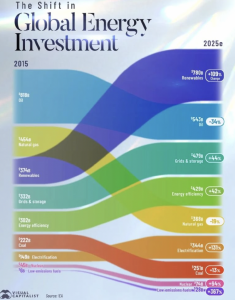
The slippage of oil, gas and coal in the investment rankings is clear to see in the chart above. A seismic power shift is already happening and it is worth keeping an eye on the headlines and developments listed below. Arguably, the current White House administration, rather than bolstering “national security” is handing the energy keys of the future to more far-sighted leaders elsewhere. Check out these data points:
In July, China’s single month electricity usage exceeded 1 trillion kw/hours. That’s more than Japan uses in a whole year. Of this total, 25% was generated by wind and solar energy sources.
In April 2025, China’s solar generation of 95 TWh was larger than the TOTAL ELECTRICITY DEMAND of all but two countries in the same month.
For the first time in history, despite soaring electricity usage, CO2 emissions in China are falling.
The UK in Q2 granted planning for 16.1 GW of renewable energy capacity. That’s up 195% on last year.
Renewables in the UK for the first time in 2024 supplied over 50% of the nation’s electricity over the entire year. Renewables and nuclear energy combined, accounted for 65% electricity generation in the world’s 5th biggest economy.
In Pakistan, over the last two years private individuals have imported solar panels which equate to 68% of the entire national public grid!
India’s solar PV manufacturing capacity has increased 50x in 10 years from 2GW to 100GW.
In May this year, 68% of Germany’s net public electricity was generated from renewable sources.
The electric vehicle (EV) revolution is not just happening in wealthy economies. 76% of new passenger cars sold in Nepal are electric. In Ethiopia that number is 60%.
EV sales in Europe took 29% market share in June 2025. The share in Sweden is 65% while China moves in to the tipping point of more than 50% of sales being electric.
The future is fast becoming electric, powered by renewable energy sources. One wouldn’t want to be on the wrong side of history, or your previously loyal customers. Ask Elon Musk and his European sales and marketing team. And…. if you want history to be a guide as to how power can shift slowly, then suddenly, maybe don’t go to a US museum. Apparently, the Dear Leader doesn’t want US museums like the Smithsonian to raise awareness “too much of the past”, but rather “focus on the future”. Yep museums shouldn’t do history too much. Go figure.
I’m going to stick my neck out here and risk future US visa issues but ……..it feels like the US energy future is not in good hands, just tiny ones clinging to the wrong power.