Tag: Stripe

  • What Signals Are You Watching?

    What Signals Are You Watching?

    I’m a bit lost. I can still remember as a child staring out at the Ballycotton Lighthouse as it guided battered yachts to safety during the Fastnet Race disaster of 1979. Fast forward to today and there’s another potentially calamitous “storm” brewing for the most basic concepts of accepted facts and truth. Worryingly, there’s increasing evidence that the “lighthouse” of global leadership on rules of law and common values has gone dark. Orwellian dark. I know we’ve been here before with White House Press Secretary, Sean Spicer, and bonkers claims of inauguration crowds for Trump 1.0 but the second coming of Trump is a whole new level of autocratic demands to “reject the evidence of your eyes or ears.” That’s Orwell, not the White House.

    It would appear that “their final, most essential command” this week is to NOT read the time-stamped texts of the US Secretary of Defense on the unsecured Signal mobile chat app shared with 16 other US security chiefs (plus one mistakenly added journalist) and conclude that this was the most embarrassing and dangerous self-inflicted security failure by US institutions in decades. The cover-up and spin-fest since the Atlantic magazine scoop has witnessed equally incompetent and criminal attempts to parse the meaning of “war plans” and “attack plans”. To be clear, the key “ground truth” in this intelligence near-miss is that advance information on a military mission puts US military personnel in danger. But here we are.

    Donald Trump has given a press briefing stating the US “has to have Greenland” and his Kremlin keeper, Vladimir Putin,  is dovetailing on message beautifully by saying “Trump’s plan to seize Greenland is serious”. Doesn’t that sound like two mob bosses agreeing ‘territory’?  Yes, but don’t ask the lawyers. Leading law firm, Skadden Arps, has just “agreed” to provide $100m of pro-bono work for initiatives supported by the White House in order to avoid adverse targeting by a regime irked by previous “woke” cases taken by Skadden.  So, do we all surrender as democracy dies in darkness? Well, there are other Signals to watch with possibly more impact than a Houthi-Yemen air strike mission. In fact, their potential impact could be sufficiently influential to trigger “lighthouse” leadership, even change.  I’m looking at three Signals in particular.

    First, as we head towards the Trump self-styled “Liberation Day” of trade tariffs imposed globally, we watch the money or flow of same. Some might think the enormous switch by investment institutions out of US equities (down 5% year to date) to international equities (eg. German Dax up 15% year to date) is a big deal. It is. But, equity markets could be due a “rotation” anyway after 15 years of US dominance and, frankly, more challenging valuations when economic leadership veers into cult lunacy territory. The awkward fact for the Trump crime gang is that foreigners own $16 trillion of US stocks and they are selling them even quicker than Tesla shares. However, the bigger more worrying signal is in the debt (or credit) markets. As we regularly say, debt(bond) markets can really intimidate as they can cause proper global economic damage. So, when I look  at the ‘plumbing’ of the financial system and corporate debt (credit) data, I’m seeing signs of cracking and stress. The jargon monoxide will involve terms like “spreads”, “VIX”, “call options” and “default pricing” but, take it from me, this is where the intimidation of the Trump White House is beginning.

    Second, how long will Trump’s ‘broligarchs’ go along with his trade war when there is possibly a far more consequential technology “war” exploding across our screens every day? My sense is that there could be a calculation that trade wars are a dangerous commercial distraction. Check out the latest data from Stripe. Software companies (SaaS) were always the uber-growth leaders, with Stripe analysis showing the median time for the top 100 software/SaaS start-up companies to reach $5m of recurring revenues was 37 months(data from 2018). But, there’s a new growth monster in town. Stripe data (2024) shows the top 100 AI start-ups hitting that $5m milestone in….. 24 months. You might have read that executive suites across the USA have been paralysed by indecision due to erratic Trump economic policy. Indeed, M&A deal activity has fallen to the lowest in a decade and year-to-date is down a whopping 30% on last year. However, the story in start-up world is very different. In the first quarter (Q1) of 2024 there were two start-ups acquired for more than $1 billion (unicorn status). In Q1 this year, there have been ELEVEN $1 billion plus start-up acquisitions. In fact , the total value of these deals this year has been more than $54 billion or 10x the activity value of Q1 2024. It’s all driven by AI and cloud infrastructure(including Google’s largest ever deal with Wiz) but when you see the latest text-to-image generation of OpenAI and the “Ghibli” craze you’ll definitely feel something’s up. But not the Tesla share price…

    Finally, and Elon Musk might think I’m being “mean” (while he cuts social security support for the elderly) but Tesla’s share price is worth watching. The DOGE whisperer in the Oval office says he’s leaving government ‘service’ at the end of May. However, for Tesla and its shareholders, post its $800 billion share price meltdown, the value destruction pain may not end in May. The brand damage of embracing right-wing extremism has been staggering to witness but the end-game could be no less dramatic. The recent deal to sell X/Twitter to xAI (this x stuff is tiresome isn’t it) has been seen as a way for Musk to avoid margin (debt) calls on Tesla shares he has pledged as security on cross-company loans. The trigger for those margin calls was reportedly a Tesla share price of $120 per share (vs today $263 per share) but I’m not sure the pain point has been removed. The market value of Tesla is still more than $800 billion compared to Ford at less than $40 billion. Let’s not forget it’s a car company where a balance sheet and cash flow can implode if sales/revenues go into reverse. Last year revenues had a small 1% decline… but this year? Watch revenues closely, and watch Musk.

    This might seem like a random set of signals to watch but sadly, there’s one emerging truth re US leadership. Money talks, not values nor principles. The Japanese (Nikkei) stock market has kicked off the week with a 4% wipe-out and we can only wonder when the men with the money (and the loans) pay a visit to the White House. We might have to wait a bit, but I’m hopeful the money will find that “lighthouse” moment.

  • Five Tech And Money Moves To Watch

    Five Tech And Money Moves To Watch

    You do wonder. Regulators all over the world are in a flap about AI and cryptocurrencies, and their potential dangers in the wrong hands. Meanwhile, every summer millions go on holiday and are literally robbed. Welcome to the “Wild West” of foreign exchange. Who hasn’t puked at the ridiculous margins/commissions charged by airport exchange bureaux, retail banks and various financial intermediaries for a basic financial transaction?  One doesn’t need to be a financial guru to know that nowadays, in our ‘flash boy’ world of high-speed trading technology, the professional traders trade financial instruments like bonds, equities, commodities and currencies at ultra-low costs where commissions are struck at tiny portions of a single percent. The professional traders’ jargon monoxide might use the term ‘basis points’  for these tiny percentages but main street consumers will usually use expletives to describe commissions (plus margins or spreads) that can amount to a cost well over 10%…. or a thousand of those basis points. So, that’s the moaning over. Let’s look at the recent tech and money developments which might inspire…

    Turning first to one of the better solutions to foreign exchange (FX) pain, Revolut, it was interesting to see the company just receive regulatory approval in the UK after a three year wait. The Revolut FX service is, on average, about 25x cheaper than the majority of consumer options. A new UK licence was also nicely timed for a share sale which put a $45 billion valuation on Revolut. That looks like a 50% uplift in valuation for the British fintech and illustrates a renewed investor enthusiasm for innovative payments platforms. Check out Ireland’s Stripe where a secondary share sale from early investors(and staff) to VC giant Sequoia was done at a $70 billion valuation. That’s an encouraging 40% jump from its March 2023 valuation low. However, it’s not just Irish international financial giants attracting foreign investment capital.

    The recent Renatus Private Equity M&A H1 report on the Irish market showed activity picking up with 207 deals completed in the first half of 2024. That compares against a 30% fall in M&A deals globally (Source: PwC). For this writer, it was significant to see, in a high interest rate environment, that financial services was the second most active sector in the country after software. Indeed 21 of those 31 deals in financial services were in accountancy and insurance. Many of the acquirers were larger overseas groups looking to consolidate intermediaries rather than the wholesale providers of financial products. Maybe, there’s a bit more going on than just cost and brand consolidation?  What about a seismic cost shift?

    If you thought cryptocurrencies and blockchain were dead you’d be dead wrong. Bitcoin is flying high and supporting a digital currency ecosystem worth $1.3 trillion. Small stuff really, but think of my FX moan earlier and know that digital currencies and blockchain are ABSOLUTELY the route to cutting out the commission cowboys and intermediary ‘tolls’ which bedevil global financial services, and particularly the average consumer. Consider the following headlines:


    Kamala Harris’ digital dollar vision: A new era of financial inclusion?  –  American Banker


    “Bitcoin is a legitimate financial instrument,” Says Blackrock CEO Larry Fink – Yahoo Finance


    Goldman Sachs to launch 3 tokenization projects by end of year – Fortune 


    You didn’t think I wouldn’t mention Kamala this week, did you! So, in the interest of political balance it should be noted that it’s not just the prosecutor getting involved in digital currencies. The felon too is due to headline the 2024 Bitcoin Conference. The former fella used to call cryptocurrencies a ‘scam’ but, not unlike his disastrous recent VP pick, he’s capable of the most marvellous position reversals (and debate commitments). It’s difficult to call or even visualise the US political future but there’s a fascinating visual story developing on the AI front.

    We have written previously about a subtle technology shift in the investment world away from software and towards hardware. We all know the Nvidia chip story by now, but who knows EssilorLuxottica? Not quite the tech everyday name. And, that’s because EssilorLuxottica is not a typical technology play. It is, in fact, a luxury sunglasses designer and manufacturer – yep Oakley, Ray-Ban, D&G, LensCrafter and Vogue are all their brands. Moreover, Facebook/Meta who dived into the metaverse prematurely are now looking to buy a stake in the luxury glasses player. Of course, the potential of a worn screen/glass interface could be the next iteration of the 8 billion mobile phones on the planet. Early days yet, but AI continues to move at rapid pace. Of course, Meta’s move for hardware could be viewed as a strategically defensive move as the consumer information landscape shifts rapidly. Google had pretty robust quarterly results this week but latest breaking news could be interesting…

    The AI pioneers at OpenAI have announced the launch of their own AI-powered search engine, SearchGPT. The product is only available in beta version for 10,000 users but I’m sure Google’s executives will be watching the feedback rather closely. So, despite the summer holidays it’s fair to say there is plenty going on. And hopefully, one day, holiday makers will have an AI assistant embedded in their ‘sunnies’ to spot an airport FX robbery in real time!


  • Five Stripe Lessons For Banking

    Five Stripe Lessons For Banking

    I am beginning to think the first trillionaire on this planet will come from the financial services sector. Stripe deservedly grabbed the headlines this week and the story should inspire. What’s not to like? The most valuable Silicon Valley private company in history, lots more highly paid Irish jobs plus astonishing wealth for the founders. The numbers are huge in the Stripe story but for the purposes of this article almost irrelevant. Almost too small. However, Stripe’s journey illustrates five big thematic lessons for the banking world. Let’s call them the five “P”s :

    1. Place: Back in January 2020 I wrote the following in “Are You Ready For Change?”:

    “Financial services and banks are a good example of businesses that must change, quickly. Recent announcements from Apple, Facebook, Google and a plethora of Chinese players are confirming a major move by Big Tech into payments and financial services. If we recall the pre-Amazon era, consumer spend and logistics were separate activities. Now, delivery is a feature of consumer spend from Christmas trees to sushi. In the world of finance it is quite likely payments and financial services will be embedded features of other services rather than standalone banking. Prepare for “location” banking to die.”

    Stripe started out as a payments facilitation technology allowing businesses to transact with customers in a new place, online. The global online commerce market is estimated by eMarketer to have reached $4.3 trillion in 2020. However, Stripe believes that online locations only account for circa 3% of total global commerce. No wonder the Stripe mission statement is to “increase the GDP of the internet”. It is also little wonder that the likes of Bank of Ireland and Ulster Bank are retreating from physical branches. They are in the wrong place for more than a hundred trillion reasons.

    2. Product: Amazon started out as an online book seller. It now retails and delivers every item under the sun. However, e-commerce is not its biggest business. In 2020 its cloud computing division, Amazon Web Services(AWS), accounted for 63% of the entire company’s operating profit. AWS makes $13.5 billion annual profits but didn’t exist 15 years ago. In a similar vein, Stripe has not stopped at payment acceptance products/code. Its product suite now includes fraud/risk management, business financing, debit card issuance and embedded treasury activities, now known as banking-as-a-service. Wowzers. Not that long ago delivery service was the ground-breaking Amazon embedded feature in online retail. Banks must realise that banking services are the new e-commerce “delivery service”.

    3. Partners: The striking thing about Big Tech companies is that they strive for best-in-class solutions across their service/product suit. And they are not afraid to buy in the best eg. Facebook /Instagram and Microsoft/LinkedIn. Stripe’s strategic view of acquiring technologies and empowering developers is simple: supporting merchant partners’ growth ultimately grows online GDP and Stripe’s payment volume opportunity. Think how Amazon’s AWS has allowed any new business to start easily and at low cost. Stripe is doing the same for online commerce. Its Atlas incorporation service has been used to incorporate 15,000 new companies in the US. Banks are not technology companies so they are continually playing catch-up and ultimately providing inferior solutions to customers. The concept of partnership with customers, developers or third party technologies is not in the bank sector DNA but banks are sitting on one huge technology goldmine….

    4. 1st Party Data: Stripe has an estimated 2 million customers. The transaction data generated by these customers has allowed Stripe to expand into funding, security, analytics, billing, banking etc. Think of how Google has built an entire business on data that understands intent. Stripe has built a business on even higher quality data. They capture what has actually transacted online. That type of data is far more powerful as an identifier of intent. But that’s just online payment activity. How about the whole shooting match? Banks probably have the most forensic profile of an individual on the planet. So who might be interested in that?

    5. Private Markets: Stripe is not a publicly listed company. However, that has not stopped big international institutions like Allianz, Fidelity and Axa investing in Stripe before a potential IPO. More striking to this observer was the investment from Ireland’s sovereign investment vehicle, the NTMA. The view of the NTMA’s CEO, Conor O’Kelly, is that “most of Stripe’s success is yet to come”. There are good reasons for Stripe optimism but what about, ahem, Ireland’s significant stakes in publicly listed banks? Not much to cheer there. Unless…. one took a peek at the home of Big Tech. Believe it or not, but US bank stocks just hit their highest level since 2007. Meanwhile, in Europe the banking sector is trading back at 1995 levels! Grim stuff. Or possibly gripping opportunity. Perhaps tech-savvy investors in the US have identified a powerful data story in the banking sector? Time will tell, or a very large private market banking deal. That would be a very interesting signal.

    I leave with one final thought. The mighty HSBC and Stripe share similar approximate $100 billion market valuations right now. However, HSBC currently captures transaction data for 40 million customers versus Stripe’s 2 million customers. Note that this HSBC data tracks ALL commercial activity, not just online commerce. Clearly, there is either an opportunity gap or a banking sector death spiral. Or both. Stripe’s success hints at huge possibilities for a bank like HSBC if it were to rip up 155 years of traditional financial services thinking. Slow transition is not an option. Fast is the only option, and it might have a digital-sounding name; FaaS or Finance-as-a-Service for the almost 4 billion banking adults on the planet. Furthermore, there’s a very good chance that FaaS innovator will be a trillionaire….

  • Ten 2021 Surprises To Trump A Crazy 2020?

    Ten 2021 Surprises To Trump A Crazy 2020?

    Well, how do you top 2020 for surprises? You probably don’t but the early days of 2021 can hardly be described as normal. Spiralling pandemic infection rates, new lockdowns and continuing White House madness are depressingly familiar developments. However, let’s dream a little positivity. Like last year, this exercise in listing potential surprises is not intended to be short-odds probabilities. The idea is to think about the possible and, for a brief few moments, not the pandemic. Our list last year managed to have a 4/10 hit rate but only if you accept that Kim Jong Un “died” for about a week!

    Anyway, 3 out of 10 probably justified the read a year ago but this year we are making it more difficult by only listing positive surprises. So, buckle up, relax the brain and be mindful of Willie Wonka’s advice that “a little nonsense now and then is relished by the wisest men.” A refresher of our 2020 list is in the link at the end of this article but for now let’s dream of 2021 possibilities…….

    1. North Korea and South Korea sign a peace agreement on Easter Sunday engineered by China’s President, Xi Jinping. Xi’s diplomatic efforts are rewarded with a Nobel Prize which prompts a legal challenge from Donald Trump’s crack(ed) legal team claiming their client was the true peacemaker.

    2. Boris Johnson resigns as Prime Minister on Good Friday. Crucified by the financial pressures of maintenance payments for six(or seven) children, Johnson is forced to re-enter the private sector to boost his income. In June, Johnson signs a 50 million pound deal with the newly launched Trump TV Network to host a weekly variety show from London.

    3. Climate change increases its economic influence. Financial assets following sustainable investing criteria(ESG) reach the $80 trillion valuation mark driven by new EU disclosure rules coming into law in March. UK assets score poorly under new frameworks due to “political risk” with many FTSE 100 shares trading at 30% discounts to EU peers.

    4. Covid-19 vaccination programs reach the 1 billion injection mark by June. Infection rates decline rapidly through the year and the virus mysteriously disappears by August.

    5. Donald Trump goes to prison on a money laundering conviction. Melania Trump sues for divorce and wins a $50,000 settlement with the agreement of banks and creditors conducting a fire sale of Trump assets.

    6. Commercial real estate and urban hospitality sector valuations soar as new surveys by big business reveal significant productivity declines where majority work-from-home options are available.

    7. Vladimir Putin is forced from office after a Russian oligarch revolt. The Biden administration’s plans to ban Russia from the Swift banking payments system as a sanction for the hacking of US government institutions is believed to have been the critical catalyst in Putin’s removal. Joe Biden goes on a triumphant diplomatic tour of Europe, including a week-long stay in Ireland, which pushes his Presidential approval ratings back home above 80%.

    8. Irish digital payments company, Stripe, attains a $200 billion valuation in its last private fund raising before a planned Q4 IPO. This valuation exceeds the combined market capitalisation of all the companies listed on the Irish Stock Exchange. Google is also rumoured to be considering acquiring Stripe before IPO.

    9. Ireland tops the GDP growth table in Europe once again with a 10% increase driven by migration of financial services operations from London to Dublin.

    10. Bitcoin trades above $50,000 in December. It turns out RTE’s intrepid science correspondent, George (g)Lee, has been a keen investor and owns a cryptocurrency portfolio valued at more than $1 billion. He retires from RTE to the relief of the nation.

    We did say dream but you never know! Last year’s list is here for the curious.

    https://gravitas.sparkcrowdfunding.com/2020-vision-or-10-more-surprises/

    Happy New Year!

  • Three Huge Trends To Earn Their Stripe

    Three Huge Trends To Earn Their Stripe

    Wowzers! The latest market chatter is that Irish fintech, Stripe, is about to raise more funding which could push it towards a $100 billion valuation. Billions, both the TV show and the monetary equivalent, feels so yesterday. Just think, the giants of Irish public markets – AIB, Bank of Ireland, CRH, Kerry and Ryanair – would currently garner a combined market capitalisation of just over €50 billion. We are witnessing decades of traditional franchise building being overtaken by tech-powered businesses which are moving at hundred billion dollar warp speeds. A touch hyperbolic, you think? Well, think Tesla….

    Elon Musk, the founder of the electric vehicle manufacturer, is now richer than Bill Gates thanks to a Tesla valuation increase of more than $100 billion in the last….. 10 days. Warp speed might be the $400 billion increase achieved over the past 300 days. However, let’s try and slow things down by exploring the trends driving these huge valuation shifts. Tesla illustrates two trends rather well.

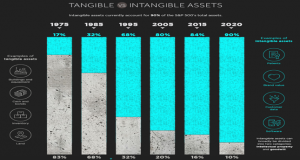
    First, investors are now heavily weighting their valuation processes towards intangible assets like IP and goodwill. Tangible assets in physical items like inventories, factories and land just don’t possess the growth and scale-up speeds implicit in mass-adoption IP. Tesla is still just a manufacturer of physical stuff but has managed to achieve a $550 billion valuation which exceeds the combined value of all the other auto manufacturers on the planet. How does a tiny Tesla 0.6% market share translate into capital markets dominance? Check out the chart below from the excellent Visual Capitalist analytics site which highlights the huge asset shift to intangibles within the S&P 500 index.

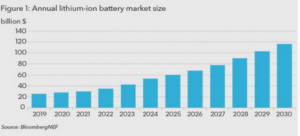
    Thirty five years ago less than one third of assets were intangible. Today’s 90% figure gives a clue as to what is driving Tesla and technology company valuations. Specifically, investors are attaching huge value to Tesla’s lithium-ion battery technology and the next chart illustrates that emerging trend/opportunity. The lithium-ion battery market is expected to more than quintuple by 2030 according to Bloomberg.

    Despite these two favourable trends many still struggle with the Tesla to-infinity-and-beyond valuation. Well, maybe not infinity but how about space? China has just launched a lunar expedition and the DiaperDon has added a Space Force to the gargantuan US defence budget but there are more immediate commercial initiatives afoot. Elon Musk’s primary wealth vehicle might be Tesla but his rocket company SpaceX is possibly the stellar trend to watch.

    Space is the new data frontier and SpaceX has launched more than 500 Starlink satellites to ultimately beam high-speed broadband from orbit to anywhere in the world. Infinity indeed. Current plans entail a constellation of up to 12,000 satellites in low-level orbit and one does wonder why this project is generating less attention than Tesla.  For a more detailed and prescient analysis of SpaceX’s strategy Gavin Sheridan’s recent article in The Currency is worth a read. More intriguing is Sheridan’s view – held impressively since 2015 – that Teslas’s fleet of electric vehicles have a role to play in this broadband network. The mind boggles but there is no doubt investors are going to hear a lot more about galactic opportunities in the next decade.

    Prepare for daily trillion dollar valuation shifts too as these three trends accelerate.

    Or as Captain Kirk said, “Set phasers to stun”.