
Tag: WeWork

  • I’m a Celebrity CEO – Get me out of here!

    I’m a Celebrity CEO – Get me out of here!

    It’s not just Presidents and Prime Ministers who are looking for the exits at the moment. CEO turnover at the largest companies in the US has just hit an all-time high. While eBay and WeWork executive departures will grab the headlines it is worth noting that 159 other CEOs also left their posts in August alone.

    That’s the highest ever monthly total and 28% higher than the 124 CEO exits in July. In fact, the pace of management change according to consultants, Challenger Gray & Christmas, is more than at the same point in 2008 when the global economy was about to enter a liquidity deep freeze. Clearly C-Suite anxiety is picking up when you see the following chart:
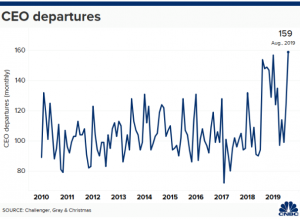
    So what’s going on? Financial markets are in reasonably healthy shape, employment conditions and confidence are very robust and yes, we have a few trade war/manufacturing cycle worries. Of course, CEOs like to leave on a high(share options don’t look too shabby at the moment either) but perhaps there are a few more structural drivers involved in the mix this time.

    Let’s start with the performance of financial markets and share prices. It is true that broad market indices are not far off all-time highs but a quick look under the hood would reveal a more nuanced story which we have alluded to in recent articles. To be frank, technology has been the outsized driver of positive market performance whereas the story in more structurally challenged sectors like retail, finance and energy has been far more frustrating. One senses some CEOs and Boards are becoming impatient and clutching at alternative solutions to boost share prices. So, the capital markets story has been a tale of sector haves and have-nots but there is also another inequality story.

    One might wonder if CEOs are watching the rise of Trumpian populism and wondering when the income inequality backlash is coming? Note that CEO-to-Worker compensation ratio has ballooned from 30:1 in 1978 to 278:1 by 2018! That particular acceleration in uber-celebrity compensation packages stands in stark contrast to productivity gains slowing to a sub-2% annual crawl in the past decade. Perhaps the bigger problem is that worker wages have stagnated over the last 40 years but that clearly has not been a priority at board level.

    The massive expansion of share buy-backs at the expense of business investment and a fixation on quarterly earnings performances has been a prevailing feature of the low interest rate monetary environment. However, that journey, as Thomas Cook employees and shareholders have discovered, can hide some pretty terminal problems for only so long. There has always been a fear that an artificially low cost of capital would lead to poor capital allocation decisions.

    In this latest iteration of financial history we may look back in years to come and rue the arrival of Kardashian capitalism. Corporate failure is likely to experience the cult of CEO celebrity and short-termism starving businesses and their workers of the capital needed to transition for the digital age. Indeed, the latest data suggests CEOs are not sticking around for that final vote.


    Spark Crowdfunding is Ireland’s only equity crowdfunding platform. We are based in Dublin city centre.

    Our equity crowdfunding platform enables investors to invest into various stage Irish companies and it gives Irish companies the opportunity to raise new funds quickly and at low cost to accelerate their business growth.

    If you are interested in learning more about Spark, then check out our website.

  • Why WeWork Won’t Work for Start-Ups Interested in Raising Funds

    Why WeWork Won’t Work for Start-Ups Interested in Raising Funds

    Mark Twain is often cited as the source of the perennial financial advisory warning that “history doesn’t repeat itself  but it often rhymes”.

    The pending WeWork IPO could be about to provide a number of harrowing wording lessons which will rhyme very sharply with recent history.

    This writer can recall the frenzied final days of the TMT bubble when the mere addition of “dot com” could inspire investors to plough capital into bog standard franchises which were suddenly poised to conquer the world with an additional 3 letters in their trading name.

    The Pets.com IPO in February 2000 is often cited as the “shoeshine moment” in marking the top of the bubbly market – pet food supplies business meets logistics reality.

    Closer to home one might remember the official launch of worldoffruit.com a month earlier and a 64% rise in the parent company’s, Fyffes, share price. Bananas stuff.

    If pet food and fruit sounds fairly well established product proposals how about commercial real estate or, more specifically, leasing office space but not even owning the buildings?

    Welcome to WeWork’s service proposition which is about to IPO in New York with a proposed valuation of $47 billion.

    But it’s not a real estate company. No, no it’s a technology company. Just read the prospectus (and weep).

    In its public filing WeWork has used a version of  the word “tech” 123 times which is more than the video calling software company Zoom did in its IPO earlier this year (thank you VOX for doing the checking).

    To be blunt, WeWork is a triumph of linguistic gymnastics over substance and start-up founders would be well advised to avoid the temptation to follow its lead. The inevitable backlash will be brutal and prompt increased scrutiny of businesses playing fast and loose with words and financial information in their investment story.

    Managements who are planning a fund raising should review their story and pay particular attention to the following:

    Corporate Structure:  An overly complex ownership structure will raise red flags for prospective investors. WeWork already has three classes of shares and it is debatable whether the entity being listed in New York has any real assets or control of the business. Keep it simple.

    Governance: With a complicated corporate structure, sharper investors will be keen to explore any conflicts of interest. WeWork is the gift that keeps on giving….. to its founder and CEO, Adam Neumann. Adam owns 10 buildings that he has leased to WeWork at a decent profit, unlike the loss making WeWork. Bizarrely, he also owns the rights to the “We” trade mark which the firm has decided it must own and pay their own CEO $5.9m for the rights! Investors might be allowed to ask whether the interests of the business, shareholders and the CEO are truly aligned.

    Financials: Loss making is a frequent fact of life in the early years of a start up. However, there should be some evidence that increased revenues are benefiting from economies of scale i.e. incremental units of sales can demonstrate better gross margins. WeWork has been operating commercially for 9 years. The S-1 filing shows revenues have almost doubled in H1 2019 to $1.54 billion but losses have spiralled up to $1.3 billion. So for every dollar of sales the company is losing 84 cents. That’s pretty staggering for a “tech” company and would raise red flags for most tech savvy investors. More alarmingly, word sophistry has reached new levels of weird with WeWork reporting “Community-based EBITDA” which takes out lots of expenses including real-estate costs. Repeat after We…. “We are not a real estate company”. Innovative/creative profit metrics are not recommended for investment pitches.

    Leverage: Equity investors are typically nervous of debt-heavy balance sheets. As global economic indicators roll over we would repeat our cautionary mantra from previous articles about business models relying on “other people’s money”. Think businesses with long term liabilities and no control over short term funding (other people, lenders, customers etc). WeWork is a hair-raising example with $47 billion of long term obligations (leases) supported by variable short term revenues of potentially $3 billion this year.

    Management Incentives: Equity investors want their interests aligned with the management and preferably any wealth created to be shared at the same time in the investment journey. WeWork having lost $700m in 2018 don’t see any problem with their revered CEO selling shares to the tune of the very same $700m. Almost three quarters of a billion dollars taken off the table by the CEO just before investors are invited to pony up circa $4 billion. This CEO must be special. Previous articles have highlighted the importance of credible advisory boards. Inspirational founders certainly help fund raising but cult cultures can also raise red flags.  The wording of the WeWork IPO prospectus brings idolatry to new levels of cult.

    If one’s gagging reflex has survived the WeWork opening statement – “Our mission is to elevate the world’s consciousness” – brace oneself for a whopping 169 mentions of “Adam” (as in the CEO) compared to an average 25 mentions for founder/CEOs in other unicorn prospectuses.

    Even Uber’s colourful CEO, Dara Khosrowshahi, managed a measly 29 mentions.

    In this Trumpian world, buzz words and a cult-like absence of governance can be effective in the near term but can build up for the future a very dangerous debt to the truth.

    How Mark Twain would smile at the power of words today.

    He too caught the technology bug and lost nearly all his money on a new typesetting technology invented in the 1890s.

    Always rhyming.