Category: Investment

  • Is This The End….?

    Is This The End….?

    Let’s start with the easy one. I’m A Celeb 2025 is almost finished. The more tricky version of this headline question might relate to the Epstein files or even the filing of war crimes charges in The Hague against US Secretary of War, Pete Hegseth. Not any time soon me thinks. We could ask Sleepy Don but he might become angry – about the sleepy bit, not the war crimes or paedophilia. Actually, the question most asked in recent weeks is about the end of the AI boom. I asked my own excellent AI ‘friend’ Claude (courtesy of Anthropic) about ‘bubble’ mentions in the media and even he agreed in his remarkably comprehensive market summaries of public and private markets that the AI bubble question is occupying investors’ minds. Mine, not so much. More on Claude later, but first a historical perspective. The last technology boom in 2000 did indeed end in a bust but generalisations on technology can be misleading.

    Back in 2000 we should remind ourselves of the telecoms companies racking up massive debt obligations to acquire mobile spectrum licences and build out fibre/internet networks. Then there were the infrastructure suppliers like Ericsson, Nortel and Cisco dependent on those telecoms, internet and wireless expansion projects. Then the projects stopped. A possible over-simplification by this writer, but a combination of over-build and debt pressures slowed activity and cratered the valuations (growth expectations) of the leading infrastructure players. For illustration, Cisco was trading on a price/earnings multiple of 200x in late 1999. Twenty five years later the Cisco share price has finally recovered to within touching distance of its $80 high in 2000. However, one must make a distinction between the infrastructure plays and the tools/applications which were built on those over-priced networks….

    The Nokia phone in my year 2000 pocket didn’t end up ruling the world but Apple and the mobile internet did. Similarly, Google was just 2 years old at the time and wouldn’t IPO until 4 years later, the same year as TheFacebook Inc was born. Mobile networks enabled commerce (Amazon) and communities (social media platforms) to flourish and generate enormous wealth. Readers might be now detecting a similar pattern with AI. The race for computing power (in 2000 it was networks) is an infrastructure story but investors must not lose sight of the applications of AI and the business models possible (Amazon was an online book store once). The tools like Claude, ChatGPT and Sora are really only in their infancy. The infrastructure story is driven by GPU/TPU chips (Nvidia), cloud computing, hyper-scale data centres and energy. And it’s possibly infrastructure again where risks are building. The CEO of IBM, Arvind Krishna, in recent days put some numbers on those risks.

    Krishna cited a data centre power consumption estimate of 100 GW which at current costs would mean an $8 trillion capital expenditure in the next few years. Now, for the wet blanket of capital reality. That ginormous $8 trillion spend would need to earn profits of $800 billion just to pay the interest/cost of that capital. Yep, that’s stretchy but get ready for the other reality. This infrastructure isn’t piping, fibre, railways or copper which lasts for decades and is depreciated gently over time. The chips which currently power Nvidia’s $5 trillion valuation and sit inside all these data centres could become technologically obsolete within 5 years. Arguably, at current innovation/evolution rates that timeline is too optimistic. Imagine having to replace all your chips every 3 years… ? That should make creditors to these huge data centre projects a little queasy.  The International Financing Review summarized the massive acceleration in borrowing as follows:


    An unprecedented splurge from companies at the forefront of the AI boom that has left banks and investors potentially on the hook for billions. Alphabet, Amazon, Blue Owl Capital, Broadcom, Oracle and Meta have between them issued US$120bn of corporate bonds since September – and are raising another US$38bn in the loan market. The debt binge shows no sign of abating, with JP Morgan predicting US$300bn of bond issuance next year – and US$1.5trn by the end of 2030. Another US$2.3trn could be raised in equity, structured finance and private capital markets over the next five years, as hyper-scalers tap every available pocket of capital to finance the US$5.3trn of investments into AI they are expected to make”


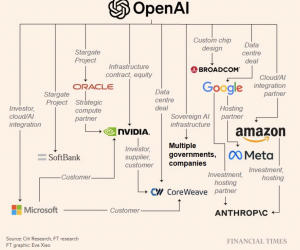
    Before everyone runs for the hills, we need to be mindful of some very positive starting points. These technology giants tapping the debt markets in most cases are swimming in cash, have dominant market positions and are generating prodigious annual cash flows of almost $700 billion. These are not the fragile telecom balance sheets of the TMT bust in 2000. Of course, OpenAI, sits in the middle of that famous Financial Times graphic showing $1.2 trillion of data centre projects. In my personal view, OpenAI is the weakest link but that could take years to play out. The harsh truth for all investors is that we don’t really know who will win the foundational large-language-model (LLM) race. Google’s Gemini 3.0 seems to be winning this month and did anyone notice Google share price is up 67% year-to-date? Yep, and my Claude’s parent company, Anthropic, is looking to IPO at a $350 billion valuation. These are very early days. Just ask Nvidia. Actually, don’t. They are saying nice things about almost everyone because all are prospective customers. But….. as always watch what a company does, not what it says.

    Nvidia made a $2 billion investment in chip designer, Synopsys, this week. This is just the latest move by Nvidia in what can only be described as a deal spree. In 2025 alone the company has backed 77 equity investments in start-ups, as well as making 5 outright acquisitions (Source: CB Insights). Let’s just say it looks like Nvidia is hedging its AI ‘winner’ bets. Indeed, the ‘AI infrastructure’ bubble fears run the risk of missing the true lessons of the TMT bubble bust of 2000. ChatGPT might be today’s Nokia but the monthly user statistics tell another ‘mobile’ story. ChatGPT is used by 800 million people each month. Gemini is fast catching up with 650 million devotees and Microsoft’s Co-pilot has 200 million monthly users. The market, business or individual, is already converted. That’s the true investor opportunity.

    Meanwhile, there’s a bigger story brewing at the other side of the world. Arguably, we really do need to see that story end very soon. More next week on why troubles in Japan’s bond market REALLY scare me……


  • Shunning Risk Not Making It EIISy For Europe…

    Shunning Risk Not Making It EIISy For Europe…

    Finally, somebody called it. Poland has a Donald as President too but he seems less enthralled by criminal heads of state. Donald Tusk’s view on the latest Trump ‘peace’ plan for Ukraine was quite  the zinger – “it would be good to know for sure who is the author of the plan and where was it created”. Answers on a postcard to the Kremlin. Sadly, Europe’s leaders have been generally slow to call out Agent Orange’s craven need to be Putin’s fluffer. Indeed, this risk aversion by Europe is not confined to geopolitics.  Mario Draghi has given a blunt assessment of progress made by Europe since his high profile EU Competitiveness Report last year.

    Draghi is unhappy about the slow pace of investment in innovation and the mobilisation of capital to scale the growth of Europe’s young companies. Worryingly, his initial estimate of innovation investment required of €800 billion has now jumped to €1.2 trillion as other economic regions accelerate their efforts to lead in healthcare, electrification, renewable energy and AI. Draghi’s words make for uncomfortable reading and go so far as to link this lack of risk courage to the existential threat to Ukraine and European sovereignty:


    “One year on, Europe is therefore in a harder place. Our growth model is fading. Vulnerabilities are mounting. And there is no clear path to finance the investments we need. We’ve been reminded painfully that inaction threatens not only our competitiveness, but also our sovereignty,”


    Inaction. Sounds familiar closer to home too. At our recent re-branding event for Spark Venture Funding, Fintan O’Toole in his guest address highlighted Ireland’s failings in housing, healthcare, infrastructure and SME support and identified a key contributing factor. Typically, Fintan did not mince his words. Citing the €150 billion or more of cash sitting in non-interest earning deposit accounts, he viewed this as symptomatic of a nation which “is afraid of risk”. The scars of the relatively recent Troika bail-out run deep but Mario Draghi is clearly saying the risks of inaction are far far worse. On a more positive note, we should remind ourselves of what can happen if investment bravery recovers again. In just the last 7 days, the European tech sector has been grabbing an unusually large share of the global financial headlines. Check out the following:

    *Revolut completes a funding round including an investment from Nvidia at a $75 billion valuation. Last year the valuation was $45 billion.

    *Lovable, the AI powered coding and developer platform, has reached annual recurring revenues (ARR) of $200 million and is raising money at a $6.3 billion valuation.

    *Energy play, Fuse Energy, founded by Revolut alumni is raising money at a $5 billion valuation just 5 months after reaching ‘unicorn’ status ($1 billion). Again ARR acceleration has been stunning, moving from $100m to $300m of recurring revenues within months.

    *Second-hand fashion market platform, Vinted, has reached the $1 billion revenue mark and is reported to be looking at a valuation close to $8 billion.

    *Quantum Drones is also raising at a $3 billion valuation while payments player, Flatpay, has just raised funds at a $1.7 billion valuation.

    All good in the ‘hood. But…here’s the really good bit. The geographic spread of these companies is pan-European with Sweden, UK, Lithuania, Germany and Denmark all represented.

    In Ireland there are many young companies with the potential to join these headlines. Returning to the embarrassing €150 billion pool of funds sitting in Irish deposit accounts doing nothing, it cannot be overstated how big an impact could be made if even 10% of that money was used in risk appropriate manner. To be clear, riskier investments should form an essential but much smaller portion of any savings/investment portfolio. We are not talking about 30-50% asset allocations. Depending on age profiles and existing risk budgets, a 5-15% allocation to innovation and young companies should be considered. And, don’t forget we are in EIIS “season”. Investments in EIIS-eligible companies can bring tax rebates (and risk reductions) of 35-50%. It is amazing how many people are unaware of this excellent government scheme used to scale young businesses, create employment and enter new markets. From this writer’s perspective, we are in a global race. Spark Private’s own portfolio of deal opportunities currently open for investment are race leaders and can deliver exciting and diversified exposures to multiple high-growth markets.

    Europe and Ireland urgently need to shake off their fears of risk. Frankly, Draghi is right: the risk of inaction could now be fatal for our economies and sovereignty. Think about that bank deposit shift, the EIIS de-risking opportunity and the speed of growth and wealth creation now possible in a global innovation economy growing at warp speed. There’s a ready-made EIIS portfolio available to curious investors which can help drive leadership and innovation in medical devices, digital currencies, e-transport, logistics infrastructure, AI and fintech. It’s worth taking a look and then considering the risk-reward of Moby, Social Voice, Quadrant, OOHPod, Nazare Point or Ostoform featuring in headlines like the ones above in just a few years from now.


  • Big Deals And Big Themes To Watch….

    Big Deals And Big Themes To Watch….

    Been a tough week. And that Epstein dog hasn’t even barked yet. Anyway, let’s not dwell on the ‘what ifs’, let’s focus on more positive action. In particular, activity in the M&A and funding worlds, which should be taken as generally upbeat pulse-takes for individual investors. These deals also reflect the key structural drivers for the rapidly changing global economy. Change, you say? Well, Germany has had an engineering/capital goods trade surplus with China for decades. Not anymore. China in 2025 is now running a surplus with Germany. Oh, and nobody in the Oval Office will tell the Donald…. but “America First” has caused US equities to underperform overseas equities for only the third time in a decade. I know, whoodathunk amid all the giddy AI headlines? Interestingly, the deals I’m seeing in recent days also have a non-US focus.

    Infrastructure is still a huge magnet for investment capital. Blackrock’s Global Infrastructure Partners vehicle has swooped in Spain to acquire the Digital & Energy unit of domestic construction giant, ACS. Yep, that’s a data centre and AI play with a whopping $27 billion price tag. Sticking with AI, and back in the US, Mira Murati’s Thinking Machine Labs is currently doing a funding round with valuation in the $50 billion region. In its last funding round in July (checks notes, yes) that valuation was $12 billion. Not to be outdone, Elon Musk’s xAI is raising $15 billion at a $200 billion valuation. So, I think we can safely say AI and the US are still leading the giddy stuff. Elsewhere, the deals are more fundamental. Try energy.

    Private equity monster, Carlyle, is exploring an acquisition of Russian oil giant Lukoil’s global assets valued at almost $22 billion. Meanwhile, Spain’s energy champion, Repsol, is considering a reverse merger of its $19 billion upstream unit with potential partners including US energy producer APA. In addition, Google has signed a deal with French oil giant, TotalEnergies, to buy 1.5 terawatt hours (TWh) of solar electricity over the next 15 years in Ohio. That’s enough power to run the entire state of California for 10 days. Again, data centres are the key driver for the energy land-grab, be it fossil-fuel or renewable. However, as Spark closes out a lightning-quick raise of €1.5m for the impressive AuriGen Medical team, we should not forget demographics and the hugely significant structural growth in healthcare opportunities(check out our May 2025 series of articles on Japan).

    Pfizer has acquired weight-loss start-up, Metsera, in a $10 billion all-cash deal. Then the rebuffed original buyer of Metsera, Novo Nordisk, went to the debt markets to finance the $5.2 billion purchase of US biotech Akero Therapeutics. The sense of a deal ‘cluster’ in pharma-land was further heightened by Merck’s likely acquisition of another biotech, Cidara Therapeutics, in a $3.3 billion deal. Like the Metsera deal, the bidding war for Cidara was intense too. So, things are looking pretty healthy in health M&A. As for the unhealthy world…. we continue to watch ‘Whiskey Pete’ deploy US Navy assets off Venezuela.

    If ever there was a classic ‘wag the dog’ distraction mission this might be the one. Particularly, given both Jeffrey Epstein and Ghislaine Maxwell in emails from 2011, sound mystified about the “dog (Trump) that hasn’t barked” in the criminal investigation under way at that time. Venezuela is yet another prompt for all sovereign nations and the investment world to be thinking defence. Some aren’t just thinking. Valor Equity Partners have led a chunky $510m funding round for a counter-drone radar start-up, Chaos Industries, at a $4.5 billion valuation. Also, watch out for Germany’s Quantum Systems which manufactures interceptor drones which can climb 4 kilometres in 30 seconds(!). Last heard on the street, they were raising $150m at a $3 billion valuation.

    All of the above sectors, bar health, position power sources and storage as key elements in competitive advantage. Note infrastructure and power are closely linked. The best positioned infrastructure assets will be those which bring energy/cost efficiencies in a world where AI is gobbling up more and more electricity, possibly at the expense of everyday consumers and traditional businesses. There is a reason why 40% of e-commerce deliveries in Europe are now done in out-of-home (OOH) parcel lockers. It makes sense for both the primary carriers (DHL,UPS, FedEx etc) and the consumer to make ‘the last mile’ more efficient. At Spark Private, we also think OOHPod makes a load of sense with lots of exit opportunities (and founder exit track-record) and great infrastructure positioning. In all of the above deals, everyone is trying to take the lead in positioning in the market. It can feel good too when it’s good for the world. In fact, I can still remember seeing a much-loved guy on his cool new electric bike just 5 years ago, and thinking to myself how happy he looked. I will keep that thought always…..

                  W.H. RIP.

  • Numbers Which Make You Wonder….

    Numbers Which Make You Wonder….

    I’m quite enjoying the “rubber meets road” moment for the leaders whose numbers never add up. In a previous political era they might just have been called liars and shunned by serious media. Now, it’s about eyeballs for the media and their audiences retaining some memory cells. Good ol’ Nigel Farage has moved from trying to avoid discussing the number of white people in ads (thanks to Reform MP Sarah Pochin) to rowing back on previous tax promises. Currently, known as “aspirations”. Like Brexit, more lies. In the US, gold-plated ballrooms and newly minted tech billionaires don’t quite cut it for the 50% of US have-nots who don’t benefit from 401k investment savings. But, the have-nots do have votes…..for now. New York has just voted for a Democrat socialist mayor with the biggest mandate since 1969. Meanwhile public representative seats and offices have flipped this week from MAGA red to Democrat blue in New Jersey, Georgia, California and Virginia. Even Mississippi is turning. In Washington adjacent, Virginia, the political landscape has morphed back to 1987 as Federal workers, either sacked or not being paid, discover some numbers are very real. Here’s a few other numbers flagging change which caught the eye in recent days….

    Sports betting was legalised in the US in 2018. Americans bet over $148 billion on sports last year, which is more than they spent on movies, books, concerts and sports tickets…. combined.  Meanwhile, Disney through its sporting broadcast arm, ESPN, is teaming up with DraftKings as its new sports betting partner. Expect more deals in the sports betting space with $148 billion of US wallets on offer and then wonder about societal shifts. Housing shortages and fewer children seems to be freeing up a lot of discretionary spending power. Watch also prediction marketplaces like Kalshi and Polymarket. The latter is doing over $1 billion of volume each month and is fully crypto-native. More traditional financial businesses are taking notice. Robinhood’s share price is up 235% year-to-date and has reported 2.5 billion prediction contracts (fees of $25m) traded on its platform in just October 2025. That is more than all of the contracts traded in Q3 2025. Any more predictions…?

    You can probably bet on OpenAI doing more AI/cloud infrastructure deals. The famous Financial Times graphic of OpenAI playing a central role in $1 trillion of AI projects is worth revisiting. OpenAI has recently announced a re-jig of its corporate structure to allow for a profit making entity under the stewardship of the original non-profit foundation. The profit bit is going to have to wait. Thanks to Microsoft’s recent results (and a circa 27% stake in OpenAI) analysts have estimated quarterly losess at OpenAI could be as high as $11 billion. Per quarter! Now think about those trillion dollars of projects planned. Then digest this little gem…

    OpenAI is requesting US government support to help guarantee financing for the massive investments in AI chips and data centers it needs for expansion, per Bloomberg.

    The latest OpenAI infrastructure project commitments, per Wall Street analysts, are heading towards $1.4 trillion. UK water utility observers will be familiar with the privatise-the-gains and socialise-the-losses model. It doesn’t end well. And, Fox News and Trump think Zohran Mamdani is the communist….

    On a more capitalist pursuit, M&A deal flow, the news is very encouraging and starting from a less frothy base. Deal research house, Pitchbook, gives the latest update on confidence levels in the C-suite. As we often say, it’s what companies DO, not say, which counts:


    “Q3 activity increased by 25.6% in M&A value and 3.8% in deal count as buyers jumped back into the market after macroeconomic headwinds disrupted momentum earlier in the year. Moreover, 2025 is shaping up to be an incredible year for global M&A despite the spooky headwinds present in the market, including geopolitical volatility, stubborn inflation, and a slowing global economy. YTD, there have been 37,096 M&A transactions for an aggregate of $3.4 trillion….. This resurgence in large-scale deals leaves the door open for two consecutive years of M&A deal value growth for the first time in over a decade. Deal count itself is on pace for year-over-year growth, with an active fourth quarter that could see the ecosystem hit nearly 50,000 deals for the year. ”


    One can expect more deals in the electricity/power sector. Close to home, Energia was bought by French private equity house, Ardian, and Blackstone bought TXNM Energy for $11.5 billion earlier in the month. It’s all part of the AI infrastructure story but the daddy of the AI rush is Nvidia’s Jensen Huang. He had some sobering thoughts in an FT interview. “China is going to win the AI race.” warned Huang, citing China’s advantages in energy and less‑stringent regulation. He later clarified that China is “nanoseconds behind” the US, adding “it’s vital that America wins by racing ahead and winning developers worldwide.” Huang might have backed away from his original statement but consider that last year China added 426 GW of electricity generation capacity. In the US that number was 30 GW. A growth differential of 14x doesn’t take many ‘nanoseconds’ for China to establish a dominant cheaper electricity base. If electricity is going to decide the global AI race then “drill baby, drill” could cost US industrial policy dearly. Go ask Germany, where manufacturing output is 20% below 2019 levels thanks to disastrous energy policy decisions. But there are prescient decisions to be made too…..

    Investors can see M&A activity pick up, corporate earnings growth above 12% year-on-year, cost of capital shift to a lower trajectory and even the possibility of the US Supreme Court stifling Trump’s ‘emergency’ tariff powers. It’s always awkward to claim ‘emergency’ in court when your lawyer (for US government) agrees the consumer pays 30-80% of tariff costs, and the judges note that tariffs have been imposed on countries like Brazil and Great Britain who actually have trade DEFICITS with the USA. More ketchup on the walls of Mar-a-Lago me thinks. However, the key point is that the investment environment for private investors is picking up momentum. And, Spark Private can help. A flow of new EIIS season deals has just hit our investors’ in-boxes. In this instance, the numbers are real, and do warrant real attention. This is a genuine opportunity to build an exciting diversified portfolio of 8-10 companies with a variety of timing/risk horizons and big thematic exposures in a matter of weeks.

  • Strong Grounds For Optimism, And Action….

    Strong Grounds For Optimism, And Action….

    I should be terrified. Watching Netflix’s House of Dynamite was definitely disturbing. In real life, the guy with the nuclear codes is having another Canada tantrum and refusing to rule out a third presidential term. Meanwhile, financial market headlines are full of ‘bubble’ talk as Hallowe’en approaches and yet…… I’m suddenly very optimistic. It might be Hallowe’en season but there are two other ‘seasons’ in full swing which could bring significant wealth enhancement. Firstly, we are in the middle of corporate earnings results for Q3. Secondly, Irish earners will soon be looking for opportunities before year end to invest in EIIS-eligible deals to reduce their income tax costs and balance their investment portfolios. My sense is that the stars are aligning nicely for a further burst of action in the next few months. As always, companies need to lead so check out the latest developments.

    We mentioned Q3 earnings season but we didn’t mention the “Magnificent 7” superstar tech stocks dominating the financial headlines. Deliberately so. The latest ‘tot up’ of Q3 earnings reveals a much broader participation of companies in healthy earnings reports. So far, 145 companies out of the S&P 500 index have reported Q3 earnings. A whopping 84% of those companies “beat” analysts earnings forecasts which is the highest “beat” rate seen in four years (Source: Bloomberg).  Average earnings growth across the reporting companies is on track for a year-on-year acceleration of 15%. The bottom line, literally, is that operational fundamentals are very strong. Critically, this profit growth is spreading to smaller companies; the Russell 2000 index of smaller companies is clocking an even higher 2025 profit uplift of 25%. You might have to pinch yourself, then check your notes re current challenges faced by companies. Try these for starters:


    • Global disruption to supply chains and energy markets due to Ukraine war.
    • Relatively high interest rates since 2022.
    • Tariff and trade chaos thanks to the unstable ‘genius’ in the White House.


    In many ways these are historical known ‘unknowns’ in Rumsfeld-speak. However, the positive twist on this uncertainty is that, if companies are able to generate significant profit growth despite these challenges, then this generation of corporates must be fundamentally very robust. This opens up another possibility, a very exciting one. What if interest rates were now beginning to fall and China and the US were about to agree a trade framework? Well, there’s a 97% chance (per money markets) of the Fed cutting interest rates this week and the news from the Trump trip to Asia is positive on a China deal happening too. Dare we dream of a Ukraine breakthrough? We might ease up on the Kool-Aid there, but we do note a weekend article in The Telegraph about Putin’s fears of a coup. We will continue to dream. However, the deal junkies in the private equity world seem to be picking up on the same fundamental positivity.

    Blackstone’s COO, Jon Gray, in its Q3 results call with Wall Street analysts was certainly pointing to more activity:


    “Directionally healthier markets, more liquid markets, better credit markets, better IPO markets; that’s healthier for realizations….The deal dam is breaking.”


    Closer to home, private equity exits in Europe’s financial services have reached an all-time high with 77 deals year-to-date worth $31 billion. As we wrote last week…… Banks are SOOOO back! However, it would be a mistake to think this was frothy financial ‘engineering’. In fact, it’s more engineering than finance on a global basis. Private equity investment deals in global infrastructure have rocketed by 44% year-on-year to $25 billion. That’s the second highest total deal value seen in a decade. Clearly, there is a lot more going on than an AI revolution. In the Spark Private world of venture funding and smaller private equity deals we keep a close eye on smaller company activity benchmarks. Two caught the eye this week:


    • Smaller company tech equity indices in the US are up 23%…. in just 3 months.
    • Small company industrials are hitting new all-time highs and breaking out on technical charts.


    An environment where global trade tensions, interest rates, corporate earnings, smaller company valuations and private equity deal activity are all moving in the right direction will undoubtedly generate more deal opportunities. Pitchbook’s latest review of European private equity (PE) activity is telling:


    “A run of large-cap deals in Q3, buoyed by interest rate cuts and improved macro stability, saw European PE dealmaking grow to €177.1 billion (about $206.7 billion) in Q3…….37% of overall PE deal value, €66 billion, came via 19 deals worth over €1 billion—more than Q1 and Q2’s mega-deal value combined. In total, 48 mega-deals took place in Europe over the first nine months of the year. That figure is expected to approach 70 by year-end, making 2025 one of the most active years for such deals in the region on record.”


    So enough of the headlines, where’s the action for private investors? The key questions for many investors at this time of year are…


    How can I access the deal flow?


    Can I do it in a tax friendly manner?


    Spark Private can help on both fronts. More specifically, investors can quickly build a well-diversified portfolio of 7-8 companies with top-calibre teams, EIIS tax rebates and genuine structural growth opportunities in a matter of months. Now, for the action…..YOUR action.

  • Banks Are So Back!!!

    Banks Are So Back!!!

    It’s a weird world right now. I endured another episode of “The Celebrity Traitors” last night and wondered how the US version would work without offending the Kremlin ‘besties’ and reality TV cast of Mar-a-Lago. And who knew Joe Marler would out-smart Stephen Fry? Serious kudos to the rugby front row forwards fraternity. Anyway, park reality TV and let’s face market reality. Another weird one very close to home – Irish banks are now achieving 89% customer satisfaction ratings. It’s amazing what one can achieve by leaving the small business sector completely unbanked in terms of risk capital. However, it can’t be denied that banks are SO back in a global sense. And, some are really ratcheting up the risk dial. Today’s article is really a whistlestop tour of global financial sector developments which caught the eye in recent weeks.

    Let’s kick off with Blackrock Inc. It’s results season and Larry Fink’s giant asset manager recorded net inflows of investment monies in excess of $250 billion in Q3 alone. Blackrock’s current total assets under management (AUM) have just hit a record $13.5 trillion, yep trillion. You might say Blackrock is not a bank but if you look closer at those investment inflows, you’ll see private credit(lending) is a huge driver of asset growth. You’d be right in thinking that other institutions are competing or replacing banks in the financing space. That trend brings its own risks. Indeed, the IMF took the opportunity in its 6 monthly Financial Stability Report to warn about “the rapid growth of non-bank financial institutions”. Then, the EU’s Single Resolution Board (which ultimately sorts bank collapses) also warned this week of the “dire” consequences of a non-bank failure. Sounds nervy, but the financial services sector is enjoying record growth thanks to the lack of nerves among investors…

    Robinhood, the trading platform loved by meme-stock and crypto fund day-traders, has seen its share price rocket by 250% since January this year. Then check out Charles Schwab, the US broker/trading platform which started out in commercial life as a newsletter with 3,000 subscribers, and was briefly owned by Bank of America in the 1980s. I had to wipe my eyes on this one, but Schwab now holds $11.6 trillion of investor assets and has just announced its intention to offer digital currency (crypto) trading in 2026. That number was just over $4 trillion when Covid-19 struck. This growth in assets can be equated to the growth of balance sheets and collateral to be used in further investing activity. We can’t avoid mentioning AI but the infrastructure spending by cash rich tech giants is another boon for investment bankers. The latest data from research house, Gartner, is that global AI spending will be $2 trillion in 2026. Amazingly, the star of our most recent article, OpenAI, sits in the middle of $1 trillion of that spending. Needless to say, Wall Street investment banks are doing cartwheels as big tech names compete with each other to announce bigger and bigger spending plans as their share prices(and executive option pools) rocket on each headline. No wonder luxury laggard, LVMH, is seeing its share price suddenly perk up. It’s not alone.

    Investment banking blue chips like JP Morgan, Morgan Stanley and Goldman Sachs all posted record equity trading activity and revenues. The Daily Upside summed up the joy across the wealth and brokerage spectrum:


    “Results from other financial firms this week also showed that clients from scrappy retail traders to high-net-worth jetsetters are hankering for equities and investments. Wealth units at Bank of America  (revenue up 19% year over year to $1.3 billion), Goldman Sachs (up 17% to $4.4 billion), Morgan Stanley (up 13% to $8.2 billion) and more notched high marks. Customer assets at Schwab competitor Interactive Brokers rose 40% to $757.5 billion, and daily trades there rose 47% to $3.86 million.” 


    But it is a weird world. The crypto universe cratered last weekend as Bitcoin elevator-shafted investors with a 20% drop in price from $126,000 to $105,000. Then gold keeps marching remorselessly to $5,000/oz in $100 clips. There is a sense that different cohorts of investors are buying different assets but there’s enough liquidity (investment flow) to drive EVERYTHING upwards. It was striking to see in Schwab’s record inflows that Gen Z and Millenial investors accounted for a third each of new accounts being set up and looking for equity exposure mainly. Meanwhile in California, there’s a new bank coming. Erebor is a new crypto-focused bank which received federal approval this week. The excellent Morning Brew newsletter reports:


    “The new venture will offer traditional and crypto-oriented banking to upstart tech companies and the ultrawealthy, according to its charter application and approval letter. It needs another stamp of approval from more federal officials before operations can commence, but road bumps are unlikely under President Trump’s crypto-friendly administration.”


    Before you think it’s all crypto and AI out there, keep an eye on more familiar moves. Goldman Sachs has done an interesting deal buying Industry Ventures for nearly $1 billion. Small beer you might think, but Industry Ventures is in the venture capital ecosystem with $7 billion of VC assets bought from other VCs (known as secondaries). Clearly, Goldman is taking a view on more VC deals/exits happening and should be a boost for the start-up world. Oh, and JP Morgan are going to put $10 billion to work in nationally important industries and supply chains. In fact JP Morgan sees itself involved or banking $1.5 trillion of projects in the coming years. Here’s what those deals might look like…

    Meta/Facebook has just sealed a $30 billion private capital deal to finance its Hyperion data centre build in rural Louisiana. Here’s the kicker – Meta retains only 20% ownership. Morgan Stanley has arranged $27 billion of debt and $2.5 billion of equity in a special purpose vehicle (SPV). Yip, that’s a more than 10:1 debt-equity structure. Welcome to the world of superhero collateral in the form of AI infrastructure. This is the largest private capital deal ever but expect many more over the next few years. Of course, there are concerns.

    FT headlines this week highlighted poorly structured loans (read opaque dodgy) going wallop and hitting US regional banks’ share prices badly. Also, volatility in financial markets is picking up. However, the key drivers of global investment activity are big tech firms, private capital, sovereign funds etc and they have trillions of cash and collateral to deploy. This is not quite TMT era when the major players, telcos and media, were already swamped with debt. Returns on investment will obviously be the metric to watch in the future but arguably we are a few years away yet from getting visibility on AI’s payback. So get ready for more deals, more AI and more financial services profit joy. You’d almost be tempted to get exposure to these big structural trends. Well….. keep your eyes peeled next week as Spark Private will have a very interesting deal for you with a strong blend of alternative assets, financial services and AI baked into the offer.

    We are SOOOO back.

  • Virtuous Circle Or Circle Of P..AI..N?

    Virtuous Circle Or Circle Of P..AI..N?

    I’m getting flashbacks. Not good ones. Financial ‘engineering’ was a feature of the world’s last two financial crises. In the TMT bubble collapse, Enron used its stock as collateral in long-term contracts or asset sales which were described as “circular hedging transactions”. The goal or impression sought was to mitigate risk but ultimately all risk was really tied to the Enron share price. In the credit crisis of 2008/2009, new ways of packaging property debt with a bewildering array of acronyms (CLO, CMO, RMBS etc) were supposed to insulate risk within different tranches. Until, they didn’t.

    Now, I’m reading about new ways to finance the AI boom and, again, the risks keep coming back to a very narrow collateral pool. The word “circular” is back and one name keeps cropping up; OpenAI. My newsfeed has been bombarded with multiple graphics from Bloomberg, Goldman Sachs and The Financial Times (see below) illustrating this circularity accompanied by headlines stating that OpenAI is at the centre of a $1 trillion AI infrastructure spending boom. And, I thought they were just building a chatbot (ChatGPT).


    Here’s a few things you might have missed about OpenAI….


    A recent funding round valued OpenAI at $500 billion, the world’s most valuable private company, but….


    It generates NO cash. Latest figures for H1 2025 reveal revenues of $4.3 billion while incurring a net loss of $13.5 billion. Yep, it’s losing more than 3 dollars for every dollar of sales it generates.


    OpenAI has signed up to $1 trillion of deals with the likes of Oracle ($300 billion), Nvidia ($100 billion), AMD ($80 billion) and Coreweave ($22 billion). The Stargate project alone is a $500 billion infrastructure project.


    OpenAI’s core product, ChatGPT, has built a weekly user base of 800 million people.


    Now, let’s return to the deals. I’m not sure the graphics of circularity really capture what’s going on. In recent weeks the world’s most valuable company, Nvidia, announced a $100 billion investment in OpenAI. In return, OpenAI will buy Nvidia’s graphic chips (GPUs) as it builds out its data centre infrastructure. You can see the circular vendor-financing risk in that deal. However, in the last 24 hours OpenAI has announced a further deal with Nividia rival chip maker, AMD. I’m going to lean on Bloomberg’s excellent Matt Levine in imagining the language of current deal negotiations with the loss-making OpenAI.


    OpenAI: We would like six gigawatts worth of your chips to do inference.

    AMD: Terrific. That will be $78 billion. How would you like to pay? 

    OpenAI: Well, we were thinking that we would announce the deal, and that would add $78 billion to the value of your company, which should cover it.  

    AMD:

    OpenAI:

    AMD: No I’m pretty sure you have to pay for the chips.  

    OpenAI: Why?

    AMD: I dunno, just seems wrong not to

    OpenAI: Okay. Why don’t we pay you cash for the value of the chips, and you give us back stock, and when we announce the deal the stock will go up and we’ll get our $78 billion back.

    AMD: Yeah I guess that works though I feel like we should get some of the value?

    OpenAI: Okay you can have half. You give us stock worth like $35 billion and you keep the rest.


    Levine is spot on. It has been bothering me for weeks now. CEOs in the tech world have spotted that a company’s share price goes up on the announcement of huge spending plans (not profits). In extremis, one could route the “value” of the share price gain to a cash-strapped customer like OpenAI. Funnily enough, AMD’s share price rocketed 35% on the OpenAI deal news adding $60 billion to its market value. And, so the merry go round continues. Sure enough, Nvidia, has responded to the behind-the-back dealing of OpenAI with rival AMD by announcing a $2 billion investment in OpenAI rival, xAI, owned by Elon Musk. The total funding round for xAI will be $20 billion but there’s a few extra ‘engineering’ twists. The $20 billion ($7.5 billion equity, $12.5 billion debt) is going into a special purpose vehicle (SPV – remember them?) which will buy GPU chips for xAI’s Memphis Colossus 2 data centre. The SPV, in turn, will rent out the GPU chips for 5 years, with the debt backed by the chips rather than the company. Hmmmm. The rent and SPV details should raise alarm bells.

    The attraction of constructs like rent, leases and special vehicles is that it increases the complexity of an organization and also makes it more difficult to track the true returns (or not) of a company. Rent and leases are considered off-balance sheet items ie they don’t show up as DEBT on the balance sheet. To complete the circle, I’m reading about Oracle today and its astonishing $380 billion in revenue it will generate by renting out its cloud servers to OpenAI and other AI developers over the next 5 years. Oracle can’t afford a rent default. It is not cash rich like Google or Microsoft. In fact, its debt-equity ratio is a whopping 520%. Michael Cembalest at JP Morgan put it rather well…


    “Oracle’s stock jumped by 25% after being promised $60 billion a year from OpenAI, an amount of money OpenAI doesn’t earn yet, to provide cloud computing facilities that Oracle hasn’t built yet, and which will require 4.5 GW of power (the equivalent of 2.25 Hoover Dams or four nuclear plants), as well as increased borrowing by Oracle whose debt to equity ratio is already 500% compared to 50% for Amazon, 30% for Microsoft and even less at Meta and Google. In other words, the tech capital cycle may be about to change.”


    Change, yes. But some things never change in credit or investment cycles. OpenAI might be at the centre of a $1 trillion investment revolution driving stock prices ever higher. But, ultimately “other people’s money” will make its presence felt. Bloomberg is reporting that the amount of debt tied to AI has ballooned to $1.2 trillion. This makes AI the largest segment(14%) of the investment-grade market, surpassing US banks. That means more eyes and scrutiny on the circular world of AI. Bluntly, if a problem emerges it won’t be seen in the stock markets first. It will be in the bond markets with its army of credit analysts. As a final thought, and given the scrutiny applied to the track records of key entities in investment ecosystems, what must credit analysts think of OpenAI?


    • As recently as 2023, the OpenAI CEO, Sam Altman, was fired, then re-hired.
    • OpenAI co-founder, Elon Musk, is now a bitter and richer rival.
    • The company is a strange governance hybrid with control residing in a non-profit Board.
    • OpenAI and early backer, Microsoft, have been in dispute over their partnership terms.
    • CEO Sam Altman was quoted this week in FT saying becoming profitable was “not in my top-10 concerns”
    • Recent $100 billion investor in OpenAI, Jensen Huang of Nvidia, was not told about the deal with rival, AMD.


    None of the above makes OpenAI a bad credit. But, with trillions of dollars of investment capital on the line any loss of confidence in OpenAI could spiral rapidly into a whole new circle of “engineering” PAIN.

  • Think Big, Think Private

    Think Big, Think Private

    Well, that wasn’t so bad. Said no US general summoned to Quantico this week by their spray-tanned hardened bosses. I actually was thinking more about September and its data-earned reputation as historically the worst month for stock markets. Scratch that. The key benchmarks for equities, the S&P 500(up 4.25% in the month) and the Nasdaq(up 5.6%), blew the hinges off investor expectations amid lots of ugly headlines. Public markets are on an absolute tear, but investors playing catch up and wondering how to get involved could be understandably wary. I’d be wary too, but in a more nuanced way. My sense is the out-sized influence and weight of big tech in public markets is troubling. Try these statistics for size…


    *AI chip superstar, Nvidia, at $4.6 trillion is now worth more than Apple, Saudi Aramco and the entire German stock market…combined.

    *The “Buffett Indicator” is a trusted temperature check on US stock market euphoria which tracks the ratio of total US stock market value to US GDP. Currently that metric is touching 217%, or about 70% above trend.

    *Another long-run measure of ‘value’ is the Shiller PE Ratio (CAPE) which divides the current value of US markets (S&P 500) by the earnings of its constituent companies over the previous 10 years. That metric is over 40x for the first time since the dotcom bubble of 2000.

    *Options markets are not for the faint-hearted. So, it was striking to see the September 19th expiry date attract over $5 trillion of notional option exposure. More striking was that the majority of options players (62% of S&P 500 volume) in August were seeking ultra-high risk “Zero Day” instrument exposure (expiry within 24 hours). That is seat-of-pants stuff.

    *Intel’s share price has rocketed 50% since September, Google is up 68% since April, and Tesla’s stock has doubled in the same period while making the DOGE-whisperer, Elon Musk, the world’s first half trillionaire. Yep, $500 billion.

    *Nvidia’s stock market value is now bigger than the GDP of 180 countries, including India and its 1.4 billion people.


    You get the ‘big tech’ picture. Now for some historical context. Remember Palm Inc and its PalmPilot?  When Palm listed as an IPO 25 years ago, it was worth more than Apple, Amazon, Google and Nvidia combined. There is a cautionary tale there, but not the key point of today’s article. The sheer intensity and speed of capital flows in the listed large cap arena is telling us there is a massive investment shift happening. However, it is possibly too late to ‘pick’ the winners in the public markets, and one could end up picking today’s Palm Inc. However, private equity and venture capital markets have been left behind by public markets. Private investment flows and deals have slowed (with the exception of AI deals) due to subdued exit, M&A, and IPO activity, further hampered by levels of geopolitical uncertainty we haven’t seen in 50 years. The critical point is that private markets are likely to ultimately benefit from the trickle-down impact of public markets hitting all-time-high valuations. I would highlight four interesting developments:


    1. The leveraged buy-out (LBO) of gaming giant, Electronic Arts(EA), at $55 billion is the biggest ever and beats the $45 billion KKR deal to buy TXU way back in 2007. This time the buyer consortium is led by the Saudi PIF and Silver Lake. The EA buy-out adds to a wave of M&A in Q3 which will have topped $1 trillion in total global deal volume for only the second time in history.
    2. The latest funding round of OpenAI was a sale of $6.5 billion of employee stock putting the valuation of the ChatGPT owner at $500 billion. That makes it possibly the most valuable private company in the world. For those thinking it’s just AI giddiness, it’s not the only $500 billion private opportunity…
    3. We have written before about the fast-approaching age of stablecoins. So, we were intrigued to see stablecoin platform, Tether, launch a funding round of $15-20 billion which would value the financial services player at $500 billion, overtaking the value of Bank of America(!).
    4. These are all big beasts in the private markets. What about the small guys? Well, if you thought tech(+11.6%) and the Nasdaq (+9.7%) had a great last 3 months, you might be surprised that smaller companies in the Russell 2000 index did even better (+13.5%). Note 50% of the constituent companies in that index LOSE money.


    Arguably, the smaller company index is the best proxy for the Spark Private world of start-up tech and smaller private equity deals. So, evidence of small company catch-up is a positive indicator. Furthermore, Spark Private investors have a real opportunity to gain exposure to the digital currency infrastructure, AI and private equity themes above in our upcoming deal pipeline. Note we are also entering EIIS ‘season’ so investors fearing they’ve missed out on public/pension opportunities will be able to use the private markets to balance out their risk budgets at highly attractive tax-assisted valuations.

    The public markets are clearly telling investors to think BIG, but valuation risks are rising rapidly. Our message is BIG too, but private as valuations (not risk) resume an upward trajectory. Watch closely, those BIG theme deals are coming very soon.


  • Have You Checked Your Pension’s American Assets Recently?

    Have You Checked Your Pension’s American Assets Recently?

    I’m nervous. This won’t win me a Nobel Peace Prize, a Pulitzer or a Green Card but it must be said. The United States is the richest, most successful and most powerful country in the world. On a global basis, we owe the United States on many levels, be it culture, sport, technology, education, medicine, defence, investment capital, tourism or friendship. Closer to home, our fortunes and miraculous recovery from a Troika bail-out are inextricably linked to US commercial supremacy. The vast majority of our pensions reflect that supremacy by holding significant amounts of US debt/bonds or stocks. EVERY pension should have exposure to US assets but risk radars are flashing red for a seismic investment shift. Behind the headlines and in the critical plumbing of the global financial system, there is increasing evidence of a global ‘exit’ from the US. That might sound odd and inevitably the counter view will cite current data which paints a record-rosy picture.

    US and global stock markets are regularly hitting record highs in recent weeks. However, the US stock markets have been clocking up vastly superior returns compared to other major bourses in the 16 years since the GFC. This outperformance of US assets has resulted in extreme levels of US weightings in global indices/benchmarks which your pensions are attempting to either track or beat. A recent Deutsche Bank research note flagged IMF data showing US equities now accounting for 67% of Bloomberg’s World Index. That’s quite the weighting for a country which represents 15% of global GDP. Go back 20 years, and the US actually accounted for a higher 19% of global GDP.  In 2005 US equities made up 51% of the same Bloomberg World Index. For context, Europe(EU) accounts for 12% of global GDP and 14% of the Bloomberg index. Of course, the big driver is technology stocks where the 6 top US tech companies are currently valued at $20 trillion, or more than the GDP of China. The AI/cloud (AI) revolution might be the more specific driver but is this hiding a bigger picture?

    According JP Morgan’s always interesting Michael Cembalest, “AI related stocks have accounted for 75% of S&P 500 returns, 80% of earnings growth and 90% of capital spending growth since ChatGPT launched in November 2022.” AI is indeed the gift that keeps on giving for US markets. But there’s giving and then there’s giddy. I’m not sure if anyone can keep up with tech companies trying to out-do each other on the size of their investment spend announcements. It has clearly been noted by the tech C-Suite that, if you announce huge investment spend on chips, data centres or any AI related infrastructure, your share price and stock options go up. Microsoft says $100 billion, Google says $85 billion, Alibaba says $53 billion and Nvidia thinks they’ve a better twist. This week Nvidia promised to invest $100 billion in ChatGPT parent, Open AI. Excellent news but where’s the $100 billion going? Ah, that would be mostly going back to Nvidia whose AI chips will be used in Open AI’s data centres. Yep, readers might see the Baldrick-esque possibilities around circularity and vendors(Nvidia) financing customers like Open AI. Anyway, investors seem optimistic, for now. Moving away from AI, and the risk of over-investment, there’s a bigger worry for US corporates and their share prices.

    The S&P 500 broke another record in recent weeks. Valuations observed by investors these days seem to ignore earnings multiples (Tesla P/E of 200x anybody?) and focus on revenues. However, there’s a traditional metric, the price-to-book ratio, which compares the market value(price) of a company to net assets (total assets minus liabilities aka book value). Where the ratio exceeds 1x, the valuation of the company is capturing ‘intangibles’ like goodwill, brand and future investment/revenue acceleration. Currently, the S&P 500 is trading at a price/book of 5.3x. That’s higher than the peak of the TMT ‘bubble’ in 2000. For context, that metric dropped to 1.6x in 2009. Of course, many companies are more ‘asset-lite’ these days and enjoy higher price/book and revenue multiples. But… there is an intangible element in many US companies’ valuation which is critically important to their premium rating over competitor companies in other countries; goodwill and/or brand power. You can see the potential goodwill problem.

    I’m no Jimmy Kimmel so it’s best be straight rather than funny. Corporate America from Disney to Tesla to law firms is haemorrhaging “goodwill” and brand value. Two thirds of the global middle-class will come from India and China by 2030. Yet, right now the US assets of Chinese video platform, TikTok, are being seized/transferred to White House friendly oligarchs while India is dealing with punitive Ukraine-related tariffs (not Russia?) and a shake-down on vitally important H-1B visas for overseas technology professionals (70% of recipients are Indian). Friendly countries like South Korea are in shock after ICE raids on Hyundai’s plant in Georgia and the detainment of more than 300 Korean workers. Trump’s speech this week to the UN with “your countries are going to hell” could have been shortened to a simple message of “Go to Hell” to the rest of the world. Anecdotally, the news from Canada is a window into future “ally” consumer behaviour. Supermarket shelves are seeing a buyers boycott of many US products as car traffic across the US-Canada border craters by 34% according to latest August data. Meanwhile, corporate America and its leaders cower in silence while the Trump White House vandalises US institutions, global trade and sovereign alliances. The assault on US rule of law is captured in almost every headline emerging from Washington:


    Trump’s new ABC threat proves Jimmy Kimmel right – CNN


    Former FBI Director James Comey expected to be indicted on criminal charges – The Guardian


    Trump pressure on Bondi to charge political foes could backfire – NBC News


    US Supreme Court ruling lets Trump fire top official – BBC News


    The final headline featuring the Supreme Court is critical to the risk profile of the US. Investors are worried that the Supreme Court will let the Trump regime interfere with the Federal Reserve Board, the most important financial institution in the world. The Fed underpins the status of the US dollar as the world’s reserve currency. That credibility is under threat as the dollar’s value against a basket of major currencies has fallen by 10% this year. That ‘fallen’ bit is people selling the US dollar and buying other stuff. Like Gold. Lots of investors are liking bullion’s 40% increase in value year-to-date. I’m not so sure it’s a positive signal. I’m also watching deposits sitting in US money market accounts hit a record $7.7 trillion, treble the number just 8 years ago.

    These depositors are not the only ones not fully convinced about the US being the “hottest” country on the planet. Investors SOLD $3.8 billion of US stocks last week (Source: BofA Securities) with institutions and hedge funds the biggest sellers by far in one of the highest exit numbers seen this year. Oh, and if record US stock markets sound positive, context is everything. The whole world is up this year and OUTPERFORMING the US. The S&P World ex-US Index is up over 20% year to date compared to US equity markets up only 10%. But…it’s worse than that if you factor in US dollar weakness. Returns for overseas investors in US equities are closer to ZERO this year. To be clear, this re-rating of US assets will happen over years not weeks but commercial contracts, the law and international treaties require a high degree of confidence. Imagine how Canada and Mexico feel right now re-negotiating a deal which Trump himself shook hands on as recently as July 2020. His own deal. Investors will deal too, and consider a sea change in how the US attracts talent (H-1B, visas), investment capital (Fed, US dollar) and goodwill (premium equity ratings). Sadly, US-based investors might struggle for similar analysis in their media.

    Despite Trump railing against windmills (literally) and media bias, the awkward truth is that the wealthiest person in the world, Elon Musk, owns Twitter/X. The second wealthiest person in the world, Larry Ellison, owns Paramount(including CBS) and will now be taking over TikTok and CNN. Jeff Bezos owns The Washington Post and Twitch. Mark Zuckerberg owns Facebook and Instagram. Throw in Larry Page as Google’s controlling shareholder and that looks like the top 5 richest men in the world are ALL media owners. It also looks like oligarchy. US corporate leaders should also consider another consumer shift within the borders of the US.

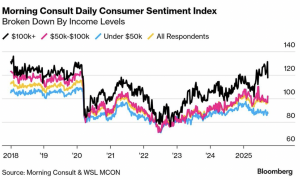
    Research from Moodys using Federal Reserve data shows the top 10% of earners in the US now account for 50% of all consumer spending. In the early 1990s (before Fox News) that number was closer to a third of all spend. Disney just discovered (as corporate America said zippo) that the average person felt that taking a comedian off air after government threats was plain un-American, and proceeded to cancel in massive numbers their Disney+ and Hulu subscriptions. Maybe, the 90% will push back on other White House over-reach? I’m not so sure, and that’s not good for US assets or pensions in the long run. Investment securities, after all, are contracts and the undermining of the rule of law will end in tears. Or, something less oligarchic. As my favourite bear strategist, Albert Edwards, said this week when posting the Bloomberg chart below, “When I look at this chart, I look at my calendar and just wonder when I should pencil in the next revolution..”   The chart dramatically shows consumer sentiment splitting sharply between the ‘have yachts’ and ‘have nots’…..

  • Follow The Deals…

    Follow The Deals…

    The White House has approved this article. Oh, wait. That’s just my slow-learning chatbot co-writer, Eric, getting nervous. Silly boy. He’s still being trained and doesn’t understand how the world works yet. Of course, as Disney and Jimmy Kimmel have just discovered, if you want to get a deal done in the USA these days you do need the approval of the Dear (or Expensive) Leader. Beijing watchers will know that a centrally controlled economy dictates whether M&A deals get done, or not. For Disney, it needs regulatory approval for a deal acquiring 10% of ESPN in exchange for NFL sports broadcasting rights. For Nextra who cancelled Jimmy early, it is awaiting FCC approval for its $6.2 billion merger with Tegna. This all makes worrying sense, but on a positive note I’m sensing an exciting pick-up in the wider world of M&A outside the truth-strangled US media. Let’s take a look at a few deal developments and note how they tick more than a few thematic boxes.

    A is for AI and we just can’t avoid it. The good news is that the AI ‘space race’ is spilling over into the wider tech world and is not just a ‘Magnificent 7’ phenomenon. Last week we touched on “forgotten” Oracle flagging a $450 billion contract backlog for its AI cloud business. This week it’s struggling chip manufacturer, Intel, receiving the AI love. Fresh from accepting an “invite” from the US government (not China) to take a 10% ownership stake, Intel has just received a $5 billion investment from chip superstar Nvidia in exchange for approximately 4% of the company. Intel’s share pricy duly rocketed 22% in a matter of hours for its best day since… 1987. Back in 2011, Marc Andreessen wrote “software is eating the world”. More recently, we have flagged a significant shift in technology – hardware is hot. AI has focused minds on chips and cloud infrastructure with the most valuable company in the world now a hardware company (ahead of software beast Microsoft). In fact, 5 of the 10 most valuable companies on the planet are technology hardware players. Interestingly, human beings seem to be benefitting from this shift too. Again, Nvidia is splashing the cash.

    We have previously written about the acqui-hire trend; the strategic acquisition of scarce knowledge/skills by buying out early stage start-ups. Enfabrica, its CEO and a handful of its employees have just had $900m waved in front of them to join Jensen Huang and Nvidia. The Enfabrica team’s key IP is the ability to connect more than 100,000 GPUs(AI chips) together.  Oh to be an AI guru, as Meta, Google and Amazon hunt the globe for unique talents and knowledge. The attraction of hiring individuals (not acquiring start-ups) for the acquiror is the avoidance of regulatory scrutiny. The biggest deal of this genre so far was Meta’s $14.3 billion purchase of a 49% stake (dodging control/regulatory process) in Scale AI, its founder Alexandr Wang and his colleagues. Of course, all this talent and  hardware needs electricity to power research, manufacturing and cloud hosting.

    So, it was interesting to see private equity giant, Blackstone, acquire Pennsylvania’s Hill Top natural gas power plant for close to $1 billion. This follows Blackstone’s July announcement that it would invest $25 billion in Pennsylvania to build out its energy and digital infrastructure for the AI revolution. Yep, $25 billion. Meanwhile, Elon Musk’s xAI vehicle has purchased an entire power plant overseas and is shipping it to Memphis where xAI plans to build a data centre hosting 1 million GPUs. Blackstone and other private equity players are clearly taking a view that electricity grid infrastructure is critical to any digital/AI ambitions. Blackstone has been particularly busy with an August announcement of the $11.5 billion purchase of New Mexico’s largest utility, TXNM Energy. So, this focus on electricity infrastructure assets raises a further question, possibly opportunity. We know electric power is critical to the AI revolution but there’s another critical component to the digital world – basic materials. The investment community is correctly focusing on the physical assets of the manufacturing and power generation sectors but the most basic manifestation of infrastructure assets is raw materials. The Chinese have bullied the Expensive Leader on tariffs thanks to control of rare earths supplies but what about other critical metals? Let’s see.

    Silver and gold prices have both recently hit new highs with precious metals funds (ETFs) posting 47% returns year-to-date. But keep your eyes on the global electrification prize. Copper is the critical metal for electricity conduction in transmission grids, renewable power projects and electric vehicles (EVs). So, check out the biggest mining deal in ages. Anglo American is planning to merge with Canadian copper play, Teck Resources, in a $70 billion deal. Given EVs use up to 4 times more copper than traditional cars and wind farms consume 10 times more copper than gas-fired plants, it’s not a surprise to see this deal happen. However, what is surprising is that the GLOBAL publicly quoted mining sector is valued at just over $1.4 trillion. That doesn’t even cover the increase in value of just one tech company, Nvidia, in the past… 6 months! The most valuable US mining company, Southern Copper, is worth $87 billion. For context, note Larry Ellison’s personal wealth increased by $100 billion in just one epic trading session for Oracle on September 9th. Not for the first time in recent giddy weeks, it feels like something doesn’t quite add up. For illustration, the top 6 US tech companies are now valued at a combined $20 trillion, more than the GDP of China. And yet, each of these 6 companies is utterly dependent on rare earths, basic metals etc. to build semiconductor chips or their precious cloud-hosting data centres. I reference China deliberately.

    Not only did China take the long view on the critical role of rare earths in the modern digital economy, they also ‘got’ electricity. In 2010 they finally caught up with the US in terms of electricity generation. But….. today the Chinese electricity generation capacity stands at 2.5x the USA. We read a lot about tech ‘sovereignty’ these days but critical mineral ‘sovereignty’ could be the next frontier of the AI race. Already, the US Department of Defense has taken a 15% ($400m) stake in rare earths mining company, MP Materials. Surely, private equity and its mounting pile of investment  ‘dry powder’ sitting idle will start to look at the mining sector? We shall see, but it must be encouraged by the US Department of Defense taking time out of bravely bombing Venezuelan fishing boats to secure mining resources. Whoops, Eric is getting nervous again…. Best I stop now before I’m Kimmeled, and best you follow those deals.