Category: Investment

  • Pick A Winner Or A Portfolio?

    I met a very glum Italian fund manager at a Dublin bus stop the other day. A former client, he’s usually a cheerful chap and my initial fear was that after 18 years living in Ireland the excruciating “1-minute due” display at urban bus stops had finally broken him. I was wrong. Something else was broken.

    Irrespective of our professional relationship, both of us over the years would have shared a passion for financial markets and the events that shape them. On this particular morning, my fund manager friend was less talkative and declared he was past caring about the specific drivers of markets as it just didn’t matter anymore. For a brief moment, I thought he had lost his job but he quickly reassured me he was still working in the equities market. He then explained that the reason for the dip in his professional enthusiasm was a sense that markets were “broken”.

    After further discussion, it was clear that central banks’ ultra low-interest rates and consequent turbocharging of prices across all asset classes were not his only professional frustration. Yes, as an “active” fund manager this combination of almost free money and frothy asset inflation made it difficult for his firm to beat or even match the performance of overall market replicating index funds and exchange-traded funds (ETFs). But there was also a whiff of resignation that the higher fees charged by an “active” manager who picks individual stock winners could no longer be justified. Bluntly, the active fund manager business model was in danger of breaking too.

    Not so in the world of super cheap index funds and ETFs. These funds don’t pick winners or actively trade. They just mimic at very low cost the exact constituents of major indices like the S&P 500, Nasdaq, Dax and FTSE 100. The past decade has only seen one negative performance year for global equities and passive fund costs to investors continue to go lower, in some cases to almost zero. No surprise then to see that index funds and ETFs have quadrupled in size since 2010 to just over $10 trillion according to Robin Wigglesworth at the FT.

    The investor flight to cheap index portfolios is killing the traditional active manager who charges his/her clients an annual management fee based on their expertise in researching and selecting winning stocks. The ugly truth is that such “expertise” fails to reveal itself consistently and only a very few active managers produce long-run market-beating performance. Time is possibly the active manager’s greatest weapon – think Warren Buffett. However, long-run historic data would suggest there really are only a few meaningful winning bets.

    We have previously referenced a famous 2017 research paper from Arizona State University’s Hendrik Bessembinder. The findings are stunning. The best-performing 4% of all listed companies account for the entire gains of the US market since 1926. As practitioners in the world of start-up investments, this has given us pause for thought as to the best investment strategy for investors on equity crowdfunding platforms like Spark CrowdFunding.  The good news for crowdfunding investors is that a critical component of performance/success in the larger public markets is low costs.

    The no-fee model for investors on crowdfunding platforms is a great start. It gets even better if one takes into account a further 40% discount on your initial capital stake when the investee start-up company carries an EIIS badge.  So far so good. The next suggestion leverages the experience of active and passive managers over the years and the historical truths in Bessembinder’s research. It is incredibly difficult to pick winners, particularly at an early stage in a company’s journey. The information gaps are huge. However, by employing a portfolio/index type strategy an investor can not only build his own low cost (free) exposure to an entire asset class of start-up private equity but can also avail of a steady stream of opportunities on crowdfunding platforms over 3-4 years.

    A simple monthly budget of even €100 to be invested in a company every month for 4 years would give a patient investor exposure to almost 50 companies with exciting prospects. Some companies might not survive but those that thrive can deliver very nice returns for the overall portfolio. Don’t forget you have a 40% tax cushion to start with so your approximate €5,000 budget over 4 years is really only €3,000. Then remember that 4% figure from Arizona.  My fund manager friend is beginning to realise his time would have been better spent building portfolios for specific asset classes (like private equity) rather than trying to find the very few “winners” in the broader market indices.

    Crowdfunding investors can benefit from the 2020 hindsight of battered active fund managers over the coming years with a sensible portfolio strategy. We will be writing much more on this in the coming weeks as we get a sense of our monthly pipeline of campaign opportunities. Unlike Dublin Bus, we will avoid the “1-minute” hype and do our best to provide a steady flow of campaigns through 2020.


    Enjoyed this blog? Then why not check out our other great content by clicking here!

  • 10 Reasons You Might Be A More Active Investor Than You Thought!

    10 Reasons You Might Be A More Active Investor Than You Thought!

    This week Bloomberg reported an epic shift in the world of US fund management. Investor assets invested in passive index-following funds have now surpassed those invested in the traditional active stock funds. And we thought the publishing of “One Up On Wall Street”  exactly thirty years ago by the first fund manager rock star, Peter Lynch, would bring active investing to main street!

    Cue an outbreak of hyperbolic commentary predicting the pending death of active management and the dangers of everybody ultimately being invested in the same things in the same amounts at the same time. The purpose of this article is not to debate the merits of investing in low-cost passive investment instruments but rather to highlight how savers can mistakenly believe they are not really actively managing their financial future.

    Here are 10 reasons you might be more active than you think.

    1. Positioning
    2. You will frequently hear people describing their financial planning as super-safe and therefore not actively investing in anything. Let’s be absolutely clear that keeping all your long term savings on deposit in cash at the bank or under the mattress is an extremely active bet. The bet, if one is trying to preserve your wealth, is that inflation will not erode the purchasing power of your capital over time. We would suggest with the benefit of history that this strategy is highly unlikely to deliver. Furthermore, any one-dimensional approach to investment is an extremely active bet – a 100% exposure to cash, equities, bonds, crypto, property, commodities, gold or any other asset class is an active bet.

    3. Timing
    4. There is a large portion of the investing population who invest in equity funds in bull markets and then step out when things get tricky. Unfortunately, that kind of active “activity” is more often than not wealth destructive. The fund giant, Fidelity, crunched the numbers for the period 1980 to 2018 and found that missing the best 5 days of market moves would cost you 35% of your overall returns. Miss the best 10 days and your returns are halved. Miss the best 50 days and you may have to work a lot longer than you hoped…

    5. Pensions
    6. It never ceases to amaze how passive people are about their pensions. Forget the actual investment strategy but just consider the impact of fees/costs over a very long period of time. We would strongly advise a very active discussion re fees incurred in your pension arrangements. Particularly in a low returns world. Think if you’d just invested in European stocks since 2015 you’d be actually underwater in a so-called bull market. But fees and in-fund hidden fees can seriously increase the pain over a long period of time.

    7. Plan
    8. In a previous article “10 Lessons in Wealth Management” we stressed the importance of a financial plan and then sticking to it. That is a sensible active undertaking. However, doing nothing but gathering assets/savings in a random manner over time is a very active but ill-advised route to wealth creation. The probabilities are more skewed towards wealth destruction without a plan.

    9. Retirement plans
    10. No, we are not repeating ourselves. Rather we are making the point that the targeted timing of your retirement(60,65, 67…) is an active bet and therefore necessitates more thought in the context of the range of instruments you will use to invest over the decades and the shift in risk appetite required as you approach the target retirement date.

    11. Life Policies
    12. These are active investments and again require advice which fits your overall financial plan.

    13. Insurance
    14. Not unlike fund managers who use different investment instruments to protect against downside risk – hedges in market-speak – your life will be peppered with a variety of hedging instruments related to your work/business, transport and property. An active approach to monitoring the fees and the actual cover provided by these insurance policies will avoid disappointment and real wealth destruction.

    15. Foreign Exchange
    16. You may over time have assets or income streams that are denominated in a foreign currency. Again be proactive in how that exposure is managed and avoid a mismatch between your domestic currency/returns requirements and the ultimate values of the foreign assets/cashflows. Doing nothing is, we repeat, a very active bet!

    17. Education
    18. No different from a business, there is an ongoing requirement to invest in yourself in a rapidly changing world. Education is a real investment that can deliver increased income and prolong your relevance in the commercial world. Be active includes maintaining an active brain.

    19. Death and Taxes
    20. We don’t need to spend too much time on the former but it is one of the two ‘certainties’ in life. So succession planning is a worthwhile proactive initiative. However, before then we’d like you to live a little and proper tax management/planning should be conducted in a very active manner. Whatever you might feel about investment fees the truly outsized costs or benefits of tax decisions render many active investment discussions moot. Attention to tax treatment of your investments can be considered an investment strategy in its own right. And it pays to be active.

    If you re-read the ten points again you will realise there actually is no such thing as a passive option. Doing nothing is simply being ‘active’ but probably resulting in wealth destruction. In fact, exactly the same point can be made with regards to the frenzied active versus passive debates consuming Wall Street right now. Time will ultimately show that passive strategies were more ‘active’ than originally intended, particularly if investors take fright along the investment journey. Remember those ten most important days(Fidelity) to stay in the market and keep our ten ‘active’ reasons in mind too. They do make a difference. You can too.


    Enjoyed this blog? Then why not check out our other great content by clicking here!

  • Investing in the Green Revolution

    Investing in the Green Revolution

    As Europe swelters in record-breaking heat there is a temptation to believe the gates of Hell have opened for the coronation of Boris. However, these flippant thoughts should not be perceived as a cynical mind resigned to our planet’s failure to act to save itself from climate catastrophe. On the contrary, there is real evidence of an acceleration of actions and investment to reduce the impact of human activity on our climate.  The integration of renewable energy generation into many countries’ electricity grids is possibly further advanced than you might think, particularly if you reside in Ireland where we sadly lag progress made elsewhere.  Let’s start with the leaders…

    Scotland is on track to deliver 100% of its electricity from renewables in 2020. The Scots will join Albania, Congo, Iceland and Paraguay who have already achieved that goal. Ireland has a bit more to do with a commitment to a 40% target by 2020. Elsewhere there are other worthy milestones being achieved. Here’s a few standout statistics…

    • Austria’s largest state(includes Vienna) achieved the 100% renewable electricity target as far back as 2015.
    • Renewable energy in Germany now provides more electricity (almost 50% year to date) than coal and nuclear power combined.
    • Uruguay thanks to a hydropower legacy has reached a 95% electricity target but the striking feature of the past 5 years is windpower rapidly rising from 1% to 33% of total generation.

    One of the scientific challenges for the renewable revolution is how to store energy generated and smooth the supply of electricity to national grids. There have been a number of occasions in recent months in Germany where electricity prices went negative! The whole area of battery technology is exploding as automakers race for leadership in the electric vehicle (EV) market. Encouragingly from an Irish perspective the University of Limerick Bernal Institute has been conducting market-leading research on enhanced EV batteries with EU funding. This Western centre of excellence has not gone unnoticed as Jaguar Land Rover have recently established an automotive research centre in Shannon.

    Clean energy and non-carbon powered autos will no doubt move the climate change dial but we also must clean up after ourselves. Happily, Ireland might be making better relative progress on waste recycling and innovation.

    The recent opening of an innovative plastics recycling plant in Portlaoise by Trifol allows waste plastics to be recycled into waxes and lubricants. Trifol is currently raising funds on Spark Crowdfunding and it is well worth taking a look at the IP and the impressive management line-up. Another Irish owned business, Olleco, has been in business longer(2014) and has built a customer base of 50,000 businesses that supply used cooking oils, fats and waste food for conversion into renewable energy, heat and biodiesel across 16 sites in the UK. The company earlier this year was on a 6 company shortlist for a global environmental award at the World Economic Forum. Impressive stuff. Be under no illusions, the recycling revolution is imminent and it is striking to read this week that Adidas intends to only use recycled plastic in all its products by… 2024! Expect more and more significant announcements like this as we move on from straws and single-cup headlines. A final thought on a potentially vulnerable sector which has experienced Irish leadership in recent decades.

    The share price performances of European airlines including Ryanair have effectively stalled since 2015. This has been a period of relatively decent economic growth and airline stocks typically perform pro-cyclically. Apart from super-low funding costs enabling stiff competition and aircraft supply, one does wonder is there a structural story mirroring what currently afflicts the oil production sector?  Is it too unrealistic to expect in the next 5 years corporates being the subject of eco-audits where Airmiles will be a key criterion for responsible corporate citizenship? If this scenario plays out then be assured aircraft leasing models will need serious re-evaluation. Aircraft leasing is still a high flying sector for Ireland as a global leader but this writer is not convinced eco-audits are in leasing risk models just yet.

    If this final thought sounds rather Cassandra-esque please recall an earlier article “Food for Thought”  where we cited a leading hedge fund manager describing all investment decisions now factor in climate change. Undoubtedly, the Green revolution is a planet positive but still has the capacity to leave investors red-faced if they fail to see both the structural opportunities and risks which accompany change.

  • How do you value your business on Planet ZIRP?

    How do you value your business on Planet ZIRP?

    In our previous article -“Does Frankfurt Have a Kremlin Branch” – we referenced a commonly used valuation metric, a company’s book value, as an illustration of  market worries. However, within hours of publishing the piece I read a fascinating article which raised the prospect of analysts and corporate financiers ripping up the textbooks on traditional valuation models and metrics.  The critical driver of this potential valuation anarchy is the incredibly low interest rate environment currently swaddling the financial markets.


    Josh Brown at the Reformed Broker blog has written a thought-provoking article – “When everything that counts can’t be counted” – describing the incredible divergence in valuations between traditional asset heavy (Value) companies and the new asset-lite market darlings (Growth). The rapid expansion of new franchises challenging older incumbents has been fueled by an abundance of capital available at almost zero cost. When the term ZIRP – zero interest rate policies – was first coined post the GFC the commonly held view was that this was temporary. How wrong we were. Despite employment levels close to structural norms, moderate global growth and asset prices close to all time highs the central banks of the world balked at 2018 market volatility caused by the first steps in the unwind of Quantitative Easing(QE).


    The Fed’s 2018 attempt to raise interest rates to normalised levels has been abandoned this year with monetary authorities around the world either cutting interest rates again or signalling the same.  As someone who started his financial career in Japan I would have shared some concerns that Europe faced a multi-decade experience of almost stagnant growth and interest rates close to zero. However, I was not expecting to read in Brown’s piece a question raised by reknowned investment author William Bernstein.  This big thinker confessed to wondering “What if the cost of capital never rises again?” This question has far-reaching implications for valuation techniques and unfortunately those who describe themselves as Value investors.


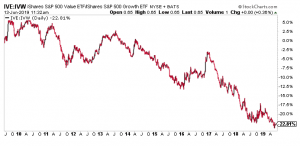
    JP Morgan’s research team has written to clients telling them that there has never been a worse time to be a value investor – “value is currently trading at the biggest discount ever”. Value investing is a strategy whereby investors look for stocks that are underpriced relative to the fundamental analysis of the companies worth. One analytical metric is book value which captures things like plants, equipment and facilities. In a sense, one is trying to discover how much would it cost to replace those assets. It doesn’t capture things like brand, intellectual property and other intangibles. Therefore, if you can buy the cheapest stocks in the market at or below replacement value the odds are in your favour over the long term that this hidden value accumulated over the years will crystalise as a decent return on your investment. That strategy has worked for decades on any long term historic view of the markets…..until now.  The story since 2010 has been very ugly for this strategy leading to massive underperformance vs growth stocks who don’t build factories but access almost-free capital to lease offices, develop IP, innovate and build user bases, brand and quasi-monopolies – think Uber, Netflix, Spotify, Amazon, AirBnB or PayPal.   See the 9 year ratio chart of a value stock ETF(IVE) divided by the growth stock ETF (IVW) for a striking illustration of this painful period for value strategies:

    This is not just a book value phenomenon. Results have been painfully similar for strategies utilising price-earnings ratios, cash flow multiples, dividend yields or a blend of them all. The value tortoise has been left behind the hare(or the hairy) strategies which ignore traditional valuations and now focus on the likes of market monopoly optionality, user base growth, recurring revenue, brand acceleration and mobile ubiquity.  In a ZIRP future of unlimited access to super cheap capital, real assets of older franchises will be under constant threat from new players and possibly remain permanently undervalued.


    Even a recession might not help as growth becomes scarce and attracts further capital relative to lower growth cyclical businesses. Clearly, over the years it has been a fool’s errand to forecast future market moves and in particular, interest rates which have been moving in only one direction for almost 40 years; US rates peaked at over 15% in 1981.  So, if we are stuck in permanent ZIRP mode what can companies and investors do? Here are two possibilities:


    1. Investors: Start to factor in long term zero interest rates and begin to think about the risks of hoping for a different outcome. Indeed, even the value wizard, Warren Buffett, has started to buy Amazon.


    1. Companies: Ensure investors see you are making a digital transformation. WalMart, Disney and McDonalds have been successful in highlighting the intangibles/user multiples of their franchises and escaping “value trap” status.


    The headline in this article asked a question. Unfortunately, there is no definitive answer but in an asset-lite world entrepreneurs/founders should be focusing on the following metrics when communicating with investors:


    1. Sales growth rate/momentum
    2. Incremental/marginal costs of producing additional unit of a good or service
    3. Growth of IP/engineering personnel cost vs growth of sales personnel cost. The latter needs to win that race.
    4. Recurring revenue(monthly, quarterly, annual)
    5. Growth in recurring revenue
    6. Lifetime value of customer – or user in today’s millenium vernacular. Customer is sooo yesterday!


    Ideally, managements should create proprietary multiples and ratios to track these metrics. These will be the basis for valuation discussions and we will write additional articles on sample companies which are using these metrics most prominently in their investor communications.  Sadly, for a cash flow returns evangelist like myself the absence of an actual cost of capital is making discounted cash flow models almost redundant! No doubt as soon I throw out my battered old HP12c calculator markets, interest rates and inflation may conspire to confound yet again.  However, Japan is our most studied ZIRP lab rat so far and that experience suggests we have more than a few years left of virtual valuation.


  • Every Bond Has A Silver Lining……

    Every Bond Has A Silver Lining……

    The non-profit research site ‘Our World in Data’ confirmed this week that there are now more people over 64 than children younger than 5. By coincidence there was a financial headline on the same day which also had demographic resonance. In financial markets dominated by FAANG acronyms and millennial focused growth strategies it seemed strange to see the country with the world’s most rapidly ageing population, Japan, being used as the case study to describe current global financial conditions.


    Of course, the headlines were focusing on the prospect of central banks, particularly the ECB, being trapped in multi-decade zero interest rate environments as experienced by Japan for almost 3 decades. Almost immediately, the talking heads on financial media seized upon the $12 trillion of sovereign bonds now carrying negative yields as a worrying signal for long term growth, inflation targets and possible recession. None of these scenarios are great news for asset prices or savers but a low GDP growth future is not necessarily a doomsday outlook.


    The word “Japanification” is often thrown into financial conversation as a cautionary tale of stagnation at a country level but misses two very critical variables. If one were to look at GDP on a per capita basis(think shrinking population) and adjust for inflation to get a sense of true purchasing power for the average citizen you might wonder what all the fuss is about.  The World Bank data tells us that since 2010 Japan has had the exact same GDP growth as the perennial ‘lucky country’, Australia (1.13%).  That’s more than double France’s efforts and intriguingly within 20bps of  the US and UK. Clearly, there are negative long term considerations for countries with large debt burdens and a shrinking worker pool to support a majority aging population in retirement. But, if one were to take a positive from this demographic challenge, there is a good chance populist immigration debates will change in tone over the next decade. It’s already happening in Japan which historically has had notoriously strict immigration controls.  So the social outlook is not all bad but there is also a whopping business opportunity for those listening to the longer term messaging from the bond market.


    Get ready to hear a lot more about the “Silver Tsunami” and the “Longevity Economy”. Merrill Lynch reckon the global spending power of those aged over 60 will be $15 trillion by 2020. Yep, that’s bigger than China’s current GDP. Quite apart from almost every global busineess trying to crack the enormous Chinese market it is staggering to read that advertisers spend 500% more on millennials than all other age groups. As this writer hits a sensitive age milestone rather soon I feel slightly offended that less than 10% of marketing dollars are aimed at the 50+ population. In financial markets the millennial marketing frenzy could be described as a “crowded trade”.  Inspired by that $15 trillion pot of silver there would appear to be a massive opportunity for strategic innovation which empowers older adults and gives them tools to continue to create and participate in the global economy.


    Very low or negative long term interest rates as signalled by bond yields can also help those innovators fund their businesses. Bluntly, savers will need to change strategies to build/preserve wealth and generate income. For those entrepreneurs out there with a product or service in health, leisure or finance which has a strong ‘silver strategy’ consider a crowdfunding campaign.  It is quite likely you will find enthusiastic funding support on such platforms given their investor registers will probably look remarkably like the market being targeted!


  • Use It or Lose It – One Solution to Income Inequality

    Use It or Lose It – One Solution to Income Inequality

    The prevailing political narrative of recent years has been the rise of populism and right wing parties but the elections in Spain at the weekend give pause for thought.

    Socialists greatly increased their number of seats and conservative parties suffered crushing losses. As Jeremy Corbyn waits in the wings in a Brexit-paralysed UK and a succession of Democratic US presidential contenders advocate centre-left solutions, there are grounds for a reappraisal of the policy solutions likely to be demanded by electorates.

    The high priests of capitalism are also taking note. Ray Dalio, the founder of  the largest hedge fund in the world, has recently made the noteworthy observation that “capitalism is a fundamentally sound system that is now not working well for the majority of people”. 

    The World Economic Forum has also warned that rising income inequality poses the biggest threat to the global economy over the next few years.  Most surprisingly, surveys of the uber-wealthy by private banks like UBS are highlighting income inequality as their clients’ biggest fear – not inflation, not China, not terrorism, not rising interest rates, not recession, not trade wars. Remarkable.

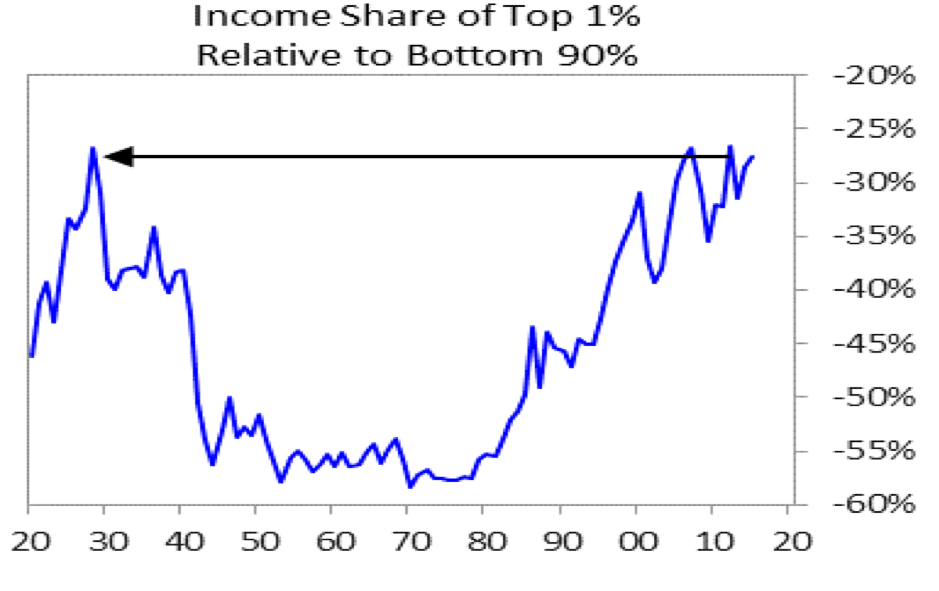
    Dalio, a keen student of history, notes that the conflict between populists of the left and right contains echoes of the 1930s and he provides a striking Income Inequality chart for historical context. The chart below shows the wealth gap is indeed the highest since the late 1930s:


    One senses something has to give. The perennial policy dilemma is described rather well by Dalio when he states that “most capitalists don’t know how to divide the economic pie well and most socialists don’t know how to grow it well”. 

    Some readers will have seen US Presidential contender Elizabeth Warren propose a wealth tax for fortunes in excess of $50m but wealth taxes scare the hell out of lots of governments for the following reasons:

    1. In response to wealth taxes, the wealthy remove funds from the relevant tax jurisdiction
    2. Wealthy investors reduce investment as incentives to make incremental profits/returns are reduced

    One wonders is there a middle ground where passive deposits of cash over a particularly high level of, say $20m, incur an additional annual tax charge (see property taxes) UNLESS the equivalent amount is invested in smaller companies/start-ups operating in the same tax jurisdiction.

    There are already numerous EIIS-type schemes in Ireland, UK and US which provides investors with the option of investing in start-ups which have attractive tax incentives for the investor eg. 40% tax back in Ireland for EIIS investments. 

    The difference for the super wealthy is that these schemes would become mandatory to offset a wealth tax. The policy message would be clear: Use it or Lose it.

    Taxes or any mandatory directive on personal capital is never popular but these are challenging times in many societies and the 1% are already acknowledging a problem and the risk of a chaotic backlash.

    The attractions of EIIS-type schemes for policy makers would be a much greater chance of capital remaining onshore and a tangible support for business formation/employment from the private sector.

    In the event of such policies emerging equity crowdfunding platforms, such as Spark Crowdfunding, will be a natural conduit for investment flows. For both investors and start-up companies today there could be real opportunities in early utilisation of crowdfunding platforms.

    Firstly, companies can gain the experience of running a fundraising campaign in preparation for potentially much larger pools of capital being available in the future.

    Second, investors will undoubtedly see the attractions of early investment in a limited number of franchises which in the near future could be chased by a wall of new monies seeking refuge from capitalism’s response to an unsustainable situation.

    Now think about that…large pools of capital chasing limited opportunities. Early crowdfunding movers might be able to help, but at a pretty price!