
Tag: AI

  • Warning: 3 Zones Of Interest

    Warning: 3 Zones Of Interest

    Nobody likes to be admonished. So, it’s an interesting commercial call to deliberately call out one’s customers. Even more daring to use the Holocaust as your messaging context. There are no adequate words (almost literally in many scenes) for Jonathan Glazer’s brilliant but upsetting Oscar-winning film, The Zone of Interest. The luxury dream life of Auschwitz commandant Rudolf Höss, his wife Hedwig and five children in a house right next door to the walls of the Nazi death camp is almost two films. One is seen, the other heard. The effect is extremely unsettling – you see nothing, but hear and know really evil events are happening.  However, director Glazer is using this notorious historical setting to deliver a present day admonishment. Like Hedwig Höss and her household, we hear things but choose not to ‘see’ bad things. However, you’ll be relieved to read I don’t plan a similar scolding…..but have some cautionary thoughts.

    It has been an interesting week for the planet’s hottest investment topic, Artificial Intelligence or AI. For main street consumers we are on the cusp of not just hearing about AI, but actually ‘seeing’ it in action. First, Google showed off the latest use cases for its AI model, Gemini, in search, education, video, workflow etc. All hugely impressive, and the intention is for Gemini to be embedded in Android powered phones soon. Not to be outdone, reports are flying around that Apple will do something similar with its iPhone and OpenAI’s ChatGPT model. As the tech-heavy Nasdaq index hits all-time-highs, it’s clear AI is going to move rapidly from being a corporate cloud story (Nvidia, Microsoft etc) to being a main street consumer revolution on our phones. However, the cloud and the powering of AI models is still entirely relevant to this move. Arguably, AI infrastructure is today’s gold rush version of  ‘spades and shovels’ which, for investors, means data centres are critical to deploying AI. You’ve probably already heard that. But, do you ‘see’ the reality…?

    My favourite trivia question of the week has been how many data centres will Microsoft open in 2024. Every answer I have received has been wrong, mainly in the low double digits. The reality, per a recent Financial Times article, is that Microsoft is opening a data centre “every three days”. Mind-blowing. These are $300-400 million facilities, not Starbucks cafes or KFC restaurants. And, that’s just one company. Here’s another – Echelon Data Centres. I had the pleasure of briefly meeting its owner, Niall Molloy, at the excellent Renatus Real Deal 2024 conference this week where Molloy was interviewed as winner of the “Deal of the Year” award. I was stunned to learn Echelon only started in the data centre construction business in 2017. Just 7 years later private equity giant, Starwood Capital,  has invested $850 million in Echelon and the business is currently valued at north of $2 billion. A super story of bold vision and world-class execution, but Molloy had a cautionary word about the pressures on global electricity grids as data centre campuses begin to match the power consumption of capital cities. The AI and data centre revolution is coinciding with an even bigger global shift – decarbonisation of our economies. The solution is more electricity power, and the challenge is the expansion of under-invested electricity grids. However, where there is risk there is opportunity.

    Ireland has been mentioned as one of the most challenged national electricity grids and many readers will have ‘heard’ the negatives of data centre power consumption. However, all data centres now have to create/install their own power supply and most likely the source will be renewable energy. That means huge investment capital is required because it is no longer just a construction project, but also includes incremental builds of electricity generation and water supplies. Hence, we should ‘see’ this week’s reports of Intel’s plans to expand its Fab34 semiconductor chip factory in Leixlip as a ‘wow’ moment. The plans are not new but the financing is ground-breaking. Intel was originally looking to spend $2 billion. Now, the number is $11 billion and global private equity player, Apollo Global, is being tapped as the solo partner on the project. The entry of global private equity into AI infrastructure funding should signal opportunity and expert eyes ‘seeing’ a way forward despite grid challenges. So, my second cautionary word after ‘seeing’ a consumer AI shift is that there are risks but also huge opportunities away from the actual technology. In other words, investing in power, storage, construction, critical minerals/materials, water, skills training/resourcing and other professional support services could generate top class returns.

    Clearly, private equity giants have spotted an investment opportunity. And, don’t forget Blackstone’s recent $1 billion purchase of a majority stake in Dublin-headquartered data centre engineering firm, Winthrop Technologies. Still, there’s one final cautionary tale; under-investment caused by political inertia or regulatory uncertainty. Exhibit A on political misrule is probably the UK. However, Brexit might be the go-to lament you ‘hear’ but the reality is a long-standing issue we wrote about in March:


    The Institute for Public Policy Research estimates the under-investment in business at $500 billion less than what other comparable OECD countries have invested since 2005. Public sector investment (infrastructure) was a further $200 billon below the G7 average. All in, this chronic lack of investment places the UK 27th out of 30 OECD countries.


    As regular readers will know, we have been quite positive about UK investment opportunities in recent months but this warmer view has been based on a contrarian prompt. Investors have been fleeing UK investments for years and Panmure Gordon published some startling figures in a research report from their Economics team this week. I would highlight three in particular:


    • UK public companies trade on a like-for-like basis (taking into account sector and growth characteristics) at a 17% valuation to comparable companies trading in the rest of the world (RoW).
    • The gap in valuation between the biggest UK companies (FTSE 100) who are globally engaged and the more domestically-focused smaller UK companies (FTSE 250) is at its widest in 20 years.
    • Funds focused on UK investing strategies have reported outflows for 82 of the last 97 months (Source: IA)


    Please ‘see’ this as the damage inflicted by chronic under-investment for almost 20 years. So, given our planet faces an existential threat without decarbonisation, the critical need for investment in global electricity grids is not exclusively an AI or data centre issue. Data centres are just a ‘wall’ blocking the bigger picture view . Without joined-up policy thinking, we risk ‘hearing’ about data centres but missing a planetary extinction event moving into irreversible territory. Don’t zone out on this one.

     

  • Get On The AI Bus Or Lose Business..

    Get On The AI Bus Or Lose Business..

    As somebody who has been watching, I’m still stunned. No, not that Rishi Sunak has his own GB News TV show and that the regulator, Ofcom, hides. Not even the fact that a former US President has thrown his NATO allies under the Vlad bus in plain sight of the forever fear-filled US media. Of course, I’m sure Poland and Estonia are terrified by Joe’s age or Hilary’s emails. Mind-boggling. However, on a brighter note there’s another bus which is enabling millions to work better. The AI bus is flying. Again, the mainstream media headlines run with AI fear but the flow of money and corporate action point to an extraordinary business revolution. The numbers are now simply too big for businesses and investors to ignore. Let’s do a brief tour of developments…

    This week kicked off with the staggering news that AI chip maker, Nvidia, has now achieved a $1.84 trillion market valuation which is higher than both Amazon and Google. To understand the expectations baked into that valuation, reflect on Amazon’s projected 2024 revenues of circa $600 billion. Then know that Nvidia is expected by Wall Street analysts do just one tenth of that revenue number. The 90% revenue catch-up is somewhere in the future but the future numbers look big, very big. The famous AI evangelist and rescued CEO of OpenAI, Sam Altman, is actively seeking funding for the development of AI chips like those of Nvidia. The word ‘funding’ doesn’t really do this exercise justice. It’s almost nation building. Sam reckons he will need $7 trillion, or the combined GDP of Japan and France. Sounds dreamy, but he’s not alone.

    Consulting firm, McKinsey, have published research suggesting the creator-focused application, Gen AI, deployed in 63 actual use cases could add $2.6 trillion to $4.4 trillion of economic benefits. Note these are actual business ‘use cases’. There’s more than dreaming going on here. In fact, Google has launched its Gemini workflow assistant to “supercharge your creativity and productivity”. Gemini is multi-modal which means it can create content using text, voice/audio, images and video. Its output can also be multi-modal. Think about a medical professional using an ‘assistant’ which can ingest a physician’s audio snippets/notes, X-ray images and MRI video scans. Also, we have moved past Chat GPT text prompts and free trials. Google is charging a $20 monthly subscription for its Bard successor, Gemini, to assist with email summaries, research, code-free data analytics and audio visual staff and customer education. Microsoft is also charging $20 a month for its Copilot AI Tool. Oh, and people and businesses really do pay for access to these AI tools.

    While OpenAI started out in life as a not-for-profit entity, it is amazing to see that the OpenAI business is already generating annualised revenues of $2 billion. The use cases might even surprise. For example, McKinsey analysis shows that 73% of fashion executives named generative AI as a priority for their companies in 2024, but only 28% have actually deployed AI so far. It’s not just business prioritising AI adoption. The investment world, particularly in our world of early stage funding is acutely aware of venture capital (VC) funds pulling in their bullish horns and nursing some of their existing investments out of sick bay. However, AI-related VC investment is bucking that trend. Check out these data points from CB Insights:


    • Broader venture funding fell 43% in 2023, but AI funding slipped by just 10%.
    • The US actually witnessed AI investment grow by 10% in 2023. Europe dropped by 29% and Asia saddled with a China confidence crisis cratered by 61%.
    • There were 22 AI unicorns (start-ups valued at $1 billion or more) created in 2023 which accounts for 31% of a global total of 71.
    • Generative AI unicorns, in particular, are hitting warp speed wealth creation mode. Gen AI unicorns reached the $1 billion valuation mark in a little over 3 years, or half the time taken by unicorns in other sectors.


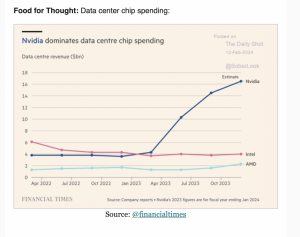
    However, investment doesn’t just happen at a company level, big or small.  If we consider Sam Altman’s funding estimate of $7 trillion, this investment capital will mainly be used to build facilities to manufacture those AI chips (fabs) and then house them (data centres).  I have written previously about the linkage between the explosive growth of AI and the race by Big Tech to build the data centres supporting their digital cloud businesses. As a proxy for this linkage, the Financial Times has highlighted Nvidia’s dominance in the area of data centre spending:


    Closer to home, the opportunity presented by data centres has attracted private equity giant, Blackstone, and prompted talks on a $900 billion acquisition of data centre construction leader, Winthrop Technologies. Clearly, the ramp up in investment activity on both a company and an infrastructure basis is signalling real AI revenues and real usage from businesses. And, it would be wrong to assume it’s part of the future. It’s now.


    • Forbes reckon 83% of companies deem AI to be a top priority in their business strategy.
    • MIT have said 9 in 10 organizations back AI to give them a competitive edge over rivals.
    • More than 50% of Americans use voice assistants for information purposes (Source: Edison)
    • Manufacturing businesses that utilize AI are performing 12% better than those using traditional methods only (Source: Microsoft)


    Remember this is AI in its infancy. That 12% ‘edge’ is only going to grow. For me, there is now an additional competition-critical question for every business to add to existing queries on the progress of their digital and sustainability transitions. Have you boarded the AI bus yet….?

  • Which Global Themes Are Flying?

    Which Global Themes Are Flying?

    Only one sleep to go until “Sixmas”, or the 6 Nations. Giddy. Another 28 days to go in the “Freezbrury” cold water swim challenge. Not so giddy. Such is the emotional ebb and flow of life but what do we make of the January investment emotional roller-coaster? Dare we say January was a game of three ‘halves’? The early days of the year saw markets puke, only for the next three weeks to see markets roar higher on familiar big tech AI giddiness, interest rate cut hopes and stronger economic numbers out of the US and Asia. Then, more fear. As always, the cost of money (rates) drives all asset markets. So when the Fed said “not so fast” on March rate cut expectations markets had another little tantrum to close out the month. Now, ignore all that trading noise. Let’s stick to longer-term thinking and revisit a few themes we flagged for 2024.

    First, we go big. The “Magnificent 7” big tech names have been driven to new all-time highs on the continuing AI theme with Microsoft hitting a $3 trillion market valuation for the first time, and AI poster-child, Nvidia, adding another 24% to its value in January alone. However, if you’re a Tesla shareholder, you might need access to the Elon Musk drugs cabinet to dull the pain of a January 24% crash in the value of the once biggest EV manufacturer in the world. As we write of potential regime shifts, I am reminded of a mandatory Thursday lunchtime every quarter in the naughties being glued to my desk and screen awaiting Nokia’s latest earnings report from Helsinki. The equivalent global pulse-check these days is one evening every quarter in New York when Microsoft and Google tell us how their cloud(AI) business is doing. This week the update was 30% and 26% cloud revenue growth respectively. Let’s just say theme intact.

    Now, go smaller. Well, not so small. On the Microsoft analyst call, Ireland’s very own An Post received a shout out from Microsoft CEO, Satya Nadella, as an example of a customer using its AI CoPilot Studio. This did prompt some thought about small companies and start-ups using AI. We probably don’t give technology and digitalisation enough credit for empowering founders and scaling up businesses over the past two decades. With a website, e-commerce applications, security/payment apps, and cloud hosting/workflow support, a start-up business no longer had to sink capital into up-front infrastructure costs but, instead, could pay software subscription fees (SaaS) to big tech and go to market quickly. This writer is just wondering could AI be an additional accelerant for start-up businesses? Maybe it’s not just me. Review site, Yelp, recently published data on a record 762,200 new US business openings in 2023, up 20% on 2022. Furthermore, US government data confirms the pandemic-inspired “entrepreneurship boom” is alive and kicking going into 2024.  However, some start-ups do need serious up-front capital….

    Check out our cleantech theme. The initial construction of huge EV battery gigafactories, renewable energy installations and decarbonised manufacturing (see steel, fertiliser, cement etc) requires billions of investment capital dollars. Encouragingly, we are seeing some really big funding deals get over the line. Sweden’s Northvolt announced a $5 billion debt financing round in January and a week later another Swedish name, H2 Green Steel, raised €4.5 billion in debt and equity. And, it’s not just cleantech start-ups being backed by significant banking syndicates. Despite the gloomy macro headlines, it feels like banks are feeling better about life in general. Note the record $188 billion of bond issuance by US companies in January and the index(ETF) which tracks the US Banks sector (XLF) hitting a 2-year high. No wonder Bloomberg was leading with a headline this week “The Credit Market Is Quietly Booming again”.

    Of course, in our earlier 2024 themes article we expected continuing stress in global real estate so it’s not all good news for banks. The slow-moving Chinese train crash of Evergrande finally hit its liquidation wall in the Hong Kong courts but the potentially more significant real estate news came out of Tokyo this week. Aozora bank shares plunged 20% after it revealed a $191 million loss for the year due to write-downs on its loans to the US commercial real estate (CRE) sector.  Meanwhile, back in the US, New York Community Bancorp reported a $185 million charge-off on just two CRE loans and watched its share price crater 38% in a matter of hours.

    Expect more of this but the key global credit swing factor will be China. For now, Beijing’s efforts to stimulate the economy is pushing capital into the wider Asian economy as the Chinese manufacturing engine ramps up activity. Evidence of early policy traction across Asia might be seen in the bellwether South Korean economy and its PMI survey of factory activity showing expansion for the first time in 19 months. Of course, with interest rate cuts firmly expected in 2024, central banks and investor want a “goldilocks” outcome rather than economies running excessively hot. We shall see, but in the area of healthcare it sounds like one form of excess has been whipped. More specifically, we are revisiting our weight-loss and healthcare/biology theme.

    In recent days Danish pharma company, Novo Nordisk, became just the second European company to  pass the $500 billion valuation mark. Its obesity drugs, Ozempic and Wegovy, have revolutionised the prospects of this 100-year old company and can only focus investor minds on further medical opportunities. We have previously highlighted the intersection of biology and technology as a theme so recent news from Cambridge University was intriguing. Scientists in recent weeks have published research on the successful re-programming of microbes to unlock new materials. This could lead to a whole range of innovative products from new drugs to enhanced carbon-absorbing materials. Here were our own thoughts on new materials and speed to discovery from a few weeks ago:

    “However, artificial intelligence(AI), probably the hottest investment theme outside cleantech right now, has just been used in conjunction with supercomputing to discover a brand new material which could reduce lithium usage by up to 70%……Microsoft and Pacific Northwest National Laboratory (PNNL) research teams whittled down 32 million potential material combinations to 18 promising molecular structures within a week. Incredibly, the whole discovery project took 9 months in a screening process that would typically have taken more than 20 years using traditional lab research methods. The new AI-derived material, simply called N2116, should prompt thought as to what’s possible in the world of medicine, agriculture, transport and construction”

    One final thought which is not so much a theme but is a necessity for these themes to accelerate; our investors always ask “where’s the exit?”. The text book response is that investor exits usually happen through a trade sale(M&A), buy-out (Private equity) or listing shares on public markets via IPO. Private equity house, Bain Capital, reckon global M&A activity of $3.2 trillion was down 15% in 2023 to its lowest in a decade. Meanwhile, EY’s global IPO report indicated listing activity was down 33% in value terms compared to 2022, and Goldman Sachs said it was the worst IPO year since 2016. The good news is that many advisory teams in the investment banks are quietly confident of an uptick in IPO pipelines for 2024. Indeed, the expected New York listing of Chinese fast-fashion play, Shein (ask the kids!), with a $90 billion valuation will be an early test of lift-off. The big global themes will still play out but juicy sales and exits would definitely confirm things are really flying. Also, and more importantly, confidence spreading outside the “Magnificent 7” to smaller businesses would be very good news.


  • Get Ready For The Cloud Wars

    Get Ready For The Cloud Wars

    When the value of just two companies changes by $200 billion in a matter of hours I usually take a closer look. That can even happen when “Married At First Sight”, and not Gaza, has brought you to the point of giving up on humanity. More Gaza later. For now, let’s revisit the events of October 24th. Despite the glow of its recent 25th birthday, Google’s quarterly earnings results failed to impress investors and the subsequent share price dive clipped the guts of $75 billion off the value of the Mountain View tech giant. In contrast, investors were excited by the update on the same night from the world’s second most valuable company, Microsoft, as investors rushed to buy shares and added a cool $125 billion to the valuation of the Seattle tech giant.

    The only word on any traders’ lips that evening in New York was ‘cloud’. More specifically, the revenues earned by the critical data storage and processing architectures which support all our personal and business digital apps and services. The ‘cloud’ is where big tech has leveraged its scale and offered enormous computing power to live and work your digital existence. However, these apps and services are now feeding off a new digital super-power – Artificial Intelligence(AI).

    Generative AI with its large language models(LLMs) and enormous data learning appetites have turned the cloud into a battle field fought by the big three – Microsoft, Google and Amazon. And, the cloud is flying – not quite literally but Microsoft’s Azure cloud business revenues are rocketing at 29% annual growth rates. Google’s cloud business was perceived the ‘loser’ last week with a growth rate of just….. 22%. You get the picture – the cloud is big money, but it’s also really all about AI. Revenues earned by cloud services (powered by data centres) are a proxy for measuring who is winning the AI ‘war’. Let’s be very clear Google and Microsoft have lots of other revenue channels but there is no doubt that the $200 billion shift in valuations between the two giants was entirely driven by the cloud, and by AI. Still sceptical? Allow me to expand on this thread…

    Remember Mistral? Yep, that was the company with 4 guys who raised $120 million with no business and no revenues. Just a PowerPoint presentation. Well, that was 4 months ago. And, now they’ve reportedly raised another $300 million. This time they can actually demonstrate a proprietary large language model(LLM) built with 7 billion parameters for AI training. Yes, built… in 4 months. In valuation terms, Mistral is already a ‘unicorn’ – a startup worth more than $1 billion. If you thought this was merely VC excitement about ‘disruption’ then think again. It feels like the world is still figuring out which of emerging disruptors (with new AI models) or big tech (with its massive proprietary data head start) will win the modelling wars. However, big is still beautiful in investors’ eyes.

    Check out all the gloomy headlines – inflation, painful interest rate hikes, war, recession. You’d think stock markets would be cratering. And, you’d almost be correct. If you strip out the share price performance of just 7 technology companies – aka the “Magnificent 7” – then global equities are probably in negative territory for 2023 so far. Now, think about what is driving Apple, Microsoft, Tesla, Google, Facebook, Nvidia, and Amazon who, on AVERAGE, have rocketed in value by 80% this year. For this writer, it is clear these 7 companies possess the best databases on the planet and are in pole position to train AI models to do whatever they want. Some are happy to use 3rd party models like OpenAI’s ChatGPT or Anthropic’s Claude and the investment monies are still flowing fast.

    Microsoft has already put $10 billion into OpenAI and the latest reports of funding activity suggest OpenAI’s valuation has jumped from $20 billion to $85 billion….in 8 months. Amazon is putting $4 billion into Claude but, as we have illustrated, there are about 200 billion reasons and counting to be in this race. We can’t forecast the future but it is worth remembering that this is AI in its infancy, or to put it another way, at its worst.

    I had the genuine pleasure of chatting to “the Oracle of AI”, Jim Dowling, who presented at an IIBN business event last week. He’s usually based in Sweden and, uniquely, is that country’s only resident lecturer in Deep Learning. It was fascinating to hear him talk about “emerging reasoning” in some of the very large AI models and how lots of well-known businesses are using his company, Hopsworks, to re-configure their data architecture for pending AI applications. What was less fascinating was my estimate that probably 75% of the questions from the audience were fixated on deep fakes, misinformation, AI ‘hallucinations’ and cheating on…. homework. I know, how do we sleep at night!

    Now, recall my earlier words that these early building stages are seeing AI ‘at its worst’. Then just repeat one word to yourself, quite a few times. GAZA. As a species we seem to be perfectly good at bringing ourselves to the brink of World War III or demonstrating barbaric behaviours which, on reflection, didn’t quite end with Ghengis Khan or the Inquisition. Bluntly, we can do far better and AI could help – think of education, the unbanked, healthcare, medicine, energy, decarbonisation, urban planning or agriculture. You know, all the bits to do with living. Of course, all important things must have governance and guardrails. How many unapproved foods, drugs or banks do you know? So, get ready for more of the following:

    Biden Executive Order Imposes New Rules For AI – ABC News


    The excellent Tech Brew newsletter gives a good summary in the following bullets:


    • The directives in the order cover everything from housing discrimination to bioweapons, and aim to address AI at each stage of development.

    • Developers must share safety test results with the government, and various agencies will work on developing standards designed to mitigate threats from AI-created biological weapons and deceptive deepfakes.

    • The order includes a regimen of new privacy research and rules that aims to better govern how developers use information they collect on users.

    • A section of the order homes in on algorithmic discrimination; it calls for guidance to landlords, federal contractors, and welfare programs on reducing bias in any AI tools they use, as well as new guidelines for the Department of Justice to probe this type of discrimination and more rules around AI’s use in the criminal justice system.

    • The general consumer protection section focuses mostly on developing standards for AI’s use in healthcare and education.

    • The order calls for a report on AI’s impact on the workplace, and lists directives for working with allies to implement AI standards internationally.


    Meanwhile, over the other side of the pond……


    UK, US, EU and China sign declaration of AI’s ‘catastrophic’ danger – The Guardian


    Hosted by the British government this week, twenty-eight governments signed up to the so-called Bletchley declaration on the first day of the AI safety summit. One can understand the British government’s eagerness to exhibit some form of responsible stewardship given the stunning revelations coming from the ongoing Covid-19 inquiry in Westminster. An “unfit” Prime Minister surrounded by “f*ckpigs and morons” administering a staggeringly incompetent response to a global pandemic is truly a review for the ages. And a relative reminder of AI’s infancy and humanity’s ability to be……. ehhh…..almost inhuman, or non-human.

    So…..GAZA or AI? My money (and clearly a lot of investment capital) is on cloud wars potentially delivering a better humanity. Keep watching, and hoping. It will be worth it.