Tag: Banks

  • Risk Warning: Trust, But Verify…..

    Risk Warning: Trust, But Verify…..

    On the fifth check of my passport at Paris’s Orly airport I did wonder. Will trust die before our planet dies? Both are under severe threat and, yet, I’m hopeful. Let’s take a look at three particular examples of widely-held mistrust where recent developments might challenge the negativity. First, some history. Ronald Reagan’s signature phrase in nuclear disarmament talks with the Soviet Union was derived, ironically, from an old rhyming Russian proverb: Trust, but verify. Of course, it was tough to trust the Kremlin but technology, in the form of satellite imagery, was the critical verification tool. These days it’s technology which is not trusted but could also be the solution.

    We have previously written about global payments processing as possibly the biggest ‘network’ yet to platform and join social media and cloud computing in the multi-trillion dollar wealth creation club. However, the payments opportunity starts with technology mistrust. Bitcoin is flying high but the cryptocurrency ecosystem is still widely mistrusted by consumers, governments and regulatory authorities. Stripe famously ceased processing Bitcoin payments on its platform back in 2018. Now, it’s all change. Stripe is bringing back crypto payments, this time with a stablecoin. The USDC stablecoin to be accepted by the platform will be pegged to the US dollar ie it tracks the US dollar value. More critically, the technology which underpins the security and verification of these currency assets is blockchain. On so many levels this is a huge verification moment for digital currencies and the software blocks used to build them. Now, for some more building…..

    The 2022 CHIPS and Science Act was a Biden administration attempt to reinvigorate the US manufacturing base by attracting huge factory construction projects. Scepticism was rife, given the Trump toddler promised ‘infrastructure week’ every week but never delivered. Well, let’s verify. First, the US government has paid out more than half its ear-marked $39 billion of incentives to companies planning to invest in manufacturing facilities. The corporate follow-through has been extraordinary – microchip manufacturers and their suppliers have announced $327 billion of investments over the next 10 years. Micron alone is planning a $100 billion project in Syracuse, NY. That’s a nationwide 15x leap in construction spend on these type of facilities and will capture 20% of the global chip manufacturing market by 2030. Currently, that number is zero. But what about our planet and other targets with Zero (Net)?

    Let’s face it, the push back on global sustainability and ESG targets is worrying. We often write that money talks and the following headlines paint a picture of worrying reversal:


    Flows to European ESG exchange traded funds halve in first quarter –  Financial Times


    US Fund Managers With ESG Mandates Have Worst-Ever OutflowsBloomberg


    Clearly, this is not good news. However, we should be careful not to equate fund flows with commitment to climate change targets. For example, the banking sector in recent decades could be described as the ultimate counterparty requiring ‘trust, but verify’ checks on their behaviours and risk management. So, with the global financial crisis barely 15 years in the rear-view mirror, how did genuine ESG investors feel about this week’s staggering headline?


    Western banks in Russia paid $800m in taxes to Kremlin last year –  Financial Times


    Yep, that was the tax bit. The profits according to the FT were over $3 billion. Trust, but verify indeed……ESG investors can rightly ask how are those “S” and “G” policies going in these shame-free and profit-full banks? Answers on a post card to Kyiv please.  Before we all blow a complete gasket, let’s finish with some more wind but a bit more climate positivity. And, no, it’s not a Trump legal challenge. But it could ultimately rhyme by starting badly, and then ending with a positive reality check.

    First, the severity of the storms and tornados sweeping through the Midwest heartland of the US this week are truly frightening. However, there’s a bigger financial storm brewing further south. An excellent article in The Lever this week highlighted the plight of Louisiana homeowners struggling to insure their houses while 12 insurance companies have failed, and 12 others have left the state. Almost one in five Louisiana residents lost their homeowner insurance last year. The crisis is climate caused. Global insurance giant, Swiss Re, in a recent report stated that natural disasters now cost the United States $97 billion a year.

    In Florida, the climate denial Governor, Ron De Santis, might be kissing the Trump ring again but home insurance rates jumped 42% last year and coverage from big players, AAA and Farmers Insurance, has been pulled from the market before hurricane season. Unsurprisingly, Florida for-sale housing inventory has jumped 57% in 12 months. Leaders in denial-mode face a wave of voters, mortgage banks, pension funds and Wall Street analysts giving them the ultimate verification check on climate crisis. The critical shift is that investment capital has checked, and is already fleeing.

    Trust me, that seismic capital flight will force leadership change and action. Verification…..pending.


  • Time For A UK Recovery?

    Time For A UK Recovery?

    Crikey, twice in one week. A positive thought on the UK. Maybe, it’s my subliminal way of keeping the rugby gods happy before Twickenham? It’s certainly not Rishi Sunak’s sole splitting toe-curler of an interview with Grazia – surely the place where political careers go to die or promote blissful dishwasher habits. No, seriously. Anyway, Budget Day comes this week in the UK but that won’t move the recovery dial. No, I’m looking for inspiration elsewhere and, as fortune would have it, we hosted a launch event in London last week. The guest speaker on the night, Chris Johns – author, podcaster, economist, fund manager, strategic thinker with a big following – made the interesting point that, in a year where 4 billion people on the planet are due to vote, the UK might be in a unique position. Its voters will most likely reject the trend of chasing populist pipe dreams.

    The 14-year suffering electorate in the UK has already tried populist politics, and it is entirely possible that a curious fixation with ‘taking back control’ and a nostalgia for historical glories could bring the Tory party to an election wipe-out where less than 100 of their Westminster parliamentary seats will survive. That’s what happens when the Dambusters theme music leads to machine-gunning dinghy policies and taking back control doesn’t quite lead to ‘ruling the waves’. In fact, quite the opposite of control, as the nation empties its bowels directly into UK waterways at a pace not seen since Nosferatu Rees-Mogg first walked the cholera-ridden streets of London in 1866, with Nanny. The toilet humour may feel misplaced in a crisis but infrastructure decay is at the root of UK decline, and pre-dates Brexit. The bottom line is that the UK, both in the public and private sector, has been under-investing for decades.

    The Institute for Public Policy Research estimates the under-investment in business at $500 billion less than what other comparable OECD countries have invested since 2005. Public sector investment (infrastructure) was a further $200 billon below the G7 average. All in, this chronic lack of investment places the UK 27th out of 30 OECD countries. So, why my optimism? Well, I’m schooled in the financial market orthodoxy that the rear-view mirror is a wealth destructor and that the greatest opportunities can be found at the maximum point of despair and disarray. The disastrous 49-day PM reign of Liz Truss and the international bond market near-strangulation of UK pension funds in September 2022 was possibly that moment. Truss’s recent reinvention as on-stage Tommy Robinson (UK civil court adjudicated racist) cheerleader with MAGA extremist, Steve Bannon, at the fascist CPAC conference merely highlights the passage of populism past the point of no return. Not even the suspended Tory Deputy Chairman, Lee ‘Anderthal’, went that far. However, the financial returns possible to investors in the UK might be about to turn for the better. In our recent “Private Portfolio Thoughts” Newsletter we highlighted a couple of interesting data points:


    The Quest quants team at Canaccord are pointing out that UK companies’ level of capital expenditure is at multi-year lows. This means there is plenty of gun-powder to acquire other companies. Also, the machine-learning macro data at Quant Insight is pointing to lower credit spreads (higher lending confidence) driving financial markets right now.


    This combination of pent up investment capability and improved borrowing conditions for UK businesses creates a very opportune environment for the purchase of UK companies by other UK companies. One could view it as a capital expenditure ‘sprint’ ie why invest organically when you can buy an existing business, customers and expertise? There are also a few other factors to consider….

    Valuation: Mid-sized UK companies which are listed in the FTSE 250 index are trading at 25-35% valuation discounts to other developed markets. Some equity research houses have boldly referred to the UK mid-market as being on ‘emerging market’ valuations of 11-12x earnings multiples compared to US markets on 19x and world developed market averages of 16x.

    Currency: Consider the Brexit devaluation of the Great British Peso (GBP) by 15% and a foreign buyer could be looking at a “50% Off, For Sale” opportunity. And, it’s not just us thinking about foreign acquirers…

    A 2023 survey conducted by London-based investment bank, Numis, showed that a whopping 90% of FTSE 250 company directors believe UK firms are vulnerable to foreign takeovers due to depressed valuations and a weak GBP. Oh, and then Numis was bought by Deutsche Bank! That’s certainly ‘walking the talk’. However, this is not just an isolated corporate coincidence. There are other headlines signalling a growing awareness of opportunity and interesting company moves:


    *Britain Isn’t Such a Basket Case Anymore, At Least To Investors – Bloomberg (March 5th 2024)


    *UK Insurer Direct Line Rejects Ageas’s $3.9 billion buyout – Reuters (February 28th 2024)


    *Dutch Fintech Bunq moves top exec to UK to lead post-Brexit return – Financial News (March 4th 2024)


    *Currys shares soar as Chinese retailer enters takeover battle –   The Guardian (February 19th 2024)


    *Santander-backed Ebury reportedly eying £2 billion London IPO – Reuters (March 5th 2024)


    That last headline is a striking confirmation of two themes we have recently highlighted on these pages. Firstly, Ebury is a UK payments fintech and the UK fintech sub-sector, despite Brexit, remains the best place in the world outside Silicon Valley to attract venture capital. Second, the payments sector within fintech is ‘hot’ and could follow digital processing and social media as the next mega-trillion dollar network. In contrast, the overall UK market has gone cold and lost its “equity culture”. No wonder the CEOs of major UK companies have been pressuring Chancellor Jeremy Hunt to bring some Budget relief or ISA incentives to UK investment. The data is damning.

    Pension fund allocations to the UK’s stock market have fallen from 53% of total investment to just 6% in the space of 25 years. In fact, the entire UK market is valued at $3 trillion which is less than the market value of a single US company, Microsoft.  This could be viewed as a long-term UK downward spiral but ….a marginal pick-up in M&A, investment and foreign capital inflows could have an outsized ‘FOMO’ impact on perceptions. Think of Japan’s recent resurgence and then consider what might happen to the UK market if investors believe the worst is in the rear-view mirror and the future is investment, not puerile populism. Watch for corporate leadership and action. Then, follow the money.

  • Banks To SME Sector: It Is What It Is

    Banks To SME Sector: It Is What It Is

    Michelle Obama killed Donald Trump. No, this is not another QAnon far-right conspiracy theory. It’s just a turn of phrase. Here’s another turn of phrase which I usually hate – “it is what it is”. But when the former First Lady used that phrase after a brief critique of Trump’s leadership qualities at this week’s Democratic National Convention, it was perfect.

    It was a brutal reality check which not only trolled Trump, but also ridiculed his recent use of the same phrase to explain the horrendous US Covid-19 death toll. The contrast between reality check and abdication of responsibility could not have been made more stark. Closer to home, economic reality is beginning to bite but only at a micro level. Thousands of businesses are in survival mode, some are already dead. At a leadership level, the coalition government and the banks are promising SME support through credit guarantee funding worth more than €2 billion. Well, almost.

    The reality is that this ‘guarantee’ applies to 80% of the funding amount. The domestic banks are on the hook for the other 20%. Now step into the parallel universe of banking reality. Imagine a bank credit officer with a very large existing loan book exposure to say….. the tourism/hospitality sector. In what universe will a bank be looking to increase its lending exposure to a new customer in that sector? If you believe the banks have appetite for even a single euro extra of risk – 20%, 30%, 95% guarantee, whatever – I have a large bucket of bleach to sell you as a global Covid-19 vaccine. The brutal reality is that the very sectors and companies in urgent need of support come from the exact same sectors which are already killing our banks.

    The banker reality is that our banks are already fighting fires on multiple fronts as new business income dries up, costs rise and existing customers struggle to service loans. Banks are under obvious political and social pressure to play along with the proposed government support schemes. However, back in the real world, the daily headlines are quoting the banks and the challenges they already face. The phrases may be different but the indirect messaging is pretty stark. Check out the following selection of challenges:

    • ‘Scars from the crash give Irish banks 2.6 billion reasons for Covid caution” – Irish Times

    • ‘FSU refers Bank of Ireland proposed redundancies to Workplace Relations Commission” – RTE

    • ‘AIB swings to half year loss on €1.2 billion bad loans’ – Morningstar

    The €2.6 billion of loss provisions referenced in the first headline was about twice as big as market analysts expected. These are ‘expected’ losses which regulators now require to be quantified in market communications. Call it a window into the thinking of bank managements about the future. Clearly, the banks are messaging strongly that the chances of increasing risk exposures in already-challenged loan books are slim.

    Discussions between banks and struggling SME companies will employ different words and phrases but the end result will be the same – no support. The SME sector urgently needs new thinking and new funding solutions. And, some honesty.

    I do not choose the following words lightly. Perpetuating the current myth of government and banking SME support is a dangerous abdication of responsibility. The banks can’t help. It is what it is.

  • The Most Important Chart in The World Today….

    The Most Important Chart in The World Today….

    Those parents anxiously awaiting CAO course offers for their children this week might have been taken by surprise at the huge number of points(601) required for admission to the Economics and Finance course in UCD.

    Observers of financial markets might be even more bemused.

    The recent financial headlines may be dominated by gold, negative interest rates, recession worries and trade wars but there is a more worrying financial trend which has been developing over a much longer period.

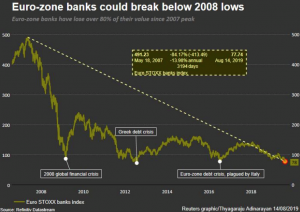
    The following chart is considered by a number of highly experienced market professionals as the most important risk signal in the world today:

    Spark-crowdfunding

    Irish readers will have very vivid memories of the 2008-2009 banking crisis. However, flashbacks are about to become more graphic now that Eurozone bank share prices in aggregate are revisiting the catastrophic lows of 2008.

    The long-run carnage visited upon European banking shares is quite staggering with prices on average down 84% from levels in the halcyon tiger days of 2007.

    Unlike short term foreign exchange moves or gold price spikes, this type of multi-year share price decline is indicative of a structural change in the banking business model and begs the question what will “finance” jobs look like 10 years from now?

    Let’s start with 10 working days from now…

    As market traders return from the beaches to their desks, and if this daily evaporation of banking equity continues, we can quite quickly expect headlines about Bank A, B or C sounding out market advisors about raising capital.

    The ugly truth is that European banks with wafer thin equity values will be perceived as having too little capital to support enormous asset bases. And, assets in  banking terms means loans.

    Think about French mega-bank, BNP, with equity values of €56 billion supporting an asset base of €2.2 trillion. Or how about the German car-crash, Deutsche Bank, with €12 billion equity supporting just the €1.4 trillion of assets.

    We are one shock(Brexit?) away from some very panicky banking days.

    For those that believe Europe’s banking problems are the result of ultra low or negative interest rates, think again. Low interest rates definitely don’t help profit margins but the major driver of banking zombiedom is the failure of banking authorities and managements to deal with problem loans post the 2008 credit freeze.

    This writer, from a previous life on Japanese trading desks, would be keen to remind readers that Japan’s banks really only started to disappear/collapse 10 years after the initial Nikkei collapse in 1989.

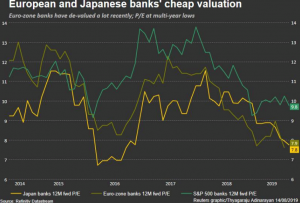
    For a more graphic reminder of how Japanified the Eurozone banks have become this Reuters chart is rather good at showing how closely Europe’s banks have tracked Japan’s since 2012 and how similarly the market now values both regions’ zombies:

    Spark Crowdfunding

    On a more positive note, Irish banks were forced by the ECB/IMF to take a lot of pain in the early days of GFC and, while not out of the woods, are possibly in better shape then many other European banking names.

    Of course, a sick European banking system is not good news but, again, on a more positive note the emergence of digital business/financial platforms has democratized finance significantly.

    Grads out there, the good news is those economics and finance degrees will more than likely be employed by new types of financial platforms. Who knew five years ago Alipay would have a billion customers?

    Furthermore, if the banking system continues to shrink, expect equity crowdfunding platforms to play a much more significant role in funding young businesses.

    Business owners should also be paying serious attention to building future “banking” relationships and could do worse than consider trial crowdfunding campaigns as an introduction to same.

    So it’s not quite Japocalypse Now….. but keep watching that chart.