Tag: Bitcoin

  • Watch Big Leadership Changes…

    Watch Big Leadership Changes…

    We do need heroes. As Irish rugby lost one this week (F.S. RIP), I was reminded of those dark days in the 1970s and 1980s and the importance of uplifting heroes at a time when Ireland needed leadership and inspiration. Regular readers of this weekly piece will know I have been very concerned about leadership on a global level for quite some time. The challenges of the breakdown of world order, AI, Ukraine, Gaza/Lebanon, climate change and the success of misinformation at the expense of truth, are crying out for leaders. At times, the challenges feel overwhelming. However, we can still be inspired and encouraged. Think back to Russia’s invasion of Ukraine on 24th February 2022. The consensus view was that Ukraine would be conquered in a matter of  days. As the conflict moves into its 5th year and surpasses even the duration of WW2 for the former Soviet Union, all is utterly changed. And, Europe might have a genuine hero.

    The 82nd anniversary of the pivotal D-Day “Operation Overlord” landings of World War II were celebrated this weekend. Melvin Hurwitz, 99 years old and one of the last surviving veterans of the Omaha Beach landing, was back there again. As was Ukraine’s President Zelensky. Melvin took the opportunity to pull Zelensky close to him and the stage microphones picked up the veteran’s words – “You’re the saviour of the people. You’re my hero”. Zelensky quickly responded, “No, no. You saved Europe. You are our hero”. Classy stuff. Two men, who both know the value and ideals of defeating totalitarian aggression. Meanwhile, a criminal grifter in Washington presides over the East Wing of the White House lying in ruins and the South Lawn playing host to a UFC fighting cage. Institutional vandalism on full display. Trump is not alone in being exposed by true heroes. Vladimir Putin woke up last Friday morning for his “Davos-for-Dictators” world economic forum to see the host city, St Petersburg, 1,100 kms from Ukraine, buzzed by drones and rocked by explosions at fuel/energy and Baltic Fleet military facilities. Incredible. Four years ago, drone “technology” amounted to grenades dropped through tank turret hatches from quadcopters purchased at Circuit City. This year Ukraine will manufacture 4 million drones of dizzying long-range and short-range capabilities.

    Arguably, Friday 5th June 2026 might well have been D-Day (drone day) for Vladimir Putin. Ukraine is  ‘winning’ this war. Russian supply chains and oil refining assets are being decimated, and military casualties at more than 1,000 per day are exceeding the numbers of replacement troops being rushed to the front lines. The Ukrainians are now destroying Russian battlefield positions without using any ground troops, just unmanned ground vehicles and watchful lethal drones in the skies. At a fraction of the cost of the annual $1 trillion US defence budget, Ukraine has changed ‘war gaming’ assumptions and possibly revealed the obsolescence of large portions of modern military weaponry and delivery equipment. Ukraine is not the only European technology leader receiving attention this week.

    Nvidia might capture the financial market headlines with its AI semiconductor chip dominance. However, it is interesting to read an increasing number of stories about AI chip competition and efforts by Big Tech like Google and Microsoft to customize their own AI chips. Let’s just say monopolistic 75%-80% gross margins enjoyed by Nvidia might not be a long-term sure thing. In fact, the entire AI chip ecosystem has a number of monopoly-like players. What about the equipment essential for every leading-edge chip manufacturing facility? Well, the standout monopolistic player in extreme-ultraviolet (EUV) lithography machines is a Dutch company. ASML, based in Veldhoven, was only founded in 1984, but has just become Europe’s most valuable company with a market capitalisation of more than $600 billion. Its customers are global, Chinese, TSMC, Apple suppliers, Intel, Hynix, Samsung etc. The mention of the last two companies is deliberate. Both these Korean manufacturers of memory chips for AI are considered ‘essential’ and have earned $1 trillion valuations. My sense is that ASML (and its relatively small 53% gross margins) is even more critical for the AI chip ecosystem…..so Europe might soon have its first trillion dollar 1980s ‘baby’.

    Sticking with European leadership, but at a sovereign level, Germany is fast losing stature. The failure to secure the ‘slam dunk’ certainty of a rotating seat on the UN Security Council reflects Germany’s abdication of leadership on anything from Ukraine to Gaza to China. The fact that relatively small European powers like Austria and Portugal were trusted more by voting nations to bring leadership to the UN has caused national introspection, and fury. And, the next European piece of leadership news won’t ease Teutonic tantrums. Germany’s perennial European rival, France, has just secured a whopping €75 billion investment commitment from Japan’s Softbank to focus its European data centre building efforts in the Gallic nation. Despite Macron’s domestic unpopularity, it does feel like France, with AI wonder-kid Mistral in the innovation vanguard, is stealing a European march in the global AI race.  Of course, not all wonder-kids grow up to deliver.

    My final thought on leadership change is in the crypto world. Bitcoin is now off 50% from its all-time highs, and one recent development hints at further trouble ahead. One of the key cheerleaders of the Bitcoin revolution has been Michael Saylor and his publicly listed MicroStrategy vehicle. Saylor’s vehicle has been a perma-buyer of Bitcoin since 2020. This dogged purchasing strategy has accumulated almost 850,000 Bitcoins which equates to 4% of total Bitcoin supply. But, last week the MicroStrategy vehicle tried to sell ….. 32 Bitcoins. Yes, thirty two at a value of just $2.5 million (circa $75,000 price). And the crypto market puked. Bitcoin has dropped below $60,000 and MicroStrategy’s share price is 78% off its all-time highs. Saylor’s strategy is now sitting on nearly $12 billion of unrealized losses. And, I’ve seen him explain and try to give comfort to investors in US TV interviews. It wasn’t pretty, or in any way financially logical. As the Strait of Hormuz continues to be strangled in non-negotiation by the “Art of The Deal” self-promoter, we should be wary of cheerleaders. They usually don’t turn out to be heroes.


  • Banks Are So Back!!!

    Banks Are So Back!!!

    It’s a weird world right now. I endured another episode of “The Celebrity Traitors” last night and wondered how the US version would work without offending the Kremlin ‘besties’ and reality TV cast of Mar-a-Lago. And who knew Joe Marler would out-smart Stephen Fry? Serious kudos to the rugby front row forwards fraternity. Anyway, park reality TV and let’s face market reality. Another weird one very close to home – Irish banks are now achieving 89% customer satisfaction ratings. It’s amazing what one can achieve by leaving the small business sector completely unbanked in terms of risk capital. However, it can’t be denied that banks are SO back in a global sense. And, some are really ratcheting up the risk dial. Today’s article is really a whistlestop tour of global financial sector developments which caught the eye in recent weeks.

    Let’s kick off with Blackrock Inc. It’s results season and Larry Fink’s giant asset manager recorded net inflows of investment monies in excess of $250 billion in Q3 alone. Blackrock’s current total assets under management (AUM) have just hit a record $13.5 trillion, yep trillion. You might say Blackrock is not a bank but if you look closer at those investment inflows, you’ll see private credit(lending) is a huge driver of asset growth. You’d be right in thinking that other institutions are competing or replacing banks in the financing space. That trend brings its own risks. Indeed, the IMF took the opportunity in its 6 monthly Financial Stability Report to warn about “the rapid growth of non-bank financial institutions”. Then, the EU’s Single Resolution Board (which ultimately sorts bank collapses) also warned this week of the “dire” consequences of a non-bank failure. Sounds nervy, but the financial services sector is enjoying record growth thanks to the lack of nerves among investors…

    Robinhood, the trading platform loved by meme-stock and crypto fund day-traders, has seen its share price rocket by 250% since January this year. Then check out Charles Schwab, the US broker/trading platform which started out in commercial life as a newsletter with 3,000 subscribers, and was briefly owned by Bank of America in the 1980s. I had to wipe my eyes on this one, but Schwab now holds $11.6 trillion of investor assets and has just announced its intention to offer digital currency (crypto) trading in 2026. That number was just over $4 trillion when Covid-19 struck. This growth in assets can be equated to the growth of balance sheets and collateral to be used in further investing activity. We can’t avoid mentioning AI but the infrastructure spending by cash rich tech giants is another boon for investment bankers. The latest data from research house, Gartner, is that global AI spending will be $2 trillion in 2026. Amazingly, the star of our most recent article, OpenAI, sits in the middle of $1 trillion of that spending. Needless to say, Wall Street investment banks are doing cartwheels as big tech names compete with each other to announce bigger and bigger spending plans as their share prices(and executive option pools) rocket on each headline. No wonder luxury laggard, LVMH, is seeing its share price suddenly perk up. It’s not alone.

    Investment banking blue chips like JP Morgan, Morgan Stanley and Goldman Sachs all posted record equity trading activity and revenues. The Daily Upside summed up the joy across the wealth and brokerage spectrum:


    “Results from other financial firms this week also showed that clients from scrappy retail traders to high-net-worth jetsetters are hankering for equities and investments. Wealth units at Bank of America  (revenue up 19% year over year to $1.3 billion), Goldman Sachs (up 17% to $4.4 billion), Morgan Stanley (up 13% to $8.2 billion) and more notched high marks. Customer assets at Schwab competitor Interactive Brokers rose 40% to $757.5 billion, and daily trades there rose 47% to $3.86 million.” 


    But it is a weird world. The crypto universe cratered last weekend as Bitcoin elevator-shafted investors with a 20% drop in price from $126,000 to $105,000. Then gold keeps marching remorselessly to $5,000/oz in $100 clips. There is a sense that different cohorts of investors are buying different assets but there’s enough liquidity (investment flow) to drive EVERYTHING upwards. It was striking to see in Schwab’s record inflows that Gen Z and Millenial investors accounted for a third each of new accounts being set up and looking for equity exposure mainly. Meanwhile in California, there’s a new bank coming. Erebor is a new crypto-focused bank which received federal approval this week. The excellent Morning Brew newsletter reports:


    “The new venture will offer traditional and crypto-oriented banking to upstart tech companies and the ultrawealthy, according to its charter application and approval letter. It needs another stamp of approval from more federal officials before operations can commence, but road bumps are unlikely under President Trump’s crypto-friendly administration.”


    Before you think it’s all crypto and AI out there, keep an eye on more familiar moves. Goldman Sachs has done an interesting deal buying Industry Ventures for nearly $1 billion. Small beer you might think, but Industry Ventures is in the venture capital ecosystem with $7 billion of VC assets bought from other VCs (known as secondaries). Clearly, Goldman is taking a view on more VC deals/exits happening and should be a boost for the start-up world. Oh, and JP Morgan are going to put $10 billion to work in nationally important industries and supply chains. In fact JP Morgan sees itself involved or banking $1.5 trillion of projects in the coming years. Here’s what those deals might look like…

    Meta/Facebook has just sealed a $30 billion private capital deal to finance its Hyperion data centre build in rural Louisiana. Here’s the kicker – Meta retains only 20% ownership. Morgan Stanley has arranged $27 billion of debt and $2.5 billion of equity in a special purpose vehicle (SPV). Yip, that’s a more than 10:1 debt-equity structure. Welcome to the world of superhero collateral in the form of AI infrastructure. This is the largest private capital deal ever but expect many more over the next few years. Of course, there are concerns.

    FT headlines this week highlighted poorly structured loans (read opaque dodgy) going wallop and hitting US regional banks’ share prices badly. Also, volatility in financial markets is picking up. However, the key drivers of global investment activity are big tech firms, private capital, sovereign funds etc and they have trillions of cash and collateral to deploy. This is not quite TMT era when the major players, telcos and media, were already swamped with debt. Returns on investment will obviously be the metric to watch in the future but arguably we are a few years away yet from getting visibility on AI’s payback. So get ready for more deals, more AI and more financial services profit joy. You’d almost be tempted to get exposure to these big structural trends. Well….. keep your eyes peeled next week as Spark Private will have a very interesting deal for you with a strong blend of alternative assets, financial services and AI baked into the offer.

    We are SOOOO back.

  • The Euphoric Wisdom Of Crowds

    The Euphoric Wisdom Of Crowds

    I laughed a lot at a very sad funeral this week. Emotions, eh. I’m hopeful this weird juxta-positioning of emotions is a kind of human coping strategy, rather than a sociopathic tell. Then again, the mourning crowd laughed at the brilliant life narration too. Back at my desk, a flurry of headlines hitting the screen prompted a further emotional conflict. Surging extreme weather events globally, Europe battered by tariff tyranny, Gaza starved and Ukrainian cities terrorised by Russian bombardment are hardly sources of optimism for the progress of our species. And, yet……I’m picking up a very euphoric vibe from the financial markets. Strangely for this publication, I’m not that interested in retro-fitting the euphoria with some financial rationale along the lines of falling cost of money(rates), corporate earnings, tech innovation or economic cycles. The sheer phenomenon of financial euphoria is worth highlighting first. Then we can do some thinking, all of us.  Now for the euphoria…..

    The “wisdom of crowds” leans on the idea that large groups of people (markets) are collectively more likely to be correct than individual experts. What is particularly striking about current financial market behaviours is that there is a wide variety of “crowds” ignoring the gloom-filled headlines and seeing a better future out there. However, that optimism is not exactly a new phenomenon. Note that financial markets typically enjoy positive returns in seven out of every ten years. In other words, it pays off to be relatively optimistic. However, in this piece we are looking at something more, evidence of euphoric excess. Let’s try a few of these crowds for starters…..


    *The crypto crowd: Bitcoin is hitting record highs of $118,000 while the entire crypto ecosystem has now surpassed $4 trillion in value.

    *The IT crowd: If one uses pre-2018 sector classifications, then technology stocks’ weighting in the S&P 500 is above 45%. That’s way higher than the dotcom bubble of 2000.

    *The ‘Magnificent 7’ crowd: There’s now, not one, but two Big Tech companies with market values in excess of $4 trillion. For context (and wobbly comparison), the $8 trillion combination of Microsoft and Nvidia alone would rank 3rd globally as a single country GDP.  

    *The meme-stock crowd: In 2021 it was Gamestop and the Robinhood day-traders. Now, it’s Kohl,’s (retail) Krispy Kreme(donuts) OpenDoor (estate agent) and American Eagle with Sydney Sweeney dominating social media, chat rooms and…. Wall Street trading volumes.

    *The AI/Cloud crowd: Earlier in the year Microsoft CEO, Satya Nadella, in a Davos interview stated he “was good for $80 billion of investment in 2025” in AI/Cloud infrastructure. Scratch that. This week he said the number will be $120 billion. Google said $85 billion (up from $75 billion) as Big Tech companies look like they will do a giddy AI spend of close to $400 billion in 2025.

    *The M&A crowd: Research data from Pitchbook shows robust merger and acquisition (M&A) activity in Q2, marking the third consecutive quarter for deal value to hit about $1 trillion across roughly 12,000 transactions. It’s not just tech showing confidence. Railway giants Norfolk Southern and Union Pacific are doing an $85 billion merger to create the first transcontinental railway line in US history.

    *The retail crowd: Barclays research points to retail investors as the “primary driver” of the recent stock market rally. In the past month alone, retail investors poured $50 billion into US stocks and now account for up to 20% of daily trading volume on Wall Street. That’s double the levels seen before the pandemic.

    *The VC crowd: The challenged venture capital (VC) world has been looking for a genuine positive pulse-take via an IPO exit. As I write, Greylock Partners, Sequoia and Index Venture will be the VCs doing cartwheels tonight after the largest VC-backed tech IPO in years, Figma, tripled in value within hours of its NYSE debut to almost $50 billion. Or… will they be wondering how they got the selling (IPO) price so wrong?

    It is entirely possible many of the above trends are rooted in fundamental investment theses but suggestions of dangerous  “euphoria” can be found in aggregate valuations of US stocks. The average price/sales valuation multiple (per Bloomberg) for US stocks is a punchy 3.3x. Furthermore, Warren Buffett’s favoured sanity check of comparing the market value(cap) of all publicly traded US companies with total US GDP currently stands at 212%. As a risk guide, Warren is usually uneasy when that number is over 100%. My own two personal favourites in the euphoria beauty parade are more esoteric but tell their own stories.

    First, it is no secret Facebook/Meta and others in the AI “arms race” are desperately looking for AI talent. However, the numbers are starting to look bonkers. According to Wired magazine, at least one prospective employee was offered a 3-year billion dollar salary package to join Meta. Others were offered hundreds of millions (rumoured to be Mira Murati’s Thinking Machines Lab team) but here’s the best bit…. the prospective hires turned down the offers!! Now, here’s a few other proposals that were turned down as recently as November 2022.

    If that date sounds familiar, you might have been vowing to stay away from markets at the time as stocks hit bear market lows spooked by rising global interest rates. Online car retailer, Carvana, was “on sale” that day after its share price had collapsed by almost 99% from its highs the previous year. Nobody wanted to touch it. As of today, it’s up more than 10,000% since then. Fear and greed, emotions eh. Oh, and Meta’s share price on that day after a rough year for the Zuck was $88.91 per share. It’s up almost 800% since then but here’s the best bit….in barely one trading session after its excellent quarterly results this week, Meta’s share price jumped by about $88.91 per share. That number sound familiar?

    No more teasing. The key point is that confidence is surging in public markets. The quieter, less public private markets have struggled to generate similar headlines. Yes, there are pockets of excess. However, it would be foolish to ignore the ‘wisdom’ of the public market crowds. Ultimately, higher trading activity levels, record capex investment, big M&A deals and higher valuations will feed into private markets and smaller companies. Indeed, you might have to get used to the giddy headlines for a bit longer. Goldman Sachs have done a bit of historical analysis and concluded that spikes in speculative trading actually precede abnormally high returns on a one-year time horizon. Don’t stay too long at the beach….the YOLO crowd might be on to something.


                                      N.H.  RIP


  • Watch Out For The New Stable Empire Build

    Watch Out For The New Stable Empire Build

    Stability wouldn’t be the word of the week. Middle East war, Indian air crash tragedy, horrific school shooting in Graz, the US Marine Corp deployed in Los Angeles and the death of America’s Mozart, Brian Wilson. But… the ground-breaking Beach Boy might also SMILE**. Tortured by mental health challenges for most of his life, his genius is rightly being recognised at a rather weird moment. Thousands of miles away from the Californian beaches which inspired a true genius, a delusional “stable genius” is marking his birthday with a military parade in Washington. The irony indeed of a wannabe emperor, without clothes or genius. However, the sharper minds out there have been busy building another type of empire….Here’s a few timely illustrations.

    Stripe kicked off the week with the $1 billion acquisition of Privy. This is Stripe’s second billion dollar acquisition in less than six months (Bridge $1.1 billion in February) in the area of stablecoins. As a quick refresher, stablecoins are digital currencies (crypto) built on blockchain technology whose value are fixed to the value of a recognized liquid security or currency. In the vast majority of cases the “stable” part of a stablecoin is the world’s chosen reserve currency, the US dollar. This means that these stablecoins can be instantly exchanged for US dollars, in most cases, at a 1:1 ratio (FX rate). However, I only use the “FX rate” terminology to assist understanding because stablecoins operate differently, and have one massive potential advantage over typical foreign exchange (FX) rates. They cut out all the intermediaries’ costs and “toll takers” that drive us all to distraction at airports when it feels like a robbery rather than a financial service has taken place. This digital capacity to cut out costs and deliver ‘frictionless’ currency services has been identified by Stripe as an enormous opportunity to “grow the GDP of the internet”, namely e-commerce. Two deals in 6 months demonstrate that strategic appetite.

    Stripe, as a global leader payments platform, bought Bridge specifically as a platform for payments in stablecoins. Bridge provides the payments infrastructure for financial services companies to issue stablecoin-linked Visa cards. So, that covers the payments bit but Stripe has moved further into stablecoin infrastructure with its Privy acquisition. As Stripe CEO, Patrick Collison put it, “Money has to reside somewhere, and Privy builds the world’s best programmable vaults. Alongside our other stablecoin work, we’re looking forward to enabling a new generation of global, internet-native financial services.” In relatively simple terms, Stripe has acquired the ability to handle stablecoin payments AND the digital wallets (vaults) needed to store those digital currencies. Note, this is not some futuristic ‘bet’. This is a very current service. Indeed, Mastercard reckon one third of Latin American consumers have already used stablecoins for purchases. And, it’s not just “Main Street” embracing stablecoins. Wall Street is buzzing this week.

    The IPO of Circle on the NYSE was 25x over-subscribed before it even began trading last week. Circle is the issuer of probably the safest and most transparent stablecoins, USDC, which is pegged 1:1 with the US dollar. By the end of its first week of trading, Circle’s share price had rocketed 378% above the IPO price to reach a valuation of $32 billion. Clearly, Wall Street’s frenzied embrace of digital currencies, wallets, payments etc could spell trouble for the traditional custodians of currency storage and movement, the banks. They are moving too.

    French banking giant, Societe Generale, announced this week plans to launch a publicly tradable dollar-backed stablecoin. Societe Generale is the first major bank to enter the stablecoin market and has named its new digital currency “USD CoinVertible”. Meanwhile, in the US, Congress is poised to pass legislation to create a regulatory framework for stablecoins. Bank of America could launch a stablecoin, its CEO said earlier this year, and some other large banks are also considering issuing a joint stablecoin. The banks won’t be alone.

    The world’s two biggest retailers, Amazon and Walmart, are looking into issuing their own stablecoins for US customers to use at checkout instead of credit or debit cards, the Wall Street Journal reported yesterday. The WSJ article suggested other big companies, including Expedia and some airlines, are also considering the move. The motive is simple and relates to my earlier explainer. Costs. Stablecoins are hugely attractive digital innovations to process payments quickly and potentially save corporations billions of dollars in swipe fees that they pay every year to credit card companies, banks, and fintech startups like Toast and Square. Businesses forked out over $172 billion in US transaction fees in 2023, a near 50% increase from before the pandemic, as more customers went contactless. Even Washington is taking notice, and is moving legislation with, again, a teeny weeny bit of irony….

    The US Congress is due to vote on a bill known as the GENIUS Act (the other crypto legislation due is the STABLE Act, I kid you not)  which would give private companies a blueprint for issuing their own stablecoins. That vote could be as soon as Monday, and rely on a body politic flushed with the narcissistic joy of watching a military parade on the streets of Washington DC – an exercise once the autocratic preserve of the Kremlin, Beijing or Pyongyang. It’s a strange new world, but there is still real genius and opportunity out there.  Watch that stablecoin empire build….


    **Brian Wilson and the Beach Boys began recording their album, Smile, in 1966. Brian was convinced it would be his masterpiece. Struggles with mental health intervened, and delayed the release of the album until almost 40 years later. TIME magazine described its ultimate arrival as “rapturously received” and ranked it as one of the ten best comeback albums of all time.


  • Three Winning Hidden Trends

    Three Winning Hidden Trends

    I was tempted. The “buddy breakup” in Washington between the Taco Toddler and the Ketamine Kid is fabulous writing material. But, no. The real risk these days is being distracted by America’s slide towards lawless autocracy and missing something bigger. Eighty one years ago on a June 5th morning President Roosevelt brought good news to the American people and its allies. Rome had been liberated by Allied troops – “The first of the Axis capitals is now in our hands.” Little did Roosevelt’s audience know that later that day paratroopers would be dropped into northern France ahead of 7,000 ships landing on the D-Day beaches of Normandy on June 6th. Fast forward to that anniversary today, and there are winning opportunities again being potentially obscured by Washington broadcasts. Indeed, it’s possible you may have missed some striking data updates to three huge investment trends this week. Let’s dive in.

    Last month at its annual Stripe Sessions conference, CEO Patrick Collison identified the “gale-force tailwinds” of AI and stablecoins. The first tailwind trend won’t be a surprise to any readers of our AI article last week but it was intriguing to hear Collison say, “Stablecoins are the underdog everyone’s sleeping on.”  He also had an interesting take on the macro “noise” and uncertainty prevalent in today’s business world – “when new technologies collide with a turbulent economy, the technology tends to win”. That seems a prescient call this week when we briefly touch on AI and reflect on its chip champion, Nvidia, revealing its latest quarterly results. Despite tariff disruption of its China business, Nvidia beat Wall Street analyst expectations and regained its status as the world’s most valuable company. Thanks to a 50% surge is its share price over the last 8 weeks, Jensen Huang’s chip behemoth is worth $3.4 trillion. The latest data point on stablecoins was also quite eye-catching.

    Not long ago Circle Internet Group was saved by the US government when Washington guaranteed deposits at the collapsing Silicon Valley Bank(SVB). Circle as an issuer of dollar-backed stablecoins was the top dollar depositor customer at SVB. However, this week the newsflow was way more optimistic as Circle waited to IPO on the New York Stock Exchange. Reports suggested investor interest was massive and the listing was 25x over-subscribed. Not surprisingly, with more buyers than sellers, Circle’s share price surged 168% on its first day of trading to a valuation just shy of $17 billion. It’s difficult not to conclude that stablecoins have “arrived” and investors are excited by Collison’s own description of stablecoins’ “real world utility in regular business”. In fact Stripe confirmed stablecoin issuance has increased by 39% year-on-year while “demand for borderless financial services go through the roof….at a growth rate which eclipses anything we’ve seen before in Stripe”. Ok, that’s two winning trends. The last one won’t surprise but the numbers might.

    Private equity (PE) and its billionaire leaders could be doubting their love-in with the Taco Toddler but they are not the only PE-related cohort in doubting mode. PE investors are quietly wondering how private equity houses are going to deploy the $1.2 trillion of ‘dry powder’ which is currently sitting on the side-lines and hurting overall return on investment (ROI) figures. A quarter of that massive total has been available for the last 4 years (Source: Bain &Co). However, there is no doubting our mantra “the future is private” when you consider private equity now controls a record 29,000 companies worth more than $3.6 trillion.  But, there are cyclical challenges. Higher interest rates, reduced IPO activity and M&A paralysis (execs can’t Taco trade those deals) don’t help valuations or exits so it’s worth noting global PE fundraising has declined for 5 straight quarters. Global PE raises in Q1 were down 33% per Pitchbook/Bloomberg reports but that cycle might be about to shift. The Wall Street Journal this week reported that the software-focused PE giant, Thoma Bravo, has just raised a staggering $34.4 billion which is the biggest funding round since the start of 2024.

    As a final thought, one must be mindful that as investment funds become bigger and bigger their opportunity pool shrinks due to size and liquidity constraints. On the other hand, as the ECB cuts interest rates, Ireland GDP growth hits almost 10%, German equities touch all-time highs and Trumpolini begs President Xi for a trade détente, it is arguably a particularly good time for investors to think small, and think private. So, if you want to build a private asset portfolio quickly, Spark Private can certainly help with a very exciting summer EIIS** pipeline of PhD-packed medtech innovations, real-time AI applications, 3-year infrastructure exits and super-growth software stories. Do not be distracted. Check out www.sparkprivate.com  and, as my old boss used to say, “They ain’t door numbers, they move !!”.

    ** EIIS tax rebates of 35-50% on your 2025 personal income tax.


  • Big Numbers That Can’t Be Missed

    Big Numbers That Can’t Be Missed

    Now, it’s my turn. I get to vote this week. For lots of busy good reasons, I haven’t read a huge amount on our own election but there’s no doubt it is important. However, I’m conscious I’m just one of 4 billion people voting in the current 12 month period. This also prompts another nagging feeling that it is external events over the lifetime of the next government which will define it. From Ukraine, to Utah, to even Mars, our planet is at an inflection point. The ‘world order’ is dangerously shifting as North Korean troops enter a European conflict zone for the first time, and yet, it would be ill-advised to down tools and just wait. There are other themes and trajectories already established and unlikely to change. Simply put, the numbers are now too big. And, we will continue to watch SIX in particular.

    Artificial Intelligence: It is striking to see various commentaries question the real ‘value’ of AI. During the summer, Goldman Sachs estimated that tech companies were about to spend $1 trillion on AI but queried whether they would ever earn a return on this capital expenditure. Fair question, but there’s another point to be made. The ‘winner takes all’ nature of this tech arms race is existential. The poster child of the AI revolution is Nvidia. Yet again, it smashed analyst forecasts this week in its latest quarterly results. My takeaway is that, of course, there will be misallocation of capital in this existential race but tech companies are going to continue to spend to stay in the race. ‘Exhibit A’ must be Nvidia’s own revenues in its data centre chip division. A whopping $30.8 billion revenues generated in the last quarter revealed a growth rate of 112% vs a year ago. Also, for context, this division has increased its quarterly revenue 7-fold since the early quarters of last year. Note, data centres are the battle ground where AI models are tested and trained, and this trend is set to continue.

    Cleantech: European cleantech suffered a blow this week as Northvolt sought Chapter 11 bankruptcy protection from its creditors. It’s a significant blow to Europe’s efforts to decouple from its dependency on China for electrical vehicle (EV) battery materials, chemistry, design and manufacture. Northvolt tried to deliver in all four process functions and received $15 billion of investment backing to do so. This has been a very expensive way to experience execution risk; both Goldman Sachs and VW have written off investments in Northvolt of $1 billion each. However, just like AI, loss is a recurring feature in any new technology area. So, keep an eye on the big numbers. In this instance, the EU is outspending the US with a $125 billion spend in 2023 (vs $86 billion). But….. China is really the cleantech benchmark. The Middle Kingdom spent $390 billion in 2023 across renewables, carbon capture, utilization and storage, hydrogen, batteries and nuclear power.

    Space: Elon Musk’s SpaceX is the most valuable private company on the planet with a recent funding mark indicating a $250 billion valuation, ahead of ByteDance (parent company of TikTok) on $225 billion. At current pace, it is launching its Starlink satellites (via Falcon 5 rockets) every 2.8 days. If you’re just about getting your head around that launch frequency think about Space X’s massive re-usable Starship which completed its 7th test flight last week. Its payload capacity is 150 tonnes and the plan is for Starship to do two launches…. daily. Now, what if the entire tonnage launched into space in history has been just shy of 40,000 tonnes? That means in the very very near future, Starship alone would be capable of repeating the entire payload history of space in just over 4 months. I’m not sure we have grasped the enormity of this feat and the implications for industries like telecommunications, mining, military defence, tourism, manufacturing or even housing (on Mars?).

    Crypto/Blockchain: Bitcoin is on the cusp of breaking the $100,000 mark. However, we need to start thinking about the entire crypto/blockchain ecosystem. Check out MicroStrategy which on the face of it is a loss-making software business but since 2020 has been investing in Bitcoin. If you thought Nvidia was the best performing share price in the world you’d be nearly correct – it has delivered 2660% returns to shareholders in the last 7 years. But….. MicroStrategy has rocketed by 3420%. Its current market value is $117 billion, making it more valuable than Nike, UPS or Starbucks. Of course, MicroStrategy is a leveraged play on Bitcoin but there are other ways to ‘leverage’ the rapid expansion of stablecoins, crypto funds, tokenisation, blockchain etc. The crypto asset ecosystem has just passed the $3 trillion valuation mark which exceeds the asset value of most countries’ stock markets. These numbers, and the opportunities to plug into this investment pool, are too big to miss…or ignore.

    Banks: It would be easy to move on to the ‘next shiny thing’ in the space or crypto universe but the banking sector is worth watching right now. Governments are finally getting good selling prices (even premia) for rescued bank shares as the UK (Nat West), Germany (Commerzbank), Ireland(AIB), Greece (Piraeus Bank), the Netherlands (ABN-AMRO) and Italy (Monte dei Paschi) all reduce sovereign shareholdings or exit altogether. As an aside, and interesting contrast to ‘shiny new things’  Monte dei Paschi began commercially lending 20 years before Christopher Columbus’s trip to America was financed. Anyway, old or not, the bank sector is hotting up. Breaking news over the weekend suggests Italy’s Unicredito will make a €10 billion + bid for rival BPM, and note Unicredito is already circling Germany’s Commerzbank. Also, it is worth noting that the tax/accounting professional services arm of UK wealth player, Evelyn Partners, has just been bought by private equity (Apax) for £700m. That is significantly more than the £500 million price tag suggested by City analysts.

    Technology Rotation: We have written previously about the particularly strong comeback for technology hardware thanks to AI, semiconductors, EVs and iPhones. The world has become very used to these themes powering the “Magnificent Seven” – Microsoft, Apple, Nvidia, Google, Meta, Amazon and Tesla – to all-time-highs but this analysis of last week’s technology price action in the newsletter, Clouded Judgment, caught the eye:


    This week saw the rapid acceleration of an interesting trend that started not too long ago – Magnificent 7 underperformance and software outperformance. Might this be the start of a rotation into software and growth (ie more risky assets)? Meta was down 3% over the last week. Amazon was down 7%. Microsoft down 3%. Google down 6%. Nvidia flat. Apple / Tesla were slightly up. QQQ was down 1.5%. Meanwhile, the WCLD index was up 6% over the last week! In addition to that, there were some really big moves in individual names. Snowflake was up >30% on Thursday after reporting earnings on Wednesday, which lifted the rest of the software market. Also just on Thursday Mongo was up 14%, Confluent / Datadog / Cloudflare were each up 7%.


    As a reminder, the Magnificent 7 have an aggregate value of $13.5 trillion which is more than the GDPs of India, Germany and Japan combined. The potential risk of an investor rotation OUT of the Magnificent 7 is a multi-trillion dollar consideration, and also can’t be missed.

    Clearly, my vote can’t change any of the big numbers above. However, these are the numbers which are far more likely to define our investing and business futures on this island.


  • Banking On A Deal Frenzy

    Banking On A Deal Frenzy

    This hurts a bit. It kills me to potentially reward poor behaviour, but hey, I’m not nominated to be the Attorney General of the United States of America. The financial giants of Wall Street kept their heads down in the lead up to the US election. We didn’t hear too much commentary on the rule of law, inflationary tariffs or accelerating budget deficits. I mean…who needs property rights (law) or a functioning national balance sheet? Possibly, the infamous Leona Hemsley’s “little people” because they pay taxes, aka the price, in time. But, for now, there’s a very clear short-term calculation being made by Wall Street. A Trump administration determined to slash regulation and speed up commercial transactions is a godsend for bankers. Of course, Elon Musk, Tesla and Bitcoin are perceived as the early big ‘winners’ of a transactional incoming President. However, at a broader level the clear winner in the week since election is the enormous financial sector.

    US Financials are the best performing sector in the markets over the last week (+1.5%) while tech, telecoms, healthcare and materials all have actually booked negative returns for investors(Source: Finviz). That big picture split is interesting and highlights the very essence of what financials are about. It’s all about deals. More deals, more commissions, more fees, more revenues, more bonuses. What deals you ask? Let’s start with the biggies like massive M&A deals. In recent years, the broligarchs have been frustrated by FTC Commissioner, Lina Khan, who has blocked more than 30 corporate mergers/acquisitions on grounds of reduced competition. High-profile deals attracting government(FTC) scrutiny included Microsoft/Activision and Kroger/Albertsons. Only this week, the parent companies of luxury brands Coach and Michael Kors abandoned their merger due to FTC competition-based objections. No deal, no fees. Hence, a more lenient transaction-friendly FTC under Trump is expected to increase deal flow. And, not just in M&A.

    How do I put this delicately? Well, if the incoming Attorney General is already under investigation by his House of Representatives colleagues for sex trafficking, let’s just say the whole area of compliance could be significantly relaxed. We can expect more financial products to be launched and faster in a more relaxed regulatory environment. One area already due to increase activity levels is the IPO sector. Interestingly, Sweden’s Klarna has just announced its plans to list publicly (IPO). However, despite its Swedish home, Klarna is going to list in the US, not Europe. Oh, and Klarna is a financial company. It’s also a great comeback story – the buy-now-pay-later (BNPL) platform and its 85 million customers is heading for a $20 billion valuation. That’s a tripling of value since the fintech ‘winter’ of 2022. Note fintech is not the only survivor of the investor ‘winter’ of 2022…

    The cryptocurrency universe has already been perceived as a Trump regulatory relaxation winner. Bitcoin has rocketed to all-time-highs of $93,000 with an individual asset value of $1.7 trillion exceeding that of Facebook/Meta. The wider cryptocurrency ecosystem has achieved a market value of $3.2 trillion but the bigger story is possibly stablecoins (cryptocurrencies backed by liquid financial assets ). Again, I’d highlight ‘transactions’ as the opportunity for financial services platforms. Stablecoins were used in $8.5 trillion of transactions in the second quarter of this year. That’s more than double Visa’s transaction volume of $3.9 trillion. It also provides a pretty good clue as to why Stripe acquired stablecoin platform, Bridge, for $1.1 billion.

    For the avoidance of doubt, more transactions and deals is an overall positive. More exits, more funding, more deals… the circle of start-up life. At Spark we know more deals, exits and IPOs eventually feeds into the smaller regions of financial markets. We also know there’s a hefty €150 billion sitting in Irish bank accounts earning almost zero returns. It’s not just an Irish phenomenon. There is currently a record $7 trillion of cash sitting in US money-market funds. That’s not a huge surprise when one can earn 4-5% interest in these US deposit accounts for relatively minimal risk. However, watch out for lower US interest rates and increased mega deal headlines in the coming months. Then watch that cash move. And, not just in the USA.

    The EU economy is 99% driven by 26 million private small and medium sized businesses (SME) who account for €5.4 trillion of economic activity. The headlines will almost exclusively focus on the impact of a Trump regime on US multinationals, corporation tax, homeshoring etc. Rather like the trading evidence in markets of the past week, probably not much will really change for the “broligarchs” and the big tech multinationals. However, the markets are telling you financial services will enjoy greater deal activity which will feed through the global funding ecosystem. Indeed, right now there’s an all-time-high number of investment campaigns on the Spark platform (8) with interesting additional private asset/deal opportunities in the 2025 pipeline. We’ve written it before; the future is private.

    So, it seems like a good time to launch Spark Private, the personalised service to grow your private asset portfolio. More details on that next week, after you’ve finished gasping at AG Gaetz.

  • Silver Linings For Finishing 2nd Almost Everywhere…

    Silver Linings For Finishing 2nd Almost Everywhere…

    I blame the Irish. Should have seen it coming. Poor immigrants once upon a time, the changed perspectives were there for all to see. A couple of Kellys, a Mulvaney, a Spicer, a McMahon and a McGahn, all key lieutenants in the Trump 1.0 cabinet of 2017, championed Muslim bans, Mexican walls and family separations. I’m being flippant and skipping through a few decades of political evolution here but political integration of immigrant communities is a good thing. Take it as a genuine US presidential election positive. Of course, there will be plenty of Democratic Party navel-gazing and gnashing of teeth in the days and years ahead, but finishing second for the first time in 20 years (last popular vote loss was 2004) will focus minds on the stunning shift of ethnic minority voters to an anti-immigrant Trump ticket.

    Things looked bad for the Harris campaign very early on Tuesday evening. Hispanic-heavy Miami-Dade County in Florida had given Hilary Clinton a 30 point winning margin in 2016. On election day, Trump obliterated that by 40 points to secure a 10 point winning margin. There were other shockers – Star County (Texas and 97% Hispanic), Suffolk County (New York) and my personal favourite, Anson County in North Carolina. Republicans have won this 45% black county only once before since…. 1870. Wowzers. The purpose of this article is not to follow most post-mortem commentary and examine where the Democrat messaging didn’t connect but rather to highlight some potentially positive developments. If anything, the change in the mix of the Republican vote is more interesting. Try the dilution of white voting power.  The ‘dilution’ phrasing might surprise readers’ perceptions of what constitutes the Republican party base vote, but the scores are in:


    *Trump won less of the white vote this year (55%) than 2020 or 2016. And…


    *Harris (43%) did better with the white vote than Hilary Clinton or Joe Biden.


    *Hispanic men voted for Trump 54% vs 44% for Harris.


    The always excellent Noah Smith in his newsletter recalled a former Irish Republican, Ronald Reagan, saying that Latinos would eventually become Republicans. The social negatives attached to that shift are for another day but Smith highlights an even more important point for a polarised US society:


    “This largely destroys the narrative that non-white immigration will demographically drown White Americans under a tide of imported minority votes….. At some point, Republicans are going to realize this, and hopefully become less anxious about America’s racial future. Hopefully they will also realize that any attempt to make voting harder actually hurts them in the future, because the impact would fall disproportionately on their own base”.


    Oooooh Tucker Carlson might not like that narrative challenge to the “Great Replacement Theory”. But, there’s also another positive attached to this stunning shift in voting patterns. Harris lost so emphatically and so early that there was no dispute over electoral process. In fact, Trump improved his vote in 90% of all counties in the USA, and that includes Guam flipping to red. For those who hoped for decency, that feels like finishing 2nd just about everywhere. Many wanted democracy to prevail. It did, but with the anticipation that the “right” side probably had to win for a smooth transition, right? That caveat is for another day’s discussion too.

    Also, while we are on the topic of ‘right’, another stunner for me was that the white evangelical vote was 22% of the total vote and they voted 81-17 for Trump. Other voters who make up the remaining 78% of the electorate voted overwhelmingly for Harris by a 19 point margin (58-39). So, without white evangelicals Harris would have won the election by 20 points!  Let’s hope God is right……

    Meanwhile, for the socially agnostic financial markets, uncertainty is a wealth destroyer, paralyses decisions and kills investment activity. So, not surprisingly, there have been a few financial wins in the early days after the election. We’d highlight the following:


    *Banking and asset management stocks like Goldman Sachs, Blackstone, Blackrock, JP Morgan and Apollo all flew up by 10% or more.


    *The S&P 500 had its best day in 2 years and best ever post-election bump (+2.5%).


    *Elon Musk’s Tesla jumped 15%


    *Bitcoin’s price rise by 9% to $75,000.


    The Musk win is probably a struggle for some but the EV revolution is climate critical and hopefully keeps Trump tangentially on board with decarbonisation of the economy. Intriguingly, the presence of Musk as chief Trump mascot could bring a slightly contrary positive. There are some, including me, not comfortable with the billionaire “broligarchs” brazenly pushing their own commercial agendas. However, it would be a mistake to conclude that it is only the Republican party engaging billionaire promoters. The Democrats had their own, possibly glitzier line up of billionaires, influencers and celebs. And, the big strategic mistake would be to react to a Jaws-like electoral savaging by suggesting “we need a bigger boat” or better billionaires. That boat has sailed. The positive lesson from this would be to “listen” and start exerting proactive power.

    One of the critical shifts in voting patterns was urban voting. Democrats still won the big cities but the winning margins were embarrassingly small compared to double-digit history. Urban voters in the likes of New Jersey, New York, Chicago, San Francisco and Detroit have witnessed a disgraceful decline in the condition of their cities. And, other urban voters have noticed. Where Democrats have governing power, they need to deliver better city living. Security, mental healthcare, housing, crime and infrastructure are very real challenges experienced, in particular, by the lower middle and working classes. Investment and solutions to these challenges will improve urban lives and win votes.

    Commentators recently described the US voter base as one now split evenly across three cohorts: i) white college-educated, ii) white non-college educated and iii) everybody non-white. Currently, the Republican party is connecting more effectively and adding voters with two of those three. The Democratic Party should be surprised and concerned about the only one with which they are growing/connecting. The good news is that the key driver of political power in today’s America is not ideology or race. The winning factor is DELIVERY, perceived or promised. Clearly, social growth and stability are important for a nation but there’s a price for everything. In this instance, the price (inflation) – and a perception of social agenda prioritisation – was too high. Just ask Latinos, now known as “Latinx” in Democratic Party literature.

    For investors, less financial regulation, lower technology oversight(AI) and more deals (M&A, IPOs) all promise more exits and further investment cycles. All good news, until it’s not. Note, only 15 years ago the world paid a shattering economic price for deregulation of financial credit markets. Go back another two decades, and here’s a final thought for the autocracy delivery (over democracy) fans out there celebrating technology and commercial freedom…….

    The last global authoritarian empire to implode was tipped into collapse by lies and a catastrophic failure of technology .


    “Every lie we tell incurs a debt to the truth. Sooner or later, that debt is paid”


    Valery Legasov, chief of the Chernobyl disaster investigative commission.

  • Is The World Going Full Oligarch?

    Is The World Going Full Oligarch?

    The lettuces won’t be happy. It looks like the UK’s new Chancellor of The Exchequer, Rachel Reeves, and her Autumn Budget 2024 will survive a relatively benign financial market reaction. So far, government debt (Gilts) markets are stable and the domestic-focused FTSE 250 stock index has bounced slightly. Liz Truss will shake her head in delusion but the more understanding reality of today’s world is that the government of the world’s 5th biggest economy was brought down by international asset traders back in October 2022. It probably won’t be the last sovereign state to lose power to commercial interests and yes, money. Simply put, at exactly the wrong moment in time, many of the world’s governments’ ATM spending cards are about to be declined. Check out the following recent headlines:


    Interest payments on the national debt (US) top $1 trillion as deficit swells  –   CNBC


    IMF warns Japan of debt deterioration in the event of future shock   –   The Japan Times


    Why France’s fiscal freak out matters to the world  – Axios


    China’s Fiscal Package Aims To Ease Debt Woes, Property Crisis   –  Asia Financial


    There’s never a good time for fiscal capacity to be tight. But… literally the planet’s survival is at stake. The climate crisis is everyone’s crisis but governments are expected to lead. Indeed, according to the IEA, governments globally in 2023 spent $1.3 trillion or 1.2% of global GDP on clean energy investment. That bill will surely rise but there’s a big question mark over how the clean energy transition will be funded by stretched governments running record deficits and the highest debt burdens in history. For a clue to that question, let’s take a look at another spending race.

    This race depending on your perspective also has an existential angle. The race, of course, is AI and Packy McCormack’s excellent piece in his Not Boring newsletter has identified a shift in commercial goal – “companies are spending for capability as opposed to straightforward ROI”. Why the ditching of seeking returns on investment? Apparently, the first company to create the AI “Digital God” boils down to an existential pursuit. Loser companies die. Indeed, Larry Page of Google fame has reportedly said many times internally…..


    “I am willing to go bankrupt rather than lose this race”


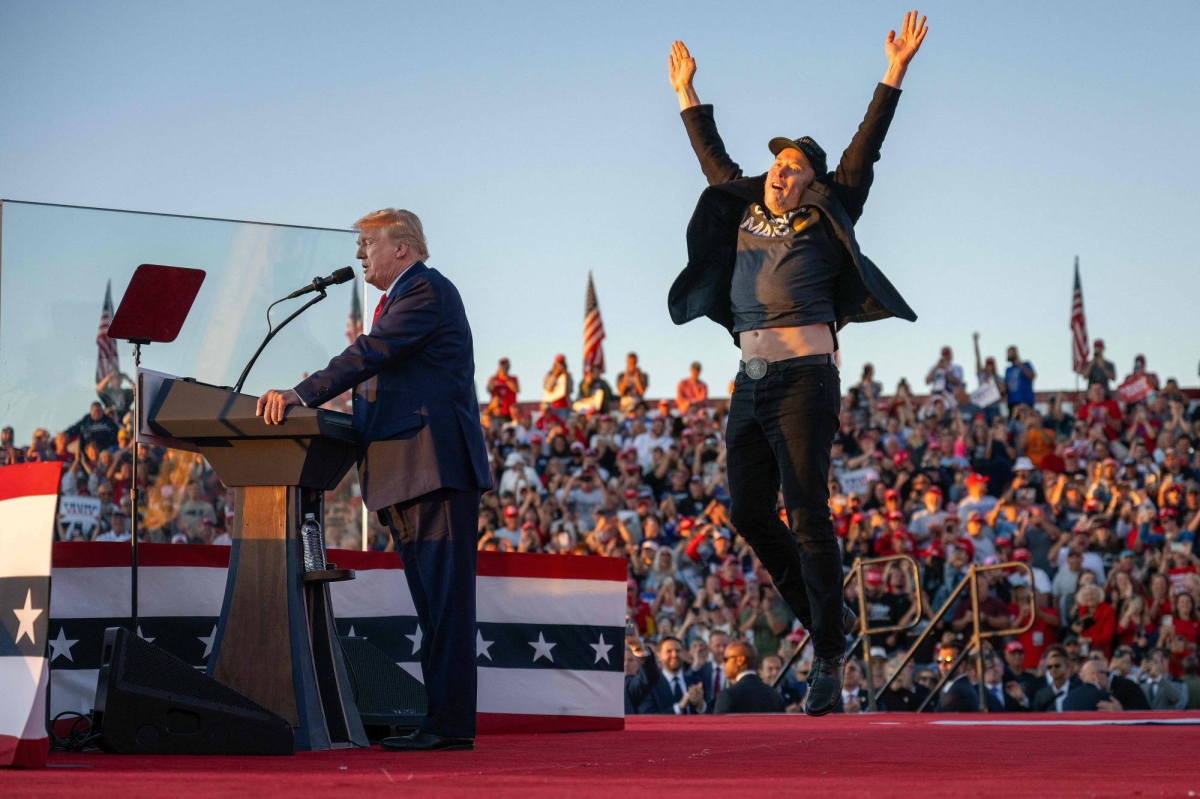
    That feels like extremely high stakes thinking. It might explain another development in the world’s most advanced technology economy. It’s one thing for a government to depend on a private company, SpaceX, to conduct an international space rescue mission. But, it’s quite another to see SpaceX’s owner Elon Musk in the words of VP hopeful, Tim Walz, “skipping like a dipshit” at various Trump rallies. Musk may cause me involuntary eye-rolls every time I read him on X or see him on TV but he’s a super-successful builder of future technologies. In fact, he has feet in both existential races with Tesla (climate) and xAI (AI) which is about to raise funds at a $40 billion valuation. If the latter doesn’t feel like an existential race, maybe the monies will convince you. In 2023, just 4 companies – Facebook, Amazon, Google and Microsoft – spent $196 billion or 0.72% of US GDP on AI research and infrastructure. Remember, these companies are really only ‘getting ready’. Furthermore, they are arguably investing at levels which historically would have only been within the compass of sovereign governments.

    I remember reading first about social media companies becoming effectively supra-sovereign powers. At the time, Facebook had 2.5 billion people on its platform, multiples of any other country populations on the planet. Now social media steers business and moves elections, but tech money might be about to go one step further. Forget about tech companies currently rolling out nuclear power for their hyper-scaling data centres. What about a seat in government?  Well, Elon Musk is on the cusp of entering a Trump ministerial cabinet with a role brief focused on cost cutting. I will give you a clue; plenty of those cuts will be in the regulatory, business and tech governance areas. Musk is not alone. Racist rallies in Madison Square Garden or not, big business is keen to put on the Orange war paint for Trump chaos and……… commercial insurance or favour. Check out the latest Trump luvvies from the world of business:


    Winklevoss Twins donate $1m each to Trump as champion of cryptocurrency  – The Guardian


    Steve Schwarzmann says Trump would be “efficient and effective” president this time – Business Insider


    Silicon Valley’s Andreesson Horowitz give Millions to Trump  – Bloomberg


    Billionaire Ken Griffin says “expectation today is that Donald Trump will win the White House” –  Fortune


    Washington Post flooded by cancellations after Bezos non-endorsement decision  –  NPR


    Ooooohh what would Washington Post legends Katherine Graham or Ben Bradlee think in this “Fat Nixon” era? It would appear big tech and big money “broligarchs” see Trump support as commercial insurance at the very least, and possibly a route to unfettered, compliance-light opportunity. One could become dispirited about the overt involvement of big business in politics. But, in reality business was always there in the Washington background. However, it’s not just a US phenomenon.

    Europe has had its share of big business influence on policy. In the UK, they have had trade and Brexit. In Germany, it was the powerful industrial sector and its push for cheap(then) dependency on Russian energy. We will say no more on either policy disaster, except there might be an intellectual reason why US business leaders are in a different universe of wealth creation compared to their strategically inept European counterparts.

    On a final more serious note, perhaps the difference this time is that governments really do need the balance sheets, cash and spending power of big tech. Just six US technology companies – Apple, Amazon, Google, Meta, Microsoft and Nvidia – have a combined market value of $15 trillion. For context, that $15 trillion equates to the  GDP of China as recently as 2020. In this writer’s reluctant view, politicians have two options – tax these guys or become partners. It might seem distasteful but public-private partnership is now an existential fact of life….or death.

    Gotta dip with the dipshits.


  • Nightmare On October’s Street….

    Nightmare On October’s Street….

    Hallowe’en has provided its fair share of horror movie classics, but Hollywood does not have exclusive rights to October fears. Wall Street is nervous every year. No pagan myths needed. The historic data shows that financial markets are at their most volatile this month. However, do not confuse volatility with sudden downward moves for stock markets. Yes, two of the worst market crashes in 1929 and 1987, and three of the four 10% + monthly falls for the benchmark Dow Jones Index over the past century all beat Freddy Krueger to the fear punch at the end of the month. However, as a professional risk observer it’s important to know that volatility and risk includes upside moves too. As gold, bitcoin, the German Dax, the S&P 500 and Nvidia hit, or threaten, all-time-highs this week you’d think the volatility this month is only going one way. I’m not so sure. Four things bother me….

    1. US ELECTIONS: Maybe it’s the seasonal pumpkins, but my mood is more orange than blue. Foremost in my mind is that the polling for the US presidential election has increasingly moved into toss-up territory. I’m in danger of going into denial mode (and consistent with earlier articles) when I take comfort from German stock markets(Ukraine) at all-time-highs, bond market stability (inflation) and utilities/ electricity stocks (climate) smoking every sector in the US including technology over the past 3 months. None of these should do well in the event of a Trump regime taking power. Yet, betting markets with real money (Polymarket) are showing Trump a full 12% ahead of Harris in the probability stakes. Of course, this just reflects weight of betting on a Musk mate’s betting platform (and backer of JD Vance) rather than votes. Anyway, it feels like there’s a few things not quite in the price of various US financial assets right now. Here’s a list of US institutions and voting cohorts who could suffer a major crisis of confidence if Trump wins:


    • US Federal Reserve – Trump making explicit noises about “control” of interest rate policy.


    • US Supreme Court – the ship has sailed on the nation’s highest court swinging violently to the right. But, the five extreme “Justices of the Apocalypse” on the Court will be emboldened to interfere further with federal laws governing female health, the environment, public safety and corporate governance.


    • US Media – Trump is talking about taking away licences from national broadcasting networks.


    • US Clean Energy sector – the irony of Governor Ron DeSantis banning mention of climate crisis in Florida’s text books won’t be lost on many this week. But, expect Trump to try to undo many of Biden’s signature industrial initiatives in decarbonising the US economy.


    • US Department of Justice – senior DOJ officers, the rule of law and 91 felony convictions could be about to ‘go through some things”.


    • US Stock Markets – Trump’s plan to apply import tariffs across the board is not just inflationary, but could cause chaos for US manufacturing supply chains.


    2.CHINA CYCLE: Trump is pretty clear about being “a dictator on day one” but what about his other autocratic heroes? Well, it looks like the Donald has been in touch reasonably regularly with his Kremlin handler (thanks Bob Woodward) which does not augur well for the defence of Ukraine’s sovereignty. However, we really should be watching China closely. The Beijing administration has launched a massive fiscal stimulus to lift China’s economic activity, with a further $238 billion economic package to be announced this weekend. Chinese stock markets have rocketed by 25% since mid-September and added $3.2 trillion of value to companies listed on the main Shanghai stock exchange. My fear is that this “whatever it takes” move by President Xi fails to alleviate the stresses in the Chinese property market and domestic economy weighed down by an estimated $15 trillion of debt owed (and much of it hidden) in local government financing vehicles (LGFVs).

    Maybe it’s coincidental, but there is a distinctly soggy feel to lots of manufacturing activity data around the world – see September PMI in US, German GDP downgrades etc. So, it’s not just China which needs a boost, and a global cyclical slow down might be the least of our worries. If the Chinese economy continues to stall and Xi becomes worried about his ability to keep power, then the ultimate distraction is war. And, Taiwan is in the crosshairs of that option. Then, note that 90% of the world’s most advanced chips are made in Taiwan and 20% of global goods trade goes through its surrounding waters. Xi might even be watching developments in the Middle-East….

    3.MIDDLE-EAST UNKNOWN: Israel’s Bibi Netanyahu seems quite keen on a permanent state of war, and staying in power. And, possibly out of jail. Sound familiar? Answers on a postcard to Mar-A-Lago. Meanwhile, Lebanon looks like the sixth country or region after Iraq, Yemen, Kurdistan, Syria and Gaza to face mass destruction and population displacement through a combination of rogue leadership and external powers forcing regime change miltarily. Now, we await Israel’s response to recent mass-missile attacks by Iran. The chat is Israel’s critical ally, the US, has asked for restraint. Apparently, Netanyahu might not be in agreement with that approach. Meanwhile, Israeli tanks are firing at UN peacekeeping bases in Lebanon. Bizarrely, these events could be described as fitting previous experiences – it’s Israel’s third invasion of Lebanon, and Iran actually attacked US bases and injured 100 servicemen during the Trump presidency. However, my real fear is that the pace of events is increasing rapidly and could potentially upset the “chaotic equilibrium”. I’m sensing an “unknown unknown” could be on the cards and create a whole new paradigm.

    4.AI CONCENTRATION: Finally, we know AI can’t solve the leadership and power problems above. But, AI itself is inspiring financial markets and business spend. Be careful. A recent Fortune article flagged the dwindling number of contenders in the AI large-language-model (LLM) race. Yes, OpenAI just raised $6.5 billion at a whopping $157 billion valuation for the largest VC raise in history. Elsewhere, the numbers might just be getting too big. Or… should I say costs. Start-up Character.AI has abandoned its attempts to build an LLM to compete with Google, Amazon or Microsoft/OpenAI citing the model training costs as “insanely expensive”. In fact, the Character.AI team and its founder Noam Shazeer have been acquired (kinda) by Google. I say ‘kinda’ because other commentators have been saying this is, in reality, a monster $2.7 billion re-hire of the former Googler, Shazeer. Big bucks. Anyway, if the field of LLM contenders is shrinking, there’s a possibility we end up with concentrated Big Tech 2.0. On that basis, there is a real danger billions will be wasted trying to take on Big Tech in the LLM space. Even for the big wallets there are increasing reports of data limitations for LLMs. In other words, the exponential demand for data to optimise performance is now generating relatively small/linear improvements. Not quite what Moore or other technology scaling laws had in mind. Oh, and the tech sector’s weighting in the S&P 500 hit 42% this month, a record which puts TMT dotcom “bubble” levels of 32% into perspective.

    Perspective indeed, maybe Hallowe’en has spooked my normal optimism. On a slightly more positive front and addressing my biggest current destabilising fear – a Trump win – here’s a few things probably not in the AI training models or the current US polling surveys. Don’t forget pollsters are facing an embarrassing hat-trick of misses, after under-polling Republican votes ahead of the 2016 and 2020 elections.  What are the chances they have over-compensated this time? Here’s a few consoling changes in electoral intentions which could surprise on November 5th:

    Female vote: All actual votes in the last 12 months at a state level have missed the huge turnout of motivated female voters alarmed by the assault on healthcare choices waged by the Supreme Court’s reversal of Roe v Wade. See votes in Kansas, Michigan, Ohio, Montana and Kentucky as good lead indicators of what motivation means.

    White college graduates: Apparently wild fantasies about eating pets, visits to Gaza, Hannibal Lecter and election denial is not a vote getter for non-cult GOP voters.

    Senior vote: Like in the UK election, we can miss the senior votes. Literally. Approximately 12 million Americans have died since Trump lost in 2020. Many will have succumbed to old age. Given the average age of a Fox News viewer is 67, there’s a reasonable chance millions of Fox viewers/MAGA cult voters will miss this vote.

    A slightly morbid end, but there could be a happy ending where the ghoulish baddie disappears as the cops arrive.

    Who needs Freddy!