Tag: Bitcoin

  • Five Tech And Money Moves To Watch

    Five Tech And Money Moves To Watch

    You do wonder. Regulators all over the world are in a flap about AI and cryptocurrencies, and their potential dangers in the wrong hands. Meanwhile, every summer millions go on holiday and are literally robbed. Welcome to the “Wild West” of foreign exchange. Who hasn’t puked at the ridiculous margins/commissions charged by airport exchange bureaux, retail banks and various financial intermediaries for a basic financial transaction?  One doesn’t need to be a financial guru to know that nowadays, in our ‘flash boy’ world of high-speed trading technology, the professional traders trade financial instruments like bonds, equities, commodities and currencies at ultra-low costs where commissions are struck at tiny portions of a single percent. The professional traders’ jargon monoxide might use the term ‘basis points’  for these tiny percentages but main street consumers will usually use expletives to describe commissions (plus margins or spreads) that can amount to a cost well over 10%…. or a thousand of those basis points. So, that’s the moaning over. Let’s look at the recent tech and money developments which might inspire…

    Turning first to one of the better solutions to foreign exchange (FX) pain, Revolut, it was interesting to see the company just receive regulatory approval in the UK after a three year wait. The Revolut FX service is, on average, about 25x cheaper than the majority of consumer options. A new UK licence was also nicely timed for a share sale which put a $45 billion valuation on Revolut. That looks like a 50% uplift in valuation for the British fintech and illustrates a renewed investor enthusiasm for innovative payments platforms. Check out Ireland’s Stripe where a secondary share sale from early investors(and staff) to VC giant Sequoia was done at a $70 billion valuation. That’s an encouraging 40% jump from its March 2023 valuation low. However, it’s not just Irish international financial giants attracting foreign investment capital.

    The recent Renatus Private Equity M&A H1 report on the Irish market showed activity picking up with 207 deals completed in the first half of 2024. That compares against a 30% fall in M&A deals globally (Source: PwC). For this writer, it was significant to see, in a high interest rate environment, that financial services was the second most active sector in the country after software. Indeed 21 of those 31 deals in financial services were in accountancy and insurance. Many of the acquirers were larger overseas groups looking to consolidate intermediaries rather than the wholesale providers of financial products. Maybe, there’s a bit more going on than just cost and brand consolidation?  What about a seismic cost shift?

    If you thought cryptocurrencies and blockchain were dead you’d be dead wrong. Bitcoin is flying high and supporting a digital currency ecosystem worth $1.3 trillion. Small stuff really, but think of my FX moan earlier and know that digital currencies and blockchain are ABSOLUTELY the route to cutting out the commission cowboys and intermediary ‘tolls’ which bedevil global financial services, and particularly the average consumer. Consider the following headlines:


    Kamala Harris’ digital dollar vision: A new era of financial inclusion?  –  American Banker


    “Bitcoin is a legitimate financial instrument,” Says Blackrock CEO Larry Fink – Yahoo Finance


    Goldman Sachs to launch 3 tokenization projects by end of year – Fortune 


    You didn’t think I wouldn’t mention Kamala this week, did you! So, in the interest of political balance it should be noted that it’s not just the prosecutor getting involved in digital currencies. The felon too is due to headline the 2024 Bitcoin Conference. The former fella used to call cryptocurrencies a ‘scam’ but, not unlike his disastrous recent VP pick, he’s capable of the most marvellous position reversals (and debate commitments). It’s difficult to call or even visualise the US political future but there’s a fascinating visual story developing on the AI front.

    We have written previously about a subtle technology shift in the investment world away from software and towards hardware. We all know the Nvidia chip story by now, but who knows EssilorLuxottica? Not quite the tech everyday name. And, that’s because EssilorLuxottica is not a typical technology play. It is, in fact, a luxury sunglasses designer and manufacturer – yep Oakley, Ray-Ban, D&G, LensCrafter and Vogue are all their brands. Moreover, Facebook/Meta who dived into the metaverse prematurely are now looking to buy a stake in the luxury glasses player. Of course, the potential of a worn screen/glass interface could be the next iteration of the 8 billion mobile phones on the planet. Early days yet, but AI continues to move at rapid pace. Of course, Meta’s move for hardware could be viewed as a strategically defensive move as the consumer information landscape shifts rapidly. Google had pretty robust quarterly results this week but latest breaking news could be interesting…

    The AI pioneers at OpenAI have announced the launch of their own AI-powered search engine, SearchGPT. The product is only available in beta version for 10,000 users but I’m sure Google’s executives will be watching the feedback rather closely. So, despite the summer holidays it’s fair to say there is plenty going on. And hopefully, one day, holiday makers will have an AI assistant embedded in their ‘sunnies’ to spot an airport FX robbery in real time!

     

  • D-Day Lesson For These Roaring ’20s?

    D-Day Lesson For These Roaring ’20s?

    The events of D-Day 80 years ago this week usually feature in the closing chapters of World War II history texts. My own current curiosity lies elsewhere, more focused on change and beginnings. Not the Reichstag fire, not Sudetenland, not Kristallnacht, not Lebensraum, not Poland. These were all events in the 1930s which historians agree shaped the outbreak of a global war. However, that decade of economic distress and social anger, whipped up by populism and propaganda, was probably inevitable. Indeed, it’s possible the seeds of war were sown much earlier. The previous decade known as the “Roaring Twenties” introduced huge economic, cultural and technology advances, but the 1929 crash and Great Depression which followed were the key catalysts for the global horror ahead. That lesson from history should not be forgotten. In fact, we should be on our guard. Welcome to the new Roaring ‘20s….

    It’s not just Reddit influencer, Keith “Roaring Kitty” Gill, reportedly banking hundred million dollar profits trading ‘meme-stocks’ like GameStop in recent days. There’s more than just a sense of giddiness about. Recall the 1920’s witnessed the arrival of mass-production and mass-consumerism as automobiles, electricity, cinema, radio and aviation made technology affordable to the middle class. And, then it wasn’t. Financial collapse and the implosion of banking leverage has been a feature of global economic cycles ever since 1929. It wasn’t a once-off in 1929. The global credit crisis in 2008-2009 proved that point, and then some. The critical factors in these financial earthquakes are excessive confidence and over-estimation of demand. First let’s illustrate confidence….


    • The S&P 500 benchmark index for global stock markets has not experienced a daily decline of 2% or more in 325 days (Source: Reuters).
    • The market capitalisation of a media company whose key ‘product’ and biggest shareholder is a convicted felon with presidential ambitions is currently over $8 billion (Source: Truth Social – just kidding!).
    • The private credit (lending) market has grown from $250 billion in 2010 to a whopping $1.7 trillion today (Source: Prequin).
    • This week AI chip maker, Nvidia, became the second most valuable private company in the world with a $3 trillion market capitalisation (Source: Bloomberg)


    Regular readers will know my views fall mainly on the optimistic side of AI. However, the odd sanity-check does no harm. Nvidia is a semiconductor manufacturer. In 2023 revenues generated by the entire semiconductor manufacturing sector globally reached $526 billion. So, for context, Nvidia’s market value is now six times the entire industry’s global revenue. I know analysts will talk about future AI spend, cash rich Big Tech customers and real demand, but there’s one other aspect to this growth story which is a little bit different with historical lessons.

    Legendary tech investor, Marc Andreessen, penned his “Why software is eating the world” essay in the Wall Street Journal in 2011 and there is no doubt software has embedded itself in every phone and corporation on the planet. The lovely thing about software is that it is embedded in an activity, generates recurring (frequent and relatively small) revenues and user stickiness/dependency is high. At a basic level software is code. It’s digital, not physical. Sure enough, coding platform giants Microsoft, Google, Amazon, Meta, Baidu, Alibaba etc. have dominated the league tables of most valuable companies in the world since the Andreessen prophecy. But, there has been a subtle recent shift in the value hierarchy.

    Consider that two of the three largest capitalised companies in the world are now HARDWARE manufacturers (Nvidia and Apple). Hardware is physical and brings an entirely different business model and a myriad of challenges including supply chain risks, materials, energy, sustainability, customer credit, consumer fashion, inventory management and capex investment. We don’t have a crystal ball in forecasting ultimate demand for AI but the semiconductor industry used to be known for its vicious cyclicality. With my risk history hat on, I’d venture there’s every chance this manufacturing sector will experience mismatches between supply and demand.  Of course, the automobiles and radios of the 1920’s might not resonate with today’s AI and technology enthusiasts. However, I’d highlight three other numbers which perhaps add to the “Roaring ‘20s” feel right now:

    Sport: The breakthrough of sports like boxing and athletics on a global scale was a feature of the 1920s but fans mostly followed events by radio. Now, it’s TV (or streaming). So, when basketball’s NBA is about to treble its broadcasting deal from $25 billion to $76 billion you do wonder about excess, and the projections of Amazon, NBC and ESPN? Maybe it’s the constant circling of private equity (PE) around US sport….? Latest data from Pitchbook research shows 63 US professional sports franchises have a PE ownership connection where PE involvement is allowed (NBA, MLS, NHL and MLB). Funnily enough, basketball (NBA) leads the way with two thirds of all teams in the league connected to PE.

    Securities: The 1920s saw the banks and their celebrity brokers on Wall Street begin to sell stock and bond securities to main street for the first time. Then came the ‘shoe shine’ moment in 1929.  Fast forward to today’s celebrities of the private equity universe and a recent FT report on that exclusive world. The headline-grabbing data point(and possibly harsh) suggests that, in the period 2010-2023, private equity funds raised $820 billion more than they actually returned to investors (Source: Prequin).

    Prohibition: Alcohol and gambling was the government target in the 1920s. So, remember when Bitcoin and its cryptocurrency ecosystem was dismissed by the ‘puritanical’ zeal of high street banks, regulators and law enforcement? Today, Bitcoin is trading above $71,000 and the total value of the crypto universe is $2.8 trillion. In fact, there are now billions of dollars invested in funds owning cryptocurrencies (ETFs) which trade daily on highly regulated public exchanges. Now, that’s a morality tale with a twist.

    Of course, the reference to Prohibition conjures up images of organised crime, judicial corruption, entire city governments ‘on the take’, high profile mob trials and flagrant violations of the rule of law. Couldn’t possibly happen again, could it?  Take that question with just a pinch of orange. On a more serious note, the erosion of the US rule of law is possibly a bigger threat in our immediate future than cyclical excess. Hopefully, the remembrance of D-Day sacrifice will remind those in power of their duty to call out faux (or Fox) ‘patriotism’. And, perhaps a read of the final speech in Charlie Chaplin’s The Great Dictator would help. Ironically, Chaplin’s own patriotism was questioned during a later shameful period (with my surname!) in US Congressional history. The Little Tramp’s words seem timely once again…

    Let us fight to free the world – to do away with national barriers – to do away with greed, with hate and intolerance. Let us fight for a world of reason, a world where science and progress will lead to all men’s happiness. Soldiers! in the name of democracy, let us all unite!    –  The Great Dictator (1940)

  • Risk Warning: Trust, But Verify…..

    Risk Warning: Trust, But Verify…..

    On the fifth check of my passport at Paris’s Orly airport I did wonder. Will trust die before our planet dies? Both are under severe threat and, yet, I’m hopeful. Let’s take a look at three particular examples of widely-held mistrust where recent developments might challenge the negativity. First, some history. Ronald Reagan’s signature phrase in nuclear disarmament talks with the Soviet Union was derived, ironically, from an old rhyming Russian proverb: Trust, but verify. Of course, it was tough to trust the Kremlin but technology, in the form of satellite imagery, was the critical verification tool. These days it’s technology which is not trusted but could also be the solution.

    We have previously written about global payments processing as possibly the biggest ‘network’ yet to platform and join social media and cloud computing in the multi-trillion dollar wealth creation club. However, the payments opportunity starts with technology mistrust. Bitcoin is flying high but the cryptocurrency ecosystem is still widely mistrusted by consumers, governments and regulatory authorities. Stripe famously ceased processing Bitcoin payments on its platform back in 2018. Now, it’s all change. Stripe is bringing back crypto payments, this time with a stablecoin. The USDC stablecoin to be accepted by the platform will be pegged to the US dollar ie it tracks the US dollar value. More critically, the technology which underpins the security and verification of these currency assets is blockchain. On so many levels this is a huge verification moment for digital currencies and the software blocks used to build them. Now, for some more building…..

    The 2022 CHIPS and Science Act was a Biden administration attempt to reinvigorate the US manufacturing base by attracting huge factory construction projects. Scepticism was rife, given the Trump toddler promised ‘infrastructure week’ every week but never delivered. Well, let’s verify. First, the US government has paid out more than half its ear-marked $39 billion of incentives to companies planning to invest in manufacturing facilities. The corporate follow-through has been extraordinary – microchip manufacturers and their suppliers have announced $327 billion of investments over the next 10 years. Micron alone is planning a $100 billion project in Syracuse, NY. That’s a nationwide 15x leap in construction spend on these type of facilities and will capture 20% of the global chip manufacturing market by 2030. Currently, that number is zero. But what about our planet and other targets with Zero (Net)?

    Let’s face it, the push back on global sustainability and ESG targets is worrying. We often write that money talks and the following headlines paint a picture of worrying reversal:


    Flows to European ESG exchange traded funds halve in first quarter –  Financial Times


    US Fund Managers With ESG Mandates Have Worst-Ever OutflowsBloomberg


    Clearly, this is not good news. However, we should be careful not to equate fund flows with commitment to climate change targets. For example, the banking sector in recent decades could be described as the ultimate counterparty requiring ‘trust, but verify’ checks on their behaviours and risk management. So, with the global financial crisis barely 15 years in the rear-view mirror, how did genuine ESG investors feel about this week’s staggering headline?


    Western banks in Russia paid $800m in taxes to Kremlin last year –  Financial Times


    Yep, that was the tax bit. The profits according to the FT were over $3 billion. Trust, but verify indeed……ESG investors can rightly ask how are those “S” and “G” policies going in these shame-free and profit-full banks? Answers on a post card to Kyiv please.  Before we all blow a complete gasket, let’s finish with some more wind but a bit more climate positivity. And, no, it’s not a Trump legal challenge. But it could ultimately rhyme by starting badly, and then ending with a positive reality check.

    First, the severity of the storms and tornados sweeping through the Midwest heartland of the US this week are truly frightening. However, there’s a bigger financial storm brewing further south. An excellent article in The Lever this week highlighted the plight of Louisiana homeowners struggling to insure their houses while 12 insurance companies have failed, and 12 others have left the state. Almost one in five Louisiana residents lost their homeowner insurance last year. The crisis is climate caused. Global insurance giant, Swiss Re, in a recent report stated that natural disasters now cost the United States $97 billion a year.

    In Florida, the climate denial Governor, Ron De Santis, might be kissing the Trump ring again but home insurance rates jumped 42% last year and coverage from big players, AAA and Farmers Insurance, has been pulled from the market before hurricane season. Unsurprisingly, Florida for-sale housing inventory has jumped 57% in 12 months. Leaders in denial-mode face a wave of voters, mortgage banks, pension funds and Wall Street analysts giving them the ultimate verification check on climate crisis. The critical shift is that investment capital has checked, and is already fleeing.

    Trust me, that seismic capital flight will force leadership change and action. Verification…..pending.

  • Fintech Is The Forgotten Network Card To Play

    Fintech Is The Forgotten Network Card To Play

    Brexit has delivered a win. There, I said it. Now, before you all head off to lobby on my behalf for a co-anchor slot on GB News with the Moggster, Bad Enoch and the Rishibot, there’s a distinct possibility I could be clutching at correlation rather than causation. However, the numbers – for a change – are real. According to KPMG’s bi-annual report, Pulse of Fintech, last year was a tough year for global fintech with funding levels hitting a 6 year low. The UK did not escape the bear market as its $12.3 billion of new investment represented a 34% drop. But….the UK remains, by far, the capital of European fintech and ranks second globally behind Silicon Valley. For global context (and Nigel Farage cartwheels), UK-based fintechs attracted more funding in 2023 than France, Germany, China, Brazil, India and Canada combined. That feels like winning to me but also prompted thought on networks and London’s global positioning in the financial ecosystem.

    London is blessed with an enormous talent and innovation pool thanks to centuries of being the dominant global financial centre and a time zone which straddles the Americas and Asia. This global positioning means there is a bigger and more realistic point to be made than Brexit. It is striking to me that when a country is in the middle of a political, institutional and trading meltdown there is a sub-sector of economic activity which defies the gloom. Fintech might have suffered investment flight in 2023 but the resilience of UK fintech in the midst of a national mental health event points to the recovery of a structural story we have written about many times before.

    It’s a network story but it has had to play second-fiddle to two much ‘hotter’ networks in recent times. Social network platforms (quasi-relationship processors!) are now bigger than sovereign nations – billions spend hours of screen time with Facebook, Instagram, YouTube, Tik Tok etc. And yes, Meta may have picked the wrong name but its share price is at all-time-highs. Also, this week we got another blow-out pulse-check on the hottest network story of recent times; Nvidia’s leading role and 400% y-o-y growth in supplying AI-capable chips for data centres. The computer/digital processor network now lives in the cloud powered by a rapidly growing network of data centres operated by Amazon, Google, Microsoft, Apple etc. However, this week we were reminded that the global financial network is the biggest beast of all and still searching for next-generation financial processing. In the vast field of fintech covering regulation, cybersecurity, analytics, flashboy trading, execution algos, insurtech and blockchain the Big Daddy of them all is payments, call it financial processing.  And this week, we saw some big payments developments.

    First, US bank Capital One announced it is buying Discover Financial Services in a $35 billion deal. At first glance this looks like Discover’s credit cards were the target and, indeed, the combined card operation would create the No.1 US credit card company, passing out JP Morgan and Citigroup. But, no, what caught my eye is that Discover also operates a payments network. Furthermore, Capital One CEO, Richard Fairbank, said that by adding Discover, he could start building “a payments network that can compete with the largest payments networks and payments companies,” a reference to Visa and Mastercard, which dominate the industry. To put the card deal in context, the $35 billion deal is not even a tenth of Visa’s $550 billion market value which is fast catching up on Nasdaq poster-child, Tesla. It’s not just traditional banks like Capital One eying up payments networks. Closer to home, there was an interesting private deal announced.

    UK digital bank, Monzo, is reported by the FT to be close to completing a £350m funding round with a £4 billion valuation. So far, so unremarkable. After a bit more reading, two things struck a chord. First, little Monzo now has a whopping 9 million customers, with 2 million coming aboard in 2023. That’s quite the banking network build and I wasn’t the only one intrigued. Apparently, the lead investor in this round is Google’s very own investment wing, CapitalG. Note Monzo is a banking service which includes payment processing but guess who is the processor behind Monzo? Stripe. And, Stripe wasn’t the only hot payments fintech I was reading about this week.

    When Mario Gabriele of the Generalist newsletter flags a disruptor company I usually pay attention. This week he did a deep dive on Australian payments fintech, Airwallex. It’s not in Stripe’s league – they raised $6.5 billion in 2023 –  but Airwallex has just raised $160m at a $5.6 billion valuation supported by 100,000 corporate customers (including SHEIN, Qantas, Canva) generating $80 billion of annual volume and $400m in revenues. The service offers payouts in 150 countries in 46 currencies, is executed by a couple of clicks and costs markedly less than traditional financial institutions. Once again, the issue of costs and tolls charged by traditional financial intermediaries looks like a key ‘win’ for fintech disruptors, and even traditional banks like Capital One. Check out the words of their own CEO, Fairbank (perfect name when you think about it);


    “Owning a network allows us to deal more directly with merchants rather than a network intermediary…..We create more value for merchants, small businesses and consumers and capture the additional economics from vertical integration.”


    That network word seems important. Arguably, there already exists a disruptive network and it’s already worth a trillion dollars. Yes, the blockchain-powered cryptocurrency, Bitcoin, traded back to the $50,000 mark in recent weeks and put the total value of the currency at $1 trillion. Of course, the recent decision of US regulators to allow funds (ETFs) invested in Bitcoin to trade on public exchanges like the NYSE is a further validation for this particular ecosystem. However, Bitcoin’s connectivity to the merchants, consumers and businesses which Fairbank covets is still very limited. What is not in doubt is the size of the global digital payments market which is, per Statista, going to exceed $15 trillion by 2027. The good news for fintech disruptors and start-ups is that reducing the “tolls” on these money flows can be a quicker route to profits than other sectors.

    In Europe, just two of the ten most valuable venture capital (VC) backed companies are making profits. Interestingly, both are fintechs –  Revolut(neobank) and SumUp (mobile merchant payment hardware). Clearly, route-to-profitability is an increasing focus of investors as higher interest rates bring tighter funding conditions. However, investor interest in payments networks appears strikingly robust. Check out the following recent funding deals:

    • UK-based Kriya secures £50m funding boost to supercharge B2B payments revolution – TechNews 180
    • Valar Ventures backs Berlin fintech, Monite, with $6 million – CB Insights
    • Colombian payments startup, Bold, secures $50m in Series C funding, led by General Atlantic – HUBFX
    • Payment orchestrator, Navro, raises $14m Series A from Bain Capital and Motive Partners – Dealroom


    The truth is that payments funding has ‘only’ seen a 30% fall in funding activity compared to wider fintech funding collapses of 50-70%. So, perhaps my Brexit blurt was too impetuous and the stronger logic attaches to London’s critical positioning in the payments ecosystem. There goes my GB News career but I’d rather you keep an eye on the forgotten third giant network – payments. And, now you know there are 15 trillion reasons why.

  • More Blue Sky Than Blue Monday

    More Blue Sky Than Blue Monday

    Apparently, the Monday of this week is the worst every year for negative thought. Furthermore, the new UK Foreign Secretary, Lord Cameron, fresh from launching war in the Red Sea, told us in a weekend TV interview that “the lights are absolutely flashing red” on the global risk dashboard. Excellent. Well, that’s settled then – I mean Lord “Call Me Dave” gets all the big calls right doesn’t he? Ok, let’s not invite the rest of the world to turn the air blue. In fact, let’s do what should have been done in 2016 and pay attention to what’s really happening in the world right now. Not surprisingly for this writer, January is already confirming themes established and developing from earlier years and we are more than happy to keep screaming about them until we are blue. So, here we go with a little whistle-stop tour of the real world….

    We truly believe the ‘convergence’ of various technologies is about to turbo-charge the acceleration of change in the global economy. An existential crisis also helps focus minds and….. money. The climate change crisis has prompted the greatest capital shift in history as $6 trillion of annual spending on cleantech is forecast every year until 2050 (Source: McKinsey). Indeed, one of the key investment destinations in moving away from fossil fuels has been electric vehicles(EVs), and the batteries used to store energy and power these vehicles. Chemistry advances have been key in driving costs down and capacity up where lithium-ion type batteries are the predominant storage technology. However, artificial intelligence(AI), probably the hottest investment theme outside cleantech right now, has just been used in conjunction with supercomputing to discover a brand new material which could reduce lithium usage by up to 70%.

    Yep, Microsoft and Pacific Northwest National Laboratory (PNNL) research teams whittled down 32 million potential material combinations to 18 promising molecular structures within a week. Incredibly, the whole discovery project took 9 months in a screening process that would typically have taken more than 20 years using traditional lab research methods. The new AI-derived material, simply called N2116, should prompt thought as to what’s possible in the world of medicine, agriculture, transport and construction,  but also counter an unhealthy commentariat focus on AI ‘safetyism”. The social and economic basics of health, shelter, mobility and food are in dire need of blue sky thinking but might just have found a genuine innovation accelerator. Microsoft themselves have told the BBC that one of the company’s missions was “to compress 250 years of scientific discovery into the next 25.” Thankfully, this was not the only positive solution speed surprise of recent weeks.

    The IEA has confirmed that renewable energy capacity increased globally by 50% in 2023 alone(!). That’s the biggest growth seen in more than two decades. At that pace, it is conceivable renewable energy could be 50% of electricity generation by 2030 and, brace yourselves… would actually meet the renewables ‘tripling’ target agreed at Cop 28. Germany – not getting great economic press in recent times – is already at the 50% renewable electricity production level with CO2 emissions currently at a 70-year low. Furthermore, coal usage at a 60-year low in Germany makes for clearer skies but the gloomy headlines could have obscured another Teutonic trophy win.  The EU has given the go-ahead for Germany to provide €902 million of state aid to battery producer, Northvolt, for the construction of a gigafactory producing EV batteries. Without that aid, Northvolt would have probably moved the project to the US. Instead, the €2.5 billion project at Heide will be the first to avail of the new ‘matching aid’ exception allowed by the EU to support more flexible/higher amounts of state aid to prevent an investment exodus to the US.  Expect more good European news on this front as the region is forecast to build a further 250 battery factories by 2033 (Source: Buck Consultants). These are real actions and projects (not headlines) but companies are also showing confidence with more traditional strategic moves.

    We perennially write “watch what they do, not what they say” and the big “tell” is often M&A activity. Given acquiring other companies results in wealth destruction almost 50% of the time, we tend to see a flurry of M&A activity as a positive illustration of executive confidence and found the headlines of recent weeks interesting.  You might think the announced $14 billion purchase of Juniper Networks by HP was just another example of the technology sector enjoying the benefits(and valuation multiples) of a stellar 2023 but back in the ‘old economy’ things are stirring too. And, if M&A was tricky enough why not try to acquire a national icon, as a foreign company? Cue the Japanese execs at Nippon Steel have decided to swoop for US Steel in another $14 billion deal. Once the most valuable company in the world, US Steel could become a political football but both boards have agreed the deal and are acutely aware that the most recent offer from domestic rival, Cleveland Cliffs, was just over $7 billion. You don’t need the finance gurus to figure that one out. Anyway, they are busy too. The world’s biggest asset manager, BlackRock, has announced the $12.5 billion purchase of Global Infrastructure Partners (owner of Gatwick Airport and Melbourne Port). Clearly, the $10 trillion giant sees a future for the old stuff.  As for the new stuff…

    The SEC in the US has just approved funds (ETFs) which invest in cryptocurrencies (Bitcoin). This is massive for the crypto and blockchain ecosystem. In simple terms, this approval by the SEC means funds invested in Bitcoin are now regulated and can be considered an asset class in their own right. Nine funds (ETFs) have been approved to trade on New York regulated exchanges, and in the first two days of trading attracted $1.5 of investor inflows. BlackRock’s fund led the way with $500m followed by Fidelity’s fund bringing in $422m. For me, cryptocurrencies are a very good indicator of risk appetite, or confidence. So, if Bitcoin is trading close to $40,000, this feels like the world is not about to fall apart. Other new stuff is doing well too.

    We’ve already touched on AI’s benefits to humanity but, if you’re an investor, the AI posterchild is still Nvidia. While the broader equity markets have spluttered in January, Nvidia continues to march to new record highs. Its market value is now in the region of $1.4 trillion. For context, if Nvidia’s share price increases by another 15% its valuation will match that of Amazon. Then consider Microsoft, another AI play, which overtook Apple this week as the most valuable company in the world. You might think all the AI excitement is in the big tech names but CB Insights has published data showing AI start-ups benefitting from  significant valuation premia when raising capital. Median valuations for early stage/seed fundings were 21% higher, larger Series A fundings saw a 39% premium and Series B funding rounds clipped an extra 59% from investors compared to non-AI companies. Get ready for more AI references in investment ‘story telling’, but also watch out for the continuing battle for authentic stories and content needing no AI.

    Over the weekend, the exclusive rights to the NFL game between the Miami Dolphins and the Kansas City Chiefs were sold to NBC’s streaming service, Peacock, for $110 million, or $1.8 million per minute of game time. According to the superb sports finance newsletter, Huddle Up, this is all about Peacock/NBC being given a foothold by the NFL as streaming overtakes cable consumption over the next 5 years.  That means Apple, Amazon and Netflix will be a big part of media rights negotiations in many sports in the coming years. Think Hulu and Wrexham, then marvel at the Rightmove data showing Wrexham as the busiest property rental market in the UK in 2023. That certainly wasn’t forecast on those Brexit red buses in 2016.

    Of course, a market whistle-stop tour would not be complete without a check on the ‘Big Daddy’ driver of all asset classes; the cost of money. Here too, the news was not blue. The cost of two year money in the US in the past week (measured by the yields on traded 2 year US Treasuries) was back to levels not seen since May 2023. In fact, the world’s most profitable bank, JP Morgan, didn’t just announce record profits last week but also told investors they believe the Fed will cut interest rates SIX times in 2024. We shall see, but it is clear that capital is “climbing a wall of worry” in lots of interesting parts of the global economy. That does not mean we can ignore the concerns of some serious and credible analysts. The world’s risk experts continue to watch Russia vs Ukraine, Israel vs Hamas and China vs Taiwan. More than enough volatility, and enough for Ian Bremmer, CEO of the Eurasia Group consultancy, to describe this year as…

    “Politically it’s the Voldemort of years. The annus horribilis…. and then there’s the biggest challenge in 2024… The United States versus itself”.

    Again, voting like sport doesn’t need AI. Who would have thought that US democracy would be the greatest geopolitical risk of 2024? Simply stunning. Yet, I am hopeful that younger voters, business leaders, investment capital and credible domestic influencers will begin to spell out the true potential cost of burning the US Constitution in front of the whole world. Just imagine fighting the “Red” threat of totalitarian Communism for decades and then discovering you have your very own Red totalitarian party at home? Now that must make more than a few voters go blue……

  • Ten 2021 Surprises To Trump A Crazy 2020?

    Ten 2021 Surprises To Trump A Crazy 2020?

    Well, how do you top 2020 for surprises? You probably don’t but the early days of 2021 can hardly be described as normal. Spiralling pandemic infection rates, new lockdowns and continuing White House madness are depressingly familiar developments. However, let’s dream a little positivity. Like last year, this exercise in listing potential surprises is not intended to be short-odds probabilities. The idea is to think about the possible and, for a brief few moments, not the pandemic. Our list last year managed to have a 4/10 hit rate but only if you accept that Kim Jong Un “died” for about a week!

    Anyway, 3 out of 10 probably justified the read a year ago but this year we are making it more difficult by only listing positive surprises. So, buckle up, relax the brain and be mindful of Willie Wonka’s advice that “a little nonsense now and then is relished by the wisest men.” A refresher of our 2020 list is in the link at the end of this article but for now let’s dream of 2021 possibilities…….

    1. North Korea and South Korea sign a peace agreement on Easter Sunday engineered by China’s President, Xi Jinping. Xi’s diplomatic efforts are rewarded with a Nobel Prize which prompts a legal challenge from Donald Trump’s crack(ed) legal team claiming their client was the true peacemaker.

    2. Boris Johnson resigns as Prime Minister on Good Friday. Crucified by the financial pressures of maintenance payments for six(or seven) children, Johnson is forced to re-enter the private sector to boost his income. In June, Johnson signs a 50 million pound deal with the newly launched Trump TV Network to host a weekly variety show from London.

    3. Climate change increases its economic influence. Financial assets following sustainable investing criteria(ESG) reach the $80 trillion valuation mark driven by new EU disclosure rules coming into law in March. UK assets score poorly under new frameworks due to “political risk” with many FTSE 100 shares trading at 30% discounts to EU peers.

    4. Covid-19 vaccination programs reach the 1 billion injection mark by June. Infection rates decline rapidly through the year and the virus mysteriously disappears by August.

    5. Donald Trump goes to prison on a money laundering conviction. Melania Trump sues for divorce and wins a $50,000 settlement with the agreement of banks and creditors conducting a fire sale of Trump assets.

    6. Commercial real estate and urban hospitality sector valuations soar as new surveys by big business reveal significant productivity declines where majority work-from-home options are available.

    7. Vladimir Putin is forced from office after a Russian oligarch revolt. The Biden administration’s plans to ban Russia from the Swift banking payments system as a sanction for the hacking of US government institutions is believed to have been the critical catalyst in Putin’s removal. Joe Biden goes on a triumphant diplomatic tour of Europe, including a week-long stay in Ireland, which pushes his Presidential approval ratings back home above 80%.

    8. Irish digital payments company, Stripe, attains a $200 billion valuation in its last private fund raising before a planned Q4 IPO. This valuation exceeds the combined market capitalisation of all the companies listed on the Irish Stock Exchange. Google is also rumoured to be considering acquiring Stripe before IPO.

    9. Ireland tops the GDP growth table in Europe once again with a 10% increase driven by migration of financial services operations from London to Dublin.

    10. Bitcoin trades above $50,000 in December. It turns out RTE’s intrepid science correspondent, George (g)Lee, has been a keen investor and owns a cryptocurrency portfolio valued at more than $1 billion. He retires from RTE to the relief of the nation.

    We did say dream but you never know! Last year’s list is here for the curious.

    https://gravitas.sparkcrowdfunding.com/2020-vision-or-10-more-surprises/

    Happy New Year!

  • We need to talk about Cryptocurrencies …. NOW!

    We need to talk about Cryptocurrencies …. NOW!

    Would your business accept payment in a cryptocurrency? You might have to consider this question a bit sooner than expected. The extreme volatility of Bitcoin and other crypto challengers would correctly give the impression that such payments would be a commercial risk requiring a rather strong stomach. However, Facebook’s recently announced plans to launch a new digital currency, Libra, is a potential game changer and has prompted serious consideration from unlikely quarters.


    The Bank for International Settlements(BIS) is the bank used by central bankers and would be perceived as a bastion of conservative thinking and risk aversion.  So, it is noteworthy to hear BIS bank head Agustin Carstens admit that “it might be… sooner than we think that there is a market and we need to be able to provide central bank digital currencies”.  Bitcoin has been with us for ten years so why has Facebook’s move caught the attention of central bankers? Clearly, the entry of big tech into financial services raises some serious strategic issues for incumbent banks already struggling with their own technology transitions. However, there are two other aspects to the Facebook initiative which suggest a viable digital currency could be a genuine business banking consideration sooner rather than later.


    Firstly, Facebook is addressing the business-killing problem of extreme volatility in cryptocurrencies. Libra’s value will be stabilised by backing it with real world financial assets drawn from liquid pools of bank deposits and short term government securities denominated in a variety of hard currencies eg. USD, JPY, GBP and EUR. This should result in a “stable coin” with reduced fluctuations compared to the local currencies used by consumers and businesses.


    Second, a credibility problem surrounding cryptocurrencies has been the lack of institutional reputation or trust being put on the line.  In a nutshell, governance and validation are critical to mainstream adoption.  The striking thing about Facebook’s approach is the international partnerships established with 100 validators to ensure neutrality and trust in the running of the Libra network(Blockchain).  The Libra Association will base itself in Switzerland and has already secured 27 founding partners including the likes of Visa, Paypal, Uber, Vodafone, Stripe, and eBay. If one can park current concerns regarding Facebook’s extraordinary data control over 2.5 billion consumers, Libra looks like a serious prospect as a global digital currency.


    This article does not propose to look at the technology issues but, given Facebook’s execution track record, we can assume their plans to use a combination of existing blockchain technologies will deliver a stable digital currency in 2020. If one re-reads the BIS quote above one senses central banks know its going to happen and are preparing for the creation of their own digital currencies. This raises a number of fundamental considerations as currency/legal tender underpins the commercial activities and financial instruments used across the global economy.  The traditional banking system and central bank/ BIS should not assume a counter initiative in digital currencies will necessarily restore some sort of influence parity.


    A clue as to traditional banking concern over the control of the foundation block of the financial system is the just published BIS Annual Economic Report and its prominent Section III – “ Big Tech in Finance: Opportunities and Risks”. While it recognizes the entry of technology firms into financial sevices as a positive for efficiency gains and potential inclusion of the “unbanked” 30% of the world’s population the report also focuses on “new and complex trade-offs between financial stability, competition and data protection”.  The reality for central banks is that technology firms have huge user bases, a commensurate stock of massively rich user data which is utilized to offer services that exploit network effects, generating further usage and even more data to drive activity. In a previous article on Internet Trends we highlighted the case of Chinese giant, Alipay, which already has a billion users and provides financial services to hundreds of millions of customers. Think Facebook and its 2.5 billion user network.


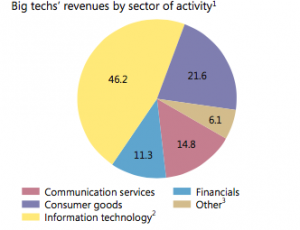
    Already commentators are focusing on the potentially rapid evolution of Facebook into a dominant financial services player. It’s early days yet and the BIS report points out that big tech currently only derives 11% of its revenues from finance as seen in the following chart:

    Given currency’s position as the commercial foundation of modern civilization and commerce there is a fascinating article in Wired which perhaps reveals the true concerns of traditional banking institutions, policy makers and regulators.  The following passage in the article was perhaps the most provocative:


    “And while Facebook’s ambitions appear unsubtle (at least to me), the biggest tech companies are all building more and more advanced and immersive ecosystems. So maybe it’s time to start asking: What is the functional difference between a company and a country?


    It’s not a crazy question: We’re already at a point where huge multinational tech monopsonies have so much power over the global economy that central bankers and regulators are starting to wonder if they even have the tools to set economic policy, like they used to in the old days.


    And the reason these big tech companies are different from other giant multinational corporations like Exxon Mobile or ConAgra or even, strangely, Microsoft is that their ambition really is to own all your interactions, not just your driving or your eating or your typing.”


    Wowzers. Facebook or Google achieving country-like status with control and influence over monster populations, or user bases, and revenues in excess of the GDPs of most countries on the planet.  No wonder the bankers are looking to wrest back control before it’s too late.  BIS head of research Hyun Song Shin does little to hide the fact that Facebook’s Libra has moved the risk dialsignificantly – “ ..there is a need for international cooperation on rules and standards. The recent proposal by Facebook to launch a digital currency, Libra, has underscored the importance of cross border cooperation.”  Yes, the regulatory stick is being waved already.  Indeed, even the US Senate Banking Committee is sitting up and taking notice; a hearing on Libra is scheduled this month while various European politicians have voiced concerns about the emergence of a Facebook “shadow bank” with a user base vastly bigger than Europe’s 600 million population. The euro under pressure from Italian mini-BOT proposals, plunging negative interest rates and pending Brexit trade chaos can ill-afford another existential threat.


    Traditional players won’t be the only ones seeing a threat. It is highly unlikely that Amazon, Google or Apple will stand idly by.  All three have rolled out their own payment options as their users have become comfortable with digital commerce. Interestingly, a country which has effectively gone almost cash-less is also moving quite rapidly towards a digital version of its currency.


    Sweden’s central bank, the Riksbank, is fully aware that only 13% of the population has carried out a recent transaction in cash.  Four out of every five purchases in Sweden are made electronically and the Riksbank can see where this is going. Hence, they have launched a pilot project to develop and test a technology solution for an “e-krona”.  This pilot is generating plenty of domestic controversy as a potential state-like interference from the Riksbank in private commerce. The future of the e-krona is more than uncertain but the digital genie is out of the banking bottle. Central bankers are clearly assuming big tech is going to enter and disrupt the financial ecosystem.


    Business owners will need to watch digital currency developments carefully and prepare for relatively quick adoption. Think back to all the lost revenues(and franchises) of retailers slow to embrace e-commerce and online payment facilities/technologies. Of course, there will be sceptics. None more famous than the world’s most powerful commercial banker, Jamie Dimon of  JP Morgan. As recently as November 2015 Dimon said Bitcoin, trading at $400 at the time, would not survive. Well, almost ten years after its launch Bitcoin is still with us and trading around $10,000. We would tend to agree with Dimon that the technology(blockchain) is more sustainable than Bitcoin but there was more than a hint of irony in February this year when JP Morgan launched its own cryptocurrency – “JPM Coin” –  for its clients.  The bankers’ message is clear.


    Digital currencies are coming to mainstream commercial activities. Big Tech is the catalyst forcing banking responses including actual crypto solutions. Businesses will need to pay attention as they most likely will have to be digital-ready quite soon….