Tag: Elon Musk

  • The Truth Can Hurt ….. Investment

    The Truth Can Hurt ….. Investment

    Forty years ago this week, reactor 4 of the Chernobyl Nuclear Power Plant exploded. The human and monetary costs were in the thousands and hundreds of billions respectively. More difficult to quantify was Chernobyl’s contribution to the collapse of the Soviet Union. However, I did re-watch the excellent HBO series Chernobyl in recent days and was struck by a non-monetary factor which might resonate for those currently enduring daily White House appeals to ignore our eyes and ears. The words of Professor Valery Legasov of Moscow State University in the opening scene of Chernobyl seem almost prescient  –  “What is the cost of lies? It’s not that we’ll mistake them for the truth. The real danger is that if we hear enough lies, then we no longer recognize the truth at all.”  For the USSR, the truth of technological decline, an obsolete economic model, and the inability of centralised power to deal with the complexity of a more connected global economy was easy to see. But fatally, not recognized. Fast forward to today, and we could be in similar TRUTH territory….

    Don’t worry, we won’t go down any conspiracy theory rabbit holes. So, no need to wonder why a would-be assassin might gain access without security challenge to the Washington Hilton and within one floor of almost the entire Trump regime senior leadership at Saturday’s annual White House Correspondents dinner. If the current head of the FBI is nicknamed “J. Edgar Boozer” then the truth is closer to incompetence than conspiracy. Similarly, but with far greater global economic impact, if Germany’s normally cautious Chancellor Merz is saying that the US has “no clear exit strategy” and is being “humiliated” by Iran, then the truth is that the US does not really “hold all the cards” or the keys to “Schrödinger’s Strait” of Hormuz. The consequences are plain to see as oil prices soar past $110 per barrel again and OPEC’s number 3 producer, UAE, just left the cartel after 59 years of membership.

    Clearly, the old world order alliances from NATO to OPEC are fragmenting. And, that’s before anyone dares to mention the eye-catching new Pew (March 2026) poll showing 60% of Americans now view Israel unfavourably — up from 42% in 2022. That’s almost as bad a swing as Trump’s voter approval on dealing with inflation shifting to a net MINUS 40, and national Consumer Sentiment surveys (Michigan/Ipsos) diving to the lowest levels seen since 1978. And yet….

    There’s a danger we have been distracted and miss other truths. Watch what people do, not what they feel. For example US consumer sentiment might be plummeting but US retail sales are running ‘hot’ at 7.7% year-on-year growth, the fastest growth pace seen since 2022. Meanwhile, fossil fuels and Strait of Hormuz blockades (unless you’re a Russian oligarch’s yacht – I know…Russia, Russia, Russia) might be dominating the gloomy headlines but there’s more positive long-term developments accelerating at speed. If you have been unable to copy or track Baron Trump’s oil trading strategies or share the Fox Business congratulations of Maria Bartiromo on Eric Trump’s new $24 million contract with the Pentagon(yup), then there’s good news and bad news. The bad news is you’re not making millions on risk-free trading or commerce, but the good news is you won’t need a fitting for an orange jump suit. However, away from the fossil fuel supply crisis, check out the following quiet developments which could hurt your investment portfolio if you miss them…


    • In 2025, for the first time in history, clean power met every single unit of new global electricity demand.
    • Renewable energy sources (33.8%) officially crushed coal (33.0%) for the first time in 100 years.
    • Electric vehicle (EV) sales in emerging markets have surged 80%.
    • In Europe, EV sales soared 51% in March while EV sales smash through 25% of the total global market.
    • Chinese company, CATL, just unveiled a battery with a 1,500km range that charges in 6 minutes
    • China exports of batteries, EVs and solar cells were up 34%, 53%, 80% respectively last month.


    A quick glance at the last two developments might suggest another uncomfortable truth; China is winning this global electrification ‘war’ and arguably is the winner of the Persian Gulf one too. However, there’s clearly only one country, USA, winning the global race for AI investment capital right now. The AI chip superstar stock, Nvidia, has just clocked up another $1.25 trillion increase in market value in less than 4 weeks. Nvidia’s current market capitalisation of $5.25 TRILLION is just shy of the entire value of Germany’s GDP and surpassed by only those of China and the USA itself. Google and Nvidia’s combined market value is now over $10 trillion.

    AI is acting like a ‘death star’ for other investment sectors as it sucks up huge amounts of investment dollars. In Q1 of this year software stocks collapsed 29% from their highs while 81% of all venture capital funding ($265 billion out of $330 billion) went to AI start-ups, with 65% of that going to just 4 companies (Source: Pitchbook). You’ll keep hearing and reading that word “concentration” and how investment capital is racing into ever narrower niches within technology. However, it might be worth keeping a mix of old and new names on the investment radar. Here’s two to watch:

    NEW: Anthropic, the parent of my new best work friend this week, Claude, is apparently trading in private markets right now at a $1 trillion valuation. Of course, it does help valuations if your annualised revenue jumps from $9 billion to $30 billion….in just 3 months.

    OLD: Samsung, the unwieldy Korean conglomerate of TV, phone and memory chip manufacture, is going to be the most profitable company in the world by 2027. Bloomberg reckon Samsung will edge out Nvidia for top spot with a whopping operating profit of $330 billion. Yep, good old memory chips (DRAM, NAND etc) are needed by Claude, Gemini and all the other agentic chatbots to remember you (and your prompts).

    So, that’s all good for now. But, let’s get back to the Truth thing. And, we’re not talking about AI chatbot hallucinations, or even Trumpolini’s Jesus delusions. It’s much more basic than that. In the middle of all this AI euphoria sits the company who kicked things off with ChatGPT, Open AI, and its CEO, Sam Altman. This week we heard OpenAI are behind on planned revenues and new subscriber growth targets. These things happen in fast growing tech stories, but OpenAI is attached to $1.2 trillion of AI infrastructure deals where OpenAI’s commitment is $600 billion despite current annual cash burn of…… $17 billion. Furthermore, OpenAI does not have a huge balance sheet like Google, Microsoft or Amazon. So, credibility and confidence matters. And, I’m concerned.

    Altman’s career history per various in-depth media articles (the New Yorker one is best) is littered with massive commercial relationship breakdowns and a common theme. Loss of trust. Phrases like “profound mistrust”, “lack of candour”, “consistent pattern of lying” and “deceptive and chaotic behaviour” are used to describe the CEO of a company seeking to publicly list (IPO) in New York this year with a valuation of more than $800 billion. This week Altman faces Elon Musk in court for a $150 billion lawsuit brought by the latter regarding governance at OpenAI. Let’s just say the potential damage to Altman’s credibility could have ‘nuclear’ consequences for the AI financial ecosystem. Watch carefully and remember the fragility of the Open AI balance sheet in the context of its trillion dollar commitments. Then think of Chernobyl and Valery Legasov’s most powerful words which we have cited before on these pages…

    “Every lie we tell incurs a debt to the truth. Sooner or later that debt is paid”

  • Summer Looking Hot….

    Summer Looking Hot….

    Last week was biblical. Firstly, President Trump became Jesus online, before dodging to “doctor” retreat on evangelical outrage. Secondly, Vice President, JD Vance, fresh from blowing up Viktor Orban’s election chances in Hungary, told the Pope to tread carefully on….theology. And then, Secretary of War, Pete Hegseth, presented a biblical verse, Ezekiel 25:17, at a Pentagon prayer service which turned out to be more fiction than truth. In fact, it was Pulp Fiction and the words delivered by Samuel L. Jackson’s character in Quentin Tarantino’s cult classic. Who needs The Gimp character with these White House slaves to ignorance?? Sadly, there’s little chance of ball gags for the Trump crime gang just yet as they ‘flood the zone’ with reality-defying nonsense. Meanwhile, our job in the macro risk world is to look behind the eye-rolling headlines connected to the on/off blockade of the Strait of Hormuz, and make sense of real events and numbers. Coincidence or not, I was about to write a rather upbeat piece before any Persian Gulf news broke. Here’s the real stuff which caught my eye away from the Oval Office clown show…


    Big Tech stocks leading a $4 trillion market rebound – Bloomberg


    Systematic hedge funds bought stocks at a record pace last week – Reuters


    Global Venture Capital (VC) investment surged to a record $330 billion in Q1 –   KPMG


    Emerging Market bond sales are soaring again as investors dive back into risk  – Bloomberg


    It feels like markets and investors have moved on, and confidence is building rapidly. Goldman Sachs research reported that March was the best month in a decade for long/short trading hedge funds. The actual average return in one month for these type of funds was 7.7%, and will be music to the ears of investment banks who need these huge institutional generators of commissions, M&A fees and securities lending to be “feeling good” and chasing opportunity/risk. Indeed, quarterly updates from all the US investment banks showed Goldman Sachs delivering a best-ever quarter for their equities trading operation, and the Guardian has reported almost $50 billion of profits (Q1) generated by just 6 banks – Goldman, Morgan Stanley, JP Morgan, Citigroup, Wells Fargo and Bank of America. It’s all about confidence and we’ve been waiting a while for the IPO market to come to life. In the private equity world, and the Spark world, this public listing channel (IPOs) is critical in providing the much needed ‘exits’ while pumping liquidity flows (and confidence) through the financial ecosystem. The latest numbers look encouraging.

    In Q1 there were 22 IPOs in the US with a combined stock sale value of $9.4 billion compared to just 15 exits the year before and $7.9 billion of liquidity generated (Source: PwC). So, the pace is picking up but we must brace ourselves for the ‘galactico’ listings promised later in the year. Elon Musk’s SpaceX alone could raise $75 billion on a $2 trillion valuation and the listings of OpenAI and Anthropic will be massive conduits of capital back into the AI ecosystem. War or no war, there seems to be no end to investor demand for a slice of AI action. CB Insights research showed that global venture capital (VC) markets invested $226 billion in AI in Q1 of this year. That compares to the $217 billion raised by private AI companies in ALL of 2025. Note that the ‘concentration’ effect familiar to many observers of the ‘Magnificent 7′ tech dominance of public markets can also be seen in private markets; more than 94% of the value of Q1’s VC funding was funnelled into deals worth more than $100m. But it’s not all AI giddiness…

    The biggest industrial IPO this century was just completed last week. Madison Air Solutions, in the ‘hot’ HVAC sub-sector critical to hi-tech construction, officially claimed the title of the largest industrial IPO since UPS in 1999, pricing its $2.23 billion offering at the top of its range and surging 18.5% in its Thursday debut. Madison Air delivers the cooling systems for servers in the data centre space but one can’t help feeling things are generally hotting up, and could make for a very interesting summer. Of course, there are big ‘IFs” on the macro geopolitical front but the longer-term picture is beginning to reveal some emerging trends. In particular, I’m watching Jeff Bezos going BIG into physical robotics and manufacturing automation with a planned  $100 billion fund named Project Prometheus. It is noteworthy how often the AI chip king, Jensen Huang of Nvidia, refers to robotics as the next multi-trillion dollar wave of the AI economy after agentic services (eg Claude, Gemini, ChatGPT etc). However, there’s another agency service which is quietly picking up speed and needs watching.

    We have written before about Waymo and autonomous driving passenger miles growing rapidly. So, the most recent data from start-up funding database, Crunchbase, is striking. Autonomous vehicle start-ups have already raised a record $21.4B across just 34 deals in 2026 year-to-date, versus $5.9B across 99 deals in all of 2025. Waymo led with a $16 billion round at a $126 billion valuation, while Shield AI raised $2 billion and Wayve raised $1.3 billion. Again, automation and human-collaboration are very much our future, and are driving (!) investor animal spirits. This also confirms the theme of a book I cite often, The Future Is Faster Than You Think, and highlights how technologies are converging – think battery power, AI, and robotics in combination. Feel free to follow the ridiculous Trump headlines, but there’s a danger you’ll miss the bigger picture. It’s hotting up out there….

  • Time To Look At The Big Savings Picture

    Time To Look At The Big Savings Picture

    As Artemis II hurtles towards a lunar orbit we are reminded of how distance can give us new perspectives on our little planet. So too for time and our savings habits. Funnily enough, those perspectives are more reminders than new lessons. And, it’s definitely a good week for reminders. Top prize for memory-jogging was the Reform UK’s housing spokesperson, Simon Dudley, whose outstanding contribution to post-Grenfell safety debate was that “everyone dies in the end” while attacking current safety regulations. Thus ended Dudley’s 23-day reign as Reform housing guru –  even Igor Tudor’s stint at Spurs was 44 days. Of course, on a bigger stage, Pam Bondi learned a very old lesson this week that in a lawless society, the shelf-life of an Attorney General is limited no matter how good the cosmetic surgery. Let’s not go there with ex “ICE Barbie”, Kirsti Noem, except to say that these evangelical-political types really do have the most astonishing fetishes hidden in those bible-stacked closets. Poor Cricket clearly knew too much. Now, let’s take a look at areas of investment where we might need to know a bit more.

    In the week of Ireland’s first Savings & Investment Forum, we must applaud any efforts to put our savings capital to better use. The critical impetus is to move from a ‘savings’ no-risk culture to an investment wealth-creation culture. However, I’m personally concerned the investment options in new tax and incentive frameworks might be quite narrow. So, as luck would have it, the most striking thing I read this week highlights the dangers of a relatively ‘narrow’ approach to investment. Credit to Ben Carlson of A Wealth of Common Sense for highlighting the updated findings of Hendrick Bessembinder’s work. If that name sounds familiar it’s because we quote Bessembinder’s work extensively in our EIIS Private Portfolio brochure and newsletters. The Professor of Finance at Arizona State University in a 2018 research paper made a very powerful case for diversification, or a ‘portfolio approach’ to investing. His view, and mine, is that ‘picking winners’ is beyond the capability of all but a handful of people on the planet. Hence, my encouragement to build multi-year portfolios. His research covering S&P 500 stock returns since 1926 flagged two key features of investing:


    **60% of all stocks underperform risk-free government bonds(Treasuries).

    **Only a tiny 4% of the entire stock market’s securities (company shares) account for the vast majority of investor gains.


    The enormous concentration of performance in just a few stocks is strong justification for just buying ‘the market’ or indexing. Think about the Magnificent 7 or MANGO stocks these days and the ‘cost’ of not being invested in a single name like Nvidia (350,000 % outperformance since 1999). Now, let’s take a look at Bessembinder’s latest updated research with a full 100 years of data in the analysis. The inclusion of an extra 10 years of data shows that concentration of performance has accelerated into an even smaller pool of stocks:


    “Over the 1926 to 2016 period studied in Bessembinder (2018), 89 firms accounted for half of the $43 trillion in net wealth creation. After including outcomes for the most recent nine years, just 46 firms account for half of the $91 trillion in net wealth creation over the full century.”


    Wowzers! $45 trillion of wealth generated by just 46 companies accounts for more than half of ALL returns over time. However, I want to concentrate on the almost 60% of stocks who don’t even beat cash/Treaury bonds. That’s not a figure which helps the marketing departments of private client stockbrokers or active fund managers. But….. it does help those of us who are trying to increase investment in private assets including venture capital, private equity and infrastructure projects. You might wonder why, given it seems to ‘prove’ that investing can result in many companies failing to beat cash – at last count there’s more than €340 billion in Irish bank accounts. Well, one of the most common rebuttal arguments of investing in young venture capital type opportunities is that “most companies fail”.  Now check out that figure from the PUBLIC markets. Yes, 60% of those publicly listed companies fail to beat cash in performance terms. So, here’s the mindset change required for investing in private markets – many of the investments won’t better cash but it’s worth it if you can just find a few winners in your portfolio. Furthermore, that should not merit a guffaw from a professional advisor that those winners are too rare to justify investing in the asset class. Repeat slowly back to him/her that 46 companies over 100 years delivered half of ALL returns in the S&P 500. This week we also received a reminder of what private markets can deliver for early stage investors.

    SpaceX has filed paperwork to IPO in June. The plan is to raise $75 billion of new money at a valuation of….. $2 trillion. For historical context, please note that the previous global record IPO was Saudi Aramco which raised $29 billion in 2019. In 2025 the entire US capital markets raised a total of $44 billion across 202 IPO listings. For the valuation curious, SpaceX looks like it’s hoping to raise money at circa 100x this year’s revenues. I think the big picture pointer here is that private asset ‘winners’ can generate an outsized proportion of your overall investment returns while the majority will destroy wealth/purchasing power. However, the big learning reminder today is that this outcome is not much different to what happens in those orderly, liquid, mature public markets.

    Hopefully, Europe and Ireland will grasp that lesson and understand that diversification should not stop at publicly listed investments. Each asset class has its own risks but the bigger picture doesn’t look too different, be it public or private assets. FORTY SIX companies tell that 100 year old story. Now, Europe must think about how it can fund its own SpaceX and mobilise the €14 trillion of European household savings sitting in wealth destructive low-yield bank accounts. Yep, FOURTEEN TRILLION. It seems apt as we look to the skies and the possible this week, that Artemis is both the Greek goddess of hunting….and transitions.

  • A Wave Of Huge Numbers And New Thoughts

    A Wave Of Huge Numbers And New Thoughts

    Freezbrury waters are imminent, but I sense things are actually hotting up. I’m also conscious it’s Friday before a bank holiday weekend so will keep it light. Let’s just highlight a few significant datapoints from the tsunami of numbers bombarding our screens this week. Then, next week we might dive deeper. Not quite as low as Cruella “Reformed” Braverman, Commandant Greg “Himmler coat” Bovino, Stephen “Peewee German” Miller, or Kristi “ICE Barbie” Noem who definitely fall into wannabe Waffen SS territory. There’s something deliciously ironic about a world which has embarked on an artificial intelligence (AI) space race while “Trump Is Making America Stupider” per The Bulwark newsletter headline. Maybe the bots won’t need to be that good? Anyway, that possibility doesn’t seem to be stalling spending by global technology giants on AI… for now.

    My favourite AI datapoints this week come from Microsoft, Meta, Sandisk, OpenAI and ElevenLabs. Given these numbers are like an assault on the senses I think it’s best to present them in bullet form:


    • Microsoft’s fiscal Q2 update this week showed its cloud/AI order backlog rocketing by 110% to $625 billion. But, that wasn’t the show stopper or the share price killer (down 10% overnight). A whopping 45% of that backlog ($281 billion) was linked to one private start-up company, OpenAI.


    • Meta/Facebook also announced a huge number, but not a future revenue one. Its planned capital spending on AI infrastructure and development this year will be $135 billion. For context, as recently as 2023 Meta did not even generate this much money as its entire year’s REVENUES (not profits).


    • Lesser-known memory chip player, Sandisk, was the S&P 500’s best performing stock last year (+577%) as a beneficiary of investors’ search for AI ‘picks and shovels’. That story continues and is a reminder not to quit on your winners. Sandisk’s quarterly update this week beat expectations with 600% earnings growth and another 25% jump in the share price in after-hours trading. So far this year, the Sandisk share price is up 127%. Yep, just January.


    • In start-up land ElevenLabs is the hot AI Voice tool backed by Sequoia. It’s not just a hot investment, it’s a hot career choice. Only 0.018% of 180,000 job applicants in a 6 -month period get a job. As the brilliant VC commentator and fund manager, Harry Stebbings, pointed out, you are 200x more likely to get into Harvard.


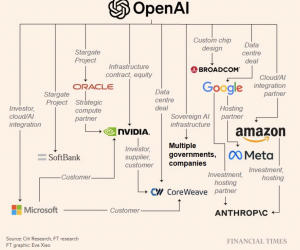
    • Back to OpenAI. Yes, people worry about that famous FT graphic and OpenAI as the potential AI investment “weakest link”. However, the capital cavalry could be on its way. Latest chat is that OpenAI plans to IPO in Q4 2026 with a raise of $100 billion on a valuation close to $1 trillion. For historical context, the previous biggest IPO raise in history was $26 billion by Saudi Aramco.


    There’s now a bigger qualitative exploration of the AI theme due, given the pretty scary comments from OpenAI rival, Anthropic, CEO founder Daro Amodei. He reckons we are moving towards “AI systems that will be better than almost all humans, at almost all tasks….by 2026, 2027.” Check out the videos on social media showing how the likes of Moltbook and Clawd are blowing people’s minds with the power of their agentic capabilities.  Here’s a few other mind-blowing datapoints in a variety of areas where regular readers will know I have been thematically focused.

    Opportunity outside USA: We talked about real things (atoms) versus digital code (bits) previously. So, see how Brazil’s real asset-rich stock market has clocked 14% gains in January alone. However, the genuine head-rocker outside US stocks is the latest earnings growth  estimates for South Korea’s stock market. Goldman’s reckon earnings growth for the entire blue chip Kospi Index will be 75% in 2026. Note most of that earnings growth will come from two companies who are critically plugged into the supply squeeze for memory chips (RAM, DRAMs, thank you Mam) – Samsung and SK Hynix. Amazingly, South Korea’s stock market is now worth more than Germany’s DAX index ($3.25 trillion).

    Automation/Power Infrastructure: It’s not a huge surprise software stocks (SaaS) like SAP are being hurt by AI speculation, investment capital shifts. However, we should note the recent overtaking of SAP as the highest valued German company by Siemens. Its key three divisions? Automation processing, power/grid systems and transport infrastructure. Note none of the famous German auto stocks feature in this table-topping race.

    Electric Vehicles: Europe hit an inflexion point in recent weeks. Latest data shows EVs as a percentage of new car sales overtook traditional internal combustion engine (ICE) powered vehicles. Looks like ICE on two levels this week faces an existential threat. Thinking of not nice people, it was amusing to see Tesla post a 61% decline in profits in its results this week. Who knew, apart from Ryanair’s Michael O’Leary, that idiotic interfering in other people’s business (politics and privacy too) can be brand destructive…?

    Last thought, and this merits a much bigger discussion. The problems for Tesla might result in a $3 trillion mega-merger/pivot of SpaceX, Xitter, xAI and Tesla, but also subtly highlights the scale of manufacturing dominance exerted by China in the electrification race. While Trump focuses on Bruce Springsteen, White House ballrooms, Melania movies and Venezuelan oil grift, the Chinese are stealing a march on the US in so many technologies. Oh, and the Chinese consumer might be coming back. Apple just told us it had its greatest ever quarter in The Middle Kingdom. A 38% jump in China sales blew the hinges off all the ‘expert’ analyst expectations.

    Lots to think about over the weekend and well done to all who invested in Social Voice before its dramatic funding close; a great illustration of investor ‘social listening’  in the venture world of little gems.

  • Big Deals And Big Themes To Watch….

    Big Deals And Big Themes To Watch….

    Been a tough week. And that Epstein dog hasn’t even barked yet. Anyway, let’s not dwell on the ‘what ifs’, let’s focus on more positive action. In particular, activity in the M&A and funding worlds, which should be taken as generally upbeat pulse-takes for individual investors. These deals also reflect the key structural drivers for the rapidly changing global economy. Change, you say? Well, Germany has had an engineering/capital goods trade surplus with China for decades. Not anymore. China in 2025 is now running a surplus with Germany. Oh, and nobody in the Oval Office will tell the Donald…. but “America First” has caused US equities to underperform overseas equities for only the third time in a decade. I know, whoodathunk amid all the giddy AI headlines? Interestingly, the deals I’m seeing in recent days also have a non-US focus.

    Infrastructure is still a huge magnet for investment capital. Blackrock’s Global Infrastructure Partners vehicle has swooped in Spain to acquire the Digital & Energy unit of domestic construction giant, ACS. Yep, that’s a data centre and AI play with a whopping $27 billion price tag. Sticking with AI, and back in the US, Mira Murati’s Thinking Machine Labs is currently doing a funding round with valuation in the $50 billion region. In its last funding round in July (checks notes, yes) that valuation was $12 billion. Not to be outdone, Elon Musk’s xAI is raising $15 billion at a $200 billion valuation. So, I think we can safely say AI and the US are still leading the giddy stuff. Elsewhere, the deals are more fundamental. Try energy.

    Private equity monster, Carlyle, is exploring an acquisition of Russian oil giant Lukoil’s global assets valued at almost $22 billion. Meanwhile, Spain’s energy champion, Repsol, is considering a reverse merger of its $19 billion upstream unit with potential partners including US energy producer APA. In addition, Google has signed a deal with French oil giant, TotalEnergies, to buy 1.5 terawatt hours (TWh) of solar electricity over the next 15 years in Ohio. That’s enough power to run the entire state of California for 10 days. Again, data centres are the key driver for the energy land-grab, be it fossil-fuel or renewable. However, as Spark closes out a lightning-quick raise of €1.5m for the impressive AuriGen Medical team, we should not forget demographics and the hugely significant structural growth in healthcare opportunities(check out our May 2025 series of articles on Japan).

    Pfizer has acquired weight-loss start-up, Metsera, in a $10 billion all-cash deal. Then the rebuffed original buyer of Metsera, Novo Nordisk, went to the debt markets to finance the $5.2 billion purchase of US biotech Akero Therapeutics. The sense of a deal ‘cluster’ in pharma-land was further heightened by Merck’s likely acquisition of another biotech, Cidara Therapeutics, in a $3.3 billion deal. Like the Metsera deal, the bidding war for Cidara was intense too. So, things are looking pretty healthy in health M&A. As for the unhealthy world…. we continue to watch ‘Whiskey Pete’ deploy US Navy assets off Venezuela.

    If ever there was a classic ‘wag the dog’ distraction mission this might be the one. Particularly, given both Jeffrey Epstein and Ghislaine Maxwell in emails from 2011, sound mystified about the “dog (Trump) that hasn’t barked” in the criminal investigation under way at that time. Venezuela is yet another prompt for all sovereign nations and the investment world to be thinking defence. Some aren’t just thinking. Valor Equity Partners have led a chunky $510m funding round for a counter-drone radar start-up, Chaos Industries, at a $4.5 billion valuation. Also, watch out for Germany’s Quantum Systems which manufactures interceptor drones which can climb 4 kilometres in 30 seconds(!). Last heard on the street, they were raising $150m at a $3 billion valuation.

    All of the above sectors, bar health, position power sources and storage as key elements in competitive advantage. Note infrastructure and power are closely linked. The best positioned infrastructure assets will be those which bring energy/cost efficiencies in a world where AI is gobbling up more and more electricity, possibly at the expense of everyday consumers and traditional businesses. There is a reason why 40% of e-commerce deliveries in Europe are now done in out-of-home (OOH) parcel lockers. It makes sense for both the primary carriers (DHL,UPS, FedEx etc) and the consumer to make ‘the last mile’ more efficient. At Spark Private, we also think OOHPod makes a load of sense with lots of exit opportunities (and founder exit track-record) and great infrastructure positioning. In all of the above deals, everyone is trying to take the lead in positioning in the market. It can feel good too when it’s good for the world. In fact, I can still remember seeing a much-loved guy on his cool new electric bike just 5 years ago, and thinking to myself how happy he looked. I will keep that thought always…..

                  W.H. RIP.

  • Virtuous Circle Or Circle Of P..AI..N?

    Virtuous Circle Or Circle Of P..AI..N?

    I’m getting flashbacks. Not good ones. Financial ‘engineering’ was a feature of the world’s last two financial crises. In the TMT bubble collapse, Enron used its stock as collateral in long-term contracts or asset sales which were described as “circular hedging transactions”. The goal or impression sought was to mitigate risk but ultimately all risk was really tied to the Enron share price. In the credit crisis of 2008/2009, new ways of packaging property debt with a bewildering array of acronyms (CLO, CMO, RMBS etc) were supposed to insulate risk within different tranches. Until, they didn’t.

    Now, I’m reading about new ways to finance the AI boom and, again, the risks keep coming back to a very narrow collateral pool. The word “circular” is back and one name keeps cropping up; OpenAI. My newsfeed has been bombarded with multiple graphics from Bloomberg, Goldman Sachs and The Financial Times (see below) illustrating this circularity accompanied by headlines stating that OpenAI is at the centre of a $1 trillion AI infrastructure spending boom. And, I thought they were just building a chatbot (ChatGPT).


    Here’s a few things you might have missed about OpenAI….


    A recent funding round valued OpenAI at $500 billion, the world’s most valuable private company, but….


    It generates NO cash. Latest figures for H1 2025 reveal revenues of $4.3 billion while incurring a net loss of $13.5 billion. Yep, it’s losing more than 3 dollars for every dollar of sales it generates.


    OpenAI has signed up to $1 trillion of deals with the likes of Oracle ($300 billion), Nvidia ($100 billion), AMD ($80 billion) and Coreweave ($22 billion). The Stargate project alone is a $500 billion infrastructure project.


    OpenAI’s core product, ChatGPT, has built a weekly user base of 800 million people.


    Now, let’s return to the deals. I’m not sure the graphics of circularity really capture what’s going on. In recent weeks the world’s most valuable company, Nvidia, announced a $100 billion investment in OpenAI. In return, OpenAI will buy Nvidia’s graphic chips (GPUs) as it builds out its data centre infrastructure. You can see the circular vendor-financing risk in that deal. However, in the last 24 hours OpenAI has announced a further deal with Nividia rival chip maker, AMD. I’m going to lean on Bloomberg’s excellent Matt Levine in imagining the language of current deal negotiations with the loss-making OpenAI.


    OpenAI: We would like six gigawatts worth of your chips to do inference.

    AMD: Terrific. That will be $78 billion. How would you like to pay? 

    OpenAI: Well, we were thinking that we would announce the deal, and that would add $78 billion to the value of your company, which should cover it.  

    AMD:

    OpenAI:

    AMD: No I’m pretty sure you have to pay for the chips.  

    OpenAI: Why?

    AMD: I dunno, just seems wrong not to

    OpenAI: Okay. Why don’t we pay you cash for the value of the chips, and you give us back stock, and when we announce the deal the stock will go up and we’ll get our $78 billion back.

    AMD: Yeah I guess that works though I feel like we should get some of the value?

    OpenAI: Okay you can have half. You give us stock worth like $35 billion and you keep the rest.


    Levine is spot on. It has been bothering me for weeks now. CEOs in the tech world have spotted that a company’s share price goes up on the announcement of huge spending plans (not profits). In extremis, one could route the “value” of the share price gain to a cash-strapped customer like OpenAI. Funnily enough, AMD’s share price rocketed 35% on the OpenAI deal news adding $60 billion to its market value. And, so the merry go round continues. Sure enough, Nvidia, has responded to the behind-the-back dealing of OpenAI with rival AMD by announcing a $2 billion investment in OpenAI rival, xAI, owned by Elon Musk. The total funding round for xAI will be $20 billion but there’s a few extra ‘engineering’ twists. The $20 billion ($7.5 billion equity, $12.5 billion debt) is going into a special purpose vehicle (SPV – remember them?) which will buy GPU chips for xAI’s Memphis Colossus 2 data centre. The SPV, in turn, will rent out the GPU chips for 5 years, with the debt backed by the chips rather than the company. Hmmmm. The rent and SPV details should raise alarm bells.

    The attraction of constructs like rent, leases and special vehicles is that it increases the complexity of an organization and also makes it more difficult to track the true returns (or not) of a company. Rent and leases are considered off-balance sheet items ie they don’t show up as DEBT on the balance sheet. To complete the circle, I’m reading about Oracle today and its astonishing $380 billion in revenue it will generate by renting out its cloud servers to OpenAI and other AI developers over the next 5 years. Oracle can’t afford a rent default. It is not cash rich like Google or Microsoft. In fact, its debt-equity ratio is a whopping 520%. Michael Cembalest at JP Morgan put it rather well…


    “Oracle’s stock jumped by 25% after being promised $60 billion a year from OpenAI, an amount of money OpenAI doesn’t earn yet, to provide cloud computing facilities that Oracle hasn’t built yet, and which will require 4.5 GW of power (the equivalent of 2.25 Hoover Dams or four nuclear plants), as well as increased borrowing by Oracle whose debt to equity ratio is already 500% compared to 50% for Amazon, 30% for Microsoft and even less at Meta and Google. In other words, the tech capital cycle may be about to change.”


    Change, yes. But some things never change in credit or investment cycles. OpenAI might be at the centre of a $1 trillion investment revolution driving stock prices ever higher. But, ultimately “other people’s money” will make its presence felt. Bloomberg is reporting that the amount of debt tied to AI has ballooned to $1.2 trillion. This makes AI the largest segment(14%) of the investment-grade market, surpassing US banks. That means more eyes and scrutiny on the circular world of AI. Bluntly, if a problem emerges it won’t be seen in the stock markets first. It will be in the bond markets with its army of credit analysts. As a final thought, and given the scrutiny applied to the track records of key entities in investment ecosystems, what must credit analysts think of OpenAI?


    • As recently as 2023, the OpenAI CEO, Sam Altman, was fired, then re-hired.
    • OpenAI co-founder, Elon Musk, is now a bitter and richer rival.
    • The company is a strange governance hybrid with control residing in a non-profit Board.
    • OpenAI and early backer, Microsoft, have been in dispute over their partnership terms.
    • CEO Sam Altman was quoted this week in FT saying becoming profitable was “not in my top-10 concerns”
    • Recent $100 billion investor in OpenAI, Jensen Huang of Nvidia, was not told about the deal with rival, AMD.


    None of the above makes OpenAI a bad credit. But, with trillions of dollars of investment capital on the line any loss of confidence in OpenAI could spiral rapidly into a whole new circle of “engineering” PAIN.

  • Think Big, Think Private

    Think Big, Think Private

    Well, that wasn’t so bad. Said no US general summoned to Quantico this week by their spray-tanned hardened bosses. I actually was thinking more about September and its data-earned reputation as historically the worst month for stock markets. Scratch that. The key benchmarks for equities, the S&P 500(up 4.25% in the month) and the Nasdaq(up 5.6%), blew the hinges off investor expectations amid lots of ugly headlines. Public markets are on an absolute tear, but investors playing catch up and wondering how to get involved could be understandably wary. I’d be wary too, but in a more nuanced way. My sense is the out-sized influence and weight of big tech in public markets is troubling. Try these statistics for size…


    *AI chip superstar, Nvidia, at $4.6 trillion is now worth more than Apple, Saudi Aramco and the entire German stock market…combined.

    *The “Buffett Indicator” is a trusted temperature check on US stock market euphoria which tracks the ratio of total US stock market value to US GDP. Currently that metric is touching 217%, or about 70% above trend.

    *Another long-run measure of ‘value’ is the Shiller PE Ratio (CAPE) which divides the current value of US markets (S&P 500) by the earnings of its constituent companies over the previous 10 years. That metric is over 40x for the first time since the dotcom bubble of 2000.

    *Options markets are not for the faint-hearted. So, it was striking to see the September 19th expiry date attract over $5 trillion of notional option exposure. More striking was that the majority of options players (62% of S&P 500 volume) in August were seeking ultra-high risk “Zero Day” instrument exposure (expiry within 24 hours). That is seat-of-pants stuff.

    *Intel’s share price has rocketed 50% since September, Google is up 68% since April, and Tesla’s stock has doubled in the same period while making the DOGE-whisperer, Elon Musk, the world’s first half trillionaire. Yep, $500 billion.

    *Nvidia’s stock market value is now bigger than the GDP of 180 countries, including India and its 1.4 billion people.


    You get the ‘big tech’ picture. Now for some historical context. Remember Palm Inc and its PalmPilot?  When Palm listed as an IPO 25 years ago, it was worth more than Apple, Amazon, Google and Nvidia combined. There is a cautionary tale there, but not the key point of today’s article. The sheer intensity and speed of capital flows in the listed large cap arena is telling us there is a massive investment shift happening. However, it is possibly too late to ‘pick’ the winners in the public markets, and one could end up picking today’s Palm Inc. However, private equity and venture capital markets have been left behind by public markets. Private investment flows and deals have slowed (with the exception of AI deals) due to subdued exit, M&A, and IPO activity, further hampered by levels of geopolitical uncertainty we haven’t seen in 50 years. The critical point is that private markets are likely to ultimately benefit from the trickle-down impact of public markets hitting all-time-high valuations. I would highlight four interesting developments:


    1. The leveraged buy-out (LBO) of gaming giant, Electronic Arts(EA), at $55 billion is the biggest ever and beats the $45 billion KKR deal to buy TXU way back in 2007. This time the buyer consortium is led by the Saudi PIF and Silver Lake. The EA buy-out adds to a wave of M&A in Q3 which will have topped $1 trillion in total global deal volume for only the second time in history.
    2. The latest funding round of OpenAI was a sale of $6.5 billion of employee stock putting the valuation of the ChatGPT owner at $500 billion. That makes it possibly the most valuable private company in the world. For those thinking it’s just AI giddiness, it’s not the only $500 billion private opportunity…
    3. We have written before about the fast-approaching age of stablecoins. So, we were intrigued to see stablecoin platform, Tether, launch a funding round of $15-20 billion which would value the financial services player at $500 billion, overtaking the value of Bank of America(!).
    4. These are all big beasts in the private markets. What about the small guys? Well, if you thought tech(+11.6%) and the Nasdaq (+9.7%) had a great last 3 months, you might be surprised that smaller companies in the Russell 2000 index did even better (+13.5%). Note 50% of the constituent companies in that index LOSE money.


    Arguably, the smaller company index is the best proxy for the Spark Private world of start-up tech and smaller private equity deals. So, evidence of small company catch-up is a positive indicator. Furthermore, Spark Private investors have a real opportunity to gain exposure to the digital currency infrastructure, AI and private equity themes above in our upcoming deal pipeline. Note we are also entering EIIS ‘season’ so investors fearing they’ve missed out on public/pension opportunities will be able to use the private markets to balance out their risk budgets at highly attractive tax-assisted valuations.

    The public markets are clearly telling investors to think BIG, but valuation risks are rising rapidly. Our message is BIG too, but private as valuations (not risk) resume an upward trajectory. Watch closely, those BIG theme deals are coming very soon.


  • Have You Checked Your Pension’s American Assets Recently?

    Have You Checked Your Pension’s American Assets Recently?

    I’m nervous. This won’t win me a Nobel Peace Prize, a Pulitzer or a Green Card but it must be said. The United States is the richest, most successful and most powerful country in the world. On a global basis, we owe the United States on many levels, be it culture, sport, technology, education, medicine, defence, investment capital, tourism or friendship. Closer to home, our fortunes and miraculous recovery from a Troika bail-out are inextricably linked to US commercial supremacy. The vast majority of our pensions reflect that supremacy by holding significant amounts of US debt/bonds or stocks. EVERY pension should have exposure to US assets but risk radars are flashing red for a seismic investment shift. Behind the headlines and in the critical plumbing of the global financial system, there is increasing evidence of a global ‘exit’ from the US. That might sound odd and inevitably the counter view will cite current data which paints a record-rosy picture.

    US and global stock markets are regularly hitting record highs in recent weeks. However, the US stock markets have been clocking up vastly superior returns compared to other major bourses in the 16 years since the GFC. This outperformance of US assets has resulted in extreme levels of US weightings in global indices/benchmarks which your pensions are attempting to either track or beat. A recent Deutsche Bank research note flagged IMF data showing US equities now accounting for 67% of Bloomberg’s World Index. That’s quite the weighting for a country which represents 15% of global GDP. Go back 20 years, and the US actually accounted for a higher 19% of global GDP.  In 2005 US equities made up 51% of the same Bloomberg World Index. For context, Europe(EU) accounts for 12% of global GDP and 14% of the Bloomberg index. Of course, the big driver is technology stocks where the 6 top US tech companies are currently valued at $20 trillion, or more than the GDP of China. The AI/cloud (AI) revolution might be the more specific driver but is this hiding a bigger picture?

    According JP Morgan’s always interesting Michael Cembalest, “AI related stocks have accounted for 75% of S&P 500 returns, 80% of earnings growth and 90% of capital spending growth since ChatGPT launched in November 2022.” AI is indeed the gift that keeps on giving for US markets. But there’s giving and then there’s giddy. I’m not sure if anyone can keep up with tech companies trying to out-do each other on the size of their investment spend announcements. It has clearly been noted by the tech C-Suite that, if you announce huge investment spend on chips, data centres or any AI related infrastructure, your share price and stock options go up. Microsoft says $100 billion, Google says $85 billion, Alibaba says $53 billion and Nvidia thinks they’ve a better twist. This week Nvidia promised to invest $100 billion in ChatGPT parent, Open AI. Excellent news but where’s the $100 billion going? Ah, that would be mostly going back to Nvidia whose AI chips will be used in Open AI’s data centres. Yep, readers might see the Baldrick-esque possibilities around circularity and vendors(Nvidia) financing customers like Open AI. Anyway, investors seem optimistic, for now. Moving away from AI, and the risk of over-investment, there’s a bigger worry for US corporates and their share prices.

    The S&P 500 broke another record in recent weeks. Valuations observed by investors these days seem to ignore earnings multiples (Tesla P/E of 200x anybody?) and focus on revenues. However, there’s a traditional metric, the price-to-book ratio, which compares the market value(price) of a company to net assets (total assets minus liabilities aka book value). Where the ratio exceeds 1x, the valuation of the company is capturing ‘intangibles’ like goodwill, brand and future investment/revenue acceleration. Currently, the S&P 500 is trading at a price/book of 5.3x. That’s higher than the peak of the TMT ‘bubble’ in 2000. For context, that metric dropped to 1.6x in 2009. Of course, many companies are more ‘asset-lite’ these days and enjoy higher price/book and revenue multiples. But… there is an intangible element in many US companies’ valuation which is critically important to their premium rating over competitor companies in other countries; goodwill and/or brand power. You can see the potential goodwill problem.

    I’m no Jimmy Kimmel so it’s best be straight rather than funny. Corporate America from Disney to Tesla to law firms is haemorrhaging “goodwill” and brand value. Two thirds of the global middle-class will come from India and China by 2030. Yet, right now the US assets of Chinese video platform, TikTok, are being seized/transferred to White House friendly oligarchs while India is dealing with punitive Ukraine-related tariffs (not Russia?) and a shake-down on vitally important H-1B visas for overseas technology professionals (70% of recipients are Indian). Friendly countries like South Korea are in shock after ICE raids on Hyundai’s plant in Georgia and the detainment of more than 300 Korean workers. Trump’s speech this week to the UN with “your countries are going to hell” could have been shortened to a simple message of “Go to Hell” to the rest of the world. Anecdotally, the news from Canada is a window into future “ally” consumer behaviour. Supermarket shelves are seeing a buyers boycott of many US products as car traffic across the US-Canada border craters by 34% according to latest August data. Meanwhile, corporate America and its leaders cower in silence while the Trump White House vandalises US institutions, global trade and sovereign alliances. The assault on US rule of law is captured in almost every headline emerging from Washington:


    Trump’s new ABC threat proves Jimmy Kimmel right – CNN


    Former FBI Director James Comey expected to be indicted on criminal charges – The Guardian


    Trump pressure on Bondi to charge political foes could backfire – NBC News


    US Supreme Court ruling lets Trump fire top official – BBC News


    The final headline featuring the Supreme Court is critical to the risk profile of the US. Investors are worried that the Supreme Court will let the Trump regime interfere with the Federal Reserve Board, the most important financial institution in the world. The Fed underpins the status of the US dollar as the world’s reserve currency. That credibility is under threat as the dollar’s value against a basket of major currencies has fallen by 10% this year. That ‘fallen’ bit is people selling the US dollar and buying other stuff. Like Gold. Lots of investors are liking bullion’s 40% increase in value year-to-date. I’m not so sure it’s a positive signal. I’m also watching deposits sitting in US money market accounts hit a record $7.7 trillion, treble the number just 8 years ago.

    These depositors are not the only ones not fully convinced about the US being the “hottest” country on the planet. Investors SOLD $3.8 billion of US stocks last week (Source: BofA Securities) with institutions and hedge funds the biggest sellers by far in one of the highest exit numbers seen this year. Oh, and if record US stock markets sound positive, context is everything. The whole world is up this year and OUTPERFORMING the US. The S&P World ex-US Index is up over 20% year to date compared to US equity markets up only 10%. But…it’s worse than that if you factor in US dollar weakness. Returns for overseas investors in US equities are closer to ZERO this year. To be clear, this re-rating of US assets will happen over years not weeks but commercial contracts, the law and international treaties require a high degree of confidence. Imagine how Canada and Mexico feel right now re-negotiating a deal which Trump himself shook hands on as recently as July 2020. His own deal. Investors will deal too, and consider a sea change in how the US attracts talent (H-1B, visas), investment capital (Fed, US dollar) and goodwill (premium equity ratings). Sadly, US-based investors might struggle for similar analysis in their media.

    Despite Trump railing against windmills (literally) and media bias, the awkward truth is that the wealthiest person in the world, Elon Musk, owns Twitter/X. The second wealthiest person in the world, Larry Ellison, owns Paramount(including CBS) and will now be taking over TikTok and CNN. Jeff Bezos owns The Washington Post and Twitch. Mark Zuckerberg owns Facebook and Instagram. Throw in Larry Page as Google’s controlling shareholder and that looks like the top 5 richest men in the world are ALL media owners. It also looks like oligarchy. US corporate leaders should also consider another consumer shift within the borders of the US.

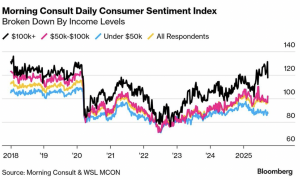
    Research from Moodys using Federal Reserve data shows the top 10% of earners in the US now account for 50% of all consumer spending. In the early 1990s (before Fox News) that number was closer to a third of all spend. Disney just discovered (as corporate America said zippo) that the average person felt that taking a comedian off air after government threats was plain un-American, and proceeded to cancel in massive numbers their Disney+ and Hulu subscriptions. Maybe, the 90% will push back on other White House over-reach? I’m not so sure, and that’s not good for US assets or pensions in the long run. Investment securities, after all, are contracts and the undermining of the rule of law will end in tears. Or, something less oligarchic. As my favourite bear strategist, Albert Edwards, said this week when posting the Bloomberg chart below, “When I look at this chart, I look at my calendar and just wonder when I should pencil in the next revolution..”   The chart dramatically shows consumer sentiment splitting sharply between the ‘have yachts’ and ‘have nots’…..

  • Follow The Deals…

    Follow The Deals…

    The White House has approved this article. Oh, wait. That’s just my slow-learning chatbot co-writer, Eric, getting nervous. Silly boy. He’s still being trained and doesn’t understand how the world works yet. Of course, as Disney and Jimmy Kimmel have just discovered, if you want to get a deal done in the USA these days you do need the approval of the Dear (or Expensive) Leader. Beijing watchers will know that a centrally controlled economy dictates whether M&A deals get done, or not. For Disney, it needs regulatory approval for a deal acquiring 10% of ESPN in exchange for NFL sports broadcasting rights. For Nextra who cancelled Jimmy early, it is awaiting FCC approval for its $6.2 billion merger with Tegna. This all makes worrying sense, but on a positive note I’m sensing an exciting pick-up in the wider world of M&A outside the truth-strangled US media. Let’s take a look at a few deal developments and note how they tick more than a few thematic boxes.

    A is for AI and we just can’t avoid it. The good news is that the AI ‘space race’ is spilling over into the wider tech world and is not just a ‘Magnificent 7’ phenomenon. Last week we touched on “forgotten” Oracle flagging a $450 billion contract backlog for its AI cloud business. This week it’s struggling chip manufacturer, Intel, receiving the AI love. Fresh from accepting an “invite” from the US government (not China) to take a 10% ownership stake, Intel has just received a $5 billion investment from chip superstar Nvidia in exchange for approximately 4% of the company. Intel’s share pricy duly rocketed 22% in a matter of hours for its best day since… 1987. Back in 2011, Marc Andreessen wrote “software is eating the world”. More recently, we have flagged a significant shift in technology – hardware is hot. AI has focused minds on chips and cloud infrastructure with the most valuable company in the world now a hardware company (ahead of software beast Microsoft). In fact, 5 of the 10 most valuable companies on the planet are technology hardware players. Interestingly, human beings seem to be benefitting from this shift too. Again, Nvidia is splashing the cash.

    We have previously written about the acqui-hire trend; the strategic acquisition of scarce knowledge/skills by buying out early stage start-ups. Enfabrica, its CEO and a handful of its employees have just had $900m waved in front of them to join Jensen Huang and Nvidia. The Enfabrica team’s key IP is the ability to connect more than 100,000 GPUs(AI chips) together.  Oh to be an AI guru, as Meta, Google and Amazon hunt the globe for unique talents and knowledge. The attraction of hiring individuals (not acquiring start-ups) for the acquiror is the avoidance of regulatory scrutiny. The biggest deal of this genre so far was Meta’s $14.3 billion purchase of a 49% stake (dodging control/regulatory process) in Scale AI, its founder Alexandr Wang and his colleagues. Of course, all this talent and  hardware needs electricity to power research, manufacturing and cloud hosting.

    So, it was interesting to see private equity giant, Blackstone, acquire Pennsylvania’s Hill Top natural gas power plant for close to $1 billion. This follows Blackstone’s July announcement that it would invest $25 billion in Pennsylvania to build out its energy and digital infrastructure for the AI revolution. Yep, $25 billion. Meanwhile, Elon Musk’s xAI vehicle has purchased an entire power plant overseas and is shipping it to Memphis where xAI plans to build a data centre hosting 1 million GPUs. Blackstone and other private equity players are clearly taking a view that electricity grid infrastructure is critical to any digital/AI ambitions. Blackstone has been particularly busy with an August announcement of the $11.5 billion purchase of New Mexico’s largest utility, TXNM Energy. So, this focus on electricity infrastructure assets raises a further question, possibly opportunity. We know electric power is critical to the AI revolution but there’s another critical component to the digital world – basic materials. The investment community is correctly focusing on the physical assets of the manufacturing and power generation sectors but the most basic manifestation of infrastructure assets is raw materials. The Chinese have bullied the Expensive Leader on tariffs thanks to control of rare earths supplies but what about other critical metals? Let’s see.

    Silver and gold prices have both recently hit new highs with precious metals funds (ETFs) posting 47% returns year-to-date. But keep your eyes on the global electrification prize. Copper is the critical metal for electricity conduction in transmission grids, renewable power projects and electric vehicles (EVs). So, check out the biggest mining deal in ages. Anglo American is planning to merge with Canadian copper play, Teck Resources, in a $70 billion deal. Given EVs use up to 4 times more copper than traditional cars and wind farms consume 10 times more copper than gas-fired plants, it’s not a surprise to see this deal happen. However, what is surprising is that the GLOBAL publicly quoted mining sector is valued at just over $1.4 trillion. That doesn’t even cover the increase in value of just one tech company, Nvidia, in the past… 6 months! The most valuable US mining company, Southern Copper, is worth $87 billion. For context, note Larry Ellison’s personal wealth increased by $100 billion in just one epic trading session for Oracle on September 9th. Not for the first time in recent giddy weeks, it feels like something doesn’t quite add up. For illustration, the top 6 US tech companies are now valued at a combined $20 trillion, more than the GDP of China. And yet, each of these 6 companies is utterly dependent on rare earths, basic metals etc. to build semiconductor chips or their precious cloud-hosting data centres. I reference China deliberately.

    Not only did China take the long view on the critical role of rare earths in the modern digital economy, they also ‘got’ electricity. In 2010 they finally caught up with the US in terms of electricity generation. But….. today the Chinese electricity generation capacity stands at 2.5x the USA. We read a lot about tech ‘sovereignty’ these days but critical mineral ‘sovereignty’ could be the next frontier of the AI race. Already, the US Department of Defense has taken a 15% ($400m) stake in rare earths mining company, MP Materials. Surely, private equity and its mounting pile of investment  ‘dry powder’ sitting idle will start to look at the mining sector? We shall see, but it must be encouraged by the US Department of Defense taking time out of bravely bombing Venezuelan fishing boats to secure mining resources. Whoops, Eric is getting nervous again…. Best I stop now before I’m Kimmeled, and best you follow those deals.


  • What Signals Are You Watching?

    What Signals Are You Watching?

    I’m a bit lost. I can still remember as a child staring out at the Ballycotton Lighthouse as it guided battered yachts to safety during the Fastnet Race disaster of 1979. Fast forward to today and there’s another potentially calamitous “storm” brewing for the most basic concepts of accepted facts and truth. Worryingly, there’s increasing evidence that the “lighthouse” of global leadership on rules of law and common values has gone dark. Orwellian dark. I know we’ve been here before with White House Press Secretary, Sean Spicer, and bonkers claims of inauguration crowds for Trump 1.0 but the second coming of Trump is a whole new level of autocratic demands to “reject the evidence of your eyes or ears.” That’s Orwell, not the White House.

    It would appear that “their final, most essential command” this week is to NOT read the time-stamped texts of the US Secretary of Defense on the unsecured Signal mobile chat app shared with 16 other US security chiefs (plus one mistakenly added journalist) and conclude that this was the most embarrassing and dangerous self-inflicted security failure by US institutions in decades. The cover-up and spin-fest since the Atlantic magazine scoop has witnessed equally incompetent and criminal attempts to parse the meaning of “war plans” and “attack plans”. To be clear, the key “ground truth” in this intelligence near-miss is that advance information on a military mission puts US military personnel in danger. But here we are.

    Donald Trump has given a press briefing stating the US “has to have Greenland” and his Kremlin keeper, Vladimir Putin,  is dovetailing on message beautifully by saying “Trump’s plan to seize Greenland is serious”. Doesn’t that sound like two mob bosses agreeing ‘territory’?  Yes, but don’t ask the lawyers. Leading law firm, Skadden Arps, has just “agreed” to provide $100m of pro-bono work for initiatives supported by the White House in order to avoid adverse targeting by a regime irked by previous “woke” cases taken by Skadden.  So, do we all surrender as democracy dies in darkness? Well, there are other Signals to watch with possibly more impact than a Houthi-Yemen air strike mission. In fact, their potential impact could be sufficiently influential to trigger “lighthouse” leadership, even change.  I’m looking at three Signals in particular.

    First, as we head towards the Trump self-styled “Liberation Day” of trade tariffs imposed globally, we watch the money or flow of same. Some might think the enormous switch by investment institutions out of US equities (down 5% year to date) to international equities (eg. German Dax up 15% year to date) is a big deal. It is. But, equity markets could be due a “rotation” anyway after 15 years of US dominance and, frankly, more challenging valuations when economic leadership veers into cult lunacy territory. The awkward fact for the Trump crime gang is that foreigners own $16 trillion of US stocks and they are selling them even quicker than Tesla shares. However, the bigger more worrying signal is in the debt (or credit) markets. As we regularly say, debt(bond) markets can really intimidate as they can cause proper global economic damage. So, when I look  at the ‘plumbing’ of the financial system and corporate debt (credit) data, I’m seeing signs of cracking and stress. The jargon monoxide will involve terms like “spreads”, “VIX”, “call options” and “default pricing” but, take it from me, this is where the intimidation of the Trump White House is beginning.

    Second, how long will Trump’s ‘broligarchs’ go along with his trade war when there is possibly a far more consequential technology “war” exploding across our screens every day? My sense is that there could be a calculation that trade wars are a dangerous commercial distraction. Check out the latest data from Stripe. Software companies (SaaS) were always the uber-growth leaders, with Stripe analysis showing the median time for the top 100 software/SaaS start-up companies to reach $5m of recurring revenues was 37 months(data from 2018). But, there’s a new growth monster in town. Stripe data (2024) shows the top 100 AI start-ups hitting that $5m milestone in….. 24 months. You might have read that executive suites across the USA have been paralysed by indecision due to erratic Trump economic policy. Indeed, M&A deal activity has fallen to the lowest in a decade and year-to-date is down a whopping 30% on last year. However, the story in start-up world is very different. In the first quarter (Q1) of 2024 there were two start-ups acquired for more than $1 billion (unicorn status). In Q1 this year, there have been ELEVEN $1 billion plus start-up acquisitions. In fact , the total value of these deals this year has been more than $54 billion or 10x the activity value of Q1 2024. It’s all driven by AI and cloud infrastructure(including Google’s largest ever deal with Wiz) but when you see the latest text-to-image generation of OpenAI and the “Ghibli” craze you’ll definitely feel something’s up. But not the Tesla share price…

    Finally, and Elon Musk might think I’m being “mean” (while he cuts social security support for the elderly) but Tesla’s share price is worth watching. The DOGE whisperer in the Oval office says he’s leaving government ‘service’ at the end of May. However, for Tesla and its shareholders, post its $800 billion share price meltdown, the value destruction pain may not end in May. The brand damage of embracing right-wing extremism has been staggering to witness but the end-game could be no less dramatic. The recent deal to sell X/Twitter to xAI (this x stuff is tiresome isn’t it) has been seen as a way for Musk to avoid margin (debt) calls on Tesla shares he has pledged as security on cross-company loans. The trigger for those margin calls was reportedly a Tesla share price of $120 per share (vs today $263 per share) but I’m not sure the pain point has been removed. The market value of Tesla is still more than $800 billion compared to Ford at less than $40 billion. Let’s not forget it’s a car company where a balance sheet and cash flow can implode if sales/revenues go into reverse. Last year revenues had a small 1% decline… but this year? Watch revenues closely, and watch Musk.

    This might seem like a random set of signals to watch but sadly, there’s one emerging truth re US leadership. Money talks, not values nor principles. The Japanese (Nikkei) stock market has kicked off the week with a 4% wipe-out and we can only wonder when the men with the money (and the loans) pay a visit to the White House. We might have to wait a bit, but I’m hopeful the money will find that “lighthouse” moment.