Tag: Elon Musk

  • A World Losing Control Of Truth….

    A World Losing Control Of Truth….

    You know that feeling. No control, just watching helplessly. On a personal level, I observed the devastating wildfires in Los Angeles from afar via Google Maps and X(itter) but was updated on the ground by my son dangerously close to events on the UCLA campus. Evacuation to San Diego was his fortunate escape while the estimates of fatalities and rebuild costs continue to climb. Sadly, the losses are not just in the physical world of lives and properties. Truth has also been scorched by the partisan politics of the US. Incoming President Trump and his oligarch allies have been quick to blame political incompetence for the fires and deflect from the urgency of the climate crisis. A cursory look at Xitter and other online channels reveals waves of misinformation on lack of water and firefighting resources, saving smelt fish(yep), DEI /woke policies (open season it seems) and even funding Ukraine as the ultimate source of blame. Now, for a few stubborn facts:

    No rain in Los Angeles (LA) since May 2024

    Highest summer temperatures in LA ever

    Land/vegetation is the second driest on record – UCLA research suggests 25% drier than average

    Strongest seasonal Santa Ana winds in 14 years (up to 150 kph)

    That lethal combination of extreme heat, bone-dry fuel and tornado-like winds are climate change driven. Fires are nothing new for California, but the change in wind/heat patterns has dramatically increased the intensity of the fires and the speed-of-spread when they occur. However, the extent of climate denial deflection at the highest US political leadership levels is amply demonstrated by the words of the incoming Trump nominee for Energy Secretary, Chris Wright, at his Senate confirmation hearing just this week: “I stand by my past comments…..the hype over wildfires is just hype”. Not for the first time, the world of finance will have its say too. In particular, the exit of insurance companies and house protection coverage for residents of LA, West Virginia, Florida and Texas is probably more instructive than the internet warriors in their underpants shrieking about political mismanagement, conspiracy theories or super-powered immigrant arsonists.  Credibility and truth are inextricably linked and the biggest bully of them all is flexing its truth-seeking muscles….

    We have written in recent days about debt markets constraining the actions of autocrats in the geopolitical world. However, in the financial world there are increasing words of worry from some very credible players about a credibility gap emerging. So, without bamboozling with jargon, let’s flag two financial facts.

    *Interest rates around the world are either falling or stabilising at lower levels than 18 months ago.

    *Bond yields which usually track interests rates are not falling, or even stabilising. Longer term yields in the UK, Japan and US have broken free of their relationship with interest rates and are rocketing higher.

    This divergence of trajectories for interest rates and bonds is HIGHLY unusual. So, what’s happening? Well, debt and bond markets do track interest rates set by the central banks….normally. But, in this instance, credibility or credit has come into play on two fronts. First, central banks like the Fed and Bank of England are facing increased scrutiny in their battle to tame inflation. Second, government bonds track the credibility of sovereign governments – their ability to confront or tell the truth. And that’s a problem now. Nobody believes current UK government policies are able to deliver growth and not many believe Trump’s tax cuts and tariffs menu will tame inflation. Bluntly, there are increasing fears in financial circles that the Fed has lost control of the most important financial market in the world: the US Treasury market. Again, truth and credibility (not denial) are critical to attract risk capital, insurance, investment etc.

    Finally, we should note the warning in President Joe Biden’s farewell address to the nation this week. Critics might argue his presidency wasn’t bold enough, even cruel enough, but his departing words might resonate with those who read President Dwight D. Eisenhower’s farewell speech warnings in 1961 about the dangers of the “military-industrial complex”. Biden points to an oligarchy of “extreme, power, wealth and influence” in a “tech-industrial complex” which wields a very modern weapon to serve their own interests. The tacky million dollar Trump inauguration donations and spineless abandonment of content moderation by the tech oligarchs could be mistaken as the source of bitterness for an ousted president but I’ve a feeling the following statement will be revisited by historians as a prescient warning:


    “Americans are being buried under an avalanche of misinformation and disinformation, enabling the abuse of power. The free press is crumbling [or] disappearing. Social media is giving up on fact checking. The truth is smothered by lies told for power and for profit…. Meanwhile, artificial intelligence is the most consequential technology of our time, perhaps of all time.”


    I’ve got some bad news. That “avalanche of misinformation” is just the start, and the reference to AI is key. It feels like every funding round at the moment is attached to “AI-agents”, bots who will carry out the mundane content generating tasks of human workers. In fact, one in every two dollars of VC funding in the US right now is going to AI. The number globally is 37% (Source: CB Insights). However, let’s think about that ‘army’ of bots to be unleashed on the future of work and communications. First, know that an estimated 50% of all online traffic right now is bot generated. Yep, that’s bot created content, bot engagement, bot dissemination….. the whole false fly-wheel effect. Now, imagine a vicious circle of billions of bots, content pieces and false engagement. Then think false content.

    You will hear more about “Dead Internet Theory” in 2025. It started out as a peripheral online conspiracy theory claiming the internet has been taken over by artificial intelligence(AI). Viral posts, engagement rankings, traffic stats etc all have a whiff of AI-bot promotion these days but there’s worse to come. The sheer volume of misinformation coming our way via AI-agency bots could kill online platforms’ utility value. Even this week, using Xitter was an exercise in dodging the underpants brigade + bots and finding real true information on the LA fires. And, now the chat is Elon Musk will be buying Tik Tok. A change of commercial control perhaps, but the reality at a higher communications level is more existential. We could lose control of not just the internet, but truth itself.


    “You can’t handle the truth!!”  – Colonel Jessup, A Few Good Men.



  • Big Numbers That Can’t Be Missed

    Big Numbers That Can’t Be Missed

    Now, it’s my turn. I get to vote this week. For lots of busy good reasons, I haven’t read a huge amount on our own election but there’s no doubt it is important. However, I’m conscious I’m just one of 4 billion people voting in the current 12 month period. This also prompts another nagging feeling that it is external events over the lifetime of the next government which will define it. From Ukraine, to Utah, to even Mars, our planet is at an inflection point. The ‘world order’ is dangerously shifting as North Korean troops enter a European conflict zone for the first time, and yet, it would be ill-advised to down tools and just wait. There are other themes and trajectories already established and unlikely to change. Simply put, the numbers are now too big. And, we will continue to watch SIX in particular.

    Artificial Intelligence: It is striking to see various commentaries question the real ‘value’ of AI. During the summer, Goldman Sachs estimated that tech companies were about to spend $1 trillion on AI but queried whether they would ever earn a return on this capital expenditure. Fair question, but there’s another point to be made. The ‘winner takes all’ nature of this tech arms race is existential. The poster child of the AI revolution is Nvidia. Yet again, it smashed analyst forecasts this week in its latest quarterly results. My takeaway is that, of course, there will be misallocation of capital in this existential race but tech companies are going to continue to spend to stay in the race. ‘Exhibit A’ must be Nvidia’s own revenues in its data centre chip division. A whopping $30.8 billion revenues generated in the last quarter revealed a growth rate of 112% vs a year ago. Also, for context, this division has increased its quarterly revenue 7-fold since the early quarters of last year. Note, data centres are the battle ground where AI models are tested and trained, and this trend is set to continue.

    Cleantech: European cleantech suffered a blow this week as Northvolt sought Chapter 11 bankruptcy protection from its creditors. It’s a significant blow to Europe’s efforts to decouple from its dependency on China for electrical vehicle (EV) battery materials, chemistry, design and manufacture. Northvolt tried to deliver in all four process functions and received $15 billion of investment backing to do so. This has been a very expensive way to experience execution risk; both Goldman Sachs and VW have written off investments in Northvolt of $1 billion each. However, just like AI, loss is a recurring feature in any new technology area. So, keep an eye on the big numbers. In this instance, the EU is outspending the US with a $125 billion spend in 2023 (vs $86 billion). But….. China is really the cleantech benchmark. The Middle Kingdom spent $390 billion in 2023 across renewables, carbon capture, utilization and storage, hydrogen, batteries and nuclear power.

    Space: Elon Musk’s SpaceX is the most valuable private company on the planet with a recent funding mark indicating a $250 billion valuation, ahead of ByteDance (parent company of TikTok) on $225 billion. At current pace, it is launching its Starlink satellites (via Falcon 5 rockets) every 2.8 days. If you’re just about getting your head around that launch frequency think about Space X’s massive re-usable Starship which completed its 7th test flight last week. Its payload capacity is 150 tonnes and the plan is for Starship to do two launches…. daily. Now, what if the entire tonnage launched into space in history has been just shy of 40,000 tonnes? That means in the very very near future, Starship alone would be capable of repeating the entire payload history of space in just over 4 months. I’m not sure we have grasped the enormity of this feat and the implications for industries like telecommunications, mining, military defence, tourism, manufacturing or even housing (on Mars?).

    Crypto/Blockchain: Bitcoin is on the cusp of breaking the $100,000 mark. However, we need to start thinking about the entire crypto/blockchain ecosystem. Check out MicroStrategy which on the face of it is a loss-making software business but since 2020 has been investing in Bitcoin. If you thought Nvidia was the best performing share price in the world you’d be nearly correct – it has delivered 2660% returns to shareholders in the last 7 years. But….. MicroStrategy has rocketed by 3420%. Its current market value is $117 billion, making it more valuable than Nike, UPS or Starbucks. Of course, MicroStrategy is a leveraged play on Bitcoin but there are other ways to ‘leverage’ the rapid expansion of stablecoins, crypto funds, tokenisation, blockchain etc. The crypto asset ecosystem has just passed the $3 trillion valuation mark which exceeds the asset value of most countries’ stock markets. These numbers, and the opportunities to plug into this investment pool, are too big to miss…or ignore.

    Banks: It would be easy to move on to the ‘next shiny thing’ in the space or crypto universe but the banking sector is worth watching right now. Governments are finally getting good selling prices (even premia) for rescued bank shares as the UK (Nat West), Germany (Commerzbank), Ireland(AIB), Greece (Piraeus Bank), the Netherlands (ABN-AMRO) and Italy (Monte dei Paschi) all reduce sovereign shareholdings or exit altogether. As an aside, and interesting contrast to ‘shiny new things’  Monte dei Paschi began commercially lending 20 years before Christopher Columbus’s trip to America was financed. Anyway, old or not, the bank sector is hotting up. Breaking news over the weekend suggests Italy’s Unicredito will make a €10 billion + bid for rival BPM, and note Unicredito is already circling Germany’s Commerzbank. Also, it is worth noting that the tax/accounting professional services arm of UK wealth player, Evelyn Partners, has just been bought by private equity (Apax) for £700m. That is significantly more than the £500 million price tag suggested by City analysts.

    Technology Rotation: We have written previously about the particularly strong comeback for technology hardware thanks to AI, semiconductors, EVs and iPhones. The world has become very used to these themes powering the “Magnificent Seven” – Microsoft, Apple, Nvidia, Google, Meta, Amazon and Tesla – to all-time-highs but this analysis of last week’s technology price action in the newsletter, Clouded Judgment, caught the eye:


    This week saw the rapid acceleration of an interesting trend that started not too long ago – Magnificent 7 underperformance and software outperformance. Might this be the start of a rotation into software and growth (ie more risky assets)? Meta was down 3% over the last week. Amazon was down 7%. Microsoft down 3%. Google down 6%. Nvidia flat. Apple / Tesla were slightly up. QQQ was down 1.5%. Meanwhile, the WCLD index was up 6% over the last week! In addition to that, there were some really big moves in individual names. Snowflake was up >30% on Thursday after reporting earnings on Wednesday, which lifted the rest of the software market. Also just on Thursday Mongo was up 14%, Confluent / Datadog / Cloudflare were each up 7%.


    As a reminder, the Magnificent 7 have an aggregate value of $13.5 trillion which is more than the GDPs of India, Germany and Japan combined. The potential risk of an investor rotation OUT of the Magnificent 7 is a multi-trillion dollar consideration, and also can’t be missed.

    Clearly, my vote can’t change any of the big numbers above. However, these are the numbers which are far more likely to define our investing and business futures on this island.


  • Is The World Going Full Oligarch?

    Is The World Going Full Oligarch?

    The lettuces won’t be happy. It looks like the UK’s new Chancellor of The Exchequer, Rachel Reeves, and her Autumn Budget 2024 will survive a relatively benign financial market reaction. So far, government debt (Gilts) markets are stable and the domestic-focused FTSE 250 stock index has bounced slightly. Liz Truss will shake her head in delusion but the more understanding reality of today’s world is that the government of the world’s 5th biggest economy was brought down by international asset traders back in October 2022. It probably won’t be the last sovereign state to lose power to commercial interests and yes, money. Simply put, at exactly the wrong moment in time, many of the world’s governments’ ATM spending cards are about to be declined. Check out the following recent headlines:


    Interest payments on the national debt (US) top $1 trillion as deficit swells  –   CNBC


    IMF warns Japan of debt deterioration in the event of future shock   –   The Japan Times


    Why France’s fiscal freak out matters to the world  – Axios


    China’s Fiscal Package Aims To Ease Debt Woes, Property Crisis   –  Asia Financial


    There’s never a good time for fiscal capacity to be tight. But… literally the planet’s survival is at stake. The climate crisis is everyone’s crisis but governments are expected to lead. Indeed, according to the IEA, governments globally in 2023 spent $1.3 trillion or 1.2% of global GDP on clean energy investment. That bill will surely rise but there’s a big question mark over how the clean energy transition will be funded by stretched governments running record deficits and the highest debt burdens in history. For a clue to that question, let’s take a look at another spending race.

    This race depending on your perspective also has an existential angle. The race, of course, is AI and Packy McCormack’s excellent piece in his Not Boring newsletter has identified a shift in commercial goal – “companies are spending for capability as opposed to straightforward ROI”. Why the ditching of seeking returns on investment? Apparently, the first company to create the AI “Digital God” boils down to an existential pursuit. Loser companies die. Indeed, Larry Page of Google fame has reportedly said many times internally…..


    “I am willing to go bankrupt rather than lose this race”


    That feels like extremely high stakes thinking. It might explain another development in the world’s most advanced technology economy. It’s one thing for a government to depend on a private company, SpaceX, to conduct an international space rescue mission. But, it’s quite another to see SpaceX’s owner Elon Musk in the words of VP hopeful, Tim Walz, “skipping like a dipshit” at various Trump rallies. Musk may cause me involuntary eye-rolls every time I read him on X or see him on TV but he’s a super-successful builder of future technologies. In fact, he has feet in both existential races with Tesla (climate) and xAI (AI) which is about to raise funds at a $40 billion valuation. If the latter doesn’t feel like an existential race, maybe the monies will convince you. In 2023, just 4 companies – Facebook, Amazon, Google and Microsoft – spent $196 billion or 0.72% of US GDP on AI research and infrastructure. Remember, these companies are really only ‘getting ready’. Furthermore, they are arguably investing at levels which historically would have only been within the compass of sovereign governments.

    I remember reading first about social media companies becoming effectively supra-sovereign powers. At the time, Facebook had 2.5 billion people on its platform, multiples of any other country populations on the planet. Now social media steers business and moves elections, but tech money might be about to go one step further. Forget about tech companies currently rolling out nuclear power for their hyper-scaling data centres. What about a seat in government?  Well, Elon Musk is on the cusp of entering a Trump ministerial cabinet with a role brief focused on cost cutting. I will give you a clue; plenty of those cuts will be in the regulatory, business and tech governance areas. Musk is not alone. Racist rallies in Madison Square Garden or not, big business is keen to put on the Orange war paint for Trump chaos and……… commercial insurance or favour. Check out the latest Trump luvvies from the world of business:


    Winklevoss Twins donate $1m each to Trump as champion of cryptocurrency  – The Guardian


    Steve Schwarzmann says Trump would be “efficient and effective” president this time – Business Insider


    Silicon Valley’s Andreesson Horowitz give Millions to Trump  – Bloomberg


    Billionaire Ken Griffin says “expectation today is that Donald Trump will win the White House” –  Fortune


    Washington Post flooded by cancellations after Bezos non-endorsement decision  –  NPR


    Ooooohh what would Washington Post legends Katherine Graham or Ben Bradlee think in this “Fat Nixon” era? It would appear big tech and big money “broligarchs” see Trump support as commercial insurance at the very least, and possibly a route to unfettered, compliance-light opportunity. One could become dispirited about the overt involvement of big business in politics. But, in reality business was always there in the Washington background. However, it’s not just a US phenomenon.

    Europe has had its share of big business influence on policy. In the UK, they have had trade and Brexit. In Germany, it was the powerful industrial sector and its push for cheap(then) dependency on Russian energy. We will say no more on either policy disaster, except there might be an intellectual reason why US business leaders are in a different universe of wealth creation compared to their strategically inept European counterparts.

    On a final more serious note, perhaps the difference this time is that governments really do need the balance sheets, cash and spending power of big tech. Just six US technology companies – Apple, Amazon, Google, Meta, Microsoft and Nvidia – have a combined market value of $15 trillion. For context, that $15 trillion equates to the  GDP of China as recently as 2020. In this writer’s reluctant view, politicians have two options – tax these guys or become partners. It might seem distasteful but public-private partnership is now an existential fact of life….or death.

    Gotta dip with the dipshits.


  • Countdown To Trend Exhaustion…?

    Countdown To Trend Exhaustion…?

    It’s day 96 of my 100-day no alcohol challenge, so who’s counting? I’m certainly not exhausted. Quite the contrary, but recently I have been prone to describe the benefits as “over-rated”. However, this proximity to completion does focus the mind on other things potentially ending in the world of business and investment. In particular, and by pure coincidence, in my day-to-day risk role I’m seeing some multi-year business trends begin to stall or enter new phases of growth. But, first let’s deal with a monetary shift.

    The consensus view on inflation and interest rates was that both were on a downward trajectory with central banks promising to cut rates if consumer prices were on track for a more manageable 2% annual growth. Europe seems to be on track, and the ECB just today indicated its rate cut cycle could begin in the summer. If anything, the Fed (FOMC) in the US was going to move before the Europeans, with money market traders heavily betting on a June cut. Ouch! This week’s US inflation report (CPI) caused some real pain for those traders as core CPI came in ‘hot’ at a year-on-year 3.8% rate of price increase. That’s way off a 2% level targeted by the Fed and means a significant reversal in monetary leadership as money markets now price an ECB cut in June, and the Fed to follow suit in September. That’s a big change in expectations.

    As always, the cost of money (rates) drives all financial asset prices and this ‘change’ in trend could have an immediate impact on currency markets. Watch the Japanese yen continuing to fall to a 34-year low versus the dollar and Tokyo’s stock market at a 34-year high. A Bank of Japan rate hike might be needed to stabilise its currency, but not necessarily cheered by stock market investors. In fact, the yen-dollar relationship is often used by traders as a proxy measure of ‘risk’. The trend in markets for the last 15-18 months has been ‘risk on’. In other words, asset prices have generally rallied as investor confidence grew. A shift to ‘risk off’ could hurt some of the higher flying assets of recent times. I note Goldman Sachs’ investment division is growing wary of US technology (“Magnificent 7”) but there’s another newer asset class which might also stall its impressive return to form.

    Bizarrely, this new asset class was designed and built to escape the scrutiny and influence of the all-powerful global central banks. I’m talking cryptocurrencies and Bitcoin which has quietly risen to its historic pricing highs of $72,000. However, rather than become independent of the traditional global financial system, Bitcoin has become an asset used by traders to increase risk exposure (buy Bitcoin) or reduce risk (sell Bitcoin).  So, if ‘risk on’ trends are due a pause or reversal, it will be deliciously ironic that decisions in an office in Nihonbashi, Tokyo, by Bank of Japan officials could drive the price action of cryptocurrencies like Bitcoin. However, cryptocurrencies are not the only technology asset on a serious upward trend but facing a few teething problems. The hottest investment topic on the planet right now is AI. However, like central banking, there seems to be an emerging divergence of fortunes…

    The remarkable feature of the AI investment boom, compared to crypto and metaverse, is the sheer scale of investment. It’s not just hype. Nvidia, the $2 trillion poster child of AI and manufacturer of the chips powering AI learning models, is booking real orders and reporting real 6-fold revenue growth in little more than 12 months. However, the future ‘winners’ in providing these AI services are less visible. Of course, Big Tech, with Amazon, Microsoft and Google leading the charge, are busy building or acquiring chips, talent, language models, data and technologies to win the AI race. This race requires vast amounts of investment capital and the smaller players are beginning to struggle. Once upon a time, London-based StabilityAI had raised $100 million at a $1 billion ‘unicorn’ valuation but has ended up with a CEO/founder departure, a Getty Images lawsuit, $99 million of debt and just $11m of revenues. A recent Forbes article suggested the firm had run out of cash to pay its Amazon(AWS) cloud computing bills. Clearly, the overall AI investment trend is intact but it is important to understand the nuances and risk-shifts within that structural story. Now, for an excellent example of that point.

    The simultaneous growth of global GDP and an ageing demographic has ensured a steady flow of pensions and savings capital into equity markets. This has resulted in long-run returns for investors in developed equity markets of 6-7% per annum over the decades. However, as the investment pool of retirees increases my little ‘risk radar’ is seeing a problem and a solution. Firstly, many readers will be aware of the Irish stock exchange(ISEQ) and the mighty London Stock Exchange (LSE) losing constituent companies to other major exchanges(NYSE, Nasdaq) or publicly listed companies being bought out by private capital. Only this week we were forced to ponder a scenario where the LSE could possibly lose FTSE 100 index titans, Royal Dutch Shell (move to a higher valuation US stock market listing) and BP (reports of a bid from Adnoc, Abu Dhabi’s national oil company). From a simple numbers perspective, the investment opportunity pool on a public market/exchange (LSE) is not just shrinking by hundreds of billions (in market capitalisation) but also potentially losing two of the 5 biggest income generators (dividends) for pensioners in the UK. That’s a problem. Now, the solution.

    Jamie Dimon, CEO of JP Morgan, in a recent CNN interview highlighted the same problem; at its peak in 1996 the US had 7,300 publicly listed companies. Today that number is 4,300. However, like AI, investment capital might just have shifted into a different corner of the same opportunity pool. In fact, it has. The number of US companies backed by private equity firms has grown from 1,900 to 11,200 over the last two decades (Source: JP Morgan). So, the solution for investors is to expand their investment horizons into private equity funds, private buy-out deals, EIIS investments etc. Until incentives are improved for companies to go public (regulation, quarterly reporting burdens, costs, PR etc), this public-private shift will continue and investors/pensions will have to find opportunities and income/dividends in private companies. Bluntly, the future is bright, but it’s private. And, it is no accident that Spark Private Portfolio investors are currently being offered an exclusive opportunity to expand their portfolios into an interesting private healthcare buy-out deal. Unsurprisingly,  the most valuable private companies right now are very much looking at the future – check out Open AI ($100 billion ) and SpaceX ($180 billion) – but what about that other Musk combination of new tech and transport, Tesla?

    Tesla’s 30% share price decline in 2024 might be perceived as a Musk-specific governance issue but the entire electric vehicle sector (EV) is encountering some growing pains. Check out these headlines:


    EV Sales Revved Up. Now Buyers Are Pumping The Brakes – Barrons


    Ford to delay rollout of new electric pickup and SUV as EV sales slow –   The Guardian


    China’s first quarter EV sales growth slowest in a year –  Reuters


    As the benchmark player, Tesla’s poor recent results and actual year-on-year sales decline in the US prompted the commentariat to quickly ask whether this was an EV market blip or something more structural. From this Dublin desk, and a country with an abysmal track record on timely infrastructure modernisation, it looks like the charging infrastructure (not enough charge points on routes) for the EV revolution is due some catch up globally. In particular, US consumer surveys continue to cite charging/range anxiety as a factor. More short-term factors probably include high interest rates (falling soon?), consumer expectations of continued manufacturer discounting and new super-cheap Chinese alternatives. This all sounds very familiar to long term observers of global durable goods manufacturing cycles, and with so many companies investing to win the EV landgrab, there will be casualties among manufacturers. Just ask the computer chip industry. In fact, that industry gives us a chance to conclude on a positive note.

    If anyone doubted the Bidenomics manufacturing revolution in the US, then this week was seismic. Taiwan’s chip manufacturing giant, TSMC, confirmed an expansion of its capital investment in the electoral swing-state of Arizona. The new TSMC investment number is $65 billion compared to an initial plan of $40 billion and will result in 3 chip factories being built in the state. Critically, a mix of US government grants and loans offered to TSMC will add up to a whopping $11 billion of investment incentives. That’s great news for Arizona, albeit TSMC might have to plan for male-only recruitment. It looks like the AI chips of the future will be built in Arizona, but the state’s Supreme Court is definitely searching for the past. In imposing a total state-wide ban on abortion this week, the state’s highest court had to travel back in time to revisit supportive legal text in the statute books from …..1864. Now, that is exhausting.

  • Great Expectations

    Great Expectations

    Sometimes I wish NPHET’s body of experts and medical chiefs would collectively do the ‘Freezebury Challenge’. As each day of February goes by, those hardy souls counting the extra minute each day in the frigid Dublin Bay waters understand the battle waged between fear of the next day’s incremental pain and the motivation of a charity challenge completed with a firm finish date; March is the fun swim focus. However, NPHET don’t do fun. Dates are fuzzy and the focus remains fear. The good news is human beings are resilient. It’s in our nature to look ahead, despite the challenges, and financial markets are currently providing a remarkable case study in expectations.

    If anything, economic conditions have worsened in recent weeks as businesses in Q1 deal with second and third wave pandemic lockdowns. Main Street is struggling. Yet, Wall Street is flying to record highs on an almost daily basis. The headlines would suggest “meme stocks” like Tesla are the drivers of this market excitement but that is not even close to the full picture. The truth is that it is not just “stories” which are generating investor enthusiasm. It is real stuff; dirty, old, fundamental stuff. And a little bit of digital dreaming. Here are a few data points which caught the eye:

    • Lumber prices in the US are up 170% over the past 10 months.

    • Oil prices above $60 per barrel are at 13 month highs.

    • Prices of natural gas in Asia almost reached $30 per MMBtu compared to just $2.60 in the US.

    • Tin prices at $30,000/tonne hit a 10 year high.

    • Copper prices at $8,400 per tonne have not been seen since 2012.

    • Soybean prices are up 60% in the past year.

    • Investor confidence in riskier companies’ debt hits record highs(price) as junk bond yields go below 4%.

    • Share prices in emerging markets are at record highs, finally eclipsing the previous peak achieved in 2007.

    • Japanese investors in the Nikkei 225 index have had to wait a little longer. The Nikkei is back at the 30,000 level it last achieved 30 years ago!

    And now for the dreamy stuff…..

    Investors can’t get enough of thematic blank cheque investment vehicles. Known as SPACs (Special Purpose Acquisition Companies) these vehicles are being listed on public markets at an unprecedented rate of almost $1 billion raised per day. In 2020 the total SPAC investment universe raised $83.4 billion dollars. We are only in mid-February and funds raised are already at $46 billion. Please note investors don’t even know where these funds will be spent in terms of acquisitions, geographies, valuations etc. You know, the fundamental stuff, right?

    Of course, we can’t ignore cryptocurrencies. Elon Musk and Tesla made a big splash in recent weeks buying $1.5 billion of Bitcoin and now this digital “store of value” has passed through the $50,000 price mark. Now there are commentators excitedly talking about Bitcoin as a more efficient substitute for gold which is an asset class ten times the size of Bitcoin’s market cap. So, next stop is $500,000 for Bitcoin!

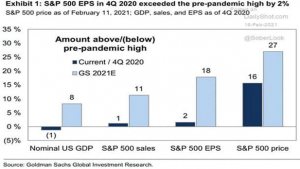
    Yes, this writer is a little concerned. However, confidence is critical to economic recovery. There will be fun and tears along the way(ask the Gamestop bandwagon victims) with pockets of irrational exuberance, particularly in a super-low interest rate environment. However, we leave you with one final fundamental data point which suggests better times ahead. There is a school of thought that Wall Street has detached itself from Main Street reality but check out the latest analysis by Goldman Sachs below. It would appear that profits from companies in the S&P 500 in Q4 2020 were actually higher than those achieved pre-pandemic….

    Clearly, things are getting better in the corporate world and the roll out of vaccines can only add to optimism. However, expectations must be managed. There is a danger some investors will chase the shiny baubles of Wall Street as a panacea for pandemic loss. Fear of missing out, FOMO, is a powerful emotion but there will always be fundamentals….. and hopefully fun. Indeed, Dickens himself told us Pip would rather have missed the glitz of wealth:

    “I used to think, with a weariness on my spirits, that I should have been happier and better if I had never seen Mrs. Havisham’s face, and had risen to manhood content to be partners with Joe in the honest old forge.” ‘Great Expectations ’

  • No Sign Of Wall Street Blues

    No Sign Of Wall Street Blues

    Happy Blue Monday but crikey! It’s tough enough these days without Father Time slapping you with a big number. Was it really 40 years ago this week when the TV crime series, Hill Street Blues, first hit our screens? Think back to Mike Post’s instrumental theme music, grimy urban scenes, innovative shaky hand-held cameras, multiple storylines and the steady din of background noise.

    The Hill Street precinct was breaking new ground in TV-land but who can remember Wall Street almost breaking the economy? More specifically, the cost of money for business was approaching nose-bleed levels of 20% interest rates. Grim days. Not so these days. Despite a global pandemic and ‘a real and present danger’ sitting in the Oval Office, financial markets are experiencing pockets of euphoria. Let’s take a look at three headlines over the last week.

    Affirm Stock Rockets More Than 90% After IPO – MarketWatch

    Bank share prices still wallow at historic low valuations but it seems that Affirm’s buy now/pay later financing facility is ground-breaking. Hmmm. Lots to think about here on top of the $24 billion valuation attributed to a financing option which has been around since 1157, according to the history of Venice.

    Signal Advance Has Soared 11,708% Since An Elon Musk Tweet – Business Insider

    A personal favourite this one. The world’s richest man, Elon Musk, tweeted “use Signal” to his 42 million followers last week. The background to this was a privacy revolt against Facebook’s WhatsApp messaging service. Sure enough, the Signal messaging app signed up millions of new users and the valuation of Signal Advance soared from a tiny $6 million to $300 million in just a few days. As Captain Blackadder might say, there was a tiny flaw in that investment strategy. Signal Advance has zero commercial connection to Signal, the encrypted messaging platform. Thousands of investors have bought the wrong stock.

    SPAC Mania Gives Early Investors Steady Returns With Little Risk – Wall Street Journal

    It is difficult to believe this is a WSJ headline. “Early” and “Mania” might be the operative words in this gem. As a brief explainer, a SPAC is a “blank cheque” investment vehicle which raises money via IPO on a promise to acquire companies in a specific(usually) sector or with an identifiable theme eg. Start-ups, hydrogen fuel, social media etc. In 2020 there were 248 SPAC IPOs. In the first 2 weeks of 2021 there have already been 40 listings on the public markets. SPACs are not new. They come into vogue when multiple “hot” sectors appear and investors look for swift access to these themes. Previous incarnations have included shipping, banking and energy exploration. The track record of these is mixed to put it mildly. Anyway, this is the early giddy expectation bit – enjoy the IPO excitement before the funds are spent and often wasted.

    Please do not take this as a blanket statement that financial markets are in a bubble. In fact, there are large parts of the market which are only just breaking out of multi-year slumps. Think smaller companies, European equities, banks and emerging markets which have all had a very tough decade. However, it would be remiss of us not to take on board the iconic daily cautionary words of Sergeant Esterhaus at the Hill Street precinct – “Let’s be careful out there”.

  • Three Huge Trends To Earn Their Stripe

    Three Huge Trends To Earn Their Stripe

    Wowzers! The latest market chatter is that Irish fintech, Stripe, is about to raise more funding which could push it towards a $100 billion valuation. Billions, both the TV show and the monetary equivalent, feels so yesterday. Just think, the giants of Irish public markets – AIB, Bank of Ireland, CRH, Kerry and Ryanair – would currently garner a combined market capitalisation of just over €50 billion. We are witnessing decades of traditional franchise building being overtaken by tech-powered businesses which are moving at hundred billion dollar warp speeds. A touch hyperbolic, you think? Well, think Tesla….

    Elon Musk, the founder of the electric vehicle manufacturer, is now richer than Bill Gates thanks to a Tesla valuation increase of more than $100 billion in the last….. 10 days. Warp speed might be the $400 billion increase achieved over the past 300 days. However, let’s try and slow things down by exploring the trends driving these huge valuation shifts. Tesla illustrates two trends rather well.

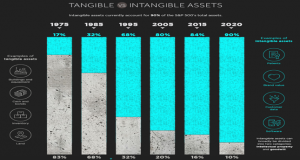
    First, investors are now heavily weighting their valuation processes towards intangible assets like IP and goodwill. Tangible assets in physical items like inventories, factories and land just don’t possess the growth and scale-up speeds implicit in mass-adoption IP. Tesla is still just a manufacturer of physical stuff but has managed to achieve a $550 billion valuation which exceeds the combined value of all the other auto manufacturers on the planet. How does a tiny Tesla 0.6% market share translate into capital markets dominance? Check out the chart below from the excellent Visual Capitalist analytics site which highlights the huge asset shift to intangibles within the S&P 500 index.

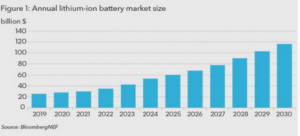
    Thirty five years ago less than one third of assets were intangible. Today’s 90% figure gives a clue as to what is driving Tesla and technology company valuations. Specifically, investors are attaching huge value to Tesla’s lithium-ion battery technology and the next chart illustrates that emerging trend/opportunity. The lithium-ion battery market is expected to more than quintuple by 2030 according to Bloomberg.

    Despite these two favourable trends many still struggle with the Tesla to-infinity-and-beyond valuation. Well, maybe not infinity but how about space? China has just launched a lunar expedition and the DiaperDon has added a Space Force to the gargantuan US defence budget but there are more immediate commercial initiatives afoot. Elon Musk’s primary wealth vehicle might be Tesla but his rocket company SpaceX is possibly the stellar trend to watch.

    Space is the new data frontier and SpaceX has launched more than 500 Starlink satellites to ultimately beam high-speed broadband from orbit to anywhere in the world. Infinity indeed. Current plans entail a constellation of up to 12,000 satellites in low-level orbit and one does wonder why this project is generating less attention than Tesla.  For a more detailed and prescient analysis of SpaceX’s strategy Gavin Sheridan’s recent article in The Currency is worth a read. More intriguing is Sheridan’s view – held impressively since 2015 – that Teslas’s fleet of electric vehicles have a role to play in this broadband network. The mind boggles but there is no doubt investors are going to hear a lot more about galactic opportunities in the next decade.

    Prepare for daily trillion dollar valuation shifts too as these three trends accelerate.

    Or as Captain Kirk said, “Set phasers to stun”.