Tag: equity

  • Technology Sector Serves Up Critical New Pension Risks…

    Technology Sector Serves Up Critical New Pension Risks…

    That was quick. Half the year gone already but no World War III, no AI ending humanity and no gains for all those crypto lemmings who increased the wealth of the Trump family by $1.4 billion. The Donald deftly sidestepped the crypto shake down with the reassuring deflection of a practiced mobster – “The stock market is going up…Everybody’s profiting”. Sure, Jan. Between Love Island and the upcoming weekend sports-fest one can understand people lacking a little financial focus. So, I will keep it brief today. I’d like to take a look at a number of technology sector financial milestones which have been achieved and then flag a couple of unintended consequences, and probably pension risks. First, the milestones….


    • Tech-heavy Nasdaq Index gained 20% in H1 vs S&P 500 up 9.5%.
    • Semiconductor/chip sector went rocketed 82% in the same 6 months (Nvidia, Broadcom, Intel etc)
    • Memory chip stocks like Sandisk, Micron, Hynix and Samsung are up a whopping 120% in H1.
    • Research house, Gartner, say AI spending will hit $2.6 TRILLION in 2026.
    • The AI hyper-scalers – Google, MSFT, Amazon and Meta – are set to spend $650 billion on AI infrastructure in 2026. 
    • The combined weight of AI-focused stocks across hyperscaling, semiconductor chips, power, hardware and software tots up to 51% of the total value of the S&P 500 index.
    • Nine major AI companies accounted for almost half of global technology borrowing, raising $122 billion in corporate bonds in a single year to fund data centres and infrastructure.


    So, my first observation based on these milestones is that, if your pension is tracking global/US stock markets, then there is a strong possibility you are ‘running’ a significant bet on AI without actually realising it. It’s what the pensions/wealth industry might refer to as a ‘concentration risk’. And, I think the following headlines are flagging a few other AI risks right now….


    • OpenAI Leans Toward waiting Until Next Year For IPO – New York Times
    • Tesla Caps Employee AI Spend At $200 Per Week After Adoption Push – The Information
    • OpenAI in early talks to give 5% stake to US government – The Guardian


    OpenAI, as a reminder, is attached to almost $1 trillion of AI infrastructure projects and the ‘mood music’ in the above headlines is not great. These projects have been funded by trillions of equity and debt from technology and banking partners. So, these partners must be wondering why OpenAI feels the need to grease Donald Trump’s tiny toddler fingers. I’m wondering too, but speculation gets us nowhere. Of course, the complete anti-Donald antidote is truth, numbers, facts and genuine science. So, I was intrigued to come across some excellent research by former colleagues of mine at Quant Insight. These guys use big AI computational power and principal component analysis (PCA) to strip out all the ‘noise’ attached to the pricing/trading behaviour of financial instruments in the equity, debt and FX markets. The benefit of this huge analytical undertaking is to identify the key factors/drivers of a share price or bond price in the current market environment/regime. This is what they found was driving the $10 trillion semiconductor sector ETF (SOXX) which rocketed 80% in Q2 alone….

    It turns out that the biggest external (macro) factor driving the share prices of semiconductor companies was….. lower cost of corporate borrowing. Now think about these companies involved in heavy capex manufacturing and infrastructure activities. A glance at the financial milestones above and trillions of dollars of planned investment spend means these tech companies need external funding given their own revenues and cash flow can’t keep up with the pace of investment required. This means technology companies are now borrowing which was never really a feature of these high margin/cash flow companies previously. For pension funds this ALSO means the whole AI infrastructure story is not just a stock market story. Hidden behind the headlines, there is a borrowing, credit, balance sheet story. Now, think about that 51% exposure of the S&P 500 index to AI. You think you’re getting equity and AI exposure but….. you’re also acquiring an exposure to a credit (lending) book as large as many dedicated private credit funds. Now check out the recent headlines on private credit funds.

    Actually don’t. Enjoy the weekend sport first!

  • Battle For Capital Starts At Home

    Battle For Capital Starts At Home

    Investment capital does not come easy. Unless you’re Kristi Noem, the very recent US Secretary of Homeland Security. It seems Kristi had no problem accessing capital to fund a $220m personal branding campaign, a fleet of $70m luxury jets with queen-sized beds to ride around the nation and multiple photo shoots of the DHS Secretary on horseback at national monuments. Those rides – that word is doing some heavy lifting – are now over. “Generalissimo Bonespurs” bravely reached for his social media keyboard last night and fired her via Truth Social. At least it was a fate less lethal than that experienced by Kristi’s late puppy, Cricket, who was shot by “ICE Barbie” for discipline issues. No tears from Cricket, or the rest of the caring world me thinks. Anyway, I’d like to stick with investment capital and discipline.

    The screaming headlines away from the Arabian Peninsula in 2026 have been again all about AI, and the ‘space race’ to spend more and more money to build that AI future. Leaving aside the discipline or uncertainty of returns(success) on that capital spend, there is one certainty. This enormous shift of investment capital – $650 billion spend this year by MSFT, Amazon, META and Google alone – risks ‘crowding out’ other sectors desperately looking for capital to fund their own growth plans. In fact, Pitchbook data indicates funding for AI exceeded half of all VC deal value in 2025 (53% of $513 billion). However, this sector concentration phenomenon highlights a challenge for Europe. Clearly, the investment capital is out there but Europe is struggling to muster up ‘big ticket’ investment to truly dominate/gain monopoly on the global stage. Consider SAP as the only European ‘startup’ of recent decades to achieve a valuation of over €100 billion. Then think of the still privately owned SpaceX eying up a 2026 IPO with a $1.7 trillion valuation. The US is on a different planet to Europe in terms of swinging the investment capital ‘bat’. Indeed, Mario Draghi’s report on EU competitiveness way back in 2024 flagged a couple of things relevant to today’s article:


    • Europe needs to radically overhaul innovation. Draghi noted only 4 of the world’s top 50 tech companies were European.


    • His solutions included innovation in Europe’s financial markets: 5% of European GDP (or €800 billion per annum) needs to be invested in Europe’s best innovative companies, infrastructure, energy etc. This capital could be unleashed through joined-up thinking on common EU debt instruments and unlocking the vast private savings pools in Europe’s aging societies.


    Closer to home, the government and Tanaiste Simon Harris are promising a new savings scheme to incentivise savers to deploy some risk capital. Despite the presence of so many bold brave successful US multinational corporations in Ireland’s economy, we have become a nation fearful of risk. Possibly we have been spoiled and become risk flabby due to multi-national ‘air cover’. The €170 billion of savings sitting in Irish banking deposit accounts earning returns below the rate of inflation is a damning indictment of our national financial literacy and an exercise in mass wealth destruction. Something radical needs to happen so we will be writing further on this theme in terms of what’s possible and what we believe might work. After all, we are pretty much the only Irish free-to-access platform for investing and purchasing the shares of young fast growing companies. So, we do have a view close to the coalface and….. we also know the hurdles currently experienced by both the companies seeking investment and the institutions assessing the returns prospects of those companies. Let’s first consider how venture capital institutions, family offices and private equity houses make that returns assessment.

    One of the more thought provoking pieces I have read in the last 12 months was an article by Progress Ireland’s Sean Keyes. He used real numbers in an investment decision example to demonstrate how an Irish company when competing against other European companies (not even US ones) for investment “need to be smarter, harder working, or luckier than Europeans to achieve the same results”.  Why? Simply put, investment companies have a ‘hurdle’ or returns target which they put in all their marketing literature for their investors, partners, shareholders etc. It will be expressed as an annual rate of return over the duration term of the investment (eg 20% or 30% per annum over 5 years). However, this is NOT the same as what the investee company achieves in its own operations. Think of two companies earning profits of €1m per annum for 5 years and then selling/exiting for €10 million to a new owner. You’d be right to think that both companies delivered €15 million over the holding period of the investment. But…. that is NOT what the investment company will receive. That will depend on the tax regime of the relevant investment. Here’s where the numbers don’t look good for Ireland’s companies. We DO have a low corporation tax (15%) but other taxes significantly change the returns picture for investment companies. Consider the following:


    • Ireland taxes dividends at the highest rates in Europe (remember the distribution – out of company – of those €1m per annum profits)
    • Capital Gains Tax is the 4th highest in the EU (remember that €10 million exit)


    Clearly, the post-tax picture for investors in Irish companies compared to the exact same average EU company is lower. Therefore, an investment manager needs to know that an Irish company is going to deliver a supra-normal PRE-tax performance in order to deliver a post-tax result in line with his ‘hurdle’ requirements. The Progress Ireland article is worth a read to understand the framework calculations but for the purposes of this article (and Friday lunch deadline approaching) I would flag the two key numbers which standout. An Irish company receiving €1m of VC funding and required to beat a hurdle of 30% per annum over 5 years needs to generate€ 23.7m over the 5 years. Meanwhile, the average EU start-up receiving the same €1m VC investment only needs to deliver €11.3m over the same period. That feels like an Irish start-up needs to be roughly twice as lucky, smart and hard working than average. It also feels wrong. Not the maths, the returns hurdle implicit in any Irish start-up investment by an institutional player is way too onerous. Radical thinking is required and none of these challenges are addressed if we end up incentivising SSIA-type savings schemes which steer investment capital into publicly listed companies on global stock markets.

    We already have an incentive solution for that. It’s called a pension. So, we will return to this topic again with more on the potential solutions and the wider imperative for Europe to mobilize its vast savings’ pools. Frankly, if we and Europe don’t encourage risk-taking discipline, then we all economically end up like poor Cricket.


  • Software Is Eating Your Pension….

    Software Is Eating Your Pension….

    Is it time to rip up our favoured playbooks? No, I’m not trying to steer Andy Farrell after that first half ‘traffic cone’ tackling effort in Paris. Nor will I hold out any hope of Britain’s Labour Party saving its government from the existential fallout of ignoring its own “Prince of Darkness” links to Epstein. Sir Keir Starmer’s premiership is already “dead in the water” but I will stick with the trading theme. Long-time political commentators are rightly appalled that Peter Mandelson tipped off Jeffrey Epstein and his elite rolodex/assets about a €500 billion bailout of the euro currency during the Greek debt crisis. The €500 billion number is huge in its own right but the derivative opportunities in banking debt, currencies, bond markets etc at the time were in the trillions and available for exploitation by Epstein & Co without any obvious trace. So, following on from last week’s article, we promised to dig deeper into the huge AI numbers hitting our screens. Actually, we won’t. Instead, we will focus on a related huge number with potentially massive knock-on/derivative investment implications.

    For me, the big number this week is the $1 trillion of value wiped from software stocks (and their SaaS subscription/business models) in just 6 days of trading. Of course, this is directly connected to the threat of AI and some developments, in particular, from the Anthropic/Claude suite of products which are making massive strides in assisting coders and companies to develop/manage their own work processes. Software, of course, is the incumbent go-to solution for companies seeking to optimise work processes and engagement with their customers. Indeed, the venture capital guru, Marc Andreessen, in 2011 was moved to say  “software is eating the world”. From Netflix to Uber to Amazon, digital subscriptions gave companies and consumers access to technology-optimised services. As AI invades the digital opportunity, software is possibly no longer the ‘always’ solution on the Boardroom table. In fact, software could be on the displacement menu itself. The twin threats of AI are summarised well by Business Insider:


    “First, if employees get more efficient using AI tools, companies may not need to buy as many business software subscriptions. That would dent the growth of “seats” or how many subscriptions software companies sell. Each employee has a seat, so if there’s no new hiring, growth stalls.

     The second threat is more existential. If AI tools and AI agents get good enough, companies could replace the software they use entirely and instead rely on new AI-powered workflows. And with AI coding tools showing big improvements lately, companies could even develop their own software, without needing to buy it from established vendors.”


    There are plenty of analysts and observers who disagree with the gloomy interpretation of AI’s eventual impact on software companies like SAP, Salesforce, Adobe, Figma and HubSpot. However, these company share prices falling by 30-40% in just one month, is telling us the ‘fear’ is real. The $1 trillion of value evaporation in less than a week is not an earth-shattering number given some individual companies are valued in the trillions alone. But… perhaps looking at the software value obliteration in isolation is misguided. The commentariat might think software fears are ‘overdone’ but, if you have a pension, this might be the less scary of TWO outcomes. The first is that software stocks growth and valuations are hit severely by AI replacement. However, there’s a second set of updated numbers/data to take a look at. While the software sector was being hammered, the AI/Cloud giants were announcing quarterly results. Interestingly, their earnings and sales growth numbers were pretty much ignored as the market focused on just one number; capital expenditure spend on AI infrastructure and development. Last week Facebook promised $135 billion of INVESTMENT in 2026 which equates to their total sales in 2023. Microsoft told us their number was circa $105 billion. This week it was Google and Amazon’s respective turns to talk the AI ‘space race’…

    Google, perceived as the AI leader these days, told the market it would spend a cool $185 billion. That equates to its total revenues in 2020(!). Meanwhile, Jeff Bezos seems happy to test out the theory that “Democracy Dies in Darkness” at the investment-starved Washington Post, as his primary wealth creation vehicle, Amazon, announces a planned $200 billion capex spend for 2026. So, the Big 4 are up for a $625 billion investment splurge this year and probably every year for the foreseeable future. That looks like a bet of $3 trillion to $5 trillion on AI, and I’m just wondering what the ‘risk’ calculations could be? I chose the ‘space race’ phrasing earlier deliberately. It feels like the prospect of AI failure for these companies is existential in terms of economic power and analogous to the geopolitical calculations at the height of the Cold War in the 1960s. Well, the historians would probably agree that Reagan’s “Star Wars”  broke the Soviet empire. It’s too early to tell who will ‘break’ in the AI race but software is in the crosshairs right now. However, the sense that big tech including software is ‘going for broke’ introduces a very new risk for financial markets.

    The beauty of software and SaaS business models is recurring revenues, huge scalability at minimal incremental cost, 80-90% margins and enormous cash flow generation. The end result can be seen in the massive spending plans of Big Tech; these companies’ balance sheets were sitting on enormous cash piles (or equivalent liquidity). Simply put, these were the most robust (credit risk) companies on the planet. Pension funds, family offices, sovereign wealth funds and Swiss bank accounts loved the security/risk safety attached to loans and bonds issued by tech/software companies. These instruments were considered “defensive”. Now, not so much.

    Stock/equities markets (as my former boss Terry Smith used to point out to me) occupy 28 of the 30 pages of the Financial Times. But, the last two pages covering debt, currencies, commodities etc are much more significant for financial markets. Now the bonds and loans associated with big technology companies are receiving intense scrutiny (and investor selling) as they each seek to out-spend their cash and balance sheet credibility. This has incredibly important implications for your pension. The credibility of the United States and global technology stocks are being reviewed for their ‘risk safety’. Some serious investment institutions are already acting and re-positioning. This doesn’t mean just selling. What investors are buying at the moment is telling too. Here’s a few data snippets to alert you to what is happening right now….


    *Software sector selling activity is the worst since 2008

    *Software valuations – forward price/earnings multiples of 20x – are now at levels (low) not seen since 2014.  

    *Now the buying: defensive consumer staples companies (Nestle, Mondelez, Heinz etc) have been up 1% on consecutive days while technology sector companies fell 1% on the same days. That divergence of performance has not happened since ….2000.

    *The same consumer staples stocks are experiencing buying intensity (“RSI” for the technicians) not seen since 1995. Other indicators (DMA 200 day) are 4.2 standard deviations above average.


    It looks like people are buying ordinary stuff; petfood, protein, household goods, chocolate….. really boring but real. We have written before that investors are flocking to atoms (real) and hedging/selling their risk with bits(digital code). One suspects the meltdown in crypto land (Bitcoin at $65,000, down over 50% from its highs) is also partly driven by digital ‘fear’. So, for those keeping an eye on the headlines and their pensions, you might want to check with your advisors on three areas:


    1. Pension exposure to technology (software or AI spend). It could be as high as 30% of your portfolio.
    2. Pension exposure to defensive real stuff. It could be as low as 5% of your portfolio.
    3. Pension exposure to the USA. It could be as high as 70% but there is currently a lawless armed militia running around the country, a Supreme Court in dereliction of its duty, international grift on an epic scale and the real threat of mid-term election suspension.


    The advisors won’t have all the answers but it should be on ALL pension radars. This period of history offers mind-boggling opportunity but we must be also aware that there is an unusual confluence of technology ambition/confidence and global political leadership operating in an environment where traditional values and rules are being disregarded. Hopefully, rules-based leadership will return soon but here’s a warning from Andrew Ross Sorkin’s book, 1929:


    “It’s a haunting elegy for a fractured era, a timeless reminder that progress is fragile, choices have repercussions, and the flaws embedded in the human condition are ours to confront”


    Might be time to make better choices and confront those flaws (including White House ape videos)….

  • Keep Your Eyes On The Prize, Not the ICE…

    Keep Your Eyes On The Prize, Not the ICE…

    I know, I know…. we’ve all heard enough of “big piece of ice”, “ICE”, “Iceland”, “hundreds of feet of ice”, “not on the frontlines” etc. And…best not mention the threat to the icy “G” spot (thousands of miles from Melania) which has ‘ruptured’ the rules-based world order. Anyway, it’s Friday and the past week felt like months before closing with the ‘bigliest’ TACO ever at Davos. Not the food version, but the geopolitical clown car currently posing as the leader-for-life of the autocrats anonymous therapy  group, The Board of Peace. Entry fee is a billion, leave your moral compass at the door. Parody is dead, but for investors not quite exhausted by awful, there are genuine investment prizes out there and they are developing nicely despite the Davos noise. The White House brown shirts in ICE might ask you not to believe your eyes and ears in Minneapolis, but for the next 3-4 minutes, just read and believe….

    Smaller companies are doing very well in 2026 on public markets. In fact, the smaller company US equities index, the Russell 2000, has beaten the blue chip S&P 500 index for the 14th consecutive day. That’s the best relative (small vs large) winning streak seen in markets since 1996. So, despite the headlines confidence in markets is actually pretty high. A more esoteric check on confidence can be found in the way bigger (than equities) bond/debt markets. Confidence in high quality company bonds is measured by the gap(extra cost) between US risk-free government bond yields (Treasuries) and the yields of the bonds(debt instruments) issued by companies themselves. The larger the gap(the “spread”), the larger the uncertainty of investors. So, check out current spreads of just 0.71% which are the lowest demanded by investors since 1998. In other words, investor confidence is riding high. That means many investment themes remain intact.

    Best performing US large company stock last year? Good ol’ Sandisk. Yep, it delivered 577% returns to investors in 2025 alone. Its run continues. Sandisk has just clocked another 110% return in January…That’s a 1,300% return in less than one year and a reminder that the ‘picks and shovels’ of AI infrastructure are still hot, hot, hot. Not long ago Sandisk was a stodgy old memory card company (think USB thumb drives) but memory chips have became a major supply bottleneck for AI development. Generative AI models like Gemini, ChatGPT and Claude need ever-increasing ‘context’ as reference data. Or, as we used to call it, memory. An interesting part of this story is Sandisk’s partnership with Japanese manufacturer, Kioxia, whose multi-decade expertise in manufacturing is delivering a significant cost advantage. There will be more Japan surprise cost/value stories this year but it’s no surprise to Gravitas readers of our “Japan Series” of articles in 2025. Take-private buyout deals in Japan hit a record $40 billion in 2025. Now, think about Japan household savings storing up $14 trillion of firepower which equates to more than three times its GDP. However, there’s another Japan story which is worth watching too…

    We keep writing about the bullying power of global bond markets. One of the biggest is Japan’s government bond market (JGBs). Last week witnessed Japanese government bond yields (cost of money) rising to levels not seen since the 1990s. That is a worry because Japan has a lot of debt (but also a lot of savings). However, there is a bright spot in this rising bond yield story. Ordinarily, inflation is a bad thing, particularly for bonds. But… in Japan, monetary authorities and successive frustrated governments have spent decades trying to generate inflation to encourage spending NOW, and not years in the future. Of course, bond yields can’t be let run out of control but if managed/balanced carefully, there will be many more buyout deals, venture capital growth and M&A in the Land of the Rising Sums….of investment capital. The bond yield spike is not just a Japanese phenomenon.

    US monetary authorities have been cutting interest rates since 2024 but bond yields (and mortgage rates) remain stubbornly high. In this instance investors are worried about Fed independence, tariff chaos and the vaporising of the rule of law in Washington. Somebody might have to explain to Agent Orange that bonds and debt instruments are financial contracts. Then again, that never meant much to him or his poor bankers in Manhattan during the ‘90s. However, this inflation uncertainty can be a good thing for particular parts of the investment markets. In particular, you will hear more about real assets. Atoms rather than bits. Anyone seen the silver price this week? Yep, $100 here we come.  Or check out Brazil. It makes and owns lots of real things in the agricultural, mineral and materials spaces. Brazil’s stock market is already up 10% year-to-date while US and European markets are sitting on more restrained returns of 1-2%.

    These are not new themes. Really this article is a reminder, despite the bewildering headlines and global ‘rupture’ (do read Canadian PM Mark Carney’s Davos speech), that investment and economic stories continue to develop along the same trajectories experienced in 2025. Indeed, to use Carney’s words, if there is a new theme/story, it is to look at the ‘middle powers’, not the autocratic gorillas, and explore opportunity in the likes of Japan, Brazil and ….. a Europe which finally stood down a bully with some not-so-subtle assistance from those law-loving global bond markets.

  • Virtuous Circle Or Circle Of P..AI..N?

    Virtuous Circle Or Circle Of P..AI..N?

    I’m getting flashbacks. Not good ones. Financial ‘engineering’ was a feature of the world’s last two financial crises. In the TMT bubble collapse, Enron used its stock as collateral in long-term contracts or asset sales which were described as “circular hedging transactions”. The goal or impression sought was to mitigate risk but ultimately all risk was really tied to the Enron share price. In the credit crisis of 2008/2009, new ways of packaging property debt with a bewildering array of acronyms (CLO, CMO, RMBS etc) were supposed to insulate risk within different tranches. Until, they didn’t.

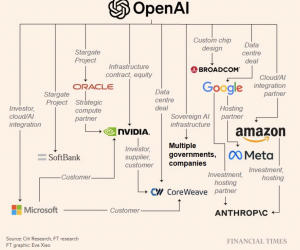
    Now, I’m reading about new ways to finance the AI boom and, again, the risks keep coming back to a very narrow collateral pool. The word “circular” is back and one name keeps cropping up; OpenAI. My newsfeed has been bombarded with multiple graphics from Bloomberg, Goldman Sachs and The Financial Times (see below) illustrating this circularity accompanied by headlines stating that OpenAI is at the centre of a $1 trillion AI infrastructure spending boom. And, I thought they were just building a chatbot (ChatGPT).


    Here’s a few things you might have missed about OpenAI….


    A recent funding round valued OpenAI at $500 billion, the world’s most valuable private company, but….


    It generates NO cash. Latest figures for H1 2025 reveal revenues of $4.3 billion while incurring a net loss of $13.5 billion. Yep, it’s losing more than 3 dollars for every dollar of sales it generates.


    OpenAI has signed up to $1 trillion of deals with the likes of Oracle ($300 billion), Nvidia ($100 billion), AMD ($80 billion) and Coreweave ($22 billion). The Stargate project alone is a $500 billion infrastructure project.


    OpenAI’s core product, ChatGPT, has built a weekly user base of 800 million people.


    Now, let’s return to the deals. I’m not sure the graphics of circularity really capture what’s going on. In recent weeks the world’s most valuable company, Nvidia, announced a $100 billion investment in OpenAI. In return, OpenAI will buy Nvidia’s graphic chips (GPUs) as it builds out its data centre infrastructure. You can see the circular vendor-financing risk in that deal. However, in the last 24 hours OpenAI has announced a further deal with Nividia rival chip maker, AMD. I’m going to lean on Bloomberg’s excellent Matt Levine in imagining the language of current deal negotiations with the loss-making OpenAI.


    OpenAI: We would like six gigawatts worth of your chips to do inference.

    AMD: Terrific. That will be $78 billion. How would you like to pay? 

    OpenAI: Well, we were thinking that we would announce the deal, and that would add $78 billion to the value of your company, which should cover it.  

    AMD:

    OpenAI:

    AMD: No I’m pretty sure you have to pay for the chips.  

    OpenAI: Why?

    AMD: I dunno, just seems wrong not to

    OpenAI: Okay. Why don’t we pay you cash for the value of the chips, and you give us back stock, and when we announce the deal the stock will go up and we’ll get our $78 billion back.

    AMD: Yeah I guess that works though I feel like we should get some of the value?

    OpenAI: Okay you can have half. You give us stock worth like $35 billion and you keep the rest.


    Levine is spot on. It has been bothering me for weeks now. CEOs in the tech world have spotted that a company’s share price goes up on the announcement of huge spending plans (not profits). In extremis, one could route the “value” of the share price gain to a cash-strapped customer like OpenAI. Funnily enough, AMD’s share price rocketed 35% on the OpenAI deal news adding $60 billion to its market value. And, so the merry go round continues. Sure enough, Nvidia, has responded to the behind-the-back dealing of OpenAI with rival AMD by announcing a $2 billion investment in OpenAI rival, xAI, owned by Elon Musk. The total funding round for xAI will be $20 billion but there’s a few extra ‘engineering’ twists. The $20 billion ($7.5 billion equity, $12.5 billion debt) is going into a special purpose vehicle (SPV – remember them?) which will buy GPU chips for xAI’s Memphis Colossus 2 data centre. The SPV, in turn, will rent out the GPU chips for 5 years, with the debt backed by the chips rather than the company. Hmmmm. The rent and SPV details should raise alarm bells.

    The attraction of constructs like rent, leases and special vehicles is that it increases the complexity of an organization and also makes it more difficult to track the true returns (or not) of a company. Rent and leases are considered off-balance sheet items ie they don’t show up as DEBT on the balance sheet. To complete the circle, I’m reading about Oracle today and its astonishing $380 billion in revenue it will generate by renting out its cloud servers to OpenAI and other AI developers over the next 5 years. Oracle can’t afford a rent default. It is not cash rich like Google or Microsoft. In fact, its debt-equity ratio is a whopping 520%. Michael Cembalest at JP Morgan put it rather well…


    “Oracle’s stock jumped by 25% after being promised $60 billion a year from OpenAI, an amount of money OpenAI doesn’t earn yet, to provide cloud computing facilities that Oracle hasn’t built yet, and which will require 4.5 GW of power (the equivalent of 2.25 Hoover Dams or four nuclear plants), as well as increased borrowing by Oracle whose debt to equity ratio is already 500% compared to 50% for Amazon, 30% for Microsoft and even less at Meta and Google. In other words, the tech capital cycle may be about to change.”


    Change, yes. But some things never change in credit or investment cycles. OpenAI might be at the centre of a $1 trillion investment revolution driving stock prices ever higher. But, ultimately “other people’s money” will make its presence felt. Bloomberg is reporting that the amount of debt tied to AI has ballooned to $1.2 trillion. This makes AI the largest segment(14%) of the investment-grade market, surpassing US banks. That means more eyes and scrutiny on the circular world of AI. Bluntly, if a problem emerges it won’t be seen in the stock markets first. It will be in the bond markets with its army of credit analysts. As a final thought, and given the scrutiny applied to the track records of key entities in investment ecosystems, what must credit analysts think of OpenAI?


    • As recently as 2023, the OpenAI CEO, Sam Altman, was fired, then re-hired.
    • OpenAI co-founder, Elon Musk, is now a bitter and richer rival.
    • The company is a strange governance hybrid with control residing in a non-profit Board.
    • OpenAI and early backer, Microsoft, have been in dispute over their partnership terms.
    • CEO Sam Altman was quoted this week in FT saying becoming profitable was “not in my top-10 concerns”
    • Recent $100 billion investor in OpenAI, Jensen Huang of Nvidia, was not told about the deal with rival, AMD.


    None of the above makes OpenAI a bad credit. But, with trillions of dollars of investment capital on the line any loss of confidence in OpenAI could spiral rapidly into a whole new circle of “engineering” PAIN.

  • Three Winning Hidden Trends

    Three Winning Hidden Trends

    I was tempted. The “buddy breakup” in Washington between the Taco Toddler and the Ketamine Kid is fabulous writing material. But, no. The real risk these days is being distracted by America’s slide towards lawless autocracy and missing something bigger. Eighty one years ago on a June 5th morning President Roosevelt brought good news to the American people and its allies. Rome had been liberated by Allied troops – “The first of the Axis capitals is now in our hands.” Little did Roosevelt’s audience know that later that day paratroopers would be dropped into northern France ahead of 7,000 ships landing on the D-Day beaches of Normandy on June 6th. Fast forward to that anniversary today, and there are winning opportunities again being potentially obscured by Washington broadcasts. Indeed, it’s possible you may have missed some striking data updates to three huge investment trends this week. Let’s dive in.

    Last month at its annual Stripe Sessions conference, CEO Patrick Collison identified the “gale-force tailwinds” of AI and stablecoins. The first tailwind trend won’t be a surprise to any readers of our AI article last week but it was intriguing to hear Collison say, “Stablecoins are the underdog everyone’s sleeping on.”  He also had an interesting take on the macro “noise” and uncertainty prevalent in today’s business world – “when new technologies collide with a turbulent economy, the technology tends to win”. That seems a prescient call this week when we briefly touch on AI and reflect on its chip champion, Nvidia, revealing its latest quarterly results. Despite tariff disruption of its China business, Nvidia beat Wall Street analyst expectations and regained its status as the world’s most valuable company. Thanks to a 50% surge is its share price over the last 8 weeks, Jensen Huang’s chip behemoth is worth $3.4 trillion. The latest data point on stablecoins was also quite eye-catching.

    Not long ago Circle Internet Group was saved by the US government when Washington guaranteed deposits at the collapsing Silicon Valley Bank(SVB). Circle as an issuer of dollar-backed stablecoins was the top dollar depositor customer at SVB. However, this week the newsflow was way more optimistic as Circle waited to IPO on the New York Stock Exchange. Reports suggested investor interest was massive and the listing was 25x over-subscribed. Not surprisingly, with more buyers than sellers, Circle’s share price surged 168% on its first day of trading to a valuation just shy of $17 billion. It’s difficult not to conclude that stablecoins have “arrived” and investors are excited by Collison’s own description of stablecoins’ “real world utility in regular business”. In fact Stripe confirmed stablecoin issuance has increased by 39% year-on-year while “demand for borderless financial services go through the roof….at a growth rate which eclipses anything we’ve seen before in Stripe”. Ok, that’s two winning trends. The last one won’t surprise but the numbers might.

    Private equity (PE) and its billionaire leaders could be doubting their love-in with the Taco Toddler but they are not the only PE-related cohort in doubting mode. PE investors are quietly wondering how private equity houses are going to deploy the $1.2 trillion of ‘dry powder’ which is currently sitting on the side-lines and hurting overall return on investment (ROI) figures. A quarter of that massive total has been available for the last 4 years (Source: Bain &Co). However, there is no doubting our mantra “the future is private” when you consider private equity now controls a record 29,000 companies worth more than $3.6 trillion.  But, there are cyclical challenges. Higher interest rates, reduced IPO activity and M&A paralysis (execs can’t Taco trade those deals) don’t help valuations or exits so it’s worth noting global PE fundraising has declined for 5 straight quarters. Global PE raises in Q1 were down 33% per Pitchbook/Bloomberg reports but that cycle might be about to shift. The Wall Street Journal this week reported that the software-focused PE giant, Thoma Bravo, has just raised a staggering $34.4 billion which is the biggest funding round since the start of 2024.

    As a final thought, one must be mindful that as investment funds become bigger and bigger their opportunity pool shrinks due to size and liquidity constraints. On the other hand, as the ECB cuts interest rates, Ireland GDP growth hits almost 10%, German equities touch all-time highs and Trumpolini begs President Xi for a trade détente, it is arguably a particularly good time for investors to think small, and think private. So, if you want to build a private asset portfolio quickly, Spark Private can certainly help with a very exciting summer EIIS** pipeline of PhD-packed medtech innovations, real-time AI applications, 3-year infrastructure exits and super-growth software stories. Do not be distracted. Check out www.sparkprivate.com  and, as my old boss used to say, “They ain’t door numbers, they move !!”.

    ** EIIS tax rebates of 35-50% on your 2025 personal income tax.


  • What Returns Can Investors Expect In A Private World?

    What Returns Can Investors Expect In A Private World?

    Well, I can’t promise you a future with a beachfront property in “Gaza Lago”. In fact, in the world of investing there are no guaranteed returns. As promised in our recent Private Portfolio Thoughts newsletter, I wanted to address expectations as to what long-run returns a private investor should be looking for in a portfolio of private assets.  First, let’s take a look at ‘industry standard’ expectations based on global historic data compiled by research house, Pitchbook. Of course, these are just averages and no doubt are ‘skewed’ by supra-normal returns for a small number of successful funds in each asset class. However, the table below gives an approximate guide to expectations over various time horizons and types of investment.


    The Spark focus is probably towards the top of this table summarising 5-year and 10-year returns for private equity (PE) and early-stage investing through venture capital (VC). However, if we strip out debt and real asset products the double-digit (%) performance picture is pretty similar across the board for private assets. The annual rates of return (IRR) implied by the performance of these private assets (in aggregate) are 13.4% over 5-years and 12.5% over 10-years.

    Let’s be more conservative and suggest that portfolios of private assets after 10 years SHOULD have grown in value at a rate of 12%. In real terms (and compounding those rates of return) that equates to an initial investment of €10,000 growing to €31,000 over 10 years. For context, a fund with publicly listed equities would be expected (by financial planners) to generate 7% returns per annum and thus turn €10,000 into €19,600. Of course, the extra return earned by the private asset portfolios is the compensation required by investors for the higher risk exposure(reduced liquidity, business failure) compared to the shares of large established businesses trading every day. These return numbers (based on history) can be described as “hurdle” rates which investors are expecting to match or beat in order to justify putting their capital at risk over long periods of time. So, let’s apply some hurdles to our world of very young companies (VC) and small businesses (private equity).

    We know that the industry standard in more mature private capital investment strategies is looking to turn €10,000 into something north of €30,000 over 10 years. We might describe this as an expectation to generate 3x your initial investment amount. Arguably, for higher risk investments in our earlier-stage world, investors could expect/demand an even higher return for their portfolios. If investors wanted 4x returns or €40,000 after 10 years that equates to a 15% annual return which is what private equity strategies have achieved(see table). So, that expectation is not unreasonable. But…. how realistic is it in a high risk portfolio of mainly early-stage business failure? We should touch on the key ‘push backs’ we get from investors who are wary of investing in start-up businesses or smaller private equity deals. The following are the most common perceived wisdoms….


    “80-90% of start-ups fail”

    “ Exits are more difficult as IPO markets for smaller companies have struggled”

    “I can just buy publicly listed equities and earn similar returns”


    There is an element of historic truth to all these statements but I’m going to use the most dangerous words in the investing lexicon by stating “this time it’s different”. First, the history of start-up failure should take into account the characteristics of older vintages of businesses. Let’s think about old economy businesses investing heavily in premises, equipment, overseas expansion facilities, logistics etc. These are, in most cases, “sunk costs” in capital-heavy businesses. Inevitably, if the business gets into trouble these ‘assets’ are not just worthless but can have an actual negative value due to ongoing liabilities/leases, maintenance costs, security, insurance etc. Now, think about many of today’s “asset light” businesses leveraging digital infrastructure and building value through the experience of the founders/team, the data gathered by the business and the development of relationships with clients and partners.

    These businesses don’t have the same level of sunk costs/liabilities (as old economy businesses) which can swamp the value of the operational “franchise”. Instead, the value within a business which might not be meeting growth targets can be recognised by a third party and lead to another form of exit which doesn’t involve liquidation. In the Spark portfolio we have seen a number of businesses acquired by third parties in the same sector in exchange for shares in the acquiring company. These shares clearly have a value and also change the traditional calculations around start-up failure.

    In the world of debt/credit one of the key financial terms/metrics is historic “recovery value”. In main street terms, this is the typical expected percentage of the debt which can be recovered when a business fails in a particular sector. You will see such sector recovery data displayed as a percentage of the debt ie 20 cents, 30 cents in the dollar. So, in the world of start-ups there is normally no debt and the equity in the business is a complete ZERO in the case of struggle or failure. But, now that’s not quite the case. If an acquiring business is offering a share exchange then the “recovery value” could by 20-50% of the original investment. And, the reason for ‘value’ being found in the business is the experience of the acquired team, the database and client relationships. This is happening on a far bigger scale elsewhere.

    Ever heard of the term ‘acqui-hiring”? This refers to a situation in which a company acquires another company primarily for its talented team or employees, rather than its products, technology, or other assets. In an acqui-hire, the acquiring company may not be interested in continuing the acquired company’s business or product, but rather wants to bring the talent into its own organization. Now, here’s another bit of jargon monoxide…. ever heard of CVC? Well, you know what venture capital (VC) does but there’s a subset of the VC ecosystem called Corporate Venture Capital(CVC). This form of VC funding is in reality larger corporations investing in smaller businesses whose franchises/technology could ultimately be relevant and value-creating for the parent company.

    So, you might think Sequoia, Index Ventures, Tiger Global and Andreessen Horowitz are the kings of VC investing. Now, think again. Amazon, Google, Microsoft and Nvidia are hugely active in the VC funding space. As an illustration, Nvidia deployed $1 billion in 50 VC funding rounds in 2024 alone. Furthermore, Google has acquired a whopping 222 start-ups over the years, and in 2023 the “Magnificent 7” tech stocks participated in 208 VC deals. So, the IPO market might not be as start-up friendly as in the past but Big Tech certainly is stepping up to the plate as a new and highly active exit event option.

    Of course, there will always be those investors who believe they can earn approximately similar returns to private asset strategies by choosing a selection of publicly listed companies. Yep, the likes of Domino’s Pizza, Paddy Power, Apple and Nvidia tick those boxes but there’s also an assumption investors will avoid the temptation of selling while on the multi-decade rocket ride. However, the more significant point is about business failure. Think it’s only start-ups?  Sixty years ago the average life-span of a company in the S&P 500 was over 50 years. Today, it’s less than 15 years! By 2027, almost 75% of companies who were quoted in the S&P 500 in 2016 will have disappeared (Source: McKinsey). Not for the first time, I’d suggest it’s worth a read of the excellent The Future is Faster Than You Think to grasp how fast business and technology leadership is changing.

    We can’t forecast the future. However, we should recognise that the world of start-ups today has changed dramatically. As a final illustration, start-up funding was traditionally populated by a majority of consumer-focused businesses – think retail, textiles, manufacturing, food, fashion etc.  The term “B2C” would be used to describe these business-to-consumer companies. Well, that’s changed too. Certainly, for Spark. A whopping 70% of funding deals completed by Spark have been business-to-business (B2B) opportunities. It should also be noted that our vetting process turns away approximately nine in every ten opportunities. Arguably, we are selecting the top decile of quality in the opportunity universe. No doubt we will get it wrong along the way, but this is still a robust risk starting point. And, it’s not the only starting point…

    The purpose of this article is to set the scene for a follow-up piece on how these structural shifts can impact the average private portfolio and future expectations using sample portfolios and outcomes. But always remember…. if I could truly forecast the future, “Gaza Lago” might personally have an entirely different meaning and location.


  • Still Some Golden Theme Tickets Left…

    Still Some Golden Theme Tickets Left…

    I’m going to save you some time. Forget about calendar-driven commentariat reviews and 2025 forecasts for investment or geopolitical risk. Sorry to be the “Grinch of Guru”, but calendars and structural investment themes have zero correlation. Opinion is cheap and even the betting markets are displaying their patchy predictive powers in recent weeks. Yip, just a 6% chance of the Ba’athist beast, President Assad, being toppled in Syria. About as much chance as a Chinese spy in Buckingham Palace… oh wait. Sadly, Prince Andrew is a multi-year clown car journey in particularly poor company but there’s a lesson there too. Almost all significant investment themes – risks and opportunities – are multi-year stories whose plots twist and turn but keep a very clear direction of travel. So, let’s take a look at some of the major themes we have previously visited and a few more developing ones; all with interesting plot twists.

    Europe Crisis or Opportunity: Nothing good in the headlines…..German government falls, UK in second month of GDP contraction, France on its 4th premiership in a year. But, but here’s a few twists on the negatives. The lists of where Europe lags the US is a long one, from labour productivity, to AI and innovation, to stock market performance. And yet, if you strip out the performance of AI hardware star, Nvidia, from the S&P 500 then Europe’s stock market (MSCI EMU) has actually earned better returns for investors than the US benchmark since the most recent bull market started in October 2022. That suggests there are lots of European companies doing very well despite ‘core’ European economies struggling. Check out also in recent days Spotify becoming only the second European tech company since SAP to crack the $100 billion market cap mark. The headlines do not lie but the narrative on Europe is more nuanced than you think.

    Healthcare: Another structural theme from previous years’ writings, healthcare has actually been a winning area for Europe thanks to the miracle weight-loss drugs, Ozempic and Wegovy. Their Danish owner, Novo Nordisk, became Europe’s most valuable company in 2024. However, we might be about to enter an accelerated era of therapy/drug discovery for all types of medical illness. The clue is in the Nobel Prizes awarded in both Physics and Chemistry in 2024 to pioneers of AI usage in research. Now, for those already struggling with how AI large language models (LLM) work and the warp-speed calculations of the almost-monthly iterations of these technologies, get ready for the ultimate head wrecker. Google has just developed a quantum computing chip, “Willow”, which performed a computation in less than 5 minutes that would have taken today’s fastest computers 10 septillion years to complete. Yeah, that’s 25 zeros which exceeds known timescales in physics and vastly exceeds the age of the universe. Think about that. This chip created by quantum physics “used” time which theoretically can’t exist unless…… there are other parallel universes. Google Quantum AI founder, Hartman Neven, calmly wrote that the stunning performance of this chip indicates that “we live in a multiverse”.  Maybe Willy Wonka wasn’t so wrong to say “Come with me and you’ll be, In a world of pure imagination”.

    Artificial Intelligence (AI): Arguably, the world of AI has moved in a completely different direction. The shift of investment capital away from bits (software) to atoms (hardware) has been spectacular. Another company nobody ever heard of until recently, Broadcom, has become the latest technology hardware company to join the trillion dollar market capitalisation club. The US chip maker is now one of FOUR tech hardware companies in the list of the 10 most valuable companies on the planet. Clearly, investors see AI infrastructure as the early ‘win’ in the AI arms race. However, do NOT ignore software. Interestingly, the Clouded Judgment software newsletter has flagged a 20% expansion in median software valuation multiples since mid-November (from 5.6x to 6.7x revenues). Also, Nvidia has dropped in value by 11% in recent weeks. Yes, rotation from hardware to software and back again will be a feature of the multi-year AI revolution but the venture capital data from CB Insights confirms the direction of AI travel. Global venture capital (VC) deals in AI jumped 24% in Q3 to the highest levels seen since the Q1 2022 peak. In fact, one in every three dollars of VC investments went to AI start-ups.

    Banking and Fintechs: Closer to home, Revolut has just confirmed it has more than 3 million customers in Ireland. A staggering 75% of all Ireland-based adults now use the UK fintech platform for banking and payments. Meanwhile, the US bank sector has rocketed 30% higher this year, Europe is seeing Italian banking M&A deals and the largest asset manager in the world, Blackrock, has embarked on a private asset acquisition frenzy. We have written before that the future is private and I’m wondering are big corporates thinking the same? Sticking with the fintech sector, it was striking in the past week to see the shipping/logistics giant AP Moller lead an €80m investment round for UK fintech, Zopa Bank. In the same week, we note another globally significant name, Walmart, was the lead investor in a $300m round for fintech platform, One. Hmmm….Private banking/fintech, private opportunity.

    Climate & Electrical Vehicles (EV): Apparently, 11 out of 16 EV battery manufacturing projects in Europe have been canned or delayed. Of course, the $15 billion investment in Northvolt was the highest profile casualty in 2024 but there will be other twists and turns in the electrification journey. And, possibly a lesson in long-term planning. China 20 years ago had almost zero car production capacity. Now, it is on track to manufacturing 30 million cars a year and has surpassed Japan as the biggest exporter in the world with 5.17m units sent overseas. In fact, Chinese built EVs now account for 76% of the global EV market. So, if one were to be thinking 20 years ahead again what is most likely to drive investment returns in the transport world? Well, how about not driving. More specifically, self-driving. So, I’m quietly stunned that Google’s Waymo self-driving cars are clocking up 175,000 rides per week compared to 50,000 rides 6 months ago. That’s actually more than 1 million miles of autonomous transport delivered with an almost flawless safety record. I sense 2025 could see self-driving transport go mainstream and, as I write, Waymo have announced they are about to trial robo-taxis in their first non-US city, Tokyo, next year.

    The list of themes above is not exhaustive but they are structural themes measured in decades rather than calendar years. These are the most likely golden tickets to deliver standout returns like Nvidia’s 27,000 % return over the last 10 years. But, as always, we should keep an eye out for reversals of long standing narratives too. Argentina might be the prompt for contrarian thought while on track to deliver the best stock market returns of 2024. Who knew! So here’s two thoughts to chew over for the festive season: i) A European refugee reversal as Syrian and Ukrainian citizens potentially return home in 2025 and ii) A renewed embrace of nuclear power/investment to drive the electrification of the global economy.

    “Oh you should never, never doubt what nobody is sure about”         –   Willy Wonka


  • Big Numbers That Can’t Be Missed

    Big Numbers That Can’t Be Missed

    Now, it’s my turn. I get to vote this week. For lots of busy good reasons, I haven’t read a huge amount on our own election but there’s no doubt it is important. However, I’m conscious I’m just one of 4 billion people voting in the current 12 month period. This also prompts another nagging feeling that it is external events over the lifetime of the next government which will define it. From Ukraine, to Utah, to even Mars, our planet is at an inflection point. The ‘world order’ is dangerously shifting as North Korean troops enter a European conflict zone for the first time, and yet, it would be ill-advised to down tools and just wait. There are other themes and trajectories already established and unlikely to change. Simply put, the numbers are now too big. And, we will continue to watch SIX in particular.

    Artificial Intelligence: It is striking to see various commentaries question the real ‘value’ of AI. During the summer, Goldman Sachs estimated that tech companies were about to spend $1 trillion on AI but queried whether they would ever earn a return on this capital expenditure. Fair question, but there’s another point to be made. The ‘winner takes all’ nature of this tech arms race is existential. The poster child of the AI revolution is Nvidia. Yet again, it smashed analyst forecasts this week in its latest quarterly results. My takeaway is that, of course, there will be misallocation of capital in this existential race but tech companies are going to continue to spend to stay in the race. ‘Exhibit A’ must be Nvidia’s own revenues in its data centre chip division. A whopping $30.8 billion revenues generated in the last quarter revealed a growth rate of 112% vs a year ago. Also, for context, this division has increased its quarterly revenue 7-fold since the early quarters of last year. Note, data centres are the battle ground where AI models are tested and trained, and this trend is set to continue.

    Cleantech: European cleantech suffered a blow this week as Northvolt sought Chapter 11 bankruptcy protection from its creditors. It’s a significant blow to Europe’s efforts to decouple from its dependency on China for electrical vehicle (EV) battery materials, chemistry, design and manufacture. Northvolt tried to deliver in all four process functions and received $15 billion of investment backing to do so. This has been a very expensive way to experience execution risk; both Goldman Sachs and VW have written off investments in Northvolt of $1 billion each. However, just like AI, loss is a recurring feature in any new technology area. So, keep an eye on the big numbers. In this instance, the EU is outspending the US with a $125 billion spend in 2023 (vs $86 billion). But….. China is really the cleantech benchmark. The Middle Kingdom spent $390 billion in 2023 across renewables, carbon capture, utilization and storage, hydrogen, batteries and nuclear power.

    Space: Elon Musk’s SpaceX is the most valuable private company on the planet with a recent funding mark indicating a $250 billion valuation, ahead of ByteDance (parent company of TikTok) on $225 billion. At current pace, it is launching its Starlink satellites (via Falcon 5 rockets) every 2.8 days. If you’re just about getting your head around that launch frequency think about Space X’s massive re-usable Starship which completed its 7th test flight last week. Its payload capacity is 150 tonnes and the plan is for Starship to do two launches…. daily. Now, what if the entire tonnage launched into space in history has been just shy of 40,000 tonnes? That means in the very very near future, Starship alone would be capable of repeating the entire payload history of space in just over 4 months. I’m not sure we have grasped the enormity of this feat and the implications for industries like telecommunications, mining, military defence, tourism, manufacturing or even housing (on Mars?).

    Crypto/Blockchain: Bitcoin is on the cusp of breaking the $100,000 mark. However, we need to start thinking about the entire crypto/blockchain ecosystem. Check out MicroStrategy which on the face of it is a loss-making software business but since 2020 has been investing in Bitcoin. If you thought Nvidia was the best performing share price in the world you’d be nearly correct – it has delivered 2660% returns to shareholders in the last 7 years. But….. MicroStrategy has rocketed by 3420%. Its current market value is $117 billion, making it more valuable than Nike, UPS or Starbucks. Of course, MicroStrategy is a leveraged play on Bitcoin but there are other ways to ‘leverage’ the rapid expansion of stablecoins, crypto funds, tokenisation, blockchain etc. The crypto asset ecosystem has just passed the $3 trillion valuation mark which exceeds the asset value of most countries’ stock markets. These numbers, and the opportunities to plug into this investment pool, are too big to miss…or ignore.

    Banks: It would be easy to move on to the ‘next shiny thing’ in the space or crypto universe but the banking sector is worth watching right now. Governments are finally getting good selling prices (even premia) for rescued bank shares as the UK (Nat West), Germany (Commerzbank), Ireland(AIB), Greece (Piraeus Bank), the Netherlands (ABN-AMRO) and Italy (Monte dei Paschi) all reduce sovereign shareholdings or exit altogether. As an aside, and interesting contrast to ‘shiny new things’  Monte dei Paschi began commercially lending 20 years before Christopher Columbus’s trip to America was financed. Anyway, old or not, the bank sector is hotting up. Breaking news over the weekend suggests Italy’s Unicredito will make a €10 billion + bid for rival BPM, and note Unicredito is already circling Germany’s Commerzbank. Also, it is worth noting that the tax/accounting professional services arm of UK wealth player, Evelyn Partners, has just been bought by private equity (Apax) for £700m. That is significantly more than the £500 million price tag suggested by City analysts.

    Technology Rotation: We have written previously about the particularly strong comeback for technology hardware thanks to AI, semiconductors, EVs and iPhones. The world has become very used to these themes powering the “Magnificent Seven” – Microsoft, Apple, Nvidia, Google, Meta, Amazon and Tesla – to all-time-highs but this analysis of last week’s technology price action in the newsletter, Clouded Judgment, caught the eye:


    This week saw the rapid acceleration of an interesting trend that started not too long ago – Magnificent 7 underperformance and software outperformance. Might this be the start of a rotation into software and growth (ie more risky assets)? Meta was down 3% over the last week. Amazon was down 7%. Microsoft down 3%. Google down 6%. Nvidia flat. Apple / Tesla were slightly up. QQQ was down 1.5%. Meanwhile, the WCLD index was up 6% over the last week! In addition to that, there were some really big moves in individual names. Snowflake was up >30% on Thursday after reporting earnings on Wednesday, which lifted the rest of the software market. Also just on Thursday Mongo was up 14%, Confluent / Datadog / Cloudflare were each up 7%.


    As a reminder, the Magnificent 7 have an aggregate value of $13.5 trillion which is more than the GDPs of India, Germany and Japan combined. The potential risk of an investor rotation OUT of the Magnificent 7 is a multi-trillion dollar consideration, and also can’t be missed.

    Clearly, my vote can’t change any of the big numbers above. However, these are the numbers which are far more likely to define our investing and business futures on this island.


  • Banking On A Deal Frenzy

    Banking On A Deal Frenzy

    This hurts a bit. It kills me to potentially reward poor behaviour, but hey, I’m not nominated to be the Attorney General of the United States of America. The financial giants of Wall Street kept their heads down in the lead up to the US election. We didn’t hear too much commentary on the rule of law, inflationary tariffs or accelerating budget deficits. I mean…who needs property rights (law) or a functioning national balance sheet? Possibly, the infamous Leona Hemsley’s “little people” because they pay taxes, aka the price, in time. But, for now, there’s a very clear short-term calculation being made by Wall Street. A Trump administration determined to slash regulation and speed up commercial transactions is a godsend for bankers. Of course, Elon Musk, Tesla and Bitcoin are perceived as the early big ‘winners’ of a transactional incoming President. However, at a broader level the clear winner in the week since election is the enormous financial sector.

    US Financials are the best performing sector in the markets over the last week (+1.5%) while tech, telecoms, healthcare and materials all have actually booked negative returns for investors(Source: Finviz). That big picture split is interesting and highlights the very essence of what financials are about. It’s all about deals. More deals, more commissions, more fees, more revenues, more bonuses. What deals you ask? Let’s start with the biggies like massive M&A deals. In recent years, the broligarchs have been frustrated by FTC Commissioner, Lina Khan, who has blocked more than 30 corporate mergers/acquisitions on grounds of reduced competition. High-profile deals attracting government(FTC) scrutiny included Microsoft/Activision and Kroger/Albertsons. Only this week, the parent companies of luxury brands Coach and Michael Kors abandoned their merger due to FTC competition-based objections. No deal, no fees. Hence, a more lenient transaction-friendly FTC under Trump is expected to increase deal flow. And, not just in M&A.

    How do I put this delicately? Well, if the incoming Attorney General is already under investigation by his House of Representatives colleagues for sex trafficking, let’s just say the whole area of compliance could be significantly relaxed. We can expect more financial products to be launched and faster in a more relaxed regulatory environment. One area already due to increase activity levels is the IPO sector. Interestingly, Sweden’s Klarna has just announced its plans to list publicly (IPO). However, despite its Swedish home, Klarna is going to list in the US, not Europe. Oh, and Klarna is a financial company. It’s also a great comeback story – the buy-now-pay-later (BNPL) platform and its 85 million customers is heading for a $20 billion valuation. That’s a tripling of value since the fintech ‘winter’ of 2022. Note fintech is not the only survivor of the investor ‘winter’ of 2022…

    The cryptocurrency universe has already been perceived as a Trump regulatory relaxation winner. Bitcoin has rocketed to all-time-highs of $93,000 with an individual asset value of $1.7 trillion exceeding that of Facebook/Meta. The wider cryptocurrency ecosystem has achieved a market value of $3.2 trillion but the bigger story is possibly stablecoins (cryptocurrencies backed by liquid financial assets ). Again, I’d highlight ‘transactions’ as the opportunity for financial services platforms. Stablecoins were used in $8.5 trillion of transactions in the second quarter of this year. That’s more than double Visa’s transaction volume of $3.9 trillion. It also provides a pretty good clue as to why Stripe acquired stablecoin platform, Bridge, for $1.1 billion.

    For the avoidance of doubt, more transactions and deals is an overall positive. More exits, more funding, more deals… the circle of start-up life. At Spark we know more deals, exits and IPOs eventually feeds into the smaller regions of financial markets. We also know there’s a hefty €150 billion sitting in Irish bank accounts earning almost zero returns. It’s not just an Irish phenomenon. There is currently a record $7 trillion of cash sitting in US money-market funds. That’s not a huge surprise when one can earn 4-5% interest in these US deposit accounts for relatively minimal risk. However, watch out for lower US interest rates and increased mega deal headlines in the coming months. Then watch that cash move. And, not just in the USA.

    The EU economy is 99% driven by 26 million private small and medium sized businesses (SME) who account for €5.4 trillion of economic activity. The headlines will almost exclusively focus on the impact of a Trump regime on US multinationals, corporation tax, homeshoring etc. Rather like the trading evidence in markets of the past week, probably not much will really change for the “broligarchs” and the big tech multinationals. However, the markets are telling you financial services will enjoy greater deal activity which will feed through the global funding ecosystem. Indeed, right now there’s an all-time-high number of investment campaigns on the Spark platform (8) with interesting additional private asset/deal opportunities in the 2025 pipeline. We’ve written it before; the future is private.

    So, it seems like a good time to launch Spark Private, the personalised service to grow your private asset portfolio. More details on that next week, after you’ve finished gasping at AG Gaetz.