Tag: equity

  • Get On The AI Bus Or Lose Business..

    Get On The AI Bus Or Lose Business..

    As somebody who has been watching, I’m still stunned. No, not that Rishi Sunak has his own GB News TV show and that the regulator, Ofcom, hides. Not even the fact that a former US President has thrown his NATO allies under the Vlad bus in plain sight of the forever fear-filled US media. Of course, I’m sure Poland and Estonia are terrified by Joe’s age or Hilary’s emails. Mind-boggling. However, on a brighter note there’s another bus which is enabling millions to work better. The AI bus is flying. Again, the mainstream media headlines run with AI fear but the flow of money and corporate action point to an extraordinary business revolution. The numbers are now simply too big for businesses and investors to ignore. Let’s do a brief tour of developments…

    This week kicked off with the staggering news that AI chip maker, Nvidia, has now achieved a $1.84 trillion market valuation which is higher than both Amazon and Google. To understand the expectations baked into that valuation, reflect on Amazon’s projected 2024 revenues of circa $600 billion. Then know that Nvidia is expected by Wall Street analysts do just one tenth of that revenue number. The 90% revenue catch-up is somewhere in the future but the future numbers look big, very big. The famous AI evangelist and rescued CEO of OpenAI, Sam Altman, is actively seeking funding for the development of AI chips like those of Nvidia. The word ‘funding’ doesn’t really do this exercise justice. It’s almost nation building. Sam reckons he will need $7 trillion, or the combined GDP of Japan and France. Sounds dreamy, but he’s not alone.

    Consulting firm, McKinsey, have published research suggesting the creator-focused application, Gen AI, deployed in 63 actual use cases could add $2.6 trillion to $4.4 trillion of economic benefits. Note these are actual business ‘use cases’. There’s more than dreaming going on here. In fact, Google has launched its Gemini workflow assistant to “supercharge your creativity and productivity”. Gemini is multi-modal which means it can create content using text, voice/audio, images and video. Its output can also be multi-modal. Think about a medical professional using an ‘assistant’ which can ingest a physician’s audio snippets/notes, X-ray images and MRI video scans. Also, we have moved past Chat GPT text prompts and free trials. Google is charging a $20 monthly subscription for its Bard successor, Gemini, to assist with email summaries, research, code-free data analytics and audio visual staff and customer education. Microsoft is also charging $20 a month for its Copilot AI Tool. Oh, and people and businesses really do pay for access to these AI tools.

    While OpenAI started out in life as a not-for-profit entity, it is amazing to see that the OpenAI business is already generating annualised revenues of $2 billion. The use cases might even surprise. For example, McKinsey analysis shows that 73% of fashion executives named generative AI as a priority for their companies in 2024, but only 28% have actually deployed AI so far. It’s not just business prioritising AI adoption. The investment world, particularly in our world of early stage funding is acutely aware of venture capital (VC) funds pulling in their bullish horns and nursing some of their existing investments out of sick bay. However, AI-related VC investment is bucking that trend. Check out these data points from CB Insights:


    • Broader venture funding fell 43% in 2023, but AI funding slipped by just 10%.
    • The US actually witnessed AI investment grow by 10% in 2023. Europe dropped by 29% and Asia saddled with a China confidence crisis cratered by 61%.
    • There were 22 AI unicorns (start-ups valued at $1 billion or more) created in 2023 which accounts for 31% of a global total of 71.
    • Generative AI unicorns, in particular, are hitting warp speed wealth creation mode. Gen AI unicorns reached the $1 billion valuation mark in a little over 3 years, or half the time taken by unicorns in other sectors.


    However, investment doesn’t just happen at a company level, big or small.  If we consider Sam Altman’s funding estimate of $7 trillion, this investment capital will mainly be used to build facilities to manufacture those AI chips (fabs) and then house them (data centres).  I have written previously about the linkage between the explosive growth of AI and the race by Big Tech to build the data centres supporting their digital cloud businesses. As a proxy for this linkage, the Financial Times has highlighted Nvidia’s dominance in the area of data centre spending:
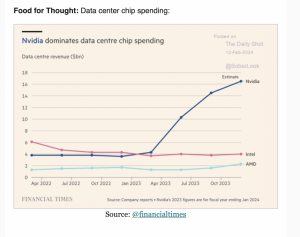


    Closer to home, the opportunity presented by data centres has attracted private equity giant, Blackstone, and prompted talks on a $900 billion acquisition of data centre construction leader, Winthrop Technologies. Clearly, the ramp up in investment activity on both a company and an infrastructure basis is signalling real AI revenues and real usage from businesses. And, it would be wrong to assume it’s part of the future. It’s now.


    • Forbes reckon 83% of companies deem AI to be a top priority in their business strategy.
    • MIT have said 9 in 10 organizations back AI to give them a competitive edge over rivals.
    • More than 50% of Americans use voice assistants for information purposes (Source: Edison)
    • Manufacturing businesses that utilize AI are performing 12% better than those using traditional methods only (Source: Microsoft)


    Remember this is AI in its infancy. That 12% ‘edge’ is only going to grow. For me, there is now an additional competition-critical question for every business to add to existing queries on the progress of their digital and sustainability transitions. Have you boarded the AI bus yet….?


  • More Blue Sky Than Blue Monday

    More Blue Sky Than Blue Monday

    Apparently, the Monday of this week is the worst every year for negative thought. Furthermore, the new UK Foreign Secretary, Lord Cameron, fresh from launching war in the Red Sea, told us in a weekend TV interview that “the lights are absolutely flashing red” on the global risk dashboard. Excellent. Well, that’s settled then – I mean Lord “Call Me Dave” gets all the big calls right doesn’t he? Ok, let’s not invite the rest of the world to turn the air blue. In fact, let’s do what should have been done in 2016 and pay attention to what’s really happening in the world right now. Not surprisingly for this writer, January is already confirming themes established and developing from earlier years and we are more than happy to keep screaming about them until we are blue. So, here we go with a little whistle-stop tour of the real world….

    We truly believe the ‘convergence’ of various technologies is about to turbo-charge the acceleration of change in the global economy. An existential crisis also helps focus minds and….. money. The climate change crisis has prompted the greatest capital shift in history as $6 trillion of annual spending on cleantech is forecast every year until 2050 (Source: McKinsey). Indeed, one of the key investment destinations in moving away from fossil fuels has been electric vehicles(EVs), and the batteries used to store energy and power these vehicles. Chemistry advances have been key in driving costs down and capacity up where lithium-ion type batteries are the predominant storage technology. However, artificial intelligence(AI), probably the hottest investment theme outside cleantech right now, has just been used in conjunction with supercomputing to discover a brand new material which could reduce lithium usage by up to 70%.

    Yep, Microsoft and Pacific Northwest National Laboratory (PNNL) research teams whittled down 32 million potential material combinations to 18 promising molecular structures within a week. Incredibly, the whole discovery project took 9 months in a screening process that would typically have taken more than 20 years using traditional lab research methods. The new AI-derived material, simply called N2116, should prompt thought as to what’s possible in the world of medicine, agriculture, transport and construction,  but also counter an unhealthy commentariat focus on AI ‘safetyism”. The social and economic basics of health, shelter, mobility and food are in dire need of blue sky thinking but might just have found a genuine innovation accelerator. Microsoft themselves have told the BBC that one of the company’s missions was “to compress 250 years of scientific discovery into the next 25.” Thankfully, this was not the only positive solution speed surprise of recent weeks.

    The IEA has confirmed that renewable energy capacity increased globally by 50% in 2023 alone(!). That’s the biggest growth seen in more than two decades. At that pace, it is conceivable renewable energy could be 50% of electricity generation by 2030 and, brace yourselves… would actually meet the renewables ‘tripling’ target agreed at Cop 28. Germany – not getting great economic press in recent times – is already at the 50% renewable electricity production level with CO2 emissions currently at a 70-year low. Furthermore, coal usage at a 60-year low in Germany makes for clearer skies but the gloomy headlines could have obscured another Teutonic trophy win.  The EU has given the go-ahead for Germany to provide €902 million of state aid to battery producer, Northvolt, for the construction of a gigafactory producing EV batteries. Without that aid, Northvolt would have probably moved the project to the US. Instead, the €2.5 billion project at Heide will be the first to avail of the new ‘matching aid’ exception allowed by the EU to support more flexible/higher amounts of state aid to prevent an investment exodus to the US.  Expect more good European news on this front as the region is forecast to build a further 250 battery factories by 2033 (Source: Buck Consultants). These are real actions and projects (not headlines) but companies are also showing confidence with more traditional strategic moves.

    We perennially write “watch what they do, not what they say” and the big “tell” is often M&A activity. Given acquiring other companies results in wealth destruction almost 50% of the time, we tend to see a flurry of M&A activity as a positive illustration of executive confidence and found the headlines of recent weeks interesting.  You might think the announced $14 billion purchase of Juniper Networks by HP was just another example of the technology sector enjoying the benefits(and valuation multiples) of a stellar 2023 but back in the ‘old economy’ things are stirring too. And, if M&A was tricky enough why not try to acquire a national icon, as a foreign company? Cue the Japanese execs at Nippon Steel have decided to swoop for US Steel in another $14 billion deal. Once the most valuable company in the world, US Steel could become a political football but both boards have agreed the deal and are acutely aware that the most recent offer from domestic rival, Cleveland Cliffs, was just over $7 billion. You don’t need the finance gurus to figure that one out. Anyway, they are busy too. The world’s biggest asset manager, BlackRock, has announced the $12.5 billion purchase of Global Infrastructure Partners (owner of Gatwick Airport and Melbourne Port). Clearly, the $10 trillion giant sees a future for the old stuff.  As for the new stuff…

    The SEC in the US has just approved funds (ETFs) which invest in cryptocurrencies (Bitcoin). This is massive for the crypto and blockchain ecosystem. In simple terms, this approval by the SEC means funds invested in Bitcoin are now regulated and can be considered an asset class in their own right. Nine funds (ETFs) have been approved to trade on New York regulated exchanges, and in the first two days of trading attracted $1.5 of investor inflows. BlackRock’s fund led the way with $500m followed by Fidelity’s fund bringing in $422m. For me, cryptocurrencies are a very good indicator of risk appetite, or confidence. So, if Bitcoin is trading close to $40,000, this feels like the world is not about to fall apart. Other new stuff is doing well too.

    We’ve already touched on AI’s benefits to humanity but, if you’re an investor, the AI posterchild is still Nvidia. While the broader equity markets have spluttered in January, Nvidia continues to march to new record highs. Its market value is now in the region of $1.4 trillion. For context, if Nvidia’s share price increases by another 15% its valuation will match that of Amazon. Then consider Microsoft, another AI play, which overtook Apple this week as the most valuable company in the world. You might think all the AI excitement is in the big tech names but CB Insights has published data showing AI start-ups benefitting from  significant valuation premia when raising capital. Median valuations for early stage/seed fundings were 21% higher, larger Series A fundings saw a 39% premium and Series B funding rounds clipped an extra 59% from investors compared to non-AI companies. Get ready for more AI references in investment ‘story telling’, but also watch out for the continuing battle for authentic stories and content needing no AI.

    Over the weekend, the exclusive rights to the NFL game between the Miami Dolphins and the Kansas City Chiefs were sold to NBC’s streaming service, Peacock, for $110 million, or $1.8 million per minute of game time. According to the superb sports finance newsletter, Huddle Up, this is all about Peacock/NBC being given a foothold by the NFL as streaming overtakes cable consumption over the next 5 years.  That means Apple, Amazon and Netflix will be a big part of media rights negotiations in many sports in the coming years. Think Hulu and Wrexham, then marvel at the Rightmove data showing Wrexham as the busiest property rental market in the UK in 2023. That certainly wasn’t forecast on those Brexit red buses in 2016.

    Of course, a market whistle-stop tour would not be complete without a check on the ‘Big Daddy’ driver of all asset classes; the cost of money. Here too, the news was not blue. The cost of two year money in the US in the past week (measured by the yields on traded 2 year US Treasuries) was back to levels not seen since May 2023. In fact, the world’s most profitable bank, JP Morgan, didn’t just announce record profits last week but also told investors they believe the Fed will cut interest rates SIX times in 2024. We shall see, but it is clear that capital is “climbing a wall of worry” in lots of interesting parts of the global economy. That does not mean we can ignore the concerns of some serious and credible analysts. The world’s risk experts continue to watch Russia vs Ukraine, Israel vs Hamas and China vs Taiwan. More than enough volatility, and enough for Ian Bremmer, CEO of the Eurasia Group consultancy, to describe this year as…

    “Politically it’s the Voldemort of years. The annus horribilis…. and then there’s the biggest challenge in 2024… The United States versus itself”.

    Again, voting like sport doesn’t need AI. Who would have thought that US democracy would be the greatest geopolitical risk of 2024? Simply stunning. Yet, I am hopeful that younger voters, business leaders, investment capital and credible domestic influencers will begin to spell out the true potential cost of burning the US Constitution in front of the whole world. Just imagine fighting the “Red” threat of totalitarian Communism for decades and then discovering you have your very own Red totalitarian party at home? Now that must make more than a few voters go blue……

  • Five Numbers Say Don’t Give Up….

    Five Numbers Say Don’t Give Up….

    Perhaps it’s the prospect of beginning a 100 day no-alcohol stint which is causing, on my part, a sudden obsession with numbers. Then again, it could be just a time thing. I mean, who knew one of the World Darts finalists would be younger than the iPhone? Or, that just 9% of UK voters believe Brexit is going to plan? Well, probably the rest of the world knew that a policy to sanction your own economy more heavily than Russia was going to end in tears. However, the rest of the world should drop the sermons-in-smug and pay attention to the first of five key numbers we are watching in 2024….

    Climate Crisis: The temporary visit on November 17th of global temperatures more than 2 degrees above pre-industrial averages is a five-alarm-bell ringing of an existential crisis for the planet. Given we have been in perpetual storm mode since late November, and the storm-naming cycle is already past “H” with Storm Henk, there is a personal sense that bad news could be good news. In particular, catastrophe losses in the insurance and capital markets could focus political leaders’ minds on the sheer cost of loose non-urgent language in the recent Cop 28 commitments.

    Bond Markets: We regularly remind readers that the cost of money (interest rates) is the critical driver of ALL asset prices. The number which caught the eye this week was that bond prices (which fall when interest rates/yields rise) have been in negative territory for 41 consecutive months – the longest ever draw down in history. And, forgive the repetition, but again bad news might actually be good news for bond prices. In other words, a slower economic environment and some employment weakness could be the trigger for global central banks to ease interest rates and allow bond prices recover.

    Venture Capital: In the Spark world of start-ups we are always watching the private markets as well as the more liquid (and better performing) public equity markets. The S&P 500 might have sucked in AI-excited investment and delivered 25% gains in 2023, but for younger companies access to capital was far more difficult. The VC data research team at PitchBook reckons global VC funding fell to $345 billion in 2023, down from $531 billion the previous year. In private equity, deployment of capital dropped by 29% and exit activity was down by 26%. That’s the worst combined performance since 2016. However, the silver lining in these numbers is that funding activity has shifted away from more mature private opportunities to early-stage, seed-type investments. In fact, two in every three deals done were in early-stage companies.

    Cleantech: While Tesla is overtaken by Chinese rival, BYD, as the top electric vehicle(EV) producer globally, there is strong evidence that Europe is ramping up its capabilities in the EV ecosystem. Buck Consultants have published research forecasting the installation of 250 EV battery gigafactories in Europe by 2033. This won’t be a huge surprise to those who have seen McKinsey estimates of annual cleantech spend until 2050 exceeding $6 trillion. Imagine investing more than the entire GDP of Japan every year…..for decades.

    Democracy: Of course, investment in our survival and a phasing out of fossil fuels can only happen with strategic political leadership. The shift to right-wing populism has been a striking feature of the global political landscape in recent years but 2024 is truly the “Year of The Vote”. The US and UK are high profile elections on the horizon but the global stakes are much much higher than that. Seven of the ten most populous countries in the world, with a combined 4 billion voters, go to the polls in 2024. That’s 46% of the world’s population, or 54% of global GDP, deciding where we go next. Oh, and don’t forget European/MEP elections this year too.

    So, we can perhaps understand why financial markets are opening up 2024 in a jittery manner. However, as Sergeant Kenneth “Hutch” Hutchinson departs in his iconic red Gran Torino for his celestial precinct in the sky, I’m hopeful that young companies and young voters can put the five numbers above on the right trajectory. In particular, we must hope that younger voters reject the fear fraudsters and focus on the sustainability of their own future. Dare we suggest that the temperatures of both hate and climate are the key dial-down numbers to their survival, and engagement? Or, as David Soul might sing, “Don’t Give Up On Us Baby…”

  • Take Your Pension Or Portfolio To Another Level

    Take Your Pension Or Portfolio To Another Level

    Fizzle sticks! There goes another billion dollar ‘unicorn’ I didn’t back. Sound familiar? This week’s news that Ireland’s Cubic Telecom has entered the ‘unicorn’ club thanks to a €473 million investment from Japan’s Softbank should focus financial planning minds. In particular, we should focus on two things very familiar to readers of these pages. Firstly, speed. The business world is moving faster and faster. Secondly, technologies are rapidly merging and compounding value.

    Just over a year ago, Cubic Telecom was reporting annual sales(Sept 2022) of circa €30 million with its connectivity software installed in 10 million vehicles. Yep, €30 million not €300 million. So, what prompted Softbank to enter into discussions for a 51% stake purchase on a valuation multiple of 31x the previous year’s revenues? One could hazard a guess that speed of growth was one consideration, given installations of its software have ramped up to 450,000 vehicles per month and are expected to go ‘exponential’. Also, one suspects the compounding of a number of technologies is beginning to drive traction. Cubic is at the fortunate intersection of the Internet of Things(IoT), 5G connectivity, electric/battery powered vehicles (EVs), cloud computing and Artificial Intelligence(AI). We need to start thinking about multiple technologies compounding at speed rather than focusing on one technology advance, and it’s not just Ireland illustrating these two themes.

    All the gloomy headlines this year have put us all in a strange place. And, awkwardly so for financial advisors who possibly went into ‘bunker’ mode. I have been asked to look at 3 different pensions in the last week where returns to date were hovering at just over 3%. That’s actually less than you’d earn on risk-free US Treasuries currently. However, the killer data point is that the tech-heavy index, the Nasdaq 100, is up 48% year-to-date. Oh, and despite all those war headlines and oil worries from Russia/Ukraine and the Middle-East, the energy sector is DOWN year-to-date. Even Germany which is staggering into recession boasts a stock-market (DAX) hitting all-time highs and returning 18% gains this year. Note, the DAX is definitely NOT filled with tech names. However, the Nasdaq is telling us lots of technology from energy storage(Tesla) to cloud(Microsoft) to AI(Google) are emerging at the same time. Just yesterday, Google showed us a new AI bot, Gemini, and its market value jumped by $85 billion over the day. That’s the equivalent of Citibank’s market capitalization after 211 years in existence. Just one day. It feels like wealth creation cycles are shrinking.

    Latest reports suggest the AI team at French start-up, Mistral, are raising funds again. Recall that this crew of AI gurus raised over $100 million 6 months ago with no product, no business or revenues. Just a PowerPoint presentation deck. Now the team have a product (large language model(LLM) for Generative AI) and want to raise more than $300 million. The current valuation level for Mistral is ….. reported to be over $2 billion. Six months. However, before we go all dollars dreamy, note that the hard yards and years are still the norm. For example, Cubic Telecom started up back in 2005. At a higher level, consider it took Microsoft 44 years to hit the trillion dollar market value mark, Apple 42 years, Amazon 24 years and Google 21 years. Keep those tech and time thoughts and let’s move to the other end of the business life spectrum.

    We have already referenced pensions, but for many investors these are vehicles for a variety of funds investing in a mix of blue chip publicly listed company shares and their debt(bonds), government bonds, possibly some real estate and a bit of cash. Given the fast-moving tech world we live in, it is increasingly apparent that investors’ pensions or savings portfolios should allocate a small portion of monies(5-10%) to early-stage companies. Pensions are not the ideal vehicle(for the majority of people) for these investments, but the good news is that the government provides incentives with a similarly attractive taxation impact.

    For years, starting with BES schemes and then evolving into the current EIIS funding initiatives, government has encouraged private investor capital to support employment and growth for early-stage companies by offering tax rebates against income generated in the year of investment(s). That rate of rebate has been a standard 40% but is due to change. More on that later but first, let’s briefly explain the mechanics of EIIS.

    If a company is eligible for EIIS investment it will typically be introduced to private investors in three ways. Note, not all companies qualify for EIIS treatment eg. financial trading businesses are not eligible. Companies which do qualify, offer shares through the following:


    • Direct Investment: The investee company offers its shares directly to investors. These direct investment opportunities are typically offered to small groups of investors known to the company’s founders or its financial advisors, and not made public.


    • EIIS Funds: These funds are managed by financial intermediaries/brokers and request lump sums up front from private investors. The capital raised is then deployed across EIIS investment opportunities. The up-front sums can be significant(> €10,000) and the managers will charge annual fees.


    • CrowdFunding Platforms: A platform like Spark (or Seedrs or Crowdcube in UK) will give thousands of signed-up investors access to 12-15 fundraising campaigns by EIIS qualifying companies each year. The business model of these platforms is different to a fund. The investors do not pay any up-front lump sums or fees. Investors can invest as little as €250 in each EIIS investment with NO commissions, and NO management fees. Instead, Spark and other platforms only charge the companies a fee(and only if successful). One other variation on this is Angel Networks, or syndicates, which invest as opportunities arise. However, the entry level investment size (€5,000 – €10,000) and lead times are not for everyone.


    So, after paying for your shares, those shares will sit in a broker account, or a fund, or in a nominee account(independent of platform). The company will then apply for EIIS certification from the Revenue. On receipt of this notification, investors will get a certification confirming same which can be filed with the Revenue to offset taxes paid in that year.

    What sort of people could this interest? The income which qualifies for tax rebates includes employment income, rental income, dividends and ARF distributions. The amount of income which can avail of EIIS has been increased from €250,000 to €500,000 in a single year under new rules to come into effect in January 2024. Also, note the investment must be for a minimum of 4 years. The new rules in the Finance Bill also have broken the standard 40% rebate rate into different bands which we have summarised in a previous article as follows:


    • 50% for businesses that ‘have not operated in any market’;
    • 35% for a business in its first EIIS fundraise within 7 years of its first sale;
    • 20% for a business in its second or subsequent EIIS fundraise;
    • 20% for a business expanding into new markets or regions; and
    • 30% for investments via a ‘Qualifying Investment Fund’, of which there is only one in Ireland.


    Quite apart from introducing potential confusion, the ‘core’ or standard EIIS rebate of an equity investment will now be reduced from 40% to 35%. On a more positive note, the 50% relief for early-stage pre-operating companies could be very interesting for Ireland and Irish investors. It won’t have escaped your attention that the trillion dollar tech club is entirely US based. That can be attributed to deeper capital markets and Silicon Valley tech leadership but could Ireland be a leader now? I’m thinking three big areas where the Irish ecosystem is quietly building real scale and a pipeline of early-stage opportunities. Here we go:

    Medical Technology/Bio-pharma: 14 of the 15 biggest MedTech players have significant operations including critical R&D functions in Ireland. Also, 12 of the biggest global pharma players are there too. That ecosystem is beginning to deliver a fly-wheel effect of training, management, success, entrepreneurial juices and world-class innovation.

    Cleantech: Irish engineering and construction companies are already leveraging their experience of executing huge hi-spec projects for tech giants like Microsoft and Intel, and global life sciences companies. These Irish companies are now key players in the build-out of EV battery gigafactories, data centres, clean energy manufacturing plants, pharmaceutical plants and chip manufacturing facilities all over the world. It is highly likely this hi-tech project expertise will generate new innovations and young companies to drive the cleantech revolution.

    Artificial Intelligence(AI): The creator economy is a $250 billion monster with all the major players from Google to LinkedIn to Meta/Facebook positioning their European HQs in Ireland. It is clear the creator economy is in the cross-hairs of AI and one can expect the Silicon Docks of Dublin to spin out a number of AI innovations. In fact, Spark will be bringing an exciting AI play to investors very soon.


    Furthermore, or a bit further afield, we should note interesting developments in Europe. Spark as a newly regulated entity with EU ‘passport’ will be looking at potential investment opportunities and encouraged by the latest data from Atomico’s “State of European Tech 2023” report:


    • Investment levels in European tech has reached $45 billion which is up 18% on 2020. Every other region is down over the same period.


    • Europe’s talent pool has grown from 750,000 to 2.3 million in the last 5 years. And, in 2023 Europe was a net beneficiary of people moving from the US to Europe. How Trumpy….


    • Europe now has 4,000 growth stage tech companies.


    • Europe (not just Mistral) can compete in AI globally. In fact, Europe has more resident AI talent than the US (120k vs 112k).


    There will be early stage investment opportunities in a faster world. And, frankly, waiting for IPOs could be a long way off. Thanks to huge private investment pools, companies like Stripe, Shein and OpenAI can stay private for longer, or forever. In the US alone, 70% of early stage/VC funding comes from pension funds and educational endowments. Europe has a bit of catching up to do; only 20% of funding comes from institutional sources. But….. on a contrarian view, this presents an opportunity for European and Irish private/individual capital to step into the gap and seize opportunities that typically might have gone straight to institutional/professional players. So, instead of fizzle sticks maybe think about sticking some funds into one of the EIIS access vehicles referenced above. As always, we recommend a portfolio-building approach, spreading your risk in smaller amounts across 8-10 investments per year. See the table below as a quick summary of what might work for you:


    Finally, if it’s speed and technology you’re looking for, then a 3-minute sign up process on the Spark platform is a pretty slick start to your early-stage investing journey.


  • And You Thought Only The Bots Did Comebacks…

    And You Thought Only The Bots Did Comebacks…

    As pantomime season approaches, it almost explains why most of the Conservative Party front bench are off the front pages. Unless, of course, you’re new Home Secretary, James Cleverly, and a wee bit envious of the coverage given to Nigel “I’m A C…….. Get Me Out Of Here”. Poor James, affectionately known in the corridors of Westminster as “Jimmy Dimly”, has been caught not once but twice using expletives in awkwardly public circumstances. However, if we are looking for real awkward stuff, consider the board of OpenAI. It has been quite the week. The board room coup and firing of CEO Sam Altman last weekend shocked the AI world and threatened to incinerate $90 billion of corporate value in OpenAI. However, a whirlwind four days later we were on to our fourth CEO, a potential 600 resignations out of 700 personnel, thousands of worried start-ups built on OpenAI’s flagship ChatGPT model and a potentially costless acquisition by Microsoft. Anyway, the fourth CEO happens to be Sam Altman who seems to have had the comeback of comebacks. So, all is back on track? Ehhh… not quite.

    The details as to what was the exact cause of the original board room bust up are not yet clear. But… the general gist of things is the tension between executives wanting to develop AI at break-neck speed and board members worried about the risks involved with super powerful models capable of Artificial General Intelligence(AGI). The advance hidden in the AGI acronym is the ability of a machine to reason and think, potentially in a superior way to a human being. Now, AGI(vs AI) was supposed to be some way off on development timelines, but reading between the lines something has spooked the members of the OpenAI board. The existential threat of out-of-human-control technology is a genuine fear but there are two key drivers as to why the “growth” champions want to keep moving, and fast:

    The Stakes: At a corporate and sovereign level, the risk of your competitors or geopolitical rivals gaining a lead in AI has huge market and political power implications. If someone gets a sufficiently big technological lead, you could be corporately or literally dead.

    The Incentives: We saw this week the incentive to be ahead in AI. The company nobody had ever heard of 6 months ago, Nvidia, released its Q3 results. Expectations were sky high evidenced by the market giving it a current market value of more than $1.2 trillion. And, yet it still beat expectations with its data centre chips (AI) revenues up 279% year-on-year and exceeding the sophisticated forecasting models of Wall Street’s finest by a whopping $2 billion.

    So, this tension between technology risk and technology development/growth is going to dominate AI discussion and regulation in the coming years. We have already seen the Biden administration put in place an Executive Order on AI safety and security, and Europe’s AI Act is imminent. However, these attempts to mitigate risk might lead to another comeback by a technology closely connected to another Sam.

    Unfortunately, Sam Bankman Fried faces Federal incarceration and won’t be restored any time soon to the helm of crypto platform FTX. Indeed, this week another platform founder in the space Changpeng Zhao or “CZ” of Binance was convicted of money laundering, fined $4 billion, stepped down from his executive role and narrowly avoided a prison sentence. Those are the bad headlines in the crypto world and could cause readers to miss the bigger picture. The reality is that one of the huge risks of AI is fraud, caused by deep fake imagery, false ID and misrepresentation. Now, crypto can help. Well, not crypto or cryptocurrencies because they are applications/digital assets. However, they are built on a really powerful technology, blockchain. And, blockchain technology is really good at ID verification, security and transparency/ traceability. Clearly, this could help with fears over AI and, like Nvidia, blockchain technologies could be a way to play or track the opportunity in AI. As always, we like to follow the money for evidence of our thinking. So, consider the following…..


    • Bitcoin is up 130% this year.
    • PayPal has launched a US dollar stablecoin ie a digital currency layered on to blockchain technology.
    • For those that giggled at NFT madness and wealth destruction, note Disney has launched its own NFT market platform in recent weeks.
    • And if you thought nobody wanted to read about their crypto wealth destruction, you might be surprised to hear that crypto exchange, Bullish, has just acquired industry publication, Coin Desk.
    • Blockchain.com just raised $110 million with a $7 billion valuation.
    • Blockchain payments firm, Fnality, in London just did a funding round for $95 million backed by Goldman Sachs.


    The funding rounds in particular indicate significant capital seeing a future for blockchain. Indeed, AI and its risks look like they are driving a faster blockchain comeback than investors expected. If the OpenAI rumours of a big AGI breakthrough are true, then the risk genie is truly out of the bottle and blockchain is on for a BIG comeback.


  • Get Ready For The Cloud Wars

    Get Ready For The Cloud Wars

    When the value of just two companies changes by $200 billion in a matter of hours I usually take a closer look. That can even happen when “Married At First Sight”, and not Gaza, has brought you to the point of giving up on humanity. More Gaza later. For now, let’s revisit the events of October 24th. Despite the glow of its recent 25th birthday, Google’s quarterly earnings results failed to impress investors and the subsequent share price dive clipped the guts of $75 billion off the value of the Mountain View tech giant. In contrast, investors were excited by the update on the same night from the world’s second most valuable company, Microsoft, as investors rushed to buy shares and added a cool $125 billion to the valuation of the Seattle tech giant.

    The only word on any traders’ lips that evening in New York was ‘cloud’. More specifically, the revenues earned by the critical data storage and processing architectures which support all our personal and business digital apps and services. The ‘cloud’ is where big tech has leveraged its scale and offered enormous computing power to live and work your digital existence. However, these apps and services are now feeding off a new digital super-power – Artificial Intelligence(AI).

    Generative AI with its large language models(LLMs) and enormous data learning appetites have turned the cloud into a battle field fought by the big three – Microsoft, Google and Amazon. And, the cloud is flying – not quite literally but Microsoft’s Azure cloud business revenues are rocketing at 29% annual growth rates. Google’s cloud business was perceived the ‘loser’ last week with a growth rate of just….. 22%. You get the picture – the cloud is big money, but it’s also really all about AI. Revenues earned by cloud services (powered by data centres) are a proxy for measuring who is winning the AI ‘war’. Let’s be very clear Google and Microsoft have lots of other revenue channels but there is no doubt that the $200 billion shift in valuations between the two giants was entirely driven by the cloud, and by AI. Still sceptical? Allow me to expand on this thread…

    Remember Mistral? Yep, that was the company with 4 guys who raised $120 million with no business and no revenues. Just a PowerPoint presentation. Well, that was 4 months ago. And, now they’ve reportedly raised another $300 million. This time they can actually demonstrate a proprietary large language model(LLM) built with 7 billion parameters for AI training. Yes, built… in 4 months. In valuation terms, Mistral is already a ‘unicorn’ – a startup worth more than $1 billion. If you thought this was merely VC excitement about ‘disruption’ then think again. It feels like the world is still figuring out which of emerging disruptors (with new AI models) or big tech (with its massive proprietary data head start) will win the modelling wars. However, big is still beautiful in investors’ eyes.

    Check out all the gloomy headlines – inflation, painful interest rate hikes, war, recession. You’d think stock markets would be cratering. And, you’d almost be correct. If you strip out the share price performance of just 7 technology companies – aka the “Magnificent 7” – then global equities are probably in negative territory for 2023 so far. Now, think about what is driving Apple, Microsoft, Tesla, Google, Facebook, Nvidia, and Amazon who, on AVERAGE, have rocketed in value by 80% this year. For this writer, it is clear these 7 companies possess the best databases on the planet and are in pole position to train AI models to do whatever they want. Some are happy to use 3rd party models like OpenAI’s ChatGPT or Anthropic’s Claude and the investment monies are still flowing fast.

    Microsoft has already put $10 billion into OpenAI and the latest reports of funding activity suggest OpenAI’s valuation has jumped from $20 billion to $85 billion….in 8 months. Amazon is putting $4 billion into Claude but, as we have illustrated, there are about 200 billion reasons and counting to be in this race. We can’t forecast the future but it is worth remembering that this is AI in its infancy, or to put it another way, at its worst.

    I had the genuine pleasure of chatting to “the Oracle of AI”, Jim Dowling, who presented at an IIBN business event last week. He’s usually based in Sweden and, uniquely, is that country’s only resident lecturer in Deep Learning. It was fascinating to hear him talk about “emerging reasoning” in some of the very large AI models and how lots of well-known businesses are using his company, Hopsworks, to re-configure their data architecture for pending AI applications. What was less fascinating was my estimate that probably 75% of the questions from the audience were fixated on deep fakes, misinformation, AI ‘hallucinations’ and cheating on…. homework. I know, how do we sleep at night!

    Now, recall my earlier words that these early building stages are seeing AI ‘at its worst’. Then just repeat one word to yourself, quite a few times. GAZA. As a species we seem to be perfectly good at bringing ourselves to the brink of World War III or demonstrating barbaric behaviours which, on reflection, didn’t quite end with Ghengis Khan or the Inquisition. Bluntly, we can do far better and AI could help – think of education, the unbanked, healthcare, medicine, energy, decarbonisation, urban planning or agriculture. You know, all the bits to do with living. Of course, all important things must have governance and guardrails. How many unapproved foods, drugs or banks do you know? So, get ready for more of the following:

    Biden Executive Order Imposes New Rules For AI – ABC News


    The excellent Tech Brew newsletter gives a good summary in the following bullets:


    • The directives in the order cover everything from housing discrimination to bioweapons, and aim to address AI at each stage of development.

    • Developers must share safety test results with the government, and various agencies will work on developing standards designed to mitigate threats from AI-created biological weapons and deceptive deepfakes.

    • The order includes a regimen of new privacy research and rules that aims to better govern how developers use information they collect on users.

    • A section of the order homes in on algorithmic discrimination; it calls for guidance to landlords, federal contractors, and welfare programs on reducing bias in any AI tools they use, as well as new guidelines for the Department of Justice to probe this type of discrimination and more rules around AI’s use in the criminal justice system.

    • The general consumer protection section focuses mostly on developing standards for AI’s use in healthcare and education.

    • The order calls for a report on AI’s impact on the workplace, and lists directives for working with allies to implement AI standards internationally.


    Meanwhile, over the other side of the pond……


    UK, US, EU and China sign declaration of AI’s ‘catastrophic’ danger – The Guardian


    Hosted by the British government this week, twenty-eight governments signed up to the so-called Bletchley declaration on the first day of the AI safety summit. One can understand the British government’s eagerness to exhibit some form of responsible stewardship given the stunning revelations coming from the ongoing Covid-19 inquiry in Westminster. An “unfit” Prime Minister surrounded by “f*ckpigs and morons” administering a staggeringly incompetent response to a global pandemic is truly a review for the ages. And a relative reminder of AI’s infancy and humanity’s ability to be……. ehhh…..almost inhuman, or non-human.

    So…..GAZA or AI? My money (and clearly a lot of investment capital) is on cloud wars potentially delivering a better humanity. Keep watching, and hoping. It will be worth it.

  • Father Ted, Perspective And Portfolio Positives

    Father Ted, Perspective And Portfolio Positives

    “Ok. One last time, Dougal” says Father Ted to his TV side-kick Father Dougal. In a small caravan on Craggy Island, Ted is holding some miniature plastic cows while pointing through the window to the real much larger versions grazing in the adjacent fields . “These are SMALL. But the other ones out there are FAR AWAY….. small…. far away” repeated Ted in yet another failed attempt to teach perspective to a confused Dougal. “Ah, forget it!!” says a defeated Ted. Great comedy, but in real life that sort of capitulation can be both dangerous and costly. The confusing aftermath of the horrific carnage at the Al-Ahli Hospital in Gaza was a reminder of the increasing dangers of deep-fake imagery, misinformation campaigns and client-journalism in fighting to establish ‘a truth’. We just can’t give up on The Truth. Perspective and reflection does help. So, in a world dominated by ugly headlines and woeful weather let’s visit a few big investment themes growing real legs. Where better to start than security…far away

    The heads of cybersecurity from the UK, Australia, the US, Canada and New Zealand, known collectively as the “Five Eyes” security alliance, have seen “a sharp rise in aggressive attempts by other states to steal competitive advantage”. In particular, they urged smaller companies and startups to be more vigilant in protecting their IP and critical business information. Having recently raised funds for Binarii Labs, we are very much aware of the increasing demand to protect data rooms for corporate finance deals, cloud storage architecture, legal files and personal ID information from being breached. The good news for Binarii shareholders is that the cybersecurity theme continues to attract VC funding. In New York fraud prevention play, Prove Identity, secured $40m from MassMutual Ventures and Capital One Ventures. Also, despite its name, Fingerprint, has built a big reputation in detecting fraudulent devices rather than human beings. The Chicago-based company has attracted $77m of investment since its 2010 inception and completed a $33 million Series C funding round this week with Nexus Venture Partners as lead. Cybersecurity feels like a portfolio “keeper”. But, as always we advise diversification of risk in a portfolio for the health of your wealth. And, for health too…

    Well, for those who have invested in AuriGen Medical then you know we like healthcare technology on lots of levels. The good news is that we have a few more medical and biotech investment opportunities to add to your startup portfolio before the end of the year. Even Bloomberg is picking up on the super medtech ecosystem which has emerged in the west of Ireland. The recent arrival and $327 million investment by medtech Dexcom in Athenry might have been the prompt for the Bloomberg article and some great data featured. However, this has been a steady build in the shadow of the higher profile Big Tech “Silicon Docks” cluster in Dublin. Now, medtech and biopharma are experiencing that virtuous circle of investment, deep-tech expertise, spin- off activity, entrepreneurship and innovation. The inspiration for this flow of healthcare startups is a multinational backbone of 14 of the world’s 15 leading medtech companies and 10 of the leading global biopharma companies. Clearly, your wealth could also be your health…..or your pet’s health.

    I have always listened carefully to the UK’s best performing fund manager of the past decade, Terry Smith. Having worked for him, and embraced his investment philosophy of observing the cash flow returns on all of the capital in a business(debt, leases/commitments and equity), I know he likes high frequency consumer product businesses – think Coca Cola, Nestle, Unilever etc. Then know that he LOVES pet food and pet health producers! He would often quote some bonkers survey that consumers would sooner feed their pets than their children. The key point is that the spend on pets is enormous and consistent. In the UK alone £10 billion is spent annually on dogs. Dubliner-founded Butternut Box recently announced a £280 million funding round with venture giant, General Atlantic, as lead. That business is valued at over $500 million now, but at the other end of the pet healthcare spectrum, Spark is raising money for a vet-designed and managed platform to match reputable breeders with properly vetted owners. Pet healthcare is the mission and Pet Bond is currently offering equity at a significant discount. It’s also eligible for a further 40% valuation discount via its EIIS tax rebate eligibility for private investors. So, that’s a lot of health covered but what about the planet’s health

    We have written plenty on the cleantech theme but it’s highly likely there will a few portfolio investment opportunities coming Spark investors’ way very soon. To whet your appetite and apply perspective, know the following:


    • European VC market sentiment is at a record low. However, the drive to save the planet doesn’t do sentiment. It’s all about action. So check out the Q3 European VC funding activity. A whopping $4.5 billion, or 25% of total tech investment, went to green technologies in Q3.


    • Aira, the latest startup from Northvolt and H2 Green Steel founder, Harold Mix, has just raised €87 million for its heat pump business.


    Of course, early stage investment is higher risk but we do need to keep an eye on those themes which are enjoying healthy investment flows. Then again, there is no such thing as a sure thing. Or…. risk free. As a final reflection, for the sceptical and the risk averse out there, who would like to guess the fall from peak value for Bitcoin compared to that of ‘risk free’ US Treasury bonds guaranteed by the mighty US Government? Who got close to a 51% dive for Bitcoin? Probably a lot of you. But did you get anywhere near US Treasuries cratering by 47% from their all-time highs!!! Probably not. It’s all about perspective really. And, keep watching those healthy portfolios.


    • For details on the Spark EIIS Private Portfolio product DM direct or call your Spark relationship manager.
  • A Decade of Lessons for European Equities

    Well, here we are. Just 54 days until a new decade dawns. These milestones tend to prompt a little bit of reflection albeit I do try to avoid the mirror for illustrations of the ravages of time. On a more constructive note, time is typically an investor’s friend as the miracle of compounding over multi-year periods can deliver surprisingly strong returns.

    If we reflect on Europe’s financial decade there has been no shortage of millstones to weigh on performance. Take your pick from the recession, sclerotic growth, banking woes, sovereign debt crises, Greece or BBBBBrexit. Would you be surprised to know that European equities managed to carve out a total return of 92.7% since October 2009?

    Thanks to the analytics team at Albert Bridge Capital we were pleasantly surprised to find out that the annualised return for European equities(MSCI Europe Index) was a solid 6.9% per annum over the ten year period. That’s pretty much what any wealth advisor will assume over the long run as a return for perceived higher-risk equities. So all ok then? Not quite.

    Obviously, the starting point for measuring performance is somewhat helpful given markets had plummeted in 2008-2009 during the global credit crisis. However, like most things in finance, exploration of relative performance can generate a better understanding and potential insights. In the same Albert Bridge report, we learned that US markets have had a much better decade. Total returns for the S&P 500 since October 2009 were 233.8%. That equates to an annualized return of 13% per annum or almost double the annual rates of return achieved by investors in Europe.

    There might be some readers who feel the US typically has been the superior performing market due to business-friendly regulations/taxes, deeper capital markets plus a vibrant tech sector. That’s where things get quite interesting. If we look at the previous three decades from 1979 to 2009 the bull market delivered total returns of over 2500% or 11.5% per annum for US investors. Amazingly, returns for European investors were exactly the same! So the question is why has the relationship broken down in the past decade?

    My own personal focus in previous articles has been the stubborn stall speed of European equities for pretty much the last 5 years. European equities have gone precisely nowhere in performance terms since April 2015. The US market has accelerated in the same 5 year period by a further 50%. It is possibly a little early to definitively explain the divergence in performance and we have noted recently belated signs of life in European equities(mean reversion anybody?). However, the following observations are worth some consideration.

    1. The US technology sector has a vastly bigger weighting in the US market than that of tech in the equivalent European index. The big tech winners like Microsoft, Apple and Amazon have accounted for a large portion of overall market performance. It is worth recalling the famous statistic from Hendrick Bessembinder’s “Do Stocks Outperform Treasury Bills?”. Bessembinder found in his study of US equities markets that the best performing 4% of stocks were responsible for all the wealth created in the stock market from 1926 through to 2018! It could be the case that the US has had a small number of very significant tech winners in the past 10 years.
    2. If we look at the European market index one can’t help noticing that there is a very big weighting attached to the banks’ sector. This is one of the sectors most challenged by technology as well as unresolved bad debts. The Japanese experience will inform readers that this can be a performance killer for decades. There’s another interesting point to make about “losers” or underperforming stocks. By avoiding losers(difficult) overall portfolio performance can dramatically improve. The research team at OSAM found that if the bottom 25% of performers were excluded since 1994 one would have enjoyed annualized returns of 22% per annum over the subsequent 25 years to today. Think how Europe would have performed in the past 5 years without its banking sector.
    3. My own preferred focus is the unintended impact of the relative difference in interest rates between the US and Europe. With zero interest rates in Europe, zombie companies(and banks) have been able to survive and continue to consume capital which otherwise might have funded a new Amazon or Netflix. The blunt truth is that companies in the US fail more quickly as lenders and investors require higher returns. The absence of a genuine cost of capital has dogged Japan’s recovery too. High numbers of limping zombies or “losers” can seriously damage the efficiency of capitalism and overall market performance.

    For private investors perhaps the key message would be that Europe has plenty of world-class investment opportunities but is also carrying a lot of baggage. For equity crowdfunding investors bear in mind that little statistical nugget about how a relatively small number of winners deliver the majority of wealth creation. There is plenty of merit in a strategy to build a portfolio of start-up investments to boost one’s risk exposure. And remember, even in the big blue-chip markets there are lots of failure zombies too. The US markets have found a few winners in recent years but there’s no reason you can’t find a few too over the next decade.


    Enjoyed this blog? Then why not check out our other great content by clicking here!

  • The Most Bullish Equity Chart This Week

    Whisper it quietly but Santa might deliver a nice surprise for equity investors by year-end. The source of our optimism stems from activity in a sector upon which we usually hesitate to lavish affection; the banks. The headline news that US equity markets are touching all-time highs is hardly revelatory fare for even the most casual reader of the business press. Indeed, we are often wary of Mr Market’s delight in generating such gushing headlines to attract the maximum number of enthusiastic investors back into stocks before delivering crushing pain.

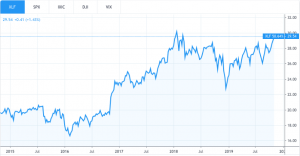
    Our cautious optimism this time is the return of the US banking sector to 12-month performance highs as captured in the following chart:

    What is worth watching over the next few trading days is whether the chart pattern can “break out” and move above previous highs set at the beginning of 2018. It is true that the US earnings season for corporates has been reasonably positive but the market is still very dependent on the technology sector. To put that concern in context we were struck by a stunning recent data point; the combined $2.3 trillion (yes) market value of Apple and Microsoft now exceeds the total value of all publicly traded companies in… Germany. The Teutonic manufacturing monster is just the 3rd largest exporting nation in the world and 4th ranked economy globally.

    The other way of expressing this hope in financial market terms is that the “value” style of investing is due a comeback after years of underperforming “growth” stocks fueled by the technology sector. Typically periods of value outperformance are rather short and very significant so we should find out rather soon if the market driver baton is passed on to the laggard value sectors like energy, mining, banks, etc. Of course, the financial press will quickly create a macro/geopolitical narrative to “explain” the melt-up in equities markets. Take your pick from the following two early favourites:

    • Potential de-escalation of US-China trade tensions.
    • China turning on the credit spigot again and the Yuan stabilizing.

    Of course, these potential macro developments are helpful but let’s be very frank here. There is really only one financial datapoint that counts; how much money(at zero cost) or liquidity is being pumped into markets by the central banks, led by the Fed.

    As a quick reminder, in 2018 central banks tried to remove financial markets from the monetary methadone clinic by phasing out quantitative easing(QE) and actually raising rates. The result was a very large negative bag of performance coal from Santa at the end of 2018.

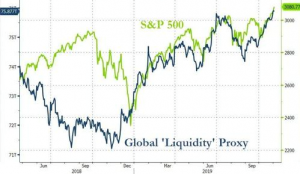
    Now check out the policy u-turn by central banks in 2019 with the Fed cutting interest rates for the third time in recent days. By some measures global liquidity provided by central banks has passed the $75 trillion mark and it doesn’t look likely to stop for some time. See in the following chart how the S&P 500 is moving in lock-step with central bank largesse in 2019. Note this in sharp contrast to the pattern in 2018 when liquidity was drained and interest rates were hiked by monetary authorities across the globe.

    The consequences of super-easy money in the longer term are for another article but, for now, let’s just say extra liquidity needs to find new investment homes; most likely they will be neglected laggard sectors showing ‘value’. Banks might be just the start…


    Enjoyed this blog? Then why not check out our other great content by clicking here!