Tag: fintech

  • Check Out Two Big Wins For Banks And EIIS Investors

    Check Out Two Big Wins For Banks And EIIS Investors

    Ok, I was wrong. I really thought that rising interest rates to over 5% over the last four years would cause greater stress in bank loan books. Yes, commercial real estate loans are causing angst in the global financial system but thanks to private equity, pension funds and family offices it’s not just the banks on the hook this time. Clearly, the rise of private investment vehicles in financial markets has helped to de-risk the banking system. Of course, the investor muscle memory of the 2008-2009 credit crisis has had a double impact too. First, consumer protective regulation has forced banks to build huge capital buffers (reserves). Second, bank customers through a combination of lack of finance education, risk aversion and behavioural inertia have added to those buffers. European bank customers in particular have left trillions of euros of cash in the bank earning almost no interest because they have not sought out specific interest-earning deposit or money market accounts. Ireland, with almost €150 billion euro sitting in accounts earning miniscule interest, is the worst European offender.  Here are the numbers:


    • Across the EU banking system there is €16 trillion of customer cash sitting in bank accounts.


    • 54% of that cash earns on average 0.13% in low-interest overnight accounts. Implicit in that number is that 46% of customer cash is in longer-term deposit accounts. In other words, almost half of European bank customers commit cash to ‘term deposit accounts’ which, in exchange for waiving access to the cash over defined time periods, pay depositors average rates of 2.65%.


    • Ireland has a VERY different mix of customer behaviours. Just 12% of customer cash earns income in term accounts. A whopping 88% of Irish cash sits in overnight accounts, earning almost nothing.


    Clearly, this is a win, if not a scandal, for Irish banks. On the other hand, the European banking system is in pretty good shape, steering capital away from higher returns but also higher risk. As an illustration of the European bank risk culture, I was staggered to see that US banking giant, JP Morgan, has a market value of $540 billion which exceeds the combined value of Europe’s top 10 banks. So, Europe’s banks are doing ‘ok’ but not exactly chasing higher returns for their shareholders which translates into underwhelming valuations. However, if you thought this was a hit piece on banks you’d be wrong. The other eye-popping data point I discovered this week was that in the critical world of customer experience (CX) – now a main priority for 80% of companies per Gartner – banks in seven major economies outside Ireland now top the CX league tables. That just wasn’t on my 2024 bingo card. In fact, that banking ‘bingo card’ is putting together a very interesting string of numbers….


    • US and global stock markets are hitting all-time highs again after August wobbles. Yes, the US tech sector has been the star sector of the last 12 months (+42%) but you might be surprised to see US Banks in second spot with a 29% return.


    • Euro area banks handed out €71 billion in loans for house purchases by consumers in July, the highest level since August 2022.


    • Italy’s Unicredito bank is signalling increased executive confidence with a shock swoop for a 9% stake in Germany’s Commerzbank. The Italians have asked permission of the German government to pursue merger discussions. Wow. Cross-border M&A featuring major European banks has not been seen for years.


    • Europe’s financial markets are increasingly pricing in climate-related risks. ECB reports that eurozone banks were charging companies in the top 25% of carbon emitters monthly interest rates 14 basis points higher on average than those in the lowest 25%


    • You may not have heard of Tether but it is a fintech platform specialising in trading digital currencies which track/tether to traditional major currencies using blockchain. These asset-backed digital instruments are known as stablecoins. Tether has 350 million stablecoin users globally and, incredibly, has generated more profit ($12 billion) than the world’s biggest asset manager, Blackrock, and its $10 trillion portfolio since early 2023.


    • Perhaps it’s no big surprise that Revolut is reportedly about to launch a stablecoin for its 45 million customers, of which 2 million reside in Ireland.


    One of the other big messages in the CX world these days is that brands suffer without innovation. Keeping the status quo is really going backwards. We have written before about the massive data/AI opportunity for banks and the ultimate platform play: payments. Trillions of dollar wealth has accrued to innovators in the social media and cloud computing platforms. Now, it could be the turn of payments to deliver trillion dollar opportunities. While we write of opportunities might we suggest another?


    As tax-return season kicks in, private investors should note that EIIS tax-friendly opportunities just became more lucrative. Thanks to changes in last year’s Finance Bill, many investments in early-stage companies currently attract 50% income tax rebate opportunities for Irish investors. Now, think about all that cash sitting in bank accounts with inflation of say 3.5% eroding its purchasing power. Here is a quick illustration of wealth destruction:


    • Keep €20,000 in overnight deposit as usual.
    • Hold for 10 years while asset prices inflate by 3.5% per annum.
    • Spend the €20,000 after 10 years but get only ‘value’ of €14,000 due to asset inflation/purchase power erosion.


    Or….. try this EIIS investment strategy.


    • Invest €20,000 in portfolio of 7-8 early stage companies.
    • Receive €10,000 back in income tax rebates.
    • In 10 year’s time, if your €20,000 investment has returned just €4,000, you have beaten the bank.
    • That €4,000 hurdle requires just one of your investments to double in value while all the others go to zero.


    Gotta be worth thinking about. Certainly, if you’re sitting on cash which will lose 30% of its purchasing value over the next 10 years. Better still, move some money into term deposit accounts and look for 3% long-term rates. Then think about using EIIS to offset the taxes on that deposit income. In the “real” world of tax savings that 3% interest earnings (offset with EIIS rebates) on your deposit equates to a 6% gross return typically promised on other types of assets, like a property or multi-asset wealth portfolio. Definitely worth a chat with your accountant.


    Finally, from a Spark perspective, we can promise our investors a very interesting pipeline of up to 8 EIIS deals spread across SaaS software, biopharma, medtech, ESG/sustainability and AI before Santa arrives and the EIIS window closes for 2024. And, if we were in Santa letter-writing mood we’d be tempted to ask government and banks to join the dots and incentivise specific support for small early-stage businesses via bank deposit accounts. Showing my age here, anyone remember SSIA’s of the early naughties? Answers on a post card to Apple or the Department of Finance with a recent €14 billion windfall/capital infusion to kick things off….




  • Themes Checklist For The Beach

    Themes Checklist For The Beach

    The weather forecast isn’t great.  I’d usually suggest some couch thinking time but that phrasing has now become a politically-charged innuendo in the US which tops off possibly the most bizarre presidential campaign month ever. Don’t ask about couches or dolphins, or JD Vance. And, he thought having no children was the problem…..! Anyway, given the amount of delusion in the air, I’m going to suggest a beach plan. That might be the wrong plan, but thematically we might be on the right track in the world of finance. So, for those enjoying some time off, one can review and reflect on the following:


    Old economy: Our suggestion “Investors Need The Old Economy Too” in May started subtle, then went full hammer. This move hasn’t just been a tech shift from software to more traditional hardware manufacturing. Say hello to the ‘great rotation’. The old economy stocks roared in July. The top performing sectors in the US were industrials, financials, utilities, basic materials and real estate. As an illustration of the scale of rotation, note technology stocks actually had a negative month (-2%) while US regional banks and housebuilders rocketed 19% and 17% respectively.


    Smaller companies: We have written “Betting On Small Can Really Win” but boy oh boy did it rock in July. Smaller companies tracked by the Russell 2000 index whipped the performance of the large company S&P 500 by 10 percentage points. That’s the largest monthly divergence between size cohorts ever recorded in history.


    Climate and cleantech: Another theme close to our hearts. VC Breakthrough Energy Ventures backed by Bill Gates has just raised the largest climate fund of the year with a funding round of $839m. In Europe, the momentum is good too. Private equity deal values in European cleantech are now on track for their best year ever(Source: Pitchbook).


    Fintech: Stripe and Revolut valuations in recent private share sale activity have jumped by 40-50% and London remains a fintech investment hotbed. Latest British Business Bank data tells an interesting City story –  the UK fintech sector is attracting 11% of global VC investment (and 48% of all investment in Europe), a share only exceeded by the US.


    UK Comeback: In March we wrote “Time For A UK Recovery” and waited for credibility and competence to return to Westminster. The scorecard at the moment looks pretty good: UK equities are seeing the strongest inflows of foreign institutional investment for years (Source: BOA), and on the currency front, the GBP (formerly known as the “Great British Peso”) has been the strongest major currency performer in the year so far (Source: Bloomberg).


    Digital infrastructure: We wrote “Get Ready For The Cloud Wars” back in November and this has morphed into a global foot race to acquire, invest, service and build the infrastructure of our digital/AI future. From data centres to state-of-the-art chip manufacturing plants the investment giants are moving fast to get involved. While Microsoft opens a data centre every three days, it feels like the likes of Blackrock, Apollo and Blackstone are competing for digital infrastructure headlines every few days too. In fact, Blackstone estimate digital infrastructure spend by top tech companies will exceed $1 trillion over the next 5 years.


    Wall Street veterans would say  ‘the trend is your friend’. So, we aren’t giving up on any of these themes just yet. However, we will return to two critical risk factors for many of these themes in a later article. Geopolitical risk from Taiwan to Iran to US electoral chaos looks like it is escalating rather than fading. US politics can make for electric watching (with the shock too) but the just announced prisoner swap deal between Russia and the US was significant. The allied multinational effort by the Biden White House shows the value of joined up thinking and shared values but the planet faces other bigger challenges. Arguably, our highly charged politics needs to address the fundamental challenge of climate and electricity too. For another day, but the race to decarbonise and electrify the global economy is definitely not on track…..


  • The Hottest Investment This Summer

    The Hottest Investment This Summer

    Ok, I’m a bit hot and bothered. When a tee-shirt ripping Hulk Hogan is the warm-up act for possibly the next President of the United States I’m inclined to think our planet is in trouble. The Republican National Convention(RNC) in Milwaukee this week marked a new level of bizarre in US politics, but the hot air sadly can’t be confined to the GOP speaker line-up. As a record-breaking 1,400 tornadoes and scorching heat batters the US, I am resigned to the fact that decarbonisation of the global economy is way down the MAGA Republican (GOP) list of priorities. However, political mayhem can often leave investment markets unmoved, even relaxed. This seems to be the case so far, but things are fascinatingly stirring in long-forgotten parts of the market and I see one particular opportunity heating up fast. First, let’s look at some data:

    Technology: It’s not just Microsoft having a bad cyber outage day. In recent days, technology stocks experienced their worst share price falls since 2022. However, overall, stock markets continue to hit new highs. Why?


    Old Economy: Sectors neglected for months, even years, are attracting investors who are watching potential interest rate cuts and interesting valuation discounts to technology, pharma and AI-giddy companies. The top performing sectors over the past week were old-fashioned financials, industrials, energy and real estate.


    Smaller Companies: Only a few weeks ago we wrote an article “Betting On Small Can Really Win”. Hoo boy. The share prices of smaller companies over the past week have been on an historic tear. Stock indices which track smaller companies are flying as Trump would say “like you’ve never seen before”. The Russell 2000 is a benchmark used for smaller companies in the US and it has rocketed 12% in just the past week.


    UK Markets: The benchmark FTSE 100 post the Tory election rout immediately embarked on a two week winning streak. Coinciding with this political re-set, UK consumer confidence just hit a 3 year high.


    Venture Capital (VC): The latest data from VC research team, Pitchbook, shows that fintech and cleantech/sustainability start-ups are attracting the most investment in Europe of recent quarters.


    Clearly, investment capital is ‘rotating’ out of large company technology and looking for alternative opportunities. Furthermore, some structural themes are here to stay. So, we believe there are alternative opportunities to plug into the ‘monster themes’ like AI, decarbonisation, cloud wars and electrification. Where better to start than our planet and the urgent need to stem global warming? We have written many times before that this $9 trillion per year decarbonisation spend can’t happen without critical materials like rare earths and base metals. However, the mining sector essential to extract these critical materials has been starved of investment as large pools of capital shun the sector’s poor sustainability/ESG track record.

    That is changing as the big money now realises if there’s no mining, there’s no EVs, no batteries, no AI, no data centres etc These big funds are now pushing for sustainability assurance solutions which will allow them to deploy capital again and ensure the supply of critical materials can keep up with the demands of economic electrification. So, if you can excuse the mining pun, we have found a little gem of a play on mining/ESG which ticks the following boxes:

    *Market leadership: The company is a fintech with mining-valuable data built over 4 years.

    *Market fit: It is winning mining company customers – there are 4,500 publicly listed and investment capital-hungry mining companies – and generating more than $1m of annual revenues already.

    *Institutional endorsement: Critically, big investment houses are telling the mining industry this company’s independent ESG assurance process can open up investment and significantly speed up investment decisions.

    *Structural tailwinds: The macro themes of smaller companies, UK and old economy all feature in this opportunity.

    *Money talks: And.. founders and international institutions are putting in their own money to grow the company’s global footprint.

    So many boxes ticked, with macro and structural themes aligning. This has to be our hottest opportunity to fight global heat this summer, and for many summers more. But, not too many. This company will surely be bought by a global data player or consultancy in less than 5 years with a potential 10x return to private investors. Think Bloomberg, Accenture, Reuters, S&P Global etc but don’t tell them yet – we are keeping this opportunity exclusive and private.

    Links to next week’s webinar here and the company’s investment memorandum here.


  • Watch Out For A New Wealth Wave

    Watch Out For A New Wealth Wave

    AI superstar stock, Nvidia, has just reached a valuation of over $2.75 trillion. That exceeds the value of the entire German stock market. How about the combined value of IBM, Tesla, Facebook, AMD, Netflix and Intel? Yup, that’s what happens when a share price clocks up a 1,000% return since 2022. And yet, those “combined” companies listed all have an AI story too. In fact, I have seen data indicating that 179 of the S&P 500’s constituent companies referenced AI in their recent quarterly analyst results’ calls. So, is AI the only game in town? We think not, and then we found a striking headline…..

    Hargreaves Lansdown rejects £5 billion bid from PE consortium –  Financial Times

    What’s the big deal? It’s not even a big deal. I mean, Nvidia just increased in value by $150 billion over a few hours on NO company-specific news. Allow me to expand. Or should I say converge….?  For those readers unfamiliar with Hargreaves Lansdown, the company is an investment platform serving 1.8 million UK-based clients with a combined £150 billion of wealth assets. However, what really caught the eye and what should resonate with regular readers is the convergence of four distinct themes we have written about in recent months:


    *The PE in the headline stands for ‘private equity’ and we are expecting stable or falling interest rates to prompt an increase in buy-out deal activity.


    *The rapidly increasing weight of private (not publicly listed) assets in high-net-worth investment portfolios. Research data from Pitchbook reckons private assets could reach a total value of $20 trillion by 2028.


    *The UK might be in the middle of the worst election campaign by any governing party in history but investors are beginning to look past the Tory party meltdown. UK companies are cheaper than similar companies in other markets and investors see opportunity and dinghy-free sanity ahead.  


    *We have highlighted the potential of ‘old economy’ companies in neglected areas of the market beginning to show signs of a new life. Specifically, we flagged a huge merger deal in the mining sector, the US bank sector actually outperforming technology this year and breaking news of an agreed £3.57 billion buy-out of the Royal Mail by a Czech billionaire.


    So, of course, we are intrigued by potential private equity interest in a cheap UK old economy financial services company. However, it’s a bit early for thematic victory laps. It feels like there is more going on than opportunistic feasting on cheap UK assets. Indeed, our curiosity is focused on the sudden appeal of wealth management businesses. Deal activity has been building steadily with Canada’s RBC buying Brewin Dolphin, private equity house Pollen Street swooping for Mattioli Woods and US bank Raymond James acquiring Charles Stanley. Other mid-size UK wealth operations like Quilter, Brooks McDonald and St James’s Place will likely feature in additional media buy-out speculation. This might appear like a simple consolidation trend in a fragmented sector plagued by digital, regulatory, capital, pricing and demographic/behavioural challenges.  In deal jargon this could be described as ‘defensive M&A’. Or, that description could be just plain wrong. What if there’s a new opportunity in wealth management? I can think of two significant drivers right now:


    1. We referenced the explosion of private investment assets to $20 trillion by 2028. The good news for investment platforms is that fees on private investments are higher than publicly traded assets given they cannot be traded on a stock exchange in a nano-second.
    2. AI, and Nvidia in particular, is investing in the processing power required for these large language models (LLMs) used to train AI applications. However, there’s a basic component of AI that every business leader, regulator, customer or user will tell you is critical – robust data.


    Thanks to years of onerous KYC(know your client) and AML (anti-money laundering) compliance, it is reasonable to conclude that the wealth management industry must be in possession of some of the most accurate and high-value/personal data on the planet. Whisper it quietly but blockchain and digital currency(crypto) technology are also staging impressive comebacks in 2024. We often write about the compounding effect of the convergence of new technologies and I’m wondering if a faltering wealth management industry might be on the cusp of increased revenue opportunities in private assets and reduced costs through AI, blockchain, digital assets, tokenisation etc. Even those companies considered digital leaders are revving up their curiosity. Only this week in Dublin, Revolut’s chair, Martin Gilbert, and founder of Aberdeen Asset Management admitted that a move into asset management by the fintech platform was a possibility – “It’s something we talk about a lot”.

    Expect lots more talk on investment desks in London and Dublin too. On days like today, I miss those desk chats…. and the laughs, lots of them.

    Mark “Dicey” Reilly RIP

  • Risk Warning: Trust, But Verify…..

    Risk Warning: Trust, But Verify…..

    On the fifth check of my passport at Paris’s Orly airport I did wonder. Will trust die before our planet dies? Both are under severe threat and, yet, I’m hopeful. Let’s take a look at three particular examples of widely-held mistrust where recent developments might challenge the negativity. First, some history. Ronald Reagan’s signature phrase in nuclear disarmament talks with the Soviet Union was derived, ironically, from an old rhyming Russian proverb: Trust, but verify. Of course, it was tough to trust the Kremlin but technology, in the form of satellite imagery, was the critical verification tool. These days it’s technology which is not trusted but could also be the solution.

    We have previously written about global payments processing as possibly the biggest ‘network’ yet to platform and join social media and cloud computing in the multi-trillion dollar wealth creation club. However, the payments opportunity starts with technology mistrust. Bitcoin is flying high but the cryptocurrency ecosystem is still widely mistrusted by consumers, governments and regulatory authorities. Stripe famously ceased processing Bitcoin payments on its platform back in 2018. Now, it’s all change. Stripe is bringing back crypto payments, this time with a stablecoin. The USDC stablecoin to be accepted by the platform will be pegged to the US dollar ie it tracks the US dollar value. More critically, the technology which underpins the security and verification of these currency assets is blockchain. On so many levels this is a huge verification moment for digital currencies and the software blocks used to build them. Now, for some more building…..

    The 2022 CHIPS and Science Act was a Biden administration attempt to reinvigorate the US manufacturing base by attracting huge factory construction projects. Scepticism was rife, given the Trump toddler promised ‘infrastructure week’ every week but never delivered. Well, let’s verify. First, the US government has paid out more than half its ear-marked $39 billion of incentives to companies planning to invest in manufacturing facilities. The corporate follow-through has been extraordinary – microchip manufacturers and their suppliers have announced $327 billion of investments over the next 10 years. Micron alone is planning a $100 billion project in Syracuse, NY. That’s a nationwide 15x leap in construction spend on these type of facilities and will capture 20% of the global chip manufacturing market by 2030. Currently, that number is zero. But what about our planet and other targets with Zero (Net)?

    Let’s face it, the push back on global sustainability and ESG targets is worrying. We often write that money talks and the following headlines paint a picture of worrying reversal:


    Flows to European ESG exchange traded funds halve in first quarter –  Financial Times


    US Fund Managers With ESG Mandates Have Worst-Ever OutflowsBloomberg


    Clearly, this is not good news. However, we should be careful not to equate fund flows with commitment to climate change targets. For example, the banking sector in recent decades could be described as the ultimate counterparty requiring ‘trust, but verify’ checks on their behaviours and risk management. So, with the global financial crisis barely 15 years in the rear-view mirror, how did genuine ESG investors feel about this week’s staggering headline?


    Western banks in Russia paid $800m in taxes to Kremlin last year –  Financial Times


    Yep, that was the tax bit. The profits according to the FT were over $3 billion. Trust, but verify indeed……ESG investors can rightly ask how are those “S” and “G” policies going in these shame-free and profit-full banks? Answers on a post card to Kyiv please.  Before we all blow a complete gasket, let’s finish with some more wind but a bit more climate positivity. And, no, it’s not a Trump legal challenge. But it could ultimately rhyme by starting badly, and then ending with a positive reality check.

    First, the severity of the storms and tornados sweeping through the Midwest heartland of the US this week are truly frightening. However, there’s a bigger financial storm brewing further south. An excellent article in The Lever this week highlighted the plight of Louisiana homeowners struggling to insure their houses while 12 insurance companies have failed, and 12 others have left the state. Almost one in five Louisiana residents lost their homeowner insurance last year. The crisis is climate caused. Global insurance giant, Swiss Re, in a recent report stated that natural disasters now cost the United States $97 billion a year.

    In Florida, the climate denial Governor, Ron De Santis, might be kissing the Trump ring again but home insurance rates jumped 42% last year and coverage from big players, AAA and Farmers Insurance, has been pulled from the market before hurricane season. Unsurprisingly, Florida for-sale housing inventory has jumped 57% in 12 months. Leaders in denial-mode face a wave of voters, mortgage banks, pension funds and Wall Street analysts giving them the ultimate verification check on climate crisis. The critical shift is that investment capital has checked, and is already fleeing.

    Trust me, that seismic capital flight will force leadership change and action. Verification…..pending.

  • Time For A UK Recovery?

    Time For A UK Recovery?

    Crikey, twice in one week. A positive thought on the UK. Maybe, it’s my subliminal way of keeping the rugby gods happy before Twickenham? It’s certainly not Rishi Sunak’s sole splitting toe-curler of an interview with Grazia – surely the place where political careers go to die or promote blissful dishwasher habits. No, seriously. Anyway, Budget Day comes this week in the UK but that won’t move the recovery dial. No, I’m looking for inspiration elsewhere and, as fortune would have it, we hosted a launch event in London last week. The guest speaker on the night, Chris Johns – author, podcaster, economist, fund manager, strategic thinker with a big following – made the interesting point that, in a year where 4 billion people on the planet are due to vote, the UK might be in a unique position. Its voters will most likely reject the trend of chasing populist pipe dreams.

    The 14-year suffering electorate in the UK has already tried populist politics, and it is entirely possible that a curious fixation with ‘taking back control’ and a nostalgia for historical glories could bring the Tory party to an election wipe-out where less than 100 of their Westminster parliamentary seats will survive. That’s what happens when the Dambusters theme music leads to machine-gunning dinghy policies and taking back control doesn’t quite lead to ‘ruling the waves’. In fact, quite the opposite of control, as the nation empties its bowels directly into UK waterways at a pace not seen since Nosferatu Rees-Mogg first walked the cholera-ridden streets of London in 1866, with Nanny. The toilet humour may feel misplaced in a crisis but infrastructure decay is at the root of UK decline, and pre-dates Brexit. The bottom line is that the UK, both in the public and private sector, has been under-investing for decades.

    The Institute for Public Policy Research estimates the under-investment in business at $500 billion less than what other comparable OECD countries have invested since 2005. Public sector investment (infrastructure) was a further $200 billon below the G7 average. All in, this chronic lack of investment places the UK 27th out of 30 OECD countries. So, why my optimism? Well, I’m schooled in the financial market orthodoxy that the rear-view mirror is a wealth destructor and that the greatest opportunities can be found at the maximum point of despair and disarray. The disastrous 49-day PM reign of Liz Truss and the international bond market near-strangulation of UK pension funds in September 2022 was possibly that moment. Truss’s recent reinvention as on-stage Tommy Robinson (UK civil court adjudicated racist) cheerleader with MAGA extremist, Steve Bannon, at the fascist CPAC conference merely highlights the passage of populism past the point of no return. Not even the suspended Tory Deputy Chairman, Lee ‘Anderthal’, went that far. However, the financial returns possible to investors in the UK might be about to turn for the better. In our recent “Private Portfolio Thoughts” Newsletter we highlighted a couple of interesting data points:


    The Quest quants team at Canaccord are pointing out that UK companies’ level of capital expenditure is at multi-year lows. This means there is plenty of gun-powder to acquire other companies. Also, the machine-learning macro data at Quant Insight is pointing to lower credit spreads (higher lending confidence) driving financial markets right now.


    This combination of pent up investment capability and improved borrowing conditions for UK businesses creates a very opportune environment for the purchase of UK companies by other UK companies. One could view it as a capital expenditure ‘sprint’ ie why invest organically when you can buy an existing business, customers and expertise? There are also a few other factors to consider….

    Valuation: Mid-sized UK companies which are listed in the FTSE 250 index are trading at 25-35% valuation discounts to other developed markets. Some equity research houses have boldly referred to the UK mid-market as being on ‘emerging market’ valuations of 11-12x earnings multiples compared to US markets on 19x and world developed market averages of 16x.

    Currency: Consider the Brexit devaluation of the Great British Peso (GBP) by 15% and a foreign buyer could be looking at a “50% Off, For Sale” opportunity. And, it’s not just us thinking about foreign acquirers…

    A 2023 survey conducted by London-based investment bank, Numis, showed that a whopping 90% of FTSE 250 company directors believe UK firms are vulnerable to foreign takeovers due to depressed valuations and a weak GBP. Oh, and then Numis was bought by Deutsche Bank! That’s certainly ‘walking the talk’. However, this is not just an isolated corporate coincidence. There are other headlines signalling a growing awareness of opportunity and interesting company moves:


    *Britain Isn’t Such a Basket Case Anymore, At Least To Investors – Bloomberg (March 5th 2024)


    *UK Insurer Direct Line Rejects Ageas’s $3.9 billion buyout – Reuters (February 28th 2024)


    *Dutch Fintech Bunq moves top exec to UK to lead post-Brexit return – Financial News (March 4th 2024)


    *Currys shares soar as Chinese retailer enters takeover battle –   The Guardian (February 19th 2024)


    *Santander-backed Ebury reportedly eying £2 billion London IPO – Reuters (March 5th 2024)


    That last headline is a striking confirmation of two themes we have recently highlighted on these pages. Firstly, Ebury is a UK payments fintech and the UK fintech sub-sector, despite Brexit, remains the best place in the world outside Silicon Valley to attract venture capital. Second, the payments sector within fintech is ‘hot’ and could follow digital processing and social media as the next mega-trillion dollar network. In contrast, the overall UK market has gone cold and lost its “equity culture”. No wonder the CEOs of major UK companies have been pressuring Chancellor Jeremy Hunt to bring some Budget relief or ISA incentives to UK investment. The data is damning.

    Pension fund allocations to the UK’s stock market have fallen from 53% of total investment to just 6% in the space of 25 years. In fact, the entire UK market is valued at $3 trillion which is less than the market value of a single US company, Microsoft.  This could be viewed as a long-term UK downward spiral but ….a marginal pick-up in M&A, investment and foreign capital inflows could have an outsized ‘FOMO’ impact on perceptions. Think of Japan’s recent resurgence and then consider what might happen to the UK market if investors believe the worst is in the rear-view mirror and the future is investment, not puerile populism. Watch for corporate leadership and action. Then, follow the money.

  • Fintech Is The Forgotten Network Card To Play

    Fintech Is The Forgotten Network Card To Play

    Brexit has delivered a win. There, I said it. Now, before you all head off to lobby on my behalf for a co-anchor slot on GB News with the Moggster, Bad Enoch and the Rishibot, there’s a distinct possibility I could be clutching at correlation rather than causation. However, the numbers – for a change – are real. According to KPMG’s bi-annual report, Pulse of Fintech, last year was a tough year for global fintech with funding levels hitting a 6 year low. The UK did not escape the bear market as its $12.3 billion of new investment represented a 34% drop. But….the UK remains, by far, the capital of European fintech and ranks second globally behind Silicon Valley. For global context (and Nigel Farage cartwheels), UK-based fintechs attracted more funding in 2023 than France, Germany, China, Brazil, India and Canada combined. That feels like winning to me but also prompted thought on networks and London’s global positioning in the financial ecosystem.

    London is blessed with an enormous talent and innovation pool thanks to centuries of being the dominant global financial centre and a time zone which straddles the Americas and Asia. This global positioning means there is a bigger and more realistic point to be made than Brexit. It is striking to me that when a country is in the middle of a political, institutional and trading meltdown there is a sub-sector of economic activity which defies the gloom. Fintech might have suffered investment flight in 2023 but the resilience of UK fintech in the midst of a national mental health event points to the recovery of a structural story we have written about many times before.

    It’s a network story but it has had to play second-fiddle to two much ‘hotter’ networks in recent times. Social network platforms (quasi-relationship processors!) are now bigger than sovereign nations – billions spend hours of screen time with Facebook, Instagram, YouTube, Tik Tok etc. And yes, Meta may have picked the wrong name but its share price is at all-time-highs. Also, this week we got another blow-out pulse-check on the hottest network story of recent times; Nvidia’s leading role and 400% y-o-y growth in supplying AI-capable chips for data centres. The computer/digital processor network now lives in the cloud powered by a rapidly growing network of data centres operated by Amazon, Google, Microsoft, Apple etc. However, this week we were reminded that the global financial network is the biggest beast of all and still searching for next-generation financial processing. In the vast field of fintech covering regulation, cybersecurity, analytics, flashboy trading, execution algos, insurtech and blockchain the Big Daddy of them all is payments, call it financial processing.  And this week, we saw some big payments developments.

    First, US bank Capital One announced it is buying Discover Financial Services in a $35 billion deal. At first glance this looks like Discover’s credit cards were the target and, indeed, the combined card operation would create the No.1 US credit card company, passing out JP Morgan and Citigroup. But, no, what caught my eye is that Discover also operates a payments network. Furthermore, Capital One CEO, Richard Fairbank, said that by adding Discover, he could start building “a payments network that can compete with the largest payments networks and payments companies,” a reference to Visa and Mastercard, which dominate the industry. To put the card deal in context, the $35 billion deal is not even a tenth of Visa’s $550 billion market value which is fast catching up on Nasdaq poster-child, Tesla. It’s not just traditional banks like Capital One eying up payments networks. Closer to home, there was an interesting private deal announced.

    UK digital bank, Monzo, is reported by the FT to be close to completing a £350m funding round with a £4 billion valuation. So far, so unremarkable. After a bit more reading, two things struck a chord. First, little Monzo now has a whopping 9 million customers, with 2 million coming aboard in 2023. That’s quite the banking network build and I wasn’t the only one intrigued. Apparently, the lead investor in this round is Google’s very own investment wing, CapitalG. Note Monzo is a banking service which includes payment processing but guess who is the processor behind Monzo? Stripe. And, Stripe wasn’t the only hot payments fintech I was reading about this week.

    When Mario Gabriele of the Generalist newsletter flags a disruptor company I usually pay attention. This week he did a deep dive on Australian payments fintech, Airwallex. It’s not in Stripe’s league – they raised $6.5 billion in 2023 –  but Airwallex has just raised $160m at a $5.6 billion valuation supported by 100,000 corporate customers (including SHEIN, Qantas, Canva) generating $80 billion of annual volume and $400m in revenues. The service offers payouts in 150 countries in 46 currencies, is executed by a couple of clicks and costs markedly less than traditional financial institutions. Once again, the issue of costs and tolls charged by traditional financial intermediaries looks like a key ‘win’ for fintech disruptors, and even traditional banks like Capital One. Check out the words of their own CEO, Fairbank (perfect name when you think about it);


    “Owning a network allows us to deal more directly with merchants rather than a network intermediary…..We create more value for merchants, small businesses and consumers and capture the additional economics from vertical integration.”


    That network word seems important. Arguably, there already exists a disruptive network and it’s already worth a trillion dollars. Yes, the blockchain-powered cryptocurrency, Bitcoin, traded back to the $50,000 mark in recent weeks and put the total value of the currency at $1 trillion. Of course, the recent decision of US regulators to allow funds (ETFs) invested in Bitcoin to trade on public exchanges like the NYSE is a further validation for this particular ecosystem. However, Bitcoin’s connectivity to the merchants, consumers and businesses which Fairbank covets is still very limited. What is not in doubt is the size of the global digital payments market which is, per Statista, going to exceed $15 trillion by 2027. The good news for fintech disruptors and start-ups is that reducing the “tolls” on these money flows can be a quicker route to profits than other sectors.

    In Europe, just two of the ten most valuable venture capital (VC) backed companies are making profits. Interestingly, both are fintechs –  Revolut(neobank) and SumUp (mobile merchant payment hardware). Clearly, route-to-profitability is an increasing focus of investors as higher interest rates bring tighter funding conditions. However, investor interest in payments networks appears strikingly robust. Check out the following recent funding deals:

    • UK-based Kriya secures £50m funding boost to supercharge B2B payments revolution – TechNews 180
    • Valar Ventures backs Berlin fintech, Monite, with $6 million – CB Insights
    • Colombian payments startup, Bold, secures $50m in Series C funding, led by General Atlantic – HUBFX
    • Payment orchestrator, Navro, raises $14m Series A from Bain Capital and Motive Partners – Dealroom


    The truth is that payments funding has ‘only’ seen a 30% fall in funding activity compared to wider fintech funding collapses of 50-70%. So, perhaps my Brexit blurt was too impetuous and the stronger logic attaches to London’s critical positioning in the payments ecosystem. There goes my GB News career but I’d rather you keep an eye on the forgotten third giant network – payments. And, now you know there are 15 trillion reasons why.

  • What’s The Score For ’24?

    What’s The Score For ’24?

    It’s that time of year again to pause, reflect and hope to do better in future. Unless, of course, you’re the Conservative Party in the UK or the Republican Party in the US and ‘the race-to-most-nasty’ is the leadership badge of shame soon to be re-spelt with a ‘Z’. Back in the do-better world, a review process can help shape future efforts. So, let’s do a quick check on our four multi-year investment themes we identified almost a year ago in “Four Pictures To Develop This Year”.  First, we will remind ourselves of what was written, and then score/review how things developed for AI, Housing, Corporate Credit and Cleantech/Batteries. We kick off with the biggie….. Artificial Intelligence (AI):

    “The excellent database resource, Our World in Data, shows annual corporate investment in AI doubling from circa $80 billion in 2019 to over $160 billion by mid 2021. More specifically, the explosion of interest in generative AI (ChatGPT, DALL-E etc) has seen VC investment increase by 425% to $2.1 billion since 2020”

    Review: Well, at the half-way stage of this year, 18% of global venture(VC) funding went to AI, clocking a total of $25 billion(Source: Crunchbase). Furthermore, with the tech-heavy Nasdaq index gaining almost 50% this year, Nvidia reaching a trillion dollar market cap and OpenAI hitting an $85 billion private market valuation, it is not hard to identify AI as the single biggest positive driver of investment markets this year. Of course, the trajectory of the cost of money (interest rates) also helps with the confidence bit, but we have written before that November 17 has more than one revolutionary connotation. As of this year, the night of November 17th will be remembered for the $200 billion swing in value between Google and Microsoft in a matter of hours, and entirely driven by the relative success or failure of their respective cloud computing divisions. The AI revolution is in full swing and will continue into 2024

    While the cloud has become the housing proxy for AI, what about our own housing markets? A year ago we were concerned:

    “Of course, rising interest rates don’t just impact companies. The biggest item on an individual’s balance sheet is likely to be a house and as interest rates rise, so do mortgage rates. The push/pull effect of higher interest/mortgage rates can reduce the price of the assets being purchased, in this case houses rather than growth companies…… indicates a more difficult 2023 for a number of major housing markets.”

    Review: Arguably, this theme did not play out in a significant way, unless you were Chinese. Bluntly speaking, the doomsday predictions of housing crashes in the US, Australia, Canada and the UK just did not materialise. However, house prices are somewhat softer in many markets. The St Louis Fed has said median house prices in the US are off 10%. Even the UK with its dysfunctional government, and one Prime Minister(Liz Truss) having a good go at crashing the property market all by herself, has seen price slippage of just 1% (Source: Halifax). The key flaw in the doomster arguments was that most people kept their jobs. Major economies in a state of full employment was not expected as the “vibecession” never turned into a recession. And, if recession is avoided then there’s another asset class which has dodged a bullet; corporate debt/credit. Here’s what we feared….

    “In real world terms, the knock–on effect of tighter funding conditions will begin to reveal themselves in 2023 as companies with challenged balance sheets/indebtedness – aka ‘zombies’ – move into distressed territory.”

    Review: As a proxy for corporate stress you’d expect high yield bond (lower quality debt) spreads to have risen through the year. But no. They’re actually at their lowest since April 2002. However, we’ve had a few big bankruptcies through the year – Silicon Valley Bank, WeWork, Diebold Nixdorf, Rite Aid, Van Moof, and even Birmingham City Council. By June UK bankruptcies were up 40% on the year before. According to S&P Global, in the first 10 months of this year 561 companies sought bankruptcy protection in the US. That’s more than any year since 2010, except for the Covid-19 hit in 2020. So, I’d give us a pass mark on this but feel there’s another year of stress ahead. In particular, commercial real estate as an asset class is going to witness some very painful write-downs and outright collapses. Check out the recent travails of Austrian billionaire, Rene Benko, and his $25 billion property empire, Signa, for a very current case study.  However, not all building is in trouble….

    “In some ways, the best proxy for the planet’s race towards reducing fossil fuel dependence is the enormous investment currently being ploughed into production facilities for batteries to power a generational shift to electric vehicles(EV). China in 2020 accounted for 75% of global battery production capacity but that’s going to change. Europe intends to up capacity 5-fold by 2030 and the US isn’t just home-shoring semiconductor manufacturing.”

    Review: Like AI, I think this gets us pretty good marks. The cleantech and energy storage(battery) revolution is in full flow. McKinsey reckon $6.5 trillion will be spent every year on capital expenditure/building facilities which, in the words of the latest Cop-out 28 text, will “transition away from fossil fuels”. We did say catch up was required by Europe and the US in battery manufacture, but arguably the US has accelerated faster. Thanks to ‘Bidenomics’ and the IRA Act the US is seeing capital investment in manufacturing reach levels not seen in four decades. According to MIT, cleantech investments in the 12 months to July 2023 hit $213 billion, and was mostly allocated to EV battery manufacturing, renewable energy and green hydrogen infrastructure. No wonder the old-economy barometer, the Dow Jones Index, just hit an all-time-high level of 37,000 points. More amusingly, Trump whisperer, Maria Bartiromo, on Fox Business was forced to say “the economy is doing much better than most people understand.”  Wonder how that misunderstanding developed, Maria?

    So, there’s a temptation to stick with the same four themes for 2024, but in the spirit of Christmas we’d like to give a bit more. The bonus good news is that Christmas might also be easier on the waistline in the coming years. Yes, AI has stolen many of the headlines this year but there’s a 100 year old company in Europe breaking records too. Denmark’s Novo Nordisk is now the most valuable company in Europe with a $437 billion market capitalisation thanks to its insulin product, turned weight-loss miracle drug, Wegovy. This semaglutide-based drug is a game-changer for up to 750 million people living with obesity. However, there might be even bigger break-through treatments to come. And, it’s all about BIOLOGY.

    We are entering the world of gene editing spearheaded by CRISPR technology. Get used to that term. CRISPR stands for Clustered Regularly Interspaced Short Palindromic Repeats. It is a component of bacterial immune systems that can cut DNA, and has been repurposed as a gene editing tool. Only this week we were reading that the FDA has approved two ground-breaking cell-based gene therapies, Casgevy and a new one, Lyfgenia, for treating sickle cell disease (SCD) in patients aged 12 and older. Notably, Casgevy is the first FDA-approved therapy utilizing CRISPR.

    Now, think about healthcare spend being almost 11% of global GDP, or $11-12 trillion. The prospect of biology rather than pharmacology being used to eliminate various life-changing diseases is mind-blowing. Furthermore, as the first attempts to regulate AI emerge let’s open our minds up to the probability that these massive new computing powers can save decades of research time. So, as a final thought, perhaps 2024 will deliver a break-through global healthcare solution through the combination of AI and biology. Just imagine, our health becoming your wealth…. I definitely think that would score well.

  • Take Your Pension Or Portfolio To Another Level

    Take Your Pension Or Portfolio To Another Level

    Fizzle sticks! There goes another billion dollar ‘unicorn’ I didn’t back. Sound familiar? This week’s news that Ireland’s Cubic Telecom has entered the ‘unicorn’ club thanks to a €473 million investment from Japan’s Softbank should focus financial planning minds. In particular, we should focus on two things very familiar to readers of these pages. Firstly, speed. The business world is moving faster and faster. Secondly, technologies are rapidly merging and compounding value.

    Just over a year ago, Cubic Telecom was reporting annual sales(Sept 2022) of circa €30 million with its connectivity software installed in 10 million vehicles. Yep, €30 million not €300 million. So, what prompted Softbank to enter into discussions for a 51% stake purchase on a valuation multiple of 31x the previous year’s revenues? One could hazard a guess that speed of growth was one consideration, given installations of its software have ramped up to 450,000 vehicles per month and are expected to go ‘exponential’. Also, one suspects the compounding of a number of technologies is beginning to drive traction. Cubic is at the fortunate intersection of the Internet of Things(IoT), 5G connectivity, electric/battery powered vehicles (EVs), cloud computing and Artificial Intelligence(AI). We need to start thinking about multiple technologies compounding at speed rather than focusing on one technology advance, and it’s not just Ireland illustrating these two themes.

    All the gloomy headlines this year have put us all in a strange place. And, awkwardly so for financial advisors who possibly went into ‘bunker’ mode. I have been asked to look at 3 different pensions in the last week where returns to date were hovering at just over 3%. That’s actually less than you’d earn on risk-free US Treasuries currently. However, the killer data point is that the tech-heavy index, the Nasdaq 100, is up 48% year-to-date. Oh, and despite all those war headlines and oil worries from Russia/Ukraine and the Middle-East, the energy sector is DOWN year-to-date. Even Germany which is staggering into recession boasts a stock-market (DAX) hitting all-time highs and returning 18% gains this year. Note, the DAX is definitely NOT filled with tech names. However, the Nasdaq is telling us lots of technology from energy storage(Tesla) to cloud(Microsoft) to AI(Google) are emerging at the same time. Just yesterday, Google showed us a new AI bot, Gemini, and its market value jumped by $85 billion over the day. That’s the equivalent of Citibank’s market capitalization after 211 years in existence. Just one day. It feels like wealth creation cycles are shrinking.

    Latest reports suggest the AI team at French start-up, Mistral, are raising funds again. Recall that this crew of AI gurus raised over $100 million 6 months ago with no product, no business or revenues. Just a PowerPoint presentation deck. Now the team have a product (large language model(LLM) for Generative AI) and want to raise more than $300 million. The current valuation level for Mistral is ….. reported to be over $2 billion. Six months. However, before we go all dollars dreamy, note that the hard yards and years are still the norm. For example, Cubic Telecom started up back in 2005. At a higher level, consider it took Microsoft 44 years to hit the trillion dollar market value mark, Apple 42 years, Amazon 24 years and Google 21 years. Keep those tech and time thoughts and let’s move to the other end of the business life spectrum.

    We have already referenced pensions, but for many investors these are vehicles for a variety of funds investing in a mix of blue chip publicly listed company shares and their debt(bonds), government bonds, possibly some real estate and a bit of cash. Given the fast-moving tech world we live in, it is increasingly apparent that investors’ pensions or savings portfolios should allocate a small portion of monies(5-10%) to early-stage companies. Pensions are not the ideal vehicle(for the majority of people) for these investments, but the good news is that the government provides incentives with a similarly attractive taxation impact.

    For years, starting with BES schemes and then evolving into the current EIIS funding initiatives, government has encouraged private investor capital to support employment and growth for early-stage companies by offering tax rebates against income generated in the year of investment(s). That rate of rebate has been a standard 40% but is due to change. More on that later but first, let’s briefly explain the mechanics of EIIS.

    If a company is eligible for EIIS investment it will typically be introduced to private investors in three ways. Note, not all companies qualify for EIIS treatment eg. financial trading businesses are not eligible. Companies which do qualify, offer shares through the following:


    • Direct Investment: The investee company offers its shares directly to investors. These direct investment opportunities are typically offered to small groups of investors known to the company’s founders or its financial advisors, and not made public.


    • EIIS Funds: These funds are managed by financial intermediaries/brokers and request lump sums up front from private investors. The capital raised is then deployed across EIIS investment opportunities. The up-front sums can be significant(> €10,000) and the managers will charge annual fees.


    • CrowdFunding Platforms: A platform like Spark (or Seedrs or Crowdcube in UK) will give thousands of signed-up investors access to 12-15 fundraising campaigns by EIIS qualifying companies each year. The business model of these platforms is different to a fund. The investors do not pay any up-front lump sums or fees. Investors can invest as little as €250 in each EIIS investment with NO commissions, and NO management fees. Instead, Spark and other platforms only charge the companies a fee(and only if successful). One other variation on this is Angel Networks, or syndicates, which invest as opportunities arise. However, the entry level investment size (€5,000 – €10,000) and lead times are not for everyone.


    So, after paying for your shares, those shares will sit in a broker account, or a fund, or in a nominee account(independent of platform). The company will then apply for EIIS certification from the Revenue. On receipt of this notification, investors will get a certification confirming same which can be filed with the Revenue to offset taxes paid in that year.

    What sort of people could this interest? The income which qualifies for tax rebates includes employment income, rental income, dividends and ARF distributions. The amount of income which can avail of EIIS has been increased from €250,000 to €500,000 in a single year under new rules to come into effect in January 2024. Also, note the investment must be for a minimum of 4 years. The new rules in the Finance Bill also have broken the standard 40% rebate rate into different bands which we have summarised in a previous article as follows:


    • 50% for businesses that ‘have not operated in any market’;
    • 35% for a business in its first EIIS fundraise within 7 years of its first sale;
    • 20% for a business in its second or subsequent EIIS fundraise;
    • 20% for a business expanding into new markets or regions; and
    • 30% for investments via a ‘Qualifying Investment Fund’, of which there is only one in Ireland.


    Quite apart from introducing potential confusion, the ‘core’ or standard EIIS rebate of an equity investment will now be reduced from 40% to 35%. On a more positive note, the 50% relief for early-stage pre-operating companies could be very interesting for Ireland and Irish investors. It won’t have escaped your attention that the trillion dollar tech club is entirely US based. That can be attributed to deeper capital markets and Silicon Valley tech leadership but could Ireland be a leader now? I’m thinking three big areas where the Irish ecosystem is quietly building real scale and a pipeline of early-stage opportunities. Here we go:

    Medical Technology/Bio-pharma: 14 of the 15 biggest MedTech players have significant operations including critical R&D functions in Ireland. Also, 12 of the biggest global pharma players are there too. That ecosystem is beginning to deliver a fly-wheel effect of training, management, success, entrepreneurial juices and world-class innovation.

    Cleantech: Irish engineering and construction companies are already leveraging their experience of executing huge hi-spec projects for tech giants like Microsoft and Intel, and global life sciences companies. These Irish companies are now key players in the build-out of EV battery gigafactories, data centres, clean energy manufacturing plants, pharmaceutical plants and chip manufacturing facilities all over the world. It is highly likely this hi-tech project expertise will generate new innovations and young companies to drive the cleantech revolution.

    Artificial Intelligence(AI): The creator economy is a $250 billion monster with all the major players from Google to LinkedIn to Meta/Facebook positioning their European HQs in Ireland. It is clear the creator economy is in the cross-hairs of AI and one can expect the Silicon Docks of Dublin to spin out a number of AI innovations. In fact, Spark will be bringing an exciting AI play to investors very soon.


    Furthermore, or a bit further afield, we should note interesting developments in Europe. Spark as a newly regulated entity with EU ‘passport’ will be looking at potential investment opportunities and encouraged by the latest data from Atomico’s “State of European Tech 2023” report:


    • Investment levels in European tech has reached $45 billion which is up 18% on 2020. Every other region is down over the same period.


    • Europe’s talent pool has grown from 750,000 to 2.3 million in the last 5 years. And, in 2023 Europe was a net beneficiary of people moving from the US to Europe. How Trumpy….


    • Europe now has 4,000 growth stage tech companies.


    • Europe (not just Mistral) can compete in AI globally. In fact, Europe has more resident AI talent than the US (120k vs 112k).


    There will be early stage investment opportunities in a faster world. And, frankly, waiting for IPOs could be a long way off. Thanks to huge private investment pools, companies like Stripe, Shein and OpenAI can stay private for longer, or forever. In the US alone, 70% of early stage/VC funding comes from pension funds and educational endowments. Europe has a bit of catching up to do; only 20% of funding comes from institutional sources. But….. on a contrarian view, this presents an opportunity for European and Irish private/individual capital to step into the gap and seize opportunities that typically might have gone straight to institutional/professional players. So, instead of fizzle sticks maybe think about sticking some funds into one of the EIIS access vehicles referenced above. As always, we recommend a portfolio-building approach, spreading your risk in smaller amounts across 8-10 investments per year. See the table below as a quick summary of what might work for you:


    Finally, if it’s speed and technology you’re looking for, then a 3-minute sign up process on the Spark platform is a pretty slick start to your early-stage investing journey.


  • Banking Facing The Digital Music

    As I flicked through the quarterly results of JP Morgan and Citigroup this week I was reminded that in some ways the whole future of the financial system lies in my brother’s hands. He currently works for another monster bank and there’s a part of me which hopes he will leave banking for all our sakes. Perhaps I’m over-egging this career wish but the previous four banks for which my grim reaper-relative worked all went bust. The world can’t afford a sudden megabank failure. The good news, for now, is that things in the near term big banking world are pretty strong.

    Despite some gloomy predictions for the future of banking, JP Morgan just posted the most profitable year in the history of US banking. This makes it increasingly likely the record total $111 billion profits made by the big 6 US banks in 2018 will be beaten in the next few weeks as 2019 joins the reporting history books. Regular readers are certainly familiar with the challenges to traditional banks posed by technology transitions and even Big Tech competition.  However, it is still possible banks will not disappear but rather change their interface with customers.

    We recently wrote in our article “Are You Ready For Change?” that finance would probably become “a feature” of most products and services but would no longer be accessed as a standalone access point:

    “If we recall the pre-Amazon era, consumer spend and logistics were separate activities. Now, delivery is a feature of consumer spend from Christmas trees to sushi. In the world of finance, it is quite likely payments and financial services will be embedded features of other services rather than standalone banking. Prepare for “location” banking to die.”

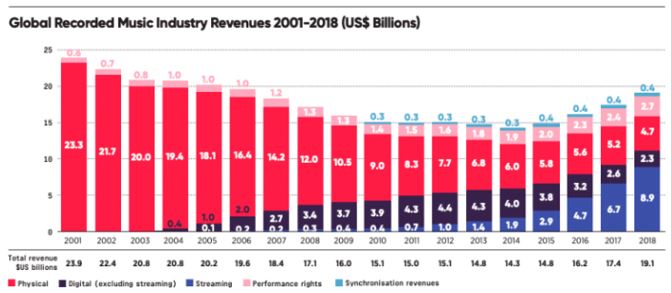
    This prompted some thought as to whether there were any analogous experiences in another industry. Well, it has become mainstream thinking these days that banking is facing a technological music with which it might struggle for relevancy. So, let’s look at the music industry. As recently as 2014 the death knell of the industry was sounded with global recorded music revenues collapsing by 25% from $19.6 billion to $14.3 billion since 2006.

    The revenues from physical music alone in 2006 were worth $16.4 billion. The doomsdayers were correct. Physical music revenues have fallen a further 75% but there was no such thing as “streaming” back in 2006. Now, music streaming revenues account for more than 50% of global music revenues. Here’s the comeback graphic:

    Graphic showing the global recorded music industry revenues 2001-2018 (US) Spark Crowdfunding blog

    So let’s hold that “streaming” thought for the banking industry. It is entirely possible there will be new channels for banks to deliver core services. We should be watching activity in the “plumbing” of financial services for clues to the future. Interestingly, this week we witnessed a very big fintech deal with Visa Inc agreeing to purchase fintech start-up Plaid for…. $5.3 billion.

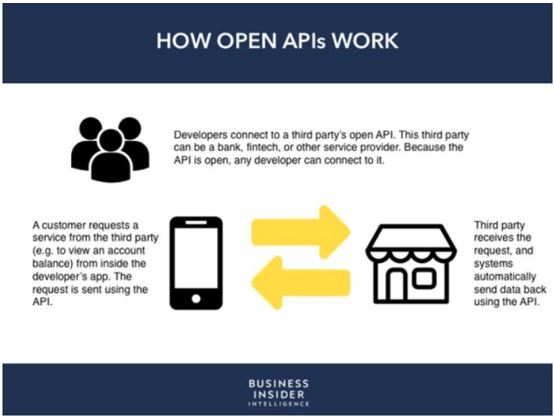
    For perspective, Plaid raised $250m in a Series C funding round barely more than a year ago at a $2.65 billion valuation. Plaid is a “plumbing” or “streaming” play as it allows consumers to connect their bank accounts to various 3rd party services from wealth manager robo-advisors to insurance. The technology which allows this connectivity is Application Programming Interfaces, or APIs. The following graphic shows how APIs work:

    How Open APIs work Spark Crowdfunding blog

    Clearly, Visa Inc sees the value of owning the plumbing which is connecting the latest fintech to traditional bank accounts. Note this deal does not preview a world where bank accounts disappear. Perhaps current thinking is too negative on the future of banking?  Music could be the inspiration, and ironically music featured in our last banking crisis. It was a rather unfortunate quote from a Citigroup CEO in 2007 who insisted “as long as the music (liquidity) is playing, you’ve got to get up and dance”. Well, the music stopped too quickly for Chuck Prince and many other failed banks.

    Technology is the current gloomy soundtrack for banking but “streaming” and APIs provide potential recovery and a future. Now, all we have to do to ensure planetary financial survival is persuade my brother to take up the guitar full time…..