Tag: fintech

  • Two Charts Telling The FinTech Story

    Readers of the latest Oireachtas this-is-not-an-Onion-headline could be forgiven for believing printing machines can command eye-watering prices. However, not for the first time, the reality outside the hallowed corridors of power and pecuniary pathos can be very different. Financial markets feature lots of hindsight moments but spare a thought for the shareholders of a company that developed the world’s first ATM machine in 1967 and presently prints almost one-third of the planet’s currencies.

    De La Rue is hardly a household name but it has been at the epicentre of the world’s financial system for almost 200 years. Sadly, this week the management of De La Rue warned that the company’s future was in doubt. That’s a far cry from the confidence expressed by management less than ten years ago when dismissing a takeover bid by French competitor, Oberthur Technologies. The protestations of “hidden value” by the target’s executives then make for distressing reading now.

    That bid in 2011 valued De La Rue at $1.5 billion. Even then, the trend away from cash payments to digital was well established. Stripe was already two years old and barely known but PayPal was thirteen years old, had 100 million active user accounts in 190 markets, and operating in 25 different currencies. Dear oh dear. Yes, hindsight would suggest the $1.5 billion valuation of the world’s largest cash printer was very dear. Here’s the share price chart to show how the rejection of the French bid cost shareholders very dearly.
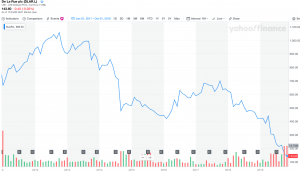
    Today’s share price indicates current value of De La Rue’s equity is just under $200 million. Arguably, management have told the market that there is a real possibility that valuation could fall to zero. Oberthur shareholders in France will no doubt reflect with wry smiles on another example of a disastrous UK decision to go it alone. However, elsewhere the story is much more positive for the UK in the world of fintech and investment capital flows.

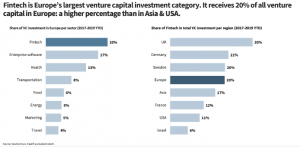
    A new report by Dealroom.co and Finch Capital reveals two very powerful trends in venture capital. Firstly, fintech is now the largest venture capital investment category in Europe. Second, on a global basis the UK has the highest percentage of fintech investment with 30% of its total venture capital funding directed towards fintechs. This is very encouraging for the UK financial sector’s future.

    Clearly, gloomy reports about the potential demise of London as a global financial centre post-Brexit are rather premature. It is also interesting that despite (or maybe inspired by) the parlous state of the region’s banks it is Europe that leads Asia and the US in channeling the largest percentage of investment into fintech. Here’s the chart telling a more positive UK and European fintech story.
    Joseph Schumpeter has written extensively about creative destruction being an essential component of capitalism. One suspects we are living that moment right now in finance and rather than just focus on the death of old franchises we should celebrate life being given to innovation and exciting new companies. In Spanish we might say “Viva La Vida” and at the same time heed the lesson of De La Rue and the destruction of wealth by complacency. Shareholders in traditional financial franchises still enjoying large market shares would do well to read the lyrics in Coldplay’s own ‘Viva La Vida’:


    I used to rule the world,
    Seas would rise when I gave the word.
    Now in the morning I sleep alone,
    Sweep the streets I used to own.
     

    Enjoyed this blog? Then why not check out our other great content by clicking here!

  • Five Fintech Trends To Watch

    Sesame Street aired its first episode fifty years ago this week but it’s all change these days. Of course, Kermit and Big Bird are still around, Bert And Ernie are still good friends but this childhood staple is now a pay-TV item courtesy of HBO. In the politically correct minefield that is the US today whoodathunk that paying for Sesame Street would attract the least social debate from that summary update. One must get used to change. And if we are going to reference muppets and commerce then it’s not a huge stretch to visit the topic of banking.

    It is no secret the banking sector faces huge technology challenges. Some banks will fail. Some will thrive. The differentiating factor will be their success in ‘fintech’, or more explicitly, the application of technology in financial services. The planet has its first billion customer financial services franchise, Alipay, but this business was built on technology not a traditional bank branch network. The opportunities in fintech are enormous as the arms race continues between old-style banks and new tech-savvy financial platforms. It will be fascinating to see how this battle plays out but here are 5 trends we are keeping a close eye on.

    1. Global fintech funding activity: Funding activity in Q3 2019 reached $12.3 billion according to the latest FT Partners report. That is the most active quarter ever despite the global economy slowing down. This tells us that fintech spend is a structural trend irrespective of economic cycles.
    2. Bank vulnerability: Consultants McKinsey have published a report saying that a significant economic downturn would put 60% of banks in a weakened state which they may not survive. McKinsey have called for the banking sector to “urgently consider a suite of radical organic or inorganic moves before we hit a downturn”. Banks will be making plenty of announcements in the coming months. It won’t be just HSBC and Deutsche Bank.
    3. Mobile meets banking: The partnership between Goldman Sachs and Apple on a payment card has attracted plenty of criticism of its gender-biased credit algorithm. Not a cool start but the trend is set. Mobile ecosystems are perfect for financial services.
    4. Big Tech wants to bank: The aforementioned 1 billion customer financial platform, Alipay, in China has not escaped the attention of other big tech players. It is no surprise to see reports of Google plans to offer checking accounts to consumers in partnership with traditional banks. Amazon are already doing credit cards and business loans so the lines between tech and banking are becoming very fuzzy.
    5. The war on cash: Surveys of consumers’ last 10 purchases reveal that a whopping 60% of payments are now executed without cash. In some countries like Sweden, that percentage can be over 90%. The shift to audit-friendly digital payments is very attractive to governments and regulators so expect further moves in the currency/cash arena. Facebook will struggle for credibility with its Libra cryptocurrency but there will be other players who won’t have to admit they will happily bank profits to publish false information. Banks may not have a great reputation but Facebook appears determined to win the race to the credibility floor. Currencies need credibility. New currencies, crypto or other, have failed that test so far.

    The good news for consumers and businesses is that fintech should deliver better services at lower costs. Consumers and costs are only moving in one direction. On that basis, this writer would actually suggest the McKinsey report is too optimistic. Muppet leadership and poor economics don’t need a recession to kill off more than 60% of banks. The trends are irreversible and the unloved status of banking means there will be no HBOs to save the muppets.


    Enjoyed this blog? Then why not check out our other great content by clicking here!