Tag: Google

  • D-Day Lesson For These Roaring ’20s?

    D-Day Lesson For These Roaring ’20s?

    The events of D-Day 80 years ago this week usually feature in the closing chapters of World War II history texts. My own current curiosity lies elsewhere, more focused on change and beginnings. Not the Reichstag fire, not Sudetenland, not Kristallnacht, not Lebensraum, not Poland. These were all events in the 1930s which historians agree shaped the outbreak of a global war. However, that decade of economic distress and social anger, whipped up by populism and propaganda, was probably inevitable. Indeed, it’s possible the seeds of war were sown much earlier. The previous decade known as the “Roaring Twenties” introduced huge economic, cultural and technology advances, but the 1929 crash and Great Depression which followed were the key catalysts for the global horror ahead. That lesson from history should not be forgotten. In fact, we should be on our guard. Welcome to the new Roaring ‘20s….

    It’s not just Reddit influencer, Keith “Roaring Kitty” Gill, reportedly banking hundred million dollar profits trading ‘meme-stocks’ like GameStop in recent days. There’s more than just a sense of giddiness about. Recall the 1920’s witnessed the arrival of mass-production and mass-consumerism as automobiles, electricity, cinema, radio and aviation made technology affordable to the middle class. And, then it wasn’t. Financial collapse and the implosion of banking leverage has been a feature of global economic cycles ever since 1929. It wasn’t a once-off in 1929. The global credit crisis in 2008-2009 proved that point, and then some. The critical factors in these financial earthquakes are excessive confidence and over-estimation of demand. First let’s illustrate confidence….


    • The S&P 500 benchmark index for global stock markets has not experienced a daily decline of 2% or more in 325 days (Source: Reuters).
    • The market capitalisation of a media company whose key ‘product’ and biggest shareholder is a convicted felon with presidential ambitions is currently over $8 billion (Source: Truth Social – just kidding!).
    • The private credit (lending) market has grown from $250 billion in 2010 to a whopping $1.7 trillion today (Source: Prequin).
    • This week AI chip maker, Nvidia, became the second most valuable private company in the world with a $3 trillion market capitalisation (Source: Bloomberg)


    Regular readers will know my views fall mainly on the optimistic side of AI. However, the odd sanity-check does no harm. Nvidia is a semiconductor manufacturer. In 2023 revenues generated by the entire semiconductor manufacturing sector globally reached $526 billion. So, for context, Nvidia’s market value is now six times the entire industry’s global revenue. I know analysts will talk about future AI spend, cash rich Big Tech customers and real demand, but there’s one other aspect to this growth story which is a little bit different with historical lessons.

    Legendary tech investor, Marc Andreessen, penned his “Why software is eating the world” essay in the Wall Street Journal in 2011 and there is no doubt software has embedded itself in every phone and corporation on the planet. The lovely thing about software is that it is embedded in an activity, generates recurring (frequent and relatively small) revenues and user stickiness/dependency is high. At a basic level software is code. It’s digital, not physical. Sure enough, coding platform giants Microsoft, Google, Amazon, Meta, Baidu, Alibaba etc. have dominated the league tables of most valuable companies in the world since the Andreessen prophecy. But, there has been a subtle recent shift in the value hierarchy.

    Consider that two of the three largest capitalised companies in the world are now HARDWARE manufacturers (Nvidia and Apple). Hardware is physical and brings an entirely different business model and a myriad of challenges including supply chain risks, materials, energy, sustainability, customer credit, consumer fashion, inventory management and capex investment. We don’t have a crystal ball in forecasting ultimate demand for AI but the semiconductor industry used to be known for its vicious cyclicality. With my risk history hat on, I’d venture there’s every chance this manufacturing sector will experience mismatches between supply and demand.  Of course, the automobiles and radios of the 1920’s might not resonate with today’s AI and technology enthusiasts. However, I’d highlight three other numbers which perhaps add to the “Roaring ‘20s” feel right now:

    Sport: The breakthrough of sports like boxing and athletics on a global scale was a feature of the 1920s but fans mostly followed events by radio. Now, it’s TV (or streaming). So, when basketball’s NBA is about to treble its broadcasting deal from $25 billion to $76 billion you do wonder about excess, and the projections of Amazon, NBC and ESPN? Maybe it’s the constant circling of private equity (PE) around US sport….? Latest data from Pitchbook research shows 63 US professional sports franchises have a PE ownership connection where PE involvement is allowed (NBA, MLS, NHL and MLB). Funnily enough, basketball (NBA) leads the way with two thirds of all teams in the league connected to PE.

    Securities: The 1920s saw the banks and their celebrity brokers on Wall Street begin to sell stock and bond securities to main street for the first time. Then came the ‘shoe shine’ moment in 1929.  Fast forward to today’s celebrities of the private equity universe and a recent FT report on that exclusive world. The headline-grabbing data point(and possibly harsh) suggests that, in the period 2010-2023, private equity funds raised $820 billion more than they actually returned to investors (Source: Prequin).

    Prohibition: Alcohol and gambling was the government target in the 1920s. So, remember when Bitcoin and its cryptocurrency ecosystem was dismissed by the ‘puritanical’ zeal of high street banks, regulators and law enforcement? Today, Bitcoin is trading above $71,000 and the total value of the crypto universe is $2.8 trillion. In fact, there are now billions of dollars invested in funds owning cryptocurrencies (ETFs) which trade daily on highly regulated public exchanges. Now, that’s a morality tale with a twist.

    Of course, the reference to Prohibition conjures up images of organised crime, judicial corruption, entire city governments ‘on the take’, high profile mob trials and flagrant violations of the rule of law. Couldn’t possibly happen again, could it?  Take that question with just a pinch of orange. On a more serious note, the erosion of the US rule of law is possibly a bigger threat in our immediate future than cyclical excess. Hopefully, the remembrance of D-Day sacrifice will remind those in power of their duty to call out faux (or Fox) ‘patriotism’. And, perhaps a read of the final speech in Charlie Chaplin’s The Great Dictator would help. Ironically, Chaplin’s own patriotism was questioned during a later shameful period (with my surname!) in US Congressional history. The Little Tramp’s words seem timely once again…

    Let us fight to free the world – to do away with national barriers – to do away with greed, with hate and intolerance. Let us fight for a world of reason, a world where science and progress will lead to all men’s happiness. Soldiers! in the name of democracy, let us all unite!    –  The Great Dictator (1940)

  • Warning: 3 Zones Of Interest

    Warning: 3 Zones Of Interest

    Nobody likes to be admonished. So, it’s an interesting commercial call to deliberately call out one’s customers. Even more daring to use the Holocaust as your messaging context. There are no adequate words (almost literally in many scenes) for Jonathan Glazer’s brilliant but upsetting Oscar-winning film, The Zone of Interest. The luxury dream life of Auschwitz commandant Rudolf Höss, his wife Hedwig and five children in a house right next door to the walls of the Nazi death camp is almost two films. One is seen, the other heard. The effect is extremely unsettling – you see nothing, but hear and know really evil events are happening.  However, director Glazer is using this notorious historical setting to deliver a present day admonishment. Like Hedwig Höss and her household, we hear things but choose not to ‘see’ bad things. However, you’ll be relieved to read I don’t plan a similar scolding…..but have some cautionary thoughts.

    It has been an interesting week for the planet’s hottest investment topic, Artificial Intelligence or AI. For main street consumers we are on the cusp of not just hearing about AI, but actually ‘seeing’ it in action. First, Google showed off the latest use cases for its AI model, Gemini, in search, education, video, workflow etc. All hugely impressive, and the intention is for Gemini to be embedded in Android powered phones soon. Not to be outdone, reports are flying around that Apple will do something similar with its iPhone and OpenAI’s ChatGPT model. As the tech-heavy Nasdaq index hits all-time-highs, it’s clear AI is going to move rapidly from being a corporate cloud story (Nvidia, Microsoft etc) to being a main street consumer revolution on our phones. However, the cloud and the powering of AI models is still entirely relevant to this move. Arguably, AI infrastructure is today’s gold rush version of  ‘spades and shovels’ which, for investors, means data centres are critical to deploying AI. You’ve probably already heard that. But, do you ‘see’ the reality…?

    My favourite trivia question of the week has been how many data centres will Microsoft open in 2024. Every answer I have received has been wrong, mainly in the low double digits. The reality, per a recent Financial Times article, is that Microsoft is opening a data centre “every three days”. Mind-blowing. These are $300-400 million facilities, not Starbucks cafes or KFC restaurants. And, that’s just one company. Here’s another – Echelon Data Centres. I had the pleasure of briefly meeting its owner, Niall Molloy, at the excellent Renatus Real Deal 2024 conference this week where Molloy was interviewed as winner of the “Deal of the Year” award. I was stunned to learn Echelon only started in the data centre construction business in 2017. Just 7 years later private equity giant, Starwood Capital,  has invested $850 million in Echelon and the business is currently valued at north of $2 billion. A super story of bold vision and world-class execution, but Molloy had a cautionary word about the pressures on global electricity grids as data centre campuses begin to match the power consumption of capital cities. The AI and data centre revolution is coinciding with an even bigger global shift – decarbonisation of our economies. The solution is more electricity power, and the challenge is the expansion of under-invested electricity grids. However, where there is risk there is opportunity.

    Ireland has been mentioned as one of the most challenged national electricity grids and many readers will have ‘heard’ the negatives of data centre power consumption. However, all data centres now have to create/install their own power supply and most likely the source will be renewable energy. That means huge investment capital is required because it is no longer just a construction project, but also includes incremental builds of electricity generation and water supplies. Hence, we should ‘see’ this week’s reports of Intel’s plans to expand its Fab34 semiconductor chip factory in Leixlip as a ‘wow’ moment. The plans are not new but the financing is ground-breaking. Intel was originally looking to spend $2 billion. Now, the number is $11 billion and global private equity player, Apollo Global, is being tapped as the solo partner on the project. The entry of global private equity into AI infrastructure funding should signal opportunity and expert eyes ‘seeing’ a way forward despite grid challenges. So, my second cautionary word after ‘seeing’ a consumer AI shift is that there are risks but also huge opportunities away from the actual technology. In other words, investing in power, storage, construction, critical minerals/materials, water, skills training/resourcing and other professional support services could generate top class returns.

    Clearly, private equity giants have spotted an investment opportunity. And, don’t forget Blackstone’s recent $1 billion purchase of a majority stake in Dublin-headquartered data centre engineering firm, Winthrop Technologies. Still, there’s one final cautionary tale; under-investment caused by political inertia or regulatory uncertainty. Exhibit A on political misrule is probably the UK. However, Brexit might be the go-to lament you ‘hear’ but the reality is a long-standing issue we wrote about in March:


    The Institute for Public Policy Research estimates the under-investment in business at $500 billion less than what other comparable OECD countries have invested since 2005. Public sector investment (infrastructure) was a further $200 billon below the G7 average. All in, this chronic lack of investment places the UK 27th out of 30 OECD countries.


    As regular readers will know, we have been quite positive about UK investment opportunities in recent months but this warmer view has been based on a contrarian prompt. Investors have been fleeing UK investments for years and Panmure Gordon published some startling figures in a research report from their Economics team this week. I would highlight three in particular:


    • UK public companies trade on a like-for-like basis (taking into account sector and growth characteristics) at a 17% valuation to comparable companies trading in the rest of the world (RoW).
    • The gap in valuation between the biggest UK companies (FTSE 100) who are globally engaged and the more domestically-focused smaller UK companies (FTSE 250) is at its widest in 20 years.
    • Funds focused on UK investing strategies have reported outflows for 82 of the last 97 months (Source: IA)


    Please ‘see’ this as the damage inflicted by chronic under-investment for almost 20 years. So, given our planet faces an existential threat without decarbonisation, the critical need for investment in global electricity grids is not exclusively an AI or data centre issue. Data centres are just a ‘wall’ blocking the bigger picture view . Without joined-up policy thinking, we risk ‘hearing’ about data centres but missing a planetary extinction event moving into irreversible territory. Don’t zone out on this one.


  • Countdown To Trend Exhaustion…?

    Countdown To Trend Exhaustion…?

    It’s day 96 of my 100-day no alcohol challenge, so who’s counting? I’m certainly not exhausted. Quite the contrary, but recently I have been prone to describe the benefits as “over-rated”. However, this proximity to completion does focus the mind on other things potentially ending in the world of business and investment. In particular, and by pure coincidence, in my day-to-day risk role I’m seeing some multi-year business trends begin to stall or enter new phases of growth. But, first let’s deal with a monetary shift.

    The consensus view on inflation and interest rates was that both were on a downward trajectory with central banks promising to cut rates if consumer prices were on track for a more manageable 2% annual growth. Europe seems to be on track, and the ECB just today indicated its rate cut cycle could begin in the summer. If anything, the Fed (FOMC) in the US was going to move before the Europeans, with money market traders heavily betting on a June cut. Ouch! This week’s US inflation report (CPI) caused some real pain for those traders as core CPI came in ‘hot’ at a year-on-year 3.8% rate of price increase. That’s way off a 2% level targeted by the Fed and means a significant reversal in monetary leadership as money markets now price an ECB cut in June, and the Fed to follow suit in September. That’s a big change in expectations.

    As always, the cost of money (rates) drives all financial asset prices and this ‘change’ in trend could have an immediate impact on currency markets. Watch the Japanese yen continuing to fall to a 34-year low versus the dollar and Tokyo’s stock market at a 34-year high. A Bank of Japan rate hike might be needed to stabilise its currency, but not necessarily cheered by stock market investors. In fact, the yen-dollar relationship is often used by traders as a proxy measure of ‘risk’. The trend in markets for the last 15-18 months has been ‘risk on’. In other words, asset prices have generally rallied as investor confidence grew. A shift to ‘risk off’ could hurt some of the higher flying assets of recent times. I note Goldman Sachs’ investment division is growing wary of US technology (“Magnificent 7”) but there’s another newer asset class which might also stall its impressive return to form.

    Bizarrely, this new asset class was designed and built to escape the scrutiny and influence of the all-powerful global central banks. I’m talking cryptocurrencies and Bitcoin which has quietly risen to its historic pricing highs of $72,000. However, rather than become independent of the traditional global financial system, Bitcoin has become an asset used by traders to increase risk exposure (buy Bitcoin) or reduce risk (sell Bitcoin).  So, if ‘risk on’ trends are due a pause or reversal, it will be deliciously ironic that decisions in an office in Nihonbashi, Tokyo, by Bank of Japan officials could drive the price action of cryptocurrencies like Bitcoin. However, cryptocurrencies are not the only technology asset on a serious upward trend but facing a few teething problems. The hottest investment topic on the planet right now is AI. However, like central banking, there seems to be an emerging divergence of fortunes…

    The remarkable feature of the AI investment boom, compared to crypto and metaverse, is the sheer scale of investment. It’s not just hype. Nvidia, the $2 trillion poster child of AI and manufacturer of the chips powering AI learning models, is booking real orders and reporting real 6-fold revenue growth in little more than 12 months. However, the future ‘winners’ in providing these AI services are less visible. Of course, Big Tech, with Amazon, Microsoft and Google leading the charge, are busy building or acquiring chips, talent, language models, data and technologies to win the AI race. This race requires vast amounts of investment capital and the smaller players are beginning to struggle. Once upon a time, London-based StabilityAI had raised $100 million at a $1 billion ‘unicorn’ valuation but has ended up with a CEO/founder departure, a Getty Images lawsuit, $99 million of debt and just $11m of revenues. A recent Forbes article suggested the firm had run out of cash to pay its Amazon(AWS) cloud computing bills. Clearly, the overall AI investment trend is intact but it is important to understand the nuances and risk-shifts within that structural story. Now, for an excellent example of that point.

    The simultaneous growth of global GDP and an ageing demographic has ensured a steady flow of pensions and savings capital into equity markets. This has resulted in long-run returns for investors in developed equity markets of 6-7% per annum over the decades. However, as the investment pool of retirees increases my little ‘risk radar’ is seeing a problem and a solution. Firstly, many readers will be aware of the Irish stock exchange(ISEQ) and the mighty London Stock Exchange (LSE) losing constituent companies to other major exchanges(NYSE, Nasdaq) or publicly listed companies being bought out by private capital. Only this week we were forced to ponder a scenario where the LSE could possibly lose FTSE 100 index titans, Royal Dutch Shell (move to a higher valuation US stock market listing) and BP (reports of a bid from Adnoc, Abu Dhabi’s national oil company). From a simple numbers perspective, the investment opportunity pool on a public market/exchange (LSE) is not just shrinking by hundreds of billions (in market capitalisation) but also potentially losing two of the 5 biggest income generators (dividends) for pensioners in the UK. That’s a problem. Now, the solution.

    Jamie Dimon, CEO of JP Morgan, in a recent CNN interview highlighted the same problem; at its peak in 1996 the US had 7,300 publicly listed companies. Today that number is 4,300. However, like AI, investment capital might just have shifted into a different corner of the same opportunity pool. In fact, it has. The number of US companies backed by private equity firms has grown from 1,900 to 11,200 over the last two decades (Source: JP Morgan). So, the solution for investors is to expand their investment horizons into private equity funds, private buy-out deals, EIIS investments etc. Until incentives are improved for companies to go public (regulation, quarterly reporting burdens, costs, PR etc), this public-private shift will continue and investors/pensions will have to find opportunities and income/dividends in private companies. Bluntly, the future is bright, but it’s private. And, it is no accident that Spark Private Portfolio investors are currently being offered an exclusive opportunity to expand their portfolios into an interesting private healthcare buy-out deal. Unsurprisingly,  the most valuable private companies right now are very much looking at the future – check out Open AI ($100 billion ) and SpaceX ($180 billion) – but what about that other Musk combination of new tech and transport, Tesla?

    Tesla’s 30% share price decline in 2024 might be perceived as a Musk-specific governance issue but the entire electric vehicle sector (EV) is encountering some growing pains. Check out these headlines:


    EV Sales Revved Up. Now Buyers Are Pumping The Brakes – Barrons


    Ford to delay rollout of new electric pickup and SUV as EV sales slow –   The Guardian


    China’s first quarter EV sales growth slowest in a year –  Reuters


    As the benchmark player, Tesla’s poor recent results and actual year-on-year sales decline in the US prompted the commentariat to quickly ask whether this was an EV market blip or something more structural. From this Dublin desk, and a country with an abysmal track record on timely infrastructure modernisation, it looks like the charging infrastructure (not enough charge points on routes) for the EV revolution is due some catch up globally. In particular, US consumer surveys continue to cite charging/range anxiety as a factor. More short-term factors probably include high interest rates (falling soon?), consumer expectations of continued manufacturer discounting and new super-cheap Chinese alternatives. This all sounds very familiar to long term observers of global durable goods manufacturing cycles, and with so many companies investing to win the EV landgrab, there will be casualties among manufacturers. Just ask the computer chip industry. In fact, that industry gives us a chance to conclude on a positive note.

    If anyone doubted the Bidenomics manufacturing revolution in the US, then this week was seismic. Taiwan’s chip manufacturing giant, TSMC, confirmed an expansion of its capital investment in the electoral swing-state of Arizona. The new TSMC investment number is $65 billion compared to an initial plan of $40 billion and will result in 3 chip factories being built in the state. Critically, a mix of US government grants and loans offered to TSMC will add up to a whopping $11 billion of investment incentives. That’s great news for Arizona, albeit TSMC might have to plan for male-only recruitment. It looks like the AI chips of the future will be built in Arizona, but the state’s Supreme Court is definitely searching for the past. In imposing a total state-wide ban on abortion this week, the state’s highest court had to travel back in time to revisit supportive legal text in the statute books from …..1864. Now, that is exhausting.

  • Fintech Is The Forgotten Network Card To Play

    Fintech Is The Forgotten Network Card To Play

    Brexit has delivered a win. There, I said it. Now, before you all head off to lobby on my behalf for a co-anchor slot on GB News with the Moggster, Bad Enoch and the Rishibot, there’s a distinct possibility I could be clutching at correlation rather than causation. However, the numbers – for a change – are real. According to KPMG’s bi-annual report, Pulse of Fintech, last year was a tough year for global fintech with funding levels hitting a 6 year low. The UK did not escape the bear market as its $12.3 billion of new investment represented a 34% drop. But….the UK remains, by far, the capital of European fintech and ranks second globally behind Silicon Valley. For global context (and Nigel Farage cartwheels), UK-based fintechs attracted more funding in 2023 than France, Germany, China, Brazil, India and Canada combined. That feels like winning to me but also prompted thought on networks and London’s global positioning in the financial ecosystem.

    London is blessed with an enormous talent and innovation pool thanks to centuries of being the dominant global financial centre and a time zone which straddles the Americas and Asia. This global positioning means there is a bigger and more realistic point to be made than Brexit. It is striking to me that when a country is in the middle of a political, institutional and trading meltdown there is a sub-sector of economic activity which defies the gloom. Fintech might have suffered investment flight in 2023 but the resilience of UK fintech in the midst of a national mental health event points to the recovery of a structural story we have written about many times before.

    It’s a network story but it has had to play second-fiddle to two much ‘hotter’ networks in recent times. Social network platforms (quasi-relationship processors!) are now bigger than sovereign nations – billions spend hours of screen time with Facebook, Instagram, YouTube, Tik Tok etc. And yes, Meta may have picked the wrong name but its share price is at all-time-highs. Also, this week we got another blow-out pulse-check on the hottest network story of recent times; Nvidia’s leading role and 400% y-o-y growth in supplying AI-capable chips for data centres. The computer/digital processor network now lives in the cloud powered by a rapidly growing network of data centres operated by Amazon, Google, Microsoft, Apple etc. However, this week we were reminded that the global financial network is the biggest beast of all and still searching for next-generation financial processing. In the vast field of fintech covering regulation, cybersecurity, analytics, flashboy trading, execution algos, insurtech and blockchain the Big Daddy of them all is payments, call it financial processing.  And this week, we saw some big payments developments.

    First, US bank Capital One announced it is buying Discover Financial Services in a $35 billion deal. At first glance this looks like Discover’s credit cards were the target and, indeed, the combined card operation would create the No.1 US credit card company, passing out JP Morgan and Citigroup. But, no, what caught my eye is that Discover also operates a payments network. Furthermore, Capital One CEO, Richard Fairbank, said that by adding Discover, he could start building “a payments network that can compete with the largest payments networks and payments companies,” a reference to Visa and Mastercard, which dominate the industry. To put the card deal in context, the $35 billion deal is not even a tenth of Visa’s $550 billion market value which is fast catching up on Nasdaq poster-child, Tesla. It’s not just traditional banks like Capital One eying up payments networks. Closer to home, there was an interesting private deal announced.

    UK digital bank, Monzo, is reported by the FT to be close to completing a £350m funding round with a £4 billion valuation. So far, so unremarkable. After a bit more reading, two things struck a chord. First, little Monzo now has a whopping 9 million customers, with 2 million coming aboard in 2023. That’s quite the banking network build and I wasn’t the only one intrigued. Apparently, the lead investor in this round is Google’s very own investment wing, CapitalG. Note Monzo is a banking service which includes payment processing but guess who is the processor behind Monzo? Stripe. And, Stripe wasn’t the only hot payments fintech I was reading about this week.

    When Mario Gabriele of the Generalist newsletter flags a disruptor company I usually pay attention. This week he did a deep dive on Australian payments fintech, Airwallex. It’s not in Stripe’s league – they raised $6.5 billion in 2023 –  but Airwallex has just raised $160m at a $5.6 billion valuation supported by 100,000 corporate customers (including SHEIN, Qantas, Canva) generating $80 billion of annual volume and $400m in revenues. The service offers payouts in 150 countries in 46 currencies, is executed by a couple of clicks and costs markedly less than traditional financial institutions. Once again, the issue of costs and tolls charged by traditional financial intermediaries looks like a key ‘win’ for fintech disruptors, and even traditional banks like Capital One. Check out the words of their own CEO, Fairbank (perfect name when you think about it);


    “Owning a network allows us to deal more directly with merchants rather than a network intermediary…..We create more value for merchants, small businesses and consumers and capture the additional economics from vertical integration.”


    That network word seems important. Arguably, there already exists a disruptive network and it’s already worth a trillion dollars. Yes, the blockchain-powered cryptocurrency, Bitcoin, traded back to the $50,000 mark in recent weeks and put the total value of the currency at $1 trillion. Of course, the recent decision of US regulators to allow funds (ETFs) invested in Bitcoin to trade on public exchanges like the NYSE is a further validation for this particular ecosystem. However, Bitcoin’s connectivity to the merchants, consumers and businesses which Fairbank covets is still very limited. What is not in doubt is the size of the global digital payments market which is, per Statista, going to exceed $15 trillion by 2027. The good news for fintech disruptors and start-ups is that reducing the “tolls” on these money flows can be a quicker route to profits than other sectors.

    In Europe, just two of the ten most valuable venture capital (VC) backed companies are making profits. Interestingly, both are fintechs –  Revolut(neobank) and SumUp (mobile merchant payment hardware). Clearly, route-to-profitability is an increasing focus of investors as higher interest rates bring tighter funding conditions. However, investor interest in payments networks appears strikingly robust. Check out the following recent funding deals:

    • UK-based Kriya secures £50m funding boost to supercharge B2B payments revolution – TechNews 180
    • Valar Ventures backs Berlin fintech, Monite, with $6 million – CB Insights
    • Colombian payments startup, Bold, secures $50m in Series C funding, led by General Atlantic – HUBFX
    • Payment orchestrator, Navro, raises $14m Series A from Bain Capital and Motive Partners – Dealroom


    The truth is that payments funding has ‘only’ seen a 30% fall in funding activity compared to wider fintech funding collapses of 50-70%. So, perhaps my Brexit blurt was too impetuous and the stronger logic attaches to London’s critical positioning in the payments ecosystem. There goes my GB News career but I’d rather you keep an eye on the forgotten third giant network – payments. And, now you know there are 15 trillion reasons why.

  • Get On The AI Bus Or Lose Business..

    Get On The AI Bus Or Lose Business..

    As somebody who has been watching, I’m still stunned. No, not that Rishi Sunak has his own GB News TV show and that the regulator, Ofcom, hides. Not even the fact that a former US President has thrown his NATO allies under the Vlad bus in plain sight of the forever fear-filled US media. Of course, I’m sure Poland and Estonia are terrified by Joe’s age or Hilary’s emails. Mind-boggling. However, on a brighter note there’s another bus which is enabling millions to work better. The AI bus is flying. Again, the mainstream media headlines run with AI fear but the flow of money and corporate action point to an extraordinary business revolution. The numbers are now simply too big for businesses and investors to ignore. Let’s do a brief tour of developments…

    This week kicked off with the staggering news that AI chip maker, Nvidia, has now achieved a $1.84 trillion market valuation which is higher than both Amazon and Google. To understand the expectations baked into that valuation, reflect on Amazon’s projected 2024 revenues of circa $600 billion. Then know that Nvidia is expected by Wall Street analysts do just one tenth of that revenue number. The 90% revenue catch-up is somewhere in the future but the future numbers look big, very big. The famous AI evangelist and rescued CEO of OpenAI, Sam Altman, is actively seeking funding for the development of AI chips like those of Nvidia. The word ‘funding’ doesn’t really do this exercise justice. It’s almost nation building. Sam reckons he will need $7 trillion, or the combined GDP of Japan and France. Sounds dreamy, but he’s not alone.

    Consulting firm, McKinsey, have published research suggesting the creator-focused application, Gen AI, deployed in 63 actual use cases could add $2.6 trillion to $4.4 trillion of economic benefits. Note these are actual business ‘use cases’. There’s more than dreaming going on here. In fact, Google has launched its Gemini workflow assistant to “supercharge your creativity and productivity”. Gemini is multi-modal which means it can create content using text, voice/audio, images and video. Its output can also be multi-modal. Think about a medical professional using an ‘assistant’ which can ingest a physician’s audio snippets/notes, X-ray images and MRI video scans. Also, we have moved past Chat GPT text prompts and free trials. Google is charging a $20 monthly subscription for its Bard successor, Gemini, to assist with email summaries, research, code-free data analytics and audio visual staff and customer education. Microsoft is also charging $20 a month for its Copilot AI Tool. Oh, and people and businesses really do pay for access to these AI tools.

    While OpenAI started out in life as a not-for-profit entity, it is amazing to see that the OpenAI business is already generating annualised revenues of $2 billion. The use cases might even surprise. For example, McKinsey analysis shows that 73% of fashion executives named generative AI as a priority for their companies in 2024, but only 28% have actually deployed AI so far. It’s not just business prioritising AI adoption. The investment world, particularly in our world of early stage funding is acutely aware of venture capital (VC) funds pulling in their bullish horns and nursing some of their existing investments out of sick bay. However, AI-related VC investment is bucking that trend. Check out these data points from CB Insights:


    • Broader venture funding fell 43% in 2023, but AI funding slipped by just 10%.
    • The US actually witnessed AI investment grow by 10% in 2023. Europe dropped by 29% and Asia saddled with a China confidence crisis cratered by 61%.
    • There were 22 AI unicorns (start-ups valued at $1 billion or more) created in 2023 which accounts for 31% of a global total of 71.
    • Generative AI unicorns, in particular, are hitting warp speed wealth creation mode. Gen AI unicorns reached the $1 billion valuation mark in a little over 3 years, or half the time taken by unicorns in other sectors.


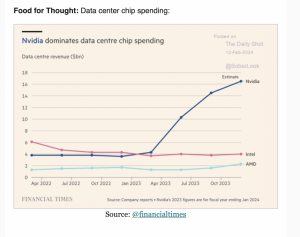
    However, investment doesn’t just happen at a company level, big or small.  If we consider Sam Altman’s funding estimate of $7 trillion, this investment capital will mainly be used to build facilities to manufacture those AI chips (fabs) and then house them (data centres).  I have written previously about the linkage between the explosive growth of AI and the race by Big Tech to build the data centres supporting their digital cloud businesses. As a proxy for this linkage, the Financial Times has highlighted Nvidia’s dominance in the area of data centre spending:


    Closer to home, the opportunity presented by data centres has attracted private equity giant, Blackstone, and prompted talks on a $900 billion acquisition of data centre construction leader, Winthrop Technologies. Clearly, the ramp up in investment activity on both a company and an infrastructure basis is signalling real AI revenues and real usage from businesses. And, it would be wrong to assume it’s part of the future. It’s now.


    • Forbes reckon 83% of companies deem AI to be a top priority in their business strategy.
    • MIT have said 9 in 10 organizations back AI to give them a competitive edge over rivals.
    • More than 50% of Americans use voice assistants for information purposes (Source: Edison)
    • Manufacturing businesses that utilize AI are performing 12% better than those using traditional methods only (Source: Microsoft)


    Remember this is AI in its infancy. That 12% ‘edge’ is only going to grow. For me, there is now an additional competition-critical question for every business to add to existing queries on the progress of their digital and sustainability transitions. Have you boarded the AI bus yet….?

  • Which Global Themes Are Flying?

    Which Global Themes Are Flying?

    Only one sleep to go until “Sixmas”, or the 6 Nations. Giddy. Another 28 days to go in the “Freezbrury” cold water swim challenge. Not so giddy. Such is the emotional ebb and flow of life but what do we make of the January investment emotional roller-coaster? Dare we say January was a game of three ‘halves’? The early days of the year saw markets puke, only for the next three weeks to see markets roar higher on familiar big tech AI giddiness, interest rate cut hopes and stronger economic numbers out of the US and Asia. Then, more fear. As always, the cost of money (rates) drives all asset markets. So when the Fed said “not so fast” on March rate cut expectations markets had another little tantrum to close out the month. Now, ignore all that trading noise. Let’s stick to longer-term thinking and revisit a few themes we flagged for 2024.

    First, we go big. The “Magnificent 7” big tech names have been driven to new all-time highs on the continuing AI theme with Microsoft hitting a $3 trillion market valuation for the first time, and AI poster-child, Nvidia, adding another 24% to its value in January alone. However, if you’re a Tesla shareholder, you might need access to the Elon Musk drugs cabinet to dull the pain of a January 24% crash in the value of the once biggest EV manufacturer in the world. As we write of potential regime shifts, I am reminded of a mandatory Thursday lunchtime every quarter in the naughties being glued to my desk and screen awaiting Nokia’s latest earnings report from Helsinki. The equivalent global pulse-check these days is one evening every quarter in New York when Microsoft and Google tell us how their cloud(AI) business is doing. This week the update was 30% and 26% cloud revenue growth respectively. Let’s just say theme intact.

    Now, go smaller. Well, not so small. On the Microsoft analyst call, Ireland’s very own An Post received a shout out from Microsoft CEO, Satya Nadella, as an example of a customer using its AI CoPilot Studio. This did prompt some thought about small companies and start-ups using AI. We probably don’t give technology and digitalisation enough credit for empowering founders and scaling up businesses over the past two decades. With a website, e-commerce applications, security/payment apps, and cloud hosting/workflow support, a start-up business no longer had to sink capital into up-front infrastructure costs but, instead, could pay software subscription fees (SaaS) to big tech and go to market quickly. This writer is just wondering could AI be an additional accelerant for start-up businesses? Maybe it’s not just me. Review site, Yelp, recently published data on a record 762,200 new US business openings in 2023, up 20% on 2022. Furthermore, US government data confirms the pandemic-inspired “entrepreneurship boom” is alive and kicking going into 2024.  However, some start-ups do need serious up-front capital….

    Check out our cleantech theme. The initial construction of huge EV battery gigafactories, renewable energy installations and decarbonised manufacturing (see steel, fertiliser, cement etc) requires billions of investment capital dollars. Encouragingly, we are seeing some really big funding deals get over the line. Sweden’s Northvolt announced a $5 billion debt financing round in January and a week later another Swedish name, H2 Green Steel, raised €4.5 billion in debt and equity. And, it’s not just cleantech start-ups being backed by significant banking syndicates. Despite the gloomy macro headlines, it feels like banks are feeling better about life in general. Note the record $188 billion of bond issuance by US companies in January and the index(ETF) which tracks the US Banks sector (XLF) hitting a 2-year high. No wonder Bloomberg was leading with a headline this week “The Credit Market Is Quietly Booming again”.

    Of course, in our earlier 2024 themes article we expected continuing stress in global real estate so it’s not all good news for banks. The slow-moving Chinese train crash of Evergrande finally hit its liquidation wall in the Hong Kong courts but the potentially more significant real estate news came out of Tokyo this week. Aozora bank shares plunged 20% after it revealed a $191 million loss for the year due to write-downs on its loans to the US commercial real estate (CRE) sector.  Meanwhile, back in the US, New York Community Bancorp reported a $185 million charge-off on just two CRE loans and watched its share price crater 38% in a matter of hours.

    Expect more of this but the key global credit swing factor will be China. For now, Beijing’s efforts to stimulate the economy is pushing capital into the wider Asian economy as the Chinese manufacturing engine ramps up activity. Evidence of early policy traction across Asia might be seen in the bellwether South Korean economy and its PMI survey of factory activity showing expansion for the first time in 19 months. Of course, with interest rate cuts firmly expected in 2024, central banks and investor want a “goldilocks” outcome rather than economies running excessively hot. We shall see, but in the area of healthcare it sounds like one form of excess has been whipped. More specifically, we are revisiting our weight-loss and healthcare/biology theme.

    In recent days Danish pharma company, Novo Nordisk, became just the second European company to  pass the $500 billion valuation mark. Its obesity drugs, Ozempic and Wegovy, have revolutionised the prospects of this 100-year old company and can only focus investor minds on further medical opportunities. We have previously highlighted the intersection of biology and technology as a theme so recent news from Cambridge University was intriguing. Scientists in recent weeks have published research on the successful re-programming of microbes to unlock new materials. This could lead to a whole range of innovative products from new drugs to enhanced carbon-absorbing materials. Here were our own thoughts on new materials and speed to discovery from a few weeks ago:

    “However, artificial intelligence(AI), probably the hottest investment theme outside cleantech right now, has just been used in conjunction with supercomputing to discover a brand new material which could reduce lithium usage by up to 70%……Microsoft and Pacific Northwest National Laboratory (PNNL) research teams whittled down 32 million potential material combinations to 18 promising molecular structures within a week. Incredibly, the whole discovery project took 9 months in a screening process that would typically have taken more than 20 years using traditional lab research methods. The new AI-derived material, simply called N2116, should prompt thought as to what’s possible in the world of medicine, agriculture, transport and construction”

    One final thought which is not so much a theme but is a necessity for these themes to accelerate; our investors always ask “where’s the exit?”. The text book response is that investor exits usually happen through a trade sale(M&A), buy-out (Private equity) or listing shares on public markets via IPO. Private equity house, Bain Capital, reckon global M&A activity of $3.2 trillion was down 15% in 2023 to its lowest in a decade. Meanwhile, EY’s global IPO report indicated listing activity was down 33% in value terms compared to 2022, and Goldman Sachs said it was the worst IPO year since 2016. The good news is that many advisory teams in the investment banks are quietly confident of an uptick in IPO pipelines for 2024. Indeed, the expected New York listing of Chinese fast-fashion play, Shein (ask the kids!), with a $90 billion valuation will be an early test of lift-off. The big global themes will still play out but juicy sales and exits would definitely confirm things are really flying. Also, and more importantly, confidence spreading outside the “Magnificent 7” to smaller businesses would be very good news.


  • Joe Biden’s Letter To Santa

    Joe Biden’s Letter To Santa

    If Joe Biden were to ask for just ONE thing this Christmas it would have to be a new writer or storyteller. I was reading various geopolitical scribes this week describe the poorly-polling Biden’s problem. According to the middle-ground commentariat, the Biden administration is describing an America with fantastic headline achievements on the economy but which the average American is not feeling on Main Street. Well, go ask the rest of the world. In fact, if Biden’s team were to follow through on their belief that “America is an idea, not a geography” then the solution to their messaging woes is staring right at them. Simply put, The USA has never been in a stronger economic or geopolitical relative position in its entire history. So here goes the report card….

    The latest GDP print for the US shows an economy roaring along at 5% growth rates. That’s the first time in decades the US growth rate has overtaken China and there’s more relative superiority to report. Other large economies at a European or Asian regional level are not seeing that growth and you will only find US-envy among German or UK voters currently enduring stagflation.

    US voters may not know it but international investors have already spotted US relative dominance. US stock markets clocked a stunning 8% monthly gain in a very rocky geopolitical November. The broader S&P 500 index is up almost 20% year-to-date and the tech-heavy Nasdaq indices have rocketed just shy of 50% this year.

    We always write about how the cost of money drives asset prices everywhere. A lower cost of money is good news and the US bond market has indicated a 0.75% drop in interest rates in the last few months. In real life terms that’s the equivalent of the central banks cutting rates by 0.25% three times in 6 weeks. It is US businesses and mortgage holders reaping that benefit, not any Europeans.

    Oil prices are back below $74 per barrel despite a Middle-East war. Of course, you won’t hear any Trump-cult Republican blowhard talk about the fact that US oil production is currently roaring along at 13.2 million barrels per day. Yep, that’s more than any country has ever produced in history. Not great for the climate, but a historic mark for US energy independence. Hold that climate thought….

    On climate and cleantech the US is leading the way in transforming the industrial base of America. The Biden IRA Act is pumping more capex investment into the US economy in this presidential term than in any of the last 3 decades. The nation is at full employment, but to paraphrase Jeff Daniels’ famous monologue in the TV series Newsroom, the average American and all Fox News viewers have “become fearful”. The daily dose of fear on US media is staggering – “deep state”, Qanon conspiracies, baby-snatchers, immigrant hordes storming the borders, lawless cities, race replacement theory, and on and on it goes. No wonder there are more guns owned (350 million) than the number of people living in this fear frenzied nation.

    It is clear that Biden’s story must feature the rest of the world. These are challenging times for the whole world, but somebody needs to tell the average American they are doing better than pretty much everyone else. The US is not perfect but it is definitely leading the planet on multiple opportunity metrics. Even better, the “America as an idea” vision is truly happening; eight of the US’s largest corporations including Microsoft, Adobe, IBM and Google have Indian-born CEOs. Incredibly, of the 700 US ‘unicorn’ start-ups with valuations above $1 billion, 100 of those companies have Indian founders. And, the beauty of nation power without borders is that it can drive activity globally.

    We already have supra-sovereign corporations with billions of customers from Google to Microsoft to Facebook. Others will want to follow from outside the US. We are now reading about China retailer Shein readying for a potential $80 billion IPO. Elsewhere, in the venture capital world Q3 funding activity globally was up 11% at almost $65 billion(Source: CB Insights). And, for those of us in the start-up universe, we are always watching exit activity. So, check out Q3 M&A activity in acquisitions which were valued at more than $100m each; deals in that $100m + category were up 38%. Also, it was interesting to see VC Q3 activity in retail fintech increasing at a 53% clip.

    Back in the US, inflation has been tamed and month-on-month price increases reduced to ZERO %. That will help Biden along with a crippled Russian military, a non-escalation by Iran or Hezbollah over Gaza, and a critical uptick in US consumer confidence. We don’t need Gen AI to write this story, albeit the US controls the 3 largest AI models globally through Microsoft(OpenA)I, Google (Bard) and Amazon (Claude/Anthropic). So, we will put that down as another Biden win too.

    In the interim, I will just wait for that call……or write to Santa myself.

  • Is There A Sequel To The FAANTAM ‘Menace’ ………..?

    Is There A Sequel To The FAANTAM ‘Menace’ ………..?

    I can remember working in Tokyo when the grounds of the Japanese Imperial Palace had an implied valuation greater than the entire state of California. Fun times and fantasy didn’t last. Sadly, only Hollywood can deliver entertaining sequels for decades. Financial markets are thrilling investors right now but I’m beginning to wonder whether we are entering fantasy territory? Let’s revisit Japan and California again.

    The combined value of just three Californian companies – Apple, Alphabet(Google) and Facebook – plus Microsoft, up the road in Seattle, currently exceed the value of the entire $4.7 trillion Japanese economy. We didn’t even need to include the $1.5 trillion Amazon in that calculation but bear with us. Here are a few other fantastic data points driving current markets.

    • These same five companies have delivered 35% returns to investors year-to-date. The next 495 biggest stocks have declined by 5% in the same period.

    • The FAANG stocks – Facebook, Apple, Amazon, Google and Netflix – recently hit a new 22% high as a percentage of the value of the overall S&P 500 index.

    • The Wall Street Journal reported this week that 78% of the S&P 500 returns over the past 5 years came from the technology and e-commerce sectors.

    • Tesla is not even included in the S&P 500 because, up until this week’s quarterly results, it had failed to make profits for four consecutive quarters….ever. At its recent $300 billion valuation Tesla is the tenth biggest company in the world by value. That’s $100 billion more than Toyota which sold 10.6 million cars in 2019. I kept the ‘0.6’ in that figure because Tesla didn’t even reach that mark and probably won’t this year either.

    Clearly, this concentration of euphoria in such a small number of stocks causes some unease and resonates with veterans of the TMT fantasy party of 1999. Perhaps we have seen this movie before or this is the original ‘FAANTAM Menace’ like its Star Wars contemporary which had its first release, ironically enough, in 1999 too.

    The FAANTAM stocks – Facebook, Alphabet, Apple, Netflix, Tesla, Amazon and Microsoft – are my own $7 trillion(!) creation but I’m struggling to see how any sequel could thrill investors to the same extent. Right now investors are enjoying the possibilities of these companies dominating their respective global markets for years to come. They could be right but do not be too surprised to see potentially darker sequels. Here are two potential contenders for an eventual trilogy:

    Inflation Strikes Back: Yes, some inflation is a good thing. But too much inflation and things go horribly wrong quickly. Why? Equity markets might look a little stretched but debt markets are incredibly vulnerable if interest rates rise to counter inflation. The IIF estimates total global debt will reach $257 trillion in 2020 as central banks and governments reflate a pandemic crippled economy. Global equity markets, for perspective, are valued at around $90 trillion.

    Revenge of The Dragon: China is being battered on the political front at the moment. UK moves on Huawei, Australian C19 fury, US consulate closures, Indian military skirmishes and Hong Kong protests are pushing China further into an isolated corner. The back lash from China could be very painful given their critical positioning in global trade. All the FAANTAM valuations assume singular global trade and technology platforms. Clearly, a world divided into two different trade and technology ecosystems is not a friendly one for equity valuations.

    Unlike Hollywood, there will be no great appetite to view those sequels.

  • Internet Trends of 2019 – How Did We Miss That?!

    Internet Trends of 2019 – How Did We Miss That?!

    There is one report worth a read every year. Veteran Wall Street analyst and technology investor, Mary Meeker, publishes an annual “Internet Trends” slide deck which has become a valuable source of information for business owners.

    It can be downloaded at www.bondcap.com and is just the 330 pages long(!)

    For those a little bit time poor we thought it might be helpful to flag a number of the key trends. Some of them might even have been covered previously in this corner.

    America is already great – the greatest it has ever been. Eight of the ten most valuable companies in the world are US owned and six of them are from the technology sector. As ‘Agent Orange’ in the White House threatens trade wars across the globe, readers should be mindful that only 30 years ago it was Japan who filled eight of those top 10 spots. Fingers crossed for the G20 meet this week!

    Technology is the new oil. The tech sector’s phenomenal ability to scale rapidly has ensured its position as the ‘fuel” to power almost all business activities. As recently as 1980 six of the ten largest companies in the world were oil companies. More than half the human population( > 3.8 billion) is now online but user growth is slowing to a single digit growth rate of 6%.

    The business future is East. The Asia Pacific region now accounts for 53% of global internet users with China and India combined making up a third of the global user base. However US technology companies are the leaders occupying 18 of the top 30 positions in the valuation tables for the global technology sector. China holds 7 of those slots but expect that to grow with its more than 800 million strong mobile user base!

    Advertising spend is chasing user behaviour changes. In 2010 US consumers spent 8% of media time on mobile with mobile ad spending at barely 0.5% of total ad budgets compared to TV time and spend at 43%. Fast forward to today and mobile user time and ad spend is at 33% compared to TV at 34%. Expect 2019 to witness mobile as the top recipient of advertising spend as time spent on mobile, estimated at a daily 226 minutes, will overtake TV at 216 minutes. Also, watch out for the likes of Amazon, Twitter and Pinterest to gain additional share of those advertising revenues from Google and Facebook.

    Humanity is returning to the caves. Early human communication was delivered via images/stories. Our brains are wired for images. Writing was a hack, a detour, but we are now returning to what is most natural. The principal delivery platforms of digital images, YouTube and Instagram, are gaining share of daily user time from Facebook and TV. Digital video consumption as a share of total watching time vs TV has doubled from 14% to 28% in just 5 years. Possibly more stunning is the fact that another image-based activity, interactive gaming, has become a social platform in its own right with total players now standing at 2.4 billion(!). Thank you Fortnite…..

    Video didn’t kill the radio star. Arguably, voice is on the come-back trail. Podcast usage has doubled in 4 years while the Amazon Echo installed base has doubled to 47 million US users in just one year.

    Banks beware. In the week that Facebook announces its own crypto-currency and Bitcoin rockets through $10,000 again the whole area of mobile payments is exploding. As European bank valuations plummet how would you value Alipay in China? This payment platform has more than 1 billion users and doesn’t just do payments; this is a full- blown financial services player providing loans, wealth management and insurance products to hundreds of millions of consumers and millions of businesses. Even closer to home, Monzo raised money this week pushing its valuation over £2 billion; and another European bank challenger, Revolut, has seen its user base double to 4 million in just 10 months.

    Cloud deployment is booming. Cloud service revenues for Amazon, Microsoft and Google are growing 58% year-on-year. The cloud has also been instrumental in allowing businesses scale up using ‘freemium business models’ – Gaming, Google G Suite and Zoom are good examples where excellent free user experiences drove subscriber revenues for additional functionality. Slack in the week of its successful IPO is also worth a mention as a business service following in the footstepos of Wix, Dropbox and SurveyMonkey. According to Mary Meeker we are only just getting started with freemium business models for business and the consumer. It was gaming which proved the model – just the 2.4 billion players later and yet we are only now writing about freemium models for enterprise/businesses. Perhaps those 330 slides of Internet Trends might be worth a closer look if you want to get a better picture of the digital future of your business……

    “Data is now fundamental to how people work & the most successful companies have intelligently integrated it into everyone’s daily workflow… Data is the new application.”
    Frank Bien – CEO & President, Looker, 6/19