Tag: Investors

  • The Most Bullish Equity Chart This Week

    Whisper it quietly but Santa might deliver a nice surprise for equity investors by year-end. The source of our optimism stems from activity in a sector upon which we usually hesitate to lavish affection; the banks. The headline news that US equity markets are touching all-time highs is hardly revelatory fare for even the most casual reader of the business press. Indeed, we are often wary of Mr Market’s delight in generating such gushing headlines to attract the maximum number of enthusiastic investors back into stocks before delivering crushing pain.

    Our cautious optimism this time is the return of the US banking sector to 12-month performance highs as captured in the following chart:
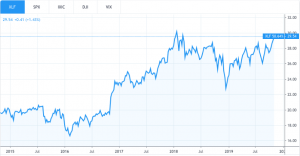
    What is worth watching over the next few trading days is whether the chart pattern can “break out” and move above previous highs set at the beginning of 2018. It is true that the US earnings season for corporates has been reasonably positive but the market is still very dependent on the technology sector. To put that concern in context we were struck by a stunning recent data point; the combined $2.3 trillion (yes) market value of Apple and Microsoft now exceeds the total value of all publicly traded companies in… Germany. The Teutonic manufacturing monster is just the 3rd largest exporting nation in the world and 4th ranked economy globally.

    The other way of expressing this hope in financial market terms is that the “value” style of investing is due a comeback after years of underperforming “growth” stocks fueled by the technology sector. Typically periods of value outperformance are rather short and very significant so we should find out rather soon if the market driver baton is passed on to the laggard value sectors like energy, mining, banks, etc. Of course, the financial press will quickly create a macro/geopolitical narrative to “explain” the melt-up in equities markets. Take your pick from the following two early favourites:

    • Potential de-escalation of US-China trade tensions.
    • China turning on the credit spigot again and the Yuan stabilizing.

    Of course, these potential macro developments are helpful but let’s be very frank here. There is really only one financial datapoint that counts; how much money(at zero cost) or liquidity is being pumped into markets by the central banks, led by the Fed.

    As a quick reminder, in 2018 central banks tried to remove financial markets from the monetary methadone clinic by phasing out quantitative easing(QE) and actually raising rates. The result was a very large negative bag of performance coal from Santa at the end of 2018.

    Now check out the policy u-turn by central banks in 2019 with the Fed cutting interest rates for the third time in recent days. By some measures global liquidity provided by central banks has passed the $75 trillion mark and it doesn’t look likely to stop for some time. See in the following chart how the S&P 500 is moving in lock-step with central bank largesse in 2019. Note this in sharp contrast to the pattern in 2018 when liquidity was drained and interest rates were hiked by monetary authorities across the globe.
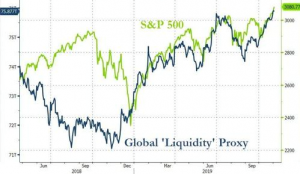
    The consequences of super-easy money in the longer term are for another article but, for now, let’s just say extra liquidity needs to find new investment homes; most likely they will be neglected laggard sectors showing ‘value’. Banks might be just the start…


    Enjoyed this blog? Then why not check out our other great content by clicking here!

  • 10 Reasons You Might Be A More Active Investor Than You Thought!

    10 Reasons You Might Be A More Active Investor Than You Thought!

    This week Bloomberg reported an epic shift in the world of US fund management. Investor assets invested in passive index-following funds have now surpassed those invested in the traditional active stock funds. And we thought the publishing of “One Up On Wall Street”  exactly thirty years ago by the first fund manager rock star, Peter Lynch, would bring active investing to main street!

    Cue an outbreak of hyperbolic commentary predicting the pending death of active management and the dangers of everybody ultimately being invested in the same things in the same amounts at the same time. The purpose of this article is not to debate the merits of investing in low-cost passive investment instruments but rather to highlight how savers can mistakenly believe they are not really actively managing their financial future.

    Here are 10 reasons you might be more active than you think.

    1. Positioning
    2. You will frequently hear people describing their financial planning as super-safe and therefore not actively investing in anything. Let’s be absolutely clear that keeping all your long term savings on deposit in cash at the bank or under the mattress is an extremely active bet. The bet, if one is trying to preserve your wealth, is that inflation will not erode the purchasing power of your capital over time. We would suggest with the benefit of history that this strategy is highly unlikely to deliver. Furthermore, any one-dimensional approach to investment is an extremely active bet – a 100% exposure to cash, equities, bonds, crypto, property, commodities, gold or any other asset class is an active bet.

    3. Timing
    4. There is a large portion of the investing population who invest in equity funds in bull markets and then step out when things get tricky. Unfortunately, that kind of active “activity” is more often than not wealth destructive. The fund giant, Fidelity, crunched the numbers for the period 1980 to 2018 and found that missing the best 5 days of market moves would cost you 35% of your overall returns. Miss the best 10 days and your returns are halved. Miss the best 50 days and you may have to work a lot longer than you hoped…

    5. Pensions
    6. It never ceases to amaze how passive people are about their pensions. Forget the actual investment strategy but just consider the impact of fees/costs over a very long period of time. We would strongly advise a very active discussion re fees incurred in your pension arrangements. Particularly in a low returns world. Think if you’d just invested in European stocks since 2015 you’d be actually underwater in a so-called bull market. But fees and in-fund hidden fees can seriously increase the pain over a long period of time.

    7. Plan
    8. In a previous article “10 Lessons in Wealth Management” we stressed the importance of a financial plan and then sticking to it. That is a sensible active undertaking. However, doing nothing but gathering assets/savings in a random manner over time is a very active but ill-advised route to wealth creation. The probabilities are more skewed towards wealth destruction without a plan.

    9. Retirement plans
    10. No, we are not repeating ourselves. Rather we are making the point that the targeted timing of your retirement(60,65, 67…) is an active bet and therefore necessitates more thought in the context of the range of instruments you will use to invest over the decades and the shift in risk appetite required as you approach the target retirement date.

    11. Life Policies
    12. These are active investments and again require advice which fits your overall financial plan.

    13. Insurance
    14. Not unlike fund managers who use different investment instruments to protect against downside risk – hedges in market-speak – your life will be peppered with a variety of hedging instruments related to your work/business, transport and property. An active approach to monitoring the fees and the actual cover provided by these insurance policies will avoid disappointment and real wealth destruction.

    15. Foreign Exchange
    16. You may over time have assets or income streams that are denominated in a foreign currency. Again be proactive in how that exposure is managed and avoid a mismatch between your domestic currency/returns requirements and the ultimate values of the foreign assets/cashflows. Doing nothing is, we repeat, a very active bet!

    17. Education
    18. No different from a business, there is an ongoing requirement to invest in yourself in a rapidly changing world. Education is a real investment that can deliver increased income and prolong your relevance in the commercial world. Be active includes maintaining an active brain.

    19. Death and Taxes
    20. We don’t need to spend too much time on the former but it is one of the two ‘certainties’ in life. So succession planning is a worthwhile proactive initiative. However, before then we’d like you to live a little and proper tax management/planning should be conducted in a very active manner. Whatever you might feel about investment fees the truly outsized costs or benefits of tax decisions render many active investment discussions moot. Attention to tax treatment of your investments can be considered an investment strategy in its own right. And it pays to be active.

    If you re-read the ten points again you will realise there actually is no such thing as a passive option. Doing nothing is simply being ‘active’ but probably resulting in wealth destruction. In fact, exactly the same point can be made with regards to the frenzied active versus passive debates consuming Wall Street right now. Time will ultimately show that passive strategies were more ‘active’ than originally intended, particularly if investors take fright along the investment journey. Remember those ten most important days(Fidelity) to stay in the market and keep our ten ‘active’ reasons in mind too. They do make a difference. You can too.


    Enjoyed this blog? Then why not check out our other great content by clicking here!

  • Wealth Management – 10 Truths from Years of Experience

    Wealth Management – 10 Truths from Years of Experience

    The wealth management industry in Ireland is consolidating rapidly with recent deals announced or imminent involving the likes of Investec, Goodbodys and Merrion.

    This writer spent three interesting years working with a local wealth management division and would argue that the strategic change being forced upon the wealth management providers should also be replicated at the investing client level. Having witnessed thousands of interactions between clients and their advisors there are a number of outstanding truths which need to be emphasised for clients to get the best out of a wealth management service.  My top ten truths would be as follows:

    1. The Plan: For a long term sustainable relationship which will deliver optimum returns the client and advisor must agree a long term plan. And, then stick to it. In order to generate returns clients must stay exposed to market risk over the long term and avoid emotional short term chopping and changing of portfolios. Market volatility and emotions are a fact of investment life. The value of an advisor is to keep the client “on plan” and  provide reassurance that the investment portfolio is positioned long term to benefit from volatility and the compounding effect of growing income streams.
    2. The Fees: High fees will eat into the long term returns to clients. Total fees will be a combination of advisory fees and execution fees.  The advantage of putting in place an investment plan is that this will reduce turnover and additional execution fees which should be negotiated aggressively. The real value which is worth paying for is the advisory side where wise experienced counsel at times of turbulence will ensure the investment plan is followed. In a previous article we have highlighted that Fidelity’s best performing clients were those that actually were dead. Dead people don’t panic or trade.
    3. Trading: Clients should be absolutely sure they are an investor for the long term. Trading or timing the ebb and flow of market volatility is incredibly challenging, even for professionals. Time and income compounding are a client’s long term secret weapon. Timing trades for optimum exit and entry in the markets is expensive and in the vast majority of cases wealth destructive. Check out the disclaimers on most of the financial trading platforms and they will warn that circa 75% of clients will lose money. So, to be clear, that’s not a return on your capital – that’s not even a return of all your capital.
    4. Portfolios: It was soul destroying to listen to clients discussing their portfolio of 20 odd stocks with an advisor and seeking recommendations as to potential new stocks/ideas to buy and then which poor performing stock to sell and make room for the latest greatest stock idea. Let’s be absolutely clear that this kind of portfolio is not fit for long term investment purpose. It is not sufficiently diversified and therefore is prone to unnecessary emotional turmoil and decisions on the hoof. Academic studies would suggest a portfolio of a minimum 35 instruments will achieve 90% of diversification required and even then I would suggest the random assembly of 35 securities is sub-optimum from a cost perspective. From an advisor’s perspective it is also a regulatory nightmare, as any unique underperformance of this portfolio versus the firm’s recommended model can invite scrutiny and potential litigation risk.  For the vast majority of clients the optimum way to access the market is via funds or ETFs.
    5. Securities: As per the previous point there are real cost benefits to leveraging the market purchasing power of a fund or ETF. They can trade for almost no cost but individual stock trading will be far more costly to a client. Remember the key value is the plan and the advice. The instruments used to achieve the plan should be as low cost as possible.
    6. Asset Allocation: Often times I would hear clients query why they should pay advisory fees for a portfolio that uses instruments which passively mimic the market’s moves. Clients rightly should pay fees that are appropriate to an active management service but clients should also be aware the use of passive instruments can drive a very active strategy/plan. Think about the long term differences in performance of bonds/equities, Europe/US equities, Commodities/Real Estate, Startup Investing and one will understand that cheap instruments can power a very active strategy. The biggest driver of performance over time will not be a clients’ exposure to single stocks. The much more important consideration in terms of delivering the plan will be keeping asset allocation on track and rebalancing same periodically.
    7. The Advisor: A really good advisor will put in place a plan/strategy which can be explained easily and reviewed regularly to reassure a client that the portfolio constituents are delivering in line with benchmarks, comparable products. A really really good advisor will know that the value of a client relationship is long term retention of that client. So, a really really really good advisor may reward a client with his/her loyalty and adherence to the investment plan by lowering advisory fees in say year 4. For real thought leadership in this area check out the fast growing US wealth management firm, Ritholtz Wealth at ritholtzwealth.com
    8. The Family: A client who has a long term investment plan is more likely to share this information with family and offers the potential of a multi-generational relationship with the advisory firm. If a client is uncomfortable sharing investment arrangements with family it is often because the financial goals and plan are not robust. A client should reflect on that, and certainly before putting a succession plan in place.
    9. Risk Free: There is no such thing as a risk free proposition/product. Even if there was, the logical real returns outcome would be zero(or worse with inflation).  We often read reports of dubious investment schemes promising super-normal returns. However, there are real risks associated with supposedly low risk products in the current market. By an unusual conflation of circumstances the regulators/monetary authorities in current financial markets have created a vast market of supposed risk-free instruments (government bonds) which currently have negative yields i.e. the investor loses a small amount of money each year to own the bonds. Every wealth advisor is in the bizarre situation right now where these government backed securities are considered/instructed by the very same regulators/monetary authorities as low risk , much lower risk than say equities. For long term investors, a portfolio of these instruments would be a sure fire route to wealth destruction. Welcome to the bizarre world of Quantitative easing (QE) but clients should look to the long term and an investment portfolio’s ability to generate compounding income.  The only payments a client should make are to a good advisor.
    10. A prospective wealth management client should forget about the last 8 Truths if the 1st Truth is ignored.

    Finally, Investors who may be interested in supporting new Irish start-ups can view equity crowdfunding investment opportunities on the Spark Crowdfunding website here.