Tag: Markets

  • When Words Are Definitely NOT Our Bonds…

    When Words Are Definitely NOT Our Bonds…

    There’s only one thing sicker than an Irish parrot outfit this morning. That’s the global bond market. The biggest bully of them all is sick of the nonsense. Not just the front-running of the US President’s social media posts. The Financial Times rightly flagged this week the gob-smacking scale of corruption and ‘insider’ trading going on close to the Oval Office but, in real financial terms, the pricing reactions of equity and oil markets to Trump’s Monday TACO were relatively muted. Of course, oil prices dipped below $100 earlier in the week but they’re back above $110 now. Similarly, the S&P 500 spiked for a day but it too is back slightly below Monday levels. Arguably, Trump’s words have been losing credibility since his first TACO retreat on tariffs in April last year but there’s a much more dangerous aspect to this credibility failure now. Truth has officially fled the higher echelons of US institutions and that impacts the biggest contracts of them all, United States Treasury bonds’ (or IOUs) credit worthiness with the rest of the world. Here are the headlines you’re not reading…


    • The yield on the US 10-year Treasury bond has deteriorated/risen by 13.5% (in yield or cost of money terms) since the Iran war began.
    • The yield on the US 20-year Treasury bond has deteriorated/risen by 11% in the same period (25 days!!).
    • The yields on US Treasuries are used to price almost everything so the average cost of a mortgage in the US is now at a 7 month high despite job creation being at a multi-year low.
    • It’s not just the cost of US assets. The global disruption caused by the Iran ‘operation’ has driven Japanese government bond yields up by 16%.
    • UK bond yields above 5% are the highest seen in 20 years.


    The price moves above are the ones that really count. And their message is very clear: the damage done to energy infrastructure and global supply chains is inflationary. The bond traders don’t believe a word of what is coming out of the White House and Pentagon propaganda machines. The opening up of the Strait of Hormuz is dependent on Iranian cooperation and the ability of logistics companies to commit their ships and crews to a safer and insurable environment.  At current levels of reduced shipping activity, the world is losing 11 million barrels of oil every day, as well as numerous other critical distillates like ammonia, diesel, helium, urea etc.  The key point is that bond markets do not “price” temporary cost spikes or supply squeezes. The bond market is explicitly contradicting the Trump regime and suggesting longer-term disruption. In fact, the French government have laid out the following observations:

    • 30-40% of Gulf oil refining capacity is destroyed.
    • That is the worst energy infrastructure destruction since WW2.
    • Full repairs could take 3 years.


    Thanks Donald. Actually, you don’t need to thank him. Speaker of the House of Representatives, Mike Johnson, went full North Korea at this week’s National Republican Congressional Committee fundraiser by presenting Trump with a new award. The Guardian reports:


    “The president has done so much for the American people and we want to honour him, in some small way, some token of our appreciation for his leadership,” said Mike Johnson, the US House speaker. “So, tonight, we have created a new award.” Johnson then introduced the “America First” award, made up of a golden eagle statue. “We could think of no better title for what that is,” said Johnson. “That’s this beautiful golden statue here – appropriate for the new golden era in America.”


    Idolatry and empty words. Asia might have other words right now. Latest headlines suggest crisis:


    Pakistan is reducing government working hours to save energy

    India is diverting gas from factories to homes

    Philippines declares a national emergency

    Japan to temporarily lift coal power plant curbs over Hormuz crisis


    Clearly, bond markets are looking East and not West for the true story. Indeed, it was striking how most commentators and traders earlier in the week were looking to Tehran to verify whether the US President was telling the truth about ‘negotiations’. Yes, an autocratic theocracy is now more credible than the leader of the ‘free world’.

    It’s a very strange world, but I suspect the bond market will have a very big say about how events unfold in the Middle East from here.


  • Don’t Get Angry, Get Ready….

    Don’t Get Angry, Get Ready….

    I was right. The first of my predictions for 2026 was spectacularly on the money. Sadly, it won’t make any of us wealthier given its focus on noise rather than direction. To refresh memories, the final words in my last article, Themes and Dreams For 2026, were as follows: “I’ve a feeling I won’t be short of writing material in 2026.” Little did I know there would be a year’s worth of material in just the first 10 days of 2026. Where do we start?

    The US is celebrating its 250th birthday by re-branding as an exploration company with an army (hat tip George Carlin) as Venezuela is ‘acquired’ and ‘takeover bids’ are lined up for the Panama Canal and Greenland. Back at HQ, the Boss re-asserts control of executive salaries and cash flows in the company’s defence supply divisions while promising a 50% expansion of investment ($1 trillion to $1.5 trillion) in its Business Development unit, previously known as the Department of War, and before that, as the Department of Defense. Meanwhile, the company’s traffic stop management division has secured immunity from regulatory or criminal oversight of its shoot-to-kill (or stop) policy on a nationwide basis, not just in Minneapolis. Of course, none of these revolutionary business initiatives can happen without funding. The company’s Treasury unit has set up overseas bank accounts to deposit proceeds of its newly acquired Venezuelan oil unit. In the interests of tax efficiency these bank accounts will be overseen directly by the Boss, and will not be consolidated in the parent company accounts. But, of course. However, US Inc is not the only company turning to oil….

    It is probably more accurate to say some companies are breaking with a seismic global shift to electric power. Again, it’s American-sourced exceptionalism. This week General Motors (GM) has followed Ford and abandoned its move in to electric vehicles (EV). These recent investment write-offs amount to $7 billion and $19 billion respectively which will hurt. But… that might not be the end of the pain. The train, or car, has already left the station. The Electric Age, per the superb Noah Smith, is here with 25% of cars purchased in 2025 of the EV variety. In many Asian and a few European countries that penetration rate is through the 40-50% level. China leads the world in the entire EV technology stack and have focused their attentions on battery production, manufacturing scale and grid expansion (solar). Fewer moving/motor parts, efficiency and superior performance are the current and long-term edge for EVs which will kill the internal combustion engine (ICE). Writer’s note: Be careful how you say or ‘weaponise’ that acronym these days.  All is political these days rather than factual which highlights why the US is making a fatal error on oil over electric. Noah Smith writes:


    The main reason America is missing the EV transition is that we’ve insisted on thinking of EVs in terms of climate — as a “green” technology whose purpose is to save the environment, rather than a superior technology whose purpose is to save you time and money. Trump canceled EV subsidies because he associates them with the environmental movement and the political left.


    It’s not just electric vehicles(EVs) experiencing their electric break-through moment. EVs share the same components as drones, trains, cameras, phones …..and robots. Just this week at the massive CES 2026 conference in Las Vegas, Nvidia’s Jensen Huang didn’t even blink when asked how long it would take for humanoid robots to match human-level ability. “This year”, he said. Guess what – those robots run on many of the exact same components which go inte EVs. Think batteries, power/motor electronics, sensors, software…..and AI. Clearly, in the AI piece of the assembly package, the US is perceived as the global leader. However, even AI and its support infrastructure is inextricably tied to electric power. And, before you say “but, but, but… the Venezuela oil reserves”, get ready for more non-delivery from the “stable genius” back at HQ. Venezuela currently produces less than a million barrels of oil per day. It’s like a rounding error of less than 1% of global oil production. Yes, that production level can grow but please note the lack of announcements from US oil company executives about investment plans and potential commercial negotiations with Venezuela’s 5,000 plus generals and regional warlords. While the Department of War was planning ‘business development’ in Latin America, China built more solar power capacity than the rest of the world combined in 2025. For perspective, that additional solar capacity of 380GW built in 2025 equates to 5x China’s total existing nuclear capacity (58 plants). Get ready or get digging on two fronts.

    First, we have written a lot in 2025 about the asynchronous explosion of excitement and revenue projections for the AI world and the mining sector. At certain times in 2025 one AI company, Nvidia, was worth 4 times more than the entire publicly listed mining sector. Get ready for a change. Gold, silver, platinum and copper prices have soared which has finally juiced the risk spirits of mining sector executives. We said the sector needed a big deal. Well, global giants Glencore and Rio Tinto are talking a megadeal again with a copper focus (yep, all that electricity) and a $260 billion valuation. Metals of course in earlier times were the basis for currency. In time, central banks became the back-stop or guarantor of currency but we might have to dig again.

    The global reserve currency, the US Dollar, lost almost 10% of its value in 2025. In isolation, this is not unprecedented. In fact, the Trump regime are quite keen on a softer dollar and lower interest rates for trade deficit and investment reasons. However, we must get ready for a further assault on institutional independence in the US. The current Fed Chair, Jerome Powell, is due to leave his post in May this year. The new appointee (apparently already decided by the Boss) will be expected to cut interest rates dramatically to keep Trump happy. However, the potential unintended consequence of this action in the context of a $40 trillion US national debt is loss of credibility for the Fed and its ability to prudently manage that debt, and the currency. Hopefully, the bond markets are more effective than Russian or Chinese radar systems in spotting and thwarting that assault on Fed and dollar credibility. A final word on markets and pensions.

    Those of you reading your pension updates/reviews for 2025 might be underwhelmed by the performance. Before you get angry, I would recommend a read of Terry Smith’s own review of his $20 billion fund which underperformed in 2025. As always, my former boss writes superbly and highlights some key factors driving investment markets these days. Terry always sticks to the basics and this might well be a theme for 2026. The thoughts above should ready minds for investment opportunities in electrification, real assets, financials, mining and assets located outside the exploitation company, US Inc, formerly known as the United States of America…..

  • Is This The End….?

    Is This The End….?

    Let’s start with the easy one. I’m A Celeb 2025 is almost finished. The more tricky version of this headline question might relate to the Epstein files or even the filing of war crimes charges in The Hague against US Secretary of War, Pete Hegseth. Not any time soon me thinks. We could ask Sleepy Don but he might become angry – about the sleepy bit, not the war crimes or paedophilia. Actually, the question most asked in recent weeks is about the end of the AI boom. I asked my own excellent AI ‘friend’ Claude (courtesy of Anthropic) about ‘bubble’ mentions in the media and even he agreed in his remarkably comprehensive market summaries of public and private markets that the AI bubble question is occupying investors’ minds. Mine, not so much. More on Claude later, but first a historical perspective. The last technology boom in 2000 did indeed end in a bust but generalisations on technology can be misleading.

    Back in 2000 we should remind ourselves of the telecoms companies racking up massive debt obligations to acquire mobile spectrum licences and build out fibre/internet networks. Then there were the infrastructure suppliers like Ericsson, Nortel and Cisco dependent on those telecoms, internet and wireless expansion projects. Then the projects stopped. A possible over-simplification by this writer, but a combination of over-build and debt pressures slowed activity and cratered the valuations (growth expectations) of the leading infrastructure players. For illustration, Cisco was trading on a price/earnings multiple of 200x in late 1999. Twenty five years later the Cisco share price has finally recovered to within touching distance of its $80 high in 2000. However, one must make a distinction between the infrastructure plays and the tools/applications which were built on those over-priced networks….

    The Nokia phone in my year 2000 pocket didn’t end up ruling the world but Apple and the mobile internet did. Similarly, Google was just 2 years old at the time and wouldn’t IPO until 4 years later, the same year as TheFacebook Inc was born. Mobile networks enabled commerce (Amazon) and communities (social media platforms) to flourish and generate enormous wealth. Readers might be now detecting a similar pattern with AI. The race for computing power (in 2000 it was networks) is an infrastructure story but investors must not lose sight of the applications of AI and the business models possible (Amazon was an online book store once). The tools like Claude, ChatGPT and Sora are really only in their infancy. The infrastructure story is driven by GPU/TPU chips (Nvidia), cloud computing, hyper-scale data centres and energy. And it’s possibly infrastructure again where risks are building. The CEO of IBM, Arvind Krishna, in recent days put some numbers on those risks.

    Krishna cited a data centre power consumption estimate of 100 GW which at current costs would mean an $8 trillion capital expenditure in the next few years. Now, for the wet blanket of capital reality. That ginormous $8 trillion spend would need to earn profits of $800 billion just to pay the interest/cost of that capital. Yep, that’s stretchy but get ready for the other reality. This infrastructure isn’t piping, fibre, railways or copper which lasts for decades and is depreciated gently over time. The chips which currently power Nvidia’s $5 trillion valuation and sit inside all these data centres could become technologically obsolete within 5 years. Arguably, at current innovation/evolution rates that timeline is too optimistic. Imagine having to replace all your chips every 3 years… ? That should make creditors to these huge data centre projects a little queasy.  The International Financing Review summarized the massive acceleration in borrowing as follows:


    An unprecedented splurge from companies at the forefront of the AI boom that has left banks and investors potentially on the hook for billions. Alphabet, Amazon, Blue Owl Capital, Broadcom, Oracle and Meta have between them issued US$120bn of corporate bonds since September – and are raising another US$38bn in the loan market. The debt binge shows no sign of abating, with JP Morgan predicting US$300bn of bond issuance next year – and US$1.5trn by the end of 2030. Another US$2.3trn could be raised in equity, structured finance and private capital markets over the next five years, as hyper-scalers tap every available pocket of capital to finance the US$5.3trn of investments into AI they are expected to make”


    Before everyone runs for the hills, we need to be mindful of some very positive starting points. These technology giants tapping the debt markets in most cases are swimming in cash, have dominant market positions and are generating prodigious annual cash flows of almost $700 billion. These are not the fragile telecom balance sheets of the TMT bust in 2000. Of course, OpenAI, sits in the middle of that famous Financial Times graphic showing $1.2 trillion of data centre projects. In my personal view, OpenAI is the weakest link but that could take years to play out. The harsh truth for all investors is that we don’t really know who will win the foundational large-language-model (LLM) race. Google’s Gemini 3.0 seems to be winning this month and did anyone notice Google share price is up 67% year-to-date? Yep, and my Claude’s parent company, Anthropic, is looking to IPO at a $350 billion valuation. These are very early days. Just ask Nvidia. Actually, don’t. They are saying nice things about almost everyone because all are prospective customers. But….. as always watch what a company does, not what it says.

    Nvidia made a $2 billion investment in chip designer, Synopsys, this week. This is just the latest move by Nvidia in what can only be described as a deal spree. In 2025 alone the company has backed 77 equity investments in start-ups, as well as making 5 outright acquisitions (Source: CB Insights). Let’s just say it looks like Nvidia is hedging its AI ‘winner’ bets. Indeed, the ‘AI infrastructure’ bubble fears run the risk of missing the true lessons of the TMT bubble bust of 2000. ChatGPT might be today’s Nokia but the monthly user statistics tell another ‘mobile’ story. ChatGPT is used by 800 million people each month. Gemini is fast catching up with 650 million devotees and Microsoft’s Co-pilot has 200 million monthly users. The market, business or individual, is already converted. That’s the true investor opportunity.

    Meanwhile, there’s a bigger story brewing at the other side of the world. Arguably, we really do need to see that story end very soon. More next week on why troubles in Japan’s bond market REALLY scare me……

  • Have You Checked Your Pension’s American Assets Recently?

    Have You Checked Your Pension’s American Assets Recently?

    I’m nervous. This won’t win me a Nobel Peace Prize, a Pulitzer or a Green Card but it must be said. The United States is the richest, most successful and most powerful country in the world. On a global basis, we owe the United States on many levels, be it culture, sport, technology, education, medicine, defence, investment capital, tourism or friendship. Closer to home, our fortunes and miraculous recovery from a Troika bail-out are inextricably linked to US commercial supremacy. The vast majority of our pensions reflect that supremacy by holding significant amounts of US debt/bonds or stocks. EVERY pension should have exposure to US assets but risk radars are flashing red for a seismic investment shift. Behind the headlines and in the critical plumbing of the global financial system, there is increasing evidence of a global ‘exit’ from the US. That might sound odd and inevitably the counter view will cite current data which paints a record-rosy picture.

    US and global stock markets are regularly hitting record highs in recent weeks. However, the US stock markets have been clocking up vastly superior returns compared to other major bourses in the 16 years since the GFC. This outperformance of US assets has resulted in extreme levels of US weightings in global indices/benchmarks which your pensions are attempting to either track or beat. A recent Deutsche Bank research note flagged IMF data showing US equities now accounting for 67% of Bloomberg’s World Index. That’s quite the weighting for a country which represents 15% of global GDP. Go back 20 years, and the US actually accounted for a higher 19% of global GDP.  In 2005 US equities made up 51% of the same Bloomberg World Index. For context, Europe(EU) accounts for 12% of global GDP and 14% of the Bloomberg index. Of course, the big driver is technology stocks where the 6 top US tech companies are currently valued at $20 trillion, or more than the GDP of China. The AI/cloud (AI) revolution might be the more specific driver but is this hiding a bigger picture?

    According JP Morgan’s always interesting Michael Cembalest, “AI related stocks have accounted for 75% of S&P 500 returns, 80% of earnings growth and 90% of capital spending growth since ChatGPT launched in November 2022.” AI is indeed the gift that keeps on giving for US markets. But there’s giving and then there’s giddy. I’m not sure if anyone can keep up with tech companies trying to out-do each other on the size of their investment spend announcements. It has clearly been noted by the tech C-Suite that, if you announce huge investment spend on chips, data centres or any AI related infrastructure, your share price and stock options go up. Microsoft says $100 billion, Google says $85 billion, Alibaba says $53 billion and Nvidia thinks they’ve a better twist. This week Nvidia promised to invest $100 billion in ChatGPT parent, Open AI. Excellent news but where’s the $100 billion going? Ah, that would be mostly going back to Nvidia whose AI chips will be used in Open AI’s data centres. Yep, readers might see the Baldrick-esque possibilities around circularity and vendors(Nvidia) financing customers like Open AI. Anyway, investors seem optimistic, for now. Moving away from AI, and the risk of over-investment, there’s a bigger worry for US corporates and their share prices.

    The S&P 500 broke another record in recent weeks. Valuations observed by investors these days seem to ignore earnings multiples (Tesla P/E of 200x anybody?) and focus on revenues. However, there’s a traditional metric, the price-to-book ratio, which compares the market value(price) of a company to net assets (total assets minus liabilities aka book value). Where the ratio exceeds 1x, the valuation of the company is capturing ‘intangibles’ like goodwill, brand and future investment/revenue acceleration. Currently, the S&P 500 is trading at a price/book of 5.3x. That’s higher than the peak of the TMT ‘bubble’ in 2000. For context, that metric dropped to 1.6x in 2009. Of course, many companies are more ‘asset-lite’ these days and enjoy higher price/book and revenue multiples. But… there is an intangible element in many US companies’ valuation which is critically important to their premium rating over competitor companies in other countries; goodwill and/or brand power. You can see the potential goodwill problem.

    I’m no Jimmy Kimmel so it’s best be straight rather than funny. Corporate America from Disney to Tesla to law firms is haemorrhaging “goodwill” and brand value. Two thirds of the global middle-class will come from India and China by 2030. Yet, right now the US assets of Chinese video platform, TikTok, are being seized/transferred to White House friendly oligarchs while India is dealing with punitive Ukraine-related tariffs (not Russia?) and a shake-down on vitally important H-1B visas for overseas technology professionals (70% of recipients are Indian). Friendly countries like South Korea are in shock after ICE raids on Hyundai’s plant in Georgia and the detainment of more than 300 Korean workers. Trump’s speech this week to the UN with “your countries are going to hell” could have been shortened to a simple message of “Go to Hell” to the rest of the world. Anecdotally, the news from Canada is a window into future “ally” consumer behaviour. Supermarket shelves are seeing a buyers boycott of many US products as car traffic across the US-Canada border craters by 34% according to latest August data. Meanwhile, corporate America and its leaders cower in silence while the Trump White House vandalises US institutions, global trade and sovereign alliances. The assault on US rule of law is captured in almost every headline emerging from Washington:


    Trump’s new ABC threat proves Jimmy Kimmel right – CNN


    Former FBI Director James Comey expected to be indicted on criminal charges – The Guardian


    Trump pressure on Bondi to charge political foes could backfire – NBC News


    US Supreme Court ruling lets Trump fire top official – BBC News


    The final headline featuring the Supreme Court is critical to the risk profile of the US. Investors are worried that the Supreme Court will let the Trump regime interfere with the Federal Reserve Board, the most important financial institution in the world. The Fed underpins the status of the US dollar as the world’s reserve currency. That credibility is under threat as the dollar’s value against a basket of major currencies has fallen by 10% this year. That ‘fallen’ bit is people selling the US dollar and buying other stuff. Like Gold. Lots of investors are liking bullion’s 40% increase in value year-to-date. I’m not so sure it’s a positive signal. I’m also watching deposits sitting in US money market accounts hit a record $7.7 trillion, treble the number just 8 years ago.

    These depositors are not the only ones not fully convinced about the US being the “hottest” country on the planet. Investors SOLD $3.8 billion of US stocks last week (Source: BofA Securities) with institutions and hedge funds the biggest sellers by far in one of the highest exit numbers seen this year. Oh, and if record US stock markets sound positive, context is everything. The whole world is up this year and OUTPERFORMING the US. The S&P World ex-US Index is up over 20% year to date compared to US equity markets up only 10%. But…it’s worse than that if you factor in US dollar weakness. Returns for overseas investors in US equities are closer to ZERO this year. To be clear, this re-rating of US assets will happen over years not weeks but commercial contracts, the law and international treaties require a high degree of confidence. Imagine how Canada and Mexico feel right now re-negotiating a deal which Trump himself shook hands on as recently as July 2020. His own deal. Investors will deal too, and consider a sea change in how the US attracts talent (H-1B, visas), investment capital (Fed, US dollar) and goodwill (premium equity ratings). Sadly, US-based investors might struggle for similar analysis in their media.

    Despite Trump railing against windmills (literally) and media bias, the awkward truth is that the wealthiest person in the world, Elon Musk, owns Twitter/X. The second wealthiest person in the world, Larry Ellison, owns Paramount(including CBS) and will now be taking over TikTok and CNN. Jeff Bezos owns The Washington Post and Twitch. Mark Zuckerberg owns Facebook and Instagram. Throw in Larry Page as Google’s controlling shareholder and that looks like the top 5 richest men in the world are ALL media owners. It also looks like oligarchy. US corporate leaders should also consider another consumer shift within the borders of the US.

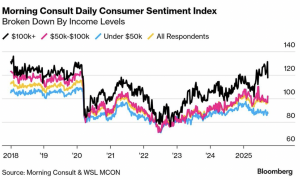
    Research from Moodys using Federal Reserve data shows the top 10% of earners in the US now account for 50% of all consumer spending. In the early 1990s (before Fox News) that number was closer to a third of all spend. Disney just discovered (as corporate America said zippo) that the average person felt that taking a comedian off air after government threats was plain un-American, and proceeded to cancel in massive numbers their Disney+ and Hulu subscriptions. Maybe, the 90% will push back on other White House over-reach? I’m not so sure, and that’s not good for US assets or pensions in the long run. Investment securities, after all, are contracts and the undermining of the rule of law will end in tears. Or, something less oligarchic. As my favourite bear strategist, Albert Edwards, said this week when posting the Bloomberg chart below, “When I look at this chart, I look at my calendar and just wonder when I should pencil in the next revolution..”   The chart dramatically shows consumer sentiment splitting sharply between the ‘have yachts’ and ‘have nots’…..

  • Who’s Really Losing Power…?

    Who’s Really Losing Power…?

    We sorta knew didn’t we? The Donald really doesn’t ever want to leave power. National Guard troops might be armed and patrolling the streets of Washington DC but we might be missing an even bigger power move. No, neither I nor the South Park writing team are contemplating a horse being appointed as a Senator, or JD Vance as President or Eric Trump …. replacing the horse. Parody and Caligula’s legacy are safe, for now. However, if you’re a fossil fuel investor things are looking anything but safe despite the Orwellian data-denial of the Dear Orange Leader. Let’s start with a few ground truths.


    *Oil prices have fallen in three of the last four weeks and are now in the low $60s per barrel pricing region which is close to a 4-year low.

    *Bloomberg recently reported that global oil markets are on track for a record surplus next year as demand growth slows and supplies keep growing [Source: International Energy Agency(IEA)]

    *IEA data shows oil inventories will accumulate next year at a rate of 2.96 million barrels a day, surpassing even the average build-up during the pandemic year of 2020

    *World oil demand this year and next is growing at less than half the pace seen in 2023.

    *But what about “Drill, Baby, Drill” ? Maybe not so much. US drilling activity continued to fall in early August as the oil rig count fell to 539, near its lowest since Dec 2021.


    No wonder Texas is trying to re-draw and gerrymander voting districts 5 years early. Texans are unlikely to fall for Fox News fealty to the Dear Leader, but they will be bombarded with untruths. That’s just a no-fact of life in politics these days. However, the strategic problem for the US in this energy leadership crisis is that climate crisis denial has directly impacted investment in renewable energy projects. The facts are stark. The Financial Times has reported a whopping $19 billion worth of projects have been cancelled this year alone. In fact, cancellation rates on all renewable projects are up over 2,000%.

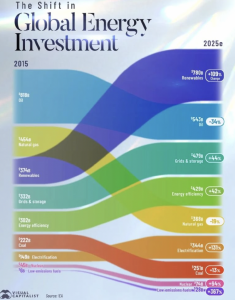
    The most recent cancellation was a biggie in Rhode Island. An off-shore wind project 80% completed by Danish company, Ørsted, was halted by the Department of the Interior citing “concerns related to the protection of national security interests”.  That project would have powered 350,000 homes in Connecticut and Rhode Island. Meanwhile, the rest of the world is rapidly shifting focus away from fossil fuel projects. The graphic below is from the Visual Capitalist team using IEA data and compares global investment from the years 2015 and 2025 (estimated). Renewable energy investment projects have more than doubled to $780 billion and overtaken oil project investment which has shrunk from over $800 billion to $543 billion. Interestingly, electricity grid, storage and efficiency projects are now forecast to reach close to $800 billion in 2025.


    The slippage of oil, gas and coal in the investment rankings is clear to see in the chart above. A seismic power shift is already happening and it is worth keeping an eye on the headlines and developments listed below. Arguably, the current White House administration, rather than bolstering “national security” is handing the energy keys of the future to more far-sighted leaders elsewhere. Check out these data points:

    In July, China’s single month electricity usage exceeded 1 trillion kw/hours. That’s more than Japan uses in a whole year. Of this total, 25% was generated by wind and solar energy sources.

    In April 2025, China’s solar generation of 95 TWh was larger than the TOTAL ELECTRICITY DEMAND of all but two countries in the same month.

    For the first time in history, despite soaring electricity usage, CO2 emissions in China are falling.

    The UK in Q2 granted planning for 16.1 GW of renewable energy capacity. That’s up 195% on last year.

    Renewables in the UK for the first time in 2024 supplied over 50% of the nation’s electricity over the entire year. Renewables and nuclear energy combined, accounted for 65% electricity generation in the world’s 5th biggest economy.

    In Pakistan, over the last two years private individuals have imported solar panels which equate to 68% of the entire national public grid!

    India’s solar PV manufacturing capacity has increased 50x in 10 years from 2GW to 100GW.

    In May this year, 68% of Germany’s net public electricity was generated from renewable sources.

    The electric vehicle (EV) revolution is not just happening in wealthy economies. 76% of new passenger cars sold in Nepal are electric. In Ethiopia that number is 60%.

    EV sales in Europe took 29% market share in June 2025. The share in Sweden is 65% while China moves in to the tipping point of more than 50% of sales being electric.


    The future is fast becoming electric, powered by renewable energy sources. One wouldn’t want to be on the wrong side of history, or your previously loyal customers. Ask Elon Musk and his European sales and marketing team. And…. if you want history to be a guide as to how power can shift slowly, then suddenly,  maybe don’t go to a US museum. Apparently, the Dear Leader doesn’t want US museums like the Smithsonian to raise awareness “too much of the past”, but rather “focus on the future”. Yep museums shouldn’t do history too much. Go figure.

    I’m going to stick my neck out here and risk future US visa issues but ……..it feels like the US energy future is not in good hands, just tiny ones clinging to the wrong power.

  • The Euphoric Wisdom Of Crowds

    The Euphoric Wisdom Of Crowds

    I laughed a lot at a very sad funeral this week. Emotions, eh. I’m hopeful this weird juxta-positioning of emotions is a kind of human coping strategy, rather than a sociopathic tell. Then again, the mourning crowd laughed at the brilliant life narration too. Back at my desk, a flurry of headlines hitting the screen prompted a further emotional conflict. Surging extreme weather events globally, Europe battered by tariff tyranny, Gaza starved and Ukrainian cities terrorised by Russian bombardment are hardly sources of optimism for the progress of our species. And, yet……I’m picking up a very euphoric vibe from the financial markets. Strangely for this publication, I’m not that interested in retro-fitting the euphoria with some financial rationale along the lines of falling cost of money(rates), corporate earnings, tech innovation or economic cycles. The sheer phenomenon of financial euphoria is worth highlighting first. Then we can do some thinking, all of us.  Now for the euphoria…..

    The “wisdom of crowds” leans on the idea that large groups of people (markets) are collectively more likely to be correct than individual experts. What is particularly striking about current financial market behaviours is that there is a wide variety of “crowds” ignoring the gloom-filled headlines and seeing a better future out there. However, that optimism is not exactly a new phenomenon. Note that financial markets typically enjoy positive returns in seven out of every ten years. In other words, it pays off to be relatively optimistic. However, in this piece we are looking at something more, evidence of euphoric excess. Let’s try a few of these crowds for starters…..


    *The crypto crowd: Bitcoin is hitting record highs of $118,000 while the entire crypto ecosystem has now surpassed $4 trillion in value.

    *The IT crowd: If one uses pre-2018 sector classifications, then technology stocks’ weighting in the S&P 500 is above 45%. That’s way higher than the dotcom bubble of 2000.

    *The ‘Magnificent 7’ crowd: There’s now, not one, but two Big Tech companies with market values in excess of $4 trillion. For context (and wobbly comparison), the $8 trillion combination of Microsoft and Nvidia alone would rank 3rd globally as a single country GDP.  

    *The meme-stock crowd: In 2021 it was Gamestop and the Robinhood day-traders. Now, it’s Kohl,’s (retail) Krispy Kreme(donuts) OpenDoor (estate agent) and American Eagle with Sydney Sweeney dominating social media, chat rooms and…. Wall Street trading volumes.

    *The AI/Cloud crowd: Earlier in the year Microsoft CEO, Satya Nadella, in a Davos interview stated he “was good for $80 billion of investment in 2025” in AI/Cloud infrastructure. Scratch that. This week he said the number will be $120 billion. Google said $85 billion (up from $75 billion) as Big Tech companies look like they will do a giddy AI spend of close to $400 billion in 2025.

    *The M&A crowd: Research data from Pitchbook shows robust merger and acquisition (M&A) activity in Q2, marking the third consecutive quarter for deal value to hit about $1 trillion across roughly 12,000 transactions. It’s not just tech showing confidence. Railway giants Norfolk Southern and Union Pacific are doing an $85 billion merger to create the first transcontinental railway line in US history.

    *The retail crowd: Barclays research points to retail investors as the “primary driver” of the recent stock market rally. In the past month alone, retail investors poured $50 billion into US stocks and now account for up to 20% of daily trading volume on Wall Street. That’s double the levels seen before the pandemic.

    *The VC crowd: The challenged venture capital (VC) world has been looking for a genuine positive pulse-take via an IPO exit. As I write, Greylock Partners, Sequoia and Index Venture will be the VCs doing cartwheels tonight after the largest VC-backed tech IPO in years, Figma, tripled in value within hours of its NYSE debut to almost $50 billion. Or… will they be wondering how they got the selling (IPO) price so wrong?

    It is entirely possible many of the above trends are rooted in fundamental investment theses but suggestions of dangerous  “euphoria” can be found in aggregate valuations of US stocks. The average price/sales valuation multiple (per Bloomberg) for US stocks is a punchy 3.3x. Furthermore, Warren Buffett’s favoured sanity check of comparing the market value(cap) of all publicly traded US companies with total US GDP currently stands at 212%. As a risk guide, Warren is usually uneasy when that number is over 100%. My own two personal favourites in the euphoria beauty parade are more esoteric but tell their own stories.

    First, it is no secret Facebook/Meta and others in the AI “arms race” are desperately looking for AI talent. However, the numbers are starting to look bonkers. According to Wired magazine, at least one prospective employee was offered a 3-year billion dollar salary package to join Meta. Others were offered hundreds of millions (rumoured to be Mira Murati’s Thinking Machines Lab team) but here’s the best bit…. the prospective hires turned down the offers!! Now, here’s a few other proposals that were turned down as recently as November 2022.

    If that date sounds familiar, you might have been vowing to stay away from markets at the time as stocks hit bear market lows spooked by rising global interest rates. Online car retailer, Carvana, was “on sale” that day after its share price had collapsed by almost 99% from its highs the previous year. Nobody wanted to touch it. As of today, it’s up more than 10,000% since then. Fear and greed, emotions eh. Oh, and Meta’s share price on that day after a rough year for the Zuck was $88.91 per share. It’s up almost 800% since then but here’s the best bit….in barely one trading session after its excellent quarterly results this week, Meta’s share price jumped by about $88.91 per share. That number sound familiar?

    No more teasing. The key point is that confidence is surging in public markets. The quieter, less public private markets have struggled to generate similar headlines. Yes, there are pockets of excess. However, it would be foolish to ignore the ‘wisdom’ of the public market crowds. Ultimately, higher trading activity levels, record capex investment, big M&A deals and higher valuations will feed into private markets and smaller companies. Indeed, you might have to get used to the giddy headlines for a bit longer. Goldman Sachs have done a bit of historical analysis and concluded that spikes in speculative trading actually precede abnormally high returns on a one-year time horizon. Don’t stay too long at the beach….the YOLO crowd might be on to something.


                                      N.H.  RIP


  • AI…AI…AI…AI…I Just Don’t Know

    AI…AI…AI…AI…I Just Don’t Know

    I’m going to have to up my game. Not just tennis. As a frequenter of the occasional business discussion panel, this week threw up a very different type of panelist. The Dublin Tech Summit at the RDS hosted a panel discussion on AI which featured contributions from a meta-human avatar created by AI, named Anja. Quite unnerving in a way. If it had been a horse on the panel, I don’t think it would have unsettled me more. Mind you, the no-clothes Emperor Taco Trump guy can’t be far away from appointing a horse to the Senate soon. Anyway, I digress as humans do. Back to AI, and I was thinking it would be no harm to highlight a few significant AI datapoints and developments which have caught my eye in recent weeks. First, the data.

    The Stargate data centre project backed by OpenAI, Japan’s Softbank, Oracle and Nvidia and to be built in the UAE is estimated to eventually have the capacity to consume 5GW of power, For context, that’s the power consumption equivalent of the entire island of Ireland. And, Ireland would already be considered a global leader in terms of data centre capacity as a proportion of the total energy grid, about 21%. Clearly, AI and its critical data centre/cloud infrastructure is moving at pace to meet expected future AI usage demand. The pulse-take on AI investment pace has been chip-maker, Nvidia, who reported quarterly results this week. Revenues for Nvidia (despite Trump China tariffs/blocks) are still growing at almost 70% but this doesn’t quite capture the scale of growth. Two years ago, at the time of ChatGPT’s launch, quarterly revenues at Nvidia were $6 billion. Now, they are at $44 billion. Furthermore, Nvidia plans to invest $500 billion to build AI infrastructure in the US. Note, things have also moved on from  ChatGPT and other Gen AI tools (like Gemini and Claude) as the drivers of AI investment. The big move now is to “Agentic AI” or “AI Agency”.

    Agentic AI is not a pilot or learning model wanting users to test its knowledge. No, this is the real “doing” stuff which companies are now paying to integrate in their work flows. According to CB Insights research, enterprise AI and copilots will generate $13 billion of revenues by the end of 2025 across a variety of activities from sales to coding to customer service. That’s a growth rate of 155% year-on-year and a wake-up call for most companies; the reality is that their competitors are likely deploying AI to dramatically improve productivity and costs. One wouldn’t want to be in the spectator seats for too long and it’s not just a corporate caution. At a sovereign level, Dubai has offered all its citizens free access to the premium ChatGPT Plus service which normally costs $20 per month. The digital information race is truly ‘on’ but there’s also a hardware story emerging.

    OpenAI has just acquired  Jony Ive’s AI hardware start-up, Io Products. The former Apple key man, whose design credits include the iPhone and iPad, will now lead design at OpenAI as the company pushes deeper into hardware. The move highlights a trend of VC-backed companies buying one another amid a shifting tech landscape and a hunger for talent. However, it is worth noting that this is the largest private-to-private acquisition ever at $6.4 billion. Indeed, over 40% (7) of all-time $1B+ private-to-private acquisitions have happened in just the last year. OpenAI, Databricks, and Stripe have each spent over 15% of their total funding to date on acquisitions in the last 2 years. Don’t forget Anja too. Venture capital investment in humanoid robots are estimated to double this year to over $2 billion per CB Insights data. Then consider that there are 660 million people in Asia (average age 27) using digital companions. That disturbing little gem came from anthropologist, Dr Lollie Mancey, in a recent RTE interview and….. I just don’t know. I’m not alone.

    The fascinating story of Irish recycling software company, AMCS, and its $2 billion wealth creation story was told by its founder, Jimmy Martin, at the Renatus/Fitzgerald Power “Real Deal” SME conference in Goffs this week. When asked about AI, he wisely declined to predict the future but did make one very interesting and more definitive point. As a hugely successful observer of ‘margin’ in industry ecosystems, Martin was quick to identify the monopolistic power of the big 3 cloud infrastructure players, Microsoft, Amazon and Google. For me, the unanswered question of who will be the winner(s) will focus on the following :


    1. The manufacturers of the critical semiconductor chips
    2. The owners of data centre infrastructure
    3. The providers of energy/power capacity
    4. Sovereign/digital alignment (China, Europe or US).


    I really don’t know, particularly the geopolitical/sovereign and energy/power questions. However, I do think it interesting that in recent days companies exposed to the nuclear power industry have seen big share price moves. Not coincidentally, the US and a number of European countries have been embracing a nuclear industry revival at the same time. Plenty to ponder, not all of it comfortable. Isn’t that right, Anja?

  • Ten MEGA Signs Of Not So Much Winning…

    Ten MEGA Signs Of Not So Much Winning…

    Never thought I’d say this. I think I need those Freezbrury cold water challenge days to extend into March. Well, I need some shock therapy to dull the senses and distract from a rules-based world order which is crumbling by the hour. Should I care that a former Fox & Friends host has just instructed the US military to cease all operations against Russian cyber threats? Probably, but I’m not sure it’s helpful to follow the dizzying pace of breaking news and broken alliances. We have previously written about how the financial markets can rein in autocratic megalomania both East and West. In that instance we flagged the power of bond (debt) markets. Now, it looks like a regime which promised “so much winning” is losing the confidence of more than the bond market. Here’s a list of losers….


    US Business Confidence: The silence or craven submission of US business leaders to the erratic ‘shake down’ of US allies and the established world order has been stunning to observe. However, as we often write, corporate actions can be more informative. Quietly removing DEI policies requires minimal leadership courage (I’m being very generous with that word). Dealmaking (M&A) on the other hand is way up there in terms of career risk for senior executives. Guess what? US M&A deal activity in January slumped to a decade low with a 30% drop year-on-year.  Uncertainty is a strategic decision killer.

    US Capital Markets: The US financial markets have dominated the world since the 2008-2009 financial crisis. US stock markets now account for more than 50% of the value of global equities after outperforming international stocks for more than 16 years. However, this year it’s a different or shifting story. At the end of February, international stocks had gained 7.3% in 2025 vs a 1.4% gain for the S&P 500.

    US Growth: Investors in US stocks appear to be concerned. They are not alone. The much-watched GDPNow forecast of the Atlanta Fed is currently projecting US GDP will CONTRACT by 1.5% in the first quarter compared to the forecast of healthy 2.3% growth a week earlier. Also, US consumer spending has just fallen for the first time in two years.

    US Technology: The “broligarchs” might have taken over the White House but the “Magnificent 7” technology stocks are experiencing slippage in 2025. Only one of Meta(+11%), Apple (-4%), Amazon (-3%), Google (-10%), Microsoft (-6%), Nvidia (-10%) or Tesla has seen its share price in positive territory this year.

    Tesla: Tesla’s share price decline this year is a whopping 23%. Apparently, Elmo Musk’s fondness for autocrats and far-right parties in Europe has been a bit of a brand-killer. Sales in Europe for the first two months of 2025 are down 46% which can’t all be explained by consumers waiting for a Model Y refresh. Don’t expect any bravery from Tesla board directors either.

    US House Sales: US existing home sales have dropped to the lowest levels since…. 1995. Yes, that’s when there were 80 million fewer people living in the US and didn’t have a President threatening a tariff war with its neighbour and construction-critical timber supplier, Canada.

    US Dollar: As the world’s reserve currency the US Dollar (USD) is a long way away from any structural impact from the waning credibility of its sovereign’s political system. However, the USD is trading at an 11-week low against 6 major rival currencies. And….one of the better macro writers out there, Barry Ritholtz of The Big Picture blog, has flagged the dangers of policy error for the USD:


    “Since the end of World War Two, the USD has been America’s “exorbitant privilege” as the world’s reserve currency. However, several factors threaten this privilege: wide-scale tariffs, the embrace of alternative digital currencies, the breaking of long-standing alliances, and dallying with dictators.

    Since the end of World War II in 1945, the rise of the United States as the world’s dominant economic, military, and cultural power has led to a relatively peaceful 75 years in the Western Hemisphere, Pax Americana, has greatly benefited the U.S. and its allies. Putting that at risk would be one of history’s greatest unforced errors.”


    US Supply Chain: The just released ISM Manufacturing survey for the US reveals the “prices paid” index for companies surged to a 32-month high as suppliers adjusted prices upwards ahead of threatened Trump tariffs. Oh, and don’t mention egg prices to the ‘Build-that-Wall’ cult – egg shortages are pushing prices up by 53% vs 2024 prices. Yep, you might remember there was some bloviating chat about inflation being fixed ‘on day one’.

    US Jobs: There’s every chance Elmo Musk could end up being the DOGE that caught the car. Musk has been tasked/appointed himself to remove unnecessary spending by the US Federal government and its 3 million employees. But… the shock being applied to the US economy is possibly underestimated. The US government spent $6.8 trillion in 2024. For context, that’s more than 10x the size of the global semiconductor industry’s annual revenues ($628 billion 2024). Firing people in climate/weather forecasting roles and shutting down foreign aid (USAID) are just headlines. The bigger picture suggests one of the US economy’s most critical components (government spend) is in contractionary territory which will impact not just government jobs but the entire government supply chain in the private sector. Yep, a $7 trillion customer of the US economy is now being  run by Elmo and his “Muskrats” with cute names like “Big Balls” and “First Buddy”. No seriously.

    Brand America: As a symbol of American global reach and brand value it’s difficult to beat McDonald’s. Some of you may even recall the opening of its first Moscow restaurant with the famed “Golden Arches” in January 1990. You just knew the geopolitical sands were shifting. Less than two years later the Soviet Union collapsed. Now, check out the IPO of a company in Hong Kong this week. McDonalds is no longer the biggest food and beverage chain in the world. That title now goes to Mixue Ice Cream & Tea which has 45,000 branches in Asia and is opening approximately 21 stores……. every single day.

    It’s a bit early to be suggesting a shift in global leadership but perhaps the competition has just shot itself in the foot. I’m thinking of Europe now and how a geopolitical crisis might just prompt real thought about making Europe great again (MEGA). Three financial data points caught the eye this week and suggested investors might be warming up to real policy action in Europe:


    • The Swedish Krona is appreciating fast (2.4% today) as investors recognise Sweden has the highest military equipment production per GDP in Europe.


    • Europe’s benchmark stock index, the Stoxx 600, has risen every week for 10 straight weeks.


    • Germany’s Rheinmetal (+14%), Britain’s Bae Systems (+19%) and France’s Thales (+23%) have seen their share prices rise by double-digit percentages in a matter of days.


    The $2.5 trillion global defence industry won’t be the only area Europe should target to compete as a “trusted partner” . Presumably, many countries and organisations seeking commercial partners in healthcare (medicine/vaccines) and financial services will have noted the risks of deal exposure to a US political leadership who ultimately might want  a “piece” of a country in exchange for “peace”.  Europe, by standing with Ukraine, could send a very powerful message on dependability to future partners as its former Washington ally works furiously to keep the KGB lieutenant colonel in the Kremlin happy.


  • Silver Linings For Finishing 2nd Almost Everywhere…

    Silver Linings For Finishing 2nd Almost Everywhere…

    I blame the Irish. Should have seen it coming. Poor immigrants once upon a time, the changed perspectives were there for all to see. A couple of Kellys, a Mulvaney, a Spicer, a McMahon and a McGahn, all key lieutenants in the Trump 1.0 cabinet of 2017, championed Muslim bans, Mexican walls and family separations. I’m being flippant and skipping through a few decades of political evolution here but political integration of immigrant communities is a good thing. Take it as a genuine US presidential election positive. Of course, there will be plenty of Democratic Party navel-gazing and gnashing of teeth in the days and years ahead, but finishing second for the first time in 20 years (last popular vote loss was 2004) will focus minds on the stunning shift of ethnic minority voters to an anti-immigrant Trump ticket.

    Things looked bad for the Harris campaign very early on Tuesday evening. Hispanic-heavy Miami-Dade County in Florida had given Hilary Clinton a 30 point winning margin in 2016. On election day, Trump obliterated that by 40 points to secure a 10 point winning margin. There were other shockers – Star County (Texas and 97% Hispanic), Suffolk County (New York) and my personal favourite, Anson County in North Carolina. Republicans have won this 45% black county only once before since…. 1870. Wowzers. The purpose of this article is not to follow most post-mortem commentary and examine where the Democrat messaging didn’t connect but rather to highlight some potentially positive developments. If anything, the change in the mix of the Republican vote is more interesting. Try the dilution of white voting power.  The ‘dilution’ phrasing might surprise readers’ perceptions of what constitutes the Republican party base vote, but the scores are in:


    *Trump won less of the white vote this year (55%) than 2020 or 2016. And…


    *Harris (43%) did better with the white vote than Hilary Clinton or Joe Biden.


    *Hispanic men voted for Trump 54% vs 44% for Harris.


    The always excellent Noah Smith in his newsletter recalled a former Irish Republican, Ronald Reagan, saying that Latinos would eventually become Republicans. The social negatives attached to that shift are for another day but Smith highlights an even more important point for a polarised US society:


    “This largely destroys the narrative that non-white immigration will demographically drown White Americans under a tide of imported minority votes….. At some point, Republicans are going to realize this, and hopefully become less anxious about America’s racial future. Hopefully they will also realize that any attempt to make voting harder actually hurts them in the future, because the impact would fall disproportionately on their own base”.


    Oooooh Tucker Carlson might not like that narrative challenge to the “Great Replacement Theory”. But, there’s also another positive attached to this stunning shift in voting patterns. Harris lost so emphatically and so early that there was no dispute over electoral process. In fact, Trump improved his vote in 90% of all counties in the USA, and that includes Guam flipping to red. For those who hoped for decency, that feels like finishing 2nd just about everywhere. Many wanted democracy to prevail. It did, but with the anticipation that the “right” side probably had to win for a smooth transition, right? That caveat is for another day’s discussion too.

    Also, while we are on the topic of ‘right’, another stunner for me was that the white evangelical vote was 22% of the total vote and they voted 81-17 for Trump. Other voters who make up the remaining 78% of the electorate voted overwhelmingly for Harris by a 19 point margin (58-39). So, without white evangelicals Harris would have won the election by 20 points!  Let’s hope God is right……

    Meanwhile, for the socially agnostic financial markets, uncertainty is a wealth destroyer, paralyses decisions and kills investment activity. So, not surprisingly, there have been a few financial wins in the early days after the election. We’d highlight the following:


    *Banking and asset management stocks like Goldman Sachs, Blackstone, Blackrock, JP Morgan and Apollo all flew up by 10% or more.


    *The S&P 500 had its best day in 2 years and best ever post-election bump (+2.5%).


    *Elon Musk’s Tesla jumped 15%


    *Bitcoin’s price rise by 9% to $75,000.


    The Musk win is probably a struggle for some but the EV revolution is climate critical and hopefully keeps Trump tangentially on board with decarbonisation of the economy. Intriguingly, the presence of Musk as chief Trump mascot could bring a slightly contrary positive. There are some, including me, not comfortable with the billionaire “broligarchs” brazenly pushing their own commercial agendas. However, it would be a mistake to conclude that it is only the Republican party engaging billionaire promoters. The Democrats had their own, possibly glitzier line up of billionaires, influencers and celebs. And, the big strategic mistake would be to react to a Jaws-like electoral savaging by suggesting “we need a bigger boat” or better billionaires. That boat has sailed. The positive lesson from this would be to “listen” and start exerting proactive power.

    One of the critical shifts in voting patterns was urban voting. Democrats still won the big cities but the winning margins were embarrassingly small compared to double-digit history. Urban voters in the likes of New Jersey, New York, Chicago, San Francisco and Detroit have witnessed a disgraceful decline in the condition of their cities. And, other urban voters have noticed. Where Democrats have governing power, they need to deliver better city living. Security, mental healthcare, housing, crime and infrastructure are very real challenges experienced, in particular, by the lower middle and working classes. Investment and solutions to these challenges will improve urban lives and win votes.

    Commentators recently described the US voter base as one now split evenly across three cohorts: i) white college-educated, ii) white non-college educated and iii) everybody non-white. Currently, the Republican party is connecting more effectively and adding voters with two of those three. The Democratic Party should be surprised and concerned about the only one with which they are growing/connecting. The good news is that the key driver of political power in today’s America is not ideology or race. The winning factor is DELIVERY, perceived or promised. Clearly, social growth and stability are important for a nation but there’s a price for everything. In this instance, the price (inflation) – and a perception of social agenda prioritisation – was too high. Just ask Latinos, now known as “Latinx” in Democratic Party literature.

    For investors, less financial regulation, lower technology oversight(AI) and more deals (M&A, IPOs) all promise more exits and further investment cycles. All good news, until it’s not. Note, only 15 years ago the world paid a shattering economic price for deregulation of financial credit markets. Go back another two decades, and here’s a final thought for the autocracy delivery (over democracy) fans out there celebrating technology and commercial freedom…….

    The last global authoritarian empire to implode was tipped into collapse by lies and a catastrophic failure of technology .


    “Every lie we tell incurs a debt to the truth. Sooner or later, that debt is paid”


    Valery Legasov, chief of the Chernobyl disaster investigative commission.

  • M&A Deals Showing Us New Opportunities

    M&A Deals Showing Us New Opportunities

    Global leadership is on my mind. Not the extreme stuff. If you can’t avoid the headlines on the excruciating UK Conservative party leadership battle between “Honest Bob” Jenrick and “Jimmy Dimly” Cleverly, I can assure you it’s well worth the effort. Instead, I’m just back from the IMI National Leadership conference and one of the key speaker messages in our uncertain geopolitical world was to watch ‘personalities’ closely. And, believe them. So, rather than jump into geopolitics, this advice can also be applied to business and financial markets too. The return of large merger and acquisition activity (M&A) is a reliable ‘tell’ of executive confidence. These big deals are the real “believe them” leadership actions, not the quarterly analyst conference call types where management commentary is invariably upbeat, and the analysis even worse. So, with excellent timing a number of M&A developments are catching the eye….


    Banking: We mentioned in recent weeks an interesting standoff between Unicredito and the German establishment after the Italian bank swooped in to take a 9% stake in Commerzbank. Let’s just say the biggest Commerzbank shareholder, the German government, were not happy. So, imagine the scenes in Berlin’s political corridors last week when Unicredito used derivative instruments to up their beneficial interest in Commerzbank to 21% and overtake the government’s 12% stake as the biggest shareholder in Commerzbank. This is highly unusual cross-border aggressive M&A tactics and suggests high levels of Italian banking confidence. Indeed, another Italian bank, Intesa, in recent days briefly became the most valuable bank in the eurozone. Not long ago the Italian banking system was in a mess as the world’s oldest bank, Monte dei Paschi di Siena, entered near-collapse restructuring in 2022.


    Software: All the tech glory has been in hardware in 2024, and software has been feeling the pain. Valuations in SaaS have slipped, pipelines have sputtered and AI has become a deflationary impetus in the coding ecosystem. Uncertainty has bred deal paralysis. So, the sector would have been hugely relieved to see a big private equity buy-out of Smartsheet by Blackstone and Vista for a chunky $8.4 billion, and a 41% premium to its recent share price average. We will return to the significance of private equity doing buy-outs of large public listed companies, but for now let’s focus on high-risk sector consolidation where management teams are already under pressure…


    Hardware: Yes, AI has been a winner for chip manufacturing superstars like Nvidia and Broadcom. However, as with all sudden technology shifts, there can be disruption to established players. Intel is a good example of model disruption. The share price is off 50% and the company has adopted a split company strategy across manufacturing(foundry) and chip design(product). As the sole US player with sufficient process/manufacturing technology, Intel has a future but possibly with a partner…..or predator. Apollo Global have been mentioned in the media as private equity financing partners, but recent reports suggest California’s Qualcomm have approached Intel in pursuit of a friendly takeover. That combination would be a $300 billion (+) chip monster supported by US government policy (US Chips & Science Act) and would cause a seismic shake up in the semiconductor manufacturing ecosystem.


    Mining: The software sector might feel unloved over the past 18 months, but spare a thought for the mining sector. And, I’m not talking crypto. No, the basic materials critical to our decarbonised electrified future are supplied by a global mining industry which has been starved of investment capital for….. 15 years. That is about to change. Supra-sovereign legislation like the Critical Raw Materials Act (EU) are a siren sound to the frightening mis-match between our cleantech future and the metals needed to meet climate crisis targets. So, watch the ‘leader signals’ as gold and silver prices hit all time highs, and then check out the deal activity. AngloGold is buying Centamin for $2.5 billion while BHP and Lundin are jointly closing a $4 billion purchase of Canadian copper play, Filo. Also, there’s an interesting $2.8 billion green equipment partnership deal between Australian giant, Fortescue, and Swiss construction player, Liebherr. We’d better start believing……in our planetary survival.


    UK: Our final M&A development is not a sector specific observation but highlights another unloved area of the investment world. The UK has been in the international investment ‘naughty corner’ thanks to its own historic lack of investment in domestic assets….and a world-first voluntary trade-reduction deal which nobody wants to talk about anymore. So, it was intriguing to read a recent piece of research from stockbroker, Peel Hunt, on UK deal activity. Apparently, there are currently a remarkable 19 ongoing bids for UK companies in the FTSE 350 index. Not all will happen, as Rightmove, Currys and Anglo American have demonstrated. But, the imminent take private deals for the Royal Mail and Hargreaves Lansdowne are a serious ‘tell’. Britain is in play.


    The deal environment is definitely picking up. Early private equity research data from Pitchbook shows deal count in Q3 was up 8% and deal value up 20% compared to last year. Also, helpfully, the story on the exit side of things is progressing too – global private equity exits are up 13% in value and 3% in deal count. Now, consider that private equity houses have circa $4 trillion of unspent investment capital (“dry powder”) to deploy and things could get rather interesting in unloved parts of the market. Finally, keep an eye on the Middle East for more than conflagration reasons. Oil prices might be falling but investment in the region is rocketing. The recent FT Mining Summit 2024 featured a whopper statistic that 20% of the world’s cranes are located in just one country…. Saudi Arabia. Oh, and Abu Dhabi’s national oil company just bought Bayer’s plastics spin-off for $16 billion. Yep, plastics. If market personalities are telling you they are beginning to love the unloved, believe them.