Tag: Markets

  • What’s The Score For ’24?

    What’s The Score For ’24?

    It’s that time of year again to pause, reflect and hope to do better in future. Unless, of course, you’re the Conservative Party in the UK or the Republican Party in the US and ‘the race-to-most-nasty’ is the leadership badge of shame soon to be re-spelt with a ‘Z’. Back in the do-better world, a review process can help shape future efforts. So, let’s do a quick check on our four multi-year investment themes we identified almost a year ago in “Four Pictures To Develop This Year”.  First, we will remind ourselves of what was written, and then score/review how things developed for AI, Housing, Corporate Credit and Cleantech/Batteries. We kick off with the biggie….. Artificial Intelligence (AI):

    “The excellent database resource, Our World in Data, shows annual corporate investment in AI doubling from circa $80 billion in 2019 to over $160 billion by mid 2021. More specifically, the explosion of interest in generative AI (ChatGPT, DALL-E etc) has seen VC investment increase by 425% to $2.1 billion since 2020”

    Review: Well, at the half-way stage of this year, 18% of global venture(VC) funding went to AI, clocking a total of $25 billion(Source: Crunchbase). Furthermore, with the tech-heavy Nasdaq index gaining almost 50% this year, Nvidia reaching a trillion dollar market cap and OpenAI hitting an $85 billion private market valuation, it is not hard to identify AI as the single biggest positive driver of investment markets this year. Of course, the trajectory of the cost of money (interest rates) also helps with the confidence bit, but we have written before that November 17 has more than one revolutionary connotation. As of this year, the night of November 17th will be remembered for the $200 billion swing in value between Google and Microsoft in a matter of hours, and entirely driven by the relative success or failure of their respective cloud computing divisions. The AI revolution is in full swing and will continue into 2024

    While the cloud has become the housing proxy for AI, what about our own housing markets? A year ago we were concerned:

    “Of course, rising interest rates don’t just impact companies. The biggest item on an individual’s balance sheet is likely to be a house and as interest rates rise, so do mortgage rates. The push/pull effect of higher interest/mortgage rates can reduce the price of the assets being purchased, in this case houses rather than growth companies…… indicates a more difficult 2023 for a number of major housing markets.”

    Review: Arguably, this theme did not play out in a significant way, unless you were Chinese. Bluntly speaking, the doomsday predictions of housing crashes in the US, Australia, Canada and the UK just did not materialise. However, house prices are somewhat softer in many markets. The St Louis Fed has said median house prices in the US are off 10%. Even the UK with its dysfunctional government, and one Prime Minister(Liz Truss) having a good go at crashing the property market all by herself, has seen price slippage of just 1% (Source: Halifax). The key flaw in the doomster arguments was that most people kept their jobs. Major economies in a state of full employment was not expected as the “vibecession” never turned into a recession. And, if recession is avoided then there’s another asset class which has dodged a bullet; corporate debt/credit. Here’s what we feared….

    “In real world terms, the knock–on effect of tighter funding conditions will begin to reveal themselves in 2023 as companies with challenged balance sheets/indebtedness – aka ‘zombies’ – move into distressed territory.”

    Review: As a proxy for corporate stress you’d expect high yield bond (lower quality debt) spreads to have risen through the year. But no. They’re actually at their lowest since April 2002. However, we’ve had a few big bankruptcies through the year – Silicon Valley Bank, WeWork, Diebold Nixdorf, Rite Aid, Van Moof, and even Birmingham City Council. By June UK bankruptcies were up 40% on the year before. According to S&P Global, in the first 10 months of this year 561 companies sought bankruptcy protection in the US. That’s more than any year since 2010, except for the Covid-19 hit in 2020. So, I’d give us a pass mark on this but feel there’s another year of stress ahead. In particular, commercial real estate as an asset class is going to witness some very painful write-downs and outright collapses. Check out the recent travails of Austrian billionaire, Rene Benko, and his $25 billion property empire, Signa, for a very current case study.  However, not all building is in trouble….

    “In some ways, the best proxy for the planet’s race towards reducing fossil fuel dependence is the enormous investment currently being ploughed into production facilities for batteries to power a generational shift to electric vehicles(EV). China in 2020 accounted for 75% of global battery production capacity but that’s going to change. Europe intends to up capacity 5-fold by 2030 and the US isn’t just home-shoring semiconductor manufacturing.”

    Review: Like AI, I think this gets us pretty good marks. The cleantech and energy storage(battery) revolution is in full flow. McKinsey reckon $6.5 trillion will be spent every year on capital expenditure/building facilities which, in the words of the latest Cop-out 28 text, will “transition away from fossil fuels”. We did say catch up was required by Europe and the US in battery manufacture, but arguably the US has accelerated faster. Thanks to ‘Bidenomics’ and the IRA Act the US is seeing capital investment in manufacturing reach levels not seen in four decades. According to MIT, cleantech investments in the 12 months to July 2023 hit $213 billion, and was mostly allocated to EV battery manufacturing, renewable energy and green hydrogen infrastructure. No wonder the old-economy barometer, the Dow Jones Index, just hit an all-time-high level of 37,000 points. More amusingly, Trump whisperer, Maria Bartiromo, on Fox Business was forced to say “the economy is doing much better than most people understand.”  Wonder how that misunderstanding developed, Maria?

    So, there’s a temptation to stick with the same four themes for 2024, but in the spirit of Christmas we’d like to give a bit more. The bonus good news is that Christmas might also be easier on the waistline in the coming years. Yes, AI has stolen many of the headlines this year but there’s a 100 year old company in Europe breaking records too. Denmark’s Novo Nordisk is now the most valuable company in Europe with a $437 billion market capitalisation thanks to its insulin product, turned weight-loss miracle drug, Wegovy. This semaglutide-based drug is a game-changer for up to 750 million people living with obesity. However, there might be even bigger break-through treatments to come. And, it’s all about BIOLOGY.

    We are entering the world of gene editing spearheaded by CRISPR technology. Get used to that term. CRISPR stands for Clustered Regularly Interspaced Short Palindromic Repeats. It is a component of bacterial immune systems that can cut DNA, and has been repurposed as a gene editing tool. Only this week we were reading that the FDA has approved two ground-breaking cell-based gene therapies, Casgevy and a new one, Lyfgenia, for treating sickle cell disease (SCD) in patients aged 12 and older. Notably, Casgevy is the first FDA-approved therapy utilizing CRISPR.

    Now, think about healthcare spend being almost 11% of global GDP, or $11-12 trillion. The prospect of biology rather than pharmacology being used to eliminate various life-changing diseases is mind-blowing. Furthermore, as the first attempts to regulate AI emerge let’s open our minds up to the probability that these massive new computing powers can save decades of research time. So, as a final thought, perhaps 2024 will deliver a break-through global healthcare solution through the combination of AI and biology. Just imagine, our health becoming your wealth…. I definitely think that would score well.


  • Take Your Pension Or Portfolio To Another Level

    Take Your Pension Or Portfolio To Another Level

    Fizzle sticks! There goes another billion dollar ‘unicorn’ I didn’t back. Sound familiar? This week’s news that Ireland’s Cubic Telecom has entered the ‘unicorn’ club thanks to a €473 million investment from Japan’s Softbank should focus financial planning minds. In particular, we should focus on two things very familiar to readers of these pages. Firstly, speed. The business world is moving faster and faster. Secondly, technologies are rapidly merging and compounding value.

    Just over a year ago, Cubic Telecom was reporting annual sales(Sept 2022) of circa €30 million with its connectivity software installed in 10 million vehicles. Yep, €30 million not €300 million. So, what prompted Softbank to enter into discussions for a 51% stake purchase on a valuation multiple of 31x the previous year’s revenues? One could hazard a guess that speed of growth was one consideration, given installations of its software have ramped up to 450,000 vehicles per month and are expected to go ‘exponential’. Also, one suspects the compounding of a number of technologies is beginning to drive traction. Cubic is at the fortunate intersection of the Internet of Things(IoT), 5G connectivity, electric/battery powered vehicles (EVs), cloud computing and Artificial Intelligence(AI). We need to start thinking about multiple technologies compounding at speed rather than focusing on one technology advance, and it’s not just Ireland illustrating these two themes.

    All the gloomy headlines this year have put us all in a strange place. And, awkwardly so for financial advisors who possibly went into ‘bunker’ mode. I have been asked to look at 3 different pensions in the last week where returns to date were hovering at just over 3%. That’s actually less than you’d earn on risk-free US Treasuries currently. However, the killer data point is that the tech-heavy index, the Nasdaq 100, is up 48% year-to-date. Oh, and despite all those war headlines and oil worries from Russia/Ukraine and the Middle-East, the energy sector is DOWN year-to-date. Even Germany which is staggering into recession boasts a stock-market (DAX) hitting all-time highs and returning 18% gains this year. Note, the DAX is definitely NOT filled with tech names. However, the Nasdaq is telling us lots of technology from energy storage(Tesla) to cloud(Microsoft) to AI(Google) are emerging at the same time. Just yesterday, Google showed us a new AI bot, Gemini, and its market value jumped by $85 billion over the day. That’s the equivalent of Citibank’s market capitalization after 211 years in existence. Just one day. It feels like wealth creation cycles are shrinking.

    Latest reports suggest the AI team at French start-up, Mistral, are raising funds again. Recall that this crew of AI gurus raised over $100 million 6 months ago with no product, no business or revenues. Just a PowerPoint presentation deck. Now the team have a product (large language model(LLM) for Generative AI) and want to raise more than $300 million. The current valuation level for Mistral is ….. reported to be over $2 billion. Six months. However, before we go all dollars dreamy, note that the hard yards and years are still the norm. For example, Cubic Telecom started up back in 2005. At a higher level, consider it took Microsoft 44 years to hit the trillion dollar market value mark, Apple 42 years, Amazon 24 years and Google 21 years. Keep those tech and time thoughts and let’s move to the other end of the business life spectrum.

    We have already referenced pensions, but for many investors these are vehicles for a variety of funds investing in a mix of blue chip publicly listed company shares and their debt(bonds), government bonds, possibly some real estate and a bit of cash. Given the fast-moving tech world we live in, it is increasingly apparent that investors’ pensions or savings portfolios should allocate a small portion of monies(5-10%) to early-stage companies. Pensions are not the ideal vehicle(for the majority of people) for these investments, but the good news is that the government provides incentives with a similarly attractive taxation impact.

    For years, starting with BES schemes and then evolving into the current EIIS funding initiatives, government has encouraged private investor capital to support employment and growth for early-stage companies by offering tax rebates against income generated in the year of investment(s). That rate of rebate has been a standard 40% but is due to change. More on that later but first, let’s briefly explain the mechanics of EIIS.

    If a company is eligible for EIIS investment it will typically be introduced to private investors in three ways. Note, not all companies qualify for EIIS treatment eg. financial trading businesses are not eligible. Companies which do qualify, offer shares through the following:


    • Direct Investment: The investee company offers its shares directly to investors. These direct investment opportunities are typically offered to small groups of investors known to the company’s founders or its financial advisors, and not made public.


    • EIIS Funds: These funds are managed by financial intermediaries/brokers and request lump sums up front from private investors. The capital raised is then deployed across EIIS investment opportunities. The up-front sums can be significant(> €10,000) and the managers will charge annual fees.


    • CrowdFunding Platforms: A platform like Spark (or Seedrs or Crowdcube in UK) will give thousands of signed-up investors access to 12-15 fundraising campaigns by EIIS qualifying companies each year. The business model of these platforms is different to a fund. The investors do not pay any up-front lump sums or fees. Investors can invest as little as €250 in each EIIS investment with NO commissions, and NO management fees. Instead, Spark and other platforms only charge the companies a fee(and only if successful). One other variation on this is Angel Networks, or syndicates, which invest as opportunities arise. However, the entry level investment size (€5,000 – €10,000) and lead times are not for everyone.


    So, after paying for your shares, those shares will sit in a broker account, or a fund, or in a nominee account(independent of platform). The company will then apply for EIIS certification from the Revenue. On receipt of this notification, investors will get a certification confirming same which can be filed with the Revenue to offset taxes paid in that year.

    What sort of people could this interest? The income which qualifies for tax rebates includes employment income, rental income, dividends and ARF distributions. The amount of income which can avail of EIIS has been increased from €250,000 to €500,000 in a single year under new rules to come into effect in January 2024. Also, note the investment must be for a minimum of 4 years. The new rules in the Finance Bill also have broken the standard 40% rebate rate into different bands which we have summarised in a previous article as follows:


    • 50% for businesses that ‘have not operated in any market’;
    • 35% for a business in its first EIIS fundraise within 7 years of its first sale;
    • 20% for a business in its second or subsequent EIIS fundraise;
    • 20% for a business expanding into new markets or regions; and
    • 30% for investments via a ‘Qualifying Investment Fund’, of which there is only one in Ireland.


    Quite apart from introducing potential confusion, the ‘core’ or standard EIIS rebate of an equity investment will now be reduced from 40% to 35%. On a more positive note, the 50% relief for early-stage pre-operating companies could be very interesting for Ireland and Irish investors. It won’t have escaped your attention that the trillion dollar tech club is entirely US based. That can be attributed to deeper capital markets and Silicon Valley tech leadership but could Ireland be a leader now? I’m thinking three big areas where the Irish ecosystem is quietly building real scale and a pipeline of early-stage opportunities. Here we go:

    Medical Technology/Bio-pharma: 14 of the 15 biggest MedTech players have significant operations including critical R&D functions in Ireland. Also, 12 of the biggest global pharma players are there too. That ecosystem is beginning to deliver a fly-wheel effect of training, management, success, entrepreneurial juices and world-class innovation.

    Cleantech: Irish engineering and construction companies are already leveraging their experience of executing huge hi-spec projects for tech giants like Microsoft and Intel, and global life sciences companies. These Irish companies are now key players in the build-out of EV battery gigafactories, data centres, clean energy manufacturing plants, pharmaceutical plants and chip manufacturing facilities all over the world. It is highly likely this hi-tech project expertise will generate new innovations and young companies to drive the cleantech revolution.

    Artificial Intelligence(AI): The creator economy is a $250 billion monster with all the major players from Google to LinkedIn to Meta/Facebook positioning their European HQs in Ireland. It is clear the creator economy is in the cross-hairs of AI and one can expect the Silicon Docks of Dublin to spin out a number of AI innovations. In fact, Spark will be bringing an exciting AI play to investors very soon.


    Furthermore, or a bit further afield, we should note interesting developments in Europe. Spark as a newly regulated entity with EU ‘passport’ will be looking at potential investment opportunities and encouraged by the latest data from Atomico’s “State of European Tech 2023” report:


    • Investment levels in European tech has reached $45 billion which is up 18% on 2020. Every other region is down over the same period.


    • Europe’s talent pool has grown from 750,000 to 2.3 million in the last 5 years. And, in 2023 Europe was a net beneficiary of people moving from the US to Europe. How Trumpy….


    • Europe now has 4,000 growth stage tech companies.


    • Europe (not just Mistral) can compete in AI globally. In fact, Europe has more resident AI talent than the US (120k vs 112k).


    There will be early stage investment opportunities in a faster world. And, frankly, waiting for IPOs could be a long way off. Thanks to huge private investment pools, companies like Stripe, Shein and OpenAI can stay private for longer, or forever. In the US alone, 70% of early stage/VC funding comes from pension funds and educational endowments. Europe has a bit of catching up to do; only 20% of funding comes from institutional sources. But….. on a contrarian view, this presents an opportunity for European and Irish private/individual capital to step into the gap and seize opportunities that typically might have gone straight to institutional/professional players. So, instead of fizzle sticks maybe think about sticking some funds into one of the EIIS access vehicles referenced above. As always, we recommend a portfolio-building approach, spreading your risk in smaller amounts across 8-10 investments per year. See the table below as a quick summary of what might work for you:


    Finally, if it’s speed and technology you’re looking for, then a 3-minute sign up process on the Spark platform is a pretty slick start to your early-stage investing journey.


  • And You Thought Only The Bots Did Comebacks…

    And You Thought Only The Bots Did Comebacks…

    As pantomime season approaches, it almost explains why most of the Conservative Party front bench are off the front pages. Unless, of course, you’re new Home Secretary, James Cleverly, and a wee bit envious of the coverage given to Nigel “I’m A C…….. Get Me Out Of Here”. Poor James, affectionately known in the corridors of Westminster as “Jimmy Dimly”, has been caught not once but twice using expletives in awkwardly public circumstances. However, if we are looking for real awkward stuff, consider the board of OpenAI. It has been quite the week. The board room coup and firing of CEO Sam Altman last weekend shocked the AI world and threatened to incinerate $90 billion of corporate value in OpenAI. However, a whirlwind four days later we were on to our fourth CEO, a potential 600 resignations out of 700 personnel, thousands of worried start-ups built on OpenAI’s flagship ChatGPT model and a potentially costless acquisition by Microsoft. Anyway, the fourth CEO happens to be Sam Altman who seems to have had the comeback of comebacks. So, all is back on track? Ehhh… not quite.

    The details as to what was the exact cause of the original board room bust up are not yet clear. But… the general gist of things is the tension between executives wanting to develop AI at break-neck speed and board members worried about the risks involved with super powerful models capable of Artificial General Intelligence(AGI). The advance hidden in the AGI acronym is the ability of a machine to reason and think, potentially in a superior way to a human being. Now, AGI(vs AI) was supposed to be some way off on development timelines, but reading between the lines something has spooked the members of the OpenAI board. The existential threat of out-of-human-control technology is a genuine fear but there are two key drivers as to why the “growth” champions want to keep moving, and fast:

    The Stakes: At a corporate and sovereign level, the risk of your competitors or geopolitical rivals gaining a lead in AI has huge market and political power implications. If someone gets a sufficiently big technological lead, you could be corporately or literally dead.

    The Incentives: We saw this week the incentive to be ahead in AI. The company nobody had ever heard of 6 months ago, Nvidia, released its Q3 results. Expectations were sky high evidenced by the market giving it a current market value of more than $1.2 trillion. And, yet it still beat expectations with its data centre chips (AI) revenues up 279% year-on-year and exceeding the sophisticated forecasting models of Wall Street’s finest by a whopping $2 billion.

    So, this tension between technology risk and technology development/growth is going to dominate AI discussion and regulation in the coming years. We have already seen the Biden administration put in place an Executive Order on AI safety and security, and Europe’s AI Act is imminent. However, these attempts to mitigate risk might lead to another comeback by a technology closely connected to another Sam.

    Unfortunately, Sam Bankman Fried faces Federal incarceration and won’t be restored any time soon to the helm of crypto platform FTX. Indeed, this week another platform founder in the space Changpeng Zhao or “CZ” of Binance was convicted of money laundering, fined $4 billion, stepped down from his executive role and narrowly avoided a prison sentence. Those are the bad headlines in the crypto world and could cause readers to miss the bigger picture. The reality is that one of the huge risks of AI is fraud, caused by deep fake imagery, false ID and misrepresentation. Now, crypto can help. Well, not crypto or cryptocurrencies because they are applications/digital assets. However, they are built on a really powerful technology, blockchain. And, blockchain technology is really good at ID verification, security and transparency/ traceability. Clearly, this could help with fears over AI and, like Nvidia, blockchain technologies could be a way to play or track the opportunity in AI. As always, we like to follow the money for evidence of our thinking. So, consider the following…..


    • Bitcoin is up 130% this year.
    • PayPal has launched a US dollar stablecoin ie a digital currency layered on to blockchain technology.
    • For those that giggled at NFT madness and wealth destruction, note Disney has launched its own NFT market platform in recent weeks.
    • And if you thought nobody wanted to read about their crypto wealth destruction, you might be surprised to hear that crypto exchange, Bullish, has just acquired industry publication, Coin Desk.
    • Blockchain.com just raised $110 million with a $7 billion valuation.
    • Blockchain payments firm, Fnality, in London just did a funding round for $95 million backed by Goldman Sachs.


    The funding rounds in particular indicate significant capital seeing a future for blockchain. Indeed, AI and its risks look like they are driving a faster blockchain comeback than investors expected. If the OpenAI rumours of a big AGI breakthrough are true, then the risk genie is truly out of the bottle and blockchain is on for a BIG comeback.


  • 9/11 Lessons on the Cost of Fear

    9/11 Lessons on the Cost of Fear

    Mike DiAgostino was the calmest broker with whom I ever worked. Our derivatives trading desk in Hong Kong in the mid-‘90s often had its panic moments which lead to fearful paralysis or worse, expletive-filled finger pointing. Mike taught me early that angry blame-shifting was not just a waste of time but could be very costly if a market was moving fast. As we pass the 19th anniversary of the horrific events of 9/11 and face the challenges of a global pandemic are we in danger of repeating the fear-filled mistakes of the post 9/11 period?

    We must remind ourselves that the ‘War on Terror’ in the Afghan mountains of Tora Bora snowballed into an illegal war of error in Iraq, quagmire in Afghanistan and the implosion of Syria. The cost in lives was millions, the cost in capital was trillions. On a more positive note, the terrifying multiple hijacks of aircraft did not kill the tourism and air travel industries. We learned to live with the ongoing terror outrages perpetrated by Al-Quaeda and ISIS. Governments co-operated and committed to improved security at all airports. Confidence returned. But now it’s gone.

    Air travel passenger volumes remain severely depressed. Governments are flying solo with their own Covid-19 containment strategies and airline balance sheets are bleeding to death. Thankfully, there is confidence coming from financial markets as both IAG and Ryanair have announced plans to raise both debt and equity capital. Just like 2001, there is an urgent need for joined-up thinking at governmental level for a proportionate response to the health threat posed by Covid19. The Irish government response is currently an outlier, and not in a good way. However, in other areas the Irish pandemic scorecard is looking pretty good and crucially steering clear of the blame game. Not so elsewhere.

    The George W Bush administration gave birth to the Tea Party movement within Republican ranks and one shudders to think what new US “Taliban” will emerge post Trump. A toxic US political environment is now entirely fueled by cultural and societal fears. And, it’s not just domestic.

    China is the current geopolitical bogeyman. As the country of origin for the Covid-19 virus, it is an easy blame target but calm heads are required to avoid an uncontrolled economic and digital decoupling. Or war.

    Finally, we should be mindful of the dangers of a “K-shaped” economic recovery. Low interest rates and fiscal support cannot just benefit those with assets, or even jobs. Rocketing financial markets can provide euphoric headlines but have virtually no impact on the vast majority of developed economies’ populations. An acceleration in income inequality will ultimately lead to a damaging backlash, for everyone.

    Fear is understandable in uncertain times but leadership is required. Calm heads and clever use of technology can connect the world once again. Mike went back to New York and played his part in the early digital development of the financial derivatives market in the North Tower of the WTC. Cool guy, cool head. I am thinking of him today.

  • The Price Of Certainty

    I attended a meeting last year which was memorable for only one reason. Certainty. The pretext for the meeting was the potential use of innovative data analytics to monitor modeling risks in the field of aircraft leasing. The aircraft leasing industry is rightly considered a genuine Irish success story that has ridden many challenges. So, I was a tiny bit struck by the confidence of the lead analyst in that 2019 meeting declaring his absolute confidence that its sovereign customers were unlikely to ever default and therefore he didn’t need any additional macro analytics on government credit or currencies. His certainty was based on a conviction that the last thing any government would want was a suspension of air travel to and from its national territory. Ehh, hold my Corona….

    All financial models try to account for risk but there are occasional “black swans” which can blindside the brightest. That’s why most investors look for some valuation comfort or a margin of risk. We do not mean to pick on aircraft leasing per se but it has certainly triggered a wry recollection while the Coronavirus threatens to shut China’s airspace from the rest of the world. Yep, the world’s second-largest economy is on lock-down and oil consumption is already estimated to have fallen by a quarter.

    Ecowarriors will be thrilled; OPEC and central bankers are extremely anxious. This virus can’t even be considered a “black swan” given previous SARS outbreaks in 2002-2003 so let’s hope aircraft leasing models have factored in significant economic damage at the sovereign level. It’s not necessarily China we are talking about. It will be poorer Asian and Latin American nations dependent on Chinese trade. This is already causing the Brazilian real and other emerging market currencies to hit new lows. Meanwhile, “certainty” is evident elsewhere across a number of financial markets. Here are a few high profile examples:

    • Apple is now worth more than Germany’s entire stock market. It is incredible that the future of Apple (all equities discount the future) outstrips the entire corporate prospects of the leading exporting nation on the planet.
    • Bonds continue to hit new valuation highs as yields go lower. Again, a multi-year perspective would hesitate in declaring inflation effectively dead. Black swans and all that…..
    • US stock markets continue to roar to new valuation highs oblivious to the fact that China is a vastly more significant player in the global economy than it was during SARS time when the S&P 500 dropped 16% in a 5 month period.


    Returning to aircraft leasing one can’t help noticing that other trends are less than helpful. Take your pick from climate change, carbon/gas emissions targets, ESG investing criteria and populist (anti-globalism) electoral trends. In some ways the Coronavirus is already a global carbon tax, killing off 3 million barrels of oil demand in a matter of weeks. It’s possible the first significant financial impact of the Coronavirus will be a commodity or oil-producing nation defaulting on debt payments. This will test my aircraft leasing friend’s assumptions.

    It is true that a country would be loath to destroy its credit rating in the aerospace market. However, Greece is the word these days for credit doomsdayers. Remember how Greece was “certain” to take decades to return to the bond market. Take a sip of that Corona and note that Greek 10 year bond yields have traded as low as 1.15% in recent days. That’s a 0.45% cheaper rate of borrowing than the U.S. of A!

    The price of certainty can sometimes be rather embarrassing and painful…


    Enjoyed this blog? Then why not check out our other great content by clicking here!

  • Corona Contagion Or Brexit Lesson?

    There used to be an old trading rule of thumb that if British Airways financial performance started to suffer then it was sensible to sell the shares of global investment banks like Goldman Sachs, Morgan Stanley and Credit Suisse. The trader thinking was that a drop in profitable business bookings on BA signaled a downturn in international financial activity. Today’s news that BA is suspending flights to and from China did prompt some similar thoughts. Clearly, the Corona Virus is a medical story first as medical authorities struggle to contain the outbreak. The good news is Australian scientists have made some progress in recreating the virus and ultimately finding a vaccine. The bad news is possibly more financial.

    Despite the best efforts of Donald Trump, Boris Johnson and other stable geniuses to mislead on trade, the global economy is incredibly connected these days. Just-in-time supply chain management allows companies to efficiently manufacture goods and sell to consumers at ever-cheaper prices. As we digest Apple’s astounding quarterly results from last night, we couldn’t help noting that AirPods alone are on course to exceed $20 billion of sales. This product only launched 4 years ago and is on the cusp of matching the annual global revenues of  Starbucks by 2021. Mind-blowing.

    Apple is Exhibit A in incredible manufacturing/supply chain management;  through 2019 Apple was shipping more than 500,000 iPhones and 150,000 AirPods on a DAILY basis. However, it needs air freight to move high-value parts and finished products around the globe. The BA news today will focus minds. Airfreight moves $6 trillion of goods globally each year which is more than a third of global trade by value. In our previous piece “Charting A Dose Of Flu” we flagged that the real worry for financial authorities is a global halt of the cross border movement of people and goods. One can be hopeful that the medical outcome will be managed but the economic damage could be significant for companies in 2020. Here’s a few headlines which caught the eye:

    Financial markets yesterday recovered from Monday’s swoon but it is difficult to see how the Coronavirus will not inflict financial pain on companies and that is before we start to read headlines about supply chain interruptions for manufacturers all over the world. Bosch has already warned about problems brewing in its own operations which employ 400,000 people globally with 60 factories in China alone. They probably know what they are talking about.

    The above information is just that. It is not a call to panic. Markets encounter external shocks all the time. On the contrary, a little deflation of markets is healthy and allows investors to avail of cheaper opportunities. Perhaps, the more significant lesson is for the anti-globalist delusionists occupying political leadership positions. Disruption to global trade or trade agreements can be incredibly painful. So, take that as our 50 pence worth for Boris and the Big Ben clappers. Sadly, the commemorative tea towels for January 31st won’t be sufficient to clear up the Brexit mess.

  • Charting A Dose Of Flu For The Markets

    The old adage that financial markets climb a wall of worry is very well known. However, human beings are particularly poor at identifying in advance exactly which specific worry or risk might spook the markets. Furthermore, the army of 2020 hindsight ‘gurus’ providing post-factum analysis has never been shy of rationalising a market swoon despite this same analysis providing zero commercial value. Risk is a fact of life in capital markets and market fluctuations come and go.

    Indeed, my former colleagues still tease me about a previous analytical role of mine in the early Noughties by mimicking my high pitched squealing about the potential impact of Bird Flu. Not surprisingly I have been on the receiving end of a few playful calls already about the Coronavirus outbreak in Wuhan. Unperturbed by this ribbing, I am going to go out on a limb here and state that markets are at an interesting inflection point where heightened levels of market exuberance are coinciding with the limited risk muscle memory of previous mystery virus outbreaks in China. Here’s a quick reminder of the impact of the SARS outbreak in 2002-2003 and a number of current exuberant data points plus charts.

    First, let’s remind ourselves of the SARS effect on markets in 2003. From November 2002 when the first SARS case was identified in Southern China to March 2003 the S&P 500 index of the largest US stocks fell by 16%. I recall a senior trader at a large Swiss Bank telling me about very anxious risk management meetings and the less-well-known critical significance of the potential global halt of cross border movement of people and goods. Let’s just say the economic worst-case scenarios were not pretty. Ok, that’s the scary reminder bit. What about the exuberance we referenced earlier? Take your pick from the following data points and charts.

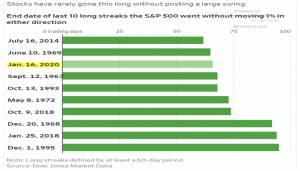
    Markets are rising on a daily basis but in terms of volatility, things have been “quiet”,  i.e. the number of individual big day moves has been non-existent for a long period now. Stocks rarely go this long without a big move. The chart below illustrates where the current period ranks in the league tables of complacency.

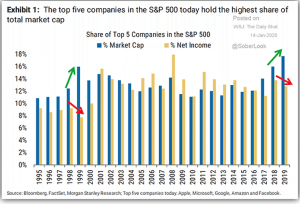
    Individual stocks showing parabolic moves can also be a “tell” of exuberance so we are quite intrigued by Tesla’s recent moves. Its market capitalisation (value) now exceeds that of the entire US auto sector (GM, Ford etc). This prospect was written up in this column previously as a potential 2020 uber-surprise; little did we think it would happen within the first three weeks of the year. It’s possible there is a single stock story there but a quick look at the 5 largest stocks in the US also raises a few eyebrows. The concentration of capital in the US market’s 5 largest companies is at a twenty-year high per this Bloomberg chart below.

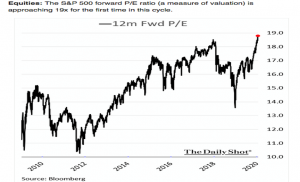
    It’s not just the mega-cap end of the market. The overall market is cruising to record valuation levels as a multiple of future earnings (P/E) for this business cycle. The chart below shows a pronounced spike in recent months courtesy of the excellent Daily Shot blog/newsletter.

    It is fair to say that if the newsflow on the Coronavirus outbreak continues to escalate the chances of investors sitting on 30-40% gains over the past 12 months taking some money off the table is pretty high. On a more positive note, corrections are healthy and the overall picture of the global economy and financial conditions is pretty robust. There is still a wall of central bank monetary support, historically low costs of capital and signs of a pick up in the global manufacturing sector.  Temporary shocks also present cheaper opportunities to revisit great stories missed in the big moves over the past year.  So, it might be time to be greedy when others fearful as Warren would say.

    In the meantime, I will brace myself for ridicule and a round of Coronas on me in a few weeks at a local hostelry with former colleagues. As the great traders know, it’s best to stay humble and liquid….


    Enjoyed this blog? Then why not check out our other great content by clicking here!

  • The Most Important Poll In Markets Today

    As impeachment hearings begin in Washington this week one can’t help wondering what Roger Ailes would do. Ailes, the creator of Fox News, is the subject of the latest US blockbuster mini-series, The Loudest Voice. It’s a scary reminder of how Fox News dramatically changed the US political landscape and used TV, not just to shape audience views but to deliver a vision of the world demanded by its viewers. Ailes himself once said, “Truth is whatever people will believe”. It is already clear Ailes’s legendary truth-shaping genius would be sorely tested on Capitol Hill right now. However, it might not even matter.

    There seems to be an air of resignation that Donald Trump’s base support of Fox viewers are unmoved by their President’s daily dose of awful. Porn star pay-offs, Greenland annexation, Kurdish betrayal, North Korean love letters, Twitter tantrums and Putin puppy dog fawning have failed to erode core voter support of circa 44% in current national polling. Critical to this robust base is the cult-like devotion of almost 90% of Republican voters. Thanks to the electoral college voting system in the US it’s entirely possible Trump could be re-elected in 2020 with a sub-50% support base. However, wall-to-wall TV coverage of impeachment hearings in Washington is possibly the last chance for this core support to shift.

    The live TV depositions of the first two witnesses from inside the US State Department, George Kent and Bill Taylor, paint a very stark reality that the Prime Minister of an ally, Ukraine, was the subject of a mobster style shake-down. The foreign policy version of wise-guy extortion was the blocking of much needed military aid to force a false investigation into election rival, Joe Biden. There are multiple other witnesses due to testify with similar tales and the only accounts missing are White House figures defying subpoenas to appear. It’s TV torture for Trump and his Twitter account is exhibiting heightened levels of agitation. However, there is only one poll that ultimately counts.

    We are only in the impeachment hearings phase. The vote to impeach is still to come in the House of Representatives and will likely pass. Then it’s on to the Senate for a trial. The hurdle in the Senate to actually convict Trump and remove him from office is a two-thirds majority guilty vote. This is where Republicans failed in impeaching Bill Clinton. Most observers correctly believe it is currently almost impossible to see how the required 20 Republican Senators cross the aisle to vote with Democrat Senators for removal of the President.

    This reluctance of Republicans to convict is not driven by any devotion to the country, the presidency or the constitution. It is entirely driven by survival instincts. Republican political careers without the support of the Trump base are toast. But that Trump approval rating within the Republican vote needs to stay at 70% or above. Below that and Senators will know the numbers with or without the MAGA Trump base won’t stack up to beat their Democrat rivals in 2020 elections. So, this internal approval rating within the Republican/Fox base is absolutely critical for Trump’s survival. It also will be watched closely by financial markets.

    A Trump presidency in real trouble will encourage the Chinese to stall on trade war negotiations. That, in turn, will continue to hurt global manufacturing activity levels. One should also consider the impact of a chaotic exit of Trump from the presidency. There will likely be an electoral backlash and fears of a new less business-friendly occupant of the White House. Wall Street is already ringing alarm bells about a potential Warren or Sanders presidency. One should also not overlook the impact on US consumer confidence.

    It will not be easy for a nation to digest the likely truth that the 2016 election was manipulated to install a Russian foreign policy asset. One should be mindful of the performance of markets the last time the US suffered a crushing embarrassment. Arguably, the Nixon resignation and the Vietnam retreat in 1973-1974 had multi-year consequences rather than the Middle-East oil crisis of 1973. The Watergate Hearings were first televised in May 1973 when the S&P 500 was trading at 615 points. By June 1982 the S&P had more than halved to the 290 level after a multi-year bear market. This makes for sober reading but one could argue we are in a better place than the 70s. Globally, investors are enjoying a good year despite geopolitics and slowing economic activity. It’s all very Goldilocks – cooler economics, warmer money-printing/rates.

    Sure, the S&P 500 chart makes for cheerful watching as it reaches all-time highs. Also, TV screens will provide some amusing moments from Capitol Hill in the coming weeks. But…voter polls have the potential to present an uncomfortable truth whether they change or not. The first possibility is that the truth, as most sentient beings understand the meaning of the word, will be ignored and the Trump support belief/truth remains unmoved. In that case, the longer-term implications of constitutional chaos, geopolitical instability and continued illegal actions from the White House will be significant.

    The alternative scenario of a significant shift in Republican polling will deliver more immediate negative market reaction but hopefully undo 25 years of Fox News reality shaping and abdication of broadcasting responsibility. No doubt there will be short term pain and embarrassment for many but a restoration of truth to US politics can only be a good thing. The loudest voices have enjoyed too much airtime.


    Enjoyed this blog? Then why not check out our other great content by clicking here!

  • Oiling our Fears

    Oiling our Fears

    Crude oil prices are now trading at the same levels as they were on the Friday before the bombing attacks on the Saudi Arabian oil fields. That seems odd. Five decades of Middle East strife has taught market traders that significant cuts to oiling due to war leads to prolonged spikes in prices.

    This is not just a 1970s phenomenon. As recently as 2003 and the second US-Iraqi conflict, the global economy experienced an oil shock of mid-$20 per barrel pricing motoring up to $140 per barrel by 2008.

    Sure, the recent Saudi outage is not quite a war scenario but the precision (too precise?) attack has taken out 5 million barrels or almost 5% of global oil supply. That’s not far off the impact of the 2003 Iraq war, and the initial 20% spike in oil prices on news of the attack did reflect a major event in energy markets. Of course, the Saudis and an election-frazzled Trump administration were quick to reassure markets about adequate reserves, quick restoration of supply etc. However, almost two weeks after the attack there is a growing acceptance by Saudi Arabia’s wannabe IPO, state oil company Aramco, that production facilities will be out of action for many months, possibly a year. That’s before we even mention a ramping up of tensions with alleged attack sponsor, Iran. Bluntly, where has all the fear gone?

    Perhaps it has been replaced by a greater fear.  Donald Trump was so scared of a 16 year old at the UN meeting in New York he chose to skip the Climate Action Summit and instead made a speech at a Religious Freedom meeting. Always important to keep those avangelicals happy. As for the one million Uighur Muslims incarcerated in China, there wasn’t even a mention. Happily, Greta Thunberg’s fear-filled speech garnered far more attention than the Dear Orange Leader’s.

    The teenage wake up call to the world was quickly followed by a rather scary report from Goldman Sachs(hardly a leftie liberal socialist champion) highlighting the significant impact of climate change on urban populations living less than 10 meters above sea level. The numbers are staggering and sadly it might be too late to prevent the consequences of an already warmer world. The warning from this Wall Street leader was stark, “ It might be prudent for some cities to start investing in adaptation now.”

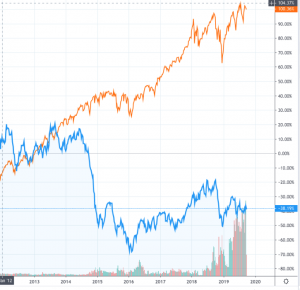
    Clearly, there is a growing consensus that carbon/greenhouse emissions are affecting climate. We have written previously on some leading hedge funds who now factor climate change into ALL their investment decisions. Arguably, the smart money has been selling out of oil for years. Here are a few data points which tell that story. The first is a chart showing how the S&P 500(orange) has diverged dramatically from the downward trajectory of oil prices(blue) since the middle of 2014.  It has been a period of healthy economic growth so that is quite striking.

    It is not just the commodity price which has lagged the market. Exxon Mobile is about to drop out of the S&P 500’s top 10 stocks for the first time in 90 years. Furthermore, the energy sector now accounts for just 4% of the overall US market. One can’t help feeling that actions of economic leaders are being watched very closely. Take, for example, the decision by Amazon to place an order for 100,000 electric delivery vans(yes, that is the correct number of zeros) from a company, Rivian, of which you probably have never even heard.

    Oil services stocks which support the major oil companies on infrastructure, logistics etc have seen their share prices fall more than 50% in 2019. That’s in a year when markets are actually up more than 20%. We have seen commentary on Wall Street puzzling over this wealth evaporation and wailing, “The oil service stocks are trading at prices that imply the entire fossil fuel industry will disappear”. That is an extreme outcome but there is a growing sense that climate change is an extreme challenge. Even Taoiseach Leo Varadkar has decided we will never be called Oiland(or Oirland) as he has told the UN Climate Summit that oil exploration in our waters will end.

    Returning to our own confusion about the lack of fear over the Saudi attacks we must consider that the temporary spike in oil prices was yet another opportunity for professional investors to lower their exposure(sell) to an industry in the cross hairs of a fearful planet and motivated leaders. In a week when the WeWork IPO has revealed itself as a “greater fool” proposition we would note that the Saudis whose entire economy depends on fossil fuels is also trying to IPO/sell you Aramco.

    WeWork didn’t work, its CEO is now out of work and the franchise itself might not see out 2020. In this warming world oil now generates a new set of fears and it doesn’t help the pricing of the product. The greater planetary health fear will win out over old-fashioned energy supply fears and that perennial investor behavioural companion, the fear of missing out. Steer clear of your old fears; the teenagers are the brave ones and will sadly be proven correct.


    Enjoyed this blog? Then why not check out our other great content by clicking here!