Tag: portfolio

  • And You Thought Only The Bots Did Comebacks…

    And You Thought Only The Bots Did Comebacks…

    As pantomime season approaches, it almost explains why most of the Conservative Party front bench are off the front pages. Unless, of course, you’re new Home Secretary, James Cleverly, and a wee bit envious of the coverage given to Nigel “I’m A C…….. Get Me Out Of Here”. Poor James, affectionately known in the corridors of Westminster as “Jimmy Dimly”, has been caught not once but twice using expletives in awkwardly public circumstances. However, if we are looking for real awkward stuff, consider the board of OpenAI. It has been quite the week. The board room coup and firing of CEO Sam Altman last weekend shocked the AI world and threatened to incinerate $90 billion of corporate value in OpenAI. However, a whirlwind four days later we were on to our fourth CEO, a potential 600 resignations out of 700 personnel, thousands of worried start-ups built on OpenAI’s flagship ChatGPT model and a potentially costless acquisition by Microsoft. Anyway, the fourth CEO happens to be Sam Altman who seems to have had the comeback of comebacks. So, all is back on track? Ehhh… not quite.

    The details as to what was the exact cause of the original board room bust up are not yet clear. But… the general gist of things is the tension between executives wanting to develop AI at break-neck speed and board members worried about the risks involved with super powerful models capable of Artificial General Intelligence(AGI). The advance hidden in the AGI acronym is the ability of a machine to reason and think, potentially in a superior way to a human being. Now, AGI(vs AI) was supposed to be some way off on development timelines, but reading between the lines something has spooked the members of the OpenAI board. The existential threat of out-of-human-control technology is a genuine fear but there are two key drivers as to why the “growth” champions want to keep moving, and fast:

    The Stakes: At a corporate and sovereign level, the risk of your competitors or geopolitical rivals gaining a lead in AI has huge market and political power implications. If someone gets a sufficiently big technological lead, you could be corporately or literally dead.

    The Incentives: We saw this week the incentive to be ahead in AI. The company nobody had ever heard of 6 months ago, Nvidia, released its Q3 results. Expectations were sky high evidenced by the market giving it a current market value of more than $1.2 trillion. And, yet it still beat expectations with its data centre chips (AI) revenues up 279% year-on-year and exceeding the sophisticated forecasting models of Wall Street’s finest by a whopping $2 billion.

    So, this tension between technology risk and technology development/growth is going to dominate AI discussion and regulation in the coming years. We have already seen the Biden administration put in place an Executive Order on AI safety and security, and Europe’s AI Act is imminent. However, these attempts to mitigate risk might lead to another comeback by a technology closely connected to another Sam.

    Unfortunately, Sam Bankman Fried faces Federal incarceration and won’t be restored any time soon to the helm of crypto platform FTX. Indeed, this week another platform founder in the space Changpeng Zhao or “CZ” of Binance was convicted of money laundering, fined $4 billion, stepped down from his executive role and narrowly avoided a prison sentence. Those are the bad headlines in the crypto world and could cause readers to miss the bigger picture. The reality is that one of the huge risks of AI is fraud, caused by deep fake imagery, false ID and misrepresentation. Now, crypto can help. Well, not crypto or cryptocurrencies because they are applications/digital assets. However, they are built on a really powerful technology, blockchain. And, blockchain technology is really good at ID verification, security and transparency/ traceability. Clearly, this could help with fears over AI and, like Nvidia, blockchain technologies could be a way to play or track the opportunity in AI. As always, we like to follow the money for evidence of our thinking. So, consider the following…..


    • Bitcoin is up 130% this year.
    • PayPal has launched a US dollar stablecoin ie a digital currency layered on to blockchain technology.
    • For those that giggled at NFT madness and wealth destruction, note Disney has launched its own NFT market platform in recent weeks.
    • And if you thought nobody wanted to read about their crypto wealth destruction, you might be surprised to hear that crypto exchange, Bullish, has just acquired industry publication, Coin Desk.
    • Blockchain.com just raised $110 million with a $7 billion valuation.
    • Blockchain payments firm, Fnality, in London just did a funding round for $95 million backed by Goldman Sachs.


    The funding rounds in particular indicate significant capital seeing a future for blockchain. Indeed, AI and its risks look like they are driving a faster blockchain comeback than investors expected. If the OpenAI rumours of a big AGI breakthrough are true, then the risk genie is truly out of the bottle and blockchain is on for a BIG comeback.

     

  • Father Ted, Perspective And Portfolio Positives

    Father Ted, Perspective And Portfolio Positives

    “Ok. One last time, Dougal” says Father Ted to his TV side-kick Father Dougal. In a small caravan on Craggy Island, Ted is holding some miniature plastic cows while pointing through the window to the real much larger versions grazing in the adjacent fields . “These are SMALL. But the other ones out there are FAR AWAY….. small…. far away” repeated Ted in yet another failed attempt to teach perspective to a confused Dougal. “Ah, forget it!!” says a defeated Ted. Great comedy, but in real life that sort of capitulation can be both dangerous and costly. The confusing aftermath of the horrific carnage at the Al-Ahli Hospital in Gaza was a reminder of the increasing dangers of deep-fake imagery, misinformation campaigns and client-journalism in fighting to establish ‘a truth’. We just can’t give up on The Truth. Perspective and reflection does help. So, in a world dominated by ugly headlines and woeful weather let’s visit a few big investment themes growing real legs. Where better to start than security…far away

    The heads of cybersecurity from the UK, Australia, the US, Canada and New Zealand, known collectively as the “Five Eyes” security alliance, have seen “a sharp rise in aggressive attempts by other states to steal competitive advantage”. In particular, they urged smaller companies and startups to be more vigilant in protecting their IP and critical business information. Having recently raised funds for Binarii Labs, we are very much aware of the increasing demand to protect data rooms for corporate finance deals, cloud storage architecture, legal files and personal ID information from being breached. The good news for Binarii shareholders is that the cybersecurity theme continues to attract VC funding. In New York fraud prevention play, Prove Identity, secured $40m from MassMutual Ventures and Capital One Ventures. Also, despite its name, Fingerprint, has built a big reputation in detecting fraudulent devices rather than human beings. The Chicago-based company has attracted $77m of investment since its 2010 inception and completed a $33 million Series C funding round this week with Nexus Venture Partners as lead. Cybersecurity feels like a portfolio “keeper”. But, as always we advise diversification of risk in a portfolio for the health of your wealth. And, for health too…

    Well, for those who have invested in AuriGen Medical then you know we like healthcare technology on lots of levels. The good news is that we have a few more medical and biotech investment opportunities to add to your startup portfolio before the end of the year. Even Bloomberg is picking up on the super medtech ecosystem which has emerged in the west of Ireland. The recent arrival and $327 million investment by medtech Dexcom in Athenry might have been the prompt for the Bloomberg article and some great data featured. However, this has been a steady build in the shadow of the higher profile Big Tech “Silicon Docks” cluster in Dublin. Now, medtech and biopharma are experiencing that virtuous circle of investment, deep-tech expertise, spin- off activity, entrepreneurship and innovation. The inspiration for this flow of healthcare startups is a multinational backbone of 14 of the world’s 15 leading medtech companies and 10 of the leading global biopharma companies. Clearly, your wealth could also be your health…..or your pet’s health.

    I have always listened carefully to the UK’s best performing fund manager of the past decade, Terry Smith. Having worked for him, and embraced his investment philosophy of observing the cash flow returns on all of the capital in a business(debt, leases/commitments and equity), I know he likes high frequency consumer product businesses – think Coca Cola, Nestle, Unilever etc. Then know that he LOVES pet food and pet health producers! He would often quote some bonkers survey that consumers would sooner feed their pets than their children. The key point is that the spend on pets is enormous and consistent. In the UK alone £10 billion is spent annually on dogs. Dubliner-founded Butternut Box recently announced a £280 million funding round with venture giant, General Atlantic, as lead. That business is valued at over $500 million now, but at the other end of the pet healthcare spectrum, Spark is raising money for a vet-designed and managed platform to match reputable breeders with properly vetted owners. Pet healthcare is the mission and Pet Bond is currently offering equity at a significant discount. It’s also eligible for a further 40% valuation discount via its EIIS tax rebate eligibility for private investors. So, that’s a lot of health covered but what about the planet’s health

    We have written plenty on the cleantech theme but it’s highly likely there will a few portfolio investment opportunities coming Spark investors’ way very soon. To whet your appetite and apply perspective, know the following:


    • European VC market sentiment is at a record low. However, the drive to save the planet doesn’t do sentiment. It’s all about action. So check out the Q3 European VC funding activity. A whopping $4.5 billion, or 25% of total tech investment, went to green technologies in Q3.


    • Aira, the latest startup from Northvolt and H2 Green Steel founder, Harold Mix, has just raised €87 million for its heat pump business.


    Of course, early stage investment is higher risk but we do need to keep an eye on those themes which are enjoying healthy investment flows. Then again, there is no such thing as a sure thing. Or…. risk free. As a final reflection, for the sceptical and the risk averse out there, who would like to guess the fall from peak value for Bitcoin compared to that of ‘risk free’ US Treasury bonds guaranteed by the mighty US Government? Who got close to a 51% dive for Bitcoin? Probably a lot of you. But did you get anywhere near US Treasuries cratering by 47% from their all-time highs!!! Probably not. It’s all about perspective really. And, keep watching those healthy portfolios.


    • For details on the Spark EIIS Private Portfolio product DM direct or call your Spark relationship manager.
  • An All Cash Strategy Is A Very Big Bet

    Winter League tennis is hardly in the glamour league of January sporting events but it still can deliver learning lessons. As my doubles partner whispered to me at the weekend that his back was crocked, we had a rueful giggle recalling the Mike Tyson quote that “Everyone has a plan until they get punched in the mouth”. Indeed, investors might be feeling the same this week as markets take fright at the potential economic impact of a Chinese Coronavirus. The excellent financial commentator, Bill Blain, at The Morning Porridge calls the unexpected punches “no-see-ums”. Of course, regular readers will be less surprised at developments given our words of caution last week in “Charting A Dose of Flu”.

    We’d rather move on and tackle another area of concern. It is striking to us that total Irish household deposits (cash) in the banking system now exceeds €110 billion. That number increased by circa €7 billion alone through 2019 despite every asset class on the planet posting significant gains thanks to the global central banks’ QE methadone clinic. Of course, it is wise to have a healthy skepticism when the crowd gets giddy. Keeping some cash on hand is always prudent. But €110 billion? Over the years when I have been in wealth advisory mode I have often heard individuals claim an agnostic attitude to financial markets and a preference for cash safety by avoiding “any bets”. Sadly, that is a dangerously inaccurate perception of one’s own safety strategy. The truth is holding too much cash is an extremely strong “bet” in its own right. We can think of two “punches” which could throw that safety plan into disarray.

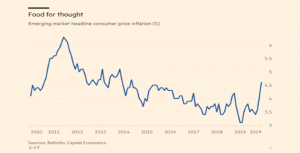
    Firstly, in a low inflation world, holding cash is less punitive because the purchasing power of savers is largely unaffected. One might quibble with that “low inflation” view when you look at health, housing education and insurance costs but let’s just focus on traditional inflation reports. It is true to say at this moment inflation is very subdued in developed markets but inflation is one of those things that can suddenly appear without much advance notice. Hence, our curiosity was tweaked to see an FT report on consumer price inflation in emerging markets hitting a six-year high in recent weeks. Here’s the chart of a significant inflation spike:

    This spike is driven mainly by food inflation which we warned of earlier in 2019 as African Swine Fever decimated the Chinese hog population. However, Coronaviruses and climate change are examples of other potential disruptions to the food supply for a rapidly growing Asian middle class.

    Perhaps inflation spikes will be just a temporary thing, but the meeting of a low-interest rate world and a digital world is also worth thinking about as a second threat to cash savers. Bluntly, banks are losing money by holding deposits for private depositors. Corporates are already being charged for the safe custody of cash in Europe as negative interest rates wreak havoc with traditional deposit/lending banking models. Furthermore, the use of physical cash in payment transactions is more costly than digital equivalents.

    Be prepared for cash payments to incur additional charges and look no further than Sweden for a glimpse of the future. Barely 1% of the value of all payments in Sweden are made using coins or notes. In fact, Sweden is forecast to become an entirely cashless society by 2030. It seems inevitable that banks and governments will encourage/incentivize the use of cash deposits through taxes and fees. Suddenly that “cash safety plan” feels like a very big bet that things are just going to carry on as before. While it is difficult to forecast the future it is safe to say the future and the value of cash are less certain.  As we always say, a strategy allocated to just one asset class, even cash, is a very risky one.

    A balanced investment strategy across residences, property, pensions, cash, alternative assets, wine, fine art and even funding exciting start-ups has its merits. For those interested in looking for cash alternatives it might be worth looking at our recent piece “Good Portfolio Habits Pay Off” to prompt some thought! So, ship those Boris Brexit souvenir 50p’s in. They could be both financial and comedy collectors’ memorabilia items over time. Embrace change. It is happening and we must remember another boxing legend’s words…

    “A man who views the world the same at 50 as he did at 20 has wasted 30 years of his life”  – Muhammad Ali

  • Good Portfolio Habits Pay Off

    Nobody ever told me the Great South Wall was that long! As the muscles screamed and the expletives flowed on my not-so-little run yesterday there was a fleeting moment when I almost quit. I wouldn’t have been alone on January 19thResearch conducted by Strava based on 800 million user-logged activities predicts this date as the day most people are likely to give up on their New Year’s resolutions. In fact, approximately 80% of resolutions are abandoned by the second week of February. Thankfully, the sun was shining and the brain cajoled me into accepting that this run was just one of a series of good habits to deliver a very productive 2020. Of course, the outcome is not a certainty but good habits vastly increase my chances. The same goes for investment goals.

    Investment can be made to sound very complex. The professionals love complexity as it’s a perfect environment to sell expensive products and services to the least sophisticated clients.  Whoodathunk there are more investment funds (75,000  at last count) to choose from than individual stocks globally? Yes, financial markets are complex but simple good financial habits can greatly increase investors’ chances of meeting their goals over time. We have previously written about the advantages of a portfolio approach versus the “lucky dip” dreamer derby so a portfolio of multiple investments is a sensible start.  But what’s your goal?

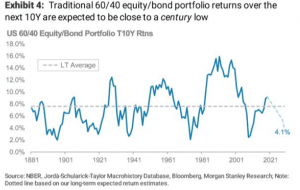
    The answer to this is entirely dependent on your age and your tolerance/capacity to suffer loss (even permanently). We shall assume for the purposes of this article the time horizon is 10 years and that the capital in this portfolio can incur some losses along the way and won’t be needed to fund living expenses over the period. No doubt readers are aware financial markets have had a good run over the past decade. It is entirely sensible to take the view that we must rein in our expectations for the next decade. Wall Street giant, Morgan Stanley, has already tried to manage expectations with its strategists suggesting a standard mix of bonds and equities in a portfolio would earn just 4.1% each year over the next ten years. Low-interest rates, low growth and commensurate low inflation are the familiar returns killers.  Here’s the chart to anchor our goal expectations:

    Now, let’s shift our attention away from the expensive large listed companies and all those bonds yielding zero or even less. In a previous thought piece, we wondered if smaller companies have some performance catch up to do on their much bigger listed peers. Holding that thought, we reckoned it might be helpful to illustrate the relative possibilities of assembling a portfolio of crowdfunding start-up opportunities over a four year period. So, here’s a suggested approach with plenty of good habits:

    1. Invest €100 in an equity crowdfunding campaign every month for 48 months (4 years). This good monthly habit avoids trying to “time” your entry into markets which will fluctuate over a long period.
    2. The portfolio goal is to own 48 equity opportunities in equal amounts of €100 by the end of year 4. This good habit of multiple holdings diversifies the portfolio across industries and geographies.
    3. A portfolio with multiple holdings also allows an investor to collect financial data across those companies and monitor various key metrics like sales, growth, cash flow/burn, margins, debt etc. Like all resolutions/habits – they are only sustainable if measured. This habit of measuring will ensure discipline and selection of opportunities which are consistent with the metrics/averages being observed. More on that again.

    Good habits now in place, will the portfolio deliver? There are no guarantees in finance but here are a few suggestions as to outcomes and the understanding that the professionals think 4% per annum might be the best on offer over the next 10 years. We are suggesting a €4,800 investment of capital. We will assume that all target investments (48) benefit from a 40% tax refund under the EIIS investment scheme.  After refunds of €1,920, investors’ are risking €2,880 in real terms. So that’s the capital at risk. We need to look at where the returns come from.

    Readers will recall our previous references to the famous Arizona University research showing just 4% of all the listed stocks in US history have delivered the entire returns of the S&P 500 since 1926. In theory, and the sample size is small, it is possible as few as 2 holdings in a 48 constituent portfolio will account for the majority of returns. Now, remember Morgan Stanley is telling us a 4 year period might deliver a return on our capital of just over 16%.  Here’s a table to suggest potential outcomes. We are going to assume the rest of the portfolio loses the equivalent of the tax refund(40%) ie 46 of the companies which received €4,600 in capital will lose €1,920 between them. Admittedly, this is probably too harsh an outcome but it will help illustrate what is required by just a few successes to beat a 16% portfolio return forecast on Wall Street. The following table lists a few scenarios and the impact of two companies achieving significant valuation growth:

    Please note in the “2 Winners”  column we are using €200 (€100 in each company) as the initial invested capital. Therefore a gain of €500 in the Match Wall Street scenario requires both companies to increase their value by just 1.5x. This is not a significant hurdle in the world of smaller companies and start-ups. The Run Wall Street scenario might sound fanciful equating to a 20x gain (or 2,000%) on the initial capital invested in the two companies. However, this is very possible in the world of private equity and startups. Yes, there is the risk of losing all your capital when betting on single winners but portfolio diversification is a very good strategy in a high-risk asset class.

    Returns are inextricably linked with risk. That’s a fact and don’t ever buy any product which claims no risk involved. In the worked example above your total capital at risk was €2,880. For perspective, that equates to €15 per week of spend where the loss of capital is permanent – think almond cappuccinos, cars/taxis and mobile data usage on a weekly basis. Maybe take a walk with a bottle of H2O? What productivity goals wouldn’t prosper by ditching the screens, exercising and hydration…..

    Finally, in the spirit of fresher thinking, it is worth noting the most unlikely companies can be the big winners so keep an open mind and spread the risk when building an investment portfolio. As an illustration and a little quiz, what’s the best performing listed stock in the US over the last 20 years? The clues would be that it features in a previous article and it delivers energy, but not the carbon-based kind!  A real Monster which has delivered 87,000% returns over two decades. Wowzers!  Good habits can really energize……

  • Pick A Winner Or A Portfolio?

    I met a very glum Italian fund manager at a Dublin bus stop the other day. A former client, he’s usually a cheerful chap and my initial fear was that after 18 years living in Ireland the excruciating “1-minute due” display at urban bus stops had finally broken him. I was wrong. Something else was broken.

    Irrespective of our professional relationship, both of us over the years would have shared a passion for financial markets and the events that shape them. On this particular morning, my fund manager friend was less talkative and declared he was past caring about the specific drivers of markets as it just didn’t matter anymore. For a brief moment, I thought he had lost his job but he quickly reassured me he was still working in the equities market. He then explained that the reason for the dip in his professional enthusiasm was a sense that markets were “broken”.

    After further discussion, it was clear that central banks’ ultra low-interest rates and consequent turbocharging of prices across all asset classes were not his only professional frustration. Yes, as an “active” fund manager this combination of almost free money and frothy asset inflation made it difficult for his firm to beat or even match the performance of overall market replicating index funds and exchange-traded funds (ETFs). But there was also a whiff of resignation that the higher fees charged by an “active” manager who picks individual stock winners could no longer be justified. Bluntly, the active fund manager business model was in danger of breaking too.

    Not so in the world of super cheap index funds and ETFs. These funds don’t pick winners or actively trade. They just mimic at very low cost the exact constituents of major indices like the S&P 500, Nasdaq, Dax and FTSE 100. The past decade has only seen one negative performance year for global equities and passive fund costs to investors continue to go lower, in some cases to almost zero. No surprise then to see that index funds and ETFs have quadrupled in size since 2010 to just over $10 trillion according to Robin Wigglesworth at the FT.

    The investor flight to cheap index portfolios is killing the traditional active manager who charges his/her clients an annual management fee based on their expertise in researching and selecting winning stocks. The ugly truth is that such “expertise” fails to reveal itself consistently and only a very few active managers produce long-run market-beating performance. Time is possibly the active manager’s greatest weapon – think Warren Buffett. However, long-run historic data would suggest there really are only a few meaningful winning bets.

    We have previously referenced a famous 2017 research paper from Arizona State University’s Hendrik Bessembinder. The findings are stunning. The best-performing 4% of all listed companies account for the entire gains of the US market since 1926. As practitioners in the world of start-up investments, this has given us pause for thought as to the best investment strategy for investors on equity crowdfunding platforms like Spark CrowdFunding.  The good news for crowdfunding investors is that a critical component of performance/success in the larger public markets is low costs.

    The no-fee model for investors on crowdfunding platforms is a great start. It gets even better if one takes into account a further 40% discount on your initial capital stake when the investee start-up company carries an EIIS badge.  So far so good. The next suggestion leverages the experience of active and passive managers over the years and the historical truths in Bessembinder’s research. It is incredibly difficult to pick winners, particularly at an early stage in a company’s journey. The information gaps are huge. However, by employing a portfolio/index type strategy an investor can not only build his own low cost (free) exposure to an entire asset class of start-up private equity but can also avail of a steady stream of opportunities on crowdfunding platforms over 3-4 years.

    A simple monthly budget of even €100 to be invested in a company every month for 4 years would give a patient investor exposure to almost 50 companies with exciting prospects. Some companies might not survive but those that thrive can deliver very nice returns for the overall portfolio. Don’t forget you have a 40% tax cushion to start with so your approximate €5,000 budget over 4 years is really only €3,000. Then remember that 4% figure from Arizona.  My fund manager friend is beginning to realise his time would have been better spent building portfolios for specific asset classes (like private equity) rather than trying to find the very few “winners” in the broader market indices.

    Crowdfunding investors can benefit from the 2020 hindsight of battered active fund managers over the coming years with a sensible portfolio strategy. We will be writing much more on this in the coming weeks as we get a sense of our monthly pipeline of campaign opportunities. Unlike Dublin Bus, we will avoid the “1-minute” hype and do our best to provide a steady flow of campaigns through 2020.


    Enjoyed this blog? Then why not check out our other great content by clicking here!