Tag: risk

  • What’s The Score For ’24?

    What’s The Score For ’24?

    It’s that time of year again to pause, reflect and hope to do better in future. Unless, of course, you’re the Conservative Party in the UK or the Republican Party in the US and ‘the race-to-most-nasty’ is the leadership badge of shame soon to be re-spelt with a ‘Z’. Back in the do-better world, a review process can help shape future efforts. So, let’s do a quick check on our four multi-year investment themes we identified almost a year ago in “Four Pictures To Develop This Year”.  First, we will remind ourselves of what was written, and then score/review how things developed for AI, Housing, Corporate Credit and Cleantech/Batteries. We kick off with the biggie….. Artificial Intelligence (AI):

    “The excellent database resource, Our World in Data, shows annual corporate investment in AI doubling from circa $80 billion in 2019 to over $160 billion by mid 2021. More specifically, the explosion of interest in generative AI (ChatGPT, DALL-E etc) has seen VC investment increase by 425% to $2.1 billion since 2020”

    Review: Well, at the half-way stage of this year, 18% of global venture(VC) funding went to AI, clocking a total of $25 billion(Source: Crunchbase). Furthermore, with the tech-heavy Nasdaq index gaining almost 50% this year, Nvidia reaching a trillion dollar market cap and OpenAI hitting an $85 billion private market valuation, it is not hard to identify AI as the single biggest positive driver of investment markets this year. Of course, the trajectory of the cost of money (interest rates) also helps with the confidence bit, but we have written before that November 17 has more than one revolutionary connotation. As of this year, the night of November 17th will be remembered for the $200 billion swing in value between Google and Microsoft in a matter of hours, and entirely driven by the relative success or failure of their respective cloud computing divisions. The AI revolution is in full swing and will continue into 2024

    While the cloud has become the housing proxy for AI, what about our own housing markets? A year ago we were concerned:

    “Of course, rising interest rates don’t just impact companies. The biggest item on an individual’s balance sheet is likely to be a house and as interest rates rise, so do mortgage rates. The push/pull effect of higher interest/mortgage rates can reduce the price of the assets being purchased, in this case houses rather than growth companies…… indicates a more difficult 2023 for a number of major housing markets.”

    Review: Arguably, this theme did not play out in a significant way, unless you were Chinese. Bluntly speaking, the doomsday predictions of housing crashes in the US, Australia, Canada and the UK just did not materialise. However, house prices are somewhat softer in many markets. The St Louis Fed has said median house prices in the US are off 10%. Even the UK with its dysfunctional government, and one Prime Minister(Liz Truss) having a good go at crashing the property market all by herself, has seen price slippage of just 1% (Source: Halifax). The key flaw in the doomster arguments was that most people kept their jobs. Major economies in a state of full employment was not expected as the “vibecession” never turned into a recession. And, if recession is avoided then there’s another asset class which has dodged a bullet; corporate debt/credit. Here’s what we feared….

    “In real world terms, the knock–on effect of tighter funding conditions will begin to reveal themselves in 2023 as companies with challenged balance sheets/indebtedness – aka ‘zombies’ – move into distressed territory.”

    Review: As a proxy for corporate stress you’d expect high yield bond (lower quality debt) spreads to have risen through the year. But no. They’re actually at their lowest since April 2002. However, we’ve had a few big bankruptcies through the year – Silicon Valley Bank, WeWork, Diebold Nixdorf, Rite Aid, Van Moof, and even Birmingham City Council. By June UK bankruptcies were up 40% on the year before. According to S&P Global, in the first 10 months of this year 561 companies sought bankruptcy protection in the US. That’s more than any year since 2010, except for the Covid-19 hit in 2020. So, I’d give us a pass mark on this but feel there’s another year of stress ahead. In particular, commercial real estate as an asset class is going to witness some very painful write-downs and outright collapses. Check out the recent travails of Austrian billionaire, Rene Benko, and his $25 billion property empire, Signa, for a very current case study.  However, not all building is in trouble….

    “In some ways, the best proxy for the planet’s race towards reducing fossil fuel dependence is the enormous investment currently being ploughed into production facilities for batteries to power a generational shift to electric vehicles(EV). China in 2020 accounted for 75% of global battery production capacity but that’s going to change. Europe intends to up capacity 5-fold by 2030 and the US isn’t just home-shoring semiconductor manufacturing.”

    Review: Like AI, I think this gets us pretty good marks. The cleantech and energy storage(battery) revolution is in full flow. McKinsey reckon $6.5 trillion will be spent every year on capital expenditure/building facilities which, in the words of the latest Cop-out 28 text, will “transition away from fossil fuels”. We did say catch up was required by Europe and the US in battery manufacture, but arguably the US has accelerated faster. Thanks to ‘Bidenomics’ and the IRA Act the US is seeing capital investment in manufacturing reach levels not seen in four decades. According to MIT, cleantech investments in the 12 months to July 2023 hit $213 billion, and was mostly allocated to EV battery manufacturing, renewable energy and green hydrogen infrastructure. No wonder the old-economy barometer, the Dow Jones Index, just hit an all-time-high level of 37,000 points. More amusingly, Trump whisperer, Maria Bartiromo, on Fox Business was forced to say “the economy is doing much better than most people understand.”  Wonder how that misunderstanding developed, Maria?

    So, there’s a temptation to stick with the same four themes for 2024, but in the spirit of Christmas we’d like to give a bit more. The bonus good news is that Christmas might also be easier on the waistline in the coming years. Yes, AI has stolen many of the headlines this year but there’s a 100 year old company in Europe breaking records too. Denmark’s Novo Nordisk is now the most valuable company in Europe with a $437 billion market capitalisation thanks to its insulin product, turned weight-loss miracle drug, Wegovy. This semaglutide-based drug is a game-changer for up to 750 million people living with obesity. However, there might be even bigger break-through treatments to come. And, it’s all about BIOLOGY.

    We are entering the world of gene editing spearheaded by CRISPR technology. Get used to that term. CRISPR stands for Clustered Regularly Interspaced Short Palindromic Repeats. It is a component of bacterial immune systems that can cut DNA, and has been repurposed as a gene editing tool. Only this week we were reading that the FDA has approved two ground-breaking cell-based gene therapies, Casgevy and a new one, Lyfgenia, for treating sickle cell disease (SCD) in patients aged 12 and older. Notably, Casgevy is the first FDA-approved therapy utilizing CRISPR.

    Now, think about healthcare spend being almost 11% of global GDP, or $11-12 trillion. The prospect of biology rather than pharmacology being used to eliminate various life-changing diseases is mind-blowing. Furthermore, as the first attempts to regulate AI emerge let’s open our minds up to the probability that these massive new computing powers can save decades of research time. So, as a final thought, perhaps 2024 will deliver a break-through global healthcare solution through the combination of AI and biology. Just imagine, our health becoming your wealth…. I definitely think that would score well.


  • Take Your Pension Or Portfolio To Another Level

    Take Your Pension Or Portfolio To Another Level

    Fizzle sticks! There goes another billion dollar ‘unicorn’ I didn’t back. Sound familiar? This week’s news that Ireland’s Cubic Telecom has entered the ‘unicorn’ club thanks to a €473 million investment from Japan’s Softbank should focus financial planning minds. In particular, we should focus on two things very familiar to readers of these pages. Firstly, speed. The business world is moving faster and faster. Secondly, technologies are rapidly merging and compounding value.

    Just over a year ago, Cubic Telecom was reporting annual sales(Sept 2022) of circa €30 million with its connectivity software installed in 10 million vehicles. Yep, €30 million not €300 million. So, what prompted Softbank to enter into discussions for a 51% stake purchase on a valuation multiple of 31x the previous year’s revenues? One could hazard a guess that speed of growth was one consideration, given installations of its software have ramped up to 450,000 vehicles per month and are expected to go ‘exponential’. Also, one suspects the compounding of a number of technologies is beginning to drive traction. Cubic is at the fortunate intersection of the Internet of Things(IoT), 5G connectivity, electric/battery powered vehicles (EVs), cloud computing and Artificial Intelligence(AI). We need to start thinking about multiple technologies compounding at speed rather than focusing on one technology advance, and it’s not just Ireland illustrating these two themes.

    All the gloomy headlines this year have put us all in a strange place. And, awkwardly so for financial advisors who possibly went into ‘bunker’ mode. I have been asked to look at 3 different pensions in the last week where returns to date were hovering at just over 3%. That’s actually less than you’d earn on risk-free US Treasuries currently. However, the killer data point is that the tech-heavy index, the Nasdaq 100, is up 48% year-to-date. Oh, and despite all those war headlines and oil worries from Russia/Ukraine and the Middle-East, the energy sector is DOWN year-to-date. Even Germany which is staggering into recession boasts a stock-market (DAX) hitting all-time highs and returning 18% gains this year. Note, the DAX is definitely NOT filled with tech names. However, the Nasdaq is telling us lots of technology from energy storage(Tesla) to cloud(Microsoft) to AI(Google) are emerging at the same time. Just yesterday, Google showed us a new AI bot, Gemini, and its market value jumped by $85 billion over the day. That’s the equivalent of Citibank’s market capitalization after 211 years in existence. Just one day. It feels like wealth creation cycles are shrinking.

    Latest reports suggest the AI team at French start-up, Mistral, are raising funds again. Recall that this crew of AI gurus raised over $100 million 6 months ago with no product, no business or revenues. Just a PowerPoint presentation deck. Now the team have a product (large language model(LLM) for Generative AI) and want to raise more than $300 million. The current valuation level for Mistral is ….. reported to be over $2 billion. Six months. However, before we go all dollars dreamy, note that the hard yards and years are still the norm. For example, Cubic Telecom started up back in 2005. At a higher level, consider it took Microsoft 44 years to hit the trillion dollar market value mark, Apple 42 years, Amazon 24 years and Google 21 years. Keep those tech and time thoughts and let’s move to the other end of the business life spectrum.

    We have already referenced pensions, but for many investors these are vehicles for a variety of funds investing in a mix of blue chip publicly listed company shares and their debt(bonds), government bonds, possibly some real estate and a bit of cash. Given the fast-moving tech world we live in, it is increasingly apparent that investors’ pensions or savings portfolios should allocate a small portion of monies(5-10%) to early-stage companies. Pensions are not the ideal vehicle(for the majority of people) for these investments, but the good news is that the government provides incentives with a similarly attractive taxation impact.

    For years, starting with BES schemes and then evolving into the current EIIS funding initiatives, government has encouraged private investor capital to support employment and growth for early-stage companies by offering tax rebates against income generated in the year of investment(s). That rate of rebate has been a standard 40% but is due to change. More on that later but first, let’s briefly explain the mechanics of EIIS.

    If a company is eligible for EIIS investment it will typically be introduced to private investors in three ways. Note, not all companies qualify for EIIS treatment eg. financial trading businesses are not eligible. Companies which do qualify, offer shares through the following:


    • Direct Investment: The investee company offers its shares directly to investors. These direct investment opportunities are typically offered to small groups of investors known to the company’s founders or its financial advisors, and not made public.


    • EIIS Funds: These funds are managed by financial intermediaries/brokers and request lump sums up front from private investors. The capital raised is then deployed across EIIS investment opportunities. The up-front sums can be significant(> €10,000) and the managers will charge annual fees.


    • CrowdFunding Platforms: A platform like Spark (or Seedrs or Crowdcube in UK) will give thousands of signed-up investors access to 12-15 fundraising campaigns by EIIS qualifying companies each year. The business model of these platforms is different to a fund. The investors do not pay any up-front lump sums or fees. Investors can invest as little as €250 in each EIIS investment with NO commissions, and NO management fees. Instead, Spark and other platforms only charge the companies a fee(and only if successful). One other variation on this is Angel Networks, or syndicates, which invest as opportunities arise. However, the entry level investment size (€5,000 – €10,000) and lead times are not for everyone.


    So, after paying for your shares, those shares will sit in a broker account, or a fund, or in a nominee account(independent of platform). The company will then apply for EIIS certification from the Revenue. On receipt of this notification, investors will get a certification confirming same which can be filed with the Revenue to offset taxes paid in that year.

    What sort of people could this interest? The income which qualifies for tax rebates includes employment income, rental income, dividends and ARF distributions. The amount of income which can avail of EIIS has been increased from €250,000 to €500,000 in a single year under new rules to come into effect in January 2024. Also, note the investment must be for a minimum of 4 years. The new rules in the Finance Bill also have broken the standard 40% rebate rate into different bands which we have summarised in a previous article as follows:


    • 50% for businesses that ‘have not operated in any market’;
    • 35% for a business in its first EIIS fundraise within 7 years of its first sale;
    • 20% for a business in its second or subsequent EIIS fundraise;
    • 20% for a business expanding into new markets or regions; and
    • 30% for investments via a ‘Qualifying Investment Fund’, of which there is only one in Ireland.


    Quite apart from introducing potential confusion, the ‘core’ or standard EIIS rebate of an equity investment will now be reduced from 40% to 35%. On a more positive note, the 50% relief for early-stage pre-operating companies could be very interesting for Ireland and Irish investors. It won’t have escaped your attention that the trillion dollar tech club is entirely US based. That can be attributed to deeper capital markets and Silicon Valley tech leadership but could Ireland be a leader now? I’m thinking three big areas where the Irish ecosystem is quietly building real scale and a pipeline of early-stage opportunities. Here we go:

    Medical Technology/Bio-pharma: 14 of the 15 biggest MedTech players have significant operations including critical R&D functions in Ireland. Also, 12 of the biggest global pharma players are there too. That ecosystem is beginning to deliver a fly-wheel effect of training, management, success, entrepreneurial juices and world-class innovation.

    Cleantech: Irish engineering and construction companies are already leveraging their experience of executing huge hi-spec projects for tech giants like Microsoft and Intel, and global life sciences companies. These Irish companies are now key players in the build-out of EV battery gigafactories, data centres, clean energy manufacturing plants, pharmaceutical plants and chip manufacturing facilities all over the world. It is highly likely this hi-tech project expertise will generate new innovations and young companies to drive the cleantech revolution.

    Artificial Intelligence(AI): The creator economy is a $250 billion monster with all the major players from Google to LinkedIn to Meta/Facebook positioning their European HQs in Ireland. It is clear the creator economy is in the cross-hairs of AI and one can expect the Silicon Docks of Dublin to spin out a number of AI innovations. In fact, Spark will be bringing an exciting AI play to investors very soon.


    Furthermore, or a bit further afield, we should note interesting developments in Europe. Spark as a newly regulated entity with EU ‘passport’ will be looking at potential investment opportunities and encouraged by the latest data from Atomico’s “State of European Tech 2023” report:


    • Investment levels in European tech has reached $45 billion which is up 18% on 2020. Every other region is down over the same period.


    • Europe’s talent pool has grown from 750,000 to 2.3 million in the last 5 years. And, in 2023 Europe was a net beneficiary of people moving from the US to Europe. How Trumpy….


    • Europe now has 4,000 growth stage tech companies.


    • Europe (not just Mistral) can compete in AI globally. In fact, Europe has more resident AI talent than the US (120k vs 112k).


    There will be early stage investment opportunities in a faster world. And, frankly, waiting for IPOs could be a long way off. Thanks to huge private investment pools, companies like Stripe, Shein and OpenAI can stay private for longer, or forever. In the US alone, 70% of early stage/VC funding comes from pension funds and educational endowments. Europe has a bit of catching up to do; only 20% of funding comes from institutional sources. But….. on a contrarian view, this presents an opportunity for European and Irish private/individual capital to step into the gap and seize opportunities that typically might have gone straight to institutional/professional players. So, instead of fizzle sticks maybe think about sticking some funds into one of the EIIS access vehicles referenced above. As always, we recommend a portfolio-building approach, spreading your risk in smaller amounts across 8-10 investments per year. See the table below as a quick summary of what might work for you:


    Finally, if it’s speed and technology you’re looking for, then a 3-minute sign up process on the Spark platform is a pretty slick start to your early-stage investing journey.


  • Joe Biden’s Letter To Santa

    Joe Biden’s Letter To Santa

    If Joe Biden were to ask for just ONE thing this Christmas it would have to be a new writer or storyteller. I was reading various geopolitical scribes this week describe the poorly-polling Biden’s problem. According to the middle-ground commentariat, the Biden administration is describing an America with fantastic headline achievements on the economy but which the average American is not feeling on Main Street. Well, go ask the rest of the world. In fact, if Biden’s team were to follow through on their belief that “America is an idea, not a geography” then the solution to their messaging woes is staring right at them. Simply put, The USA has never been in a stronger economic or geopolitical relative position in its entire history. So here goes the report card….

    The latest GDP print for the US shows an economy roaring along at 5% growth rates. That’s the first time in decades the US growth rate has overtaken China and there’s more relative superiority to report. Other large economies at a European or Asian regional level are not seeing that growth and you will only find US-envy among German or UK voters currently enduring stagflation.

    US voters may not know it but international investors have already spotted US relative dominance. US stock markets clocked a stunning 8% monthly gain in a very rocky geopolitical November. The broader S&P 500 index is up almost 20% year-to-date and the tech-heavy Nasdaq indices have rocketed just shy of 50% this year.

    We always write about how the cost of money drives asset prices everywhere. A lower cost of money is good news and the US bond market has indicated a 0.75% drop in interest rates in the last few months. In real life terms that’s the equivalent of the central banks cutting rates by 0.25% three times in 6 weeks. It is US businesses and mortgage holders reaping that benefit, not any Europeans.

    Oil prices are back below $74 per barrel despite a Middle-East war. Of course, you won’t hear any Trump-cult Republican blowhard talk about the fact that US oil production is currently roaring along at 13.2 million barrels per day. Yep, that’s more than any country has ever produced in history. Not great for the climate, but a historic mark for US energy independence. Hold that climate thought….

    On climate and cleantech the US is leading the way in transforming the industrial base of America. The Biden IRA Act is pumping more capex investment into the US economy in this presidential term than in any of the last 3 decades. The nation is at full employment, but to paraphrase Jeff Daniels’ famous monologue in the TV series Newsroom, the average American and all Fox News viewers have “become fearful”. The daily dose of fear on US media is staggering – “deep state”, Qanon conspiracies, baby-snatchers, immigrant hordes storming the borders, lawless cities, race replacement theory, and on and on it goes. No wonder there are more guns owned (350 million) than the number of people living in this fear frenzied nation.

    It is clear that Biden’s story must feature the rest of the world. These are challenging times for the whole world, but somebody needs to tell the average American they are doing better than pretty much everyone else. The US is not perfect but it is definitely leading the planet on multiple opportunity metrics. Even better, the “America as an idea” vision is truly happening; eight of the US’s largest corporations including Microsoft, Adobe, IBM and Google have Indian-born CEOs. Incredibly, of the 700 US ‘unicorn’ start-ups with valuations above $1 billion, 100 of those companies have Indian founders. And, the beauty of nation power without borders is that it can drive activity globally.

    We already have supra-sovereign corporations with billions of customers from Google to Microsoft to Facebook. Others will want to follow from outside the US. We are now reading about China retailer Shein readying for a potential $80 billion IPO. Elsewhere, in the venture capital world Q3 funding activity globally was up 11% at almost $65 billion(Source: CB Insights). And, for those of us in the start-up universe, we are always watching exit activity. So, check out Q3 M&A activity in acquisitions which were valued at more than $100m each; deals in that $100m + category were up 38%. Also, it was interesting to see VC Q3 activity in retail fintech increasing at a 53% clip.

    Back in the US, inflation has been tamed and month-on-month price increases reduced to ZERO %. That will help Biden along with a crippled Russian military, a non-escalation by Iran or Hezbollah over Gaza, and a critical uptick in US consumer confidence. We don’t need Gen AI to write this story, albeit the US controls the 3 largest AI models globally through Microsoft(OpenA)I, Google (Bard) and Amazon (Claude/Anthropic). So, we will put that down as another Biden win too.

    In the interim, I will just wait for that call……or write to Santa myself.

  • And You Thought Only The Bots Did Comebacks…

    And You Thought Only The Bots Did Comebacks…

    As pantomime season approaches, it almost explains why most of the Conservative Party front bench are off the front pages. Unless, of course, you’re new Home Secretary, James Cleverly, and a wee bit envious of the coverage given to Nigel “I’m A C…….. Get Me Out Of Here”. Poor James, affectionately known in the corridors of Westminster as “Jimmy Dimly”, has been caught not once but twice using expletives in awkwardly public circumstances. However, if we are looking for real awkward stuff, consider the board of OpenAI. It has been quite the week. The board room coup and firing of CEO Sam Altman last weekend shocked the AI world and threatened to incinerate $90 billion of corporate value in OpenAI. However, a whirlwind four days later we were on to our fourth CEO, a potential 600 resignations out of 700 personnel, thousands of worried start-ups built on OpenAI’s flagship ChatGPT model and a potentially costless acquisition by Microsoft. Anyway, the fourth CEO happens to be Sam Altman who seems to have had the comeback of comebacks. So, all is back on track? Ehhh… not quite.

    The details as to what was the exact cause of the original board room bust up are not yet clear. But… the general gist of things is the tension between executives wanting to develop AI at break-neck speed and board members worried about the risks involved with super powerful models capable of Artificial General Intelligence(AGI). The advance hidden in the AGI acronym is the ability of a machine to reason and think, potentially in a superior way to a human being. Now, AGI(vs AI) was supposed to be some way off on development timelines, but reading between the lines something has spooked the members of the OpenAI board. The existential threat of out-of-human-control technology is a genuine fear but there are two key drivers as to why the “growth” champions want to keep moving, and fast:

    The Stakes: At a corporate and sovereign level, the risk of your competitors or geopolitical rivals gaining a lead in AI has huge market and political power implications. If someone gets a sufficiently big technological lead, you could be corporately or literally dead.

    The Incentives: We saw this week the incentive to be ahead in AI. The company nobody had ever heard of 6 months ago, Nvidia, released its Q3 results. Expectations were sky high evidenced by the market giving it a current market value of more than $1.2 trillion. And, yet it still beat expectations with its data centre chips (AI) revenues up 279% year-on-year and exceeding the sophisticated forecasting models of Wall Street’s finest by a whopping $2 billion.

    So, this tension between technology risk and technology development/growth is going to dominate AI discussion and regulation in the coming years. We have already seen the Biden administration put in place an Executive Order on AI safety and security, and Europe’s AI Act is imminent. However, these attempts to mitigate risk might lead to another comeback by a technology closely connected to another Sam.

    Unfortunately, Sam Bankman Fried faces Federal incarceration and won’t be restored any time soon to the helm of crypto platform FTX. Indeed, this week another platform founder in the space Changpeng Zhao or “CZ” of Binance was convicted of money laundering, fined $4 billion, stepped down from his executive role and narrowly avoided a prison sentence. Those are the bad headlines in the crypto world and could cause readers to miss the bigger picture. The reality is that one of the huge risks of AI is fraud, caused by deep fake imagery, false ID and misrepresentation. Now, crypto can help. Well, not crypto or cryptocurrencies because they are applications/digital assets. However, they are built on a really powerful technology, blockchain. And, blockchain technology is really good at ID verification, security and transparency/ traceability. Clearly, this could help with fears over AI and, like Nvidia, blockchain technologies could be a way to play or track the opportunity in AI. As always, we like to follow the money for evidence of our thinking. So, consider the following…..


    • Bitcoin is up 130% this year.
    • PayPal has launched a US dollar stablecoin ie a digital currency layered on to blockchain technology.
    • For those that giggled at NFT madness and wealth destruction, note Disney has launched its own NFT market platform in recent weeks.
    • And if you thought nobody wanted to read about their crypto wealth destruction, you might be surprised to hear that crypto exchange, Bullish, has just acquired industry publication, Coin Desk.
    • Blockchain.com just raised $110 million with a $7 billion valuation.
    • Blockchain payments firm, Fnality, in London just did a funding round for $95 million backed by Goldman Sachs.


    The funding rounds in particular indicate significant capital seeing a future for blockchain. Indeed, AI and its risks look like they are driving a faster blockchain comeback than investors expected. If the OpenAI rumours of a big AGI breakthrough are true, then the risk genie is truly out of the bottle and blockchain is on for a BIG comeback.


  • Government NOT Making It EIISy For Startups?

    Government NOT Making It EIISy For Startups?

    In the investment world of benchmarks and relative performance, portfolio managers will tell you every year is a tough year. World going thrillingly gang-busters? Gotta keep pace. Risk, slowdown and volatility? Don’t blow up, survive. Arguably, for startup businesses and founders dependent on external funding support there is a similar dynamic in play.

    In the giddy years, if your investment story isn’t ‘shiny’ enough you can be starved of capital which is diverted to other sectors. Then, in tougher more cautious funding environments like the last 12 months, you’re possibly juggling slower sales cycles and slower funding rounds and decisions. Worse still, no decisions. Uncertainty is a decision and business killer. And, we have no shortage of uncertainties fuelled by inflation, rocketing interest rates and geopolitical powder kegs in Ukraine and the Middle East. Now, smaller businesses and investors must deal with a fresh uncertainty coming from perhaps a surprising source, our own government.

    The last US President to close out a global geopolitical proxy war was Ronald Reagan but he’s also famous for his disdain of government over-reach. In a 1986 press conference he said, “The nine most terrifying words in the English language are ‘I’m from the government and I’m here to help.’” Arguably, these words might resonate with businesses and investors currently wrangling with the latest Finance Bill and its changes to EIIS rules for equity investors and investee companies. Firstly, an easy-to-understand flat rate of 40% income tax rebates for Irish resident investors in qualifying Irish startup businesses has been chopped up into 5 different bands. The different bands, to come into effect on January 1st 2024, are as follows:


    • 50% for businesses that ‘have not operated in any market’;
    • 35% for a business in its first EIIS fundraise within 7 years of its first sale;
    • 20% for a business in its second or subsequent EIIS fundraise;
    • 20% for a business expanding into new markets or regions; and
    • 30% for investments via a ‘Qualifying Investment Fund’, of which there is only one in Ireland.


    Quite apart from introducing potential confusion, the ‘core’ or standard EIIS rebate of an equity investment will now be reduced from 40% to 35%. Clearly, this reduces the incentive to invest rather than increases the incentive with what could be considered particularly poor timing. We would highlight three key pre-existing factors as challenges for businesses seeking investment capital:


    • Higher interest rates: Remember our reference to capital chasing the “shiny” things? Well, interest rates rocketing to 5% are forcing all asset classes to increase their attractiveness by offering better returns. Think deposit rates, mortgage bonds, corporate bonds and other lower risk options to earn returns. They are all upping incentives/yields while the government is seeking to make startup investment less “shiny” or easy.


    • Financial Conditions: The Goldman Sachs research team tracks the broader financial climate and looks at lending patterns, terms, spreads, credit trading etc Its view on euro-area financial conditions is that they haven’t been this tight since the Great Financial Crisis (GFC) in 2008-2009. This means businesses must search harder for investment, endure tougher terms and possibly find new banking channels unless your choice is….


    • Irish Banks: A senior Dublin legal eagle only recently told me that the banks are effectively ‘not open’ for any additional risk on their books before year end. True or not, the banking choices for SMEs are extremely limited as Nat West(Ulster) and KBC have pulled up sticks in Ireland and followed Rabobank and Danske Bank into retreat to their higher margin core markets.


    The recent memories of Covid-19 and the pitiful take-up of the government’s Credit Guarantee Scheme (just 12% of funds used by April 2021) hint at a limited banking system which isn’t massively interested in the SME sector. As a reminder, the government was guaranteeing 80% of the €2 billion in loans under this Credit Guarantee Scheme but it seems even a 20% share of the risk was too much for the Irish banks. But, also be mindful that 99% of active enterprises in the state are SMEs and account for 70% of employment. Of course, there are other institutional sources of capital.

    In the US 70% of venture capital comes from pension funds and educational endowments. In Europe, you’d be lucky if that number even reached 20%. So, despite the fabulous efforts of Ireland’s state funding agency, Enterprise Ireland, the role of private investors is critical in supporting early stage businesses. It is true that European government agencies and EU institutions(eg Horizon 2020, EIC) play a significant part and these latest EIIS changes in the Finance Bill are part of a broader harmonization of state aid. However, harmony works both ways.

    Due to limited competition and regulatory constraints, smaller Irish businesses are experiencing a much more difficult banking and funding environment than their European peers. In those circumstances, one would hope that European and Irish policy makers were encouraging private capital to fill the institutional and bank funding holes. Complicating simple tax treatments is not a good start and, to add to decision paralysis, there is a critical question outstanding in the new EIIS rules.

    The 50% rate applied to investments made in companies “not operating in any market” is leaving many people, both founders and investors, in the startup world scratching their heads. For us, we need to clarify the “not operating” phrase. Does this mean companies not generating revenues yet or is this demarcation geared towards companies in earlier risk stages like R&D, pre-API-type development phases? These are the questions which, left unanswered, will delay business funding and investment. Fatally, in some cases.

    Now, to finish on a more upbeat note. This writer, as a long-time analyst of investments and their returns, has always been wary of treating tax rebates as a means of re-setting your starting point. In other words, if EIIS of 40% is applied, your €1,000 investment cost only €600 post your tax rebate. In my world of valuations and RETURNS the more critical point was that your investment value remained €1,000. So, in a 35% EIIS rebate world the return of your €1,000 in subsequent exit value would amount to just shy of a 54% return. If that €1,000 becomes €2,000 that’s a greater than 3x return, irrespective of whether you started with a €600 or €650 cost. That broad quantum of outcome should still keep investors very interested in startup investing. However, as we hit GFC levels of funding tightness, the government may not be able to magic up more banks but it could certainly incentivise more private investors to support the 99%. Kinda like what governments used to say they do.

  • Father Ted, Perspective And Portfolio Positives

    Father Ted, Perspective And Portfolio Positives

    “Ok. One last time, Dougal” says Father Ted to his TV side-kick Father Dougal. In a small caravan on Craggy Island, Ted is holding some miniature plastic cows while pointing through the window to the real much larger versions grazing in the adjacent fields . “These are SMALL. But the other ones out there are FAR AWAY….. small…. far away” repeated Ted in yet another failed attempt to teach perspective to a confused Dougal. “Ah, forget it!!” says a defeated Ted. Great comedy, but in real life that sort of capitulation can be both dangerous and costly. The confusing aftermath of the horrific carnage at the Al-Ahli Hospital in Gaza was a reminder of the increasing dangers of deep-fake imagery, misinformation campaigns and client-journalism in fighting to establish ‘a truth’. We just can’t give up on The Truth. Perspective and reflection does help. So, in a world dominated by ugly headlines and woeful weather let’s visit a few big investment themes growing real legs. Where better to start than security…far away

    The heads of cybersecurity from the UK, Australia, the US, Canada and New Zealand, known collectively as the “Five Eyes” security alliance, have seen “a sharp rise in aggressive attempts by other states to steal competitive advantage”. In particular, they urged smaller companies and startups to be more vigilant in protecting their IP and critical business information. Having recently raised funds for Binarii Labs, we are very much aware of the increasing demand to protect data rooms for corporate finance deals, cloud storage architecture, legal files and personal ID information from being breached. The good news for Binarii shareholders is that the cybersecurity theme continues to attract VC funding. In New York fraud prevention play, Prove Identity, secured $40m from MassMutual Ventures and Capital One Ventures. Also, despite its name, Fingerprint, has built a big reputation in detecting fraudulent devices rather than human beings. The Chicago-based company has attracted $77m of investment since its 2010 inception and completed a $33 million Series C funding round this week with Nexus Venture Partners as lead. Cybersecurity feels like a portfolio “keeper”. But, as always we advise diversification of risk in a portfolio for the health of your wealth. And, for health too…

    Well, for those who have invested in AuriGen Medical then you know we like healthcare technology on lots of levels. The good news is that we have a few more medical and biotech investment opportunities to add to your startup portfolio before the end of the year. Even Bloomberg is picking up on the super medtech ecosystem which has emerged in the west of Ireland. The recent arrival and $327 million investment by medtech Dexcom in Athenry might have been the prompt for the Bloomberg article and some great data featured. However, this has been a steady build in the shadow of the higher profile Big Tech “Silicon Docks” cluster in Dublin. Now, medtech and biopharma are experiencing that virtuous circle of investment, deep-tech expertise, spin- off activity, entrepreneurship and innovation. The inspiration for this flow of healthcare startups is a multinational backbone of 14 of the world’s 15 leading medtech companies and 10 of the leading global biopharma companies. Clearly, your wealth could also be your health…..or your pet’s health.

    I have always listened carefully to the UK’s best performing fund manager of the past decade, Terry Smith. Having worked for him, and embraced his investment philosophy of observing the cash flow returns on all of the capital in a business(debt, leases/commitments and equity), I know he likes high frequency consumer product businesses – think Coca Cola, Nestle, Unilever etc. Then know that he LOVES pet food and pet health producers! He would often quote some bonkers survey that consumers would sooner feed their pets than their children. The key point is that the spend on pets is enormous and consistent. In the UK alone £10 billion is spent annually on dogs. Dubliner-founded Butternut Box recently announced a £280 million funding round with venture giant, General Atlantic, as lead. That business is valued at over $500 million now, but at the other end of the pet healthcare spectrum, Spark is raising money for a vet-designed and managed platform to match reputable breeders with properly vetted owners. Pet healthcare is the mission and Pet Bond is currently offering equity at a significant discount. It’s also eligible for a further 40% valuation discount via its EIIS tax rebate eligibility for private investors. So, that’s a lot of health covered but what about the planet’s health

    We have written plenty on the cleantech theme but it’s highly likely there will a few portfolio investment opportunities coming Spark investors’ way very soon. To whet your appetite and apply perspective, know the following:


    • European VC market sentiment is at a record low. However, the drive to save the planet doesn’t do sentiment. It’s all about action. So check out the Q3 European VC funding activity. A whopping $4.5 billion, or 25% of total tech investment, went to green technologies in Q3.


    • Aira, the latest startup from Northvolt and H2 Green Steel founder, Harold Mix, has just raised €87 million for its heat pump business.


    Of course, early stage investment is higher risk but we do need to keep an eye on those themes which are enjoying healthy investment flows. Then again, there is no such thing as a sure thing. Or…. risk free. As a final reflection, for the sceptical and the risk averse out there, who would like to guess the fall from peak value for Bitcoin compared to that of ‘risk free’ US Treasury bonds guaranteed by the mighty US Government? Who got close to a 51% dive for Bitcoin? Probably a lot of you. But did you get anywhere near US Treasuries cratering by 47% from their all-time highs!!! Probably not. It’s all about perspective really. And, keep watching those healthy portfolios.


    • For details on the Spark EIIS Private Portfolio product DM direct or call your Spark relationship manager.
  • Back to Work – All is Very Good!

    Back to Work – All is Very Good!

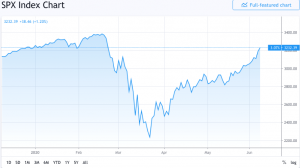
    Well, that was quick. As Main Street tip-toes back to work, Mr. Market has voted with a loud and large V. That’s the ‘V shaped” recovery of financial charts all over the world, particularly in the US. Check out the S&P 500 recovery and its move back into positive territory for 2020. Whooodathunk!

    That is a 40% move since the lows of March. The tech-heavy Nasdaq index has had an even stronger rocket ride; it hit all time highs yesterday and is actually up 10% in 2020. Wall Street is doing its market thing and looking through the current turmoil and “discounting” a better future. Even if a company is “dead”. Rental zombie, Hertz, filed for bankruptcy a few weeks ago but the share price (yes, the equity) gained 115% yesterday. Chesapeake Energy with its $8 billion of Q1 losses and debts in write-off mode went a bit better; just the 181% trip to the stars yesterday. The market is always right, right? Honestly, we just don’t know. Benjamin Graham puts it better – “In the short run, the market is a voting machine, but in the long run, it is a weighing machine.”

    Investors have voted and followed a wall of central bank emergency funding into risk assets. Back on Main Street business owners are weighing up the challenges presented by an ongoing global pandemic, lost revenues, new regulations, new behaviours and their costs. Oh, and Covid-19 is still here – WHO said it recorded its highest daily tally of new infections on Sunday (136,000). Interestingly, for those assuming all will return to pre-Covid exuberance, the National Bureau of Economic Research didn’t quite get the White House ‘Keep-America-Great’ memo. It turns out that the US officially went into recession in February. Yes, the US economy was already contracting before lock-down. Who cares, say investors clocking gains every day. Dare we say exuberance is back? Buckle up, we have a transport dream to sell you.

    Nikola Corp makes hydrogen and battery powered trucks. Not one truck has been produced yet, we don’t know who will make them and the company has zero revenues to date. The Nikola share price doubled on Monday and the value of the company now exceeds $33 billion. That is now $3 billion higher than the value of the 117 year old Ford Motor Company and its annual revenues of $150 billion. Punchy stuff. I think we can agree Wall Street has voted for a big V-shaped recovery. ‘Mission Accomplished” springs to mind.

    There is one tiny flaw in that prognosis. Main Street gets to vote too. Up until now, most business people with US commercial interests would tell you their local contacts/partners are emphatic President Trump will be re-elected. With the most recent CNN poll putting Biden 14 points ahead of Bunker Boy, one wonders is that confidence about to be tested? As Main Street returns to work and polls its pandemic pain through the hot summer months, what are the chances Mr Market reaches for the weighing-scales and reins in its exuberance. Then, we may appreciate “V’ is for volatility too.

  • Ship Ahoy, A Lesson in Risk……

    The giddy financial headlines of the past decade have been dominated by massive profits for investors in technology stocks, social media influencers and opportunistic purchasers of distressed property portfolios. However, the stories in the world of shipping have been less cheerful. Years of over-supply of freight capacity killed pricing in a global fleet of over 10,000 ships which doubled in size from the early 2000’s. The dry bulk sector has possibly been worst hit with benchmark shipping rates falling by up to 98% from previous highs in 2015-2016. Needless to say investors in publicly traded dry bulk shipping stocks have experienced share price implosions of 95-99%.

    As China’s economy and global manufacturing slows with an increasingly fraught geopolitical environment one could be forgiven for thinking the chances of a shipping recovery would be certainly dead and buried. Welcome to the risk of certainty and the explosive results of almost everyone being caught out at the same time with the same wrong view.

    Events in recent weeks in the crude oil carrier sector have been mind-blowing. And, we are not talking about the Donald’s latest attempt to blow up the Middle East with his Syrian gift to Turkey’s Erdogan. Yes, the Saudi refinery bombings and general US-Iran tensions have contributed to a squeeze on the pricing of rates for very-large-crude-carriers (VLCCs) but crude oil prices have subsequently settled back to pre-bombing levels. Not so VLCC shipping rates. What if we told you VLCCs are currently on daily charging rates of $300,000?  For context, as recently as mid-August daily rates were as low as $25,000.

    The purpose of this article is not to explore the exact combination of factors contributing to a ten-fold increase in freight pricing and an 80% increase in the value of certain shipping stocks in a matter of weeks. We’d rather use this event as a cursory reminder that a relatively minor combination of events can, in certain circumstances, create a violent reversal in market behaviour and views. More specifically, be very wary of an asset class displaying symptoms(pricing) of an extremely certain view. Think of crude shipping and a strong consensus view that the sector was nowhere close to recovery. Now think of a much larger asset class…

    How about the sovereign bond market where $16 trillion of debt currently carries negative yields? In lay person’s terms that is an overwhelmingly benign view of inflation over the coming years, ie bond yields would have to rise significantly(and bond prices fall at the same time) to counter the destructive effects of inflation on capital currently delivering no compensatory income. In contrast to the shipping sector, the cheery consensus view on bonds feels a little too one-sided and allows for very few surprises. A world without surprises just doesn’t feel like the right call in the current bizarre geopolitical environment.

    Finally, to complete our shipping journey it is worth highlighting it is only the VLCC sector(fleet size of 800 ships) which is experiencing stratospheric rate inflation. The larger dry bulk sector remains incredibly depressed in terms of asset values – barely 2 x annual cash flows – but has a couple of interesting drivers over the next few years. Firstly, there is no bank lending appetite and stricter regulatory rules which ensure excess capacity is being whittled down rapidly. Second, recall our mantra that every investment should now consider climate change. The shipping industry is in clean-up mode with global regulations now requiring costly installation of ballast water treatments plus engine re-calibrations for lower-sulphur content fuels by 2020. That means there will be further temporary capacity hits next year.

    Now, also consider shipping as a sector typically non-correlated with other financial assets which are currently trading across the board at close to all-time highs. In fact, shipping is considered a ‘geopolitical hedge” – shipping rates benefit from wars, conflict, canal closures and the odd lunatic leader. The world is currently well supplied on the “leader” front  so don’t be afraid to ship in some protection from madness.

    Of course, the Greeks have been the ultimate shipping nation which has hit hard times. Up until recently, it was assumed Greece would never be able to access bond markets for a decade. Now they are borrowing at cheaper rates than the Land of the Donald. Whoodathunk!

    Certainty, in transport terms, can be laden with risk and emotional biases. Aristotle Onassis put it quite well…

    “I made a big mistake. I never believed in the world that we live in, emotions can overcome every logic in business” 


    Enjoyed this blog? Then why not check out our other great content by clicking here!

  • Five Market Risks You Might Not Read About This Weekend

    Five Market Risks You Might Not Read About This Weekend

    The Bojo and Trump show is exhausting. The good news is that Sharpie-scribbled weather maps and fainting police have ensured our ribcages are now incapable of further shock and comic torture. The serious market risks associated with trade wars and a chaotic Brexit will receive more media coverage this weekend but not much will surprise.

    In fact, the sheer incompetence of the protagonists has resulted in more positive developments in both the US-China trade dialogue and Westminster. A check of the price charts for the S&P 500 and Sterling (GBP) for the past week will confirm increasing optimism. However, shocks are by definition events not yet considered by market participants. Looking past trade wars and Brexit there are five potential risks which probably won’t get headlines in the coming days but might genuinely surprise.

    1. A Dollar Shortage
    2. It might sound strange that a currency which accounts for 62% of global central bank reserves would be in short supply. However, companies(ex banks) in emerging markets had borrowed $3.7 trillion US dollars by the end of last year according to the Bank for International Settlements. That’s double the levels in 2010 and as the economic cycle slows the US dollar is unhelpfully climbing to new valuation highs versus it’s trading partners’ currencies in emerging markets. Suffice to say debtors are struggling to find/earn the dollars to service debts. The default worries surrounding borrowers like Argentina and China’s Evergrande Group are real-time illustrations of distress in funding markets. To add to these worries there are reports that in recent days an unidentified bank requested a $870m facility from the Federal Reserve. That’s not normal.

    3. European Banks
    4. Negative rates are crushing European banks already struggling with challenged balance sheets. A German economy slipping into recession as data suggested this week could be the final nail in Deutsche Bank’s coffin. Not surprisingly the CEOs of both Deutsche Bank and UBS have pleaded with banking authorities to consider alternatives to negative interest rates as monetary stimuli. European banks are into the ICU phase and it’s possible some won’t make it into 2020.

    5. Saudi Turmoil
    6. There has been more intrigue this week within the royal House of Saud. Ahead of the IPO of the state oil company, Aramco, Mohammed Bin Bonesaw has removed the chairman of the company which will only increase tensions between various factions within the royal family. Growing awareness of climate change and pressure on oil prices won’t help IPO valuations and the royal family’s ability to bribe its citizens and pay protection money to the US. The Saudi story has “coup” written all over it.

    7. EurFired!
    8. The Brexit story had its own “coup” this week as the move to prorogue Westminster resulted in a counter-coup by the opposition, potentially removing by law the ability of the government to leave Europe without a deal. Interestingly, there has been market chat in recent days that Europe has given up on the UK and possibly could cut and run. Yes, the reality TV show “Brexit” could have a “EurFired!” punchline with Europe refusing any extension, citing the need for certainty and the paralysing effect of Brexit on investment and policy decisions across the trading bloc.

    9. Inflation
    10. The headlines keep highlighting the $16 trillion worth of sovereign bonds currently trading with negative yields. The consensus view is that this is signaling lower growth, or worse, in the future. Implicit in that scenario is very low inflation. But, but there is another scenario. Check out the latest data in the US. Job growth and manufacturing activity has materially weakened. Well, there’s your low growth scenario. Now here’s the twist. Trump Tariffs(yes, they must be branded) are pushing inflation(CPI data) to 6-month highs and wage inflation is now cruising along at a 4.2% annualized rate! If Fed Chair, Jay Powell, thinks he has problems with the Orange Toddler right now we shudder to think what he will make of a dreaded stagflation scenario.

    None of the above events are high probability forecasts. In the investment world, they would be considered “tail risks”. However, for pure devilment this writer would hazard one strong long odds tip for the weekend. Prepare for the possibility for Boris de Pfeffel Johnson’s resignation on Monday morning and his place in history as Great Britain’s shortest-serving Prime Minister; the previous record was George Canning who served for just 115 days. By George, that would be a story!


    Enjoyed this blog? Then why not check out our other great content by clicking here!