Tag: tesla

  • A Wave Of Huge Numbers And New Thoughts

    A Wave Of Huge Numbers And New Thoughts

    Freezbrury waters are imminent, but I sense things are actually hotting up. I’m also conscious it’s Friday before a bank holiday weekend so will keep it light. Let’s just highlight a few significant datapoints from the tsunami of numbers bombarding our screens this week. Then, next week we might dive deeper. Not quite as low as Cruella “Reformed” Braverman, Commandant Greg “Himmler coat” Bovino, Stephen “Peewee German” Miller, or Kristi “ICE Barbie” Noem who definitely fall into wannabe Waffen SS territory. There’s something deliciously ironic about a world which has embarked on an artificial intelligence (AI) space race while “Trump Is Making America Stupider” per The Bulwark newsletter headline. Maybe the bots won’t need to be that good? Anyway, that possibility doesn’t seem to be stalling spending by global technology giants on AI… for now.

    My favourite AI datapoints this week come from Microsoft, Meta, Sandisk, OpenAI and ElevenLabs. Given these numbers are like an assault on the senses I think it’s best to present them in bullet form:


    • Microsoft’s fiscal Q2 update this week showed its cloud/AI order backlog rocketing by 110% to $625 billion. But, that wasn’t the show stopper or the share price killer (down 10% overnight). A whopping 45% of that backlog ($281 billion) was linked to one private start-up company, OpenAI.


    • Meta/Facebook also announced a huge number, but not a future revenue one. Its planned capital spending on AI infrastructure and development this year will be $135 billion. For context, as recently as 2023 Meta did not even generate this much money as its entire year’s REVENUES (not profits).


    • Lesser-known memory chip player, Sandisk, was the S&P 500’s best performing stock last year (+577%) as a beneficiary of investors’ search for AI ‘picks and shovels’. That story continues and is a reminder not to quit on your winners. Sandisk’s quarterly update this week beat expectations with 600% earnings growth and another 25% jump in the share price in after-hours trading. So far this year, the Sandisk share price is up 127%. Yep, just January.


    • In start-up land ElevenLabs is the hot AI Voice tool backed by Sequoia. It’s not just a hot investment, it’s a hot career choice. Only 0.018% of 180,000 job applicants in a 6 -month period get a job. As the brilliant VC commentator and fund manager, Harry Stebbings, pointed out, you are 200x more likely to get into Harvard.


    • Back to OpenAI. Yes, people worry about that famous FT graphic and OpenAI as the potential AI investment “weakest link”. However, the capital cavalry could be on its way. Latest chat is that OpenAI plans to IPO in Q4 2026 with a raise of $100 billion on a valuation close to $1 trillion. For historical context, the previous biggest IPO raise in history was $26 billion by Saudi Aramco.


    There’s now a bigger qualitative exploration of the AI theme due, given the pretty scary comments from OpenAI rival, Anthropic, CEO founder Daro Amodei. He reckons we are moving towards “AI systems that will be better than almost all humans, at almost all tasks….by 2026, 2027.” Check out the videos on social media showing how the likes of Moltbook and Clawd are blowing people’s minds with the power of their agentic capabilities.  Here’s a few other mind-blowing datapoints in a variety of areas where regular readers will know I have been thematically focused.

    Opportunity outside USA: We talked about real things (atoms) versus digital code (bits) previously. So, see how Brazil’s real asset-rich stock market has clocked 14% gains in January alone. However, the genuine head-rocker outside US stocks is the latest earnings growth  estimates for South Korea’s stock market. Goldman’s reckon earnings growth for the entire blue chip Kospi Index will be 75% in 2026. Note most of that earnings growth will come from two companies who are critically plugged into the supply squeeze for memory chips (RAM, DRAMs, thank you Mam) – Samsung and SK Hynix. Amazingly, South Korea’s stock market is now worth more than Germany’s DAX index ($3.25 trillion).

    Automation/Power Infrastructure: It’s not a huge surprise software stocks (SaaS) like SAP are being hurt by AI speculation, investment capital shifts. However, we should note the recent overtaking of SAP as the highest valued German company by Siemens. Its key three divisions? Automation processing, power/grid systems and transport infrastructure. Note none of the famous German auto stocks feature in this table-topping race.

    Electric Vehicles: Europe hit an inflexion point in recent weeks. Latest data shows EVs as a percentage of new car sales overtook traditional internal combustion engine (ICE) powered vehicles. Looks like ICE on two levels this week faces an existential threat. Thinking of not nice people, it was amusing to see Tesla post a 61% decline in profits in its results this week. Who knew, apart from Ryanair’s Michael O’Leary, that idiotic interfering in other people’s business (politics and privacy too) can be brand destructive…?

    Last thought, and this merits a much bigger discussion. The problems for Tesla might result in a $3 trillion mega-merger/pivot of SpaceX, Xitter, xAI and Tesla, but also subtly highlights the scale of manufacturing dominance exerted by China in the electrification race. While Trump focuses on Bruce Springsteen, White House ballrooms, Melania movies and Venezuelan oil grift, the Chinese are stealing a march on the US in so many technologies. Oh, and the Chinese consumer might be coming back. Apple just told us it had its greatest ever quarter in The Middle Kingdom. A 38% jump in China sales blew the hinges off all the ‘expert’ analyst expectations.

    Lots to think about over the weekend and well done to all who invested in Social Voice before its dramatic funding close; a great illustration of investor ‘social listening’  in the venture world of little gems.

  • Think Big, Think Private

    Think Big, Think Private

    Well, that wasn’t so bad. Said no US general summoned to Quantico this week by their spray-tanned hardened bosses. I actually was thinking more about September and its data-earned reputation as historically the worst month for stock markets. Scratch that. The key benchmarks for equities, the S&P 500(up 4.25% in the month) and the Nasdaq(up 5.6%), blew the hinges off investor expectations amid lots of ugly headlines. Public markets are on an absolute tear, but investors playing catch up and wondering how to get involved could be understandably wary. I’d be wary too, but in a more nuanced way. My sense is the out-sized influence and weight of big tech in public markets is troubling. Try these statistics for size…


    *AI chip superstar, Nvidia, at $4.6 trillion is now worth more than Apple, Saudi Aramco and the entire German stock market…combined.

    *The “Buffett Indicator” is a trusted temperature check on US stock market euphoria which tracks the ratio of total US stock market value to US GDP. Currently that metric is touching 217%, or about 70% above trend.

    *Another long-run measure of ‘value’ is the Shiller PE Ratio (CAPE) which divides the current value of US markets (S&P 500) by the earnings of its constituent companies over the previous 10 years. That metric is over 40x for the first time since the dotcom bubble of 2000.

    *Options markets are not for the faint-hearted. So, it was striking to see the September 19th expiry date attract over $5 trillion of notional option exposure. More striking was that the majority of options players (62% of S&P 500 volume) in August were seeking ultra-high risk “Zero Day” instrument exposure (expiry within 24 hours). That is seat-of-pants stuff.

    *Intel’s share price has rocketed 50% since September, Google is up 68% since April, and Tesla’s stock has doubled in the same period while making the DOGE-whisperer, Elon Musk, the world’s first half trillionaire. Yep, $500 billion.

    *Nvidia’s stock market value is now bigger than the GDP of 180 countries, including India and its 1.4 billion people.


    You get the ‘big tech’ picture. Now for some historical context. Remember Palm Inc and its PalmPilot?  When Palm listed as an IPO 25 years ago, it was worth more than Apple, Amazon, Google and Nvidia combined. There is a cautionary tale there, but not the key point of today’s article. The sheer intensity and speed of capital flows in the listed large cap arena is telling us there is a massive investment shift happening. However, it is possibly too late to ‘pick’ the winners in the public markets, and one could end up picking today’s Palm Inc. However, private equity and venture capital markets have been left behind by public markets. Private investment flows and deals have slowed (with the exception of AI deals) due to subdued exit, M&A, and IPO activity, further hampered by levels of geopolitical uncertainty we haven’t seen in 50 years. The critical point is that private markets are likely to ultimately benefit from the trickle-down impact of public markets hitting all-time-high valuations. I would highlight four interesting developments:


    1. The leveraged buy-out (LBO) of gaming giant, Electronic Arts(EA), at $55 billion is the biggest ever and beats the $45 billion KKR deal to buy TXU way back in 2007. This time the buyer consortium is led by the Saudi PIF and Silver Lake. The EA buy-out adds to a wave of M&A in Q3 which will have topped $1 trillion in total global deal volume for only the second time in history.
    2. The latest funding round of OpenAI was a sale of $6.5 billion of employee stock putting the valuation of the ChatGPT owner at $500 billion. That makes it possibly the most valuable private company in the world. For those thinking it’s just AI giddiness, it’s not the only $500 billion private opportunity…
    3. We have written before about the fast-approaching age of stablecoins. So, we were intrigued to see stablecoin platform, Tether, launch a funding round of $15-20 billion which would value the financial services player at $500 billion, overtaking the value of Bank of America(!).
    4. These are all big beasts in the private markets. What about the small guys? Well, if you thought tech(+11.6%) and the Nasdaq (+9.7%) had a great last 3 months, you might be surprised that smaller companies in the Russell 2000 index did even better (+13.5%). Note 50% of the constituent companies in that index LOSE money.


    Arguably, the smaller company index is the best proxy for the Spark Private world of start-up tech and smaller private equity deals. So, evidence of small company catch-up is a positive indicator. Furthermore, Spark Private investors have a real opportunity to gain exposure to the digital currency infrastructure, AI and private equity themes above in our upcoming deal pipeline. Note we are also entering EIIS ‘season’ so investors fearing they’ve missed out on public/pension opportunities will be able to use the private markets to balance out their risk budgets at highly attractive tax-assisted valuations.

    The public markets are clearly telling investors to think BIG, but valuation risks are rising rapidly. Our message is BIG too, but private as valuations (not risk) resume an upward trajectory. Watch closely, those BIG theme deals are coming very soon.


  • Who’s Really Losing Power…?

    Who’s Really Losing Power…?

    We sorta knew didn’t we? The Donald really doesn’t ever want to leave power. National Guard troops might be armed and patrolling the streets of Washington DC but we might be missing an even bigger power move. No, neither I nor the South Park writing team are contemplating a horse being appointed as a Senator, or JD Vance as President or Eric Trump …. replacing the horse. Parody and Caligula’s legacy are safe, for now. However, if you’re a fossil fuel investor things are looking anything but safe despite the Orwellian data-denial of the Dear Orange Leader. Let’s start with a few ground truths.


    *Oil prices have fallen in three of the last four weeks and are now in the low $60s per barrel pricing region which is close to a 4-year low.

    *Bloomberg recently reported that global oil markets are on track for a record surplus next year as demand growth slows and supplies keep growing [Source: International Energy Agency(IEA)]

    *IEA data shows oil inventories will accumulate next year at a rate of 2.96 million barrels a day, surpassing even the average build-up during the pandemic year of 2020

    *World oil demand this year and next is growing at less than half the pace seen in 2023.

    *But what about “Drill, Baby, Drill” ? Maybe not so much. US drilling activity continued to fall in early August as the oil rig count fell to 539, near its lowest since Dec 2021.


    No wonder Texas is trying to re-draw and gerrymander voting districts 5 years early. Texans are unlikely to fall for Fox News fealty to the Dear Leader, but they will be bombarded with untruths. That’s just a no-fact of life in politics these days. However, the strategic problem for the US in this energy leadership crisis is that climate crisis denial has directly impacted investment in renewable energy projects. The facts are stark. The Financial Times has reported a whopping $19 billion worth of projects have been cancelled this year alone. In fact, cancellation rates on all renewable projects are up over 2,000%.

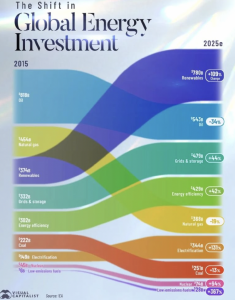
    The most recent cancellation was a biggie in Rhode Island. An off-shore wind project 80% completed by Danish company, Ørsted, was halted by the Department of the Interior citing “concerns related to the protection of national security interests”.  That project would have powered 350,000 homes in Connecticut and Rhode Island. Meanwhile, the rest of the world is rapidly shifting focus away from fossil fuel projects. The graphic below is from the Visual Capitalist team using IEA data and compares global investment from the years 2015 and 2025 (estimated). Renewable energy investment projects have more than doubled to $780 billion and overtaken oil project investment which has shrunk from over $800 billion to $543 billion. Interestingly, electricity grid, storage and efficiency projects are now forecast to reach close to $800 billion in 2025.


    The slippage of oil, gas and coal in the investment rankings is clear to see in the chart above. A seismic power shift is already happening and it is worth keeping an eye on the headlines and developments listed below. Arguably, the current White House administration, rather than bolstering “national security” is handing the energy keys of the future to more far-sighted leaders elsewhere. Check out these data points:

    In July, China’s single month electricity usage exceeded 1 trillion kw/hours. That’s more than Japan uses in a whole year. Of this total, 25% was generated by wind and solar energy sources.

    In April 2025, China’s solar generation of 95 TWh was larger than the TOTAL ELECTRICITY DEMAND of all but two countries in the same month.

    For the first time in history, despite soaring electricity usage, CO2 emissions in China are falling.

    The UK in Q2 granted planning for 16.1 GW of renewable energy capacity. That’s up 195% on last year.

    Renewables in the UK for the first time in 2024 supplied over 50% of the nation’s electricity over the entire year. Renewables and nuclear energy combined, accounted for 65% electricity generation in the world’s 5th biggest economy.

    In Pakistan, over the last two years private individuals have imported solar panels which equate to 68% of the entire national public grid!

    India’s solar PV manufacturing capacity has increased 50x in 10 years from 2GW to 100GW.

    In May this year, 68% of Germany’s net public electricity was generated from renewable sources.

    The electric vehicle (EV) revolution is not just happening in wealthy economies. 76% of new passenger cars sold in Nepal are electric. In Ethiopia that number is 60%.

    EV sales in Europe took 29% market share in June 2025. The share in Sweden is 65% while China moves in to the tipping point of more than 50% of sales being electric.


    The future is fast becoming electric, powered by renewable energy sources. One wouldn’t want to be on the wrong side of history, or your previously loyal customers. Ask Elon Musk and his European sales and marketing team. And…. if you want history to be a guide as to how power can shift slowly, then suddenly,  maybe don’t go to a US museum. Apparently, the Dear Leader doesn’t want US museums like the Smithsonian to raise awareness “too much of the past”, but rather “focus on the future”. Yep museums shouldn’t do history too much. Go figure.

    I’m going to stick my neck out here and risk future US visa issues but ……..it feels like the US energy future is not in good hands, just tiny ones clinging to the wrong power.

  • Truly A Moron

    Truly A Moron

    We are into the name-calling phase of global trade policy. The “Stable Genius” Party told us to “reject the evidence of your eyes or ears” or even the ten trillion dollars of capital destruction. But, enough is enough. Or, so thinks DOGE-whisperer Elon Musk. The focus of his ire is the White House driver of Donald Trump’s trade tariff policies, Peter Navarro. Now, Peter is an interesting chap. He first came to my attention with a series of books featuring hard line views on China and US trade deficits generally.  He then served in the Trump 1.0 administration of 2016-2020 when his “fringe” economist status acquired an unusual qualification. Well, weird. It turns out the globally reputed economist, Ron Vara, quoted in many of Peter’s books was a fictional figure. Indeed, Ron Vara was not just supportive of Peter’s bonkers economics but also an anagram of his own name. No, seriously.

    So, who’s surprised to read the Navarro tariff calculations are the work of a ChatGPT output which the right-leaning American Enterprise Institute (AEI) think could be out by a factor of four times(400%)? It’s a bit late now but Musk has just described Navarro as “dumber than a sack of bricks” and “truly a moron”.  You’ll note my view that Musk is too late to undo the damage of the Mad Orange King and the Ron Vara school of economics. In fact, it’s not actually my view.  Policy uncertainty paralyses business activity and the scores are coming in fast….


    *Larry Fink, CEO of the largest asset manager on the planet, BlackRock Inc, with $10 trillion reasons to care says “Most CEOs I talk to would say we are probably in a recession right now.”

    *Jamie Dimon, CEO of the most valuable bank on the planet, JP Morgan, in his annual letter to shareholders delivered a blunt warning – “The recent tariffs will likely increase inflation and are causing many to consider a greater probability of a recession.”

    *Airline share prices are traditionally viewed as early warning signals of trouble ahead. So, when you see Delta, American and United stocks drop 35-45% this year we should pay attention. Larry Fink is anyway – “Airlines and air traffic are a canary in the coal mine. Right now the canary is sick”


    Cheery stuff. However, these are US-focused observations. We have been here before and we should remind ourselves that capital markets can be quite effective in taming policy tyranny. Ask Liz Truss. Then check bond markets. Interestingly, if bond markets “believed” recession was imminent then bond yields(rates) would not be rising like they are right now. US 10 year Treasury yields have jumped from 3.87% to 4.52% in the past two trading sessions. This is highly unusual bond behaviour when equity markets are so volatile or declining. In fact, it’s the all-powerful bond market questioning the credibility of US institutions. Hence, you’ll soon be hearing Trump whining about the Fed lowering interest rates but, again, not quite understanding bond markets. Other markets are behaving in a more orthodox manner but could also upset the tariff toddler.

    You might have noticed that Trump has refused the pre-‘Liberation Day’ EU offer of zero tariffs on industrial goods. Trump and his team are now switching focus to “non-tariff trade barriers” and demanding the EU buy $350 billion of energy to balance out trade deficits. The White House is rapidly losing the faith of its fossil-fuel friends who are staring down the barrel of $50 spot prices for oil. Ahead of inauguration, the reversal of Biden’s signature IRA act and decarbonisation/cleantech investment incentives sounded good to the oil barons but they didn’t plan on Trumpolini playing Texas Hold ‘Em with every trading partner in the world …..at the same time. And, don’t forget the Kremlin and its war economy is acutely oil price sensitive too.

    Cryptocurrencies and their broligarch fan boys are also going to be a bit tetchy apart from “car assembler” Musk. Bitcoin is down 17% year-to-date with cryptocurrency ETFs (funds) suffering their third consecutive month of outflows. In fact, the big picture worry for all cryptocurrency evangelists is that on current pricing history evidence Bitcoin appears to have morphed into a tracking instrument for the tech-heavy Nasdaq equity index. It’s supposed to be a currency, as a quick reminder.  Go check the charts and then wonder how long before the broligarchs put pressure on Trump to move the markets into risk-on crypto-friendly mode. We will wait but private markets won’t stand still. In fact, big global structural themes (outside trade) will continue to play out in private. Just this week we spotted these three deals amid all the screaming red ticker-chyrons and panic headlines:


    • Faster research: San Francisco-based Rescale provides AI-powered R&D simulation software and has raised $115m from investors including Nvidia.
    • Content generation: Another Californian start-up with Spanish founders, Krea, uses generative AI for image content generation and design. They have just raised $83m from investors including Bain Capital.
    • Payment infrastructure: Juspay, an Indian payment infrastructure start-up has raised $60m from institutions including Kedaara Capital.


    Humanity and innovation will keep moving forward irrespective of the headlines. Public markets gyrating violently are the real-time expression of capital flows, fears and policy paralysis but, in private, both in Washington and in private markets we can be far more optimistic. Nothing crystal clear right now but the waters will still be blue ahead…

  • What Signals Are You Watching?

    What Signals Are You Watching?

    I’m a bit lost. I can still remember as a child staring out at the Ballycotton Lighthouse as it guided battered yachts to safety during the Fastnet Race disaster of 1979. Fast forward to today and there’s another potentially calamitous “storm” brewing for the most basic concepts of accepted facts and truth. Worryingly, there’s increasing evidence that the “lighthouse” of global leadership on rules of law and common values has gone dark. Orwellian dark. I know we’ve been here before with White House Press Secretary, Sean Spicer, and bonkers claims of inauguration crowds for Trump 1.0 but the second coming of Trump is a whole new level of autocratic demands to “reject the evidence of your eyes or ears.” That’s Orwell, not the White House.

    It would appear that “their final, most essential command” this week is to NOT read the time-stamped texts of the US Secretary of Defense on the unsecured Signal mobile chat app shared with 16 other US security chiefs (plus one mistakenly added journalist) and conclude that this was the most embarrassing and dangerous self-inflicted security failure by US institutions in decades. The cover-up and spin-fest since the Atlantic magazine scoop has witnessed equally incompetent and criminal attempts to parse the meaning of “war plans” and “attack plans”. To be clear, the key “ground truth” in this intelligence near-miss is that advance information on a military mission puts US military personnel in danger. But here we are.

    Donald Trump has given a press briefing stating the US “has to have Greenland” and his Kremlin keeper, Vladimir Putin,  is dovetailing on message beautifully by saying “Trump’s plan to seize Greenland is serious”. Doesn’t that sound like two mob bosses agreeing ‘territory’?  Yes, but don’t ask the lawyers. Leading law firm, Skadden Arps, has just “agreed” to provide $100m of pro-bono work for initiatives supported by the White House in order to avoid adverse targeting by a regime irked by previous “woke” cases taken by Skadden.  So, do we all surrender as democracy dies in darkness? Well, there are other Signals to watch with possibly more impact than a Houthi-Yemen air strike mission. In fact, their potential impact could be sufficiently influential to trigger “lighthouse” leadership, even change.  I’m looking at three Signals in particular.

    First, as we head towards the Trump self-styled “Liberation Day” of trade tariffs imposed globally, we watch the money or flow of same. Some might think the enormous switch by investment institutions out of US equities (down 5% year to date) to international equities (eg. German Dax up 15% year to date) is a big deal. It is. But, equity markets could be due a “rotation” anyway after 15 years of US dominance and, frankly, more challenging valuations when economic leadership veers into cult lunacy territory. The awkward fact for the Trump crime gang is that foreigners own $16 trillion of US stocks and they are selling them even quicker than Tesla shares. However, the bigger more worrying signal is in the debt (or credit) markets. As we regularly say, debt(bond) markets can really intimidate as they can cause proper global economic damage. So, when I look  at the ‘plumbing’ of the financial system and corporate debt (credit) data, I’m seeing signs of cracking and stress. The jargon monoxide will involve terms like “spreads”, “VIX”, “call options” and “default pricing” but, take it from me, this is where the intimidation of the Trump White House is beginning.

    Second, how long will Trump’s ‘broligarchs’ go along with his trade war when there is possibly a far more consequential technology “war” exploding across our screens every day? My sense is that there could be a calculation that trade wars are a dangerous commercial distraction. Check out the latest data from Stripe. Software companies (SaaS) were always the uber-growth leaders, with Stripe analysis showing the median time for the top 100 software/SaaS start-up companies to reach $5m of recurring revenues was 37 months(data from 2018). But, there’s a new growth monster in town. Stripe data (2024) shows the top 100 AI start-ups hitting that $5m milestone in….. 24 months. You might have read that executive suites across the USA have been paralysed by indecision due to erratic Trump economic policy. Indeed, M&A deal activity has fallen to the lowest in a decade and year-to-date is down a whopping 30% on last year. However, the story in start-up world is very different. In the first quarter (Q1) of 2024 there were two start-ups acquired for more than $1 billion (unicorn status). In Q1 this year, there have been ELEVEN $1 billion plus start-up acquisitions. In fact , the total value of these deals this year has been more than $54 billion or 10x the activity value of Q1 2024. It’s all driven by AI and cloud infrastructure(including Google’s largest ever deal with Wiz) but when you see the latest text-to-image generation of OpenAI and the “Ghibli” craze you’ll definitely feel something’s up. But not the Tesla share price…

    Finally, and Elon Musk might think I’m being “mean” (while he cuts social security support for the elderly) but Tesla’s share price is worth watching. The DOGE whisperer in the Oval office says he’s leaving government ‘service’ at the end of May. However, for Tesla and its shareholders, post its $800 billion share price meltdown, the value destruction pain may not end in May. The brand damage of embracing right-wing extremism has been staggering to witness but the end-game could be no less dramatic. The recent deal to sell X/Twitter to xAI (this x stuff is tiresome isn’t it) has been seen as a way for Musk to avoid margin (debt) calls on Tesla shares he has pledged as security on cross-company loans. The trigger for those margin calls was reportedly a Tesla share price of $120 per share (vs today $263 per share) but I’m not sure the pain point has been removed. The market value of Tesla is still more than $800 billion compared to Ford at less than $40 billion. Let’s not forget it’s a car company where a balance sheet and cash flow can implode if sales/revenues go into reverse. Last year revenues had a small 1% decline… but this year? Watch revenues closely, and watch Musk.

    This might seem like a random set of signals to watch but sadly, there’s one emerging truth re US leadership. Money talks, not values nor principles. The Japanese (Nikkei) stock market has kicked off the week with a 4% wipe-out and we can only wonder when the men with the money (and the loans) pay a visit to the White House. We might have to wait a bit, but I’m hopeful the money will find that “lighthouse” moment.

  • Ten MEGA Signs Of Not So Much Winning…

    Ten MEGA Signs Of Not So Much Winning…

    Never thought I’d say this. I think I need those Freezbrury cold water challenge days to extend into March. Well, I need some shock therapy to dull the senses and distract from a rules-based world order which is crumbling by the hour. Should I care that a former Fox & Friends host has just instructed the US military to cease all operations against Russian cyber threats? Probably, but I’m not sure it’s helpful to follow the dizzying pace of breaking news and broken alliances. We have previously written about how the financial markets can rein in autocratic megalomania both East and West. In that instance we flagged the power of bond (debt) markets. Now, it looks like a regime which promised “so much winning” is losing the confidence of more than the bond market. Here’s a list of losers….


    US Business Confidence: The silence or craven submission of US business leaders to the erratic ‘shake down’ of US allies and the established world order has been stunning to observe. However, as we often write, corporate actions can be more informative. Quietly removing DEI policies requires minimal leadership courage (I’m being very generous with that word). Dealmaking (M&A) on the other hand is way up there in terms of career risk for senior executives. Guess what? US M&A deal activity in January slumped to a decade low with a 30% drop year-on-year.  Uncertainty is a strategic decision killer.

    US Capital Markets: The US financial markets have dominated the world since the 2008-2009 financial crisis. US stock markets now account for more than 50% of the value of global equities after outperforming international stocks for more than 16 years. However, this year it’s a different or shifting story. At the end of February, international stocks had gained 7.3% in 2025 vs a 1.4% gain for the S&P 500.

    US Growth: Investors in US stocks appear to be concerned. They are not alone. The much-watched GDPNow forecast of the Atlanta Fed is currently projecting US GDP will CONTRACT by 1.5% in the first quarter compared to the forecast of healthy 2.3% growth a week earlier. Also, US consumer spending has just fallen for the first time in two years.

    US Technology: The “broligarchs” might have taken over the White House but the “Magnificent 7” technology stocks are experiencing slippage in 2025. Only one of Meta(+11%), Apple (-4%), Amazon (-3%), Google (-10%), Microsoft (-6%), Nvidia (-10%) or Tesla has seen its share price in positive territory this year.

    Tesla: Tesla’s share price decline this year is a whopping 23%. Apparently, Elmo Musk’s fondness for autocrats and far-right parties in Europe has been a bit of a brand-killer. Sales in Europe for the first two months of 2025 are down 46% which can’t all be explained by consumers waiting for a Model Y refresh. Don’t expect any bravery from Tesla board directors either.

    US House Sales: US existing home sales have dropped to the lowest levels since…. 1995. Yes, that’s when there were 80 million fewer people living in the US and didn’t have a President threatening a tariff war with its neighbour and construction-critical timber supplier, Canada.

    US Dollar: As the world’s reserve currency the US Dollar (USD) is a long way away from any structural impact from the waning credibility of its sovereign’s political system. However, the USD is trading at an 11-week low against 6 major rival currencies. And….one of the better macro writers out there, Barry Ritholtz of The Big Picture blog, has flagged the dangers of policy error for the USD:


    “Since the end of World War Two, the USD has been America’s “exorbitant privilege” as the world’s reserve currency. However, several factors threaten this privilege: wide-scale tariffs, the embrace of alternative digital currencies, the breaking of long-standing alliances, and dallying with dictators.

    Since the end of World War II in 1945, the rise of the United States as the world’s dominant economic, military, and cultural power has led to a relatively peaceful 75 years in the Western Hemisphere, Pax Americana, has greatly benefited the U.S. and its allies. Putting that at risk would be one of history’s greatest unforced errors.”


    US Supply Chain: The just released ISM Manufacturing survey for the US reveals the “prices paid” index for companies surged to a 32-month high as suppliers adjusted prices upwards ahead of threatened Trump tariffs. Oh, and don’t mention egg prices to the ‘Build-that-Wall’ cult – egg shortages are pushing prices up by 53% vs 2024 prices. Yep, you might remember there was some bloviating chat about inflation being fixed ‘on day one’.

    US Jobs: There’s every chance Elmo Musk could end up being the DOGE that caught the car. Musk has been tasked/appointed himself to remove unnecessary spending by the US Federal government and its 3 million employees. But… the shock being applied to the US economy is possibly underestimated. The US government spent $6.8 trillion in 2024. For context, that’s more than 10x the size of the global semiconductor industry’s annual revenues ($628 billion 2024). Firing people in climate/weather forecasting roles and shutting down foreign aid (USAID) are just headlines. The bigger picture suggests one of the US economy’s most critical components (government spend) is in contractionary territory which will impact not just government jobs but the entire government supply chain in the private sector. Yep, a $7 trillion customer of the US economy is now being  run by Elmo and his “Muskrats” with cute names like “Big Balls” and “First Buddy”. No seriously.

    Brand America: As a symbol of American global reach and brand value it’s difficult to beat McDonald’s. Some of you may even recall the opening of its first Moscow restaurant with the famed “Golden Arches” in January 1990. You just knew the geopolitical sands were shifting. Less than two years later the Soviet Union collapsed. Now, check out the IPO of a company in Hong Kong this week. McDonalds is no longer the biggest food and beverage chain in the world. That title now goes to Mixue Ice Cream & Tea which has 45,000 branches in Asia and is opening approximately 21 stores……. every single day.

    It’s a bit early to be suggesting a shift in global leadership but perhaps the competition has just shot itself in the foot. I’m thinking of Europe now and how a geopolitical crisis might just prompt real thought about making Europe great again (MEGA). Three financial data points caught the eye this week and suggested investors might be warming up to real policy action in Europe:


    • The Swedish Krona is appreciating fast (2.4% today) as investors recognise Sweden has the highest military equipment production per GDP in Europe.


    • Europe’s benchmark stock index, the Stoxx 600, has risen every week for 10 straight weeks.


    • Germany’s Rheinmetal (+14%), Britain’s Bae Systems (+19%) and France’s Thales (+23%) have seen their share prices rise by double-digit percentages in a matter of days.


    The $2.5 trillion global defence industry won’t be the only area Europe should target to compete as a “trusted partner” . Presumably, many countries and organisations seeking commercial partners in healthcare (medicine/vaccines) and financial services will have noted the risks of deal exposure to a US political leadership who ultimately might want  a “piece” of a country in exchange for “peace”.  Europe, by standing with Ukraine, could send a very powerful message on dependability to future partners as its former Washington ally works furiously to keep the KGB lieutenant colonel in the Kremlin happy.


  • Still Some Golden Theme Tickets Left…

    Still Some Golden Theme Tickets Left…

    I’m going to save you some time. Forget about calendar-driven commentariat reviews and 2025 forecasts for investment or geopolitical risk. Sorry to be the “Grinch of Guru”, but calendars and structural investment themes have zero correlation. Opinion is cheap and even the betting markets are displaying their patchy predictive powers in recent weeks. Yip, just a 6% chance of the Ba’athist beast, President Assad, being toppled in Syria. About as much chance as a Chinese spy in Buckingham Palace… oh wait. Sadly, Prince Andrew is a multi-year clown car journey in particularly poor company but there’s a lesson there too. Almost all significant investment themes – risks and opportunities – are multi-year stories whose plots twist and turn but keep a very clear direction of travel. So, let’s take a look at some of the major themes we have previously visited and a few more developing ones; all with interesting plot twists.

    Europe Crisis or Opportunity: Nothing good in the headlines…..German government falls, UK in second month of GDP contraction, France on its 4th premiership in a year. But, but here’s a few twists on the negatives. The lists of where Europe lags the US is a long one, from labour productivity, to AI and innovation, to stock market performance. And yet, if you strip out the performance of AI hardware star, Nvidia, from the S&P 500 then Europe’s stock market (MSCI EMU) has actually earned better returns for investors than the US benchmark since the most recent bull market started in October 2022. That suggests there are lots of European companies doing very well despite ‘core’ European economies struggling. Check out also in recent days Spotify becoming only the second European tech company since SAP to crack the $100 billion market cap mark. The headlines do not lie but the narrative on Europe is more nuanced than you think.

    Healthcare: Another structural theme from previous years’ writings, healthcare has actually been a winning area for Europe thanks to the miracle weight-loss drugs, Ozempic and Wegovy. Their Danish owner, Novo Nordisk, became Europe’s most valuable company in 2024. However, we might be about to enter an accelerated era of therapy/drug discovery for all types of medical illness. The clue is in the Nobel Prizes awarded in both Physics and Chemistry in 2024 to pioneers of AI usage in research. Now, for those already struggling with how AI large language models (LLM) work and the warp-speed calculations of the almost-monthly iterations of these technologies, get ready for the ultimate head wrecker. Google has just developed a quantum computing chip, “Willow”, which performed a computation in less than 5 minutes that would have taken today’s fastest computers 10 septillion years to complete. Yeah, that’s 25 zeros which exceeds known timescales in physics and vastly exceeds the age of the universe. Think about that. This chip created by quantum physics “used” time which theoretically can’t exist unless…… there are other parallel universes. Google Quantum AI founder, Hartman Neven, calmly wrote that the stunning performance of this chip indicates that “we live in a multiverse”.  Maybe Willy Wonka wasn’t so wrong to say “Come with me and you’ll be, In a world of pure imagination”.

    Artificial Intelligence (AI): Arguably, the world of AI has moved in a completely different direction. The shift of investment capital away from bits (software) to atoms (hardware) has been spectacular. Another company nobody ever heard of until recently, Broadcom, has become the latest technology hardware company to join the trillion dollar market capitalisation club. The US chip maker is now one of FOUR tech hardware companies in the list of the 10 most valuable companies on the planet. Clearly, investors see AI infrastructure as the early ‘win’ in the AI arms race. However, do NOT ignore software. Interestingly, the Clouded Judgment software newsletter has flagged a 20% expansion in median software valuation multiples since mid-November (from 5.6x to 6.7x revenues). Also, Nvidia has dropped in value by 11% in recent weeks. Yes, rotation from hardware to software and back again will be a feature of the multi-year AI revolution but the venture capital data from CB Insights confirms the direction of AI travel. Global venture capital (VC) deals in AI jumped 24% in Q3 to the highest levels seen since the Q1 2022 peak. In fact, one in every three dollars of VC investments went to AI start-ups.

    Banking and Fintechs: Closer to home, Revolut has just confirmed it has more than 3 million customers in Ireland. A staggering 75% of all Ireland-based adults now use the UK fintech platform for banking and payments. Meanwhile, the US bank sector has rocketed 30% higher this year, Europe is seeing Italian banking M&A deals and the largest asset manager in the world, Blackrock, has embarked on a private asset acquisition frenzy. We have written before that the future is private and I’m wondering are big corporates thinking the same? Sticking with the fintech sector, it was striking in the past week to see the shipping/logistics giant AP Moller lead an €80m investment round for UK fintech, Zopa Bank. In the same week, we note another globally significant name, Walmart, was the lead investor in a $300m round for fintech platform, One. Hmmm….Private banking/fintech, private opportunity.

    Climate & Electrical Vehicles (EV): Apparently, 11 out of 16 EV battery manufacturing projects in Europe have been canned or delayed. Of course, the $15 billion investment in Northvolt was the highest profile casualty in 2024 but there will be other twists and turns in the electrification journey. And, possibly a lesson in long-term planning. China 20 years ago had almost zero car production capacity. Now, it is on track to manufacturing 30 million cars a year and has surpassed Japan as the biggest exporter in the world with 5.17m units sent overseas. In fact, Chinese built EVs now account for 76% of the global EV market. So, if one were to be thinking 20 years ahead again what is most likely to drive investment returns in the transport world? Well, how about not driving. More specifically, self-driving. So, I’m quietly stunned that Google’s Waymo self-driving cars are clocking up 175,000 rides per week compared to 50,000 rides 6 months ago. That’s actually more than 1 million miles of autonomous transport delivered with an almost flawless safety record. I sense 2025 could see self-driving transport go mainstream and, as I write, Waymo have announced they are about to trial robo-taxis in their first non-US city, Tokyo, next year.

    The list of themes above is not exhaustive but they are structural themes measured in decades rather than calendar years. These are the most likely golden tickets to deliver standout returns like Nvidia’s 27,000 % return over the last 10 years. But, as always, we should keep an eye out for reversals of long standing narratives too. Argentina might be the prompt for contrarian thought while on track to deliver the best stock market returns of 2024. Who knew! So here’s two thoughts to chew over for the festive season: i) A European refugee reversal as Syrian and Ukrainian citizens potentially return home in 2025 and ii) A renewed embrace of nuclear power/investment to drive the electrification of the global economy.

    “Oh you should never, never doubt what nobody is sure about”         –   Willy Wonka


  • Big Numbers That Can’t Be Missed

    Big Numbers That Can’t Be Missed

    Now, it’s my turn. I get to vote this week. For lots of busy good reasons, I haven’t read a huge amount on our own election but there’s no doubt it is important. However, I’m conscious I’m just one of 4 billion people voting in the current 12 month period. This also prompts another nagging feeling that it is external events over the lifetime of the next government which will define it. From Ukraine, to Utah, to even Mars, our planet is at an inflection point. The ‘world order’ is dangerously shifting as North Korean troops enter a European conflict zone for the first time, and yet, it would be ill-advised to down tools and just wait. There are other themes and trajectories already established and unlikely to change. Simply put, the numbers are now too big. And, we will continue to watch SIX in particular.

    Artificial Intelligence: It is striking to see various commentaries question the real ‘value’ of AI. During the summer, Goldman Sachs estimated that tech companies were about to spend $1 trillion on AI but queried whether they would ever earn a return on this capital expenditure. Fair question, but there’s another point to be made. The ‘winner takes all’ nature of this tech arms race is existential. The poster child of the AI revolution is Nvidia. Yet again, it smashed analyst forecasts this week in its latest quarterly results. My takeaway is that, of course, there will be misallocation of capital in this existential race but tech companies are going to continue to spend to stay in the race. ‘Exhibit A’ must be Nvidia’s own revenues in its data centre chip division. A whopping $30.8 billion revenues generated in the last quarter revealed a growth rate of 112% vs a year ago. Also, for context, this division has increased its quarterly revenue 7-fold since the early quarters of last year. Note, data centres are the battle ground where AI models are tested and trained, and this trend is set to continue.

    Cleantech: European cleantech suffered a blow this week as Northvolt sought Chapter 11 bankruptcy protection from its creditors. It’s a significant blow to Europe’s efforts to decouple from its dependency on China for electrical vehicle (EV) battery materials, chemistry, design and manufacture. Northvolt tried to deliver in all four process functions and received $15 billion of investment backing to do so. This has been a very expensive way to experience execution risk; both Goldman Sachs and VW have written off investments in Northvolt of $1 billion each. However, just like AI, loss is a recurring feature in any new technology area. So, keep an eye on the big numbers. In this instance, the EU is outspending the US with a $125 billion spend in 2023 (vs $86 billion). But….. China is really the cleantech benchmark. The Middle Kingdom spent $390 billion in 2023 across renewables, carbon capture, utilization and storage, hydrogen, batteries and nuclear power.

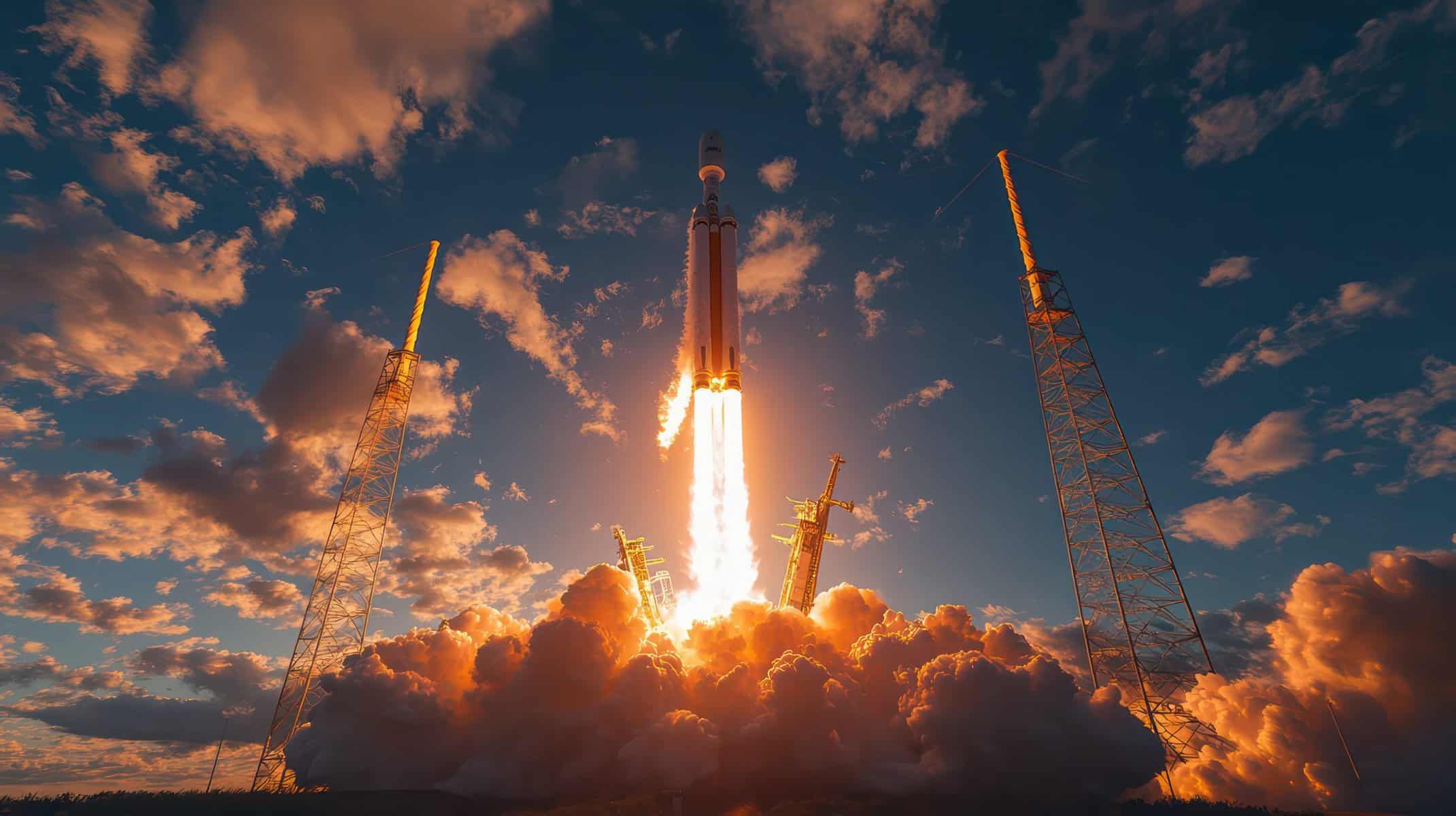
    Space: Elon Musk’s SpaceX is the most valuable private company on the planet with a recent funding mark indicating a $250 billion valuation, ahead of ByteDance (parent company of TikTok) on $225 billion. At current pace, it is launching its Starlink satellites (via Falcon 5 rockets) every 2.8 days. If you’re just about getting your head around that launch frequency think about Space X’s massive re-usable Starship which completed its 7th test flight last week. Its payload capacity is 150 tonnes and the plan is for Starship to do two launches…. daily. Now, what if the entire tonnage launched into space in history has been just shy of 40,000 tonnes? That means in the very very near future, Starship alone would be capable of repeating the entire payload history of space in just over 4 months. I’m not sure we have grasped the enormity of this feat and the implications for industries like telecommunications, mining, military defence, tourism, manufacturing or even housing (on Mars?).

    Crypto/Blockchain: Bitcoin is on the cusp of breaking the $100,000 mark. However, we need to start thinking about the entire crypto/blockchain ecosystem. Check out MicroStrategy which on the face of it is a loss-making software business but since 2020 has been investing in Bitcoin. If you thought Nvidia was the best performing share price in the world you’d be nearly correct – it has delivered 2660% returns to shareholders in the last 7 years. But….. MicroStrategy has rocketed by 3420%. Its current market value is $117 billion, making it more valuable than Nike, UPS or Starbucks. Of course, MicroStrategy is a leveraged play on Bitcoin but there are other ways to ‘leverage’ the rapid expansion of stablecoins, crypto funds, tokenisation, blockchain etc. The crypto asset ecosystem has just passed the $3 trillion valuation mark which exceeds the asset value of most countries’ stock markets. These numbers, and the opportunities to plug into this investment pool, are too big to miss…or ignore.

    Banks: It would be easy to move on to the ‘next shiny thing’ in the space or crypto universe but the banking sector is worth watching right now. Governments are finally getting good selling prices (even premia) for rescued bank shares as the UK (Nat West), Germany (Commerzbank), Ireland(AIB), Greece (Piraeus Bank), the Netherlands (ABN-AMRO) and Italy (Monte dei Paschi) all reduce sovereign shareholdings or exit altogether. As an aside, and interesting contrast to ‘shiny new things’  Monte dei Paschi began commercially lending 20 years before Christopher Columbus’s trip to America was financed. Anyway, old or not, the bank sector is hotting up. Breaking news over the weekend suggests Italy’s Unicredito will make a €10 billion + bid for rival BPM, and note Unicredito is already circling Germany’s Commerzbank. Also, it is worth noting that the tax/accounting professional services arm of UK wealth player, Evelyn Partners, has just been bought by private equity (Apax) for £700m. That is significantly more than the £500 million price tag suggested by City analysts.

    Technology Rotation: We have written previously about the particularly strong comeback for technology hardware thanks to AI, semiconductors, EVs and iPhones. The world has become very used to these themes powering the “Magnificent Seven” – Microsoft, Apple, Nvidia, Google, Meta, Amazon and Tesla – to all-time-highs but this analysis of last week’s technology price action in the newsletter, Clouded Judgment, caught the eye:


    This week saw the rapid acceleration of an interesting trend that started not too long ago – Magnificent 7 underperformance and software outperformance. Might this be the start of a rotation into software and growth (ie more risky assets)? Meta was down 3% over the last week. Amazon was down 7%. Microsoft down 3%. Google down 6%. Nvidia flat. Apple / Tesla were slightly up. QQQ was down 1.5%. Meanwhile, the WCLD index was up 6% over the last week! In addition to that, there were some really big moves in individual names. Snowflake was up >30% on Thursday after reporting earnings on Wednesday, which lifted the rest of the software market. Also just on Thursday Mongo was up 14%, Confluent / Datadog / Cloudflare were each up 7%.


    As a reminder, the Magnificent 7 have an aggregate value of $13.5 trillion which is more than the GDPs of India, Germany and Japan combined. The potential risk of an investor rotation OUT of the Magnificent 7 is a multi-trillion dollar consideration, and also can’t be missed.

    Clearly, my vote can’t change any of the big numbers above. However, these are the numbers which are far more likely to define our investing and business futures on this island.


  • Is The World Going Full Oligarch?

    Is The World Going Full Oligarch?

    The lettuces won’t be happy. It looks like the UK’s new Chancellor of The Exchequer, Rachel Reeves, and her Autumn Budget 2024 will survive a relatively benign financial market reaction. So far, government debt (Gilts) markets are stable and the domestic-focused FTSE 250 stock index has bounced slightly. Liz Truss will shake her head in delusion but the more understanding reality of today’s world is that the government of the world’s 5th biggest economy was brought down by international asset traders back in October 2022. It probably won’t be the last sovereign state to lose power to commercial interests and yes, money. Simply put, at exactly the wrong moment in time, many of the world’s governments’ ATM spending cards are about to be declined. Check out the following recent headlines:


    Interest payments on the national debt (US) top $1 trillion as deficit swells  –   CNBC


    IMF warns Japan of debt deterioration in the event of future shock   –   The Japan Times


    Why France’s fiscal freak out matters to the world  – Axios


    China’s Fiscal Package Aims To Ease Debt Woes, Property Crisis   –  Asia Financial


    There’s never a good time for fiscal capacity to be tight. But… literally the planet’s survival is at stake. The climate crisis is everyone’s crisis but governments are expected to lead. Indeed, according to the IEA, governments globally in 2023 spent $1.3 trillion or 1.2% of global GDP on clean energy investment. That bill will surely rise but there’s a big question mark over how the clean energy transition will be funded by stretched governments running record deficits and the highest debt burdens in history. For a clue to that question, let’s take a look at another spending race.

    This race depending on your perspective also has an existential angle. The race, of course, is AI and Packy McCormack’s excellent piece in his Not Boring newsletter has identified a shift in commercial goal – “companies are spending for capability as opposed to straightforward ROI”. Why the ditching of seeking returns on investment? Apparently, the first company to create the AI “Digital God” boils down to an existential pursuit. Loser companies die. Indeed, Larry Page of Google fame has reportedly said many times internally…..


    “I am willing to go bankrupt rather than lose this race”


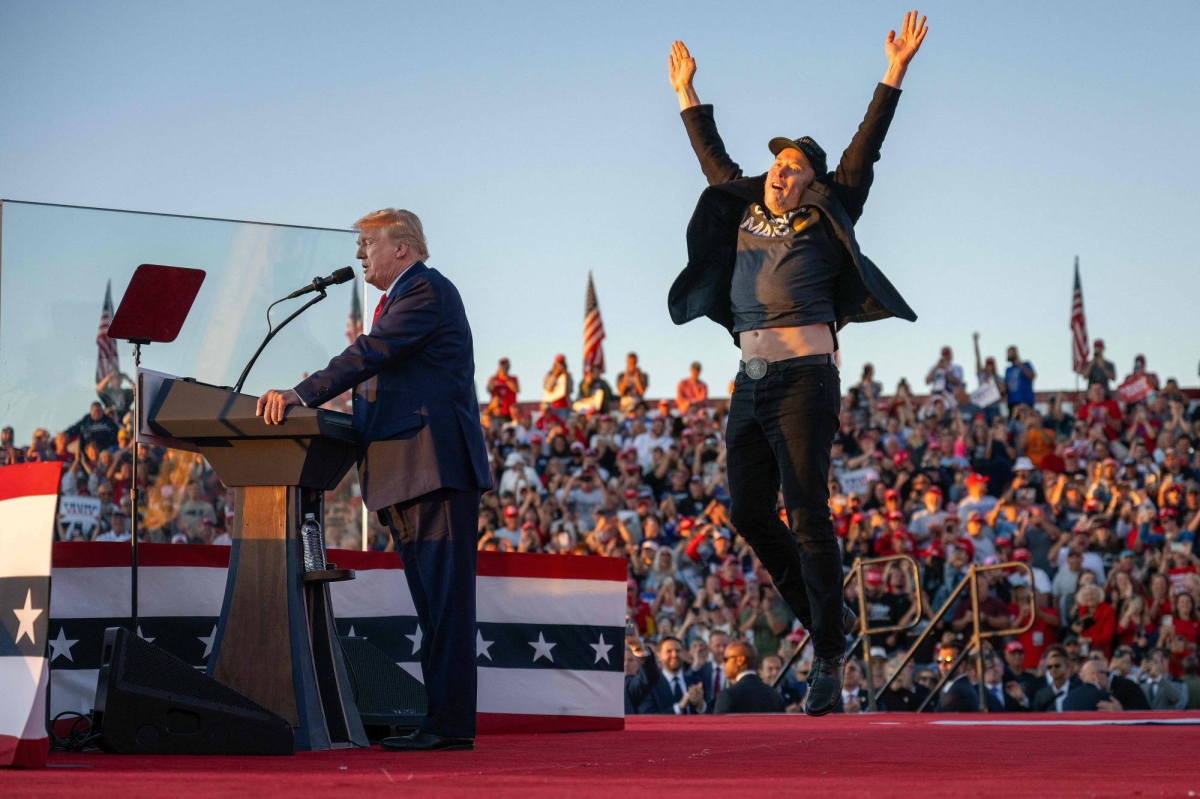
    That feels like extremely high stakes thinking. It might explain another development in the world’s most advanced technology economy. It’s one thing for a government to depend on a private company, SpaceX, to conduct an international space rescue mission. But, it’s quite another to see SpaceX’s owner Elon Musk in the words of VP hopeful, Tim Walz, “skipping like a dipshit” at various Trump rallies. Musk may cause me involuntary eye-rolls every time I read him on X or see him on TV but he’s a super-successful builder of future technologies. In fact, he has feet in both existential races with Tesla (climate) and xAI (AI) which is about to raise funds at a $40 billion valuation. If the latter doesn’t feel like an existential race, maybe the monies will convince you. In 2023, just 4 companies – Facebook, Amazon, Google and Microsoft – spent $196 billion or 0.72% of US GDP on AI research and infrastructure. Remember, these companies are really only ‘getting ready’. Furthermore, they are arguably investing at levels which historically would have only been within the compass of sovereign governments.

    I remember reading first about social media companies becoming effectively supra-sovereign powers. At the time, Facebook had 2.5 billion people on its platform, multiples of any other country populations on the planet. Now social media steers business and moves elections, but tech money might be about to go one step further. Forget about tech companies currently rolling out nuclear power for their hyper-scaling data centres. What about a seat in government?  Well, Elon Musk is on the cusp of entering a Trump ministerial cabinet with a role brief focused on cost cutting. I will give you a clue; plenty of those cuts will be in the regulatory, business and tech governance areas. Musk is not alone. Racist rallies in Madison Square Garden or not, big business is keen to put on the Orange war paint for Trump chaos and……… commercial insurance or favour. Check out the latest Trump luvvies from the world of business:


    Winklevoss Twins donate $1m each to Trump as champion of cryptocurrency  – The Guardian


    Steve Schwarzmann says Trump would be “efficient and effective” president this time – Business Insider


    Silicon Valley’s Andreesson Horowitz give Millions to Trump  – Bloomberg


    Billionaire Ken Griffin says “expectation today is that Donald Trump will win the White House” –  Fortune


    Washington Post flooded by cancellations after Bezos non-endorsement decision  –  NPR


    Ooooohh what would Washington Post legends Katherine Graham or Ben Bradlee think in this “Fat Nixon” era? It would appear big tech and big money “broligarchs” see Trump support as commercial insurance at the very least, and possibly a route to unfettered, compliance-light opportunity. One could become dispirited about the overt involvement of big business in politics. But, in reality business was always there in the Washington background. However, it’s not just a US phenomenon.

    Europe has had its share of big business influence on policy. In the UK, they have had trade and Brexit. In Germany, it was the powerful industrial sector and its push for cheap(then) dependency on Russian energy. We will say no more on either policy disaster, except there might be an intellectual reason why US business leaders are in a different universe of wealth creation compared to their strategically inept European counterparts.

    On a final more serious note, perhaps the difference this time is that governments really do need the balance sheets, cash and spending power of big tech. Just six US technology companies – Apple, Amazon, Google, Meta, Microsoft and Nvidia – have a combined market value of $15 trillion. For context, that $15 trillion equates to the  GDP of China as recently as 2020. In this writer’s reluctant view, politicians have two options – tax these guys or become partners. It might seem distasteful but public-private partnership is now an existential fact of life….or death.

    Gotta dip with the dipshits.


  • Watch Out For Joyful Asset Shocks

    Watch Out For Joyful Asset Shocks

    Wow, what just happened! In the last 33 days we saw an incumbent US President forced out of his re-election campaign, financial markets take a battering, Japan’s Nikkei dropping 20% in just two days’ trading,  the Republican National Convention celebrate polls predicting the second-coming of their Cheesus, and a likely funds-deprived military capitulation of Ukraine to Agent Orange’s mate in the Kremlin. It was all rather scary and in the financial markets the ‘fear gauge’ measured by an options derivative, the VIX index, rocketed from its long-run median level of $17.6 to $60 on the 5th August. In fact, that was the largest single-day increase in the ‘fear index’ in history. Then, over the next 7 days it fell right back to its average $17 level. Incredible. But, not even the VIX could have foretold the emergence of the ‘joyful warrior’ Kamala Harris as the pollsters’ best current bet for the White House in the November election, nor the invasion of Russian territory for the first time since 1941 by Ukrainian soldiers (in German tanks!!). These are amazing geopolitical turnarounds but not necessarily the type of shocks to move financial markets. However, we’d like you to think about a few developments which really could shock….in a good way.


    Productivity: The scary headlines would suggest recent ‘revisions’ of US jobs data revealed a less healthy US employment picture. The revisions showed that the statisticians over-counted the number of jobs created in the year to March 2024 by 818,000. However, before we go all wobbly-kneed about job creation moving at a pace of  ‘only’ 175,000 new jobs per month (vs previous estimate of 245,000) we need to consider that US GDP growth numbers have not changed. This means that labour productivity which has stalled for decades is picking up serious speed. Hmmm. Anyone tempted to ask ChatGPT what’s going on? Well, our AI boom might be beginning to pay dividends but in a more subtle way. Probably the best read of the week is a guest contribution by Brian Albrecht, Chief Economist at the International Centre for Law & Economics, on Noah Smith’s always excellent blog. Two snippets really hit home with me. First, the subtle impact of AI:


    To be clear, the progress isn’t about chatbots. Instead, it’s about small improvements across every sector of the economy. It’s the human resources manager using AI to sift through resumes more efficiently, the logistics planner optimizing delivery routes in real-time, or the data analyst automating report generation. These minor advances, multiplied across millions of workers and thousands of businesses, are what will ultimately drive significant productivity gains.


    Second, massive change in productivity could be already under way but is hidden by upfront costs like training, reorganizing workflows and designing new processes:


    The computer revolution offers a helpful parallel. In 1987, Nobel laureate Robert Solow famously quipped, “You can see the computer age everywhere but in the productivity statistics.” This “productivity paradox” persisted for years. It’s almost comical now to think of 1987—when the original Macintosh was brand new, and C++ was just gaining traction—as an era when “the computer age was everywhere.” Even then, the transformative potential of computers was clear to many observers. Despite the invention of the personal computer in the 1970s, we didn’t see significant productivity gains until the late 1990s. Why? It took time for businesses to figure out how to use computers effectively, redesign workflows, and develop complementary innovations.


    My own sense of things is that we are obsessing over generative AI (chat bots) and missing the integration of AI applications which have been around far longer than ChatGPT or Gemini; think machine learning, automation, robotics, virtual assistants etc. Of course, with far more powerful digital assistance available this has a potentially huge impact on the formation of new companies.


    New Business Formation: The US Census Bureau shows that 5.5 million businesses were started in 2023. This is the highest total ever and is a 57% increase on the numbers prior to Covid in 2019. Recent data from Ryan Decker and John Haltiwanger at the US Federal Reserve showed a surge in new business formation, particularly in hi-tech industries. But, there’s a pick-up in business formation in sectors like construction and building services too. These trends point to fresh ideas, innovation and pressure on incumbents to keep pace. It also points to higher productivity ahead. Our reference to ‘old economy’ activities like construction is deliberate because there is another forgotten sector beginning to stir.


    Critical Materials: This week the price of a gold bar reached $1 million for the first time ever. I’m no gold bug and I really don’t want to get into a philosophical debate about stores of wealth and inflation protection. But, I do know one thing. Gold tends to lead when the mining sector is due a recovery. Mining has been in the naughty corner for almost 15 years but I’m beginning to wonder whether sovereign anxiety over the supply of critical materials will lead to not just regulatory action (see the EU Critical Raw Materials Act) but actual sovereign/state investment in mining assets? If AI is now considered by nearly all experts as a sovereign-level risk race then the sector critical to industrial supply chains and decarbonising the planet could be about to receive its own positive sovereign attention.


    Electric Vehicles: Finally, on the theme of global decarbonisation, we could be on the cusp of a serious acceleration in electric vehicle (EV) adoption. Consider the following three developments:


    *For the first time ever in July, more than half of all vehicles sold in China were electric.


    *BMW pulled ahead of Tesla as the lead EV brand in Europe last month for the first time. Note to Elon Musk, Silicon Valley “broligarchs” and a few tech heads closer to home; funding a felon can be brand destructive.


    *Electric vehicles are now cheaper than combustion models in China.


    So, the competitive landscape is broadening out with Chinese and European players catching up with Tesla. This also means production of EVs is ramping up as market penetration of the total auto market approaches 20%. This production volume surge also has cost implications. According to Wright’s Law, used by MIT and proven in the wind and solar markets, when production of an item doubles the cost of producing that item falls by 20%. Critical to the EV revolution is the cost of lithium-ion batteries, and the cost of those batteries has fallen by 90% since 2010. Indeed, as the headline above suggested, China has reached a critical market penetration inflection point. Given the cost of batteries in China have fallen by 51% in just the last year, one can understand why EVs are racing past combustion models. Get ready for the virtuous circle of more production, lower costs and accelerated consumer adoption globally.


    All four developments above are capable of delivering significant positive shocks to the global economy and could be perfectly timed for a joyful new US President. Whoodathunk!