Tag: tesla

  • Betting On Small Can Really Win

    Betting On Small Can Really Win

    Please, no political bets. The headline is absolutely not referring to the UK Prime Miniature. The 14-year Conservative Party mission to shrink public services, business investment, critical trading relationships, institutional integrity and individual standards of public behaviour is ending in electoral wipe-out. Time for new beginnings, even small ones. As I read about UK ‘global leadership’ (with China) in a potential 9,000 millionaires leaving the country before the end of this year, I’m thinking more about generational change and down-sizing shifts in wealth creation strategies. That might seem strange in a world of mega-trillion tech companies but wealth works across different types of assets and for different generations. First a couple of size observations.

    An interesting chart this week from Private Equity/VC research data house, Pitchbook, showed smaller private equity(PE) funds outperformed bigger ones over a 10-year time horizon. In the best performing quartile of funds the performance gap was a whopping 6.7%. In real money terms, the returns of small funds were one third higher than the bigger funds. Here’s the chart:


    Clearly, the challenge of earning high returns with massive pools of money runs into the problem of a smaller opportunity set. In other words, big funds can only deploy capital in bigger companies and miss out on opportunities with smaller (probably faster growing) companies. However, funds as they become bigger can also suffer from strategy “drift” as pressure to deploy capital forces funds into other sectors, geographies, vintages, styles etc. As a classic illustration of this challenge, look no further than the ARKK innovation fund managed by Cathie Wood. Back in 2021, a big winning bet on Tesla and other innovative companies by the ARKK fund attracted billions of investor dollars. However, since then, the fund has cratered in value by 59% while the funds which track the Nasdaq tech index are up 37%. Big can sometimes be painful. Of course, new strategies can help diversify risk for investors and five headlines caught my eye this week:


    Blackrock Muscles Into Private Assets Market For Wealth ClientsBloomberg

    Andreessen Horowitz plans to launch a private equity fund  –  Fortune

    Carlyle and KKR beat rivals to win $10bn Discover Financial loan portfolio – Financial Times

    Private Credit Is Trouncing Private Equity So Far This Year – Wall Street Journal

    Watford FC Sells Digital Equity Tokens – Techopedia


    So, the giant manager of publicly listed assets is looking for private assets, the venture capital giant wants private equity, the private equity monsters are going for better returns in private credit (loans) and Elton John’s former club is looking for digital equity. Got all that? Probably not, but, if we think about Elton and the music business 20 years ago then you’re witnessing a similar generational shift in investment/wealth products. Investors, as individuals or as families, are increasingly looking to invest in private assets, not just publicly listed companies or funds. There is also an additional trend we should be watching. Private investors are now organising themselves in syndicates or family office structures and the latter segment is sitting on enormous pools of wealth. Try these for size:


    *Family offices currently manage circa $10 trillion of investments. Compare that to the higher profile hedge fund industry which manages $6.5 trillion.


    *There are currently 15,000 family offices operating and actively investing globally.


    *Now, for the banger. In the next 20 years there will be a seismic transfer of wealth from “Baby Boomers” to the next generation. Current estimates of this generational wealth transfer exceed $80 trillion.


    So, this investor base of family offices will have new principals and new ‘purpose’. Apart from asset growth , tax structuring, succession planning and philanthropy, it is increasingly likely these investors will be ‘values driven’, and possibly less interested in the buy-and-sell 5-year cycles of private equity and venture capital funds. In this writer’s view, a massive pool of patient purposeful capital is poised to disrupt the traditional way companies are funded. And, for smaller companies and smaller investors this should be considered a win without any need for Gambling Commission scrutiny…..

  • Countdown To Trend Exhaustion…?

    Countdown To Trend Exhaustion…?

    It’s day 96 of my 100-day no alcohol challenge, so who’s counting? I’m certainly not exhausted. Quite the contrary, but recently I have been prone to describe the benefits as “over-rated”. However, this proximity to completion does focus the mind on other things potentially ending in the world of business and investment. In particular, and by pure coincidence, in my day-to-day risk role I’m seeing some multi-year business trends begin to stall or enter new phases of growth. But, first let’s deal with a monetary shift.

    The consensus view on inflation and interest rates was that both were on a downward trajectory with central banks promising to cut rates if consumer prices were on track for a more manageable 2% annual growth. Europe seems to be on track, and the ECB just today indicated its rate cut cycle could begin in the summer. If anything, the Fed (FOMC) in the US was going to move before the Europeans, with money market traders heavily betting on a June cut. Ouch! This week’s US inflation report (CPI) caused some real pain for those traders as core CPI came in ‘hot’ at a year-on-year 3.8% rate of price increase. That’s way off a 2% level targeted by the Fed and means a significant reversal in monetary leadership as money markets now price an ECB cut in June, and the Fed to follow suit in September. That’s a big change in expectations.

    As always, the cost of money (rates) drives all financial asset prices and this ‘change’ in trend could have an immediate impact on currency markets. Watch the Japanese yen continuing to fall to a 34-year low versus the dollar and Tokyo’s stock market at a 34-year high. A Bank of Japan rate hike might be needed to stabilise its currency, but not necessarily cheered by stock market investors. In fact, the yen-dollar relationship is often used by traders as a proxy measure of ‘risk’. The trend in markets for the last 15-18 months has been ‘risk on’. In other words, asset prices have generally rallied as investor confidence grew. A shift to ‘risk off’ could hurt some of the higher flying assets of recent times. I note Goldman Sachs’ investment division is growing wary of US technology (“Magnificent 7”) but there’s another newer asset class which might also stall its impressive return to form.

    Bizarrely, this new asset class was designed and built to escape the scrutiny and influence of the all-powerful global central banks. I’m talking cryptocurrencies and Bitcoin which has quietly risen to its historic pricing highs of $72,000. However, rather than become independent of the traditional global financial system, Bitcoin has become an asset used by traders to increase risk exposure (buy Bitcoin) or reduce risk (sell Bitcoin).  So, if ‘risk on’ trends are due a pause or reversal, it will be deliciously ironic that decisions in an office in Nihonbashi, Tokyo, by Bank of Japan officials could drive the price action of cryptocurrencies like Bitcoin. However, cryptocurrencies are not the only technology asset on a serious upward trend but facing a few teething problems. The hottest investment topic on the planet right now is AI. However, like central banking, there seems to be an emerging divergence of fortunes…

    The remarkable feature of the AI investment boom, compared to crypto and metaverse, is the sheer scale of investment. It’s not just hype. Nvidia, the $2 trillion poster child of AI and manufacturer of the chips powering AI learning models, is booking real orders and reporting real 6-fold revenue growth in little more than 12 months. However, the future ‘winners’ in providing these AI services are less visible. Of course, Big Tech, with Amazon, Microsoft and Google leading the charge, are busy building or acquiring chips, talent, language models, data and technologies to win the AI race. This race requires vast amounts of investment capital and the smaller players are beginning to struggle. Once upon a time, London-based StabilityAI had raised $100 million at a $1 billion ‘unicorn’ valuation but has ended up with a CEO/founder departure, a Getty Images lawsuit, $99 million of debt and just $11m of revenues. A recent Forbes article suggested the firm had run out of cash to pay its Amazon(AWS) cloud computing bills. Clearly, the overall AI investment trend is intact but it is important to understand the nuances and risk-shifts within that structural story. Now, for an excellent example of that point.

    The simultaneous growth of global GDP and an ageing demographic has ensured a steady flow of pensions and savings capital into equity markets. This has resulted in long-run returns for investors in developed equity markets of 6-7% per annum over the decades. However, as the investment pool of retirees increases my little ‘risk radar’ is seeing a problem and a solution. Firstly, many readers will be aware of the Irish stock exchange(ISEQ) and the mighty London Stock Exchange (LSE) losing constituent companies to other major exchanges(NYSE, Nasdaq) or publicly listed companies being bought out by private capital. Only this week we were forced to ponder a scenario where the LSE could possibly lose FTSE 100 index titans, Royal Dutch Shell (move to a higher valuation US stock market listing) and BP (reports of a bid from Adnoc, Abu Dhabi’s national oil company). From a simple numbers perspective, the investment opportunity pool on a public market/exchange (LSE) is not just shrinking by hundreds of billions (in market capitalisation) but also potentially losing two of the 5 biggest income generators (dividends) for pensioners in the UK. That’s a problem. Now, the solution.

    Jamie Dimon, CEO of JP Morgan, in a recent CNN interview highlighted the same problem; at its peak in 1996 the US had 7,300 publicly listed companies. Today that number is 4,300. However, like AI, investment capital might just have shifted into a different corner of the same opportunity pool. In fact, it has. The number of US companies backed by private equity firms has grown from 1,900 to 11,200 over the last two decades (Source: JP Morgan). So, the solution for investors is to expand their investment horizons into private equity funds, private buy-out deals, EIIS investments etc. Until incentives are improved for companies to go public (regulation, quarterly reporting burdens, costs, PR etc), this public-private shift will continue and investors/pensions will have to find opportunities and income/dividends in private companies. Bluntly, the future is bright, but it’s private. And, it is no accident that Spark Private Portfolio investors are currently being offered an exclusive opportunity to expand their portfolios into an interesting private healthcare buy-out deal. Unsurprisingly,  the most valuable private companies right now are very much looking at the future – check out Open AI ($100 billion ) and SpaceX ($180 billion) – but what about that other Musk combination of new tech and transport, Tesla?

    Tesla’s 30% share price decline in 2024 might be perceived as a Musk-specific governance issue but the entire electric vehicle sector (EV) is encountering some growing pains. Check out these headlines:


    EV Sales Revved Up. Now Buyers Are Pumping The Brakes – Barrons


    Ford to delay rollout of new electric pickup and SUV as EV sales slow –   The Guardian


    China’s first quarter EV sales growth slowest in a year –  Reuters


    As the benchmark player, Tesla’s poor recent results and actual year-on-year sales decline in the US prompted the commentariat to quickly ask whether this was an EV market blip or something more structural. From this Dublin desk, and a country with an abysmal track record on timely infrastructure modernisation, it looks like the charging infrastructure (not enough charge points on routes) for the EV revolution is due some catch up globally. In particular, US consumer surveys continue to cite charging/range anxiety as a factor. More short-term factors probably include high interest rates (falling soon?), consumer expectations of continued manufacturer discounting and new super-cheap Chinese alternatives. This all sounds very familiar to long term observers of global durable goods manufacturing cycles, and with so many companies investing to win the EV landgrab, there will be casualties among manufacturers. Just ask the computer chip industry. In fact, that industry gives us a chance to conclude on a positive note.

    If anyone doubted the Bidenomics manufacturing revolution in the US, then this week was seismic. Taiwan’s chip manufacturing giant, TSMC, confirmed an expansion of its capital investment in the electoral swing-state of Arizona. The new TSMC investment number is $65 billion compared to an initial plan of $40 billion and will result in 3 chip factories being built in the state. Critically, a mix of US government grants and loans offered to TSMC will add up to a whopping $11 billion of investment incentives. That’s great news for Arizona, albeit TSMC might have to plan for male-only recruitment. It looks like the AI chips of the future will be built in Arizona, but the state’s Supreme Court is definitely searching for the past. In imposing a total state-wide ban on abortion this week, the state’s highest court had to travel back in time to revisit supportive legal text in the statute books from …..1864. Now, that is exhausting.

  • Which Global Themes Are Flying?

    Which Global Themes Are Flying?

    Only one sleep to go until “Sixmas”, or the 6 Nations. Giddy. Another 28 days to go in the “Freezbrury” cold water swim challenge. Not so giddy. Such is the emotional ebb and flow of life but what do we make of the January investment emotional roller-coaster? Dare we say January was a game of three ‘halves’? The early days of the year saw markets puke, only for the next three weeks to see markets roar higher on familiar big tech AI giddiness, interest rate cut hopes and stronger economic numbers out of the US and Asia. Then, more fear. As always, the cost of money (rates) drives all asset markets. So when the Fed said “not so fast” on March rate cut expectations markets had another little tantrum to close out the month. Now, ignore all that trading noise. Let’s stick to longer-term thinking and revisit a few themes we flagged for 2024.

    First, we go big. The “Magnificent 7” big tech names have been driven to new all-time highs on the continuing AI theme with Microsoft hitting a $3 trillion market valuation for the first time, and AI poster-child, Nvidia, adding another 24% to its value in January alone. However, if you’re a Tesla shareholder, you might need access to the Elon Musk drugs cabinet to dull the pain of a January 24% crash in the value of the once biggest EV manufacturer in the world. As we write of potential regime shifts, I am reminded of a mandatory Thursday lunchtime every quarter in the naughties being glued to my desk and screen awaiting Nokia’s latest earnings report from Helsinki. The equivalent global pulse-check these days is one evening every quarter in New York when Microsoft and Google tell us how their cloud(AI) business is doing. This week the update was 30% and 26% cloud revenue growth respectively. Let’s just say theme intact.

    Now, go smaller. Well, not so small. On the Microsoft analyst call, Ireland’s very own An Post received a shout out from Microsoft CEO, Satya Nadella, as an example of a customer using its AI CoPilot Studio. This did prompt some thought about small companies and start-ups using AI. We probably don’t give technology and digitalisation enough credit for empowering founders and scaling up businesses over the past two decades. With a website, e-commerce applications, security/payment apps, and cloud hosting/workflow support, a start-up business no longer had to sink capital into up-front infrastructure costs but, instead, could pay software subscription fees (SaaS) to big tech and go to market quickly. This writer is just wondering could AI be an additional accelerant for start-up businesses? Maybe it’s not just me. Review site, Yelp, recently published data on a record 762,200 new US business openings in 2023, up 20% on 2022. Furthermore, US government data confirms the pandemic-inspired “entrepreneurship boom” is alive and kicking going into 2024.  However, some start-ups do need serious up-front capital….

    Check out our cleantech theme. The initial construction of huge EV battery gigafactories, renewable energy installations and decarbonised manufacturing (see steel, fertiliser, cement etc) requires billions of investment capital dollars. Encouragingly, we are seeing some really big funding deals get over the line. Sweden’s Northvolt announced a $5 billion debt financing round in January and a week later another Swedish name, H2 Green Steel, raised €4.5 billion in debt and equity. And, it’s not just cleantech start-ups being backed by significant banking syndicates. Despite the gloomy macro headlines, it feels like banks are feeling better about life in general. Note the record $188 billion of bond issuance by US companies in January and the index(ETF) which tracks the US Banks sector (XLF) hitting a 2-year high. No wonder Bloomberg was leading with a headline this week “The Credit Market Is Quietly Booming again”.

    Of course, in our earlier 2024 themes article we expected continuing stress in global real estate so it’s not all good news for banks. The slow-moving Chinese train crash of Evergrande finally hit its liquidation wall in the Hong Kong courts but the potentially more significant real estate news came out of Tokyo this week. Aozora bank shares plunged 20% after it revealed a $191 million loss for the year due to write-downs on its loans to the US commercial real estate (CRE) sector.  Meanwhile, back in the US, New York Community Bancorp reported a $185 million charge-off on just two CRE loans and watched its share price crater 38% in a matter of hours.

    Expect more of this but the key global credit swing factor will be China. For now, Beijing’s efforts to stimulate the economy is pushing capital into the wider Asian economy as the Chinese manufacturing engine ramps up activity. Evidence of early policy traction across Asia might be seen in the bellwether South Korean economy and its PMI survey of factory activity showing expansion for the first time in 19 months. Of course, with interest rate cuts firmly expected in 2024, central banks and investor want a “goldilocks” outcome rather than economies running excessively hot. We shall see, but in the area of healthcare it sounds like one form of excess has been whipped. More specifically, we are revisiting our weight-loss and healthcare/biology theme.

    In recent days Danish pharma company, Novo Nordisk, became just the second European company to  pass the $500 billion valuation mark. Its obesity drugs, Ozempic and Wegovy, have revolutionised the prospects of this 100-year old company and can only focus investor minds on further medical opportunities. We have previously highlighted the intersection of biology and technology as a theme so recent news from Cambridge University was intriguing. Scientists in recent weeks have published research on the successful re-programming of microbes to unlock new materials. This could lead to a whole range of innovative products from new drugs to enhanced carbon-absorbing materials. Here were our own thoughts on new materials and speed to discovery from a few weeks ago:

    “However, artificial intelligence(AI), probably the hottest investment theme outside cleantech right now, has just been used in conjunction with supercomputing to discover a brand new material which could reduce lithium usage by up to 70%……Microsoft and Pacific Northwest National Laboratory (PNNL) research teams whittled down 32 million potential material combinations to 18 promising molecular structures within a week. Incredibly, the whole discovery project took 9 months in a screening process that would typically have taken more than 20 years using traditional lab research methods. The new AI-derived material, simply called N2116, should prompt thought as to what’s possible in the world of medicine, agriculture, transport and construction”

    One final thought which is not so much a theme but is a necessity for these themes to accelerate; our investors always ask “where’s the exit?”. The text book response is that investor exits usually happen through a trade sale(M&A), buy-out (Private equity) or listing shares on public markets via IPO. Private equity house, Bain Capital, reckon global M&A activity of $3.2 trillion was down 15% in 2023 to its lowest in a decade. Meanwhile, EY’s global IPO report indicated listing activity was down 33% in value terms compared to 2022, and Goldman Sachs said it was the worst IPO year since 2016. The good news is that many advisory teams in the investment banks are quietly confident of an uptick in IPO pipelines for 2024. Indeed, the expected New York listing of Chinese fast-fashion play, Shein (ask the kids!), with a $90 billion valuation will be an early test of lift-off. The big global themes will still play out but juicy sales and exits would definitely confirm things are really flying. Also, and more importantly, confidence spreading outside the “Magnificent 7” to smaller businesses would be very good news.


  • Five Numbers Say Don’t Give Up….

    Five Numbers Say Don’t Give Up….

    Perhaps it’s the prospect of beginning a 100 day no-alcohol stint which is causing, on my part, a sudden obsession with numbers. Then again, it could be just a time thing. I mean, who knew one of the World Darts finalists would be younger than the iPhone? Or, that just 9% of UK voters believe Brexit is going to plan? Well, probably the rest of the world knew that a policy to sanction your own economy more heavily than Russia was going to end in tears. However, the rest of the world should drop the sermons-in-smug and pay attention to the first of five key numbers we are watching in 2024….

    Climate Crisis: The temporary visit on November 17th of global temperatures more than 2 degrees above pre-industrial averages is a five-alarm-bell ringing of an existential crisis for the planet. Given we have been in perpetual storm mode since late November, and the storm-naming cycle is already past “H” with Storm Henk, there is a personal sense that bad news could be good news. In particular, catastrophe losses in the insurance and capital markets could focus political leaders’ minds on the sheer cost of loose non-urgent language in the recent Cop 28 commitments.

    Bond Markets: We regularly remind readers that the cost of money (interest rates) is the critical driver of ALL asset prices. The number which caught the eye this week was that bond prices (which fall when interest rates/yields rise) have been in negative territory for 41 consecutive months – the longest ever draw down in history. And, forgive the repetition, but again bad news might actually be good news for bond prices. In other words, a slower economic environment and some employment weakness could be the trigger for global central banks to ease interest rates and allow bond prices recover.

    Venture Capital: In the Spark world of start-ups we are always watching the private markets as well as the more liquid (and better performing) public equity markets. The S&P 500 might have sucked in AI-excited investment and delivered 25% gains in 2023, but for younger companies access to capital was far more difficult. The VC data research team at PitchBook reckons global VC funding fell to $345 billion in 2023, down from $531 billion the previous year. In private equity, deployment of capital dropped by 29% and exit activity was down by 26%. That’s the worst combined performance since 2016. However, the silver lining in these numbers is that funding activity has shifted away from more mature private opportunities to early-stage, seed-type investments. In fact, two in every three deals done were in early-stage companies.

    Cleantech: While Tesla is overtaken by Chinese rival, BYD, as the top electric vehicle(EV) producer globally, there is strong evidence that Europe is ramping up its capabilities in the EV ecosystem. Buck Consultants have published research forecasting the installation of 250 EV battery gigafactories in Europe by 2033. This won’t be a huge surprise to those who have seen McKinsey estimates of annual cleantech spend until 2050 exceeding $6 trillion. Imagine investing more than the entire GDP of Japan every year…..for decades.

    Democracy: Of course, investment in our survival and a phasing out of fossil fuels can only happen with strategic political leadership. The shift to right-wing populism has been a striking feature of the global political landscape in recent years but 2024 is truly the “Year of The Vote”. The US and UK are high profile elections on the horizon but the global stakes are much much higher than that. Seven of the ten most populous countries in the world, with a combined 4 billion voters, go to the polls in 2024. That’s 46% of the world’s population, or 54% of global GDP, deciding where we go next. Oh, and don’t forget European/MEP elections this year too.

    So, we can perhaps understand why financial markets are opening up 2024 in a jittery manner. However, as Sergeant Kenneth “Hutch” Hutchinson departs in his iconic red Gran Torino for his celestial precinct in the sky, I’m hopeful that young companies and young voters can put the five numbers above on the right trajectory. In particular, we must hope that younger voters reject the fear fraudsters and focus on the sustainability of their own future. Dare we suggest that the temperatures of both hate and climate are the key dial-down numbers to their survival, and engagement? Or, as David Soul might sing, “Don’t Give Up On Us Baby…”

  • Get Ready For The Cloud Wars

    Get Ready For The Cloud Wars

    When the value of just two companies changes by $200 billion in a matter of hours I usually take a closer look. That can even happen when “Married At First Sight”, and not Gaza, has brought you to the point of giving up on humanity. More Gaza later. For now, let’s revisit the events of October 24th. Despite the glow of its recent 25th birthday, Google’s quarterly earnings results failed to impress investors and the subsequent share price dive clipped the guts of $75 billion off the value of the Mountain View tech giant. In contrast, investors were excited by the update on the same night from the world’s second most valuable company, Microsoft, as investors rushed to buy shares and added a cool $125 billion to the valuation of the Seattle tech giant.

    The only word on any traders’ lips that evening in New York was ‘cloud’. More specifically, the revenues earned by the critical data storage and processing architectures which support all our personal and business digital apps and services. The ‘cloud’ is where big tech has leveraged its scale and offered enormous computing power to live and work your digital existence. However, these apps and services are now feeding off a new digital super-power – Artificial Intelligence(AI).

    Generative AI with its large language models(LLMs) and enormous data learning appetites have turned the cloud into a battle field fought by the big three – Microsoft, Google and Amazon. And, the cloud is flying – not quite literally but Microsoft’s Azure cloud business revenues are rocketing at 29% annual growth rates. Google’s cloud business was perceived the ‘loser’ last week with a growth rate of just….. 22%. You get the picture – the cloud is big money, but it’s also really all about AI. Revenues earned by cloud services (powered by data centres) are a proxy for measuring who is winning the AI ‘war’. Let’s be very clear Google and Microsoft have lots of other revenue channels but there is no doubt that the $200 billion shift in valuations between the two giants was entirely driven by the cloud, and by AI. Still sceptical? Allow me to expand on this thread…

    Remember Mistral? Yep, that was the company with 4 guys who raised $120 million with no business and no revenues. Just a PowerPoint presentation. Well, that was 4 months ago. And, now they’ve reportedly raised another $300 million. This time they can actually demonstrate a proprietary large language model(LLM) built with 7 billion parameters for AI training. Yes, built… in 4 months. In valuation terms, Mistral is already a ‘unicorn’ – a startup worth more than $1 billion. If you thought this was merely VC excitement about ‘disruption’ then think again. It feels like the world is still figuring out which of emerging disruptors (with new AI models) or big tech (with its massive proprietary data head start) will win the modelling wars. However, big is still beautiful in investors’ eyes.

    Check out all the gloomy headlines – inflation, painful interest rate hikes, war, recession. You’d think stock markets would be cratering. And, you’d almost be correct. If you strip out the share price performance of just 7 technology companies – aka the “Magnificent 7” – then global equities are probably in negative territory for 2023 so far. Now, think about what is driving Apple, Microsoft, Tesla, Google, Facebook, Nvidia, and Amazon who, on AVERAGE, have rocketed in value by 80% this year. For this writer, it is clear these 7 companies possess the best databases on the planet and are in pole position to train AI models to do whatever they want. Some are happy to use 3rd party models like OpenAI’s ChatGPT or Anthropic’s Claude and the investment monies are still flowing fast.

    Microsoft has already put $10 billion into OpenAI and the latest reports of funding activity suggest OpenAI’s valuation has jumped from $20 billion to $85 billion….in 8 months. Amazon is putting $4 billion into Claude but, as we have illustrated, there are about 200 billion reasons and counting to be in this race. We can’t forecast the future but it is worth remembering that this is AI in its infancy, or to put it another way, at its worst.

    I had the genuine pleasure of chatting to “the Oracle of AI”, Jim Dowling, who presented at an IIBN business event last week. He’s usually based in Sweden and, uniquely, is that country’s only resident lecturer in Deep Learning. It was fascinating to hear him talk about “emerging reasoning” in some of the very large AI models and how lots of well-known businesses are using his company, Hopsworks, to re-configure their data architecture for pending AI applications. What was less fascinating was my estimate that probably 75% of the questions from the audience were fixated on deep fakes, misinformation, AI ‘hallucinations’ and cheating on…. homework. I know, how do we sleep at night!

    Now, recall my earlier words that these early building stages are seeing AI ‘at its worst’. Then just repeat one word to yourself, quite a few times. GAZA. As a species we seem to be perfectly good at bringing ourselves to the brink of World War III or demonstrating barbaric behaviours which, on reflection, didn’t quite end with Ghengis Khan or the Inquisition. Bluntly, we can do far better and AI could help – think of education, the unbanked, healthcare, medicine, energy, decarbonisation, urban planning or agriculture. You know, all the bits to do with living. Of course, all important things must have governance and guardrails. How many unapproved foods, drugs or banks do you know? So, get ready for more of the following:

    Biden Executive Order Imposes New Rules For AI – ABC News


    The excellent Tech Brew newsletter gives a good summary in the following bullets:


    • The directives in the order cover everything from housing discrimination to bioweapons, and aim to address AI at each stage of development.

    • Developers must share safety test results with the government, and various agencies will work on developing standards designed to mitigate threats from AI-created biological weapons and deceptive deepfakes.

    • The order includes a regimen of new privacy research and rules that aims to better govern how developers use information they collect on users.

    • A section of the order homes in on algorithmic discrimination; it calls for guidance to landlords, federal contractors, and welfare programs on reducing bias in any AI tools they use, as well as new guidelines for the Department of Justice to probe this type of discrimination and more rules around AI’s use in the criminal justice system.

    • The general consumer protection section focuses mostly on developing standards for AI’s use in healthcare and education.

    • The order calls for a report on AI’s impact on the workplace, and lists directives for working with allies to implement AI standards internationally.


    Meanwhile, over the other side of the pond……


    UK, US, EU and China sign declaration of AI’s ‘catastrophic’ danger – The Guardian


    Hosted by the British government this week, twenty-eight governments signed up to the so-called Bletchley declaration on the first day of the AI safety summit. One can understand the British government’s eagerness to exhibit some form of responsible stewardship given the stunning revelations coming from the ongoing Covid-19 inquiry in Westminster. An “unfit” Prime Minister surrounded by “f*ckpigs and morons” administering a staggeringly incompetent response to a global pandemic is truly a review for the ages. And a relative reminder of AI’s infancy and humanity’s ability to be……. ehhh…..almost inhuman, or non-human.

    So…..GAZA or AI? My money (and clearly a lot of investment capital) is on cloud wars potentially delivering a better humanity. Keep watching, and hoping. It will be worth it.

  • Great Expectations

    Great Expectations

    Sometimes I wish NPHET’s body of experts and medical chiefs would collectively do the ‘Freezebury Challenge’. As each day of February goes by, those hardy souls counting the extra minute each day in the frigid Dublin Bay waters understand the battle waged between fear of the next day’s incremental pain and the motivation of a charity challenge completed with a firm finish date; March is the fun swim focus. However, NPHET don’t do fun. Dates are fuzzy and the focus remains fear. The good news is human beings are resilient. It’s in our nature to look ahead, despite the challenges, and financial markets are currently providing a remarkable case study in expectations.

    If anything, economic conditions have worsened in recent weeks as businesses in Q1 deal with second and third wave pandemic lockdowns. Main Street is struggling. Yet, Wall Street is flying to record highs on an almost daily basis. The headlines would suggest “meme stocks” like Tesla are the drivers of this market excitement but that is not even close to the full picture. The truth is that it is not just “stories” which are generating investor enthusiasm. It is real stuff; dirty, old, fundamental stuff. And a little bit of digital dreaming. Here are a few data points which caught the eye:

    • Lumber prices in the US are up 170% over the past 10 months.

    • Oil prices above $60 per barrel are at 13 month highs.

    • Prices of natural gas in Asia almost reached $30 per MMBtu compared to just $2.60 in the US.

    • Tin prices at $30,000/tonne hit a 10 year high.

    • Copper prices at $8,400 per tonne have not been seen since 2012.

    • Soybean prices are up 60% in the past year.

    • Investor confidence in riskier companies’ debt hits record highs(price) as junk bond yields go below 4%.

    • Share prices in emerging markets are at record highs, finally eclipsing the previous peak achieved in 2007.

    • Japanese investors in the Nikkei 225 index have had to wait a little longer. The Nikkei is back at the 30,000 level it last achieved 30 years ago!

    And now for the dreamy stuff…..

    Investors can’t get enough of thematic blank cheque investment vehicles. Known as SPACs (Special Purpose Acquisition Companies) these vehicles are being listed on public markets at an unprecedented rate of almost $1 billion raised per day. In 2020 the total SPAC investment universe raised $83.4 billion dollars. We are only in mid-February and funds raised are already at $46 billion. Please note investors don’t even know where these funds will be spent in terms of acquisitions, geographies, valuations etc. You know, the fundamental stuff, right?

    Of course, we can’t ignore cryptocurrencies. Elon Musk and Tesla made a big splash in recent weeks buying $1.5 billion of Bitcoin and now this digital “store of value” has passed through the $50,000 price mark. Now there are commentators excitedly talking about Bitcoin as a more efficient substitute for gold which is an asset class ten times the size of Bitcoin’s market cap. So, next stop is $500,000 for Bitcoin!

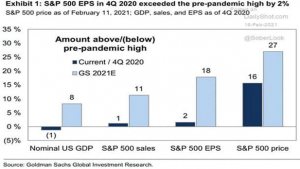
    Yes, this writer is a little concerned. However, confidence is critical to economic recovery. There will be fun and tears along the way(ask the Gamestop bandwagon victims) with pockets of irrational exuberance, particularly in a super-low interest rate environment. However, we leave you with one final fundamental data point which suggests better times ahead. There is a school of thought that Wall Street has detached itself from Main Street reality but check out the latest analysis by Goldman Sachs below. It would appear that profits from companies in the S&P 500 in Q4 2020 were actually higher than those achieved pre-pandemic….

    Clearly, things are getting better in the corporate world and the roll out of vaccines can only add to optimism. However, expectations must be managed. There is a danger some investors will chase the shiny baubles of Wall Street as a panacea for pandemic loss. Fear of missing out, FOMO, is a powerful emotion but there will always be fundamentals….. and hopefully fun. Indeed, Dickens himself told us Pip would rather have missed the glitz of wealth:

    “I used to think, with a weariness on my spirits, that I should have been happier and better if I had never seen Mrs. Havisham’s face, and had risen to manhood content to be partners with Joe in the honest old forge.” ‘Great Expectations ’

  • An Apple A Day Keeps Capital Away …….?

    An Apple A Day Keeps Capital Away …….?

    Swimming is the new banana bread I am told. My fellow swimmers in the Forty Foot this morning might argue this is a healthier, if colder, development of our pandemic response. Not so in financial markets. Things are hotting up dramatically and possibly not in a healthy way. As of today, Apple is now worth more than all of the blue chip companies listed in the UK’s flagship FTSE 100 index, combined.

    Yep, the corporate empire of Boristan and Elgar’s “Hope and Glory” has just been trumped by a $2 trillion mobile ring tone. On a less flippant note, investor capital flows are chasing an ever smaller opportunity set. Big is not only beautiful, but grows bigger every day in a fundamentals vacuum. For illustration, yesterday Apple Inc and Tesla Inc executed a stock split. This administrative exercise has no impact on the valuation of either Apple or Tesla, it merely creates more shares with a lower price. Not last night. Here is what happened.

    Apple Inc’s valuation increased by $72 billion.

    Tesla Inc’s valuation increased by $51 billion.

    The combined additional value of $123 billion generated in just one day’s trading exceeds the entire market value of IBM.

    This additional $123 billion “franchise” value would equate to the FTSE 100’s second largest stock, BHP Billiton.

    Of course, there will always be “hot” stocks and sectors like technology. A global pandemic has certainly focused investor minds on the winners. Our worry is that governments and central banks might be doing the same. Check out the US corporate debt market. Federal Reserve support of debt markets has triggered a wave of borrowing by large US companies with total corporate debt soaring to $10.5 trillion. Ultra low interest rates definitely help but one wonders whether investor capital is being steered into the right places?

    The Bank for International Settlements (BIS) appears to share our fears according to this Bloomberg article:

    Companies with annual revenues above $1 billion dominate corporate borrowing now more than any time in at least a decade, according to the Bank for International Settlements. These firms account for 78% of global issuers of dollar bonds so far this year, according to data compiled by Bloomberg.

    “Led by easier access to bond markets, large firms significantly increased their borrowing,” BIS researchers Tirupam Goel and José María Serena wrote this month in a report about credit during the Covid-19 crisis. “The rest of the firms faced bottlenecks due to their reliance on a strained syndicated loan market and hurdles in switching to bond markets.”

    You may have read lots of the financial commentariat debate the prospects of a “V shaped” recovery. However, the colder reality for many smaller firms is no access to funding as banks tighten lending conditions. This opens up the possibility of what some are calling a lopsided “K shaped” recovery where large firms attract nearly all available investor capital and crowd out smaller firms. Ultimately, the overall economy suffers when capital is misallocated on a grand scale. Current headlines may gush about record, even bananas, valuations but the outcome could be far from healthy for economic recovery. As small firms fail and job losses continue it will not just be the streets of Portland hosting inequality protests…..

  • Corporate Activity is the Long View Tell

    Corporate Activity is the Long View Tell

    The pubs are back and so are the heroic trader tales, growing by the billion every day. By now readers may have heard about a new army of day-traders investing their stay-at-home savings in financial markets. There are some pretty good tales too; the Nasdaq hitting all time highs, gold flying to record prices, Chinese stocks up 10% in 48 hours, Amazon trading over $3,000 per share and Tesla up 42% in just 5 days. Whoop whoop. Welcome to a financial world with $10 trillion of central banking largesse.

    Tesla might win the trader-tastic trophy this week given it is now the most valuable car company in the world. Elon Musk’s electric vehicle franchise is currently worth almost $250 billion or, to put it in a more domestic context, that’s the gross national product(GNP) of Ireland from as recently as 2017! Tesla has lost almost one billion dollars in each of the last two years so investors are certainly taking a very long term view on cash returns from this business of making……automobiles. Or possibly not.

    The vast majority of buyers of Tesla stock through the pandemic lock-down are “trading” a short term view of further upside and hoping to exit with a quick profit. Nice if you can do it, yet all retail trading website disclaimers state clearly that most don’t. The track record of longer term investors is much better and this article is focused on a particular type of buyer, the corporate strategic buyer. These guys don’t have the luxury of a quick exit . They are in for the long haul and therefore their mergers and acquisitions (M&A) activity is a better barometer of confidence in the future. Clearly, a global pandemic has hit C-suite confidence but the data suggests some cautious optimism. Here are a few data tells:

    • Bloomberg tells us the first 6 months of 2020 saw global M&A activity fall by 50% to $1 trillion. But that’s still $1 trillion of long-term wagers on the future.

    • The Asia-Pacific region showed remarkable resilience with just a 7% decline compared to the similar period in 2019.

    • According to Crunchbase global venture funding in younger companies was $129 billion in H1. That’s also just a 7% slip from last year.

    • And at last, Warren Buffett is dipping into his $137 billion cash pile at Berkshire Hathaway to buy a gas pipeline from Dominion Energy for $10 billion.

    • The FT is also citing data from Refinitiv showing private equity(PE) firms upping their activity. These firms are also long-term thinkers and they accounted for 16% of all M&A activity in H1. That’s the highest share for PE since 2007 and they have another estimated $2.5 trillion to spend.

    It is not all dreamy optimism. US activity has collapsed by 90% and 44 deals have been pulled. That contrasts sharply with previous periods of turmoil and possibly reflects an executive pool truly exhausted by all that Trumpy winning. We just won’t go there today… and one can only hope Florida’s school children take the same view.

    But let’s finish on a more upbeat note and return to our previous theme of a possible surprise recovery for the “sick man” of financial markets, Europe. We note with interest that European deal activity has slipped by just 15% in 2020 so far. It is early days yet but, when Buffett and Europe are leading again, there are grounds for longer term optimism. Natural gas and Europe are quasi-inflationary bets so it won’t be just us watching carefully. Indeed, feel free to listen to the day trader tall tales but we can assure you the bond trader tales could be seismic….and very very real.

  • The Wisdom And Energy Of Crowds

    Mitt Romney defied his own crowd last night when voting to convict GOP cult President Trump of high crimes and misdemeanors in the White House. History will probably be kind to Romney but, as a general observation, large groups tend to make superior decisions in the fields of pop culture, psychology, biology, behavioural economics and other fields. The concept of crowd superiority was popularized by James Surowiecki in his 2004 book, ‘The Wisdom of Crowds’.

    The key idea is that large groups of people are collectively smarter than individual experts. We would agree that’s a rather difficult thought to digest in the midst of Trump and Brexit chaos. Indeed, it is not just the political arena that presents difficulties for this concept given current events in the world of investment and financial markets. Traditional thinking is that the predictive power of crowds will win out over individual expertise but this is tested now and again when things go a bit crazy. Financial history is peppered with periods of crowd “mania” behaviour as tulips, South Sea Islands, technology, crypto-assets and property markets bubble up with investor excitement only to pop painfully after sucking in vast amounts of the crowd and price-following investment capital.  Take Tesla as a very recent example of manic investor excitement.

    The US electric vehicle manufacturer Tesla experienced a parabolic rise in its share price this week which attracted many raised eyebrows from those who did not read our surprises for 2020. True, we didn’t expect this level of madness. Nevertheless, various milestones were truly breathtaking. Here are a few of them:

    •  At one point the value of Tesla with $25 billion worth of annual sales exceeded that of Ford, GM, Chrysler and Daimler (Merc) who actually sell $620 billion worth of cars annually.
    •  One of the daily moves in Tesla’s share price was the equivalent of the entire value of Ford Motor Inc.
    •  The actual value of Tesla shares traded in one day approached $40 billion which is a record for an individual stock.
    •  At the peak valuation of $170 billion on Tuesday the Tesla electric vehicle (EV) franchise was worth more than BP, McDonalds or HSBC and would rank as the second-highest valued stock in Europe.

    We include an oil company deliberately in the final observation above for good reason. Energy is at the centre of the two most extreme market conditions right now. One is a very recent spike in activity (Tesla), the other is a slow-moving multi-year trend (oil stocks). The two examples highlight a key point about the concept of the wisdom of crowds. The information value of a multi-year trend is far more significant than a short term explosion of enthusiasm in the market. One can debate the merits of Tesla’s valuation and the exciting theories as to recent share price surges. Take your pick from climate change, EV revolutions, hidden data centre capabilities and AI but we do need more time to arrive at firm conclusions on the Tesla investment rationale. For the curious, Gavin Sheridan (@gavinsblog) on Twitter is very interesting on the data story. In contrast, the oil market is sending out some serious distress signals.

    First, energy stocks have just had their worst January on record despite World War 3 nearly breaking out in the Persian Gulf. More damning, as a longer trend, the energy sector has been the worst-performing industrial sector for three consecutive years. The arrival of ESG as a primary investment consideration has dramatically reduced investment flows into the sector culminating in the spectacular failure of the Saudi giant, Aramco, to attract any international capital for its 2019 IPO. Furthermore, bankruptcies are picking up significantly in the US oil sector as falling oil prices and declining shale oil well performance squeezes cash flows. And, to cap it all off, the Swiss investment bank, UBS, with lots of Middle-Eastern clients(!) has just published a research paper stating that recently announced global climate/ temperature targets render vast amounts of reserve energy assets almost worthless. UBS estimates the cost of writing off these reserves, or stranded assets, could be in the region of $900 billion. The energy sector is in very big trouble and for lots of reasons which brings us to our final point about crowd wisdom.

    One of the caveats in Surowiecki’s book was that wise crowds should be able to have a diversity of opinions. In the case of energy there is more than one driver of the steady decline in the sector – renewable energy, EV revolution, climate change, etc all have their champions. In the Tesla share price gymnastics this week there was a sense the only driver of investor purchasing or selling was overconfidence on an individual and crowd basis that expertise existed on the direction of the share price. We are tempted to use the expression “price cult” as a description of the crowd. Sadly, history and science would beg to differ with that crowd’s confidence in its ability to predict future price moves.

    Similarly, we would boldly suggest Trump and Brexit cults will in years to come painfully understand the difference between the wisdom of crowds and cult-like intolerance of diverse opinions, history and science.

    “You know, a long time ago being crazy meant something. Nowadays everybody’s crazy” – Charles Manson

    Enjoyed this blog? Then why not check out our other great content by clicking here!

  • 2020 Vision or 10 More Surprises?

    I had a great rugby coach in school who used to always say “expect the unexpected”. The original quote has been attributed to Heraclitus in about 500 BC but Oscar Wilde a bit later tweaked the phrase with a conclusion that it “shows a thoroughly modern intellect”. Certainly, as a species, we are brutal at making forecasts so perhaps knowing one’s weaknesses does illustrate some intellect.

    Anyway, as 2020 approaches prepare to be bombarded with forecasts but then cast your minds back to 12 months ago. Did anyone forecast $15 trillion worth of bonds yielding negative rates of interest, a WeWork near-death experience or a Boris Johnson-led government to achieve the greatest Conservative electoral win since 1987?  Yep, whoodathunk. Financial and geopolitical developments will continue to surprise so it is probably good risk management to entertain the possibility of plenty more surprises in 2020. Here are 10 more potential surprises the team at Spark Crowdfunding have put together for those of a curious persuasion.

    1. Donald Trump resigns from the US Presidency for health reasons and global financial markets experience the best single-day advance in a decade.
    2. Softbank as WeWork’s largest shareholder and the world’s second-largest non-financial corporate debtor endures its own near-death experience and enters into credit restructuring talks with its bankers.
    3. Tesla’s market value exceeds $100 billion which is more than the combined value of General Motors and Ford.
    4. US 10 Year Treasury Bonds join their European peers in the negative rates yielding club.
    5. Deutsche Bank collapses and enters state ownership.
    6. Fianna Fail is the big winner in the 2020 general election and forms a coalition government.
    7. Kim Jong-Un dies in a horse-riding accident. South Korea and North Korea enter into peace/reunification talks 3 weeks later.
    8. Los Angeles is evacuated as multiple mega fires burn out of control fueled by unusually high wind speeds.
    9. Russian hackers cripple JP Morgan’s payment technology systems for 2 weeks. Republican party leaders insist the attackers could be Ukrainian.
    10. A coup in Saudi Arabia topples the House of Saud and Prince MBS. Brent crude prices rocket 30% in the first 24 hours after the coup. Two weeks later oil prices have retreated back to pre-coup levels.

    Happy Christmas everyone and best wishes for 2020.