Author: Gary McCarthy

  • Charting the Next Era of Change

    Charting the Next Era of Change

    Dr. Tony “Holocaust” Houlihan will try and change government minds again this week on Covid-19 curtailment strategies. Change seems inevitable. Indeed, the timing of change seems to be the only area of dispute between NPHET and the politicians. In business and financial markets, change is omnipresent but again strategy shifts are often resisted. Sometimes for too long. Look at IBM which has just decided to break itself in two.

    Founded 109 years ago, IBM was as recently as 1980 the most valuable company in the world. The global pandemic can’t be blamed for this remarkable strategic decision but there is no doubt Zoom was a catalyst. In recent months this video conferencing upstart has attracted a market value of over $130 billion and left IBM in the dinosaur dust at a mere $117 billion valuation. IBM spent too long defending a hardware business; the future and focus should have been cloud software. However, IBM is not alone in its strategic sclerosis.

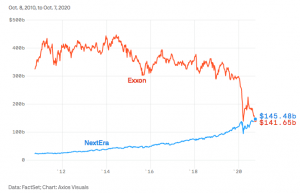
    Exxon Mobile(XOM) as recently as 2013 was the most valuable company in the world. Zoom is almost as valuable as XOM but the real zinger this week was watching wind and solar power company, NextEra, surpass the market capitalization of the Rockefeller fossil fuel descendent. Quite remarkable. But, also an embarassing reminder of the costs of hubris, climate change denial and sipping the Trump kool-aid. NextEra is now the most valuable energy company in the US and the following chart painfully captures the strategic miss by XOM executives.
    XOM should have gone shopping for renewable energy assets years ago. Then again shopping has changed too with Ocado just overtaking Tesco as the UK’s most valuable retailer with a £21.7 billion valuation. Tesco executives must be scratching their heads with a 27% share of the UK grocery market compared to Ocado’s hi-tech delivery share of….. 1.7%! This writer must confess to similar confusion but the chart below points to some pretty impressive confidence from financial markets:
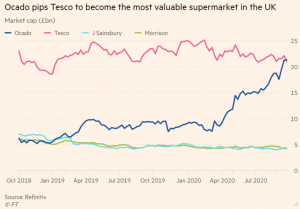
    Investors have perhaps decided that retail is moving rapidly towards being a service attached to a technology platform. We shall see. However, we have more conviction, and have written so previously, in the world of banking. It is interesting to note that Europe’s relatively small technology sector has now exceeded the value of the region’s enormous banking system. See the chart below and think about that €800 billion valuation of Europe’s entire banking sector.
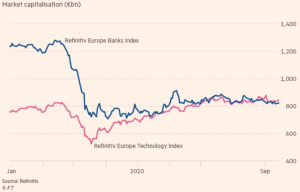
    Yes, that €800 billion figure resonates with us. It happens to be only slightly more than the current market value of a single social media platform company, Facebook. How will that comparison chart loook in the years to come? We certainly won’t have to wait 109 years like IBM to see banks change dramatically. But, perhaps the more interesting question is what will Facebook look like in the next decade. Only 10 years ago we watched the Facebook start-up story, “The Social Network”. The corporate skulduggery detailed in that version was at the playschool end of the spectrum compared to what we (and most US and UK voters) know today. The ugly truth of supra-sovereign power was already apparent in this 2017 chart below:
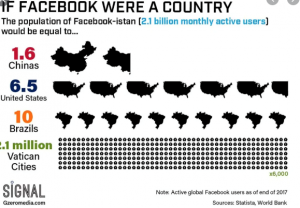
    The brutal truth is that Facebook exerts more influence than entire countries. China might be the focus of US geopolitical worries today given its huge consumer market and outsized influence on the world economy. However, one wonders will a probable Democrat President in the White House initiate a more robust discussion about breaking up Facebook. In America, the home of capitalism? Really? Never? Think again and revisit history.

    In the same year that IBM was founded, another huge US monopoly was broken up. The Republican Presidency of William Howard Taft in 1911 witnessed a successful antitrust case brought by the US Justice Department against the Rockefellers and Standard Oil. What a year it was. The world’s largest company was broken up and a future global number one, IBM, began its corporate journey. However, IBM wasn’t the only global number one company to begin its corporate life that year. One of the 34 independent oil companies spun out of Standard Oil was…….. Exxon. Fuel for thought me thinks. Whither Facebook and its influencing spawn in 2021?


  • Are Markets Focused On The Wrong Second Wave?

    Are Markets Focused On The Wrong Second Wave?

    Being bashed by big swells at the Forty Foot seemed more than appropriate this morning. Brief chats in the water touched on further domestic pandemic restrictions and breaking news of a Presidential infection in Washington. The virus apparently doesn’t do white supremacy or mask-free immunity. We are thinking karma, but undoubtedly more chaos.

    Already, governments in many Western economies are battling a second wave of C-19 infections and increased pressure on public health systems. Indeed, financial market concern has been reflected in declining equity markets and, more recently, oil prices through September. But… is this resurgence in infection the “second wave” we should fear? Of course, on a public health level fears are justifiable but there are early hopeful indications we will not revisit the awful mortality and ICU hospitalizations experienced earlier in the year. One can only hope our worst fears do not materialize. And, there is economic precedent. Our own Department of Finance is now forecasting a 2020 GDP decline of 2.5% which compares to an initial April forecast of a 10.5% collapse. In hindsight, there were a couple of good reasons for such resilience.

    First, our multi-national sector is heavily weighted to health and technology. Both sectors are experiencing a boom in demand as economies and companies moved to protect populations and migrate staff (and customers) online. Second, incomes were replaced or subsidized by government funding. This income protection strategy has been a major driver of spending in the economy and avoided further consumptions shocks. Yes, there has been severe damage in sectors like hospitality and travel but it could have been so much worse. It could still be.

    Many businesses have limped through the first 6 months of Covid-19. The latest public health restrictions in Dublin are beginning to prompt realistic fears of a full year of pandemic pressures out to Easter 2021. Every small business survey highlights the very small cash reserves available to the SME sector – a tiny percentage can survive a 12 month cash flow shock. More worrying, the government is scaling back wage support subsidies. One senses we are on the cusp of many managements about to make extremely difficult decisions about keeping businesses and staff afloat.

    Rationalisation has already started at the larger company level. Ryanair might be threatening Cork and Shannon this week but in the UK the dole queue drum beat is growing very loud. Royal Dutch Shell and TSB Bank announced over 10,000 job cuts yesterday. British Airways, Rolls Royce, John Lewis, H&M, M&S and easyjet have already announced their own staffing cuts with the UK events industry also warning of 90,000 job losses. Dare we even mention Brexit? Smaller businesses in Ireland will go quietly into insolvency. There won’t be big headlines but mass unemployment is the second wave we should truly fear. The social and economic damage will be huge and certainly not revived by a vaccine or multi-national corporate success.

    Leaving Cert screw ups and risky student revelry are currently grabbing the headlines but in the generational scheme of things they are mere side-shows. The true generational threat is the lack of political alarm about the future of Ireland’s SME sector and its more than one million jobs. They are the growth, they are the future. Surely, the youth and their futures deserve a voice and urgent protection from that second wave too?

  • Ulster and Irish Banks Say No

    Ulster and Irish Banks Say No

    No, Ulster Bank is not quitting the Irish market but its parent, Nat West, is conducting a “strategic review”. So, that’s a yes then. Forgive the cynicism but it has been a very strange week. The Donald wants to stay in the White House in perpetuity and UK lorry drivers are about to have a similar but involuntary experience of inertia in Kent.

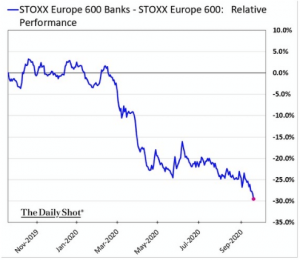
    Was it only a few short days ago that the UK government was prepared to break international law to defend the internal integrity of the United Kingdom? Now, it looks like the county of Kent will have its own borders. We never saw that plastered on the side of a red bus; good-bye “Garden of England”, hello “Herbaceous Border”. Of course, Brexit will continue to exasperate most Europeans but another “B” word is potentially a far bigger danger. Europe’s banks are in trouble again. Check out this performance chart (from The Daily Shot) of European banking shares:

    In the past 12 months Europe’s bank sector has under-performed the broader European equity markets by a whopping 30%. Negative interest rates, pandemic destruction of loan books, lack of new business and competition from 38 digital challenger banks are a huge headwind for all European banks, not just Ulster Bank. The banking sector is now smaller in value terms than Europe’s relatively small technology sector which tells its own structural story. However, there’s another story developing.

    Most readers can understand that banks are quick to say “No” when economic conditions are difficult. What is less understandable is the tortuous and time consuming nature of most loan applications. The banks justify the bureaucracy on compliance and regulatory grounds. But, apparently not for all customers. A new investigation by the International Consortium of Investigative Journalists(ICIJ) has just hit the headlines. Leaked documents have identified $2 trillion worth of transactions between global banks linked to money-laundering and other criminal activities since 1999. Apparently, banks can say “Yes” when the profits are pretty good. Curious compliance, not. Closer to home we should be more curious too.

    The government has set up funding schemes for the SME sector where local banks take on a small proportion of the risk, as little as 20%. But it isn’t little enough for our banks it seems. The latest figures show that, of the €2.5 billion ‘available’ to SME companies for funding through pandemic difficulties, just €180m has actually been drawn down by just over 1,000 companies. For context and contrast, the UK government has just released its own figures. In one scheme alone, almost €15 billion was borrowed by more than 60,000 firms. As a sanity check, our economy and population is approximately 1/10th of the UK. Clearly, something is not working in Ireland. Indeed, Ulster Bank was one of the three pillar banks in the flagship €2 billion Credit Guarantee Scheme launched by government.

    Now think about that “strategic review” at Nat West and wonder how enthusiastic Ulster Bank is to extend its loan book to companies in real pandemic trouble. It is not too difficult to imagine AIB and Bank of Ireland are not exactly enthusiastic to add risk to their creaking loan books and plunging share prices. Furthermore, get your heads around that €180 million of funding “support” and the ESRI estimates of between €6 and €10 billion of lost SME business in the March-June period alone. The Irish banks are quick to trot out the line that Irish companies are reluctant to take on additional debt in uncertain times. Ponder that very briefly, and then watch Michael Gove in Westminster shamelessly blaming UK business for not having export paperwork “ready for Brexit” and the Kent lorry-park. Different failures, similar deflection.

    Our government needs to show a bit more curiosity as to why UK businesses are accessing funding at a far quicker pace and in much larger size. Ulster is not the only one saying No.

  • Nikola Says It’s Better To Travel Than Arrive

    Nikola Says It’s Better To Travel Than Arrive

    I once dated a girl called Nikola, with a “k,” as Ross O’Carroll Kelly would say. On our first date she introduced me to one of her mates as “JFK”. Momentary confusion was allayed when she added, “….as in the airport, not the President – lots of baggage!”. Gotta giggle. Indeed, we need a few laughs this week as Dublin stares down the barrel of Level 3 pandemic restrictions on travel. Meet another Nikola. This one is a truck company and it caught our eye previously in a June column here. These were our thoughts then….

    “Nikola Corp makes hydrogen and battery powered trucks. Not one truck has been produced yet, we don’t know who will make them and the company has zero revenues to date. The Nikola share price doubled on Monday and the value of the company now exceeds $33 billion. That is now $3 billion higher than the value of the 117 year old Ford Motor Company and its annual revenues of $150 billion. Punchy stuff.”

    Then, earlier this month the giant GM announced a $2 billion deal involving an 11% equity stake in Nikola Corp and its assistance in manufacturing the start-up’s battery-electric and hydrogen fuel cell truck, The Badger. Roll on to this week and a little-known equity research group with an intimidating name for travellers, Hindenburg, dropped a few bombs on the $20 billion valuation of Nikola. Hindenburg alleged that a corporate video “Nikola One in Motion” was an elaborate ruse. Rather than an electric truck cruising at high speed, it is claimed that Nikola had a truck towed to the top of a hill and then simply filmed it rolling down the same hill. The research group further accused the founder and Chairman of Nikola, Trevor Milton, of a career-long record of deception and misleading partners about the existence of its proprietary technology.

    Suffice to say Nikola’s share price cratered by 40% over the next few trading sessions losing $8 billion of its value. But, there are still $12 billion worth of promises left in Nikola. GM is standing by its investment but the potential for serious red faces and career car crashes for board members and senior GM executives must be high. To add fuel to investor concerns the SEC and US Department of Justice have both opened investigations into possible fraud. One wonders will the Badger ever arrive? In fact, a wider perusal of market action this week did prompt memories of that old trading adage that it’s better to travel than arrive ie trade on future promises rather than actual delivery. Our current concern is that some of our critical trading partners are giving promises way too much weight.

    In the political arena about 40% of the US population have cult like faith in the “stable genius” of Donald Trump and his lawless disorder of bleach and bluster. Closer to home, Boris Johnson, 9 months after landslide-winning electoral promises, has been forced to potentially breach international law to deliver Brexit. Boris usually does better with 9 month “oven-ready” buns but, not for the first time(or 7th?), Brexiteers appear undeterred. As always, we would look to financial markets as a more reality-balanced environment with real money at stake. However, we are a little concerned as future profits/delivery appear to be growing into very very large promises…..

    Check out the IPO of Snowflake this week. This company is a leader in cloud based data platforms. A hot space so the IPO was going to be hot. Sure enough, the IPO was priced at $120 per share rather than the initial guide of $85. So, that equated to a franchise valuation above $30 billion rather than the initial thinking of $20 billion. What’s another $10 billion, eh! Well…… try another $50 billion. On its first day of trading Snowflake shares traded as high as $313 per share. That’s a market capitalization of $88 billion and more than the value of 431 members of the S&P 500. Snowflake has delivered sales worth $403 million over the last 12 months. The ratio of peak first-day valuation to sales was 219 times the last year’s worth of sales. That’s a helluva lot of promises. But there’s more.

    SPACs are back. Special Purpose Acquisition Companies. Often referred to as “Blank Cheque” companies, investors park funds in these IPO’s on the promise the money will be spent to acquire companies in specific sectors or themes. There is a double-whammy of risk here. One, the money is not fully spent and two, the vehicle over-spends on poor acquisitions. Year-to-date investors have parked $30 billion in these promise trucks. In pandemic-free 2019 that number was just $13 billion. One suspects many of these vehicles will, like the Badger, look good on camera but never arrive. Of course, we have written many times about the positive aspects of confidence but one must be wary of weighting the unknown future too heavily. The good news is that there will be opportunities in more boring stories. How about transport, with no hydrogen or hot air?

    FedEx the logistics giant is valued at $65 billion. It delivered $69 billion of sales last year – yep, that’s a sales multiple of less than 1x compared to Snowflake on more than 200x. Yesterday, FedEx reported fiscal 1st quarter results which saw profits up 60%, volumes up 30% and sales up 13%. Sounds like they do the travelling and arriving rather well. Maybe the first Nikola got it right – weight the logistics over the personality!

  • 9/11 Lessons on the Cost of Fear

    9/11 Lessons on the Cost of Fear

    Mike DiAgostino was the calmest broker with whom I ever worked. Our derivatives trading desk in Hong Kong in the mid-‘90s often had its panic moments which lead to fearful paralysis or worse, expletive-filled finger pointing. Mike taught me early that angry blame-shifting was not just a waste of time but could be very costly if a market was moving fast. As we pass the 19th anniversary of the horrific events of 9/11 and face the challenges of a global pandemic are we in danger of repeating the fear-filled mistakes of the post 9/11 period?

    We must remind ourselves that the ‘War on Terror’ in the Afghan mountains of Tora Bora snowballed into an illegal war of error in Iraq, quagmire in Afghanistan and the implosion of Syria. The cost in lives was millions, the cost in capital was trillions. On a more positive note, the terrifying multiple hijacks of aircraft did not kill the tourism and air travel industries. We learned to live with the ongoing terror outrages perpetrated by Al-Quaeda and ISIS. Governments co-operated and committed to improved security at all airports. Confidence returned. But now it’s gone.

    Air travel passenger volumes remain severely depressed. Governments are flying solo with their own Covid-19 containment strategies and airline balance sheets are bleeding to death. Thankfully, there is confidence coming from financial markets as both IAG and Ryanair have announced plans to raise both debt and equity capital. Just like 2001, there is an urgent need for joined-up thinking at governmental level for a proportionate response to the health threat posed by Covid19. The Irish government response is currently an outlier, and not in a good way. However, in other areas the Irish pandemic scorecard is looking pretty good and crucially steering clear of the blame game. Not so elsewhere.

    The George W Bush administration gave birth to the Tea Party movement within Republican ranks and one shudders to think what new US “Taliban” will emerge post Trump. A toxic US political environment is now entirely fueled by cultural and societal fears. And, it’s not just domestic.

    China is the current geopolitical bogeyman. As the country of origin for the Covid-19 virus, it is an easy blame target but calm heads are required to avoid an uncontrolled economic and digital decoupling. Or war.

    Finally, we should be mindful of the dangers of a “K-shaped” economic recovery. Low interest rates and fiscal support cannot just benefit those with assets, or even jobs. Rocketing financial markets can provide euphoric headlines but have virtually no impact on the vast majority of developed economies’ populations. An acceleration in income inequality will ultimately lead to a damaging backlash, for everyone.

    Fear is understandable in uncertain times but leadership is required. Calm heads and clever use of technology can connect the world once again. Mike went back to New York and played his part in the early digital development of the financial derivatives market in the North Tower of the WTC. Cool guy, cool head. I am thinking of him today.

  • Brexit Clown Car Now A ClusterTruck

    Brexit Clown Car Now A ClusterTruck

    The satirical puppet show, Spitting Image, will soon be back on our screens after a 24 year break. It might struggle. The daily reality comedy show from Westminster surely can’t be trumped. Can a puppet really compete with the awfulness of Michael Govern Oven Ready, Dinghy Patel, Mark ne-Francois-pas, Lord Rayling of Failing or Jacob Rees-Mogg, Honourable Member for the 18th Century? These are just the minor characters but often they steal the show.

    I thought the Secretary for Health, Matt Hancock, would this week. When challenged by Sky News’ Kay Burley about newly appointed trade envoy Tony Abbot and his track record of misogyny and homophopia in Australian politics, the quick-thinking Matt was able to play defence with “but he’s good on trade”. Hold that gong. Enter Boris Johnson and his Svengali of Barnard Castle, Dominic Cummings with their latest Brexit wheeze.

    The UK Prime Minister and signatory to the Brexit Withdrawal Agreement is now claiming this international treaty is “contradictory” on Northern Ireland and “never made sense”. Incredibly, Boris Johnson is the very same man who negotiated the deal, signed it, prevented parliamentary scrutiny of it, campaigned and won an election on the back of it. Who needs Spitting Image? Well, possibly the financial markets. International providers of capital are not amused. There is extreme unease about a government going rogue and conceding they are breaking international law. No wonder the kingdom’s top legal civil servant, Jonathan Jones, has just quit. He’s not alone. Check out the following stories of UK fright and flight….

    Global Factory Growth Hits 21-month High; FTSE 100 Hits 3 month Low – The Guardian

    Pound Could Fall To Parity With Euro – Dow Jones

    So, those are equity and foreign exchange traders running for the exits. UK debt markets remain stable but there’s another risk emerging in the financial world. This snippet from an article in the FT caught our eye this week:

    Global regulatory body to harmonise ‘plethora’ of ESG standards

    The huge rise in popularity of funds that invest according to environmental, social and governance principles over the past decade has led asset managers to ask for more information on sustainability risks from their investee companies. This has given rise to a wide range of initiatives aimed at defining disclosure standards, such as the voluntary Task Force on Climate-related Financial Disclosures.

    One might think sustainability risks are not exactly relevant to Brexit. However, ESG scoring frameworks will ultimately look at the risk profile of individual countries where the rule-of-law (or absence of same) can impact a company’s ability to meet Social and Governance commitments. Now think about the latest noises from Westminster where Northern Ireland Secretary, Brandon Lewis, has just astonished MPs with an admission that plans to reinterpret the Brexit Withdrawal Agreement “does break international law in a very specific and limited way.” Well, that’s alright then.

    If it were not so serious it would be comedy gold. Expect tough days ahead for puppets, satire and the rest of us.

  • An Apple A Day Keeps Capital Away …….?

    An Apple A Day Keeps Capital Away …….?

    Swimming is the new banana bread I am told. My fellow swimmers in the Forty Foot this morning might argue this is a healthier, if colder, development of our pandemic response. Not so in financial markets. Things are hotting up dramatically and possibly not in a healthy way. As of today, Apple is now worth more than all of the blue chip companies listed in the UK’s flagship FTSE 100 index, combined.

    Yep, the corporate empire of Boristan and Elgar’s “Hope and Glory” has just been trumped by a $2 trillion mobile ring tone. On a less flippant note, investor capital flows are chasing an ever smaller opportunity set. Big is not only beautiful, but grows bigger every day in a fundamentals vacuum. For illustration, yesterday Apple Inc and Tesla Inc executed a stock split. This administrative exercise has no impact on the valuation of either Apple or Tesla, it merely creates more shares with a lower price. Not last night. Here is what happened.

    Apple Inc’s valuation increased by $72 billion.

    Tesla Inc’s valuation increased by $51 billion.

    The combined additional value of $123 billion generated in just one day’s trading exceeds the entire market value of IBM.

    This additional $123 billion “franchise” value would equate to the FTSE 100’s second largest stock, BHP Billiton.

    Of course, there will always be “hot” stocks and sectors like technology. A global pandemic has certainly focused investor minds on the winners. Our worry is that governments and central banks might be doing the same. Check out the US corporate debt market. Federal Reserve support of debt markets has triggered a wave of borrowing by large US companies with total corporate debt soaring to $10.5 trillion. Ultra low interest rates definitely help but one wonders whether investor capital is being steered into the right places?

    The Bank for International Settlements (BIS) appears to share our fears according to this Bloomberg article:

    Companies with annual revenues above $1 billion dominate corporate borrowing now more than any time in at least a decade, according to the Bank for International Settlements. These firms account for 78% of global issuers of dollar bonds so far this year, according to data compiled by Bloomberg.

    “Led by easier access to bond markets, large firms significantly increased their borrowing,” BIS researchers Tirupam Goel and José María Serena wrote this month in a report about credit during the Covid-19 crisis. “The rest of the firms faced bottlenecks due to their reliance on a strained syndicated loan market and hurdles in switching to bond markets.”

    You may have read lots of the financial commentariat debate the prospects of a “V shaped” recovery. However, the colder reality for many smaller firms is no access to funding as banks tighten lending conditions. This opens up the possibility of what some are calling a lopsided “K shaped” recovery where large firms attract nearly all available investor capital and crowd out smaller firms. Ultimately, the overall economy suffers when capital is misallocated on a grand scale. Current headlines may gush about record, even bananas, valuations but the outcome could be far from healthy for economic recovery. As small firms fail and job losses continue it will not just be the streets of Portland hosting inequality protests…..

  • Banks To SME Sector: It Is What It Is

    Banks To SME Sector: It Is What It Is

    Michelle Obama killed Donald Trump. No, this is not another QAnon far-right conspiracy theory. It’s just a turn of phrase. Here’s another turn of phrase which I usually hate – “it is what it is”. But when the former First Lady used that phrase after a brief critique of Trump’s leadership qualities at this week’s Democratic National Convention, it was perfect.

    It was a brutal reality check which not only trolled Trump, but also ridiculed his recent use of the same phrase to explain the horrendous US Covid-19 death toll. The contrast between reality check and abdication of responsibility could not have been made more stark. Closer to home, economic reality is beginning to bite but only at a micro level. Thousands of businesses are in survival mode, some are already dead. At a leadership level, the coalition government and the banks are promising SME support through credit guarantee funding worth more than €2 billion. Well, almost.

    The reality is that this ‘guarantee’ applies to 80% of the funding amount. The domestic banks are on the hook for the other 20%. Now step into the parallel universe of banking reality. Imagine a bank credit officer with a very large existing loan book exposure to say….. the tourism/hospitality sector. In what universe will a bank be looking to increase its lending exposure to a new customer in that sector? If you believe the banks have appetite for even a single euro extra of risk – 20%, 30%, 95% guarantee, whatever – I have a large bucket of bleach to sell you as a global Covid-19 vaccine. The brutal reality is that the very sectors and companies in urgent need of support come from the exact same sectors which are already killing our banks.

    The banker reality is that our banks are already fighting fires on multiple fronts as new business income dries up, costs rise and existing customers struggle to service loans. Banks are under obvious political and social pressure to play along with the proposed government support schemes. However, back in the real world, the daily headlines are quoting the banks and the challenges they already face. The phrases may be different but the indirect messaging is pretty stark. Check out the following selection of challenges:

    • ‘Scars from the crash give Irish banks 2.6 billion reasons for Covid caution” – Irish Times

    • ‘FSU refers Bank of Ireland proposed redundancies to Workplace Relations Commission” – RTE

    • ‘AIB swings to half year loss on €1.2 billion bad loans’ – Morningstar

    The €2.6 billion of loss provisions referenced in the first headline was about twice as big as market analysts expected. These are ‘expected’ losses which regulators now require to be quantified in market communications. Call it a window into the thinking of bank managements about the future. Clearly, the banks are messaging strongly that the chances of increasing risk exposures in already-challenged loan books are slim.

    Discussions between banks and struggling SME companies will employ different words and phrases but the end result will be the same – no support. The SME sector urgently needs new thinking and new funding solutions. And, some honesty.

    I do not choose the following words lightly. Perpetuating the current myth of government and banking SME support is a dangerous abdication of responsibility. The banks can’t help. It is what it is.

  • Tik Tok …. Time for Europe to Shine

    Tik Tok …. Time for Europe to Shine

    I love Sarah Cooper. Not long ago Sarah was writing articles for the Financial Times. Now she’s a TikTok star. Her hilarious use of the lip-sync video app to ridicule Donald Trump’s daily vomit of gibberish have been social media gold. Needless to say, the Donald has been less impressed and one can only wonder what the true motivation for his most recent executive order.

    The thin skinned Toddler-in-Chief has ordered the Chinese corporate parent of TikTok to sell its US operations citing security concerns. Sarah will be fine – she has just secured a contract for a Netflix series – but there’s a potentially much bigger impact. The Trump administration is also demanding that US firms sever commercial links with another social media platform, WeChat, owned by a Chinese parent.

    WeChat is the Chinese equivalent of Whatsapp, Instagram and Facebook all rolled into the one app. It is commercially critical for any company with Chinese customers. Surveys already confirm iPhone sales in China would evaporate if Apple was unable to support WeChat on its devices. Is this the next phase of the technology decoupling between the planet’s two largest economic powers? If so, what next? Financial markets might already be providing a few clues.

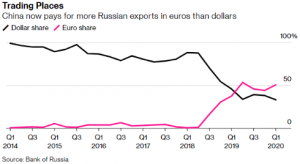
    The currency markets are seeing some interesting moves. Not long ago the Trump regime was all talk about building a wall to keep immigrants out. It turns out, thanks to a spectacularly bad management of the C19 pandemic, that the rest of the world now wants its own wall to curtail the cross-border travel of American citizens. As US infection rates over the past 3 months climbed to the 5 million mark it has been noteworthy to see the euro strengthen by 10% in the same period compared to the US dollar. More striking was this chart below from Bloomberg showing the Chinese now paying for more Russian exports in euros than in dollars.

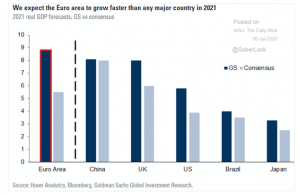
    The new-found enthusiasm for the euro might be a relative vote of confidence in a post-pandemic recovery. Goldman Sachs thinks the Eurozone economy will grow faster than any other major country next year. The next chart tells that story.

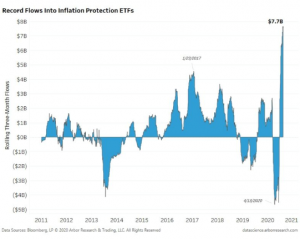
    Of course, growth stocks have dominated the headlines in 2020 as technology sector valuations have rocketed and clocked our first $2 trillion company, Apple. Cheaper, more traditional old economy stocks have struggled to perform for a decade. Europe, with a relatively small technology sector, has lagged too. But whisper it softly, old economy(value) and European stocks could benefit from the “i” which hasn’t really been seen since the iPhone arrived. We are seeing signs of investors protecting themselves from….. inflation. An early vaccine(I’m hearing lots about October) and $10 trillion worth of central bank pandemic pumping is a juicy inflation combo and might explain this chart of record buying levels in inflation protection instruments(ETFs):

    Time will tell on inflation but one thing is almost certain. The unwind of Chinese-US trade and internet connectivity is set to continue. TikTok might have 45 days to comply with Washington’s demands but investment capital can move even quicker. Like right now. The charts above suggest that capital is ready to sync with Europe. Cue Ms. Cooper, Netflix and the theme tune from ‘Curb Your Enthusiasm’ with footage from the White House bunker……

  • Gold Glitters, Money Waits ………….

    Gold Glitters, Money Waits ………….

    It wasn’t just the waters of East Cork glistening last week. Gold prices hit $2,000 per ounce for the first time ever too, but the barbarous relic was not the only financial asset glittering on our trading screens. The technology-rich Nasdaq index touched new record highs and Apple marched towards a staggering $2 trillion valuation. Hot stuff. And yet, the nether regions still shrank in the bracing waters of Ballycotton. Should we be mindful of Twain’s aphorism as we observe all this financial glitter? Let’s take a look at a few headlines which tweaked our curiosity.

    • ‘As dollar slides, investors fret about status as world’s reserve currency’ – Reuters

    • ‘Bitcoin rockets above $11,000 to year highs as dollar weakens’ – Business Insider

    • ‘China’s 800 year old paper money pilot project will be ending soon’ – Forbes

    • ‘Turkish lira hits record low in sharp decline’ – Financial Times

    • ‘US Debt Outlook is Downgraded’ – New York Times

    You will note there are no headlines in this selection above referencing stock markets but readers will already know share prices are flying from previous FAANTAM articles written here. Clearly, this is not the case with many commentators writing on record gold prices in recent days. Most have attributed gold’s recent rush to “nervous investors”. Tell that to the Robinhood investors trading an average 4.3 million times daily and chasing the combined valuation of Apple, Amazon, Google and Microsoft to over $6 trillion. For context, that number would place these four companies as the third largest GDP on the planet after China and the US. There is no fear in those expectations. Yes, there are investors investing in gold for safety but, when one views frothy corners of the stock market, perhaps there is a more nuanced interpretation of gold’s return to favour?

    If we return to our selection of headlines you will note they are all very closely linked to currency markets. Currencies are the most basic store of ‘value’. Indeed, gold is often described in similar terms and historically was often used to “back” a currency. However, after the US abandoned the gold standard and the linkage to the dollar in 1971, central banks have since relied upon interest rates to manage the flow of capital in and out of a currency. Now think about those headlines capturing the emergence of digital currencies, China and soaring government debt as a challenge to the position of the US dollar. Of course, human beings are woeful at forecasting the future but this writer is inclined to wonder whether current moves into gold are driven by investors who are curious and seriously asking the following questions about the future of money…

    1. Will a more insular US foreign policy ripping up international treaties on a monthly basis lead to a commensurate deterioration in the status of the US dollar as the financial system’s reserve currency?

    2. Will China-US geopolitical tensions accelerate Chinese moves into digital currencies and drive capital into same from those countries wishing to trade with 20% of the planet’s population?

    3. Will fiscal spending by governments to support economic recovery from the C-19 pandemic lead to debt defaults and devaluations of currencies more influential than those of Turkey, Argentina, Lebanon etc?

    It is too early to answer those questions but one senses, as always, change is on its way. As the most fundamental financial asset, currency markets and their headlines are worth watching closely. Gold prices are the hint of change, not the answers. The big money must wait…..