Author: Gary McCarthy

  • Which Floor Will You Work On?

    Which Floor Will You Work On?

    High profile developer Johnny Ronan had a tricky PR week with a Bewleys collapse and a questionably toned and timed holiday video. But…it could have been worse. Not that long ago Johnny’s PR efforts were devoted to convincing Dublin City Council of the benefits of high rise office buildings. The Council were not persuaded. Now, in a Covid-19(CV19) world, that decision may have been a blessing in disguise.

    As back-to-work health and safety protocols come into effect you do wonder about elevator capacity restrictions (potential max 4 persons for skyscrapers) and the practicality of very tall buildings. Anecdotally, one hears about HSBC calculating a potential 2-3 hour wait for its 5,000 personnel in 20 Canada Square, Canary Wharf. The brutal truth for managers of that facility is that possibly only 10% of its workforce would be able to get to their desk in a reasonable time.

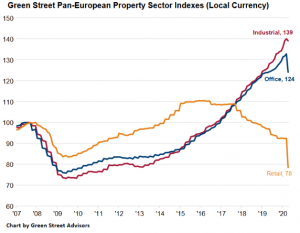
    It will not be just retail properties dealing with a new reality. However, the chart below of European property price indices from Green Street Advisors would suggest a 6.6% fall in the office sector might not capture the full impact of CV19 compared to the 15% hit in the retail sector.

    The consultants, Teuben and Bothra, estimated the size of the global professionally managed real estate market at $8.5 trillion. Savills thought the total commercial property market(retail plus office) was $30 trillion in 2015. Let’s just say there’s a lot of investment capital staring down the barrel of a design disaster if CV19 precautions remain an ongoing feature of working life.

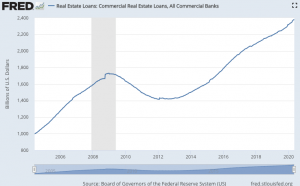
    The US and its Federal Reserve Bank have pretty good data on the risks involved. Here is a chart showing commercial real estate loans from all US banks hitting $2.4 trillion which is a 50% higher exposure than the 2008 crash period. Now, think about all the non-bank providers of debt capital who were chasing yields over the last decade of almost-zero interest rates. Think hedge funds, private equity, pension funds, sovereign wealth funds……

    Meanwhile, the daily drum beat of “forever” work-from-home announcements from the likes of Facebook, Shopify and Twitter would suggest office leases and valuations are due some challenging reviews.

    Of course, there are challenges everywhere in business but now and again a fortuitously delayed decision or a stubborn policy stance can make things a lot easier. It would appear, at this surreal pandemic moment in time, that Dublin and Johnny Ronan might have just dodged a high rise bullet….

  • Value Is Dead, Long Live Value

    Value Is Dead, Long Live Value

    Poor Joe Duffy. After the latest broadcast of the hit college love story, ‘Normal People’, the RTE Liveline radio host was moved to tweet, “I’m phoning in sick”. The TV flesh-fest was guaranteed to trigger an avalanche of outraged radio phone-ins from the 1970’s (or the 1700s) and one could only giggle at Joe’s quip. He could afford to have a laugh. After all, this was just a 6 week TV series. Not so elsewhere in a long-suffering corner of the investment world.

    Spare a thought for portfolio managers who pursue a value investing style. The value style has had many famous disciples, including Warren Buffett, but it has had a miserable decade of performance compared to the overall market. The faith of long-frustrated clients is being sorely tested and more than a few portfolio managers have confessed to this writer a Joe Duffy-fear of the telephone switchboard. However, the contrarian in all value investors was possibly tweaked in recent days by an article in the FT.

    The piece by the excellent Robin Wigglesworth, “Does value investing still make sense?”, struck a chord with those who have over the years watched the likes of Barron’s, Goldman Sachs and The Wall Street Journal mark an ironic trend reversal within weeks of publishing a headline grabbing pronouncement of a new paradigm in the financial world. When one views the chart in the FT article chronicling a decade of laggardism it probably is worth asking whether value is relevant in an increasingly digital world, with or without pandemics. See for yourself…
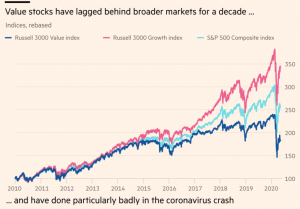
    The numbers don’t lie. Since 2010 the Value index above has delivered 80% returns. The snazzier Growth index powered by technology has returned 240%. To refresh memories, value investing attempts to invest in stocks trading at low prices relative to the value of a company’s assets and the cash flows it generates through the business cycle. Many value evangelists hoped a bear market would hammer tech and highlight the quaint attractions of boring old cheap companies. Hold that beer, or Corona.

    The global pandemic has brought no such relief for Value. The CV19 sell off has not been kind to this approach with another leg down in relative performance. The following headlines give a good clue as to where the damage is being inflicted:

    ‘€2.4bn wiped off value of State’s shareholding in two main banks’ – Irish Times, March 16th 2020

    ‘Historic loss in oil prices sends US stocks reeling’ – Washington Post , April 20th 2020

    ‘FTSE 100 groups cut £24bn of dividends’ – Financial Times, 9th May 2020

    My old boss, Terry Smith, is not particularly surprised as his eponymous investment vehicle coasts towards £20 billion of funds under management:

    “Shares in companies that are lowly rated are so mostly for good reasons. Because their businesses are heavily cyclical, highly leveraged, they have poor returns on capital and/or they face other structural or management issues. It doesn’t sound like a combination likely to protect the business and your investment in difficult times, and so it has proven thus far.”

    I have always felt safer on lots of levels when I agree with Terry. In this instance, I agree the CV19 pandemic was never going to be a good launch pad for value outperformance given the sectors impacted. I also have written multiple cautionary pieces on the perils of depending on “Other People’s Money”. However, CV19 is not your classic business cycle slowdown. There are possibly some superb businesses which have now entered value territory and deserve some oppotunistic scrutiny.

    In one of my occasional “counselling” sessions with a traumatised portfolio manager this week he highlighted a dividend growth fund which is currently trading on multiples of earnings below 10x. The dividend yields are likely to be in the 4-5% region and it did prompt some exploratory thoughts for the post CV19 era. I thought of home champions and I thought of travel. Three very strong franchises came to mind.

    First, I thought about restoration of international flights and Ryanair valued at just over €8 billion. This monster “flying Spar” was on its way to an annual passenger count of 150 million souls. Given its recent pre-CV19 valuation of just over €16 billion there’s a reasonable symmetry between passengers and valuation. And this did leave me wondering whether more than 50 million passengers would never return to the skies.

    Second, if you like the idea of captive travellers in “flying Spars” and extortionate retail margins, look no further than WH Smith. The WH Smith share price has fallen by two thirds and this 200 year old franchise is valued at just over £1 billion. More than 60% of its revenues are travel related and you do wonder again.

    My final thought is very much an “Other People’s Money” candidate. Ardagh Group has been a stunning growth story born out of a Dublin glass bottle factory and lots of junk debt financing. Given the owner/architect, Paul Coulson, has seen most macro challenges off over the years and the Ardagh business is focused on packaging food and beverages, one senses a halving of the equity value of the business since March might be only a temporary visit to the value saloon.

    So, perhaps we need to think about Value as part of the economic recovery period. As a serial advocate of diversification, I think a portfolio should always contain an allocation to the value style. I recall my former colleagues at the quants research unit, Quest, seeing value presenting positive signals in November 2008. The market took off a few months later, in March 2009. Guess which quants team were making similar sounds on value in the past week?

    And a final final thought…. Value investing will always have its leader sectors. The past might have featured oil, banking and retail leaders. A global pandemic might just have accelerated the future. And, this writer’s sense is that, like monarchies, we are going through a succession period. There are new leaders and curiosity could be richly rewarded.

  • Torn in the USA

    Torn in the USA

    The USA is very important to Ireland. It is our single most important trading partner, accounting for 31% of our total exports. However, the commercial relationship is far more embedded than just traded goods. The CSO tell us we import almost €50 billion worth of services from our American friends on an annual basis. Well, we did. In the middle of a global pandemic it is understandable to wonder about the future. Or maybe not.

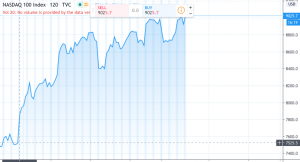
    As a technology focused economy one can only be encouraged by the massive rebound of the tech-heavy NASDAQ 100 index in US equities markets over the past month. The Nasdaq is now within 7% of all time highs. Check out the following chart from Tradingview.com:

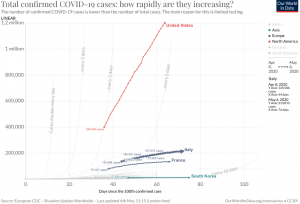
    It is quite incredible to witness such market enthusiasm when one considers the latest PMI economic activity indices from the likes of France and India plummeting to single digits from expansionary norms above fifty. Perhaps, as Warren Buffett reiterated this week, it is wise not to bet against America. And yet, there’s something not quite right. Despite President Trump’s best efforts, it is extremely difficult to ignore the inexorable march of C19 across the US. Here’s a chart of C19 case growth in the US over the exact same one month period as that covered in the Nasdaq chart:

    There are a few other things that are not quite right in the US right now. Take your pick from the following:

    • 30 million US jobs lost in the last 6 weeks

    • The US Treasury expecting to borrow $4.5 trillion to support a C19-crippled economy

    • The State of Illinois, already burdened with a huge debt mountain, forced to cancel a bond sale

    • Armed demonstrators bedecked in Confederate and Nazi paraphernalia storming Michigan’s state capitol

    Of course, there are other countries where tensions are rising as the economic costs of pandemic lock-downs bite. However, not every country accounts for 50% of the world’s capital markets. And, not every country is cursed with a leader so unsuited to lead. President Trump believes he needs an economy back at work to win another term in the White House. The election is all that matters to Trump and he is not shy about letting the world know where he sits on the wealth vs health debate. Unfortunately, without a vaccine, one can’t bend nature to your electoral will, or call the Kremlin.

    A polarised political climate, a dysfunctional media, woeful education standards and severe social inequality are all revealing themselves in this tug-of-war between public health protection and wealth preservation. There is a real risk that a failure to control the Covid-19 virus in the US could have explosive social repercussions. The truth is that the virus is the only new element in the social decline of the US. Arguably, the USA is searching for its true heart. Somewhere along the way ‘patriot’ , ‘true American’, ‘war’, ‘religion’, ‘heartland’, ‘great’, ‘united’ and ‘homeland’ all lost their true meaning in a cultural battle waged by chyrons, charlatans and cheerleaders.

    Thirty six years ago next month Bruce Springsteen released a rock album flagging the betrayal of America’s working class veterans of the Vietnam war in the recessionary early 1980s. It was an uncomfortable truth but it’s time had come. With no little irony, over the last few decades the awkwardly critical lyrics of the title track, “Born in the USA”, have been ignored by multiple politicians who have used the song during rallies, campaign events and victory celebrations. The album is often credited with popularizing heartland rock in the mainstream which raises another awkward question. Will the multi-decade political hijacking of the “heartland” ultimately rip Main Street USA apart? If so, those Wall Street charts and our trade figures will probably look very different.

  • Small Businesses Need Big Aid Fast!

    Oh dear. Those heroes of the credit crisis, the credit ratings agencies, are back. Excuse the sarcasm, but did we really need to read this week that the S&P ratings agency gurus have put the three big Irish banks on negative watch? Think it best we save our gratitude and equate this post-factum analysis to a service scenario where the Red Cross returns to the battlefield to shoot the wounded.

    There is no doubt a global pandemic and recession will inflict wounds on our banks. The good news for taxpayers is the banks are in much better shape than 2008. The bad news for small businesses is that the banks will be so busy firefighting there will be no time to build new banking relationships and source funding capital. In an Irish context, the reality is our corporate banking network is sub-scale and our small business sector (SME) is massive. That ‘massive’ adjective might surprise but the numbers don’t lie and come straight from the Central Bank.  See for yourself…

    • More than two-thirds of private-sector jobs (1 million) are in SMEs.
    • Trade credit in the Irish economy is unusually large as a percentage of overall economy. Outstanding trade credit liabilities amount to a whopping €250 billion.

    But there’s a problem……

    • Trade credit is used by up to 80% of Irish firms as a source of financing. This compares to 40-50% levels in the average European country.
    • Undrawn credit/bank facilities amount to just €2.7 billion.
    • Currently 60% of SMEs have NO debt.

    Clearly, interruptions to the normal flow of €250 billion worth of trade and payments are going to be significant multiples of the €2.7 billion of funds/facilities currently set-up by the banks. The fact that 60% of firms have no previous lending relationship with a bank is another challenge. For illustration, check out one of the working capital support schemes set up by the government, with the banks as chosen administrator. Press reports this week show just €17m drawn down from a potential €250m pot, and only 100 borrowers actually being accepted on the scheme. The experience is somewhat similar in the UK where approval rates in the CBIL scheme are just over 2%!

    While funding and vaccines are scarce there is no shortage of opinions as to what is the best form of funding (loans, grants, equity) or the appropriate risk sharing between SME, bank and taxpayer. In this writer’s opinion any funding detail is moot without an appropriate execution plan and platform. These pages have never been particularly kind to the banking sector but in the midst of a global pandemic there is clearly no point in shooting the corporate wounded.  What would be helpful would be an honest communication from our banks that they do not have the resources on their own to execute an aid programme for the SME sector.  Just like the Revenue was cleverly employed to administer payroll/cash flow relief in the early stages of this crisis there now needs further innovative and original thinking.

    Would it be too bold to ask the fintech sector and their speedy execution platforms to assist? In pandemic parlance, SMEs are effectively already in the ICU unit. Speed of action is now critical. And there are 250 billion reasons to warn this is a very very big problem for the Irish economy. Just thinking, and hoping.


    Enjoyed this blog? Then why not check out our other great content by clicking here!

  • Store Up Some Fuel Thoughts

    The recently deceased actor, Brian Dennehy, once asked to stay the night in our house and we turned him away. True story.  However, context and logistics are everything. Of course, we would have loved to tell the tale of hosting a Hollywood legend except there were already 25 Irish teenagers staying in our house during that J-1 summer of 1989 in Montauk, Long Island. So, it is no surprise that Dennehy’s death and oil prices (with a minus) over the past week did jog the memory and highlight all over again the importance of space irrespective of the opportunity.

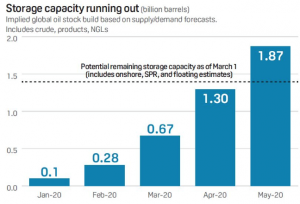
    As US oil futures plunged into negative territory in recent days we were reminded that if there is no storage available you can’t even give away a bulky commodity. In fact, some contractual parties in the futures market were prepared to pay somebody, anybody $35 for each barrel of oil to be taken off their hands. Just think, if one could have taken delivery of a million barrels of West Texas oil there was a whopping $35 million payment to accompany that load. The problem as the following chart from energy consultant, Platts, shows is that the US market has maxed out on storage capacity:

    Yes, that looks like we are rapidly approaching a stock build of almost 2 billion barrels of oil with storage capacity for closer to 1.5 billion barrels. The main driver of the stock build is CV-19 and the evaporation of oil demand. Think back to 2019 and daily oil consumption of 100 million barrels per day. Current estimates suggest we might be consuming 25 million barrels less, each day! To halt production would be very expensive hence the stock build and furious prayers to the Donald, Allah and Saint Christopher, the patron saint of travel. Hopefully, the rest of the world can follow China back to some sort of post Covid recovery phase but the decline of oil pricing power has been a multi-year trend.

    Here are a few further thoughts on the decline in influence of carbon fuel producers:

    1. For consumers of energy, as individuals or as businesses, a collapse in fuel prices should be viewed as an enormous tax cut.
    2. In 1980 the oil sector accounted for 30% of US equity markets. It now accounts for less than 3% while the technology sector represents more than 23% of the market. Who said data was the new business fuel?
    3. Rogue states and despotic leaderships dependent on commodity markets can be vulnerable to sovereign debt implosions and civil unrest. Russia and Saudi Arabia are more fragile than perhaps financial markets and investors appreciate.
    4. Storage has hurt the oil markets temporarily but on a longer term view storage will be equally important to the emerging renewable/electric/battery powered economy. There is still much to be done to improve battery/storage technologies. One can reasonably expect material science/chemistry graduates to be the hot talent property of the future.
    5. US shale oil production has exploded in recent years. Investment, employment and GOP election coffers have all benefitted. Oil prices, even if they recover back to the $30 levels, make shale oil an uneconomic proposition. US oil producing states are mainly Republican voting states but jobless voters can be fickle. It might be tough for them to stomach a Democrat President but it seems the current White House incumbent believes they can stomach disinfectant. So, anything is possible in the November election.

    As always, human beings are not great at forecasting the future. However, it is a racing certainty that the oil markets have not exhausted their ability to deliver further shocks in 2020.


    Enjoyed this blog? Then why not check out our other great content by clicking here!

  • We Are All Start-Ups Now!

    So, it’s The Great Lockdown then. That’s the name given to this crisis period by the IMF and I’m hoping there’s another Isaac Newton out there. Well, not quite. Newton famously developed humanity’s knowledge of calculus, light refraction and gravity while quarantined during the Great Plague of 1665. Right now, behind the global public health priority of a CV-19 vaccine, the world is in urgent need of a gravity-defying economic plan. Newton’s falling apple suggested what goes up must come down. The task today is to figure out how a Lock-Down transitions to, hopefully, an Open-Up in the coming months. The laws of gravity and economics are challenging to say the least.

    Let’s start with a few numbers. How much are we really down? The IMF reckons global GDP in 2020 will shrink by a higher percentage (3 %) than any period since the Great Depression. That’s even more than the nadir of the credit crisis in 2009. In dollar terms, January IMF forecasts of 3% growth this year have in a matter of weeks seen $5.2 trillion worth of activity evaporate from those 2020 expectations. The IMF think the ultimate cost through 2021 could be closer to $9 trillion – that is the equivalent of Japan and Germany’s economies disappearing. Here are a few other numbers which hint at the scale of the gravitational pull on economic recovery:

    • Commodities: The IEA is forecasting oil demand for 2020 to fall by more than 9 million barrels per day (!). In April alone that number will fall by 29 million barrels per day. In effect, global economic activity/consumption has returned to 1995 levels. Good news for the climate but catastrophic for nations dependent on exporting commodities.
    • Banks: Ireland might escape the worst GDP implosions likely to hit Italy and Spain but a quick check of bank share prices in Ireland gives some clues as to the scale of capital destruction. The combined market valuations of AIB, BOI and IPTSB amount to just over €4 billion, or just over 20% of the combined book value of these banks ie the market is discounting €16 billion of capital at risk of wipe-out. Then, factor in a 2020 Irish government budget surplus of €2 billion vaporizing into an estimated €19 billion deficit. That’s another €21 billion we might not have in 2021.
    • Corporate Debt: Back in 2009 a critical factor in capital destruction was the amount of leverage in the banking system. We have written frequently about the risks of being dependent on “other people’s money”. Fast forward to 2020, and it is clear companies across the globe have feasted on ultra-low interest rates and loaded their balance sheets with debt. The Institute of International Finance estimated corporate debt levels among non-banks had rocketed to $75 trillion by the end of 2019. That figure was $48 trillion at the end of 2009.

    Yes, the numbers are quite scary. However, the intention of this article is not to frighten but rather to highlight the difference between two competing emergencies. Governments and central banks everywhere have moved swiftly to address the immediate cash flow issues of citizens and companies experiencing a collapse in income and revenues. The longer term issue is how creditors and debtors deal with damaged balance sheets and the need for additional capital to “Open-Up”.

    The Lockdown is a cash flow emergency. The Open-Up phase will probably be phased and slow. The entire world from universities to airlines will need capital buffers to navigate a possibly very changed world. Bluntly, the capital destruction estimated/discounted in the forecasts summarized above suggests too many capital-hungry mouths to feed. Previous years’ financial performances by established corporates may not be a helpful guide to the future. Companies will have to be realistic with their projections and tell their story very well. The risk profile for many sectors has endured a meteor strike and, in a sense, business models will have to be rebuilt, or in start-up terminology, pivot.

    Yes, the Great Open-Up will be a capital event without precedent.  We are all start-ups now.

  • Corporate Change Is Not New, Just Accelerating…

    I have to confess I haven’t been sleeping great the last few days. It is probably only natural that a changing world is causing the mind to race a little. Pink moons, or not, the nights can be dark for many in these uncertain hours. Some might think of lithium. I’m thinking of equilibrium. Balancing so much uncertainty and change is a mental challenge but perhaps we were already doing that? Just at a slower pace. Let’s think slowly about change for a few moments.

    Amazon started out in life more than 25 years ago as an online marketplace for books. An online marketplace, who knew? The Amazon monster has been blamed for the obliteration of many retail businesses since but would it surprise you to know that prior to the CV-19 shut-down employment in the US retail sector was at an all-time high?  Change, yes. Destruction, not so much.

    Microsoft is 45 years old. The software giant is now at the forefront of a work revolution. Thanks to cloud hosting services, many businesses have been able to operate on a remote basis in the current shut down. But hot desks, work-from-home and 4-day weeks are not new concepts as companies compete for talent and efficiencies. In fact, productivity has been a major challenge for developed economies for the last decade. Microsoft itself, in 2019, trialled a 4-day week in its Japanese operation and achieved 40% productivity improvements. Expect more “trials” and rapid change after this crisis.

    Away from work, Netflix is 23 years old and streaming an enormous channel of high-quality content to our homes and mobile devices. It spent $15 billion on creating content last year and is forcing change at the very largest media giants. Disney will be relieved they had embraced the streaming revolution as cinemas and theme parks now lie empty. Their Disney+ streaming service just signed up their 50 millionth subscriber since November. So, they achieved in 5 months what it took Netflix 7 years to do.  Change can literally mean survival.

    Clearly, the education, fitness and healthcare industries have their own revolutionary protagonists. And don’t forget the EV revolutionary, Tesla, and it’s 17 year journey. Just a quick reminder that Tesla’s market value was higher than Ford, GM and BMW combined before CV-19! So, let’s be very clear that change is constant but can suddenly accelerate into more universal adoption. The prizes can vary from supra-normal profits to survival.  The costs can vary from increased integration/education costs and investment spend to bankruptcy and liquidation fees.

    CV-19 is an accelerator period not unlike WW2. Science, healthcare and security will be uppermost in people’s minds and exact a cost from business. But not all costs are bad. Change can be frightening but very often good for all in the long run. In two instances an acceleration of change would be a very good thing. For far too long urbanization has been a driver of wealth creation. But at what cost?  CV-19 has laid bare the risks in neglecting two huge public health issues: adequate access to housing and healthcare.

    Perhaps the biggest change to come is a reversal of urbanization as corporates embrace remote working arrangements and a diversification of their greatest asset, talent.  Be under no illusions, workers are recalibrating their values and their lives right now too. Change is guaranteed, much of it good. You might even sleep better too. Good night, John Prine.

    “ When I was a mailman, writing songs was my escape from the regular world, and now writing songs is my job. And I’ve always been one to avoid my job.” – John Prine (1946-2020)


    Enjoyed this blog? Then why not check out our other great content by clicking here!

  • Data For New Businesses And Behaviours

    And just for a moment I felt part of the new social Zeitgest. My search for business trivia questions for our Zoom table quiz this evening included a quick perusal of the Financial Times (FT) and a rude awakening. Germany is not just leading Europe in the Covid-19 containment stakes. The country is celebrating its medical Covid heroes in dramatic social fashion. The FT article which caught the eye highlighted data from Bavaria revealing a 3,000% increase in sales of fantasy nurse costumes. Leaving aside that racy data point, there is no question social activities and behaviours will evolve through this pandemic and create new business opportunities.

    If we return to more casual attire and online social interaction it would appear a Zoom generation of quiz maestros and game gurus has been launched. Zoom the online meeting app has experienced a 535% growth in monthly traffic with millions experiencing the low-cost joy of online giggles, competition and banter accompanied by the odd grape or grain sourced beverage. People have discovered their homes, big or small, can host a social life and skip the hassle of babysitters, taxis and wardrobe anxiety. One can expect social platforms for various interests and competitive activities to emerge with exciting scaling opportunities. Even before this pandemic, an online quiz app, HQ Trivia, was played by more than 2 million people a day at its peak. But it’s not all play and no work.

    The vast majority of my work conversations this week have referenced the future of work. More specifically, cramped open-plan offices are unlikely to be the answer in a post-Covid-19 world. According to the US real estate company, CoStar, the average number of square feet of office space per worker has declined from 260 square feet in 1990 to 180 square feet today in many large cities. We have previously written about how WeWork probably won’t work as an investment but its successors and other co-working sites will need to address design issues urgently. WeWork operates on a 75 square foot per worker model and that includes the spacious common areas and the beer taps!

    Of course, going forward companies will also potentially look at significant percentages of their workforce continuing to work from home for certain days in the week. Collaborative working tools like Microsoft Teams and Slack are witnessing explosive growth in usage. Microsoft alone added 12 million new users in the week ending March 19th.  On a more ominous note, there have been reports of some companies using the video cameras in worker laptops to alert them if people leave their desks. This raises privacy issues irrespective of what governments will use next in their efforts to enforce social distancing policies. In an uncertain world, one thing is certain. Companies are going to be spending a lot of money on advice on how best to re-configure their office staffing levels and work-from-home conditions. Benchmarking of those steps is yet another data opportunity for the ESG world and could be costly for less attentive corporates. Indeed, ignorance could be fatal.

    Speaking of ignorance and privacy. Who isn’t fascinated by the location data release from Google on population mobility?  In order to control populations, the Big Brother approach might be needed. Particularly if a worryingly large percentage of a population watch Fox News and have missed some pretty important information. The Governor of Georgia just yesterday claimed he was only aware of asymptomatic Covid-19 transmission “in the last 24 hours”. Meanwhile, Google traffic data tells us visits to retail and recreation locations are down by 62% in New York State. The state of Arkansas is another GOP governor state and blissful ignorance is still rife – just the 29% fall in retail and recreation movement.

    We are in an unknown territory but ignorance could be fatal for individuals and businesses. Data will help inform and record the experience but also signal change. Business owners and entrepreneurs would be advised to watch the data carefully.

  • Health And Wealth

    I am sitting in the ‘West Wing’ of my home office. Rooms, corners, even furniture pieces have been given new names to inspire a sense of space in The Emergency but the brain remains unmoved. That must change. There are potentially even greater socio-economic transformations ahead. Was it only a few days ago the political leaders of the UK and the US were attempting to calculate a public health and economic trade-off in their Covid-19 containment strategies?

    Thinking at the highest levels of the oldest capitalist democracies on the planet was actually trying to figure out was there an ‘acceptable’ human cost to ensure economic activity was sustained. The outcry was predictable but possibly misplaced. Yes, a failure to “flatten the curve” would lead to much higher death tolls. But, this raises an existing uncomfortable truth for many societies. Ageing populations, income inequality and dysfunctional insurance frameworks have challenged public health systems for years and resulted in unnecessary loss of life. That death toll rises every year and will continue to do so without fresh thinking. Clearly, this curve wasn’t steep enough to care enough. However, a global crisis has focused minds both globally and locally.

    Ireland, fresh from elections dominated by images of hospital trolleys and homeless statistics, has impressively responded to the Covid-19 pandemic with the rapid deployment of funds, medical resources, beds and even properties. All is utterly changed, and in record time. In the UK the railway system has been nationalised by a Conservative government. In Ireland the caretaker centre-right Fine Gael government is effectively nationalising private medical facilities. Arguably, capitalism is due a re-set. At the epicenter of this socio-economic inflexion point is the fundamental right of a country’s citizens to access healthcare and safe living conditions.

    A full-blown crisis has unleashed a massive effort to ensure limited medical resources can meet the needs of a supra-normal demand. It is a war. And wars can leverage combined intelligence to deliver huge efficiencies and innovations. Ventilators are the key weapons in the Covid-19 battles waged in all hospitals but they are expensive. As the likes of Dyson and GM apply their engineering expertise to mass-produce these life-saving devices one can be reasonably hopeful that the pricing point for such equipment will permanently fall for future generations of the sick. Closer to home, a drive to make our health system more efficient and capable to serve more patients has accelerated the embrace of technology.

    Wellola was a recipient of Spark CrowdFunding investor support and is now delivering a Covid-19 communication portal to allow patients remote access to GPs. Similarly, the Mater Hospital is using software robots to input data and save nurses hours of administrative work. It has taken a crisis to force decisions and change working practices and technologies in healthcare. The benefits will last beyond this crisis and highlight the dangers of dysfunction and utilitarian capitalism.

    The US is fast becoming the poster child of how a profit-based healthcare system can struggle to deal with a universal crisis.  Apart from 60 million citizens excluded from its health insurance system, we have witnessed extraordinary bidding wars between state and federal entities for the same urgently required medical equipment. It remains to be seen how the huge private hospital industry in the US deals with the expected surge in the numbers of Covid-19 patients requiring acute treatment but it is likely to be ugly. After the tiny orange finger-pointing is over expect a social and political backlash against a healthcare industry designed for dollars and not for disaster. The ultimate capitalist society will possibly have to consider another way to look after all its citizens.

    Indeed, as students ponder public exams being taken remotely, I am reminded of a literary figure from my own school days. Charles Dickens created the Thomas Gradgrind character in ‘Hard Times’ to illustrate the coldness of utilitarianism. One might hope the words of Gradgrind will echo in Washington political lobby chambers in the coming months…

    “Some persons hold that there is a wisdom of the Head, and that there is a wisdom of the Heart. I have not supposed so; but, as I have said, I mistrust myself now. I have supposed the Head to be all-sufficient. It may not be all-sufficient…”

  • Ten Rising Valuations

    On the odd occasion over the past week, I will admit to a tinge of regret over the timing of a 100-day alcohol-free challenge. It doesn’t last long. A quick glance at any news footage swiftly calibrates my thoughts as to the true challenges in our utterly transformed Covid-19 world.

    The human, economic and social losses are already dreadful and we have no idea when our lives might return to a more normal rhythm. The not knowing is tough. However, that day will come and a very sobering ten days has prompted a search for positive thoughts. Ironically, as financial markets fall in value there are welcome signs of other socio-economic essentials gaining in value. Here’s our top ten:

    1. Value of Science: Science and facts have recovered their essential role in decisions of critical importance. In this era of social media dependency there has been an alarming consequence of individuals “choosing” their own sources of information. Widescale disdain for science and subjective selection of “facts” has facilitated a dangerous conflation of opinion and fact. Unfortunately, it has taken more than 10,000 deaths, horrific ICU scenes and a global economic shut down to disabuse the “just a flu” view. The facts and real doctors have overwhelmed the spin doctors. Now the hope going forward is that expertise is once again valued rather than sneered upon.
    2. Value of Leadership: It is unfortunate that Ireland’s two most important trading partners are burdened with dysfunctional political environments and chronic fact-free leadership. The “herd immunity” gymnastics of Boris Johnson and Dominic Cummings have cost the UK precious days of Covid-19 containment. There is a real danger of needless additional loss of life and a painful realisation that a leader’s casual acquaintance with the truth in a crisis is extremely damaging. Indeed, the consequences of Donald Trump’s daily delusions could be even more catastrophic for US citizens. In contrast, the informed and realistic public messaging from Merkel, Macron and Varadkar has illustrated what leadership can be, but laid bare the risks of entrusting power in the hands of mendacious journalists and reality TV stars.
    3. Value of Planet Earth: We haven’t figured out anywhere else to inhabit. One would be hopeful that mass exposure to the threat of a global socio-economic collapse will focus minds on preventing similar threats in the future. Climate change is a scientifically documented threat to all inhabitants of our planet despite what Donald Trump and other fossil fuel champions might opine. So, expect the ESG revolution to gather further momentum.
    4. Value of Work: We have often written about the dangers of extreme income inequality which now rivals levels last seen in the 1930s. This crisis has surely revealed the true value of essential skills in the likes of healthcare, logistics, education and food supply. The irony of “unskilled workers” now being described as essential to the UK economy skirts over the fact that many of these workers are also immigrants. Perhaps the next round of pay negotiations will be more rewarding and supported by a more appreciative society. Furthermore, governments are also now being introduced to the instant evaporation of incomes from the gig economy and zero-hour contracts. Post Covid-19, expect companies who avail of state bailouts to receive serious scrutiny of their commitments to their workers, even if they don’t want them badged as employees.
    5. Value of Technology: As families, businesses and communities adjust to huge change many will be introduced for the first time to the solutions technology can provide. How many families were thankful of the online children’s PE class hosted by Joe Wicks yesterday morning? About 800,000 families apparently. Take your pick from tele-conferencing, online order/deliveries, entertainment streaming, telemedical apps and educational videos as 20% of the planet’s population is in lock-down. Life will never be the same again for many as they discover new services and more rewarding uses of their time. All powered by technology.
    6. Value of Education: As people experience a curtailment of their social lives and an exhaustion of Netflix, Instagram and Tik-Tok entertainment this is a timely opportunity to reflect and stretch the mind. In a sense, we have been forced to confront our own mortality and the safety of those we love. But also, we might reflect on the potential ‘mortality’ of a business or career. This feels like the moment when continuous learning and upskilling goes mainstream. Educational platforms like Coursera, LinkedIn Learning, EdX and Udemy can expect significant growth in the coming months.
    7. Value of Community: Who would have thought the UK Conservative Party would go full metal jacket socialist while the Labour Party ripped itself apart for a post-Corbyn coronation! On a more serious note, don’t be surprised to see the traditional and much-maligned European model of state/social support being the winner in a post Covid-19 world. Some communities will fare better than others in this crisis and it will depend on how all tiers of each society share the challenge and support the vulnerable. Reports of a spike in ammunition and gun sales in the US are not a particularly auspicious start to the challenges fast approaching that society. On a more positive note this is the first time the world is united against a common enemy since WW2. Community solidarity can achieve many things from innovation to workforce inclusivity. Even empathy.
    8. Value of History: Voltaire said, “History never repeats itself; man always does.” After the 2008-2009 credit crisis there has been frustration in many countries that previous bad actors in corporate, media and political life were able to re-invent themselves and airbrush history. Surely in a digital world we can do better this time. Exhibit A in the nausea stakes is White House economics advisor, Larry Kudlow, revisiting our screens to reassure and spout the same utter nonsense he floated on CNBC in 2008. This writer’s earnest wish is that all passive enablers and promoters of Trumpian and Boris falsehoods will be exiled from ‘expert’ panels, company boards, legislative bodies and TV screens forever. Covid-19 will have many innocent victims but history must convict the guilty few charlatans swiftly.
    9. Value of Mental Health: Social isolation will be a new experience for many. They will learn new coping mechanisms and swiftly understand the challenges of the lack of social interaction. For a significant percentage of society mental health is an every day, every year challenge. There is a genuine possibility this crisis will massively increase awareness, prompt good habits and deepen the understanding and importance of mental health.
    10. Value of Kindness: Already this crisis has revealed uplifting stories of outstanding kindness. What is less well documented is the positive feedback loop created by little acts of kindness. Just reaching out to 5 people a day and asking how they are doing is a good habit and strengthens the resilience of both parties during this period of quiet isolation. The same could be said in business. Those franchises that continue to communicate well to staff, suppliers, community and customers through this period will emerge from the crisis stronger versus less thoughtful competitors. It should also become apparent that deliberate misinformation or callous messaging could be fatal for business too. Fancy a pint in Wetherspoons any time in the next decade?

    The months ahead will be tough. Hopefully, the values listed above continue to rise and society re-sets in a positive way. Honesty will probably save many lives and prompts one final thought. In some ways the Chernobyl nuclear meltdown was a greater threat to the planet but we just didn’t know about it at the time. The HBO series documenting these terrifying events had a wonderful line from the nuclear scientist, Valery Legasov – “Every lie we tell incurs a debt to the truth. Sooner or later that debt is paid.”

    Now it’s our turn. Covid-19 truths and debts are coming due.