Author: Gary McCarthy

  • Leverage, Loss, Rinse, Repeat ………

    Leverage, Loss, Rinse, Repeat ………

    Ok, I admit I did watch the Ireland-Qatar game last night. Will I ever learn? Ten games without a win but still I was drawn to the action from our eleventh attempt in Budapest. Action mighty be stretching it. That ship in the Suez seemed to be moving quicker than some of our players but our winning day will come; that’s the beauty of sport.

    However, financial markets are different. It’s not a game and some losing streaks never ever change. The consequences of extreme leverage are always guaranteed and always ugly. We have written many times about the dangers of dependence on “other people’s money” but the latest installment from Wall Street is particularly bizarre. The implosion of a little-known family office called Archegos Capital was triggered by other people, banks in this case, demanding a return of their money.

    More specifically, this was a margin call – banks uneasy about the falling value of Archegos’ investment portfolio required more collateral(cash) to offset the increased risk. The only problem in this case was that each of the banks had no idea how many other banks had funded Archegos’s trading activities. That changed last week. A meeting of the lending banks seemed to crystalise the impending disaster and set off a stampede for the exits. The frenzied selling of Archegos’ portfolio of stocks generated some eye-catching losses. Here’s a taste of the carnage:

    • Viacom, the media giant, saw its share price collapse by 23% on Friday 26th March on massive selling volume.

    • US companies were not the only ones battered. China education player, GSX Techedu, lost 52% of its value in just two days trading.

    • The Archegos portfolio is estimated to have cratered by 40% which in the world of leverage means other people’s money not only does not get a return but actually doesn’t get returned.

    • Japanese investment bank, Nomura, was the first to alert the market as to the quantum of potential losses for the lending banks with an estimated $2 billion hit.

    • Credit Suisse, fresh from its Greensill debacle, was less forthcoming but talked of ‘significant’ losses. Market commentators believe the Swiss bank is still unwinding its positions and could be facing losses of over $3 billion.

    • Archegos Capital is believed to have lost all $15 billion of its estimated assets.

    This financial story is an exact replica of every other leverage implosion in history. The result has zero surprise value but the quantum of loss will raise eyebrows and a few new troubling questions. The following snippets deserve more scrutiny by investors and regulators:

    • Archegos Capital was not regulated as it was categorised as a ‘family office’.

    • This family office was able to use relatively well known derivative instruments(CFDs and Total Return Swaps) to massively increase its bets.

    • The estimated notional value of Archegos’s portfolio was as high as $100 billion, backed by just $15 billion of its own capital. The rest was borrowed. And here’s the worrying thing.

    • The banks who provided up to $80 billion of combined funding to Archegos seemed to have no idea that the same $15 billion of capital was being used multiple times as collateral with each bank. Imagine a house being mortgaged 5-6 times except, unlike a house, this portfolio was yo-yoing in value by 5-10% on a daily basis.

    So perhaps, the new twist in this tale of banking greed(versus risk curiosity) and leverage was the category of borrower and its almost total anonymity. Regulators will be particularly unnerved that a virtual “nobody” was swinging a $100 billion bat on Wall Street. The fact that pension funds who own shares in the loss making banks and the battered portfolio stocks(Viacom, GSX etc) have suffered loss will also focus regulatory minds. How many more of these secretive offices are massively leveraged?

    There are believed to be more than 100 family offices world-wide who manage significant capital. My own view is that there are way more below-the-radar pools of capital out there than is currently thought. And this story has one further detail which adds a modern twist to the traditional leverage torture tale.

    Archegos Capital operated out of a New York office. However, the source of its capital was Asian and the majority of the stocks in its highly concentrated portfolio were Chinese (eg GSX, Baidu, Tencent). These stocks were listed on US stock exchanges but, because derivatives were used, the brokers/ intermediaries of these instruments appeared as owners. So, in the middle of last week investors and regulators would have thought regular Wall Street players like Morgan Stanley, Nomura, Goldman Sachs, Citigroup and Credit Suisse held positions in these stocks. By Monday, the whole world and the chronically incurious lending banks discovered one Asian investment counterparty was the ultimate owner/beneficiary of huge positions in a small number of companies. Knowing me, knowing who… A-Ha!

    Get ready for more leverage implosions. The story will still be the same but the cast of characters has become far more global and disguised. Think money laundering too. Leverage…loss…rinse….repeat. Hmmmmm…….

  • Five Stripe Lessons For Banking

    Five Stripe Lessons For Banking

    I am beginning to think the first trillionaire on this planet will come from the financial services sector. Stripe deservedly grabbed the headlines this week and the story should inspire. What’s not to like? The most valuable Silicon Valley private company in history, lots more highly paid Irish jobs plus astonishing wealth for the founders. The numbers are huge in the Stripe story but for the purposes of this article almost irrelevant. Almost too small. However, Stripe’s journey illustrates five big thematic lessons for the banking world. Let’s call them the five “P”s :

    1. Place: Back in January 2020 I wrote the following in “Are You Ready For Change?”:

    “Financial services and banks are a good example of businesses that must change, quickly. Recent announcements from Apple, Facebook, Google and a plethora of Chinese players are confirming a major move by Big Tech into payments and financial services. If we recall the pre-Amazon era, consumer spend and logistics were separate activities. Now, delivery is a feature of consumer spend from Christmas trees to sushi. In the world of finance it is quite likely payments and financial services will be embedded features of other services rather than standalone banking. Prepare for “location” banking to die.”

    Stripe started out as a payments facilitation technology allowing businesses to transact with customers in a new place, online. The global online commerce market is estimated by eMarketer to have reached $4.3 trillion in 2020. However, Stripe believes that online locations only account for circa 3% of total global commerce. No wonder the Stripe mission statement is to “increase the GDP of the internet”. It is also little wonder that the likes of Bank of Ireland and Ulster Bank are retreating from physical branches. They are in the wrong place for more than a hundred trillion reasons.

    2. Product: Amazon started out as an online book seller. It now retails and delivers every item under the sun. However, e-commerce is not its biggest business. In 2020 its cloud computing division, Amazon Web Services(AWS), accounted for 63% of the entire company’s operating profit. AWS makes $13.5 billion annual profits but didn’t exist 15 years ago. In a similar vein, Stripe has not stopped at payment acceptance products/code. Its product suite now includes fraud/risk management, business financing, debit card issuance and embedded treasury activities, now known as banking-as-a-service. Wowzers. Not that long ago delivery service was the ground-breaking Amazon embedded feature in online retail. Banks must realise that banking services are the new e-commerce “delivery service”.

    3. Partners: The striking thing about Big Tech companies is that they strive for best-in-class solutions across their service/product suit. And they are not afraid to buy in the best eg. Facebook /Instagram and Microsoft/LinkedIn. Stripe’s strategic view of acquiring technologies and empowering developers is simple: supporting merchant partners’ growth ultimately grows online GDP and Stripe’s payment volume opportunity. Think how Amazon’s AWS has allowed any new business to start easily and at low cost. Stripe is doing the same for online commerce. Its Atlas incorporation service has been used to incorporate 15,000 new companies in the US. Banks are not technology companies so they are continually playing catch-up and ultimately providing inferior solutions to customers. The concept of partnership with customers, developers or third party technologies is not in the bank sector DNA but banks are sitting on one huge technology goldmine….

    4. 1st Party Data: Stripe has an estimated 2 million customers. The transaction data generated by these customers has allowed Stripe to expand into funding, security, analytics, billing, banking etc. Think of how Google has built an entire business on data that understands intent. Stripe has built a business on even higher quality data. They capture what has actually transacted online. That type of data is far more powerful as an identifier of intent. But that’s just online payment activity. How about the whole shooting match? Banks probably have the most forensic profile of an individual on the planet. So who might be interested in that?

    5. Private Markets: Stripe is not a publicly listed company. However, that has not stopped big international institutions like Allianz, Fidelity and Axa investing in Stripe before a potential IPO. More striking to this observer was the investment from Ireland’s sovereign investment vehicle, the NTMA. The view of the NTMA’s CEO, Conor O’Kelly, is that “most of Stripe’s success is yet to come”. There are good reasons for Stripe optimism but what about, ahem, Ireland’s significant stakes in publicly listed banks? Not much to cheer there. Unless…. one took a peek at the home of Big Tech. Believe it or not, but US bank stocks just hit their highest level since 2007. Meanwhile, in Europe the banking sector is trading back at 1995 levels! Grim stuff. Or possibly gripping opportunity. Perhaps tech-savvy investors in the US have identified a powerful data story in the banking sector? Time will tell, or a very large private market banking deal. That would be a very interesting signal.

    I leave with one final thought. The mighty HSBC and Stripe share similar approximate $100 billion market valuations right now. However, HSBC currently captures transaction data for 40 million customers versus Stripe’s 2 million customers. Note that this HSBC data tracks ALL commercial activity, not just online commerce. Clearly, there is either an opportunity gap or a banking sector death spiral. Or both. Stripe’s success hints at huge possibilities for a bank like HSBC if it were to rip up 155 years of traditional financial services thinking. Slow transition is not an option. Fast is the only option, and it might have a digital-sounding name; FaaS or Finance-as-a-Service for the almost 4 billion banking adults on the planet. Furthermore, there’s a very good chance that FaaS innovator will be a trillionaire….

  • Brexit Goes Full Dead Parrot

    Brexit Goes Full Dead Parrot

    I almost spat out my gloriously British manufactured Weetabix this morning. Not even Piers Morgan can be blamed. Nor Meghan Markle. Nope, the latest head swivel moment from the British establishment was provided by Lord Frost of Allenton, chief Brexit negotiator and current cabinet office minister for EU-UK relations and still……..Brexit. The gift that keeps on giving, unless you are a British business owner.

    Check out the latest UK trade figures for January from the Office for National Statistics (ONS):

    • UK exports to the EU collapsed by 40.7% in January, the first post-Brexit month.

    • EU imports to the UK fared slightly better, dropping just the 21.6%.

    • Standout calamity areas for exports were Food & Live Animals (-54%), Beverages & Tobacco(-40%), Chemicals (-41%) and Machinery (-34%).

    • Let’s not forget those fish, Nigel. Exports of Fish & Shellfish imploded by 83%.

    • Meat and Dairy exports fell by 59% and 50% respectively. For context, the UK food industry is far bigger than any of the usual high profile export sectors – Autos and Aerospace – touted as Brexit negotiation ‘leverage’.

    • Clothing and Footwear exports were down 68% and 76%. Cool Britannia.

    • For further context, the overall value of UK exports to the EU were the lowest since 1997. An almost 25 year re-wind.

    • Finally, if one were looking for causation explainers bear in mind that UK exports outside the EU actually increased by 1.7%. Imports from non-EU countries dropped by 12.7%.

    Clearly, there has been a trade shock. It could be temporary but like any problem it is important to identify the actual problem if one plans to sort it. Step forward Lord Frost with some reassuring words and an insistence that the Brexit trade parrot is not dead…..

    Lord Frost, as always with Brexiteers’ keen eye for the facts, requests that “caution should be applied when interpreting these statistics”. This should be the moment to take the anti-nausea tablets to save my Weetabix and most of British trade but too late, the “Frostie facts” have been casually spewed onto Twitter. The trade expert in the cabinet wants us to note “evidence of stockpiling late last year” removing the need to move goods in January. Hmmmm…… just a wild guess here, but wouldn’t the food, fish and live animals(even parrots) be a little dead by January?

    Next up, was the trusty Covid-19 deflection tactic and Lord Frost’s expert analysis of “Covid lockdowns across Europe bringing reduced demand for goods overall”. Michael Palin couldn’t have said it better. But reality bites again when one checks the ONS data and sees with the naked eye that it’s only trade with the EU which is dead or dying. Yep, UK exports to non-EU destinations actually increased. How awkward is that…? Best to move on and hint at trade disruption as a temporary thing.

    Sure enough, Lord Frost wants business owners and employees to know that “the latest information indicates that overall freight volumes between the UK and EU have been back to their normal levels for over a month now”. Excellent news until you realise Lord Frost is counting trucks. The most basic of business surveys will tell you that EU goods are coming into the UK but that the trucks are returning to Europe empty.

    Brexiteers might argue to a Python audience that UK trade is merely “stunned”. However, the latest unilateral attempts by the Johnson government to extend grace periods for trade with the EU reveal a more panicked longer-term reality. Prepare for more denial and cage banging but the data is rather damning. Indeed, the Guardian’s Philip Inman has gone full John Cleese mode and put it rather well….

    “As an act of self-sabotage, Boris Johnson’s willingness to negotiate the thinnest of Brexit deals was always going to rank alongside the greatest economic debacles of the past century”

  • Knowing Me, Knowing You… A-Ha!

    Knowing Me, Knowing You… A-Ha!

    Zoom, Teams, Google and cloud technology have connected us during lockdown to the people in our professional life in a hugely effective manner. But, one aspect of this remote work flow is often overlooked. We usually know the other person or people in the interaction. Throw in audio visual technology and pre-pandemic communication via phone or email almost feels sensory deprived. Superior connectivity is a positive fact of business communication, but what about knowledge? Specifically, who are you dealing with?

    Now think about those using or working in financial services. Know Your Customer(KYC) requirements are a fundamental step in conducting any regulated financial transaction. Yes, the process can sometimes be frustrating and time-consuming, but this week’s newsflow had a striking cluster of stories highlighting the serious risks when KYC processes fall down. There also might be a very current twist to these KYC failures. Let’s take a look at the headlines.

    German regulator takes oversight of Greensill Capital as crisis deepens – The Guardian

    The huge Wirecard scandal seems to have prompted the normally somnolent German regulator, BaFin, to adopt a more proactive approach in this complex story. Greensill Capital and its banking entity in Germany were a very big player in a niche banking activity known as supply chain finance. It’s a $1.3 trillion market, and Greensill was the innovation leader, providing $150 billion of funding to millions of customers since its inception in 2011. Greensill now faces collapse in multiple jurisdictions from Australia to the UK. And the cast of characters in the story is fascinating; the likes of Credit Suisse, David Cameron, BaFin, the UK government and Softbank are the headline names but the critical counterparty is less well known.

    It appears Greensill Capital had an outsized, over-exposed, financing relationship with the Gupta Family Group(GFC). The Gupta business portfolio includes the huge Liberty steel group and Wyelands Bank, with the former a hungry recipient of funding from Greensill. The German regulators were not comfortable with the concentration of Greensill’s risk/exposure to one group(GFC) and froze payments in and out of its German banking subsidiary. The picture emerging is that counterparties who thought they were dealing with Greensill were actually funding GFC. Credit Suisse have taken fright and suspended their $10 billion fund JV with Greensill. Tokio Marine acted even earlier pulling insurance policies on Greensill assets. These policies expired on March 1st and dramatically accelerated events.

    Greensill is currently hurtling towards insolvency with Softbank writing off their entire $1.5 billion investment in the group. When the litigation teams pick over the carcass of Greensill there will be two key questions. Did counterparties really know Greensill (and its GFC relationship) and should they have known? In Ireland the regulators are answering this question rather emphatically in a very different case of misidentification.

    Davy’s CEO steps down after bond deal revelations – The Financial Times

    The choice of an international press headline is deliberate. For Irish readers, another tale of financial chicanery won’t exactly stun a nation previously skewered by apparent greed in financial services. However, the story will resonate with international readers on two levels. First, this story emerged from another private deal in the debt markets. Second, there’s a new global sheriff in town.

    For transaction context, private debt deals, unlike shares trading on exchanges, are more difficult to monitor and prone to poor visibility/discovery of “fair” prices. So, there are occasions when prices found for clients can subsequently be perceived as unfair, and lead to dispute. Sure enough, a client of Ireland’s pre-eminent stockbroker, J&E Davy, wasn’t happy with a price he received for Anglo-Irish debt instruments he sold back in 2014. The twist here was that the counterparty who made a significant profit at the client’s expense was his paid advisor, the firm itself, J&E Davy. More specifically, a consortium of Davy employees, turned out to be the purchasing counterparty but was never identified as so to the client.

    For those that think it would be pretty common for clients not to know the identity of their counterparty they would be almost correct. In this case, the status of the consortium, as advisor to the client, opens up a huge can of worms regarding a potential conflict of interest. Potential, but not actual, the accused firm might have argued. But no. Unfortunately, the J&E Davy compliance department were kept in the KYC dark for 4 long months. If all was tickety-boo, compliance would have known the true counterparty ID on the day of the deal. Now, back to the sheriff.

    The titular regulatory sheriff in Ireland is the Central Bank who brought an enforcement action and slapped a €4.13 million fine on the miscreant firm. Seasoned local observers were expecting the ample-necked Dublin outfit to make the usual do-better-next-time PR noises and move on. Not so this time. There’s another sheriff, a bigger one. All governments, banks and companies are signing up to do better in the areas of Environmental, Social and Governance compliance (ESG) at the behest of regulators and asset managers. The big stick being used is international capital flows.

    As much as $70 trillion of investment funds now claim to be paying significant attention to ESG compliance. So, Davy’s pretty awful first step in “no heads” PR repair was quickly overtaken by much bigger player concerns. The Irish state’s financing arm and key sovereign bond client counterparty, the NTMA, issued a statement with an accusation of a “breach of trust”. Big corporates, including Bank of Ireland, expressed similar concerns in public and private. And heads are now finally rolling down Dawson Street. The new reality is that states and corporates across the globe have to make real efforts to ensure their commercial eco-system is adhering to similar ESG frameworks. ESG is a game-changer which is increasingly occupying the minds of board directors and executives. Arguably, knowing your client (KYC) is one of many relationship hurdles which have become much more complicated. And if that’s complicated try this….

    ARK funds fall into bear market – The Wall Street Journal

    This writer first came across the ARK group of funds and its leader, Cathie Wood, in early 2020. At the time this US investment team was taking big bets on innovation darlings like Tesla, Zoom, Shopify, Teladoc and Roku. Total funds being managed by Wood’s team were a little over $13 billion. Fast forward to last month and the fund family was managing more than $50 billion! This was the hottest fund family with the hottest stocks. However, the number of stocks in the portfolio didn’t grow as fast as the fund flows so positions in some stocks have become very heavy e.g as much as 10% of Tesla. That’s not too bad in a rising market as lots of buyers chase up a limited number of available shares. The reverse is not so pretty.

    A weaker NASDAQ and jittery bond markets has prompted a vicious 23% fall in the underlying value of the ARK fund holdings. Lots of sellers, right? But there’s more, as in more sellers than you think. Did buyers/clients of the ARK funds know there were other funds mimicking(under licence from ARK) the trading strategy and portfolio? We are now hearing that Japanese fund giant, Nikko, has billions of client funds copying the ARK strategy. So, there are now certain individual stocks in the ARK portfoio where Nikko and ARK combined own up to 25% of the entire share capital. Some of these stocks are illiquid and recent memories of the Woodward debacle in the UK should focus regulatory minds. In simplified terms, investors may ultimately take the view that they should have been told the ARK investment strategy was really an ARK + Nikko strategy. Knowing me, knowing who…..is important.

    Technology, financial complexity, ESG, connectivity and regulation continue to move forward. Probably not human behavioural failings and conflicts of interest but they remain critical franchise risks if KYC processes do not keep pace. The good news is Irish companies like Fenergo, ID-Pal and UBO Services are leading the race to upgrade KYC processes. Now it is incumbent on senior executives and board directors to show more tech curiosity in solving KYC issues. The upcoming ‘Senior Executive Accountability Regime’ is a significant step by the regulators in holding individuals to account. And remember that $70 trillion ESG stick too. A post-factum “A-Ha” from a responsible individual won’t cut it. The commercial world will just cut you.

  • Daft Junk Government Might Not Get Lucky

    Daft Junk Government Might Not Get Lucky

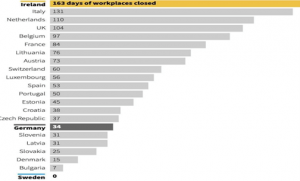
    In the London office of KPMG they might tell you to “stop moaning”. Perhaps we should. Vaccinations are coming, efficacy rates are great, schools are opening up again and spring is in the warmer brighter air. And yet, frustration is growing with a perceived lack of government urgency in returning the country to a more normal level of social and economic activity. I never thought I’d write this but my sense is a major driver of governmental sclerosis is money. No surprise there. But what if I said it was easy access to money rather than the lack of money? First, let us confirm the perception as a data reality in the following graphic (Source: Oxford Coronovirus Government Tracker) showing Ireland topping the European charts in the number of days in lockdown:

    Lockdowns cost money, lots of it. Last week we mentioned that high-risk companies were raising debt (junk bonds) at all-time low interest rates. Governments, thanks to central bank support, are even luckier with borrowing costs close to zero or better(negative rates). In fact, Ireland is doubly blessed as the only European country to actually achieve positive GDP growth in 2020. Very large multi-national tech and health sectors do help. Lucky us.

    But, I’m not so sure of luck over the long run. This may sound odd, but one wonders would our government show a bit more urgency and innovation if funding was a little tighter? The government is tasked with dealing with both a public health and an economic crisis. Very difficult but in recent days I am reminded of those famous words of Ronald Reagan – “The nine most terrifying words in the English language are, ‘I’m from the government, and I’m here to help’. ” The following government actions or inactions could come back to haunt us.

    1. The government has announced an extension of social and economic lockdown until April 5th but has assured us “the end is truly in sight”. There was specific mention of new virus variants as additional reason for caution but no mention of shutting airports and borders. Is it just easier to lock us up?

    2. As we approach one year anniversaries of pandemic lockdowns recent reports suggest NPHET have told the government additional lockdown periods are necessary until hospitals begin to reduce record patient waiting lists. Despite a wall of debt funding available to government, it would seem the Department of Health and the HSE has failed to upgrade our hospital capacity or staffing levels. Back in October our “No Funding Limits As Lockdown Bites” article made pointed reference to the lack of HSE planning for a “consistent spike in non-Covid hospitalizations through the winter months…EVERY year”. Is the government calculation that business owners are more capable of shutting businesses than the HSE is capable of delivering a public health system which is fit for purpose?

    3. The SME sector employs one million people. It is the crippled arm of our K-shaped economic recovery but the government seems incapable of articulating an effective capital support strategy for SMEs. There are lots of supportive words, even credit guarantee schemes, but the dogs in the empty streets know there is no real urgency to bring new thinking to the crisis. The draw down statistics on the SME Credit Guarantee Scheme are damning; in the last update, just over 10% of the €2.5 billion of “available” funding had been taken by SME companies. Where is the government curiosity on this disfunctional support scheme?

    4. The government is a significant shareholder in two of our three pillar banks, AIB and PTSB. And a fourth big SME player, Ulster Bank, has just thrown in the towel. Competition is now a quaint concept for business customers. Recall those Reagan words and wonder why Irish mortgage rates are double the European average. It is even worse for SME customers. A Central Bank report in October showed Irish businesses were lumbered with borrowing costs more than two and a half times the euro area average (5.03% vs 1.90%). After Ulster finally says “NO” what price will businesses pay for a government-owned “Yes”?

    The Ulster Bank exit also provides a window into the out-dated thinking being applied to business banking. Latest reports suggest government owned AIB will buy/take over the €4 billion Ulster Bank commercial lending portfolio. Think of a world embracing the efficiencies of digital platforms, artificial intelligence(AI), remote/cloud computing and data science. Now think about the number of staff it is suggested are needed to accompany that portfolio of loans to AIB……. 300. The mind boggles. Yes, government is scarred by the 2008 financial/banking crisis but it is possible to re-invent our banking sector. A fresh(no legacy loans) well-capitalised national digital business bank operated by the best tech-savvy banking experience would be a really good start in breaking our customer-crushing image. It can be done.

    Check out France, the home of recently split dance duo, Daft Punk. Some might not even know they were French. Here’s a few other things we may have missed about France in recent years. For most of my financial services life French stocks have failed to excite most fund managers – 30 hour work weeks, state-intervention and tight relationships between the national champion firms are often cited. Sounds like Reagan’s most feared form of government help. But look again, as Bill Blain at Shard Capital has done, and you’ll find there are more top 500 global companies in France than any other country in Europe. Blain thinks fund managers are missing a trick; “France could be on a roll. It has reasons to be. There are over 1 million trained engineers, 13,000 AI researchers and almost 60,000 French PhDs – all of them as dedicated to beating les Rostbifs in business.”

    France has a plan. We don’t and there’s a growing sense that difficult government decisions are being put on the long finger as a hope strategy. Hope is not a strategy. And there’s some cautionary signals coming from global debt markets. Government needs to move quickly as the “Get Lucky” period of low interest rates won’t last forever. The FT headline today highlights growing debt market concerns – ‘Bond investors suffer worst start to year since 2015”. Let’s hope bond markets this time inspire some constructive urgency rather than 2008 destruction. The government need to remove the pandemic helmets and apply modern solutions to our healthcare system and SME funding. Pandemic excuses and easy money will probably end. Public anger will not.

  • Great Expectations

    Great Expectations

    Sometimes I wish NPHET’s body of experts and medical chiefs would collectively do the ‘Freezebury Challenge’. As each day of February goes by, those hardy souls counting the extra minute each day in the frigid Dublin Bay waters understand the battle waged between fear of the next day’s incremental pain and the motivation of a charity challenge completed with a firm finish date; March is the fun swim focus. However, NPHET don’t do fun. Dates are fuzzy and the focus remains fear. The good news is human beings are resilient. It’s in our nature to look ahead, despite the challenges, and financial markets are currently providing a remarkable case study in expectations.

    If anything, economic conditions have worsened in recent weeks as businesses in Q1 deal with second and third wave pandemic lockdowns. Main Street is struggling. Yet, Wall Street is flying to record highs on an almost daily basis. The headlines would suggest “meme stocks” like Tesla are the drivers of this market excitement but that is not even close to the full picture. The truth is that it is not just “stories” which are generating investor enthusiasm. It is real stuff; dirty, old, fundamental stuff. And a little bit of digital dreaming. Here are a few data points which caught the eye:

    • Lumber prices in the US are up 170% over the past 10 months.

    • Oil prices above $60 per barrel are at 13 month highs.

    • Prices of natural gas in Asia almost reached $30 per MMBtu compared to just $2.60 in the US.

    • Tin prices at $30,000/tonne hit a 10 year high.

    • Copper prices at $8,400 per tonne have not been seen since 2012.

    • Soybean prices are up 60% in the past year.

    • Investor confidence in riskier companies’ debt hits record highs(price) as junk bond yields go below 4%.

    • Share prices in emerging markets are at record highs, finally eclipsing the previous peak achieved in 2007.

    • Japanese investors in the Nikkei 225 index have had to wait a little longer. The Nikkei is back at the 30,000 level it last achieved 30 years ago!

    And now for the dreamy stuff…..

    Investors can’t get enough of thematic blank cheque investment vehicles. Known as SPACs (Special Purpose Acquisition Companies) these vehicles are being listed on public markets at an unprecedented rate of almost $1 billion raised per day. In 2020 the total SPAC investment universe raised $83.4 billion dollars. We are only in mid-February and funds raised are already at $46 billion. Please note investors don’t even know where these funds will be spent in terms of acquisitions, geographies, valuations etc. You know, the fundamental stuff, right?

    Of course, we can’t ignore cryptocurrencies. Elon Musk and Tesla made a big splash in recent weeks buying $1.5 billion of Bitcoin and now this digital “store of value” has passed through the $50,000 price mark. Now there are commentators excitedly talking about Bitcoin as a more efficient substitute for gold which is an asset class ten times the size of Bitcoin’s market cap. So, next stop is $500,000 for Bitcoin!

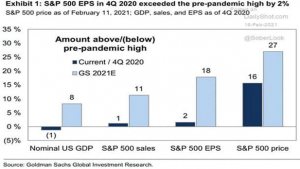
    Yes, this writer is a little concerned. However, confidence is critical to economic recovery. There will be fun and tears along the way(ask the Gamestop bandwagon victims) with pockets of irrational exuberance, particularly in a super-low interest rate environment. However, we leave you with one final fundamental data point which suggests better times ahead. There is a school of thought that Wall Street has detached itself from Main Street reality but check out the latest analysis by Goldman Sachs below. It would appear that profits from companies in the S&P 500 in Q4 2020 were actually higher than those achieved pre-pandemic….

    Clearly, things are getting better in the corporate world and the roll out of vaccines can only add to optimism. However, expectations must be managed. There is a danger some investors will chase the shiny baubles of Wall Street as a panacea for pandemic loss. Fear of missing out, FOMO, is a powerful emotion but there will always be fundamentals….. and hopefully fun. Indeed, Dickens himself told us Pip would rather have missed the glitz of wealth:

    “I used to think, with a weariness on my spirits, that I should have been happier and better if I had never seen Mrs. Havisham’s face, and had risen to manhood content to be partners with Joe in the honest old forge.” ‘Great Expectations ’

  • To Be Or Not To Be?  The Game Stopping Social Media Question

    To Be Or Not To Be? The Game Stopping Social Media Question

    Dear Minister Donnelly, can you please impose more restrictions? I won’t take an emoji for an answer. Then again, which emoji could come even close to the sensory onslaught unleashed in the past few days? Without even stepping foot outside the door we have been treated to a bizarro ensemble of events on our screens.

    Who would have thought the DUP, representing the 17th Century , is now positioned in voter polls as a centrist Unionist party to the left of Jim Allister’s TUV with 10% support? Did an army of retail traders almost take down Wall Street last week? In our last article we did say, “Let’s be careful out there” but we weren’t quite expecting manic nostalgia trading in late-millennial names like Gamestop, Nokia and Blackberry to crush the hedge fund wizards.

    Not exactly the stuff of ‘Bonfire of the Vanities’ but if we are talking fires how do we top first-term Congress Representative, Marjorie Taylor Greene, who suggested that Californian wild fires may not have been due to climate change. This is where the GOP would have liked their latest Qanon fruitcake to leave the climate debate but no such luck; Marjorie has been vocal on social media advancing the theory that a “space laser” funded by Jewish banking families created a solar beam to set California ablaze. We would be veering into comedy teritory if it weren’t so serious. Public health and safety is at risk and it all boils down to misinformation.

    Boris and the Brexiteers were always going to shaft the DUP and its wish for a stronger Union. One by one, all those misleading Brexit campaign messages have been thrown under a very large red bus. Now, council staff at Larne port have been withdrawn due to threats to their safety. Meanwhile over on Wall Street, the staff at retail trading platform, Robinhood, won’t want to read the online Reddit vitriol aimed at them; the keyboard warriors are blaming Robinhood(and other brokers) trading restrictions in Gamestop shares for a 65% downward return to reality yesterday. Conspiracy theories abound and leave little room for the most basic of trading constants; more sellers than buyers and a share price will fall. Yes, last week’s meteoric Gamestop share price rise was a complicated mix of short sellers, borrowed stock, margin/debt trading, options instruments and liquidity but, in truth, it was just a lot more buyers than sellers. We probably don’t need to tackle the “space laser” conspiracy theory but we will confront the major contributing cause.

    Social media platforms are the dominant source of public misinformation in the digital era. Kim Kardashian hit our screens in 2007 but governments and regulators have failed to Keep Up With the consequences of influencers communicating via social media platforms. There are now 4.2 billion social media users around the world according to a just-published report by Hootsuite. This writer is old enough to remember broadcasters had standards authorities, financial advisors had regulators and politicians had credibility. The power of Reddit, Twitter, Facebook etc to promote influencers to billions of people has been a game changer and raises three fundamental questions:

    Should social media platforms be regulated like traditional media broadcasters? The fact that millions believed Brexit lies or US election misinformation has massive implications for modern democracies.

    Should social media platforms be regulated like financial advisory businesses? The Reddit account, r/WallStreetBets, built an audience of over 4 million people last week and convinced many of those that Gamestop was not hurtling towards retail obsolescence. Hundreds of thousands of retail investors followed influencers like Davey Day Trader and Roaring Kitty and invested in Gamestop. Many will lose money they can’t afford to lose in inappropriate single-stock investments.

    Should social media platforms be regulated like critical national infrastructure? The national security risk here is not that a social media platform ceases to function. Rather, it falls into the wrong hands and is used as an instrument of chaos, as destructive as a failed electricity power grid. Malign messaging can threaten, even overthrow democracy. Only this week we are reading about a challenged election result in a far away land, the imprisonment of senior political leaders and the attempted restoration of a disgraced party to power. And that’s only the briefing papers for the upcoming US Senate impeachment trial of Donald Trump. Meanwhile in Myanmar the military has taken power and shut down the internet. The tragic irony of that action will not be lost on the Rohingyan minority in Myanmar. As recently as 2013 the military used a Facebook campaign to incite genocidal violence against the Rohingya population. These events did prompt US Congress scrutiny and Facebook has admitted it was “too slow to prevent misinformation and hate”. But doesn’t it all sound too familiar?

    The most advanced nation on the planet experienced a societal near-miss when Capitol Hill and Wall Street faced down a social media insurrection. It seems inevitable we might not be so lucky next time. Action is urgently required. Social media platforms must state what they want to be, and what they don’t want to be. Then they must act, or governments will. There are now more than 4 billion reasons why they will and every Minister of Health on the planet is anxiously watching the steady rise of the Anti-Vax movement. Over to you Minister Donnelly……

  • No Sign Of Wall Street Blues

    No Sign Of Wall Street Blues

    Happy Blue Monday but crikey! It’s tough enough these days without Father Time slapping you with a big number. Was it really 40 years ago this week when the TV crime series, Hill Street Blues, first hit our screens? Think back to Mike Post’s instrumental theme music, grimy urban scenes, innovative shaky hand-held cameras, multiple storylines and the steady din of background noise.

    The Hill Street precinct was breaking new ground in TV-land but who can remember Wall Street almost breaking the economy? More specifically, the cost of money for business was approaching nose-bleed levels of 20% interest rates. Grim days. Not so these days. Despite a global pandemic and ‘a real and present danger’ sitting in the Oval Office, financial markets are experiencing pockets of euphoria. Let’s take a look at three headlines over the last week.

    Affirm Stock Rockets More Than 90% After IPO – MarketWatch

    Bank share prices still wallow at historic low valuations but it seems that Affirm’s buy now/pay later financing facility is ground-breaking. Hmmm. Lots to think about here on top of the $24 billion valuation attributed to a financing option which has been around since 1157, according to the history of Venice.

    Signal Advance Has Soared 11,708% Since An Elon Musk Tweet – Business Insider

    A personal favourite this one. The world’s richest man, Elon Musk, tweeted “use Signal” to his 42 million followers last week. The background to this was a privacy revolt against Facebook’s WhatsApp messaging service. Sure enough, the Signal messaging app signed up millions of new users and the valuation of Signal Advance soared from a tiny $6 million to $300 million in just a few days. As Captain Blackadder might say, there was a tiny flaw in that investment strategy. Signal Advance has zero commercial connection to Signal, the encrypted messaging platform. Thousands of investors have bought the wrong stock.

    SPAC Mania Gives Early Investors Steady Returns With Little Risk – Wall Street Journal

    It is difficult to believe this is a WSJ headline. “Early” and “Mania” might be the operative words in this gem. As a brief explainer, a SPAC is a “blank cheque” investment vehicle which raises money via IPO on a promise to acquire companies in a specific(usually) sector or with an identifiable theme eg. Start-ups, hydrogen fuel, social media etc. In 2020 there were 248 SPAC IPOs. In the first 2 weeks of 2021 there have already been 40 listings on the public markets. SPACs are not new. They come into vogue when multiple “hot” sectors appear and investors look for swift access to these themes. Previous incarnations have included shipping, banking and energy exploration. The track record of these is mixed to put it mildly. Anyway, this is the early giddy expectation bit – enjoy the IPO excitement before the funds are spent and often wasted.

    Please do not take this as a blanket statement that financial markets are in a bubble. In fact, there are large parts of the market which are only just breaking out of multi-year slumps. Think smaller companies, European equities, banks and emerging markets which have all had a very tough decade. However, it would be remiss of us not to take on board the iconic daily cautionary words of Sergeant Esterhaus at the Hill Street precinct – “Let’s be careful out there”.

  • Trends Check: Keep Calm and Worry On …….

    Trends Check: Keep Calm and Worry On …….

    I just read an article referring to today’s date as “December 42nd 2020”. Do you blame them? The early days of 2021 still see Dryrobes, George Lee, lockdowns, NPHET and Brexit regularly flying up the Twitter trending charts. Sadly, Covid-19 remains omnipresent but, thankfully, the Donald has been cancelled by Twitter and replaced with our very own Don, or Donie O’Sullivan. Democracy almost failed last week on Capitol Hill but Cahirsiveen’s gift to CNN was on the spot to bring some sanity to the chaos. Now, it’s our turn.

    It would be easy to pinpoint Covid as the source of most of this chaos but that would be almost Fake News. In reality, there are a number of markets and geopolitical trends which have been around for a few years now, even decades. However, one of the better descriptions of the pandemic’s impact was that it had hugely accelerated established trends. For illustration we thought it no harm to re-visit 10 trends we identified in December 2019 PP (pre-plague) and monitor the development or death of same.  The link to the full 2019 article is at the end of this piece but for explanatory convenience we will show those early views in bold text followed by our current thoughts and potential new trends gathering momentum. We will review in the same order as last year so here goes…..

    Debt: Global debt has just topped the $250 trillion mark according to the International Institute of Finance (IIF). It’s rather scary to think that in the ten years since the credit crisis of 2008-2009 the world has piled on another $70 trillion of debt. This debt mountain is incredibly sensitive to rising interest rates. Hence, central banks led by the Fed have had to abandon attempts in 2018 to return interest rates to more normal levels. Central banks are now stuck in a Japan-style debt trap with additional credit creation achieving less and less stimulatory impact on economies. Now, frustrated and worried central banks are pressuring politicians to introduce fiscal policies to break out of this stagnation spiral. Unfortunately, politics at a global level is increasingly polarised.

    The same IIF is now saying global debt reached $277 trillion in 2020. Another $27 trillion…. Hoo boy. Of course, trapped central banks didn’t see Covid coming but have played a critical role in supporting the global economy. However, the pressure is now on governments to deliver fiscal stimulus themselves. Let’s just say that debt number could be $300 trillion by the end of 2021. The pandemic was a definite accelerant.

    Democracy: Levels of income inequality not seen since the 1930s presents the potential danger of history repeating itself. Democracy is under pressure. The Freedom House think tank published a report in 2018 highlighting that year as the 13th in succession where democratic freedoms were in decline. A total of 68 countries witnessed a tightening of civil liberties and political rights whereas only 50 countries registered progress in these areas. As 2019 comes to a close the strong-arm tactics of Trump, Putin, Xi, Orban, Erdogan and Prince MBS do not provide reassurance that authoritarian trends will reverse any time soon.

    Democracy had a bad year where most bad actors named above got away with further repression. The only bright spot was the repudiation of the Trump regime at the ballot box but not without the deadly events on Capitol Hill. Arguably, the pandemic cost Trump the presidency and halted a dangerous erosion of US democratic institutions.

    ESG: There is grounds for optimism that businesses and investors see “doing good” as a prerequisite for wealth creation. It almost sounds like common sense but the ESG investment framework covering Environment, Social and Governance factors is gaining traction rapidly with $30 trillion worth of investments now employing ESG metrics in their investment processes. That $30 trillion number will grow and standardised metrics to measure and audit ESG will be the next challenge for business and investor alike.

    2020 was a huge year for ESG. The value of funds now employing ESG investment frameworks has exceeded $40 trillion during 2020 and will no doubt attract more follower funds in 2021. However, we would be wary of attributing all this enthusiasm as a pandemic appreciation of the need to save our planet. It was extremely helpful that technology stocks which score well in ESG frameworks had fantastic share price performances. Despite global economic chaos, the technology-heavy Nasdaq index delivered 43% returns to investors in 2020. Profits, or performance, always helps trends find new friends…..

    Trade: President Trump is now saying phase 1 of the China-US trade negotiations might not conclude until after the 2020 US elections. Who knows what will come out of Trump’s mouth next but expect 2020 to again be dominated by trade tensions in the EU with Brexit, and in Asia-Pacific with China. The rise of populist politics and trade protectionism are the two sides of a no-win economic confidence trick. Closer to home, Boris Johnson’s bombastic certainty of concluding trade deals with Europe by the end of 2020 will be particularly painful to watch unravelling.

    One of the few areas where there is bi-partisan agreement in US politics is trade with China. Ironically, despite the Orange Toddler’s tariff tantrums, China’s global trade surplus hit $460 billion in November. The surplus with the US alone was up 52% in November!! In this instance, China’s faster economic recovery from pandemic than the West has accelerated this sensitive surplus. Needless to say, trade tensions will continue into 2021, as will Brexit chaos but we will spare you the Johnson narrative.

    China: The most important macro story apart from debt in the world today is China. It’s arguably the engine of growth which services the planet’s debt. By the end of this year Chinese consumers will have purchased goods worth more than $5 trillion, exceeding that of the original consumption super power, the US. So, financial markets will now have to pay much closer attention to the role of Chinese consumer confidence in the global economy. Think of how many decades financial research and trading teams have agonised every first Friday of the month for the US Non-Farm Payrolls. Get ready for Sunday night China economic reports but before that keep an eye on bond default newsflow. There have been four or five relatively significant blow ups in recent weeks, even involving State Owned Enterprises (SOEs). Do not underestimate the potential impact on consumer confidence if the all powerful state can’t save its own.

    Our fears on debt defaults were unfounded so far. Debt defaults in the first 9 months of 2020 actually fell 20% to $13 billion according to Bloomberg data. The pandemic, in this case, may have stalled the trend rather than accelerated things .  China remains the biggest structural macro story in the world apart from global debt levels.

    Tech Tension: Technology has been a dominant driver of markets since the credit crisis. Some companies now have user bases which would be in the top 3 populations of the world if they were sovereign states. Think Facebook and Alipay with 2.5 billion and 1 billion users respectively. As Microsoft and Apple’s combined market value now exceeds that of Germany’s entire stock market at $2.25 trillion it is tempting to think this is a high water mark for tech valuations. Two developing stories/trends suggest the tech sector could meet some growth challenges. First, Facebook’s power and abdication of responsibility on publishing false information to huge numbers of people is moving towards a 1911 moment. That date is neither a typo nor hyperbolic. For the historians, that’s the year when the Standard Oil refinery monopoly was broken up. Second, the rise of ESG is ultimately not compatible with corporate deference and fear of China’s wrath. The recent China anger incidents involving the NBA, Apple and Google suggest corporates may have to decouple from Chinese internet and broadcasting platforms. Yes, the internet could splinter and anyone following the Huawei case with fears over 5G security might be forgiven for thinking a “net split” is not just a possibility but inevitable.

    Covid has possibly diverted attention away from the China tech/security threat but the 9/11 moment for democracy in America last week has possibly accelerated the 1911(Standard Oil monopoly) moment for Big Tech. Google and Facebook now face anti-trust litigation from the Federal government. But, these cases were announced months before the Senate run-off races in Georgia. If you are wondering why Google, Facebook, Amazon and Twitter have moved rapidly to neuter far-right conspiracy personalities and channels just think how many future Senate Committee heads(Democrats) were hiding under their desks in Washington last week. The role of social media disinformation in the awful pandemic death tolls in the US will also focus executive minds but it might be too late for Facebook.

    Content is King: Even with a potential internet split, original content continues to be the critical asset for every media platform on the planet. We mentioned monopolies earlier but has anyone noticed that Disney has quietly assembled a portfolio of content assets with enormous power? Even before Star Wars opens in cinemas, Disney has accounted for $1 in every $3 spent in cinemas in 2019! The battle for content has exploded to unsustainable levels with almost 500 originally scripted TV shows produced this year. In 2012 that number was less than 300. And the costs are rocketing. One statistic we read recently was that for each $1 of a Netflix subscription the user was receiving $1 billion of content. It’s not just entertainment content. Think about the $5 billion valuation of Manchester City implied by the recent private equity investment made by Silver Lake Partners from Silicon Valley. Live sport is hot but $5 billion for a franchise which can’t fill its home ground…?

    Production of content clearly suffered in 2020 but the uncertainty facing cinenas has accelerated the adoption of streaming services.  Remarkably, Warner Bros. have said they will debut ALL its movies in 2021 in cinemas and on its HBO Max streaming service on the same day! And check out Disney Plus. The ‘House of  Mouse’ only launched its streaming service, Disney Plus, just over a year ago but has reached subscriber numbers of 86 million already. For context, Disney planned to hit the 90 million subscriber mark by year FOUR in its initial communications.

    Energy: Climate change is for some top hedge funds now a critical factor in every investment selection. The climate crisis headlines multiply each week and this means continued pain for fossil fuel investors. Apple’s valuation is now bigger than the entire US Energy sector. Furthermore, for fossil fuel dependent economies like Saudi Arabia and Russia it is striking that their levels of sovereign interference have increased in recent years in the likes of Yemen, Syria and Ukraine. There is a suspicion that this projection of international power is an attempt to disguise significant structural weakness.

    Irrespective of pandemic hits to economic activity and energy consumption, the climate/ESG trends look set to continue to keep energy in the ‘unloved’ corner of the market. It is staggering to think that Tesla’s market value now exceeds the market cap of the entire US energy sector! However, it is worth bearing in mind how well “unloved” tobacco served its investors over the last three decades. Debt levels and long-term capital investment required do not make the tobacco and energy sectors comparable but there will be pockets of excitement along the way. Note LNG prices are rocketing in Asia to all time highs as unusually cold weather bites.

    AI: We have been inclined to highlight the risks/areas to avoid but Accenture tells us there is a $14 trillion opportunity in AI across 16 industries in the years out to 2035. Health, finance, logistics and agriculture all look particularly suited to AI innovation and it is striking to see an out-of-favour sector like finance now attracting the largest chunk of venture capital money via European fintech.

    We were told a pandemic vaccine was years away. It was delivered in 9 months. If ever the population of the planet was given a striking lesson on the power of AI this was it. The ability of AI to crunch huge numbers of varaiables and predict results in delivering a life or death solution for humanity will massively accelerate further AI investment in healthcare, education and finance.

    Inflating Value: And that leaves us finally with another potential positive albeit it is difficult to argue this trend is established just yet. However, we can include this in our list with a speculative health warning! For years, value investing has been clobbered in performance terms by growth and momentum investing strategies. Yes, it might be difficult for oil to make a come back but other commodities could bounce back sharply if inflation picks up. Whisper it very gently but there is data/evidence to support wage inflation picking up in Europe. Wages are growing at the fastest pace in a decade and Europe remains the largest trading bloc in the world. A stronger Europe would be a very positive development. No doubt, investors stuck in value strategies will be watching hopefully for an end to their performance misery. The rest of the world should hope for the same too.

    We are whispering again. However, for most of 2020, investing using value factors was a disaster. The FT was reporting at the end of October that value stocks were having their worst run in two centuries. Of course, economically sensitive stocks tend to sit at the value end of the investment spectrum so Covid allowed tech share prices to literally ‘Zoom’ while economies went into deep freeze and cheap stocks became even cheaper. Fast forward to today, and an earlier than expected vaccination, super low interest rates and fiscal spending from governments has thrown huge amounts of money into the system. There’s even chat of another ‘Roaring ‘20s”. Ireland borrowed €5 billion for 10 years last week at a negative interest rate, Tesla is racing towards a $1 trillion valuation and Bitcoin has just hit the $1 trillion mark too. Go back to that $27 trillion of new global debt in our first comments and then think about lots of capital chasing an unchanged number of opportuities and assets. We watch, we worry. But first, value investors could ride that inflation comeback extremely profitably.

    So, it would seem almost every trend has survived the pandemic, in many cases accelerated. However, did Covid kick start any new trends worth watching? We think three are worth keeping an eye on:

    1. The pandemic has shone a tragic light on income inequality and poor education. The death rates in the poorer sections of society are significantly higher than average. Governments will act. The next version of The Donald could be far more competent and dangerous.


    1. Hong Kong has attracted geopolitical attention for some time but there’s a far more critical flashpoint developing in the Sino-sphere: Taiwan. More critically for the global economy, Taiwan is the epicentre of global semiconductor production. These chips are the real “oil” of the global economy. Watch and worry as tensions rise over China’s inevitable plans to control Taiwan.


    1. Work-from-home is now accepted as the future. Expect more strategic decisions by companies to facilitate that shift. However, we might also expect to find in the coming years that early hopes of similar or superior worker productivity were unfounded. After all, we are only human, and the pandemic has surely shown us that we do crave social contact not just screen contact.


    Yes, we are human. We can’t forecast the future as there is always change around the corner. So, know the trends, keep calm and know some of your worst worries may never materialise.

    Our original December 2019 article is here: https://gravitas.sparkcrowdfunding.com/top-10-trends-to-watch-for-2020/

  • Ten 2021 Surprises To Trump A Crazy 2020?

    Ten 2021 Surprises To Trump A Crazy 2020?

    Well, how do you top 2020 for surprises? You probably don’t but the early days of 2021 can hardly be described as normal. Spiralling pandemic infection rates, new lockdowns and continuing White House madness are depressingly familiar developments. However, let’s dream a little positivity. Like last year, this exercise in listing potential surprises is not intended to be short-odds probabilities. The idea is to think about the possible and, for a brief few moments, not the pandemic. Our list last year managed to have a 4/10 hit rate but only if you accept that Kim Jong Un “died” for about a week!

    Anyway, 3 out of 10 probably justified the read a year ago but this year we are making it more difficult by only listing positive surprises. So, buckle up, relax the brain and be mindful of Willie Wonka’s advice that “a little nonsense now and then is relished by the wisest men.” A refresher of our 2020 list is in the link at the end of this article but for now let’s dream of 2021 possibilities…….

    1. North Korea and South Korea sign a peace agreement on Easter Sunday engineered by China’s President, Xi Jinping. Xi’s diplomatic efforts are rewarded with a Nobel Prize which prompts a legal challenge from Donald Trump’s crack(ed) legal team claiming their client was the true peacemaker.

    2. Boris Johnson resigns as Prime Minister on Good Friday. Crucified by the financial pressures of maintenance payments for six(or seven) children, Johnson is forced to re-enter the private sector to boost his income. In June, Johnson signs a 50 million pound deal with the newly launched Trump TV Network to host a weekly variety show from London.

    3. Climate change increases its economic influence. Financial assets following sustainable investing criteria(ESG) reach the $80 trillion valuation mark driven by new EU disclosure rules coming into law in March. UK assets score poorly under new frameworks due to “political risk” with many FTSE 100 shares trading at 30% discounts to EU peers.

    4. Covid-19 vaccination programs reach the 1 billion injection mark by June. Infection rates decline rapidly through the year and the virus mysteriously disappears by August.

    5. Donald Trump goes to prison on a money laundering conviction. Melania Trump sues for divorce and wins a $50,000 settlement with the agreement of banks and creditors conducting a fire sale of Trump assets.

    6. Commercial real estate and urban hospitality sector valuations soar as new surveys by big business reveal significant productivity declines where majority work-from-home options are available.

    7. Vladimir Putin is forced from office after a Russian oligarch revolt. The Biden administration’s plans to ban Russia from the Swift banking payments system as a sanction for the hacking of US government institutions is believed to have been the critical catalyst in Putin’s removal. Joe Biden goes on a triumphant diplomatic tour of Europe, including a week-long stay in Ireland, which pushes his Presidential approval ratings back home above 80%.

    8. Irish digital payments company, Stripe, attains a $200 billion valuation in its last private fund raising before a planned Q4 IPO. This valuation exceeds the combined market capitalisation of all the companies listed on the Irish Stock Exchange. Google is also rumoured to be considering acquiring Stripe before IPO.

    9. Ireland tops the GDP growth table in Europe once again with a 10% increase driven by migration of financial services operations from London to Dublin.

    10. Bitcoin trades above $50,000 in December. It turns out RTE’s intrepid science correspondent, George (g)Lee, has been a keen investor and owns a cryptocurrency portfolio valued at more than $1 billion. He retires from RTE to the relief of the nation.

    We did say dream but you never know! Last year’s list is here for the curious.

    https://gravitas.sparkcrowdfunding.com/2020-vision-or-10-more-surprises/

    Happy New Year!