Author: Gary McCarthy

  • Night Of The Living Debts

    A former boss of mine used to marvel at the typical information bias of editors and readers of the broadsheet version of the Financial Times (FT). Of the thirty-odd pages in the daily must-read for finance professionals, all bar the back two or three pages were devoted to equities. My boss’s point was that that the debt and currency markets were quantums bigger and ultimately far more influential than stock markets. I was reminded of this overnight as various market commentators and media outlets breathlessly gushed about yet another huge move in stock markets around the world.

    For this writer, last night’s 1000 point upwards move by the Dow Jones share price index was almost irrelevant. What caught the eye was the emerging significance of the asset class usually confined to the back pages of the FT – debt. In a previous article, “Other People’s Money”  back in July 2019, we cautioned readers about business models, and even countries, overly dependent on the daily funding/kindness of strangers. Furthermore,  we specifically warned that “these companies struggle for survival when markets take fright and all providers suddenly decide they would rather hold onto their liquid funds until volatility recedes”.

    Well, this is a “fright” moment for capital markets and that sucking sound you hear is not a gurgling Texan oil well but capital swiftly draining from riskier parts of the markets. Let’s start with oil, or rather shale oil. The dramatic escalation of production in Saudi Arabia and subsequent collapse in oil prices is threatening the survival of many US shale oil players who have borrowed via the high yield (junk) bond markets. More than two-thirds of these companies are now trading at distressed levels in junk bond portfolios. This is not good news for these oil companies or their bankers.

    US banks will be watching high yield indices as nervously as they watched mortgage-backed securities (MBS) indices back in 2008. The mighty Bank of America has seen its share price crater by a third in less than three weeks. That’s worrying but not fatal. However, in Italy, a country now in total shut-down mode, one wonders how an already fragile national banking system will cope with a shock hit to funding flows. Recall that all banks and insurance company business models are dependent on other people’s money to carry out their daily operations. It can become very ugly if daily funders suddenly take fright. Just ask Robinhood.

    Fintech has been receiving great press on these pages and elsewhere but it is not a one-way bet. A real crisis can expose weaker fintech platforms. Robinhood has had a number of trading outages in the past week which has frustrated users wishing to buy or sell shares on its investment platform. If this wasn’t worrying enough for its customers there have been reports that the company maxed out its $200 million credit line in February when market volatility first struck. The company has reassured the market that liquidity has been restored but this will hardly keep its army of 10 million users in “merry men” mood. Expect more news there.

    Of course, the news is already full of stories on airlines struggling to keep empty fleets airborne. Note many airlines use other people’s money when they lease aircraft. This has been a rapidly growing sector of the debt securities market and Ireland is the global leader and IP capital of this funding model. We have written previously about our caution on leasing models predicated on airlines benefitting from a national “backstop” from governments. The rationale is that countries would be unwilling to restrict/shut off their airspace by defaulting on leasing debts. Let’s just say public health systems have just zoomed to the top of most government funding queues in the Covid-19 crisis and difficult choices may lie ahead. The potential impact of Covid-19 at a national level could cause defaults in sovereign debt markets too.

    Lebanon has already defaulted on its bonds over the weekend. Turkey and Brazil worry lots of observers, and Japan had already experienced a GDP decline of 6% BEFORE Covid-19 struck. It’s early days yet but there is no doubt debt stories are migrating towards the front pages of the FT.  As always, when the funding tide goes out naked bad behaviour can reveal itself at the corporate level.

    The hospital operator NMC Health is a blue-chip name in the FTSE 100 but it looks like investors will now be screaming blue murder. The company has kindly informed the market it has discovered it has an extra $2.7 billion of debt its board never even knew about! That more than doubles the debt burden of the company and probably ensures a fraud investigation. Meanwhile, Boeing has had a bad 12 months already but its bankers were happy last month to provide it with a $14 billion credit facility to assist it through production and delivery delays on its troubled 737 Max aircraft model. Those same loan syndicate banks might be a little bit queasy to hear Boeing plans to draw down on the entire $14 billion by Friday…

    None of this is good for creditor confidence. Hence, our caution about companies’ dependent on other people’s money. Those kind people might just take fright when the back pages of the FT become the main story and naked corporate bodies wash up on the shore.
  • Interesting Corporate Activity Despite Covid-19 Fear Fest

    Pandemics are scary and the loss of life is a genuine tragedy. On a more positive note, the decisive actions of authorities in the likes of South Korea, Hong Kong and Singapore will hopefully provide a public health management template for Ireland and its European neighbours. Containment is key and discipline critical. Contagion can also be an unexpected risk in finance and is usually caused by rogue activity. Step forward Mohammed Bin Bonesaw.

    Not content with the murder of a US-based journalist, the Crown Prince of subtle appears to have set his sights on dismembering Texas and North Dakota from the election coffers of the GOP. Currently, markets are experiencing full-blown panic as Saudi and Russian leaders decided at the weekend that a deliberate oil pricing implosion was just what the world needed. Presumably, Agent Orange in the White House might have a different view after a few calls from Wall Street and Houston have set him straight.

    Good news at the gas pumps maybe, but not so good for oil companies and their creditors, the banks and junk bondholders. Once again the global banking system is about to be challenged. It is not news to readers here that financial services companies are already under pressure. The challenge for them is the adoption of technology to survive competition from nimble new entrants and existing players who execute digital transitions swiftly. Not unlike the Covid-19 crisis, swift decisive action rather than words is required.

    The good news is that recent headlines would suggest that there has been an acceleration of corporate activity which provides hard evidence of a renewed urgency in financial services. Take your pick from the following.

    A global crisis like Covid-19 will remain primarily a challenge for humanity with tragic losses. However, it will hopefully run its course like every other pandemic in human history. As financial observers, it will be instructive to see which sectors took decisive strategic action in a period of huge business uncertainty. It is not unreasonable to suggest that the necessity for certain sectors like financial services to act right now tells a bigger story than mere fear. Some business models have no choice; the failure to act will be fatal.


    Enjoyed this blog post? Then why not check out our other great content here!

  • Winning In A Crisis

    Yes, the headlines are scary. And, of course, some commentators are making 2008 comparisons but all this “noise” will pass and those companies who seize opportunities during this Covid-19 crisis will win big time. History is a rather good guide. When the TMT bubble imploded it was Amazon and Google who hoovered up lots of talent fleeing weaker business models. More importantly, this talent was acquired at a less bubbly price.

    When the credit crisis (GFC) hit in 2008 the US banking system wobbled and many famous institutions went to the wall. However, in the aftermath of the GFC, the major US banks aggressively wrote down bad loans and restructured their business models and invested in technology. In contrast, the European banks failed to act in any significant way to address their obvious vulnerabilities and that is the lesson for today.

    The big US banks are now the most robust and profitable financial institutions on the planet. Meanwhile, European banks are teetering on the brink of another financial crisis as the fragile Italian banking system stares down the barrel of a Covid-19 economic shock. The strategic lesson is clear. A crisis can provide opportunities to future proof a franchise. In more pragmatic terms, expectations on profits for 2020 are softening along with share prices which provides useful cover for some very wise investment. Bold strategic action is likely to be rewarded and we can think of a few obvious areas:

    • Digital Transition: In a low inflation world there are many sectors where pricing is under pressure. The winning franchises will be those who successfully excel on two fronts. First cost bases need to be best-in-class which necessitates smart technology and faster cheaper solutions. Second, technology can drive sales with superior marketing, customer engagement, execution, finance interfaces and customer retention. Many of these technology solutions are now residing in “the cloud” and it was fascinating to see leading Irish cloud transition services player, Version1, make its 11th acquisition this week with the purchase of another Irish digital star, Singlepoint. This type of corporate activity/confidence gives you a clue about the pipeline of digital transition work coming down the tracks.
    • ESG: Climate change is the hot topic but that’s only the “E” in ESG. We have repeatedly stated that corporate health is wealth. Environmental, Social and Governance criteria are now being monitored by investors managing over $30 trillion of funds. Many companies will try to “greenwash” this emerging trend by paying lip service to ESG frameworks but this will end up being a costly lack of action. McKinsey in a recent report made it very clear that funding costs, operational costs, regulatory/safety fines, personnel productivity/retention and cash flow are real risks that will ultimately diminish the value of a franchise. As an illustration, banks are now beginning to peg lending rates to a corporate’s ESG rating.
    • Automation & Talent: Imminent research from Loughborough University is about to reveal that the UK is facing the biggest slowdown in productivity in 250 years. Amazingly, Brexit is not the key culprit. In fact, all developed economies have particularly struggled on the productivity front since the GFC crisis. The reasons are complex but the good news is that automation offers huge productivity opportunities for both employees and companies. The implementation of robotic process automation(RPA) is poised to accelerate dramatically and take a huge number of repetitive, low-value manual tasks off employee to-do lists. The powering of employees using AI and RPA will enable them to focus on higher-value activities and enhance creativity. One can expect that companies who fail to embrace automation will struggle to keep quality employees and, more importantly, customers wary of franchises with high staffing turnover and outdated clunky business processes.

    All of the above actions require investment and management focus. The companies which seize the opportunity to strengthen their business models in the increasing likelihood of a challenging 2020 can gain a very valuable head start on distracted competitors. Just think, Yahoo celebrated its 25th anniversary this week. It is safe to say most of the business world didn’t really notice. The choice for companies is simple; DO or YAHOO.

  • Pull Back The Curtain On 10 Covid-19 Truths

    No matter how many times Donald Trump clicks his platform-boosted heels the Coronavirus will not go back to Kansas or a Chinese food market. Science and reality now have the upper hand as Covid-19 goes global and takes a tragic human toll. Beyond the tragic fatalities from the virus, the uncertainty surrounding its infection rates and pressures on healthcare systems has created fear at the very highest levels.

    The G-7 nations are planning an emergency conference call today as containment measures threaten to cripple global economic activity.  Already, shipping container traffic into the West Coast of the US is down 25%, tourist traffic into France is estimated to be 40% below average, airlines are cutting capacity everywhere and Apple’s manufacturing facilities in China are operating at just 25% staffing levels. Central banks across the globe are signaling financial support and the G-7 call is a recognition that this is probably the biggest shock to the global economy since the GFC in 2008-2009.

    As with all shocks, the global economy and financial markets will recover in time. However, like the virus itself, financial stress does have a habit of exposing activities and policies which have, to date, been untested or have escaped more forensic scrutiny.  As Warren Buffett has said, “It’s only when the tide goes out that you learn who’s been swimming naked”.  With the benefit of experience from previous financial crises we would advise readers to watch the following closely as the curtain of normality is pulled back:

    1. Peak China: Irrespective of how history reviews the actions of Chinese authorities in containing Covid-19, the almost total shut down of the Middle Kingdom’s manufacturing base will prompt serious review in multi-national C-suites. The era of concentrating one’s manufacturing assets in one region/country is over. Expect the likes of Vietnam, Albania, Mexico, Colombia and Indonesia to benefit from likely diversification of manufacturing activities.
    2. Zombie Apocalypse: Ultra-low interest rates have helped weak franchises stay afloat as banks avoid painful loan write-downs. Given many healthy franchises will need financial support, banks might finally have to cut loose the zombie companies and save those with a genuine future.
    3. Governing the Gig Economy: The explosion of task-based contract work through digital platforms has created an army of independent workers in the services sector. This independence is a double-edged sword. In a public health emergency, one wonders, particularly in transport based services, whether governance is strong enough at a corporate level to ensure compliance with safety guidelines. Expect increased regulation in the future of gig work which is now firmly embedded in nearly all economies. For illustration, 36% of US workers are involved in the gig economy through primary or secondary jobs.
    4. CEO Health: We have written in a previous article how Churchill advised never to waste a good crisis. A large spike in CEO departures is already underway as Covid-19 is used as a convenient curtain to camouflage structural challenges facing certain sectors.
    5. Financial Fraud: Enron was a TMT crisis reveal; Bernie Madoff and multiple banks were our GFC gifts of the gab and gruesome. Whither Covid-19? Readers won’t have to wait too long we fear as cashflow and credit stalls.
    6. Panic Platforms: Markets have experienced furious gyrations over the past week. There have been repeated warnings over the years that liquidity won’t be sufficient to handle customer requests to redeem/sell/buy in high volume scenarios ie panic. Spare a thought for clients of the Robinhood investment platform for retail traders which seized up yesterday. Never good to miss out on a 5% up day. Even worse if, as speculated, the website shut down due to coders missing out the Leap Year 29th
    7. Ghoulish Globalisation: Sadly, China is at the epicentre of the storm and ultimately consumers in the West facing product shortages will only encourage the likes of Trump and Boris to “take back control” and make steel, coal and toilet roll great again. Expect a further wrongly-informed electoral retreat from globalism and additional delusional nationalism.
    8.  Sub-Prime Oil: If we recall the GFC crisis there’s usually one sector that kicks off the financial domino chain of credit implosions. In 2008 “The Big Short” was the sub-prime mortgage sector in the US which killed off Merrill Lynch, Bear Stearns, Lehman Brothers, Washington Mutual and Countrywide. The sector we are watching most closely right now is the shale oil producers in the US. The sector has binged on junk bonds at very low-interest rates and is already struggling to generate positive cash flow. The oil & gas production sector, loved by Trump, accounts for a very large portion of junk bond indices so any sharp falls in these benchmarks will be a red flag that a demand shock (oil price drop) is going to trigger plenty of Chapter 11 filings and very ugly write-downs at large US banks.
    9. Balance Sheet Supremacy: Critical to understanding the financial threat of Covid-19 is that this is both a supply (chain) and demand (spend) shock. Hence the G-7 emergency call. This writer’s experience of the financial world’s army of equities analysts is that they spend the vast majority of their time trying to forecast earnings with almost no benefit to investors and abysmally fail to understand the company balance sheet dynamics of a sharp reduction in revenues. Great analysts (very few) and great companies(many in Ireland with huge GFC experience) will prosper post-crisis with fewer competitors and enhanced credibility.
    10. Politics Meets Facts: Death doesn’t do “spin”. Funerals and ICU units are real and the statistics will rebuff the most egregious exponents of science denial. It is very possible Covid-19 will be the death knell of the Trump presidency as the US grapples with the structural problems of so many outside the support net of government. No sick pay, no insurance, no education and no information could cause a far higher death toll per capita than other “developed” countries. Katrina and New Orleans destroyed Bush; thoughts and prayers won’t save Mike Pence or the President.


    If there is a single long term positive of a challenging Covid-19 crisis it must be the hope that science and facts reveal poor actors, incompetence and dangerous misinformation. Sadly, the human costs could be far higher than a digitally informed world would have hoped….

                    “Some people without brains do an awful lot of talking, don’t you think?” 

                                                                                                     – Scarecrow in The Wizard of Oz.


    Enjoyed this blog? Then why not check out our other great content by clicking here!

  • Charting Poor CEO Health

    Winston Churchill is often credited with the advice to “Never let a good crisis go to waste”.  In human terms, the Covid-19 outbreak cannot be described as a ‘good’ crisis. It is also arguable that it is not even a crisis yet despite the financial markets generating price charts dripping with fear. We have no idea how long Covid-19 will exert its influence on the global economy but centuries of history would suggest disease, even pandemics, do pass. In contrast, the world of business often has to deal with long-run structural challenges as well as temporary commercial shocks. One chart caught our eye this week and prompted thought.

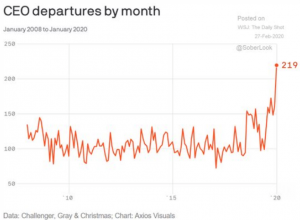
    Back in October in “I’m a Celebrity CEO – Get Me Out of Here!” we highlighted an acceleration in the number of CEOs leaving their positions. In fact, July’s total of 159 exits was the highest ever monthly total. Fast forward six months and check out the chart below spiking to a whopping 219 exits this month. This is not a Covid-19 infection chart.

    Clearly, the broad sample of departing CEOs from the likes of Google, BP, Boeing, McDonalds, Mastercard and IBM cannot be pinned on the prospect of a global pandemic. However, there is a sneaking suspicion that the flurry of exit announcements in February could be the wise use of a crisis to prevent scrutiny as to executive motivations. While the financial press might be obsessed with virus infection rates, threatened recessions and VP Mike Pence’s comical history of fighting public health crises, there are a number of structural challenges facing the business world on a longer time horizon.  We can think of three or four global themes that require critical executive attention.
    First, the Covid-19 outbreak is further ammunition for those wedded to reversing globalism. The concentration of manufacturing assets in China will need to be addressed but is not really a result of globalism. No, the wrongly identified outcome of globalism is income inequality. There is no doubt income inequality is in urgent need of attention – Ireland could be Exhibit A in how to blow an election by confusing the difference between average net income and median net income. The latter metric reveals up to 50% of the country is making no progress as Irish national (average) figures zoom ahead.

    The prospect of raising wages and damaging profits and stock options for CEOs is possibly one they’d rather leave to the next boss. Another cost demanded of the markets is also about to rise and initially hit the bottom line. Climate change is real and ESG investment rules are already hurting some very large sectors and their valuations – think Oil & Gas, Steel, Autos and the Transport sector.

    Finally, spare a thought for the monster financial services industry. Yet another one of our 10 outlier surprises for 2020, the prospect of US 10 Year Bonds with negative yields, is not that far away. Yields are at 1.15% and falling fast, even before the Fed is bullied by the recession-threatened Orange Toddler to fix (again?) his 2020 election. The news almost as bad as another four years of Trump would be negative interest rates crushing the traditional business models of banks and curtailing lending.

    Time will tell if Covid-19 fades into history as a temporary tale of human loss and economic shock. However, there are greater structural challenges ahead and it would appear plenty of CEOs are quitting while they are well ahead in wealth terms and also ahead of difficult commercial decisions. Actions do speak louder than words and particularly pay attention when the easier route is chosen.  Churchill, again, put it rather well:

    “The problems of victory are more agreeable than those of defeat, but they are no less difficult”

  • A Short History Of Investor Panic

    So, do I wear a face mask on my weekly Ryanair run to London? Will I eat Italian for lunch? Not sure. Will it matter in the long run? Probably not. Welcome to the world of human emotions, fear and temporary loss of reason. Sadly the human cost of the Coronavirus is very permanent just like measles, malaria and the flu. However, in the context of financial markets, a new virus and an understandably fast-moving learning curve can generate real fear and uncertainty. And that is a markets killer.

    More than a month ago we tried to warn and quantify that very impact in “Charting a Dose of Flu” and we are already halfway there in terms of wealth destruction on US equity markets. Now, it’s time to move ahead of the CNBC “Markets in Turmoil” chyrons and apply a bit of historical perspective. This wide-angle history lens should calm investor nerves as financial headlines scream “Panic”. Firstly, investors are correct to interpret the quasi-shut down of the master cog in the global supply chain, China, as financially damaging for companies.

    However, the likelihood is that depressed economic activity will catch up on lost production/demand in later months in the year. What is less rational from an investor perspective is that the valuations of major companies with multi-decade cash flows ahead of them have suddenly changed. That makes no sense as equities discount the long-run cash flow returns of a company. In a nutshell, the financial impact, unlike the human impact, is temporary, not permanent. Fear is the driver and markets almost every year experience the same. We thought the following data points, many from the excellent Charlie Bilello on Twitter, would provide some interesting context:

    • The S&P 500 is down 6.28% over the past 2 days. That’s the 109th largest 2-day decline going back to 1928
    •  The S&P 500 is now down 7.6% from its recent all-time high. Now consider the average intra-year drop for the S&P since 1928 is 16.3%.
    •  Volatility has been very low in recent times thanks to central bank support. In fact, there had not been a 5% pullback for a whopping 8 months. Have we become spoilt by zero volatility?
    •  1000 point declines for the Dow Jones Index sound scary but consider inflation and the growth of capital markets over the past 40 years. A daily 1000 point decline in percentage terms(3.56%) ranks as merely the 229th worst day since 1900.
    •  Since 2009 markets have experienced 5% plus declines on 26 occasions. We’ve been here before, many times.
    •  Investors are not quite abandoning capital markets. Bonds are hitting all-time highs, Zoom the video conferencing app is flying so business and capital markets will adjust to current conditions.
    •  Remember in a previous article we highlighted the research from Fidelity that its clients with the best returns were dead ones ie those that can’t react to headlines and emotions. Non-professional traders should try to avoid emotional reflex actions or panic selling.

    If one were to be slightly constructive on serious economic disruption there a number of less obvious positives that could emerge. First, ultra low-interest rates have kept zombie companies alive and stifled productivity and investment in better companies. A short sharp shock might force some franchises (or their bankers) to finally call time on their activities. Second, an uncomfortable concentration of global manufacturing capacity in China needs to be reviewed. With ESG investment criteria coming down the tracks it might force some real conversations/negotiations on China’s track record on human rights.

    Of course, Warren Buffett will also tell you time is your greatest investment tailwind and that the time to be greedy is when others are fearful. It will be interesting to see what he does with his $128 billion cash pile sitting on Berkshire Hathaway’s balance sheet.  So, buckle up, things are moving fast but keep an eye on financial history and you’ll avoid the fearful holes others will fall into.

    One slip, and down the hole we fall/

    It seems to take no time at all

                                             –   ‘One Slip’ from Pink Floyd’s  Momentary Lapse of Reason

  • Ireland Is Hot Right Now

    No, this is not a climate change observation. Let’s ignore the “soft” February days soaking Dublin commuters on a daily basis and highlight a significant heating up of Ireland Inc. Despite domestic electoral demands for change (we can’t recall a democratic election being any different) and genuine Covid-19 virus fears, Ireland’s economy could actually be picking up speed. Whoodathunk! Readers can judge for themselves but here’s a selection of stories we’ve been reading with interest….

    • Global Tech Giants Building: It looks like Google, Amazon, LinkedIn, Facebook and Salesforce have plans to add 3.6m square feet of office space to their Dublin campuses. Based on those plans that translates into space for 36,000 workers.
    • Job Numbers Hit Record: The CSO has reported a record 2.36 million people had jobs in Q4 of 2019. Despite more sclerotic growth elsewhere in the world, particularly Europe, employment grew by 3.5% in 2019 with the addition of 80,000 new jobs. Tech added 12,300 new roles but growth was seen in 13 of 14 sectors tracked.
    • Modern Ireland: CSO report also highlights the total number of non-nationals living in Ireland now accounts for 12.7% of the population. The tech sector now employs more people than the agriculture sector.
    • FT Awards: The Financial Times FDI Magazine has awarded Ireland South East the number 1 ranking as “Small EU Region of the Future for FDI Strategy”. Well done to the Crystal Valley – love the name!
    • High Profile Buy-Outs: The recent big-money exits by the founders of Pointy ($160 million) and Decawave ($400 million) is sure to inspire a few more entrepreneurial spirits.
    • Great Future For Irish Start-ups in Next Decade: Finn Murphy of VC firm, Frontline, penned an interesting article this week highlighting a shift in the tech ecosystem. Ireland is no longer a sales & operations centre for tech. It has now moved into the product/engineering space. Witness Amazon quietly building a 1200-strong engineering team in Dublin. Murphy’s view is that in the past decade only one venture-backed domestic firm, Intercom, has reached a billion-dollar valuation. He expects that number to be higher in the next decade and name-checks the following prospects: Evervault, Inscribe, Workvivo, Teachkloud, WarDucks, Modulz, Sweepr, Manna, Flipdish and 17 other names. Between them, the 26 start-ups have raised $125m over the past 18 months.
    • UK To Close Door To Unskilled Workers: The UK as our closest English speaking neighbour competes with us for capital and talent. While Ireland Inc hurts when the UK economy falters there is no reason to fear our growth prospects outstripping those of our larger neighbour. It has been a difficult week for the UK government to discover from its EU negotiating counterparties that it is not “Canada”. Number 10 is also about to discover that taking back “full control” of UK borders and an overhaul of immigration laws might not appeal to sharper minds(talent) who understand the importance of a functioning service sector, particularly the health and food industries.

    Possibly the most positive development from the stories above is the culture shift in Ireland from a large sales/operations base to a rapidly growing engineering/building gene pool. It does feel like there is more activity and a sense that the tech community has seen successes like Stripe and Intercom and wants more. Don’t forget a lot of these start-ups are driven by founders who have already experienced success.

    This also brings another new important player to the table. Global venture capital houses. Clearly, the previous track records of the current generation of start-up founders have attracted heavy-hitting overseas capital. Check out the arrival of the likes of Sequoia, Greylock Partners, Kleiner Perkins, Blossom and Index Ventures. Success does indeed breed success.

  • Global Trade On The Rocks Or Blocks?

    It is strange to see a tiny fishing village in East Cork provide a global image for a media world currently dominated by Coronavirus cruises, Apple warnings, Love Island tragedies and a Bloomberg presidential charge. Ironically, the ghost freighter ship washed up on the rocks of Ballycotton might represent the watershed event that will endure as the world inevitably moves on to other news stories. Yes, air travel to and from China has collapsed by up to 90% but it will recover. However, the information vacuum surrounding the current state of the Chinese economy and critical supply chains in global trade is certain to raise more fundamental questions about the latter.

    Global trade is not just under attack from a mystery virus. The rise of populism (or anti-globalism), 5G cybersecurity fears and the ESG revolution in investment will find China at the epicentre of all three developments.

    Global trade is critically dependent on China and that may not be sustainable as these three trends develop. The US Chamber of Commerce has stated that more than 60% of its member firms with Chinese manufacturing facilities have no contingency plans for a prolonged shut down of their operations in the Middle Kingdom. This should prompt a serious strategic re-think on concentration risks in supply chains. However, not all the news on trade is gloomy. China, in fact, might be the leading light on the future of trade.

    Think of trade and blocks, not rocks. Specifically, blockchains. Blockchain technology has been associated with crypto-currencies and understandably conjures up images of complexity, volatility and significant risk. However, blockchain technology can deliver significant benefits to global trade in terms of finance and security without ever touching currency units. Blockchain type solutions involve some form of private/secure digital channel to execute a transfer of goods/services in exchange for payment. The slightly more ‘techno-speak’ term is distributed ledger technologies (DLT). Note no mention of currencies or crypto!

    As you can see in the language used above, technology is in effect digitizing a contract. In the context of trade, the creation of a digital contract can be enhanced further by adding additional automated/ functions customized for the contracting parties. Remember Nokia mobile phones. Now think Android or iOS powered smartphones. The former is now “a ghost”, the latter two now control 99% of the market. Step forward “smart contracts” and watch the world of trade transformed. Not yet transformed, but the Chinese are once again blazing a trail on trade. Research firm, IDC, believes 85% of China’s container shipping will be contracted and tracked using blockchain by 2024.  A staggering 50% of these contracts will utilize blockchain-powered cross-border payments.   The key benefits of smart contracts can be summarized as follows:

    • Privacy: Blockchain technology facilitates coded privacy exclusive to the contracting parties.
    • Security: The elimination of 3rd parties reduces cyber-security risks and the irreversible nature of the multi-ledger(evidenced) code in the digital contract prevents fraud/alterations.
    • Environment: The elimination of mountains of paperwork is an obvious digital dividend.
    • Personnel: Staff retention and engagement in higher-value activities deliver financial benefits in their own right as repetitive administration workloads are reduced.
    • Funding: Trade requires funding. Banks are enthusiastic promoters of trade growth as they can earn fees on facilitating funding that growth.
    • Timely Payments: We said the contracts would be smart. Not only are the contracts digitally recording the agreement, but they are also coded to execute performance ie when goods/services are verified as received, payment is triggered automatically. For smaller businesses, this is seriously good news on the cash flow front. Also, it should, in an ESG world, improve the behaviour of larger corporates who have been guilty of delayed payments to fund their own activities. In a more monitored future, it could be considered “suspicious” if a firm was unwilling to sign up to a smart contract…..

    Global trade is temporarily on the rocks but it will bounce back and then face other structural challenges associated with China. Change is inevitable, as is risk and opportunity. For trade sceptics, it might surprise to read this writer’s view that companies who embrace change and smart solutions can still profit from following China. Then again, the view from Ballycotton’s cliffs has always been uplifting.

  • Crowdfunding The ESG Revolution

    ESG might strike some as a larger company fad to keep investors comfortable that the C-suite are good corporate citizens on environmental, social and governance issues. Wrong. We often say actions speak louder than words, particularly investment. Check out Spark Crowdfunding’s platform whose last three campaigns raised an eye-catching €1 million for companies providing solutions to real environmental challenges. Accucolour is the latest start-up company to successfully raise funds for innovative products allowing fast-track recycling of plastic bottles. Pardon the pun but an ESG ‘ecosystem’ is emerging.

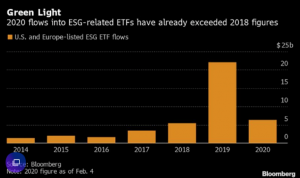
    ESG is here to stay and companies who can help larger companies meet ESG benchmarks/standards are going to do rather well. The flow of funds into investment products that track ESG friendly corporates is striking and provides further incentive for laggard companies to up their game or face valuation discounts in public markets or M&A discussions.  Already, fund flows 6 weeks into 2020 have surpassed total flows for all of 2018 as this graphic from Bloomberg illustrates:

    To get a flavour of the punishment inflicted on less ESG friendly companies, consider the case of Exxon Mobile whose valuation has crumbled by $184 billion since its peak in 2014. Clearly, an excess supply of oil, consequent lower prices and the growth of renewable energy have hurt cash flows. However, that doesn’t explain all of Exxon’s collapse from being the world’s most valuable company as recently as 2012. Climate change is the elephant in the room which is applying an ESG discount to those still-enormous cash flows.

    The opportunity for smaller companies is to help these monster enterprises join the ESG-friendly club. There is no shortage of cash to throw at this challenge and no shortage of opportunities for innovative solutions. Just yesterday BP, under a new Irish CEO, announced plans to “reinvent” the oil giant by setting a net-zero carbon footprint target by 2050. Whether BP meets those targets or not is up for debate but it is absolutely certain they are going to spend BIG to reposition the firm.

    That’s a double whammy of good news for entrepreneurial spirits. It’s always good to know there are some very rich and desperate ESG customers out there, as well as an informed and active investor base consistently funding great startups at Spark Crowdfunding. These investors are not alone. Currently, $30 trillion of investment funds use ESG criteria in their securities selection process.  So, as the political world grapples with daily Watergate flashbacks and worse, it would seem prudent once again to take the sage advice of that era to follow the money…..

    Interested in learning more about ESG? Then check our previous blog on the topic “ESG: Corporate Health Is Your Wealth“!

  • Voting Trust Over Wealth

    Admit it. You are a bit surprised. The fastest-growing economy in Europe with almost full employment has just voted for a very significant change of direction. Leaving aside the gymnastics involved in actually forming a government, Ireland has become a useful illustration of a very significant macro-economic risk looming over most developed economies.  Back in April 2019 we had written “Use it Or Lose It” after the Spanish elections to highlight rising income inequality as potentially the biggest threat to the global economy over the next few years. To coin an unfortunate phrasing, it hasn’t gone away……

    The fear-mongering electoral shifts to the right in the US and the UK, or the social rebellion to the left in Ireland are merely symptoms of the same disease. Too many people have been left behind as global wealth has raced ahead. This is not a shock election snap reflex. The World Economic Forum (WEF) has already warned on the threat posed by income inequality. Ray Dalio of the world’s largest hedge fund, Bridgewater,  says capitalism “is not working for the majority of people”.

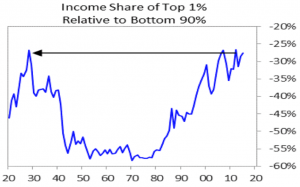
    And for those horrified at the potential return of Sinn Fein to democratic power after 100 years, take a look at the chart below highlighting today’s inequality reaching levels not seen since the 1930s. Students of history might recall that decade as a rather turbulent one when massive left (Communism) and right (Fascism) wing political movements promised solutions to the forgotten masses.

    Voting Trust Over Wealth graphic for Spark Crowdfunding blog post

    Clearly, the 1930s didn’t end well as capital was poured into war plans rather than people and social infrastructure. The signs are more encouraging this time but inevitably there are policy concerns.  Dalio puts it rather well when he states that “capitalists don’t know how to divide the economic pie well and most socialists don’t know how to grow it well”. Ultimately, all citizens and taxpayers, in particular, would like capital to be deployed in a smarter way. Sure, some of the economic policies of Elizabeth Warren, Mary Lou McDonald and Bernie Sanders do not survive serious scrutiny but nearly all surveys of the uber-wealthy recognize that action must be taken quickly or a more violent backlash could destroy wealth on a serious scale. Indeed, action may not be as dramatic as feared. Take a look at Ireland and Sinn Fein.

    Who would have thought that Sinn Fein’s manifesto would be bottom of the individual party rankings in terms of tax cuts and public spending? The world is truly upside down but we have often written on the irony that the Trump presidency is the most socialist in decades as agriculture, the military, energy industries and country-sized prison populations are effectively state-supported and do not reflect market realities. Perhaps the policy solutions to Ireland’s housing and health debacles are more “smart capital” rather than additional capital. How hard is it to build higher buildings in urban areas?  As for the health service, let’s sip a Corona and put things in perspective.

    Yesterday, the day of Ireland’s election results, and a Monday, would have seen more than 5,000 of the country’s 100,000 health workers absent. Yep, the 5%-plus absenteeism rate is more than twice the levels experienced in the private sector and, intriguingly,  the patient-facing personnel are not the ones missing in action. In a digital age, more than 50% of health workers are involved in administration but amazingly they appear to fall sick more frequently than the front line troops actually dealing with sick people. Smart capital deployed to bring the health service into an automated/digital age would be money very well spent and save our sick from the additional risk of coming into contact with even sicker personnel. Wuhan can’t even compete with some of those Monday absentee statistics….

    As a former colleague and excellent market economist, Alan McQuaid, wrote quite recently, societies could do with a bit more honesty.  Recent insurance headlines certainly resonate when reading McQuaid’s analysis, “In my view, the real socio-economic divide should be honest versus dishonest. We need to reward the honest and punish the dishonest. Now if there was a party called Honesty Before Dishonesty (HBD) I would definitely vote for it.” Well, the people have voted and clearly didn’t trust that the incumbent leaders cared enough. Indeed, it is not too revolutionary to state that honesty would be a smart start for the new government and probably save plenty of capital.