Author: Gary McCarthy

  • 2020 Vision or 10 More Surprises?

    I had a great rugby coach in school who used to always say “expect the unexpected”. The original quote has been attributed to Heraclitus in about 500 BC but Oscar Wilde a bit later tweaked the phrase with a conclusion that it “shows a thoroughly modern intellect”. Certainly, as a species, we are brutal at making forecasts so perhaps knowing one’s weaknesses does illustrate some intellect.

    Anyway, as 2020 approaches prepare to be bombarded with forecasts but then cast your minds back to 12 months ago. Did anyone forecast $15 trillion worth of bonds yielding negative rates of interest, a WeWork near-death experience or a Boris Johnson-led government to achieve the greatest Conservative electoral win since 1987?  Yep, whoodathunk. Financial and geopolitical developments will continue to surprise so it is probably good risk management to entertain the possibility of plenty more surprises in 2020. Here are 10 more potential surprises the team at Spark Crowdfunding have put together for those of a curious persuasion.

    1. Donald Trump resigns from the US Presidency for health reasons and global financial markets experience the best single-day advance in a decade.
    2. Softbank as WeWork’s largest shareholder and the world’s second-largest non-financial corporate debtor endures its own near-death experience and enters into credit restructuring talks with its bankers.
    3. Tesla’s market value exceeds $100 billion which is more than the combined value of General Motors and Ford.
    4. US 10 Year Treasury Bonds join their European peers in the negative rates yielding club.
    5. Deutsche Bank collapses and enters state ownership.
    6. Fianna Fail is the big winner in the 2020 general election and forms a coalition government.
    7. Kim Jong-Un dies in a horse-riding accident. South Korea and North Korea enter into peace/reunification talks 3 weeks later.
    8. Los Angeles is evacuated as multiple mega fires burn out of control fueled by unusually high wind speeds.
    9. Russian hackers cripple JP Morgan’s payment technology systems for 2 weeks. Republican party leaders insist the attackers could be Ukrainian.
    10. A coup in Saudi Arabia topples the House of Saud and Prince MBS. Brent crude prices rocket 30% in the first 24 hours after the coup. Two weeks later oil prices have retreated back to pre-coup levels.

    Happy Christmas everyone and best wishes for 2020.

  • Brexit Border Opportunity

    We have done our best to avoid mentioning the “B” word for a few weeks now but the coronation of Boris as King of the Little Englanders has forced our hand. A whopping victory for the Conservatives on a very effective “Get Brexit Done” message had initially led to hopes of a stable Johnson government having more flexibility to pursue a softer Brexit. As with most hopes associated with Boris Johnson, that didn’t last long.

    The new UK government has announced in its first week of power that it will push through legislation making it illegal to extend the 2020 extension period beyond 11 months. Clearly, this move is designed to pressure European negotiators to agree on a trade framework by 31st December 2020 or face the potential chaos of the UK automatically moving to a WTO-type trading relationship. The UK as a WTO trading counterparty would require the imposition of higher tariffs and more draconian regulatory restrictions on cross-border trade and services. This is not good news and currency markets have responded emphatically by paring back all the gains made by the GBP currency since the election last Thursday. However, the UK elections have presented a more optimistic scenario in one corner of the kingdom.

    Arlene Foster’s DUP, representing the 17th Century, suffered a fairly traumatic election. Its leader in the House of Commons, Nigel Dodds, lost his North Belfast seat to Sinn Fein and delivered a first time Nationalist representative for a constituency steeped in Unionist traditions and memories of Edward Carson as its most famous parliamentarian. Seismic stuff. But there’s more as the other Belfast Carson, Frank, used to say.

    Thanks to the win of the North Belfast seat by Sinn Fein there is now a majority of Westminster seats held by Nationalists. Furthermore, with the centrist Alliance party and the SDLP winning 3 seats there is a majority representation for parties who are politically opposed to Brexit. Not only has the DUP and Unionism lost its leverage with the Conservative government, it has lost its majority in Northern Ireland too. Demographics and social trends are unlikely to reverse this situation any time soon.

    Whisper it softly but there’s a chance of reviving the local Stormont government with a chastened DUP and then potentially some progress for the people of Northern Ireland. The requirement under international law and the Good Friday Agreement (GFA) to keep the border open with the Republic of Ireland presents an interesting opportunity. In the financial world, we might term this “regulatory arbitrage” but in the language of main street Northern Ireland has a unique status being simultaneously in the post-Brexit UK and in the EU. Think Hong Kong and its “gateway” status into mainland China and a completely different set of laws and political systems. Irrespective of current unrest in Hong Kong, its unique status has generated enormous wealth for investors and businesses in the territory.

    A more inclusive Northern Ireland (NI) with a functioning local government could become a very attractive location for UK and EU businesses wishing to capitalise (arbitrage) on its unique status. While tariffs and regulations are usually considered non-business friendly there will no doubt be smart management who will sniff out an opportunity to gain an advantage over their competitors. Companies in the following four industries/activities will probably take a close look at NI developments:

    1. Logistics: Could Belfast port return to previous glories as a significant EU gateway?
    2. Finance: The challenges faced by financial services companies would suggest any small tax or regulatory advantage is worth investigation.
    3. Food Processing: The food sector is reliant on time-sensitive supply chain systems. The potential use of an EU “badge” could be very interesting to companies engaged in value-added food manufacturing.
    4. High-Value Manufacturing: The Republic of Ireland is already considered the number one high value manufacturing location in the world. Businesses that can straddle the different UK and EU regulatory and tax regimes will be very interested to explore the possibilities of locating to NI.

    Of course, the opportunities don’t just lie with business owners. Investors would do well to think about the potential increases in income (lowest in UK) and the likely positive impact on asset values in the commercial real estate, hotels and consumer services sectors.

    Perhaps this all sounds a bit fanciful. Edward Carson’s former Trinity College acquaintance, Oscar Wilde once said, “A dreamer is one who can only find his way by moonlight, and his punishment is that he sees the dawn before the rest of the world”. Certainly, the North of Ireland’s unique status and dual identity will continue to confound the outside world but there’s a sense we are moving from the darkness into the light. How wonderfully ironic it would be if the North Belfast political fortress of Edward Carson, a Dubliner, could be the catalyst for a different union with exciting wealth creation possibilities!

    Enjoyed this blog? Then why not check out our other great content by clicking here!

  • A Letter To Santa From Christine Lagarde and The ECB…

    There’s a new boss in town. Christine Lagarde chairs her first ECB monetary policy meeting this week and will then face the press. One can only hope that there are no nearby fridges to stand in the way of hearing the new ECB President’s vision of monetary life after Super Mario (Draghi). Her predecessor is credited with saving the euro but President Lagarde might have to save the world.

    There are early hopes among environmental activists that the ECB will bring its considerable financial weight to bear on fighting the global climate emergency. However, the reality is that the nascent “green bond” market is too small to really make a significant impact on climate change. The environment is one of many items likely to appear on the Lagarde wish list. As a former head of the IMF, she will be well aware of the challenges facing Europe and the planet. Many of those challenges are long-standing, almost hopeless causes, but it is the season of hope ahead of a brand new decade so we thought a little letter to Santa might be in order. Here’s a guide to what we think the ECB would like Santa to deliver.

    • Inflation: The world’s largest trading bloc has been crippled with very low inflation. Ultra-low, even negative interest rates have utterly failed to deliver higher inflation to stimulate consumer spending of cash which remains hoarded in banks across the region. The phrase “Japanification” is being increasingly employed to describe Europe’s predicament of using a failed monetary tactic but unable to change course for fear of strangling economic growth in the region. A gift of higher inflation from Santa would hugely help the ECB and allow it to address its other intractable problem.
    • Healthy Banking System: It is no secret Europe’s banking system is in a parlous state. Burdened with massive bad debts like the Japanese banks of the late ‘80s, there has been a lack of political will to mandate the ECB to cease the can-kicking and call time on some serious banking franchises. The standout banking patient in Europe is Deutsche Bank but it is arguable that the entire Italian banking system is equally in need of tough structural medicine. Santa’s gift of a banking “solution” will need to be very innovative as any concerted ECB policy effort to shrink the banking system could push the region’s economy into recession. So…
    • Structural Growth: Europe is often described as being in structural decline and destined to be a low growth economy for decades to come. Demographics are certainly not helpful as the workforce ages and dictates a smaller pool of labour is required to support the pension draw downs of a rapidly increasing retired population. Poor industrial policies of many European governments have also been guilty of protecting older industries at the expense of faster growing sectors, primarily technology. European industrial policy is a classic case study in misallocation of capital. Bloated public(government) sectors and the protection of older industries like utilities, coal, steel and autos have consumed huge amounts of capital and starved structural growth sectors of capital. We are thinking information technology, health, education and materials technology(energy storage) as areas with very strong structural growth stories. Santa needs to deliver a new European growth story soon.
    • Brexit: Get it done, says Boris. Good luck, says Santa. Europe really needs to move on. Brexit uncertainty is killing investment and confidence. Sadly, a letter to Santa is really the only hope for Boris as current thinking on trade negotiations and timings are the stuff of Lapland fantasy.
    • Climate: Of course, Santa has not enough room in his sack to deliver an entire planet but maybe just maybe Santa could help? We were thinking he could give inspirational guidance to Europe which could address not just the climate challenge but deliver on most of the gift requests listed above. What if the ECB rather than trying to cajole the European consumer to spend, declared that many goods and services would over time be only available in a finite amount. Think water, food, forestry, plastic, buildings, travel and broadband spectrum and then think about a race to consume and acquire before scarcity. This would instantly not only generate inflation but also dramatically change humanity’s rate of consumption of the planet’s precious resources. This writer had often thought the best way to change consumer inflation expectations was to “tell” people there was significant increasing inflation ie fake inflation news. It doesn’t seem so much a sin of spin these days given the daily dose of delusion being visited on the UK and US electorates. One way, or the other, inflation is really what Europe needs to free itself from its stagnancy straitjacket. Ironically, the planet’s climate could be, over time, the disciplinary Santa which delivers resource scarcity plus inflation rather than a sack of “beautiful clean coal”. A very Trumpian irony indeed.

    Anyway, in a few hours we shall see what Christine Lagarde thinks is possible. And, where Santa really is needed…

    Enjoyed this blog? Then why not check out our other great content by clicking here!

  • Asset Performances See The Ghost of Christmas Past

    As the UK faces electoral choices filled with Dickensian levels of misery one could be forgiven for approaching Christmas with some trepidation. However, there is better news in the financial world where mendacity and spin is consistently thwarted by an ever-present reality, price. With mere days to go, 2019 is turning into rather a good year for financial markets across asset classes. Here’s a quick menu of performances to cheer the wallet:

    • World equities are up 25% in euro terms year-to-date (YTD).
    • It’s not just the US markets; Germany’s Dax is up 23% and Emerging Markets are up 11%.
    • Bonds have also enjoyed central bank rate cuts with benchmark bond indices up 6-7%.
    • Property markets as bond proxies have generated positive returns in aggregate.
    • QE has been good to commodities with oil, iron and even gold generating returns for investors.
    • And, if that’s not racy enough, Bitcoin as the lead cryptocurrency has almost doubled in value.

    So, all good then? Yes, 2019 has been very good and history suggests subsequent returns can be pretty healthy after a strong year. However, Dickens’ Ghost of Christmas Past visited Scrooge not just to shine a light on kinder days. Scrooge was also forced to visit some less welcome memories and the dangers of CHANGE in intent.

    Let’s jog readers’ memories here and think a little further back to Christmas 2018 when equity markets were nursing their third circa 20% negative correction since 2009. Fear was the prevailing emotion and not just in equities. Deutsche Bank’s investment research team a year ago were highlighting that 90% of the 70 asset classes they tracked globally were on track to post negative annual returns. The last time that breadth of carnage was endured was in 1920!

    We referenced the dangers of change in intent earlier. Specifically, the critical change of intent in global financial markets has been the approach of the world’s central banks led by the Fed. As a quick refresher 2018 was the year when the Fed rapidly raised interest rates back to a more normal historical level. By January this year that tightening path was abandoned and we are now looking at the frothy results of a more accommodative approach from central banks, namely quantitative easing (QE). Think of the central banks as Scrooge. Markets and investors love “kind” central banks. So, here we are enjoying a benevolent central banking utopia of forever rising asset prices, right? Sadly no. There are two other human conditions we should watch for change.

    First, the vast majority of the world’s population is not participating in this asset price inflation. Income inequality now approaches the 1930s extremes. The dangers of a populist backlash are already revealing themselves in trade protectionist campaigns waged by the likes of Boris Johnson and Donald Trump. Global trade is under pressure and could still derail the QE train and the global economy it is fueling.

    Second, interest rates may be very low right now but there is another human behaviour which could cause real problems for a benign monetary environment. Expectation. Specifically, a change in consumers’ expectations of future prices for goods and services. That’s called inflation and that can raise interest rates and erode the value of financial assets very quickly.

    It’s difficult to identify an inflationary catalyst in the current technology revolution. However, it is worth considering a current image in the news which is very far from a Dickens picture of Christmas. Check out the gigantic bush fires suffocating Sydney and the absence of any technology solution so far. One wonders whether climate change and natural catastrophes could ultimately cause dramatic scarcity of certain goods and trigger inflationary panic? At the very least, Sydney is a reminder of our own greed and refusal to change our polluting habits. These words may seem harsh and apocryphal but recall the Ghost’s final words to Scrooge as he begged for no further reminders of the unhappy consequences of his actions…

    “These are the shadows of things that have been. That they are what they are, do not blame me!”


    Enjoyed this blog? Then why not check out our other great content by clicking here!

  • Top 10 Trends To Watch For 2020

    The end of the calendar year, and the decade, means readers should brace themselves for a bombardment of articles with all manner of forecasts and predictions for 2020. As always, many will be spectacularly wrong given human beings are particularly awful at forecasting. However, in the world of financial trading the trend is often your profitable friend. More importantly, trends can be evidenced with hard data. On that basis we thought it might be helpful to identify a mix of financial and geopolitical trends which are already established but will continue to impact business owners and investors for the forseeable future. Here’s our Top 10 with the usual health warnings:

    • Debt: Global debt has just topped the $250 trillion mark according to the International Institute of Finance (IIF). It’s rather scary to think that in the ten years since the credit crisis of 2008-2009 the world has piled on another $70 trillion of debt. This debt mountain is incredibly sensitive to rising interest rates. Hence, central banks led by the Fed have had to abandon attempts in 2018 to return interest rates to more normal levels. Central banks are now stuck in a Japan-style debt trap with additional credit creation achieving less and less stimulatory impact on economies. Now, frustrated and worried central banks are pressuring politicians to introduce fiscal policies to break out of this stagnation spiral. Unfortunately, politics at a global level is increasingly polarised.
    • Democracy: Levels of income inequality not seen since the 1930s presents the potential danger of history repeating itself. Democracy is under pressure. The Freedom House think tank published a report in 2018 highlighting that year as the 13th in succession where democratic freedoms were in decline. A total of 68 countries witnessed a tightening of civil liberties and political rights whereas only 50 countries registered progress in these areas. As 2019 comes to a close the strong-arm tactics of Trump, Putin, Xi, Orban, Erdogan and Prince MBS do not provide reassurance that authoritarian trends will reverse any time soon.
    • ESG: There is grounds for optimism that businesses and investors see “doing good” as a prerequisite for wealth creation. It almost sounds like common sense but the ESG investment framework covering Environment, Social and Governance factors is gaining traction rapidly with $30 trillion worth of investments now employing ESG metrics in their investment processes. That $30 trillion number will grow and standardised metrics to measure and audit ESG will be the next challenge for business and investor alike.
    • Trade: President Trump is now saying phase 1 of the China-US trade negotiations might not conclude until after the 2020 US elections. Who knows what will come out of Trump’s mouth next but expect 2020 to again be dominated by trade tensions in the EU with Brexit, and in Asia-Pacific with China. The rise of populist politics and trade protectionism are the two sides of a no-win economic confidence trick. Closer to home, Boris Johnson’s bombastic certainty of concluding trade deals with Europe by the end of 2020 will be particularly painful to watch unravelling.
    • China: The most important macro story apart from debt in the world today is China. It’s arguably the engine of growth which services the planet’s debt. By the end of this year Chinese consumers will have purchased goods worth more than $5 trillion, exceeding that of the original consumption super power, the US. So, financial markets will now have to pay much closer attention to the role of Chinese consumer confidence in the global economy. Think of how many decades financial research and trading teams have agonised every first Friday of the month for the US Non-Farm Payrolls. Get ready for Sunday night China economic reports but before that keep an eye on bond default newsflow. There have been four or five relatively significant blow ups in recent weeks, even involving State Owned Enterprises (SOEs). Do not underestimate the potential impact on consumer confidence if the all powerful state can’t save its own.
    • Tech Tension: Technology has been a dominant driver of markets since the credit crisis. Some companies now have user bases which would be in the top 3 populations of the world if they were sovereign states. Think Facebook and Alipay with 2.5 billion and 1 billion users respectively. As Microsoft and Apple’s combined market value now exceeds that of Germany’s entire stock market at $2.25 trillion it is tempting to think this is a high water mark for tech valuations. Two developing stories/trends suggest the tech sector could meet some growth challenges. First, Facebook’s power and abdication of responsibility on publishing false information to huge numbers of people is moving towards a 1911 moment. That date is neither a typo nor hyperbolic. For the historians, that’s the year when the Standard Oil refinery monopoly was broken up. Second, the rise of ESG is ultimately not compatible with corporate deference and fear of China’s wrath. The recent China anger incidents involving the NBA, Apple and Google suggest corporates may have to decouple from Chinese internet and broadcasting platforms. Yes, the internet could splinter and anyone following the Huawei case with fears over 5G security might be forgiven for thinking a “net split” is not just a possibility but inevitable.
    • Content is King: Even with a potential internet split, original content continues to be the critical asset for every media platform on the planet. We mentioned monopolies earlier but has anyone noticed that Disney has quietly assembled a portfolio of content assets with enormous power? Even before Star Wars opens in cinemas, Disney has accounted for $1 in every $3 spent in cinemas in 2019! The battle for content has exploded to unsustainable levels with almost 500 originally scripted TV shows produced this year. In 2012 that number was less than 300. And the costs are rocketing. One statistic we read recently was that for each $1 of a Netflix subscription the user was receiving $1 billion of content. It’s not just entertainment content. Think about the $5 billion valuation of Manchester City implied by the recent private equity investment made by Silver Lake Partners from Silicon Valley. Live sport is hot but $5 billion for a franchise which can’t fill its home ground…?
    • Energy: Climate change is for some top hedge funds now a critical factor in every investment selection. The climate crisis headlines multiply each week and this means continued pain for fossil fuel investors. Apple’s valuation is now bigger than the entire US Energy sector. Furthermore, for fossil fuel dependent economies like Saudi Arabia and Russia it is striking that their levels of sovereign interference have increased in recent years in the likes of Yemen, Syria and Ukraine. There is a suspicion that this projection of international power is an attempt to disguise significant structural weakness.
    • AI: We have been inclined to highlight the risks/areas to avoid but Accenture tells us there is a $14 trillion opportunity in AI across 16 industries in the years out to 2035. Health, finance, logistics and agriculture all look particularly suited to AI innovation and it is striking to see an out-of-favour sector like finance now attracting the largest chunk of venture capital money via European fintech.
    • Inflating Value: And that leaves us finally with another potential positive albeit it is difficult to argue this trend is established just yet. However, we can include this in our list with a speculative health warning! For years, value investing has been clobbered in performance terms by growth and momentum investing strategies. Yes, it might be difficult for oil to make a come back but other commodities could bounce back sharply if inflation picks up. Whisper it very gently but there is data/evidence to support wage inflation picking up in Europe. Wages are growing at the fastest pace in a decade and Europe remains the largest trading bloc in the world. A stronger Europe would be a very positive development. No doubt, investors stuck in value strategies will be watching hopefully for an end to their performance misery. The rest of the world should hope for the same too.

    Enjoyed this blog? Then why not check out our other great content by clicking here!

  • Two Charts Telling The FinTech Story

    Readers of the latest Oireachtas this-is-not-an-Onion-headline could be forgiven for believing printing machines can command eye-watering prices. However, not for the first time, the reality outside the hallowed corridors of power and pecuniary pathos can be very different. Financial markets feature lots of hindsight moments but spare a thought for the shareholders of a company that developed the world’s first ATM machine in 1967 and presently prints almost one-third of the planet’s currencies.

    De La Rue is hardly a household name but it has been at the epicentre of the world’s financial system for almost 200 years. Sadly, this week the management of De La Rue warned that the company’s future was in doubt. That’s a far cry from the confidence expressed by management less than ten years ago when dismissing a takeover bid by French competitor, Oberthur Technologies. The protestations of “hidden value” by the target’s executives then make for distressing reading now.

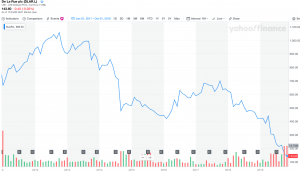
    That bid in 2011 valued De La Rue at $1.5 billion. Even then, the trend away from cash payments to digital was well established. Stripe was already two years old and barely known but PayPal was thirteen years old, had 100 million active user accounts in 190 markets, and operating in 25 different currencies. Dear oh dear. Yes, hindsight would suggest the $1.5 billion valuation of the world’s largest cash printer was very dear. Here’s the share price chart to show how the rejection of the French bid cost shareholders very dearly.

    Today’s share price indicates current value of De La Rue’s equity is just under $200 million. Arguably, management have told the market that there is a real possibility that valuation could fall to zero. Oberthur shareholders in France will no doubt reflect with wry smiles on another example of a disastrous UK decision to go it alone. However, elsewhere the story is much more positive for the UK in the world of fintech and investment capital flows.

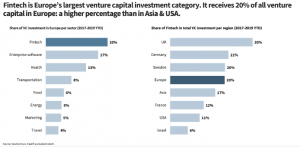
    A new report by Dealroom.co and Finch Capital reveals two very powerful trends in venture capital. Firstly, fintech is now the largest venture capital investment category in Europe. Second, on a global basis the UK has the highest percentage of fintech investment with 30% of its total venture capital funding directed towards fintechs. This is very encouraging for the UK financial sector’s future.

    Clearly, gloomy reports about the potential demise of London as a global financial centre post-Brexit are rather premature. It is also interesting that despite (or maybe inspired by) the parlous state of the region’s banks it is Europe that leads Asia and the US in channeling the largest percentage of investment into fintech. Here’s the chart telling a more positive UK and European fintech story.

    Joseph Schumpeter has written extensively about creative destruction being an essential component of capitalism. One suspects we are living that moment right now in finance and rather than just focus on the death of old franchises we should celebrate life being given to innovation and exciting new companies. In Spanish we might say “Viva La Vida” and at the same time heed the lesson of De La Rue and the destruction of wealth by complacency. Shareholders in traditional financial franchises still enjoying large market shares would do well to read the lyrics in Coldplay’s own ‘Viva La Vida’:


    I used to rule the world,
    Seas would rise when I gave the word.
    Now in the morning I sleep alone,
    Sweep the streets I used to own.
     

    Enjoyed this blog? Then why not check out our other great content by clicking here!

  • ESG: Corporate Health Is Your Wealth!

    Readers may have noticed yet another deal announced in the health technology sector this week. Irish 3D imaging company, 3D4Medical, is about to be bought by Dutch media giant Elsevier for nearly €50m. This newsflow will no doubt keep venture capital (VC) funds focused on current “hot” sectors, health tech and fintech. However, start-up entrepreneurs and retail investors need not despair if they feel they are being excluded from VC activities. There’s another “health” sector which could offer plenty of wealth creation opportunities.

    This writer attends the odd financial conference and was seriously struck by the size of attendance at this week’s Bloomberg ESG Summit in Dublin. The audience was in the hundreds and it had nothing to do with a campaign for the US presidency or a wonderful display of tractors on St Stephen’s Green. The attendees’ focus was ESG investing. In layperson terms, ESG investing describes the application of environmental, social and corporate governance factors into investment selection processes. The corollary to applying ESG investment criteria is a growing awareness by companies that their own response to these considerations, from water management to employee diversity, will be monitored and ultimately “valued” by these investment houses.

    ESG is a term around since 2005 but SRI (Socially Responsible Investing) predates it as an ethical framework. However, latter-day thinking is the assumption that ESG factors have financial as well as ethical relevance. You will often hear the phrase “sustainable investment ” in ESG discussions and this possibly best captures the financial rationale for an ESG focus. Bluntly, if a company culture is not healthy it is at risk of losing fixed assets, customers, quality staff/management, suppliers or investors. None of these potential losses are good for company or investor returns. Financial fundamentals (or health) were always critical to investment decisions but the wider “corporate health” of a company is now a big deal.

    Current estimates suggest up to $30 trillion of assets under institutional management now include ESG considerations in their investment processes. Clearly, corporate health is a growth area and already forcing both investors and companies to spend money on resourcing this analysis with quality people and information. Remember, all this resource is about outcomes. The luxury goods sector has featured in headlines this week with LVMH making a $16 billion swoop for Tiffany. Perhaps more intriguing, and hidden away from the front pages, was the news that Prada has secured a €45 million bank loan with repayment terms/interest rates conditional on meeting “sustainability targets” in its products and operations. Better health means cheaper capital ….Hmmm. For the entrepreneurs out there here’s a few thoughts as to how one could capitalise on this corporate health rush.

    Companies will need guidance as to best ways to integrate ESG on both cultural and operational bases. This requires expert advice, possible internal training/education and periodic audits of companies’ “health” and responses to ESG considerations.

    Audits require metrics or data. Most ESG conferences these days focus on the challenge of “standardising” ESG compliance. There is a huge opportunity for those that can create and gather credible measures for ESG factors as investors and companies are crying out for benchmarks and raw data. Current thinking is that different companies will provide data in different areas ie carbon footprint(CO2e) and health and safety data(EHS) is likely to come from separate providers.

    The combination of performance and people’s money inevitably attracts the attention of regulators. ESG regulation will follow soon and, of course, the legal profession will be getting giddy at the thought of litigation risk and advisory fees. Be under no illusion, finance always pays the middlemen. As for investors, the evidence is more mixed. So, ESG compliance is going to be a very big area.

    Encouragingly, Ireland is taking the lead in some ESG initiatives. There are currently €140 billion of “Green Bonds” listed on the Irish Stock Exchange as part of the wider Euronext group of international exchanges. This feels like Euronext is betting on Dublin as ESG lead, not unlike the aircraft leasing ecosystem successfully built here too. Furthermore, the existence of a “live” asset class of investment securities in Dublin is a good “lab rat” for enquiring minds trying to figure out how they might monetise the ESG revolution.

    No doubt the VCs will move on from mainstream healthcare one day. However, right now there are 30 trillion reasons for curious minds to get a head start in the rapidly expanding area of corporate health.


    Enjoyed this blog? Then why not check out our other great content by clicking here!

  • Could The Internet Fracture?

    The debate about what is the true “fuel” of modern business is now over. The world’s largest oil company, Aramco, failed to drum up any international interest in its planned IPO last week. Not so for the world’s largest online retailer. And, we don’t mean Amazon. Despite plenty of shocking headlines about China in recent days, it would appear the world’s investors will park their social consciences if a tech-fueled business rolls into IPO town.

    Alibaba is the Chinese e-commerce giant that outsells Amazon by a factor of three times in terms of merchandise value and is listing its shares in Hong Kong this week. Yes, Hong Kong. Local elections may have delivered a bloody nose to Beijing-aligned candidates this week and blown up the party line that “the silent majority” was against the long-running protests against mainland political interference. However, Alibaba and its lucky stock code “9988” has provided some positive news for the Politburo. Investors have snapped up almost $13 billion worth of shares sending the stock price up more than 6% and delivering a vote of commercial confidence in Hong Kong. Alibaba’s success will be cheered in Beijing. Probably less so in the Chinese region of Xinjiang.

    Xinjiang is home to 11 million Uighurs of the Islamic faith. The persecution of this minority by Chinese authorities is not a new story and has been consistently denied by Beijing spokespersons. However, in recent days we have witnessed an all too rare media occurrence. Multiple international news broadcasters and publishers have given over top billing and front-page headlines to a remarkable expose which has generated its own “handle”, The China Cables.

    The cables are actually leaked documents given to the International Consortium of Investigative Journalists (ICIJ) and shared with seventeen media organisations including the BBC, the Guardian and Irish Times. The documents are a damning account of deliberative Chinese attempts to intimidate and oppress the Uighurs. The numbers are staggering as a complex of mass detention camps house up to 1 million prisoners without charge or trial. The ugly truth revealed is, per the Irish Times, “the largest incarceration of a minority since the Holocaust”.

    The leaked documents further detail the monitoring of mobile phone apps usage by Uighurs and behavioural flags prompting investigation and likely “re-education” in internment camps. In fact, China is well on its way to compiling a massive database to assist surveillance of its entire population and ultimately deliver “predictive policing” based on a social scoring system. Seventy-five years on, Auschwitz meets Alibaba. We are faced with the uncomfortable prospect of technology, the internet, which has brought the world closer together now being used as a weapon, forcing communities and nations to put up barriers. Indeed, China itself already employs a “Great Firewall” to control information received by its citizens. It would seem our fears are shared at the very highest levels of the planet’s most important sovereign community, the UN.

    In a recent interview with Wired magazine, Antonio Guterres as UN Secretary General expressed his view that the world’s next major conflict will start in cyberspace. Clearly, a cyber threat requires self-protective actions and it was striking that Guterres sounded the alarm bells about the current confrontation on trade and technology between China and the US. More specifically, he spoke about the risk of “decoupling” between the world’s two largest economies, “in which all of a sudden each of these two areas will have its own market, its own rules, its own internet, its own strategy in artificial intelligence.” The current travails of Chinese 5G champion, Huawei, might be only the beginning of protectionist policies introduced by countries watching China’s weaponisation of the internet.

    It is striking that one of the few areas in US politics which generate fully-fledged bi-partisan policy support is challenging China on its aggression in the technology sector. This is often described as “phase 2’ of US-China trade negotiations. Seasoned US-China observers increasingly believe there will never be a phase 2 of negotiations. At the moment the Orange Toddler in the White House is trying to undo the self-inflicted trade tariff damage covered by phase 1 negotiations. However, one does wonder whether events in Xinjiang will reverse the direction of talks and lead to a discussion at the UN level of additional global trade sanctions against the Beijing regime? One sadly suspects sovereign commercial interests will supersede human rights, for now.

    Events in Hong Kong will be watched closely as Beijing patience wears thin with the protestors encouraged by voter defiance this week. A harsh crackdown by Chinese authorities could force further strategic appraisal by business leaders of commercial exposure to a country whose social and technology policies diverge from the ethos of their firms. It is slightly unnerving that Holocaust references this week haven’t already prompted significant discussions. As business owners and investors, be under no illusions that any “decoupling” from China will have a far more significant online impact than the conscious uncoupling of Gwyneth Paltrow and Chris Martin. The internet risks fracturing into geopolitical spheres of influence with real cyber defensive and offensive weaponry.

    Consider recent instances of protectionist cyber actions in India/Kashmir, Iran and Turkey as early tests of the internet world order as we know it. History tells us that relatively local events like Sudetenland, Anschluss, Saar and Kristallnacht combined with political weakness can add up to a sudden global destabilisation. The global internet faces new technology challenges and an increasing number of bad actors – democratic nations are falling in number. Even the UN is worried the internet could suffer a decoupling or fracture. We are worried too, albeit we suspect Boris’s technology “lessons” in Shoreditch won’t prepare him for the fallout…


    Enjoyed this blog? Then why not check out our other great content by clicking here!
  • The Most Important Crowdfunding Chart in Europe

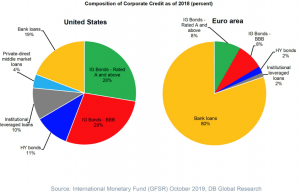
    The market value of The Walt Disney Company is now greater than that of the five largest banks in Europe. If one were impolite you might describe this as a triumph of creativity over destruction. However, the aim of this article to be constructive and recognize the role of Europe’s banks as the primary source of capital for business. That must be a good thing, right? Yes, but there can be too much of a good thing. Here’s a chart from the IMF which should challenge the thinking of all investors and business owners in Europe. It compares the role of US and European banks in funding corporates.

    Wowzers! Banks in Europe provide about 80% of debt capital to businesses. Only 20% of funds are provided by investment markets. In the US the market structure is almost the exact opposite. The graphic above tells us that capital markets are far deeper, more diversified and more sophisticated in the US. It is very apparent, if we consider the US a market leader, that there are opportunities for alternative providers of capital to engage with European corporates. Of course, there are cultural challenges and banking traditions in Europe but the ugly truth is that corporates will have to look elsewhere as ultra-low interest rates (ZIRP) crush banking business models.

    If one were to think further about the market data above it is also clear that European investors have favoured saving in bank deposits rather than investing. In a negative interest rate world that strategy looks a little challenged. It is quite possible decades of traditional saving behaviour will change and seek out new investment opportunities. Many investors will have seen “Dragons’ Den” TV programmes in recent years and wonder can they add a little extra risk/return to their portfolio. The good news is that equity crowdfunding platforms are growing rapidly in size and numbers across Europe to bank the start-up Disneys of the future. The dragons are hunting in size.

    That’s not a fantasy. It’s a current banking reality on Planet ZIRP.


    Enjoyed this blog? Then why not check out our other great content by clicking here!
  • Fuel For Thought for Aramco…

    Well, well, well. It appears oil wells are no longer the stuff of bankers’ dreams. For a fleeting moment this writer almost felt sorry for the investment bankers who had to meet with Crown Prince Mohammed bin Salman’s officials in Riyadh at the weekend. The message the bankers had to deliver over the whirring of bonesaws was not an easy one. The crown jewel of Saudi industry and national oil champion, Aramco, was due to embark on a series of investor roadshows around the world this week to sell shares in its planned December IPO. However, there was a small flaw in the plan.

    Despite the efforts of the 25 banks employed in the selling syndicate there was almost zero international investor appetite for shares in Aramco at even reduced valuations. The awkward advisory report delivered was that there would be no international roadshows and that the only likely interest was in Saudi Arabia itself and some neighboring Gulf states. The shunning of Aramco is remarkable given its status as the world’s most profitable company. In 2018 it’s profits were $111 billion thanks to an ability to pump an average of 13 million barrels of oil daily. For context, the total US output is 10 million barrels daily.

    The banker embarrassment didn’t end with roadshow cancellations. The much-hyped goal of the Crown Prince to list a company valued at $2 trillion was dashed with current valuations pitched at around the $1.5 trillion level. Without international participation, the number of shares is being scaled back dramatically to just 1.5% of the total share capital rather than the anticipated 5%. One suspects the subjects of the Saudi kingdom won’t have the luxury of negotiating valuations albeit they might get the opportunity to visit the Riyadh Ritz Carlton…

    On a slightly more serious note there are a number of issues to consider for investors in light of this IPO push back. Aramco is no WeWork. It is a hugely profitable company with real assets, sovereign customers like China and the prospect of relatively high dividend yields in a zero interest rate world. It is easy to dismiss investor unease as a fear of being a minority shareholder in a Saudi state-owned enterprise or Aramco’s vulnerability in the unstable Middle East. Recent Houthi/Iran attacks on Aramco refining infrastructure will also bolster that risk factor in investor minds but we think there are bigger structural trends to consider.

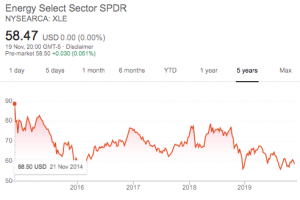
    Fossil fuel energy is in a long term downtrend in international financial markets. The US energy sector ETF (XLE) has almost halved in value in the past 5 years. In previous articles, we have referenced hedge funds which now consider climate change risks before every investment. Pools of capital are chasing renewable energy, electric vehicles, recycling, meat alternatives, etc. as the investment assets with future rising demand and returns. Oil is not part of the climate change future. In fact, Aramco alone has generated 4.4% of all the world’s CO2 and methane emissions since 1965. That’s some history. Here’s the misery chart for oil company investors over the last 5 years.

    Fuel For Thought Spark Crowdfunding blog
    So there is definitely an environmental risk factor in most investors’ processes these days. However, that’s not the only risk consideration. The increasing popularity of ESG compliant investment (that’s Environment, Social, Governance standards) is not just driven by a sudden embrace of “good” corporate citizenship by companies and investing institutions alike. The other critical factor is that recent performance data suggests funds which feature ESG risk filters in their investment process are more likely to outperform.

    The problem for Aramco and its outsized share of the Saudi economy was that investors have equated Aramco with the Saudi kingdom itself. The Saudi track record of repression of women, dissent, Shiite minorities and weaker neighbour states like Bahrain was a difficult pitch for the bankers to investors who would be minority shareholders in governance terms. The human rights atrocities in Yemen and the murder of WSJ journalist Jamal Khashoggi are the more lethal examples of societal tyranny listed earlier and would be red flags in any social or ESG risk evaluation.

    Aramco is an extreme example of ESG failure given investors are now prepared to give up on attractive near term dividends. ESG will continue to grow in influence and actually start to impact valuations; think of it in terms of investor demand(ability to invest). Unfortunately for the oil sector, all the ESG trends are moving in the wrong direction. Climate comes first… and then the creditors.

    Many oil and gas companies will in the not too distance future have their Riyadh Ritz Carlton “moment” with their lenders. Tears will flow rather than oil, but not so many from the planet’s citizens who will continue to battle extreme fire, flood and temperature events.


    Enjoyed this blog? Then why not check out our other great content by clicking here!