Author: Gary McCarthy

  • The Business of Sport

    The Business of Sport

    What could be the biggest sports story this week? Take your pick from possible typhoons at the rugby World Cup, shock results in the Euro 2020 football qualifiers or the NBA’s craven apology to the Chinese. Or, maybe not.

    Sport is not just professional. It weaves its way into the fabric of society at multiple levels and so it is entirely possible that the biggest sports story this week will be the emerging Twitter/tabloid betrayal blockbuster between footballing wives Coleen Rooney and Rebekah Vardy! We may forecast this with tongue firmly embedded in cheek but there is a more serious point that sport has an enormous impact on many societies at multiple levels including social cohesion, health and commerce. In fact, we have timely data to tell the story of sport at a local level rather well.

    The recent publication by Investec and the Irish Federation of Sport of “An Assessment of The Economic Benefits of Sport in Ireland” is an interesting read. The big takeaway for us was the surprisingly large commercial footprint which sport has in Ireland despite a relatively small population and professional franchise sector. Sport actually accounts for 2.7% of total personal consumption expenditure equating to €30 per household per week. For context that’s the same spend as clothing and footwear. That’s real money but what about the implied value of volunteerism?

    Investec’s economics team used average industrial wages to calculate an economic value of volunteering for sport at €1.1 billion. That’s not far off what is generated in our entire maritime industry(don’t get this writer started on the missed sea opportunity!). In real employment terms, the numbers are equally impressive with almost 40,000 individuals in full time work in sport. That’s about the same number as the entire primary school teaching staff in the country and accounts for 1.7% of total employment in the country. That percentage should be bigger when the potential additional returns to the state are taken into account.

    Sports tourism already generates €500m annually but consumer trends suggest this number can grow much further. The growing demand for touring “experiences” has severely impacted the “fly and flop” beach business models of the likes of Thomas Cook. Given Ireland’s climate there is an opportunity to gear up for increasing numbers of experience-hungry travellers. Not for the first time, government thinking is off the pace to coin a sporting phrase. It’s Budget time this week but Central Government spend on Sports and Recreation Services is now lower than 2009 depite tax revenues increasing by 77% in the same period. That’s enough to make you sick before we even consider the obvious health benefits of sport.

    Investment in sport could offset our ballooning HSE costs and waistlines. The Department of Health research states that 62% of the population is overweight or obese and incurring additional costs of €1 billion to the state. The European Commission in a separate report has calculated that for every €1 outlay on sport there is a multiplier effect of 1.95x in economic activity ie the government could earn a return of €1.95 for every €1 invested. That looks way more attractive than zero interest bank deposits or negative yielding German bunds. Even Angela Merkel might think we are working (for those with Euro 2012 flashbacks…).

    It is easy to be critical but we are hopeful that the government’s excellent track record on attracting multi-national employment might allow the relevant cabinet departments to pitch sport in a similar vein. The good news is that sporting activity is an employment intensive service/good. As always we tend to look across the water and that might help too even in a Brexit world. Sport accounts for 3.75% of employment in the UK or more than twice the levels seen in Ireland. One suspects sports related business pitches in the near future will attract greater government support with the jobs still a huge priority, particularly post a probable rocky Brexit outcome. Two other government/electorate priorities also spring to mind.

    Mental health is a huge social problem and increased sports participation has been shown in studies to boost mental wellness and cognitive cecline in older adults. Also, gender equality is a big area of current government focus and the trends are good in sport with the gender gap closing by more than half since 2011(per CSO figures and Irish Sports Monitor).

    Finally, as society lurches towards mobile screen addiction and nonsensical social media celebrity do not fall into total despair. Sport remains the most commercially valuable live content on the planet. No Netflix, no WAG nor streaming device can generate the social capital of watching sporting thrills and greatness in real time. So, for those with an entrepreneurial bent get thinking. There’s a strong possibility governments and private investors will sit up and take notice of the rich returns available in sport in a low returns world. Sport loves a crowd and one would be confident that equity crowdfunding will equally love a sports story. Tell it soon with the data and, as they say, if you’re not in you can’t win.


  • Six Impossible Things to Believe Before Brexit

    Six Impossible Things to Believe Before Brexit

    It is looking increasingly likely that Brexit negotiations between the UK government and the EU will end in chaotic break down. A Merkel-Johnson telephone call has already triggered a blame game fueled by various unsourced briefings from Downing Street advisors. One would have hoped that recent judicial censure for misleading the Queen would have tempered said advisors’ enthusiasm for the ridiculous, but sadly not.

    The Brexit Mad Hatters Tea Party remains shameless and determined to foist an alternative view of Brexit realities upon potential voters who at some point will discover they stepped through a logic-lite looking glass. Before then, one can’t help feeling that Brexiteers are faithful subjects of another Queen, the White Queen, who once confessed to Alice, “Sometimes I’ve believed as many as six impossible things before breakfast”. Indeed, there could also be six impossible things to believe before Brexit. Here’s our six favourites.

    1. The solution to a hard Northern Ireland border is three borders: Difficult as it is to believe, the latest thinking from the Johnson brains trust is to put customs posts/stops at a polite distance on either side of the border thus creating “three” borders or if one were to be constructive a much wider border.
    2. Technology will ensure the seamless operation of two distinct customs/regulatory regimes: The tiny flaw in this solution is that the technology does not exist.
    3. The UK will avoid recession with government fiscal support: Profit warnings from construction sector bellwethers(SIG) and recruitment firms(Page Group) on top of the worst UK September retail figures since 1995 would suggest Brexit paralysis is already paralysing business and consumer spending decisions.
    4. A clean quick (no deal) Brexit will end this uncertainty and business paralysis: Perhaps the biggest lie of all. There is an assumption that the UK will immediately switch into the WTO trade framework and carry on trading with its largest partner, the EU. Think again. Trade agreements will still need to be agreed with the EU but in a post-Brexit world all the leverage will lie with the larger trading bloc as a country of 65 million subjects discovers its diminishing relevance in the global trade discussion.
    5. The Trump administration will provide a favourable trade deal with the world’s largest economy: The US Congress is not only about to impeach Trump but its leadership has been emphatic that any failure to honour the Good Friday Agreement will prevent any trade deal being done with the US and its highly influential Irish-American vote. Bonnie Greer on a recent BBC Question Time is worth a look if one needs confirmation of that Brexiteer pipe dream.
    6. Other People will fund the UK government’s fiscal efforts post Brexit: This column often writes about the folly of relying upon “other people’s money”. Britain’s public finances in a no-deal Brexit scenario would push UK debt to its highest since the 1960s according to the Institute for Fiscal Studies(IFS). Consider a likely drop in the GBP currency and a simultaneous spike in inflation before assuming foreign investors will commit funds to a country which has demonstrated unprecedented levels of self harm and delusion.

    Irrespective of these impossible delusions the Brexit saga will drag on for a while longer and suck the life out of most sentient human beings. However, amid the paralysing uncertainty there are still a few certainties when it comes to the relationship between the UK and Europe. As tempers fray between the UK and EU, one can be assured of a generous supply of un-diplomatic soundbites plus the always reliable talk of surrender, the empire and plucky Blighty “taking back control”. Language will undoubtedly drift into dreamy wartime territory so it will be difficult to separate tragedy from comedy but, if it has to be war then we will leave it to Captain Blackadder to say it best:

    “There hasn’t been a war run this badly since Olaf the Hairy, King of all the Vikings, ordered 80,000 battle helmets with the horns on the inside.”
     

    Enjoyed this blog? Then why not check out our other great content by clicking here!

  • I’m a Celebrity CEO – Get me out of here!

    I’m a Celebrity CEO – Get me out of here!

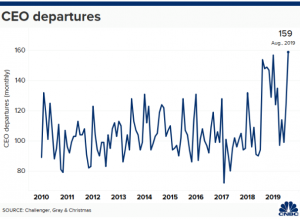
    It’s not just Presidents and Prime Ministers who are looking for the exits at the moment. CEO turnover at the largest companies in the US has just hit an all-time high. While eBay and WeWork executive departures will grab the headlines it is worth noting that 159 other CEOs also left their posts in August alone.

    That’s the highest ever monthly total and 28% higher than the 124 CEO exits in July. In fact, the pace of management change according to consultants, Challenger Gray & Christmas, is more than at the same point in 2008 when the global economy was about to enter a liquidity deep freeze. Clearly C-Suite anxiety is picking up when you see the following chart:

    So what’s going on? Financial markets are in reasonably healthy shape, employment conditions and confidence are very robust and yes, we have a few trade war/manufacturing cycle worries. Of course, CEOs like to leave on a high(share options don’t look too shabby at the moment either) but perhaps there are a few more structural drivers involved in the mix this time.

    Let’s start with the performance of financial markets and share prices. It is true that broad market indices are not far off all-time highs but a quick look under the hood would reveal a more nuanced story which we have alluded to in recent articles. To be frank, technology has been the outsized driver of positive market performance whereas the story in more structurally challenged sectors like retail, finance and energy has been far more frustrating. One senses some CEOs and Boards are becoming impatient and clutching at alternative solutions to boost share prices. So, the capital markets story has been a tale of sector haves and have-nots but there is also another inequality story.

    One might wonder if CEOs are watching the rise of Trumpian populism and wondering when the income inequality backlash is coming? Note that CEO-to-Worker compensation ratio has ballooned from 30:1 in 1978 to 278:1 by 2018! That particular acceleration in uber-celebrity compensation packages stands in stark contrast to productivity gains slowing to a sub-2% annual crawl in the past decade. Perhaps the bigger problem is that worker wages have stagnated over the last 40 years but that clearly has not been a priority at board level.

    The massive expansion of share buy-backs at the expense of business investment and a fixation on quarterly earnings performances has been a prevailing feature of the low interest rate monetary environment. However, that journey, as Thomas Cook employees and shareholders have discovered, can hide some pretty terminal problems for only so long. There has always been a fear that an artificially low cost of capital would lead to poor capital allocation decisions.

    In this latest iteration of financial history we may look back in years to come and rue the arrival of Kardashian capitalism. Corporate failure is likely to experience the cult of CEO celebrity and short-termism starving businesses and their workers of the capital needed to transition for the digital age. Indeed, the latest data suggests CEOs are not sticking around for that final vote.


    Spark Crowdfunding is Ireland’s only equity crowdfunding platform. We are based in Dublin city centre.

    Our equity crowdfunding platform enables investors to invest into various stage Irish companies and it gives Irish companies the opportunity to raise new funds quickly and at low cost to accelerate their business growth.

    If you are interested in learning more about Spark, then check out our website.

  • Private Funding Meets Public Reality

    Private Funding Meets Public Reality

    WeWork really really doesn’t work. What a week it has been. The WeWork IPO has not just been pulled but its CEO, Adam Neumann, has also been yanked off the stage along with a number of other senior executives. WeWork’s mission to ”elevate the world’s consciousness” has elevated much much more. WeWork planned leases have been canceled, loans/bonds are being watched nervously and the investors are now putting private company valuations under a public reality microscope.

    Another planned IPO, Endeavour, in the events/talent space has been pulled in New York and the much-hyped lifestyle franchise, Peloton, has had a difficult first few days trading since IPO. Current losses for public investors in Peloton are 13% after a couple of days but it could be worse. Teeth straightening play, SmileDirectClub, is generating very few investor grins as its share price has plummeted 44% in its first few weeks as a public quoted company. It will be argued that WeWork was the most egregious attempt to sell to “the greater fool” and was the sudden trigger for valuation fatigue and a halt to governance nonsense. However, this writer would suggest that the divergence between private funding froth and the greater transparency of public market valuations was running out of road over a much longer period of trading time.

    Yes, public markets are not far off all-time highs in a US context but this narrative hides a more demanding environment for public markets in recent years. If US markets(big if) finish 2019 at similar levels as today the S&P 500 will have gone pretty much nowhere over a period of 2 years. No wonder the Orange Toddler Twitter machine is in super frustration mode. It could be worse, you could be an investor in Europe. The benchmark European index, the Stoxx 600, is actually trading at the same level as March 2015. Go East and weep at Groundhog Day for China whose markets have endured a round trip to nowhere since 2014!

    Investors in the likes of Uber, Lyft and Slack will attest to public market debuts lacking in any joy. The simple truth is that valuation eventually does count and lends itself to Benjamin Graham’s assertion that in the long run the market is a weighing machine. The shorter-term popularity, voting machine approach to private equity unicorn valuations are now poised to give way to some serious discussions on valuations and governance. As we previously wrote, there will be real skepticism surrounding any “cult” founder stories and one suspects Adam Neumann’s humbling 169 mentions in WeWork’s IPO filing will be a high watermark for funding hagiography.

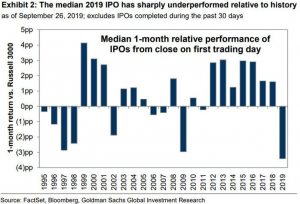
    The good news for startups and younger companies seeking funds is that a solid story with a strong management structure and realistic financials will have less funding competition from “hot” concepts. This is capitalism. Creative destruction will create a cautionary tone for a while but ultimately ensure capital is properly allocated in line with more fundamental investment processes. The data suggests 2019 has provided an inflection point for private valuation excitement. The median IPO in 2019 has had its worst first-month performance since 2009. The S-1 filing documents for IPOs like WeWork can mislead but this chart certainly does not:

    The good news for startup founders is that there is plenty of private capital out there and interest rates/yields for investors are currently at historic lows. So, there is plenty of interested investor ears. For those thinking about access to capital, one should consider crowdfunding as a good platform to learn and ultimately execute your own fundraising story. Equity crowdfunding does work. Contact us today to learn more about how Spark Crowdfunding can help your company grow.

  • Belt Up for the Year of the Rat

    Belt Up for the Year of the Rat

    In terms of purchasing power China is now the number one economy in the world. However, when we read financial headlines about monetary policy, Brexit and trade wars there is a tendency to view the challenges facing the global economy through Western-oriented glasses. More bluntly, one could be under the impression that it is in the gift of Western economies to find solutions to said challenges and all will be right with the world. Whisper it quietly to the Donald but 2020, the Chinese Year of the Rat, might not just be about whistleblowers…

    Trade wars may grab the headlines but the reality in a US context is less weighty. Goldman Sachs in 2017 published a report which showed the top 500 companies in the US (S&P 500) earned 30% of their revenues overseas. However, China accounted for just 1% of its revenues. In fact, a mere 41 of those companies generate 10% or more of their revenues in China. There is a real possibility that the business world is placing too much significance on the dampening effects of the US-China trade war on economic activity. In this writer’s view market analysts need to be more curious as to why Germany is teetering on the brink of recession.

    There is a real possibility that China is facing a structural challenge which Japan has faced for the last 3 decades; the growth-killing combination of a 300% debt/GDP ratio and an ageing labour force which is projected to lose 200 million workers by 2050. These numbers are massive and frankly won’t be changed by Fed monetary policies or the impeached removal of a US President. The global trade truth is that Europe is the largest trading bloc in the world and therefore serves as the canary in the coalmine for China’s impact on all its trading partners. The struggles of the German manufacturing sector tell us there may be a bigger story emerging.

    The Belt & Road initiative (BRI), China’s strategy to become a rival super power to the US is a classic example of Sino-long term planning. What has been missed by many, and is possibly now being experienced by German factories, is the sheer scale of this project. Here are a few data points which tell a huge story.

    • The Plan: The BRI strategy involves investment in 65 countries.
    • The Population: BRI countries have combined population of 4.4 billion people or 62% of the world.
    • The Economy: Combined GDP of BRI countries is $23 trillion, larger than the $20 trillion US economy.
    • The Spend: Estimated infrastructure requirements and spend through 2030 is $26 trillion.

    Let’s just say all roads lead to China. Or did. There is no doubt the BRI project has been a key driver of global economic activity in recent years but has been very dependent on Chinese credit. Unfortunately, China which has pledged $1 trillion to the BRI project is struggling under a crippling debt pile. There is a strong suspicion that a downturn in Germany’s manufacturing sector is an early warning signal that China is reining in its spend and this will not change irrespective of trade war resolution or central bank monetary interference.

    One wonders if the waning influence of Oriental fiscal stimulus is the reason why the ECB is almost begging the Germans and other governments to launch fiscal programmes? The real fear of central bankers is that renewed QE has no economic impact and kills market confidence. If China really does dial down its BRI activity the ECB fears will undoubtedly prove correct. Watch China GDP and credit growth very carefully, not the trade negotiations.

    Misplaced optimism on the resolution of US-China trade issues in the Year of the Rat might sink a few ships as well as a Presidency.


    Enjoyed this blog? Then why not check out our other great content by clicking here!

  • Oiling our Fears

    Oiling our Fears

    Crude oil prices are now trading at the same levels as they were on the Friday before the bombing attacks on the Saudi Arabian oil fields. That seems odd. Five decades of Middle East strife has taught market traders that significant cuts to oiling due to war leads to prolonged spikes in prices.

    This is not just a 1970s phenomenon. As recently as 2003 and the second US-Iraqi conflict, the global economy experienced an oil shock of mid-$20 per barrel pricing motoring up to $140 per barrel by 2008.

    Sure, the recent Saudi outage is not quite a war scenario but the precision (too precise?) attack has taken out 5 million barrels or almost 5% of global oil supply. That’s not far off the impact of the 2003 Iraq war, and the initial 20% spike in oil prices on news of the attack did reflect a major event in energy markets. Of course, the Saudis and an election-frazzled Trump administration were quick to reassure markets about adequate reserves, quick restoration of supply etc. However, almost two weeks after the attack there is a growing acceptance by Saudi Arabia’s wannabe IPO, state oil company Aramco, that production facilities will be out of action for many months, possibly a year. That’s before we even mention a ramping up of tensions with alleged attack sponsor, Iran. Bluntly, where has all the fear gone?

    Perhaps it has been replaced by a greater fear.  Donald Trump was so scared of a 16 year old at the UN meeting in New York he chose to skip the Climate Action Summit and instead made a speech at a Religious Freedom meeting. Always important to keep those avangelicals happy. As for the one million Uighur Muslims incarcerated in China, there wasn’t even a mention. Happily, Greta Thunberg’s fear-filled speech garnered far more attention than the Dear Orange Leader’s.

    The teenage wake up call to the world was quickly followed by a rather scary report from Goldman Sachs(hardly a leftie liberal socialist champion) highlighting the significant impact of climate change on urban populations living less than 10 meters above sea level. The numbers are staggering and sadly it might be too late to prevent the consequences of an already warmer world. The warning from this Wall Street leader was stark, “ It might be prudent for some cities to start investing in adaptation now.”

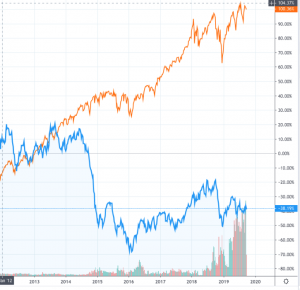
    Clearly, there is a growing consensus that carbon/greenhouse emissions are affecting climate. We have written previously on some leading hedge funds who now factor climate change into ALL their investment decisions. Arguably, the smart money has been selling out of oil for years. Here are a few data points which tell that story. The first is a chart showing how the S&P 500(orange) has diverged dramatically from the downward trajectory of oil prices(blue) since the middle of 2014.  It has been a period of healthy economic growth so that is quite striking.

    It is not just the commodity price which has lagged the market. Exxon Mobile is about to drop out of the S&P 500’s top 10 stocks for the first time in 90 years. Furthermore, the energy sector now accounts for just 4% of the overall US market. One can’t help feeling that actions of economic leaders are being watched very closely. Take, for example, the decision by Amazon to place an order for 100,000 electric delivery vans(yes, that is the correct number of zeros) from a company, Rivian, of which you probably have never even heard.

    Oil services stocks which support the major oil companies on infrastructure, logistics etc have seen their share prices fall more than 50% in 2019. That’s in a year when markets are actually up more than 20%. We have seen commentary on Wall Street puzzling over this wealth evaporation and wailing, “The oil service stocks are trading at prices that imply the entire fossil fuel industry will disappear”. That is an extreme outcome but there is a growing sense that climate change is an extreme challenge. Even Taoiseach Leo Varadkar has decided we will never be called Oiland(or Oirland) as he has told the UN Climate Summit that oil exploration in our waters will end.

    Returning to our own confusion about the lack of fear over the Saudi attacks we must consider that the temporary spike in oil prices was yet another opportunity for professional investors to lower their exposure(sell) to an industry in the cross hairs of a fearful planet and motivated leaders. In a week when the WeWork IPO has revealed itself as a “greater fool” proposition we would note that the Saudis whose entire economy depends on fossil fuels is also trying to IPO/sell you Aramco.

    WeWork didn’t work, its CEO is now out of work and the franchise itself might not see out 2020. In this warming world oil now generates a new set of fears and it doesn’t help the pricing of the product. The greater planetary health fear will win out over old-fashioned energy supply fears and that perennial investor behavioural companion, the fear of missing out. Steer clear of your old fears; the teenagers are the brave ones and will sadly be proven correct.


    Enjoyed this blog? Then why not check out our other great content by clicking here!

  • How Can The Federal Reserve Impact Irish Business?

    How Can The Federal Reserve Impact Irish Business?

    What a difference a year makes! In September 2018 the US Federal Reserve and 15 other central banks across the globe raised interest rates in an attempt to wean markets off a multi-year rehab programme of monetary methadone. Fast forward to August 2019 and 21 central banks from Iceland to Peru were furiously cutting rates.

    A global manufacturing slowdown and growing trade tensions have ostensibly prompted this monetary U-turn by multiple smaller central banks but be in no doubt the critical easing moves have been made by the ECB last week and the Federal Reserve yesterday. The decision of the latter to cut rates is striking as the US economy has been experiencing healthy growth, inflation and full employment.  What’s not to like about that?

    The unfortunate truth for the new Fed Chairman Jay Powell is that the position of the US dollar as the world’s reserve currency means US monetary authorities, unlike the occupant of the White House, must give consideration to the healthy functioning of global financial markets. It would appear that the Fed’s attempts to return interest rates to more normal levels have created problems elsewhere in the world. As an obvious example, higher interest rates in the US would attract buyers of the dollar which in turn causes the dollar to strengthen. That doesn’t seem a bad outcome for non-US companies whose goods and services would become cheaper relative to US-based competitors.

    However, it has not panned out that way. Higher interest rates are good for depositors but not so for borrowers who have loans priced in USD. That challenge is further exacerbated if the borrower’s cash flow to service the loans is earned in a weakening local currency.  Bluntly, the attempt to return to more normal higher interest rates has revealed a problem of excess leverage in the financial system.

    We have touched upon a number of quiet developments in this column in recent weeks which have now crept onto the front pages of financial media.  For Irish businesses, these developments could now start impacting the behaviours of service providers and customers.  Let’s start with the murky world of financial plumbing.

    We had written last week about the slightly bizarre possibility of a “dollar shortage”. Sure enough, over the last three days market observers have been grappling with unusual happenings in a very technical part of the intra-bank funding market; the Repo market. On a daily basis(as a basic guide) banks swap high-quality collateral like US Treasury Bonds for US dollar cash to meet overnight obligations. All works smoothly until it doesn’t, usually a shortage of actual cash or confidence – think 2008. What has commentators worried and confused this time is that the Federal Reserve has been required to pump additional cash into this niche market to avoid a bank, or banks, being unable to meet its obligations overnight. The Fed has not had to intervene in the repo market like this since…. 2008. The sums are not small. In the early hours of Tuesday morning, the Fed had to come to the rescue to the tune of $53 billion. The next day it was $75 billion, and the next day…

    This could be a temporary blip in the money markets but we don’t know which banks needed the cash. There is a suspicion it could be Asian banks whose clients are struggling under a $3.7 trillion mountain of debt which is dollar-denominated. For Irish corporates exporting goods and services to Asian markets, it is probably worth keeping a watch on any significant exposures to single banking entities or corporates.  This may sound Casandra-ish but when confidence begins to waver things can develop quite suddenly and not in a good way.

    Only a few weeks ago we were writing about our concerns on the WeWork IPO proposition. It now turns out the IPO has been delayed after initial valuations of over $40 billion circled the drain at $10 billion for a few days before the bankers gave up. You might think an IPO delay is not too bad an outcome but the knock-on effect has been worrying for the entire WeWork franchise. The company’s bonds(debts) have been weakening significantly subsequent to the pulling of the IPO financing. This, in turn, has raised concerns about the actual WeWork business model. Recall that this “technology” property company has $47 billion worth of lease commitments serviced by a not-so-certain estimated revenue base of $3 billion. Just this week there are reports of property deals in London falling through as WeWork was the key tenant in the buildings. Now consider WeWork is the largest private occupier of office space on Manhattan island and the increasing speculation as to whether WeWork will actually be working by 2021!

    A major dislocation in the office rental market could spell trouble for the global commercial real estate sector but could be helpful for startups struggling with office rental rates. Property companies with large debt obligations can suddenly be quite open to negotiation.

    Ultimately, the level of interest rates or rents is not what kills a franchise.  It’s all about the leverage employed in the business. The Fed knows that too.


    Enjoyed this blog? Then why not check out our other great content by clicking here!

  • 10 Reasons You Might Be A More Active Investor Than You Thought!

    10 Reasons You Might Be A More Active Investor Than You Thought!

    This week Bloomberg reported an epic shift in the world of US fund management. Investor assets invested in passive index-following funds have now surpassed those invested in the traditional active stock funds. And we thought the publishing of “One Up On Wall Street”  exactly thirty years ago by the first fund manager rock star, Peter Lynch, would bring active investing to main street!

    Cue an outbreak of hyperbolic commentary predicting the pending death of active management and the dangers of everybody ultimately being invested in the same things in the same amounts at the same time. The purpose of this article is not to debate the merits of investing in low-cost passive investment instruments but rather to highlight how savers can mistakenly believe they are not really actively managing their financial future.

    Here are 10 reasons you might be more active than you think.

    1. Positioning
    2. You will frequently hear people describing their financial planning as super-safe and therefore not actively investing in anything. Let’s be absolutely clear that keeping all your long term savings on deposit in cash at the bank or under the mattress is an extremely active bet. The bet, if one is trying to preserve your wealth, is that inflation will not erode the purchasing power of your capital over time. We would suggest with the benefit of history that this strategy is highly unlikely to deliver. Furthermore, any one-dimensional approach to investment is an extremely active bet – a 100% exposure to cash, equities, bonds, crypto, property, commodities, gold or any other asset class is an active bet.

    3. Timing
    4. There is a large portion of the investing population who invest in equity funds in bull markets and then step out when things get tricky. Unfortunately, that kind of active “activity” is more often than not wealth destructive. The fund giant, Fidelity, crunched the numbers for the period 1980 to 2018 and found that missing the best 5 days of market moves would cost you 35% of your overall returns. Miss the best 10 days and your returns are halved. Miss the best 50 days and you may have to work a lot longer than you hoped…

    5. Pensions
    6. It never ceases to amaze how passive people are about their pensions. Forget the actual investment strategy but just consider the impact of fees/costs over a very long period of time. We would strongly advise a very active discussion re fees incurred in your pension arrangements. Particularly in a low returns world. Think if you’d just invested in European stocks since 2015 you’d be actually underwater in a so-called bull market. But fees and in-fund hidden fees can seriously increase the pain over a long period of time.

    7. Plan
    8. In a previous article “10 Lessons in Wealth Management” we stressed the importance of a financial plan and then sticking to it. That is a sensible active undertaking. However, doing nothing but gathering assets/savings in a random manner over time is a very active but ill-advised route to wealth creation. The probabilities are more skewed towards wealth destruction without a plan.

    9. Retirement plans
    10. No, we are not repeating ourselves. Rather we are making the point that the targeted timing of your retirement(60,65, 67…) is an active bet and therefore necessitates more thought in the context of the range of instruments you will use to invest over the decades and the shift in risk appetite required as you approach the target retirement date.

    11. Life Policies
    12. These are active investments and again require advice which fits your overall financial plan.

    13. Insurance
    14. Not unlike fund managers who use different investment instruments to protect against downside risk – hedges in market-speak – your life will be peppered with a variety of hedging instruments related to your work/business, transport and property. An active approach to monitoring the fees and the actual cover provided by these insurance policies will avoid disappointment and real wealth destruction.

    15. Foreign Exchange
    16. You may over time have assets or income streams that are denominated in a foreign currency. Again be proactive in how that exposure is managed and avoid a mismatch between your domestic currency/returns requirements and the ultimate values of the foreign assets/cashflows. Doing nothing is, we repeat, a very active bet!

    17. Education
    18. No different from a business, there is an ongoing requirement to invest in yourself in a rapidly changing world. Education is a real investment that can deliver increased income and prolong your relevance in the commercial world. Be active includes maintaining an active brain.

    19. Death and Taxes
    20. We don’t need to spend too much time on the former but it is one of the two ‘certainties’ in life. So succession planning is a worthwhile proactive initiative. However, before then we’d like you to live a little and proper tax management/planning should be conducted in a very active manner. Whatever you might feel about investment fees the truly outsized costs or benefits of tax decisions render many active investment discussions moot. Attention to tax treatment of your investments can be considered an investment strategy in its own right. And it pays to be active.

    If you re-read the ten points again you will realise there actually is no such thing as a passive option. Doing nothing is simply being ‘active’ but probably resulting in wealth destruction. In fact, exactly the same point can be made with regards to the frenzied active versus passive debates consuming Wall Street right now. Time will ultimately show that passive strategies were more ‘active’ than originally intended, particularly if investors take fright along the investment journey. Remember those ten most important days(Fidelity) to stay in the market and keep our ten ‘active’ reasons in mind too. They do make a difference. You can too.


    Enjoyed this blog? Then why not check out our other great content by clicking here!

  • Inflating Expectations

    Inflating Expectations

    It’s Groundhog Day again at the European Central Bank. Was it only nine months ago the ECB declared an end to its easy money policy of Quantitative Easing (QE)? Well, trade wars and a manufacturing downturn have raised the imminent spectre of German recession and forced the ECB to embark on a new round of QE purchases and even more negative interest rates. And…we haven’t even mentioned Brexit.

    It all sounds so painfully Japanese and this can easily conjure up images of a lost generation of low-interest rates, large debt mountains and stubbornly low inflation. However, there is a suspicion the central banks already know this new round of QE will be as equally ineffectual as previous monetary interference. The new ingredient in the stimulus mix could be governments willing to initiate fiscal spending programmes and abandon budgetary discipline. Do we dare imagine the return of a long lost financial phenomenon which we touched upon in a previous article “Five Market Risks”? Yes, whisper it here…. Inflation could make a comeback. It’s a possibility rather than a nailed on probability but we see a number of conditions and indicators which suggest business owners and investors should have inflation on their risk radar.

    We are fans of data here and financial markets are excellent real-time indicators of investor expectations. So, let’s start with gold which has traditionally been used as a hedge against the dwindling purchasing power of currency; in other words, inflation. The gold price has been hitting six-year highs in recent times which is interesting as one would have thought the collapse in interest rates and a whopping $16 trillion worth of negatively yielding bond yields would be pointing to a very subdued inflation environment. What is noteworthy is that when bonds were last seen at very negative yields in 2016 the gold price did not break out as they have on this occasion.  Note, inflation kills the value of bonds as well as the purchasing power of cash.

    Another data point from industry also caught our eye. There is no doubt global manufacturing is in quasi-recession so it is somewhat surprising wage inflation in the US is now hitting a 4% cruising speed. There is a growing sense that income inequality needs to be urgently addressed as the rise of nationalist populist politics reflects restless electorates being “left behind” by technology, asset inflation and urbanization. Wage inflation can be expected to pick up as the 1% try to quell a political backlash.

    A less constructive type of inflation can also be expected to raise its profile. Supply chain management and global trade has been the driver of the global economy for decades but messy trade wars and Brexit will introduce new costs into global logistics. These costs will inevitably be put through to consumers/customers and drive inflation statistics.

    A more difficult data point to quantify at this point is the effect of potential fiscal stimulus by governments in dealing with a slower economic cycle. Arguably, the US with its ballooning budget deficit and the UK in Boris-electioneering mode have already embarked on a “bread and circuses” campaign which even Caligula would appreciate. All that’s missing in these campaigns is horses being appointed to senate and cabinet positions, albeit this can’t be ruled out just yet. For a bit of Teutonic sanity and the critical piece in the fiscal pie the world waits for Germany to finally spend. Early soundings from Berlin are encouraging and lead us to our final indicator of  ‘something different this time’.

    As the ECB confirms further cuts in interest rates one would expect European bank share prices to be on a firm downward trajectory this week. We couldn’t be more wrong. The European banks’ index is up almost 10% in September! That is noteworthy and like the gold price was not the experience in 2016 when global interest rates were plunging. The most dangerous words in the investment lexicon are “this time it’s different” and this writer has no doubt central banks acting with monetary policy alone will confirm Einstein’s theory on repetition and insanity. However, governmental interference for good(fiscal stimulus) and bad(trade wars) could change the outcome this time. Gold and bank share prices are already behaving differently but it will take time for political and trade mists to lift and reveal the new world order and change expectations.

    “We changed again, and yet again, and it was now too late and too far to go back, and I went on. And the mists had all solemnly risen now, and the world lay spread before me.” ― Charles Dickens, Great Expectations


    Enjoyed this blog? Then why not check out our other great content by clicking here!

  • Five Market Risks You Might Not Read About This Weekend

    Five Market Risks You Might Not Read About This Weekend

    The Bojo and Trump show is exhausting. The good news is that Sharpie-scribbled weather maps and fainting police have ensured our ribcages are now incapable of further shock and comic torture. The serious market risks associated with trade wars and a chaotic Brexit will receive more media coverage this weekend but not much will surprise.

    In fact, the sheer incompetence of the protagonists has resulted in more positive developments in both the US-China trade dialogue and Westminster. A check of the price charts for the S&P 500 and Sterling (GBP) for the past week will confirm increasing optimism. However, shocks are by definition events not yet considered by market participants. Looking past trade wars and Brexit there are five potential risks which probably won’t get headlines in the coming days but might genuinely surprise.

    1. A Dollar Shortage
    2. It might sound strange that a currency which accounts for 62% of global central bank reserves would be in short supply. However, companies(ex banks) in emerging markets had borrowed $3.7 trillion US dollars by the end of last year according to the Bank for International Settlements. That’s double the levels in 2010 and as the economic cycle slows the US dollar is unhelpfully climbing to new valuation highs versus it’s trading partners’ currencies in emerging markets. Suffice to say debtors are struggling to find/earn the dollars to service debts. The default worries surrounding borrowers like Argentina and China’s Evergrande Group are real-time illustrations of distress in funding markets. To add to these worries there are reports that in recent days an unidentified bank requested a $870m facility from the Federal Reserve. That’s not normal.

    3. European Banks
    4. Negative rates are crushing European banks already struggling with challenged balance sheets. A German economy slipping into recession as data suggested this week could be the final nail in Deutsche Bank’s coffin. Not surprisingly the CEOs of both Deutsche Bank and UBS have pleaded with banking authorities to consider alternatives to negative interest rates as monetary stimuli. European banks are into the ICU phase and it’s possible some won’t make it into 2020.

    5. Saudi Turmoil
    6. There has been more intrigue this week within the royal House of Saud. Ahead of the IPO of the state oil company, Aramco, Mohammed Bin Bonesaw has removed the chairman of the company which will only increase tensions between various factions within the royal family. Growing awareness of climate change and pressure on oil prices won’t help IPO valuations and the royal family’s ability to bribe its citizens and pay protection money to the US. The Saudi story has “coup” written all over it.

    7. EurFired!
    8. The Brexit story had its own “coup” this week as the move to prorogue Westminster resulted in a counter-coup by the opposition, potentially removing by law the ability of the government to leave Europe without a deal. Interestingly, there has been market chat in recent days that Europe has given up on the UK and possibly could cut and run. Yes, the reality TV show “Brexit” could have a “EurFired!” punchline with Europe refusing any extension, citing the need for certainty and the paralysing effect of Brexit on investment and policy decisions across the trading bloc.

    9. Inflation
    10. The headlines keep highlighting the $16 trillion worth of sovereign bonds currently trading with negative yields. The consensus view is that this is signaling lower growth, or worse, in the future. Implicit in that scenario is very low inflation. But, but there is another scenario. Check out the latest data in the US. Job growth and manufacturing activity has materially weakened. Well, there’s your low growth scenario. Now here’s the twist. Trump Tariffs(yes, they must be branded) are pushing inflation(CPI data) to 6-month highs and wage inflation is now cruising along at a 4.2% annualized rate! If Fed Chair, Jay Powell, thinks he has problems with the Orange Toddler right now we shudder to think what he will make of a dreaded stagflation scenario.

    None of the above events are high probability forecasts. In the investment world, they would be considered “tail risks”. However, for pure devilment this writer would hazard one strong long odds tip for the weekend. Prepare for the possibility for Boris de Pfeffel Johnson’s resignation on Monday morning and his place in history as Great Britain’s shortest-serving Prime Minister; the previous record was George Canning who served for just 115 days. By George, that would be a story!


    Enjoyed this blog? Then why not check out our other great content by clicking here!