Author: Gary McCarthy

  • Ireland is now Facing Category 5 Trade Winds

    Ireland is now Facing Category 5 Trade Winds

    Hurricane Dorian may have lost its Category 5 status in recent hours but the headwinds facing global trade are ratcheting up in intensity. At a mid-summer Spark Crowdfunding investor night the challenges facing Irish businesses from Brexit and Trump Trade wars were discussed. One of the key observations of the night was that when trade negotiation counterparties are driven by political survival motives – think Prisoners’ Dilemma – game theory models indicate the probable result is the worst economic outcome for both sides.

    The Nobel prize-winning work of John Nash was profiled in the Russell Crowe movie, A Beautiful Mind, and has become a key foundation of game theory and understanding how multi-lateral trade agreements can play out. Unfortunately, the Nash Equilibrium predicts an ugly commercial outcome for all when political risk considerations trump(sorry) co-operation between parties. Indeed, events over recent days have provided strong evidence of theory meeting reality head-on.

    Yes, there’s a huge hurricane approaching the US coastline but political protests in Hong Kong may well be the political typhoon which visits even more harm on the US economy. Consider the “butterfly effect” of chaos theory and it is increasingly likely that China’s relatively passive response to Hong Kong unrest makes it politically impossible for President Xi to show any weakness in the trade war with the US. The Dear Leader in Washington was apparently stunned China responded to his latest round of tariffs with tariffs of their own on US goods which would be politically sensitive for the White House toddler – think oil, more agricultural products, etc.

    The problem for Trump is that he can’t back down on the tariffs as that would be an admission that his esteemed economics team of the discredited economist, ridiculed CNBC host and Lego Batman movie producer has triggered a global manufacturing recession. In fact, the just-published US ISM Manufacturing Index just posted a sub-50 reading indicating a contractionary manufacturing environment in Trump’s own MAGA hinterland. As Trump would say, but neither the poor US farmers nor factory workers… “Always winning”.

    Having failed to build a Mexican wall, Trump is politically sensitive to showing any weakness on China and has resorted to excoriating his own Fed Chairman appointee, Jay Powell, and demanding lower interest rates to bail out his faltering “greatest economy ever”. The irony of the greatest economy needing a Fed bail will not be lost on some readers nor will the wayward nature of Trump’s trade weaponry. Who would have thought that a core part of the Trump fan base, Mid West farming communities, would be paying the hefty price for Trump’s insistence that China respect the IP/patents of the leftie liberal technology elites in Silicon Valley!

    It is fast becoming apparent that US-China relations have entered a new less co-operative phase. This is structurally bad news for global trade and Ireland’s business community will need to factor this into growth projections over the coming years, not months. One would hope Brexit could deliver a more upbeat outcome but the coronation of Boris Johnson has merely confirmed fears the UK political establishment is in a state of near-complete meltdown.

    Events of recent days would appear to confirm the Johnson strategy is to deliver Brexit no matter what. The request by the new PM of the Queen to prorogue Parliament has triggered a furious ongoing backlash in the House of Commons. EU negotiators and Ireland look on in bewilderment as Johnson’s parliamentary majority of one has evaporated to a 43 seat deficit. This purge of deal-supporting Conservatives including Winston Churchill’s grandson has forced Johnson to threaten a general election. The small problem with this initiative is that the Labour party and Jeremy Corbyn, in particular, are politically aware it is in their interests to see Johnson fail spectacularly and deliver a chaotic Brexit. There is a real chance an election will be delayed until after Brexit. That is worrying but our key mid-summer observation was that Brexit in the near term could be ugly due to political ineptitude and ignorance of international law(Good Friday Agreement). However, the longer-term story could be more positive. A delayed election for an electorate experiencing the chaos of Brexit might kill off the suicide mission once and for all. David McWilliams put it brilliantly in a recent FT article:

    “We understand the yearning for sovereignty, identity and independence, believe me. But just one piece of advice: the first 70 years are the hardest, after that it gets easier.”

    Clearly, Irish business would prefer to avoid any hard Brexit and certainly not a 70-year economic divorce from its closest trading partner. It is unfortunate timing that a combination of income inequality/populism and truly dreadful political leadership in both our largest trading partners has set in motion a series of events which make it very difficult for the protagonists to back down despite the huge commercial damage likely to be inflicted on all sides. There is a Sarajevo 1914 air about developments right now, almost the sense that troops have already been mobilized on thousands of trains and it’s too complicated and late to halt the escalation.

    As we witness Jacob Rees Mogg reclining on the front bench of the House of Commons this week and Trump bestowing the title of “The Chosen One” upon himself it is difficult to avoid comparisons with one of The Great War’s best parodies – “Blackadder Goes Forth”. In particular, this exchange in the trenches of the Somme between Captain Edmund Blackadder and his men resonates quite loudly with the Boris and Trump show we are currently enduring:

    Captain Blackadder: “You see, Baldrick, in order to prevent war two great super-armies developed. Us, the Russians and the French on one side, Germany and Austro-Hungary on the other. The idea being that each army would act as the other’s deterrent. That way, there could never be a war.”
    Private Baldrick: “Except, this is sort of a war, isn’t it?”
    Captain Blackadder: “That’s right. There was one tiny flaw in the plan.”
    Lieutenant George: “O, what was that?”
    Captain Blackadder: “It was bollocks.”

    If only it were a comedy right now. There are stormy days ahead with careful business leadership and strategies required. The good news is that even Category 5 hurricanes eventually die and generate a flurry of investment in perhaps less vulnerable areas. Ireland in a Brexit context could be a beneficiary from investment seeking more sane business environments.


  • Urban Inequality and Opportunity

    Urban Inequality and Opportunity

    In a world rapidly embracing artificial intelligence(AI) one has to marvel at the complete absence of any evidence of intelligence, human or digital, employed in Dublin’s traffic light system. It might surprise non-residents of the city to know that Dublin and its relatively small population of 1.4 million souls is now the 14th most congested city on the planet. For local drivers assaulted on a daily basis by Dublin’s bizarre traffic light sequencing, the challenge is not news to them and merely confirms the existence of planned idiocy(PI). Urban planning is about to become a critical component in driving the prosperity and wellbeing of the planet’s inhabitants.

    Urbanization of the world’s population is rapidly accelerating and revealing winners and losers. The UN predicts the world’s urban populations became the majority of 55% in 2008 and will grow to 70% by 2050. The European Commission using satellite technology and broader definitions of urban centres estimate 84% of the world’s population, or 6.4 billion people, already live in urban areas. One gets the sense that this trend has caught governments off guard and presented challenges and opportunities. Not unlike Dublin’s traffic planning, recent headlines might appear random but actually reveal proactive initiatives to cope with urbanization. Consider the following recent reports which caught the attention of this trapped driver:

    • Indonesia is building a new capital:
    • The reason for this move is that the current capital, Jakarta, and its 10 million inhabitants are sinking into the Java Sea. Excessive pumping of the city’s groundwaters has resulted in aquifer compression and a 4-metre fall in surface elevation. Given Jakarta sits on the coast and sea levels are rising a perfect storm of climate change and planned idiocy(PI) has forced a major governmental re-think and cost; estimates to relocate 1.5 million civil servants are already above $33 billion.

    • India has revoked Article 370 in Kashmir:
    • This critical article in the Indian constitution guarantees special rights to the Muslim-majority state and restricts migration to preserve historic demographics. Kashmiris now suspect the removal of constitutional protections will lead to mass migration to its higher altitude(cooler) territory from Indian cities enduring extreme temperatures, traffic chaos and pollution due to decades of PI. Consider the urban population reports of the UN and EC and then think about India’s urban population percentage at just 33%. The government appears to be looking for planning short cuts even at the risk of war with Pakistan. That smells of panic.

    • Boston is using machine learning to improve its school bus system:
    • Boston has teamed up with MIT to deploy an algorithm which identifies the most efficient and cost-effective routes for its school bus operations. The result has been $5m worth of savings and a reduction of CO2 emissions by 9,000kg daily thanks to 1.6m fewer kilometres driven. The algorithm takes 30 minutes to do a job that used to take weeks.

    Hello Dublin. Any chance of a call to Siemens who have just helped the Chinese city of Zhuhai become a smart green city with the most ecological traffic system in the world powered by AI? Urbanization is a long term structural story and smart solutions to the challenges of legacy planning idiocy will command juicy prices from panic-stricken governments.

    Get planning. Get solution. Get funding.


    Enjoyed this blog? Then why not check out our other great content by clicking here!

  • Five Things To Know About Negative Interest Rates…..

    Five Things To Know About Negative Interest Rates…..

    What a weird world. While President Trump heralds the bigliest strongest US economy of all time he is at the same time demanding the Fed lowers interest rates to support this very same ‘super’ economy. Colour me orange but that’s not really how it’s supposed to work. Then again quite a few things are broken right now.

    Take your pick from the following recent events in the financial markets:

    • Currently there are $14 trillion worth of government bonds trading with negative yields ie borrowers are being paid by the lenders to borrow.
    • Nordea Bank in Denmark has just started offering 20 year fixed rate mortgages which charge no interest.
    • UBS in Zurich has just told its super-rich clients it will now charge 0.6% per annum on cash savings of more than €500,000. Yep, the new way to save is to shrink capital…
    • Beyond Meat the non-meat burger company with just under 400 employees listed publicly a few months ago via IPO. Its current market value of $13 billion recently exceeded that of Molson Coors with 18,000 employees and a 233-year history in brewing beer.
    • Shipmaker Harland & Wolff and retailer Barneys face final closure after many painful years of battling structural change.

    The above events might strike you as a random list but there is a common thread running through each of these developments. Central banks across the globe are reversing course and creating a financial environment where borrowing costs are ultra-low or even negative. The aim of this article is not to explore the drivers of this phenomenon but rather highlight the implications for business owners and investors if money was to remain effectively free for a prolonged period of time. We thought of five key implications:

    1. Capital Flows:
    2. A key fear of central banks is deflation so the purpose of removing incentives to deposit money is to force savers to put money to work in the economy via direct investment or spending/consumption. So, if capital is redirected there is potentially a much greater opportunity for young businesses to access growth capital.

    3. Business Valuations:
    4. Low-interest rates also have another nice benefit for those seeking equity funding of their businesses. Most valuation methodologies will seek to discount the future cash flows of business back to the present to generate a present/current value. As part of this calculation, an interest rate is used to account for the time value of cash flows/profits due in the future. Lower interest rates boost the present value of those cash flows and increase the value of the equity in these businesses.

    5. Banking Pain:
    6. Clearly borrowers are helped by lower interest rates. But, banks will struggle in this kind of environment. Think retailers and the loss of pricing power and you will understand the pressures on banking franchises already struggling with the digital transition, increased competition and regulatory costs. It is no surprise these days to read frequent reports of banks struggling to generate decent returns for shareholders and share prices experiencing dramatic declines in relatively strong equity markets.

    7. Competition:
    8. For existing businesses there is a drawback associated with almost free capital. New competitors can start up very quickly and attack market shares with loss-making strategies funded by cheap and returns-starved capital.

    9. Zombies:
    10. The references to very old franchises like Harland & Wolff and Barneys above also highlights another negative for the healthy functioning of capitalism. Struggling franchises (aka Zombies) availing of very low-interest rates can stay in business far longer than would have been normally the case. This tends to depress investment and economic growth – just ask Japan how low rates have worked over the past 30 years. It also raises the risks of a far more damaging wealth destruction event in the future if interest rates were suddenly to rise.

It is probably best to think about negative rates as a short-term fix in an increasingly toxic and populist political environment. We are currently seeing capital chasing increasingly scarce yield to earn a return and ignoring valuation risks. However, history would suggest the long-run outcome of that strategy is significant and permanent capital destruction. On the flip side of this risk warning, the good news is that great business ideas and start-ups will get funding and with the arrival of equity crowdfunding platforms the small investor can access these opportunities before the big institutions start to seek alternative homes for their capital. See our previous article “Use It or Lose It” for a reminder as to why timing is on the side of smaller investors this time!


Enjoyed this blog? Then why not check out our other great content by clicking here!

  • Are We Too Fearful of Recessions?

    Are We Too Fearful of Recessions?

    Recessions are painful for bosses, shareholders, employees and their families. Resilience is required and often difficult decisions must be made. All are familiar with the negative aspects of an economic downturn but the benefits are rarely heralded in the media headlines; the bad news is so much better for clicks and viewers.

    This has probably resulted in an outsized fear of recessions and an unhelpful recent phenomenon of political pressure on central banks to come to the rescue. In this instance, the wannabe Orange Emperor of Greenland cannot be solely blamed. The political nannying of the business cycle is a global exercise.

    We are currently witnessing a monetary experiment without precedent as $17 trillion worth of bonds carry negative yields thanks to central bank intervention; in practical terms, borrowers are being paid to borrow thus making the cost of capital free.

    The prompt for this intervention has been increasing evidence of the global economy approaching a stall speed and in the case of global manufacturing probably contraction.

    On the face of it, monetary intervention to stave off recession sounds like a good thing but the longer-term effects on economic behaviours and corporate resilience are arguably quite dangerous.

    To use a parenting analogy, we are seeing the emergence of “helicopter parenting” which has been correctly criticized as ultimately unhelpful to the healthy development of children. An unnatural desire by parents to interfere and protect children from any stressful experiences, even low-risk danger, can lead to unintended consequences.

    Adults helicoptered through childhood are behaviourally unprepared for the normal stresses and pressures of the real adult world and end up with limited coping strategies and resilience to deal with sudden challenges.

    It could be an unhappy coincidence that Ben Bernanke, the former Chair of the Federal Reserve, way back in 2002 referred to “helicopter money” as the ultimate weapon to defeat a severe recession.

    The phrase ‘helicopter money’ was used to describe the blunt instrument of printing money in huge amounts to defeat deflation. Well, it could be argued that $17 trillion of free loans (bonds) is getting very close to a helicopter moment. And the longer-term implications are not good.

    If capital is almost free and yields (interest rates on deposits) are too low, it forces investment capital to chase higher riskier yields elsewhere. At one point in July, Greek bonds traded with lower yields than US Treasuries! Who would have predicted that in 2012 when Greek bonds were yielding 35%?

    When money is almost free, painful economic history tells us capital will be poorly invested and permanently destroyed.

    A previous article on the WeWork IPO highlights the degree to which investors will ignore red flags and chase the short term opportunity of a “hot IPO”.

    We are now into our tenth year of economic growth compared to average expansion periods of circa three and a half years. This extended period of growth and cheap capital covers up a lot of weaknesses in the corporate world. Bluntly, there are too many zombie companies staying afloat and destroying capital year after year.

    Europe and China are probably the biggest culprits.

    The large loss of jobs in a normal business cycle, of course, is bad news for employees but ultimately those jobs will be lost as the company shrinks to survive and then finally fail. Politicians, as usual, will lobby governments with emotional statements and sudden expertise on business restructuring and global markets.

    Sadly, the only thing politicians can be relied upon for expertise is election cycles and polling data.

    Think back to 1984 and the huge pressures to keep the Ford plant with 800 jobs open in Cork.

    A little company called Apple had opened a plant a few years earlier but one wonders would it have received the government attention it subsequently received if the Ford plant continued to dominate government policy? Maybe ask the 5,500 Apple employees in Cork today who are probably quite happy that Ford did pull out in 1984.

    It is a fact that some of the best companies in the world started in recessionary periods.

    The robust business models and culture of resilience required in challenging times are hugely important building blocks for super-successful companies. Think Microsoft, Electronic Arts, Burger King and FedEx.

    Apart from building robust business models, startups in a downturn can benefit from lower costs of professional services, leases, machinery, plants and technology.

    And perhaps the biggest challenge of all right now is talent.

    In a cooler economic climate, there are opportunities to hire top quality recruits at sensible remuneration rates.

    It also forces talented individuals to reassess their long term career plans and perhaps consider a move away from sectors which are structurally challenged and unlikely to survive the next downturn.

    The CEO of the government funding agency (NTMA), Conor O’Kelly recently said he was 100% sure there will be a recession. He cleverly refused to put a timeline on that prediction.

    For business owners and employees, it might be worth considering whether you have the resilience for a downturn.

    If you are unsure about the answer it is possible you could become a longer-term victim of helicopter monetary parenting.

    For those that feel they can meet the challenge of a recession – get ready to take the necessary pain and the opportunities.

    Oh, and the average length of a recessionary period is around 18 months or just over 500 days.

    As parents in the old days used to say, you can do it.

  • Any Irish Entrepreneurs up for a Dip in the Sea?

    Any Irish Entrepreneurs up for a Dip in the Sea?

    Did you know that the production of one standard hamburger emits as much greenhouse gas as a car journey of 320 kilometres?

    This was the stunning finding of a Japanese study by the National Research Institute for Agriculture which also estimated the production of that same burger will consume 3000 litres of water! Surely we can try as a species to be a little more efficient in producing our food. Anyway, we soon might not have a choice.

    The UN’s Intergovernmental Panel on Climate Change has just released a rather disturbing report on humanity’s failure to fight climate change by refusing to re-think how we grow crops and raise livestock. The stark facts are that global agriculture contributes up to 37% of greenhouse emissions, uses almost 75% of the world’s ice-free surface area and wastes a quarter of the food produced.

    We are now entering a destructive spiral where available arable land is shrinking due to climate change, deforestation and pollution while the planet population races towards the 9 billion mark by 2050.

    We are farming this planet to death and the land-based solutions to this challenge are limited. A fundamental shift away from meat consumption and our dependence on thirsty methane-belching cows is unlikely to be achieved by humans switching to a plant based diet when fresh water is in short supply.

    But, ironically, water might well be the solution rather than the challenge.

    Our oceans cover over 70% of the planet’s surface and yet only 16% of global animal protein consumption by humans comes from fish. Yes, traditional wild-caught fish stocks are depleted but there is vast potential to scale up the commercial scope of aquaculture.

    A research paper by Rebecca Gentry and her team at University of California suggested a tiny fraction of the ocean’s surface at maximum depths of 650 feet could move the dial significantly on seafood production.

    For illustration, the scientists’ calculations show that an area of water about the size of Lake Michigan( 1/67th of 1% of the ocean) could produce 110 million tons of fish and shellfish each year. That’s about the same amount of seafood caught annually by commercial fisherman.

    It certainly sounds promising but aquaculture does have its own challenges and costs as farmed fish need to be fed from existing wild fish stocks and land-based vegetable feeds.

    Good planning is essential and Norway leads the way.

    Norway exports more than €10 billion of seafood each year. For context, and possible irritation, Ireland’s seafood industry in total generates just over €1 billion with exports accounting for €650 million of that amount in 2018.

    It’s not just Norway showing us up. Denmark with a smaller coastline and roughly similar population exports €4 billion worth of fish and seafood and Holland with an even smaller coastal footprint exports €3.5 billion worth.

    Food for further thought.

    Asia’s growing population and demographic shifts will account for more than 60% of the global middle class by 2030 and drive demand for increased quantities of quality protein in daily diets.

    Unsurprisingly, Asia already leads the way in aquaculture.

    China and Indonesia already cover more than 70% of global aquaculture production and that level of farming is 3-4 times greater than commercial fisheries production in those countries.

    By contrast, only one fifth of EU production comes from aquaculture.

    As a coincidence, Ireland’s territorial ocean waters are more than ten times the land mass of our island and account for 22% of the entire EU fishing waters.  Are we missing something? One hopes there are a few sharp minds out there looking at where food and climate trends are going.

    There is now no doubt the food-climate space will become hot (sorry!) and one suspects there will be plenty of capital to fund the urgent production shift required.

    Ireland has a number of natural maritime advantages which possibly requires greater government support.

    The timing couldn’t be better as this week we witnessed 10 year Irish government bonds trading with negative yields ie lenders are paying our government to borrow from them.

    So, why not ask the same lenders to pay us to invest in aquaculture?

  • Why WeWork Won’t Work for Start-Ups Interested in Raising Funds

    Why WeWork Won’t Work for Start-Ups Interested in Raising Funds

    Mark Twain is often cited as the source of the perennial financial advisory warning that “history doesn’t repeat itself  but it often rhymes”.

    The pending WeWork IPO could be about to provide a number of harrowing wording lessons which will rhyme very sharply with recent history.

    This writer can recall the frenzied final days of the TMT bubble when the mere addition of “dot com” could inspire investors to plough capital into bog standard franchises which were suddenly poised to conquer the world with an additional 3 letters in their trading name.

    The Pets.com IPO in February 2000 is often cited as the “shoeshine moment” in marking the top of the bubbly market – pet food supplies business meets logistics reality.

    Closer to home one might remember the official launch of worldoffruit.com a month earlier and a 64% rise in the parent company’s, Fyffes, share price. Bananas stuff.

    If pet food and fruit sounds fairly well established product proposals how about commercial real estate or, more specifically, leasing office space but not even owning the buildings?

    Welcome to WeWork’s service proposition which is about to IPO in New York with a proposed valuation of $47 billion.

    But it’s not a real estate company. No, no it’s a technology company. Just read the prospectus (and weep).

    In its public filing WeWork has used a version of  the word “tech” 123 times which is more than the video calling software company Zoom did in its IPO earlier this year (thank you VOX for doing the checking).

    To be blunt, WeWork is a triumph of linguistic gymnastics over substance and start-up founders would be well advised to avoid the temptation to follow its lead. The inevitable backlash will be brutal and prompt increased scrutiny of businesses playing fast and loose with words and financial information in their investment story.

    Managements who are planning a fund raising should review their story and pay particular attention to the following:

    Corporate Structure:  An overly complex ownership structure will raise red flags for prospective investors. WeWork already has three classes of shares and it is debatable whether the entity being listed in New York has any real assets or control of the business. Keep it simple.

    Governance: With a complicated corporate structure, sharper investors will be keen to explore any conflicts of interest. WeWork is the gift that keeps on giving….. to its founder and CEO, Adam Neumann. Adam owns 10 buildings that he has leased to WeWork at a decent profit, unlike the loss making WeWork. Bizarrely, he also owns the rights to the “We” trade mark which the firm has decided it must own and pay their own CEO $5.9m for the rights! Investors might be allowed to ask whether the interests of the business, shareholders and the CEO are truly aligned.

    Financials: Loss making is a frequent fact of life in the early years of a start up. However, there should be some evidence that increased revenues are benefiting from economies of scale i.e. incremental units of sales can demonstrate better gross margins. WeWork has been operating commercially for 9 years. The S-1 filing shows revenues have almost doubled in H1 2019 to $1.54 billion but losses have spiralled up to $1.3 billion. So for every dollar of sales the company is losing 84 cents. That’s pretty staggering for a “tech” company and would raise red flags for most tech savvy investors. More alarmingly, word sophistry has reached new levels of weird with WeWork reporting “Community-based EBITDA” which takes out lots of expenses including real-estate costs. Repeat after We…. “We are not a real estate company”. Innovative/creative profit metrics are not recommended for investment pitches.

    Leverage: Equity investors are typically nervous of debt-heavy balance sheets. As global economic indicators roll over we would repeat our cautionary mantra from previous articles about business models relying on “other people’s money”. Think businesses with long term liabilities and no control over short term funding (other people, lenders, customers etc). WeWork is a hair-raising example with $47 billion of long term obligations (leases) supported by variable short term revenues of potentially $3 billion this year.

    Management Incentives: Equity investors want their interests aligned with the management and preferably any wealth created to be shared at the same time in the investment journey. WeWork having lost $700m in 2018 don’t see any problem with their revered CEO selling shares to the tune of the very same $700m. Almost three quarters of a billion dollars taken off the table by the CEO just before investors are invited to pony up circa $4 billion. This CEO must be special. Previous articles have highlighted the importance of credible advisory boards. Inspirational founders certainly help fund raising but cult cultures can also raise red flags.  The wording of the WeWork IPO prospectus brings idolatry to new levels of cult.

    If one’s gagging reflex has survived the WeWork opening statement – “Our mission is to elevate the world’s consciousness” – brace oneself for a whopping 169 mentions of “Adam” (as in the CEO) compared to an average 25 mentions for founder/CEOs in other unicorn prospectuses.

    Even Uber’s colourful CEO, Dara Khosrowshahi, managed a measly 29 mentions.

    In this Trumpian world, buzz words and a cult-like absence of governance can be effective in the near term but can build up for the future a very dangerous debt to the truth.

    How Mark Twain would smile at the power of words today.

    He too caught the technology bug and lost nearly all his money on a new typesetting technology invented in the 1890s.

    Always rhyming.

  • The Most Important Chart in The World Today….

    The Most Important Chart in The World Today….

    Those parents anxiously awaiting CAO course offers for their children this week might have been taken by surprise at the huge number of points(601) required for admission to the Economics and Finance course in UCD.

    Observers of financial markets might be even more bemused.

    The recent financial headlines may be dominated by gold, negative interest rates, recession worries and trade wars but there is a more worrying financial trend which has been developing over a much longer period.

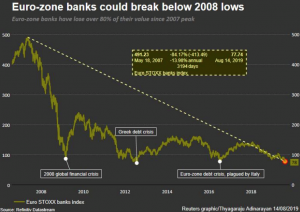
    The following chart is considered by a number of highly experienced market professionals as the most important risk signal in the world today:

    Spark-crowdfunding

    Irish readers will have very vivid memories of the 2008-2009 banking crisis. However, flashbacks are about to become more graphic now that Eurozone bank share prices in aggregate are revisiting the catastrophic lows of 2008.

    The long-run carnage visited upon European banking shares is quite staggering with prices on average down 84% from levels in the halcyon tiger days of 2007.

    Unlike short term foreign exchange moves or gold price spikes, this type of multi-year share price decline is indicative of a structural change in the banking business model and begs the question what will “finance” jobs look like 10 years from now?

    Let’s start with 10 working days from now…

    As market traders return from the beaches to their desks, and if this daily evaporation of banking equity continues, we can quite quickly expect headlines about Bank A, B or C sounding out market advisors about raising capital.

    The ugly truth is that European banks with wafer thin equity values will be perceived as having too little capital to support enormous asset bases. And, assets in  banking terms means loans.

    Think about French mega-bank, BNP, with equity values of €56 billion supporting an asset base of €2.2 trillion. Or how about the German car-crash, Deutsche Bank, with €12 billion equity supporting just the €1.4 trillion of assets.

    We are one shock(Brexit?) away from some very panicky banking days.

    For those that believe Europe’s banking problems are the result of ultra low or negative interest rates, think again. Low interest rates definitely don’t help profit margins but the major driver of banking zombiedom is the failure of banking authorities and managements to deal with problem loans post the 2008 credit freeze.

    This writer, from a previous life on Japanese trading desks, would be keen to remind readers that Japan’s banks really only started to disappear/collapse 10 years after the initial Nikkei collapse in 1989.

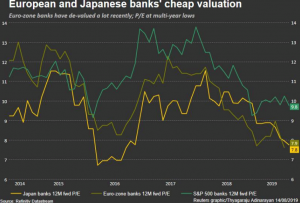
    For a more graphic reminder of how Japanified the Eurozone banks have become this Reuters chart is rather good at showing how closely Europe’s banks have tracked Japan’s since 2012 and how similarly the market now values both regions’ zombies:

    Spark Crowdfunding

    On a more positive note, Irish banks were forced by the ECB/IMF to take a lot of pain in the early days of GFC and, while not out of the woods, are possibly in better shape then many other European banking names.

    Of course, a sick European banking system is not good news but, again, on a more positive note the emergence of digital business/financial platforms has democratized finance significantly.

    Grads out there, the good news is those economics and finance degrees will more than likely be employed by new types of financial platforms. Who knew five years ago Alipay would have a billion customers?

    Furthermore, if the banking system continues to shrink, expect equity crowdfunding platforms to play a much more significant role in funding young businesses.

    Business owners should also be paying serious attention to building future “banking” relationships and could do worse than consider trial crowdfunding campaigns as an introduction to same.

    So it’s not quite Japocalypse Now….. but keep watching that chart.

  • Brexit – The Great British Bake Off or Break Off?

    Brexit – The Great British Bake Off or Break Off?

    Staff at the Spark Crowdfunding office had a little bake-off competition this week.

    The competition was keen, voting was controversial and rankings were debated long into the day. However, the true ‘reveal’ emerged over the next day as ‘tasting’ morphed into multiple appetising return visits to the competing creations. The empty serving plates and expanded waistlines revealed the true leaders but the barely touched dishes also put to bed any ranking disputes or inflated expectations…

    On further reflection, this revelatory process did bring to mind the wise words of one of the greatest ever investment thinkers, Benjamin Graham.

    As we ponder the potential outcomes of Brexit we could do worse than heed Graham’s explanation of financial markets, “In the short run the market is a voting machine, but in the long run it is a weighing machine.”

    In the context of the Brexit crisis (it is one now) there are no shortage of opinions, political machinations and financial media commentaries but such verbals are close to worthless. The most credible views are those expressed with real money.

    The currency markets have become the ultimate near term “voting process” on Brexit outcomes.

    So, the strongest voting on the gravity of the situation is now being expressed on a daily basis via the fluctuations of the value of the Great British Pound (GBP).

    Leaving aside the reflex reaction plummet of the GBP at the time of the Brexit referendum result in June 2016, arguably the currency is now at 34-year lows versus the global reserve currency, the US dollar. Clearly, currency traders and corporate treasury departments are taking evasive action in preparation for an ugly British break off from the EU. However, this is just a near term view reflecting understandable fearful emotions.

    The counter-intuitive longer-term view is possibly more interesting and is expressed via much larger individual bets.

    The “weighing machine” for the long run could arguably be reflected in the strategic mergers and acquisitions (M&A) activity of corporates.

    In this respect it might surprise readers to know that in 2018 M&A activity involving UK companies reached a three year high of £360 billion, beating 2017’s total by a whopping 28%. Admittedly activity in Q1 2019 slumped by 55% compared to the same period in 2018 but despite this apparent drop in deal-making confidence a survey published by EY in April revealed the UK as the most likely target for foreign companies seeking acquisitions pushing the US into second spot.

    History would suggest a fall in the value of a target currency and a relatively more expensive US market typically prompts opportunistic thinking from executives looking at long term corporate strategies.

    So, it was interesting to see last week a couple of huge deals announced which ran counter to the narrative generated by the GBP hitting multi-year lows on a daily basis.

    The announced combination of the London Stock Exchange and Refinitiv (formerly the Reuters data business) in a £27 billion deal is noteworthy given the US owners of Refinitiv are one of the sharpest private equity players on the planet, Blackstone Partners.

    There is also another deal to chew on this week. Food delivery giant Just Eat is merging with the Dutch outfit Takeaway.com in a €9 billion deal. Thus speaks the weighing machine.

    Worried Brexit watchers should reflect on Benjamin Graham’s words and consider the likelihood that the near term voting process in currency markets is more akin to a popularity contest with a truly awful collection of UK political representatives.

    Further Graham consideration would suggest the weighing machine of long term corporate dealmaking decisions reveals where there is real substance and value.

    For Irish corporates there may well be opportunities but it’s worth recalling our little bake-off and how the good stuff gets eaten quite quickly…

  • What would Ireland’s population be today if we didn’t have the Famine?

    What would Ireland’s population be today if we didn’t have the Famine?

    Ever wonder what Ireland’s population would be today if we didn’t have the famine from 1845 to 1849?

    I met with a senior Google executive recently and had a little moan.

    My complaint was about Big Tech’s ability to pay relatively junior employees huge salaries compared to smaller companies who desperately need talent to develop products which could benefit the planet at large. He was reasonably sympathetic to the dangers of outsized talent flight to Big Tech but also highlighted the small population of Ireland relative to Big Tech scale-up plans as being a significant contributing factor.

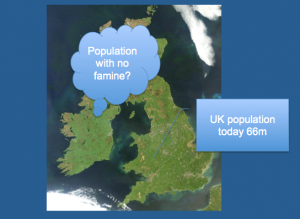
    This prompted a little quiz question which featured in a recent Spark Crowdfunding Investor Night – what would Ireland’s population be today if there was no 1840s famine and the supra-normal emigration which followed?

    Given the current population of the UK is 66 million you still might be a little surprised by the projected population estimate. A quick look at the relative land masses of the two islands might be a clue….

    My Google man was staggered that his 20 million guesstimate was about 12 million people shy of the actual 32 million projection. Both of us then proceeded to agree this capacity for population growth and flexibility to strategically influence demographics could be a big opportunity for Ireland. Imagine how many Irish startups could be funded through equity crowdfunding if we had a population of 32 million!

    That might appear slightly delusional as we struggle to house our existing population but some policy thought leadership could emerge if big money is put on the table.

    It has been interesting to read in recent weeks about the Google plans to invest $1 billion in the San Francisco Bay area to build 20,000 homes, of which 5,000 will be affordable housing units.

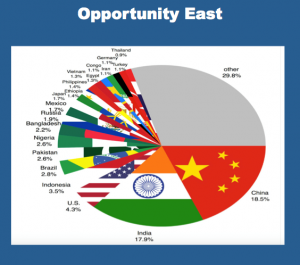
    Watch that space and another map which prompted plenty of discussion at the Investor Night mentioned previously. You might ask who would be the most likely new residents in a scaled-up Ireland?  Let’s take a look at another thought provoking graphic:

    The graphic above is telling us 36% of the planet’s population is living in China and India and both countries are grappling with major environmental and climate change challenges.

    Perhaps the more stunning statistic is that 64% of the global middle class is projected to be living in Asia by 2030. Now think about that 64% and Ireland’s current export value to Asia of circa €2 billion.

    One would expect Ireland’s current over-dependence on the US and UK is posing some strategic questions at corporate level in light of Trump trade wars and Brexit.

    At the same time perhaps we should think about encouraging some of this new middle class to move to less environmentally challenged regions of the world. Vancouver and Canada can already bear witness to significant Asian immigration with positive economic effects.

    Maybe Big Tech and Ireland should put their heads together and solve their housing and talent problems simultaneously….?

  • Investing in the Green Revolution

    Investing in the Green Revolution

    As Europe swelters in record-breaking heat there is a temptation to believe the gates of Hell have opened for the coronation of Boris. However, these flippant thoughts should not be perceived as a cynical mind resigned to our planet’s failure to act to save itself from climate catastrophe. On the contrary, there is real evidence of an acceleration of actions and investment to reduce the impact of human activity on our climate.  The integration of renewable energy generation into many countries’ electricity grids is possibly further advanced than you might think, particularly if you reside in Ireland where we sadly lag progress made elsewhere.  Let’s start with the leaders…

    Scotland is on track to deliver 100% of its electricity from renewables in 2020. The Scots will join Albania, Congo, Iceland and Paraguay who have already achieved that goal. Ireland has a bit more to do with a commitment to a 40% target by 2020. Elsewhere there are other worthy milestones being achieved. Here’s a few standout statistics…

    • Austria’s largest state(includes Vienna) achieved the 100% renewable electricity target as far back as 2015.
    • Renewable energy in Germany now provides more electricity (almost 50% year to date) than coal and nuclear power combined.
    • Uruguay thanks to a hydropower legacy has reached a 95% electricity target but the striking feature of the past 5 years is windpower rapidly rising from 1% to 33% of total generation.

    One of the scientific challenges for the renewable revolution is how to store energy generated and smooth the supply of electricity to national grids. There have been a number of occasions in recent months in Germany where electricity prices went negative! The whole area of battery technology is exploding as automakers race for leadership in the electric vehicle (EV) market. Encouragingly from an Irish perspective the University of Limerick Bernal Institute has been conducting market-leading research on enhanced EV batteries with EU funding. This Western centre of excellence has not gone unnoticed as Jaguar Land Rover have recently established an automotive research centre in Shannon.

    Clean energy and non-carbon powered autos will no doubt move the climate change dial but we also must clean up after ourselves. Happily, Ireland might be making better relative progress on waste recycling and innovation.

    The recent opening of an innovative plastics recycling plant in Portlaoise by Trifol allows waste plastics to be recycled into waxes and lubricants. Trifol is currently raising funds on Spark Crowdfunding and it is well worth taking a look at the IP and the impressive management line-up. Another Irish owned business, Olleco, has been in business longer(2014) and has built a customer base of 50,000 businesses that supply used cooking oils, fats and waste food for conversion into renewable energy, heat and biodiesel across 16 sites in the UK. The company earlier this year was on a 6 company shortlist for a global environmental award at the World Economic Forum. Impressive stuff. Be under no illusions, the recycling revolution is imminent and it is striking to read this week that Adidas intends to only use recycled plastic in all its products by… 2024! Expect more and more significant announcements like this as we move on from straws and single-cup headlines. A final thought on a potentially vulnerable sector which has experienced Irish leadership in recent decades.

    The share price performances of European airlines including Ryanair have effectively stalled since 2015. This has been a period of relatively decent economic growth and airline stocks typically perform pro-cyclically. Apart from super-low funding costs enabling stiff competition and aircraft supply, one does wonder is there a structural story mirroring what currently afflicts the oil production sector?  Is it too unrealistic to expect in the next 5 years corporates being the subject of eco-audits where Airmiles will be a key criterion for responsible corporate citizenship? If this scenario plays out then be assured aircraft leasing models will need serious re-evaluation. Aircraft leasing is still a high flying sector for Ireland as a global leader but this writer is not convinced eco-audits are in leasing risk models just yet.

    If this final thought sounds rather Cassandra-esque please recall an earlier article “Food for Thought”  where we cited a leading hedge fund manager describing all investment decisions now factor in climate change. Undoubtedly, the Green revolution is a planet positive but still has the capacity to leave investors red-faced if they fail to see both the structural opportunities and risks which accompany change.